甜樱桃(Prunus avium L.)是蔷薇科李属植物,因其汁多味美,富含维生素、酚类、生物碱、萜烯类等营养物质,在世界各地广泛种植[1]。2020年全球甜樱桃种植面积和产量分别为44.51万hm2和260.96万t,我国种植面积约25.64万hm2,是世界上最大甜樱桃生产和消费国[2]。然而软化、病害、开裂、凹陷等问题严重制约了甜樱桃果实市场的进一步扩大[3-4]。
硬度是表征水果商品品质的重要指标,与细胞壁的组成和结构密切相关[5],受果胶相关酶(如果胶裂解酶、多聚半乳糖醛酸酶和果胶甲酯酶)和氧化还原酶(如过氧化物酶和过氧化氢酶)的动态调控[6-7]。果实硬度不仅是育种过程中优良品种筛选的重要目标性状,通过定向选育提升果实硬度以适应市场需求[8];而且也是确定最佳采摘时机的关键依据,不同硬度对应果实成熟度差异,直接影响采后品质保持。此外,硬度赋予了水果一定的经济价值[9],还与果实采后运输过程中的损伤率、货架期长短密切相关[10-11]。因此,测定水果硬度有助于对培育良种、采摘时间、贮藏品质、出口运输和货架期等进行合理掌握,提高果实品质。
目前针对水果硬度的检测方法可分为穿刺检测和非穿刺检测。穿刺检测主要是利用硬度计和质构仪,需先在果实的选定位置削除一层薄果皮,随后将硬度计的探头垂直于果面,匀速缓慢刺入果实,以测定水果硬度[12]。而非穿刺检测技术不会破坏果实的外观和内部结构,确保果实的商品价值不受影响,且可以实现快速、批量的果实硬度检测,提高检测效率。水果硬度的非穿刺检测技术可分为基于光学的方法和基于机械的方法[13-14]。基于光学的方法主要是指高光谱或多光谱成像等。利用高光谱技术结合回归算法,对苹果硬度进行非穿刺快速检测,为评估苹果品质提供高效的解决方案[15]。基于机械的方法,包括微变形、振动测量、声学冲击响应、坠落冲击、锤击和超声波方法等多种技术[14]。Ma等[16]提出了利用接触桃果实表面可产生微小变形的弹性体,并在传感器和桃果实的交互过程中,使用相机捕捉有关弹性体变形的详细信息,再利用CNN-LSTM架构分析相机记录的图像序列,以评估桃果实的硬度。Zhang等[17]开发了一种声学装置,可同时检测梨赤道的共振频率和花萼肩部的共振频率,基于这2个频率评估非球形梨的硬度。在甜樱桃硬度的非穿刺检测方面,Karageorgiadou等[18]采用压缩距离法测定甜樱桃果实硬度,主要评估在与果实直径的不同压缩百分比距离相等的位置施加的变形力。然而在现有非穿刺检测技术中,部分方法存在设备成本高、操作复杂或针对特定水果品种的适用性有限等问题,尤其在甜樱桃这类表皮薄、果形小且易损伤的果实检测中,其检测精度和稳定性仍有提升空间。
鉴于此,笔者以不同受压质量和形变距离2种模式检测甜樱桃硬度,建立甜樱桃硬度的检测方法,并对相关参数进行优化,同时对当前各地市场常见的甜樱桃硬度进行测定,以期为优化甜樱桃硬度检测及判定方法提供理论依据。
1 材料和方法
1.1 材料
供试甜樱桃品种包括红灯、黄蜜、萨米托、美早、晚红珠、红南阳、先锋、斯坦拉、拉宾斯、布鲁克斯、佳红,均为2025年购于北京市场。河北产区的美早、玲珑脆、萨米托,四川产区的红灯、红艳、先锋、佐藤锦,辽宁产区的美早、萨米托均为2025年购于当地市场。北京、河北、辽宁产区供试甜樱桃采摘后24 h,四川产区供试甜樱桃采摘后48 h内冷链(5~10 ℃)运输至实验室。挑选无机械损伤,无病虫害,大小均一,颜色相近,成熟度一致(红熟期,可溶性固形物含量≥14%[19])的果实进行试验。在(20±1)℃、相对湿度80%~85%的实验室中平衡5 h后测定硬度值。本试验中使用硬度计为Firmtech eleven软性果实硬度检测仪(FT11,UP GmbH Firmensitz,德国)。
1.2 方法
1.2.1 用果量的确定 用果量的确定参考沈朱俐等[20]的方法,但略有修改。以压力阈值250 g模式(其他参数均为初始设定)测定萨米托、美早、红灯、黄蜜4个甜樱桃品种的果实硬度。设定200个果实的硬度测定值平均数为“真值”,“真值”±5%标准差的区间为置信区间。将200个硬度测定值等分为5个层次,按照分层抽样法,分别抽取样本量为100、75、50、25、5的测定值,每个样本量重复抽取1000次。计算抽取样本的平均值作为该样本量的虚拟测定值并统计虚拟测定值落入置信区间内的概率。
1.2.2 压力阈值模式下硬度测定条件的优化 压力阈值是使果实产生可检测形变且不造成损伤的最大压力值。根据方法1.2.1中确定的用果量,在压力阈值150、200、250、300、350 g模式下分别测定萨米托、美早、晚红珠、红南阳4个甜樱桃品种的果实硬度。以测定过程中的受压质量和果实硬度绘制回归曲线,并评价其相关性。
1.2.3 形变阈值模式下硬度测定条件的优化 形变阈值是果实受压后保持结构完整的最大形变量。根据方法1.2.1中确定的用果量,在形变阈值0.5、1.0、1.5、2.0 mm模式下分别测定萨米托、美早、晚红珠、红南阳4个甜樱桃品种的果实硬度。以测定过程中的形变距离和果实硬度绘制回归曲线,并评价其相关性。
1.3 数据处理
采用Excel 2013统计分析软件进行随机抽样、变异系数分析、相关性分析和数据整理;利用IBM SPSS Statistics 27进行差异显著性分析;使用Origin Pro 2025软件绘图。
2 结果与分析
2.1 用果量的确定
萨米托、美早、红灯、黄蜜4个品种各200个甜樱桃果实硬度的均值分别为207.159、199.422、222.723 5、105.245 5 g·mm-1。以该平均值±5%标准差的区间为置信区间,则萨米托、美早、红灯、黄蜜4个品种甜樱桃的置信区间分别为(201.20,213.12)、(193.63,205.21)、(217.14,228.30)和(101.76,108.73)。图1反映了不同抽样量下,甜樱桃硬度测定值的离散程度。当抽样量为5时,4个甜樱桃品种的四分位距最大;且除美早外,异常值最多,表明其离散程度最大。随着抽样量增加,4个甜樱桃品种的四分位距逐渐缩小,异常值逐渐减少。图2展示了不同抽样量下,甜樱桃硬度测定值落入置信区间的比例。当抽样量为5时,美早甜樱桃硬度测定值落入置信区间的比例为52.2%;而其他3个品种的甜樱桃硬度测定值落入置信区间的比例均不足50%。随着抽样量增加,4个品种甜樱桃硬度测定值落入置信区间的比例逐渐增加。当抽样量为75时,4个品种甜樱桃硬度测定值落入置信区间的比例均超过99%。虽然当抽样量为100时,甜樱桃硬度测定值精准度更高,但在实际操作中,会大幅增加测定所花费的时间和投入成本。
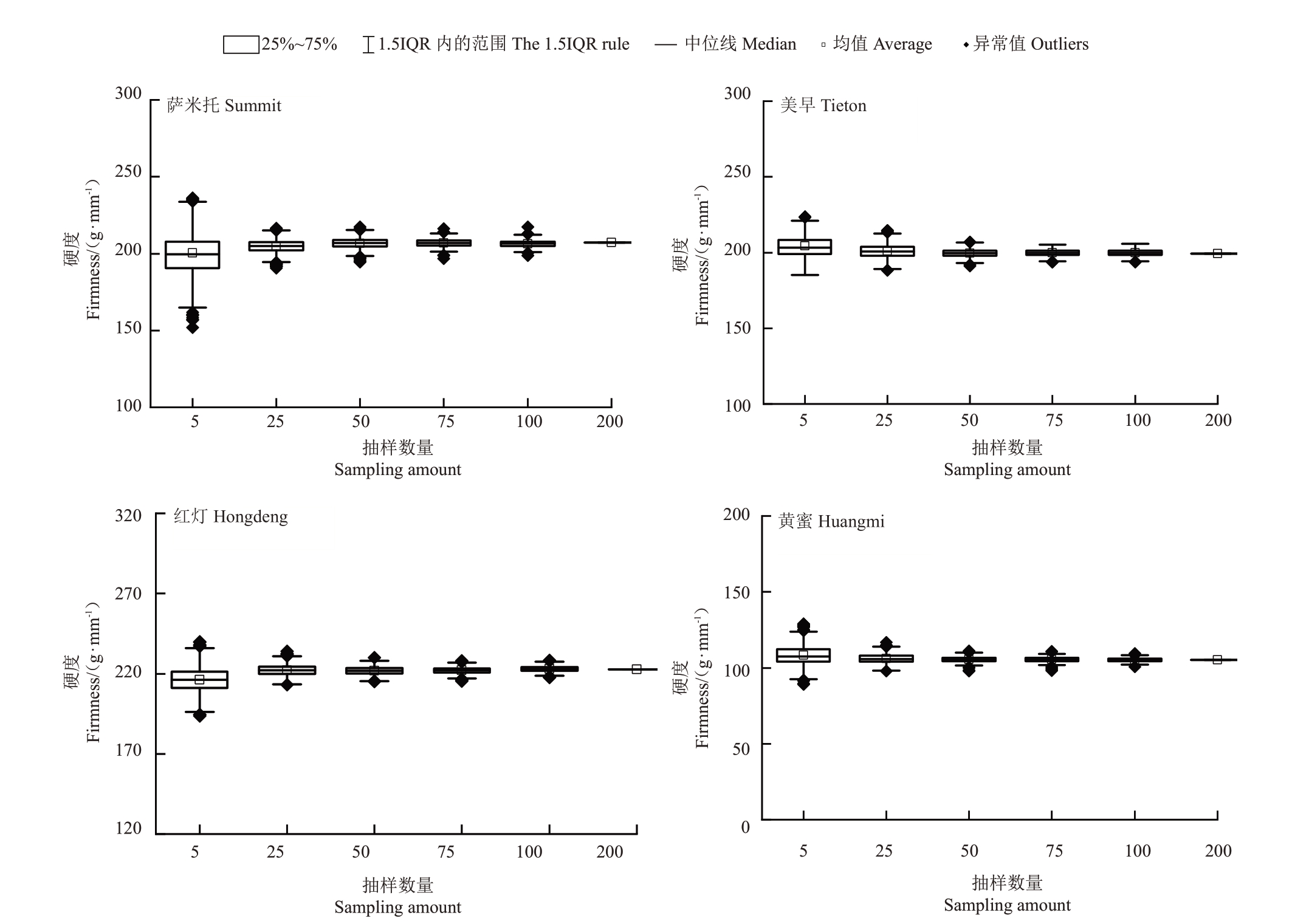
图1 不同抽样量下甜樱桃硬度
Fig.1 Box plots of sweet cherry firmness at different sampling amout
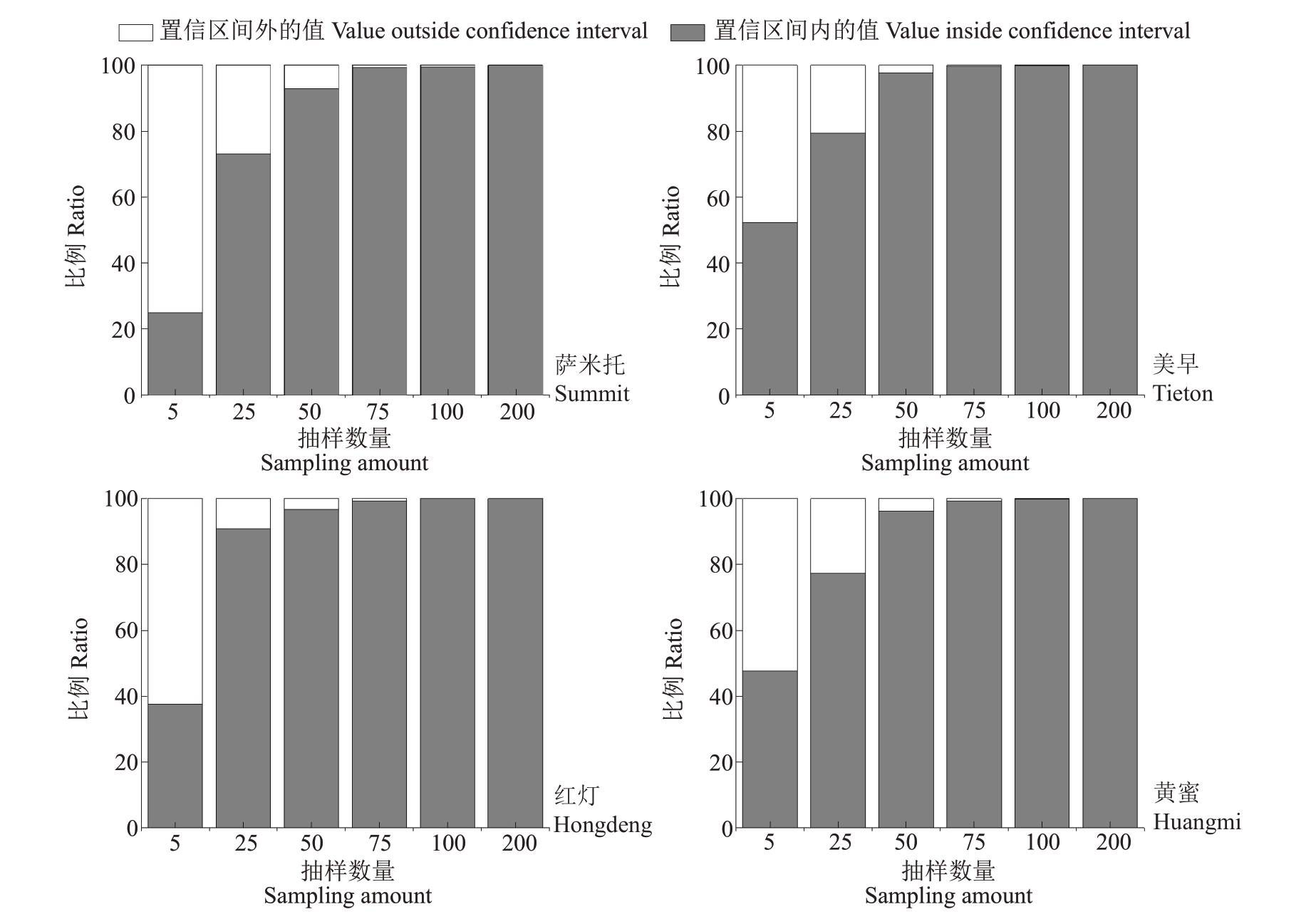
图2 不同抽样量下甜樱桃硬度属于置信区间的百分比堆积
Fig.2 Stacked columns of sweet cherry firmness falling within confidence intervals at different sampling amout
图3是不同抽样量下4个品种甜樱桃硬度测定值的变异系数,随着抽样量的增加,变异系数均呈下降趋势。当抽样量为5时,甜樱桃的变异系数处于较高水平,其中萨米托、美早、黄蜜甜樱桃硬度测定值的变异系数在0.06左右,而红灯的变异系数为0.034。在抽样量增加的过程中,甜樱桃硬度测定值的变异系数逐渐下降。当抽样量≥75时,4个品种甜樱桃硬度测定值变异系数均小于0.02,处于较低且平稳状态。当抽样量达到100时,萨米托和美早的变异系数均为0.011;而红灯和黄蜜的变异系数分别为0.007和0.013。综上,考虑到甜樱桃品种多样性、测定结果精准度及测量成本,用果量为75个为较优选择。
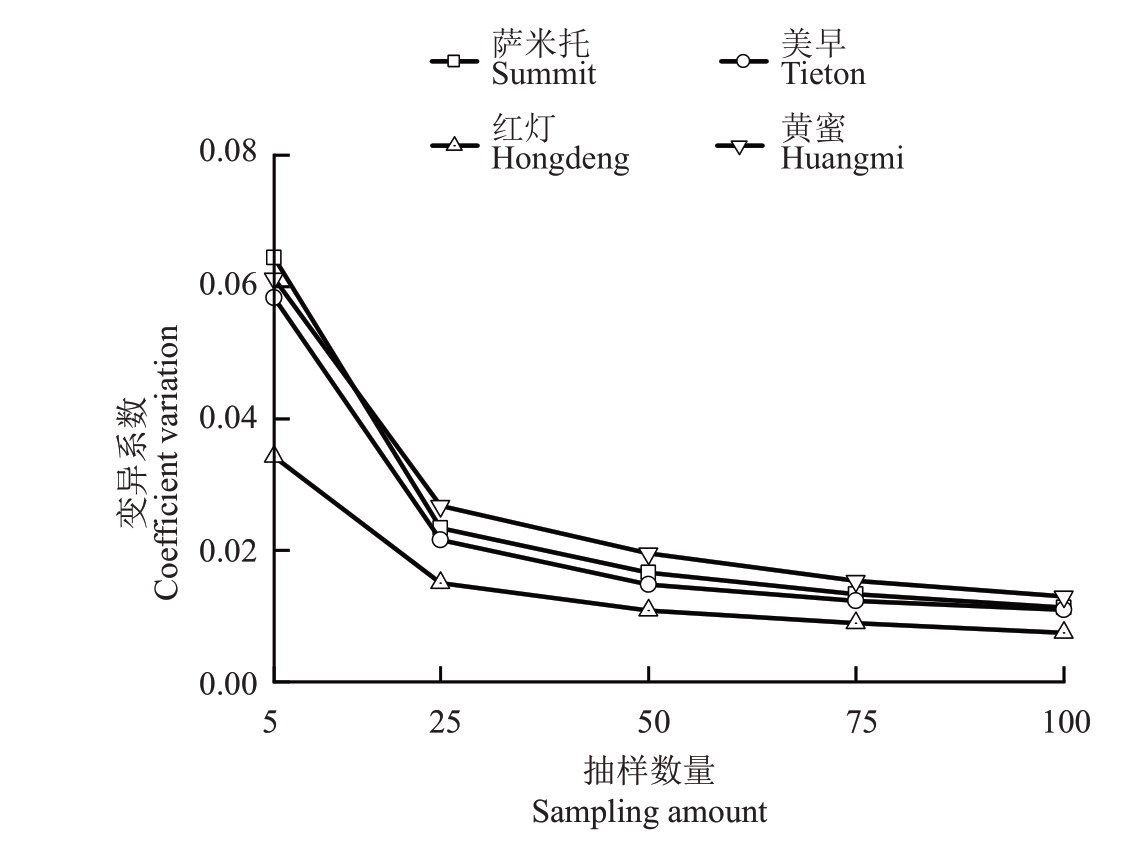
图3 不同抽样量下甜樱桃硬度的变异系数
Fig.3 Line graph of sweet cherry firmness coefficient variation at different sampling amount
2.2 受压质量的确定
图4展示的是晚红珠、美早、红南阳、萨米托甜樱桃分别在150、200、250、300、350 g压力阈值模式下的果实硬度及测定果实硬度与过程压力值的相关系数。4个甜樱桃品种的果实硬度测定值均随受压质量增加呈同步上升趋势。当受压质量为200 g时,晚红珠的果实硬度与过程压力值的相关系数最高,达到0.999。美早和红南阳的相关系数随受压质量的上升呈先增加后降低的趋势,峰值出现在受压质量为200 g时,相关系数分别为0.999和0.998。而萨米托的相关系数逐渐下降,当受压质量为150 g时,相关系数为0.999。因此,晚红珠、美早、红南阳、萨米托在低受压质量(150和200 g)下的果实硬度与过程压力值的相关性更显著。综上,应选择200 g压力阈值模式对甜樱桃进行非穿刺硬度测定。
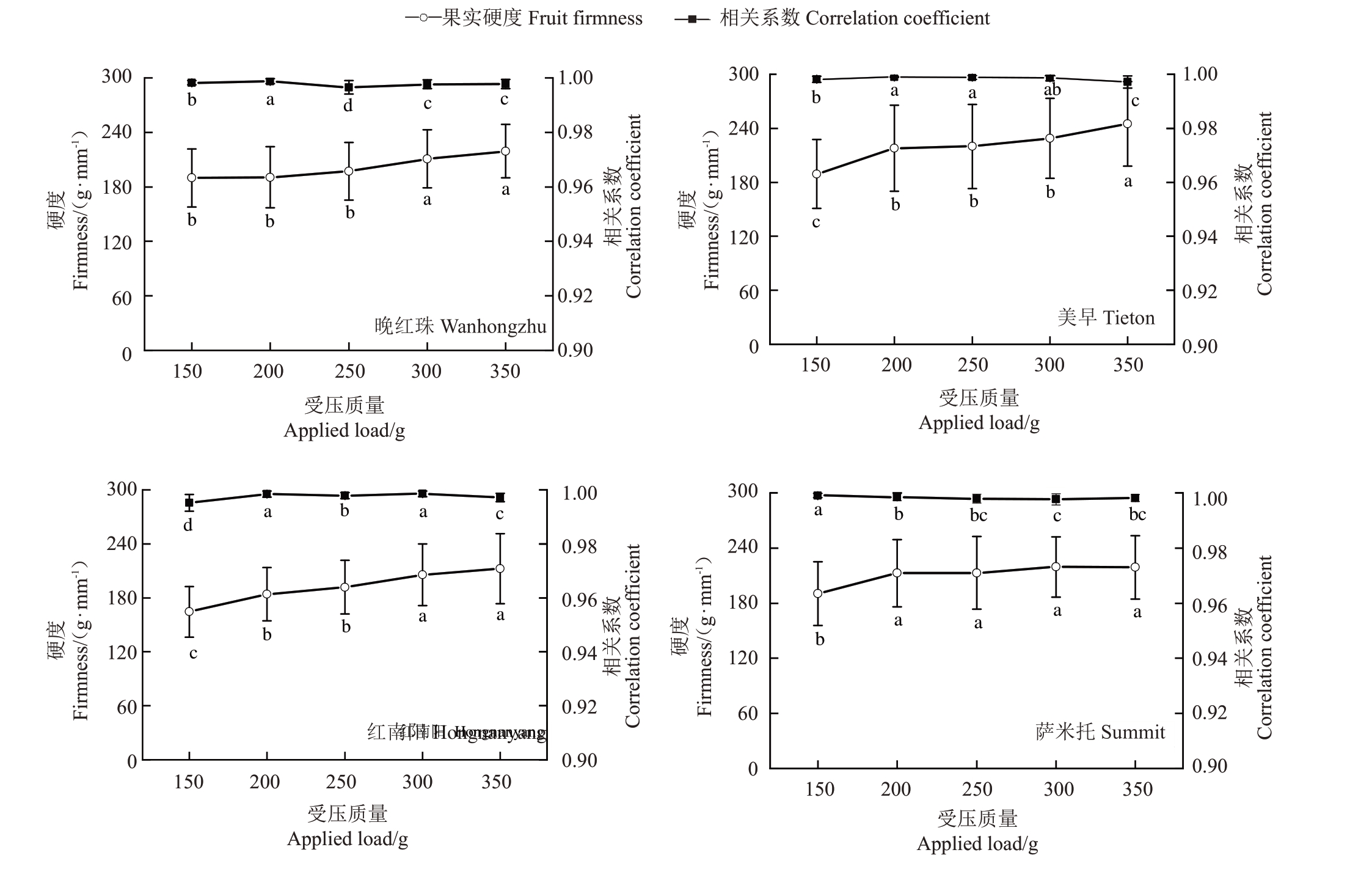
图4 不同受压质量下甜樱桃硬度及其与压力值的相关系数
Fig.4 Fruit firmness and correlation coefficient between fruit firmness and force-on-fruit of sweet cherry at different applied load
不同小写字母表示在0.05水平差异显著。下同。
Different small letters indicate significant difference at 0.05 level.The same below.
2.3 形变距离的确定
图5展示的是晚红珠、美早、红南阳、萨米托甜樱桃分别在0.5、1.0、1.5、2.0 mm形变阈值模式下的果实硬度及测定果实硬度与过程形变距离的相关系数。晚红珠、美早、萨米托甜樱桃的硬度随形变距离的增加呈先增加后降低的趋势,且当形变距离为1.5 mm时,3个品种甜樱桃硬度测定值最高。而红南阳甜樱桃硬度的测定值随着形变距离的增加而升高。对晚红珠甜樱桃果实硬度与形变距离的相关性进行分析,发现当形变距离为1.0 mm时二者相关性最显著。当形变距离为1.5 mm时,美早和红南阳甜樱桃果实硬度与过程形变距离的相关系数最高,分别达到0.999和0.998。萨米托甜樱桃的相关系数随着形变距离的增加而逐渐下降,形变距离为0.5 mm时,相关系数为0.999。综上,1.5 mm的形变阈值模式下,4个品种甜樱桃的硬度测定值更稳定,与形变距离的相关性更显著,可作为其果实硬度测定的适宜参数。
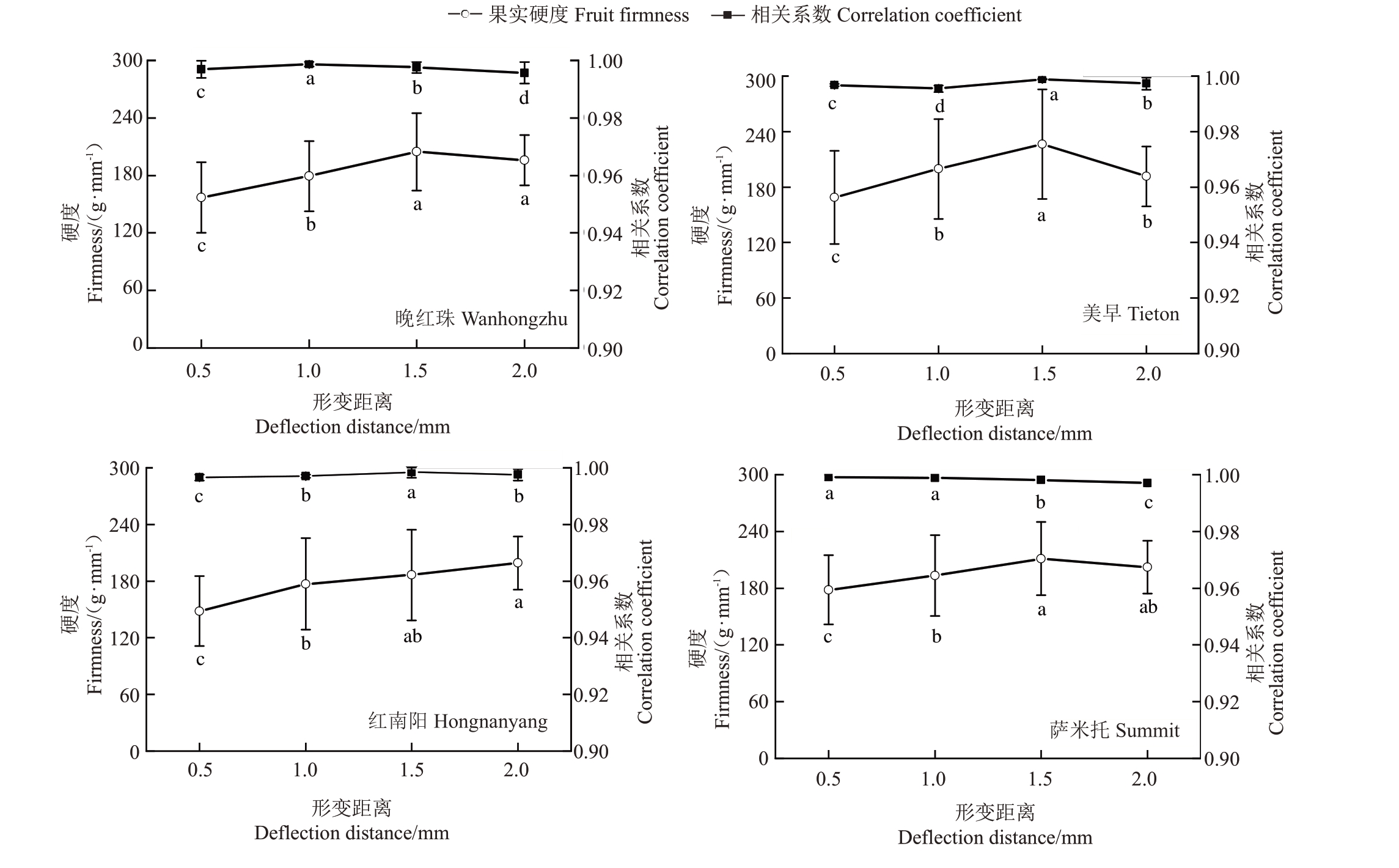
图5 不同受压质量下甜樱桃硬度及其与压力值的相关系数
Fig.5 Fruit firmness and correlation coefficient between fruit firmness and force-on-fruit of sweet cherry at different deflection distance
2.4 不同地区甜樱桃品种的果实硬度比较
相较1.5 mm的形变阈值模式,200 g压力阈值模式下的相关系数更稳定,更能排除不同品种间甜樱桃果实硬度测定值的差异。因此以200 g压力阈值模式测定了来自北京、河北、四川、辽宁4个产区共14个品种甜樱桃的果实硬度(图6),其测定值变化范围为84.42~310.15 g·mm-1。在北京产区的5个品种中,布鲁克斯硬度最低(214.74 g·mm-1),拉宾斯硬度最高(310.15 g·mm-1)。河北产区的美早、玲珑脆和萨米托硬度分别为192.76、220.03和257.77 g·mm-1。在四川产区的4个品种中,红灯硬度最高(137.17 g·mm-1),佐藤锦硬度最低(84.42 g·mm-1)。辽宁产区的美早和萨米托硬度分别为242.14和183.16 g·mm-1。同一品种甜樱桃跨产区也呈现差异,美早硬度表现为辽宁>北京>河北;萨米托硬度表现为河北>北京>辽宁。
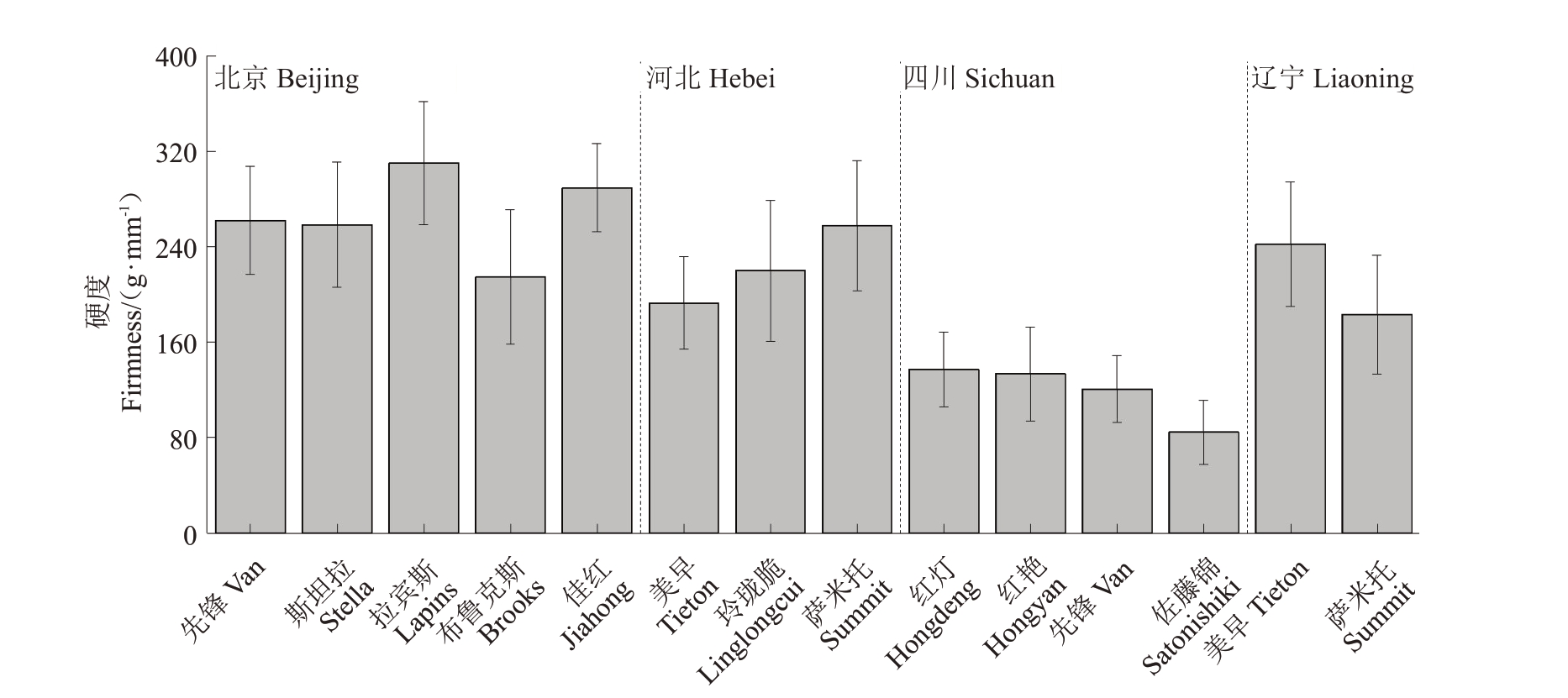
图6 不同地区各品种甜樱桃果实硬度
Fig.6 Fruit firmness of different varieties sweet cherry in different regions
3 讨论
果实硬度是评估水果成熟度、品质和贮藏性的重要指标,并最终决定水果的商品价值[21]。当前水果硬度的测定方法主要依赖穿刺检测,检测后果实无法销售或贮藏,造成浪费,且易受操作手法和穿刺位置等人为因素的影响。在非穿刺检测方面,基于高光谱技术对果实硬度的检测通过光谱建模,易受果实色泽、水分含量的影响,且操作复杂。因此,高光谱技术在果实硬度非穿刺检测的产业应用中尚未形成稳定可靠的方法,致使检测精度与准确性存在显著差异。基于超声检测技术的硬度测定方法则是利用超声波在果肉中的传播速度、衰减系数与硬度的相关性判断,受果实水分含量、内部缺陷影响大,设备成本较高。Firmtech eleven软性果实硬度检测仪可实现自动化检测,探头下降的速度为3~12 mm·s-1,节约了人力成本和时间成本,而且不受果实品质的影响,稳定性高。本研究利用Firmtech eleven软性果实硬度非穿刺式检测仪,建立并优化了基于形变距离和受压质量模式测定甜樱桃果实硬度的方法。
在用果量方面,传统的甜樱桃硬度检测通常使用10~30个样本[22-24],而本研究发现采用75个果实样本量可明显提高硬度测定数据的稳定性。沈朱俐等[20]利用Firmtech 7检测蓝莓果实硬度,并确定了当用果量为60~75个时,果实硬度测量值准确度高、可重复性好,与本研究结果相似。尽管小样本量的硬度测定方法节约检测成本,而本研究采用非穿刺检测方法,降低了果实损耗。所以在条件允许的情况下,建议采用75个样本,以提升果实硬度数据的准确性。在测定方法上,传统手持硬度计对果实有破损、操作主观性强、数据精度低的不足,因此使用受到限制[25]。质构仪虽应用广泛,但仍存在探头规格多样、操作流程未标准化,大规模测定效率低等问题[26]。本研究发现,在压力阈值模式下,甜樱桃果实硬度的测定值随着压力的增加而增大,且在200 g受压质量下的果实硬度与过程压力值的相关性较显著;在形变阈值模式下,当果实形变距离为1.5 mm时,大部分甜樱桃果实硬度测定值达到最高,且与形变距离的相关性更显著。Karageorgiadou等[18]使用压缩距离法评估甜樱桃采后贮藏过程中果实的硬度,发现0.16 mm的固定距离和最小1%的变形力最适宜检测甜樱桃的果实硬度。
利用200 g压力阈值模式,对来自4个地区的14个品种甜樱桃进行硬度测定。研究发现,同一地区不同品种甜樱桃硬度差异较大,不同产区的同一品种甜樱桃硬度也存在明显差异。其中,产自北京的拉宾斯硬度最高,而产自四川的佐藤锦硬度最低。值得注意的是,北京地区主栽品种以美早、萨米托等硬肉型品种为主,四川甜樱桃以红灯等常规品种为主。此外,北京地区属于温带季风气候,果实成熟期昼夜温差较大,对促进细胞壁的合成有利;四川产区甜樱桃成熟期气温较高且昼夜温差较小,可能提高了细胞壁降解酶的活性,导致果实硬度下降[10]。
4 结论
笔者利用Firmtech eleven软性果实硬度检测仪,确定测定甜樱桃果实硬度时的最佳用果量、受压质量和形变距离。结果表明,在压力阈值模式下,200 g受压质量下的果实硬度与过程压力值的相关性较显著;在形变阈值模式下,1.5 mm形变距离下的果实硬度测定值较高,且与形变距离的相关性更显著。当用果量为75个时,检测结果较为准确且节约成本。以200 g压力阈值模式,对来自4个产区的14个品种甜樱桃进行硬度测定,发现甜樱桃的硬度在同一产区不同品种间差异明显,而同一品种跨产区时也呈现明显变化。该方法的应用范围主要涵盖新鲜甜樱桃果实,以及草莓、李子、葡萄等具有弹性的果实。然而该方法对果皮破损或畸形果实的检测精度下降,不适用于冷冻或加工处理后的甜樱桃,且需在常温环境下使用,极端温度会影响数据稳定性。
[1] Zheng H Y,Deng W Q,Yu L,Shi Y C,Deng Y,Wang D F,Zhong Y.Chitosan coatings with different degrees of deacetylation regulate the postharvest quality of sweet cherry through internal metabolism[J].International Journal of Biological Macromolecules,2024,254(Pt 1):127419.
[2] 郭青青,马建坤,吴传宝,王晶,薛哲勇,段续伟.中国甜樱桃栽培状况分析[J].落叶果树,2024,56(4):35-41.Guo Qingqing,Ma Jiankun,Wu Chuanbao,Wang Jing,Xue Zheyong,Duan Xuwei.Analysis of sweet cherry planting status in China[J].Deciduous Fruits,2024,56(4):35-41.
[3] Michailidis M,Karagiannis E,Tanou G,Sarrou E,Karamanoli K,Lazaridou A,Martens S,Molassiotis A.Sweet cherry fruit cracking:Follow-up testing methods and cultivar-metabolic screening[J].Plant Methods,2020,16(1):51.
[4] Campoy J A,Le Dantec L,Barreneche T,Dirlewanger E,Querogarcía J.New insights into fruit firmness and weight control in sweet cherry[J].Plant Molecular Biology Reporter,2015,33(4):783-796.
[5] Wang C,Tao Y,Han Y Q,Zhang R,Li L F,Gao Y.Influences of subcellular Ca redistribution induced by γ irradiation on the fruit firmness of refrigerated blueberries[J].Postharvest Biology and Technology,2023,195:112146.
[6] Radhika J,Bons H K.Dynamic changes in pectin composition,flesh firmness and oxidoreductase enzymes across different stages of fruit development in loquat cultivars[J].Applied Fruit Science,2024,66(6):2393-2401.
[7] Balic I,Ejsmentewicz T,Sanhueza D,Silva C,Peredo T,Olmedo P,Barros M,Verdonk J C,Paredes R,Meneses C,Prieto H,Orellana A,Defilippi B G,Campos-vargas R.Biochemical and physiological study of the firmness of table grape berries[J].Postharvest Biology and Technology,2014,93:15-23.
[8] Qi X L,Dong Y X,Liu C L,Song L L,Chen L,Li M.A 5.2-kb insertion in the coding sequence of PavSCPL,a serine carboxypeptidase-like enhances fruit firmness in Prunus avium[J].Plant Biotechnology Journal,2024,22(6):1622-1635.
[9] Gallardo R K,Li H X,Mccracken V,Yue C Y,Luby J,Mcferson J R.Market intermediaries’willingness to pay for apple,peach,cherry,and strawberry quality attributes[J].Agribusiness,2015,31(2):259-280.
[10] 陈瑶,才丰,艾佳音,何明莉,张琪静.甜樱桃采收期果实软化原因及防治措施[J].中国果树,2025(6):105-108.Chen Yao,Cai Feng,Ai Jiayin,He Mingli,Zhang Qijing.Reasons and preventive measures for softening of sweet cherry fruits during harvest[J].China Fruits,2025(6):105-108.
[11] Fathizadeh Z,Aboonajmi M,Beygi S R H.Nondestructive firmness prediction of apple fruit using acoustic vibration response[J].Scientia Horticulturae,2020,262:109073.
[12] NY/T 2009—2011水果硬度的测定[S].NY/T 2009—2011 Determination of fruit firmness[S].
[13] Yue C Y,Gallardo R K,Luby J J,Rihn A L,Mcferson J R,Mccracken V,Oraguzie N,Weebadde C,Sebolt A,Iezzoni A.An evaluation of U.S.tart and sweet cherry producers trait prioritization:Evidence from audience surveys[J].HortScience,2014,49(7):931-937.
[14] Tian S J,Xu H R.Mechanical-based and optical-based methods for nondestructive evaluation of fruit firmness[J].Food Reviews International,2023,39(7):4009-4039.
[15] Gao W J,Cheng X,Liu X H,Han Y S,Ren Z H.Apple firmness detection method based on hyperspectral technology[J].Food Control,2024,166:110690.
[16] Ma C,Ying Y B,Xie L J.Visuo-tactile sensor development and its application for non-destructive measurement of peach firmness[J].Computers and Electronics in Agriculture,2024,218:108709.
[17] Zhang H,Wu J,Zhao Z Q,Wang Z P.Nondestructive firmness measurement of differently shaped pears with a dual-frequency index based on acoustic vibration[J].Postharvest Biology and Technology,2018,138:11-18.
[18] Karageorgiadou M,Rodovitou M,Nasiopoulou E,Titeli V S,Michailidis M.Sweet cherry fruit firmness evaluation using compression distance methods[J].Horticulturae,2024,10(5):435.
[19] GB/T 26906—2024甜樱桃[S].GB/T 26906—2024 Sweet cherry[S].
[20] 沈朱俐,顾莉莉,李晓谊,李永强,宗宇,徐丽珊,郭卫东.基于形变距离和受压质量混合模式测定蓝莓果实硬度的方法建立和优化[J].果树学报,2023,40(1):169-179.Shen Zhuli,Gu Lili,Li Xiaoyi,Li Yongqiang,Zong Yu,Xu Lishan,Guo Weidong.Foundation and optimization of protocol for blueberry fruit firmness measurement under mix mode of deflection distance and pressure weight[J].Journal of Fruit Science,2023,40(1):169-179.
[21] 薛智展,冉江林,冯琛,段续伟,王晶,郑宝江.果实硬度影响因素研究进展[J].落叶果树,2025,57(3):40-47.Xue Zhizhan,Ran Jianglin,Feng Chen,Duan Xuwei,Wang Jing,Zheng Baojiang.Progress in the study of factors affecting fruit firmness[J].Deciduous Fruits,2025,57(3):40-47.
[22] 冯雅蓉,杜俊杰.预冷方式对甜樱桃采后耐贮性及新橙皮苷代谢的影响[J].食品科学,2023,44(15):239-250.Feng Yarong,Du Junjie.Effects of precooling treatments on postharvest storability and neohesperidin metabolism in sweet cherries[J].Food Science,2023,44(15):239-250.
[23] 张帅奇,徐冉冉,王宝刚,周家华,王云香,梁丽雅.四氢嘧啶对甜樱桃果实采后贮藏品质的影响[J].保鲜与加工,2025,25(2):62-69.Zhang Shuaiqi,Xu Ranran,Wang Baogang,Zhou Jiahua,Wang Yunxiang,Liang Liya.Effects of ectoine treatment on storage quality of postharvest sweet cherry fruits[J].Storage and Process,2025,25(2):62-69.
[24] 候杰,杨青珍,王锋,齐英舰,刘鹏,畅元生.1-MCP处理对甜樱桃果实凹陷、贮藏品质及活性氧代谢的影响[J].食品与发酵工业,2024,50(21):280-286.Hou Jie,Yang Qingzhen,Wang Feng,Qi Yingjian,Liu Peng,Chang Yuansheng.Effect of 1-MCP treatment on fruit pitting,storage quality and reactive oxygen species metabolism of sweet cherry fruit[J].Food and Fermentation Industries,2024,50(21):280-286.
[25] Cao M K,Cao C H,Zhang T C,Guo W C.A dielectric method for predicting pear firmness combining deep data augmentation and ensemble learning[J].Food Control,2025,167:110790.
[26] 陈桂香,杨天天,孙蕾,朱子成,刘宏宇,王学征.园艺作物果实硬度测量方法研究进展[J].分子植物育种,2024,22(17):5817-5824.Chen Guixiang,Yang Tiantian,Sun Lei,Zhu Zicheng,Liu Hongyu,Wang Xuezheng.Research progress on measurement of fruit hardness in horticulture crops[J].Molecular Plant Breeding,2024,22(17):5817-5824.