树型结构影响果树的整形修剪、授粉、果品产量等方面,是果园精细化管理的重要内容。矮化密植栽培是当前中国苹果现代化生产的发展趋势,轻简化和机械化管理的树型也适于未来苹果产业的发展。柱型苹果是普通型苹果上发现的一个短节间芽变,具有生长紧凑、节间短、腋芽萌发为大量的短枝、很少或无长分枝、光合效率高的特点,因其树型无需拉枝,修剪量极轻,适于机械化规范管理,所以是选育轻简化栽培品种的重要种质资源[1-5]。以柱型苹果资源为亲本,选育株型适于轻简化栽培的品种,对苹果产业未来的发展有重要意义。然而,通过形态学观察往往难以确定一年生杂种后代的株型[6],因此,如何准确地鉴别、筛选柱型苹果品种,是目前研究的重点。
苹果柱型是由显性单基因Co 控制的质量性状[7-9],MpCoL是调控苹果柱型性状形成的关键候选基因[10-13]。目前已根据苹果Co基因开发了鉴定柱型苹果的分子标记,但是分子标记鉴定法所需仪器和试剂较繁琐,耗时较长,操作者需具有一定分子生物学基础,所以不适用于田间快速地鉴别柱型苹果材料。切片染色分析方法丰富了柱型苹果的鉴定方式,满足了田间快速鉴定柱型苹果的基本需求,但是该方法对试验试剂和试验环境要求较高,且试剂毒性强[14]。本研究基于柱型苹果叶片的生理特点,新开发一种快速鉴别柱型苹果材料的简易方法,利于柱型苹果材料的选育与推广。
光合作用是地球上几乎所有生命的能量和物质基础,其应用与农业、能源和环境的可持续发展密切相关[15]。柱型苹果的叶绿素含量和光合速率较普通型高[4],柱型苹果舞佳和润泰一号中MpCoL 表达量也显著高于非柱型苹果富士和华硕[16]。实验室前期研究发现,在过表达MpCoL基因杨树叶片中叶绿素b含量提高,即叶绿素a/b减小(未发表)。基于这一结果,本研究推测柱型苹果中也存在叶绿素a/b值降低的情况,并通过测定与计算柱型和非柱型苹果的叶绿素a与叶绿素b比值,以反映其叶绿素含量特征,旨在开发一种新型高效的早期筛选方法。叶绿素浸提法是植物叶绿素提取分析的常用方法,利用相似相溶原理可将叶绿素溶解到乙醇等有机溶剂中,根据有机溶剂中叶绿素a和叶绿素b最大吸收峰所在波长的吸收系数,通过测定该波长下吸光值计算分析叶绿素浓度比例等特征。在95%乙醇溶液的叶绿素溶液中,叶绿素a和叶绿素b的最大吸收峰分别为665 nm和649 nm,结合叶绿素a和叶绿素b在两个波长的吸收系数,可以根据公式计算出叶绿素a和叶绿素b浓度。
本研究通过计算苹果叶片中叶绿素a与叶绿素b含量比值(Chl a/b)的大小来分析柱型苹果和非柱型苹果叶绿素含量特征,并以此开发了一种早期鉴定柱型后代的新方法。新方法的鉴定结果与分子标记鉴定结果的一致性为97.6%,可靠性高,为苗期快速鉴别柱型苹果杂种后代,也为选育及推广柱型苹果提供了高效的解决方案。
1 材料和方法
1.1 试验材料与试剂
本研究所使用的苹果(Malus pumila Mill.)[17]包括金冠、澳洲青苹、新红星、红月、王林、瑞雪、粉红女士、福丽、福美和旭等10个非柱型品种,塔斯坎、贵妃、福蕾、鲁加5号、鲁加4号、舞美和威赛克旭等7个柱型品种,以及20株柱型和非柱型苹果的杂交后代。上述材料均为种植于青岛农业大学胶州基地的12年生苹果树。每个品种选取3~5株,从中选取3~5枚叶片,以备后续观察分析。每个品种/杂种后代中随机选取2~3个枝条,每个枝条上取一枚嫩叶并混合,经液氮速冻后保存至-80 ℃冰箱,以备后续分子标记鉴定。
本研究所用的植物基因组DNA提取试剂盒、2×Taq Mix、2000 bp DNA marker均购自于艾科瑞生物工程有限公司(长沙);无水乙醇购自于富宇精细化工有限公司(天津)。
1.2 叶绿素荧光测定方法
使用imaging-parm叶绿素荧光成像分析仪进行参数检测。从上往下数,以苹果正常生长的枝条第1枚长度大于0.5 cm的叶片记为第1枚叶,取第8枚叶。将柱型和非柱型苹果叶片样本置于暗环境中处理30 min。随后对叶片进行荧光特性分析,记录暗适应状态下的基础荧光值(F0)、峰值荧光强度(Fm)等,并通过公式Fv/Fm=(Fm—F0)/Fm计算得出光系统Ⅱ在暗适应条件下的最大光能转换效率。
1.3 叶绿素提取方法
从上往下数,以苹果正常生长的枝条第1枚长度大于0.5 cm的叶片记为第1枚叶,取第8枚叶。去掉待测叶片叶脉并剪碎,称质量后加入2.5 mL的95%乙醇溶液研磨成组织匀浆,再加10 mL的95%乙醇继续研磨至组织变白,静置3 min,连同残渣移入15 mL容量瓶用95%乙醇定容。将1 mL待测液加入2 mL的95%乙醇溶液稀释后移入光径1 cm比色皿,以95%乙醇为空白,用分光光度计测量波长665、649 nm下的吸光度,根据公式计算叶绿素a含量和叶绿素b含量的比值。
1.4 Chl a/b计算分析
叶绿素含量按照以下公式计算:
叶绿素含量(mg·g-1)=C×V×N/ω;
式中:C表示叶绿素质量浓度,mg·L-1;V表示待测液体积,mL;N表示测量稀释倍数;ω表示植物叶片组织鲜质量,g。
在95%乙醇溶液中,根据朗伯-比尔定律和叶绿素a和叶绿素b在最大吸收峰665和649 nm的吸光系数,可知叶绿素a和叶绿素b质量浓度分别按照以下公式计算:
Chl a=13.95×A665—6.88×A649;
Chl b=24.96×A649—7.32×A665。
式中:Chl a表示叶绿素a质量浓度,mg·L-1;Chl b表示叶绿素b浓度,mg·L-1;A665表示待测液在665 nm吸光度;A649表示待测液在649 nm吸光度。
1.5 分子标记鉴定
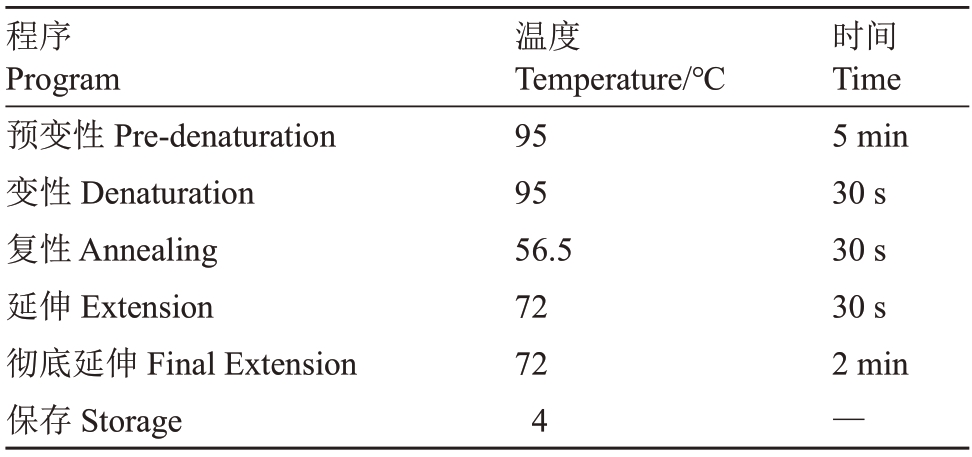
采用植物基因组DNA提取试剂盒进行植物叶片DNA提取。通过琼脂糖凝胶电泳检测DNA样本质量。分子标记鉴定所用引物AF1(5′-GGTTTTGCGTCAAGTCTTATGTTAG-3′)、AR1(5′-CCCTCTAG CTAGTCCGTCATTTATC-3′ )和AR2(5′-AAGGTTTGGGCTACGTCCATACTA-3′)均源自前人研究[18]。按表1配制PCR反应体系,按表2进行PCR反应程序设定,反应完成后,使用琼脂糖凝胶进行电泳并通过AlphaImager HP荧光/可见光凝胶成像分析系统(Alpha Innotech,美国加州)观察结果。
表1 PCR扩增体系
Table 1 PCR amplification system
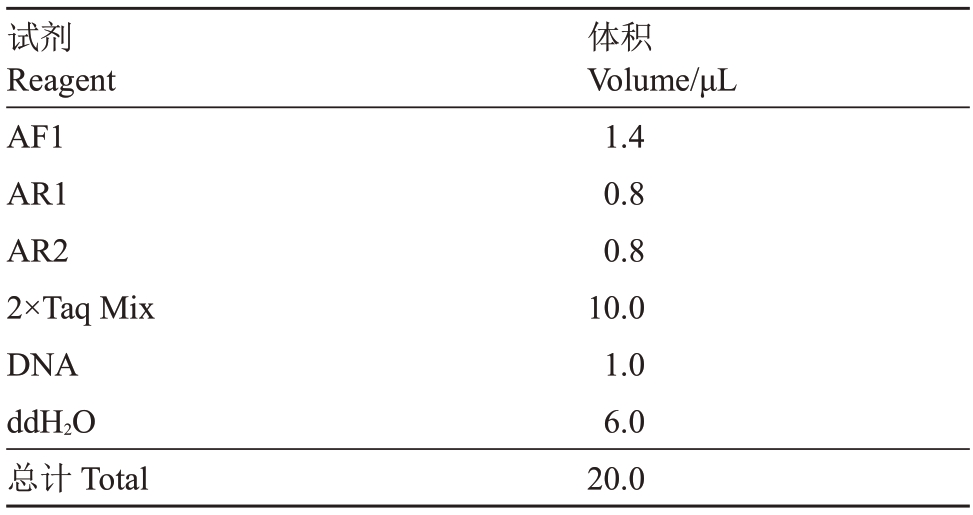
表2 PCR程序
Table 2 PCR procedure
1.6 试验设计与数据统计分析
本研究中不同苹果品种/优系设置2~10个生物学重复,每个生物学重复通过4组Chl a/b计算平均值,并确定鉴定结果。统计分析时,准确率/%=单个重复与最终鉴定结果一致的个数/总的生物学重复数×100。试验数据使用Graphpad Prism 8进行差异显著性分析并绘图。
2 结果与分析
2.1 柱型苹果和非柱型苹果光合作用能力分析
本试验取不同品种柱型非柱型苹果叶片,测定其叶绿素荧光参数(图1),发现在正常生长条件下,柱型品种PSⅡ最大光化学量子产量较非柱型品种更高。非柱型品种中澳洲青苹、福丽、红月的Fm值整体低于柱型品种塔斯坎、福蕾、鲁加五号;柱型品种和非柱型品种之间Fo值差异不明显,柱型品种较高。通过这些光合荧光参数的测定,说明柱型苹果品种相较于非柱型苹果品种具有更高的光合生理优势。
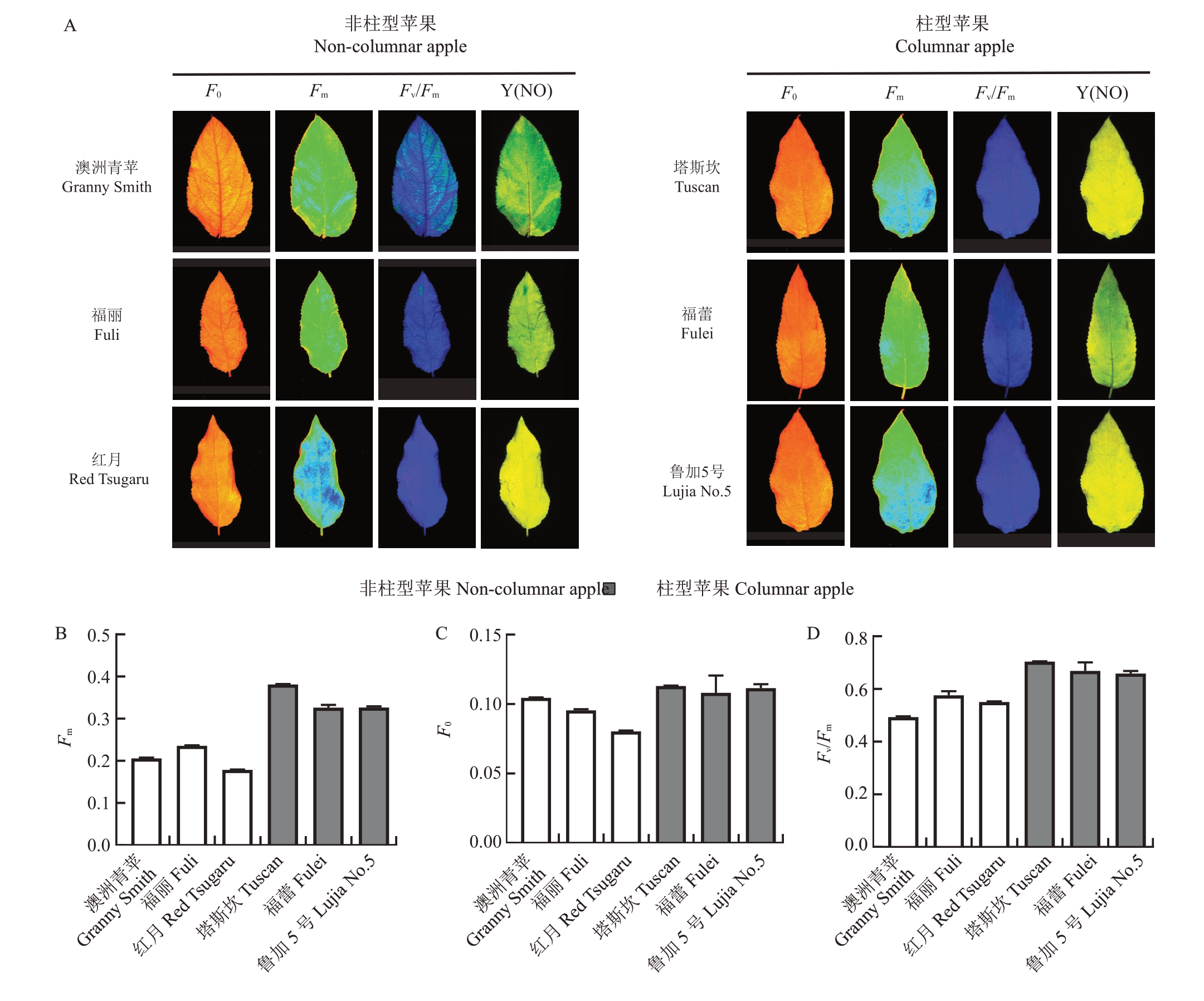
图1 非柱型和柱型苹果光合作用能力分析
Fig.1 Analysis of photosynthetic capacity in non-columnar and columnar apple
A.非柱型和柱型苹果叶片的叶绿素荧光表型观察;B.PSⅡ反应中心都处于关闭状态时的最大荧光;C.PSⅡ反应中心都处于开放状态时的最小荧光;D.PSⅡ最大光化学量子产量。
A.Phenotype observation of chlorophyll fluorescence in non-columnar and columnar apple leaves;B.Maximum fluorescence when PSⅡreaction centers are all closed;C.Minimum fluorescence when PSⅡreaction centers are all open;D.Maximum photochemical quantum yield of PSⅡ.
2.2 不同柱型和非柱型苹果品种叶绿素提取分析
为分析柱型苹果叶绿素特征,选取7个柱型苹果品种和10个非柱型苹果品种,每个品种取3~5枚叶片,共计63份材料(一枚叶片作为一份材料),作为鉴定试材(图2)。计算得出各试验材料Chl a/b的原始数值及平均数值(表3)。
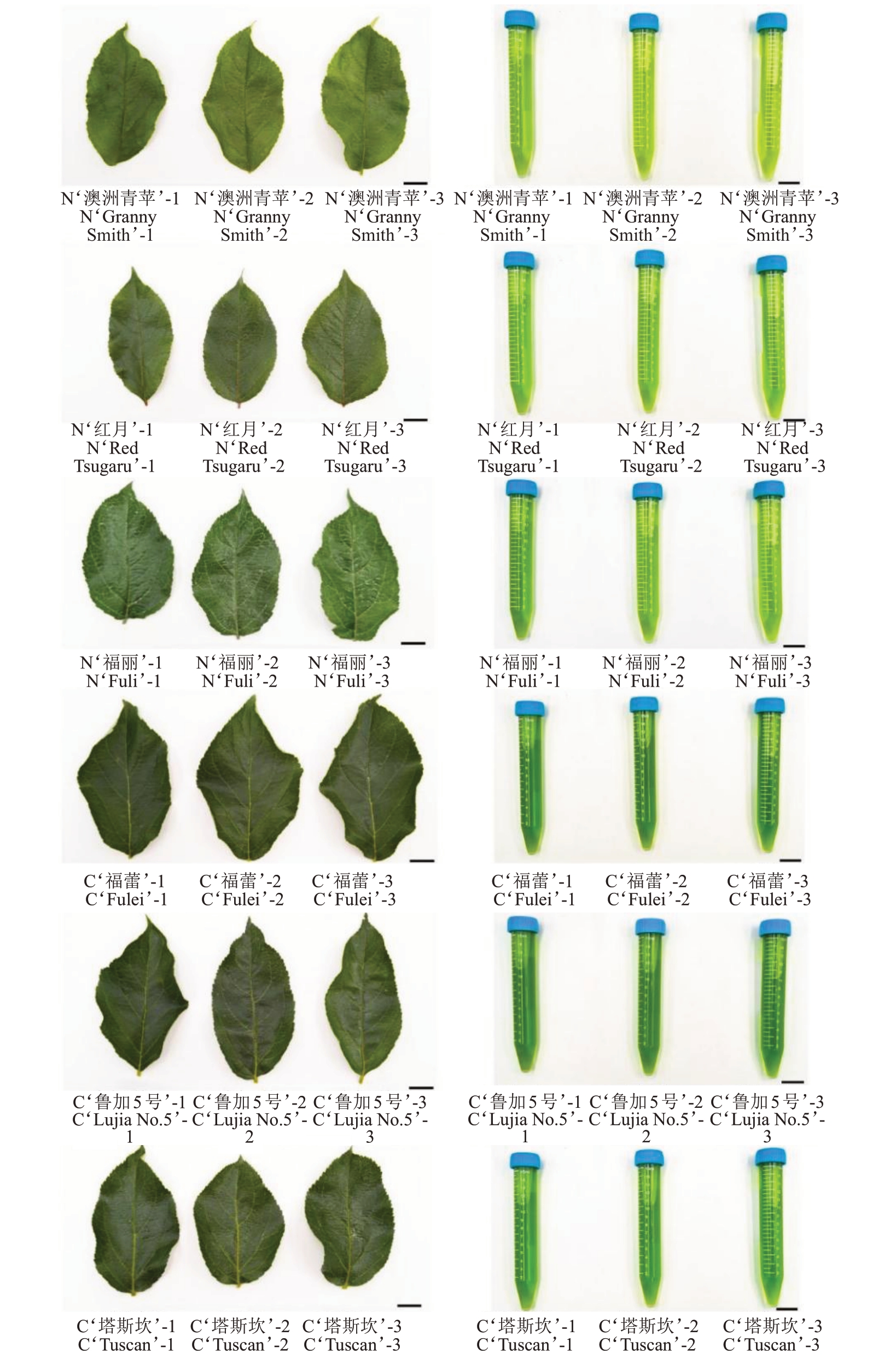
图2 部分非柱型和柱型苹果叶片表型与叶绿素提取液
Fig.2 Partial non-columnar and columnar apple leaf samples and chlorophyll extraction solution
图中比例尺为50 mm;“C”或“N”分别表示“柱型”或“非柱型”;品种名称后的数字n 表示该品种的第n 份生物学重复。例:N‘澳洲青苹’-1表示非柱型苹果嘎拉的第1个重复。
The scale bar in the figure represents 50 mm;“C”or“N”denotes“columnar”or“non-columnar”respectively;The number“n”following the cultivar name indicates the nth biological replicate of that cultivar.For example:N‘Granny Smith’-1 represents the 1th replicate of the non-columnar apple cultivar Gala.
表3 利用叶绿素分析方法鉴定不同苹果品种的结果统计
Table 3 Statistics of chlorophyll analysis methods for identifying different apple varieties
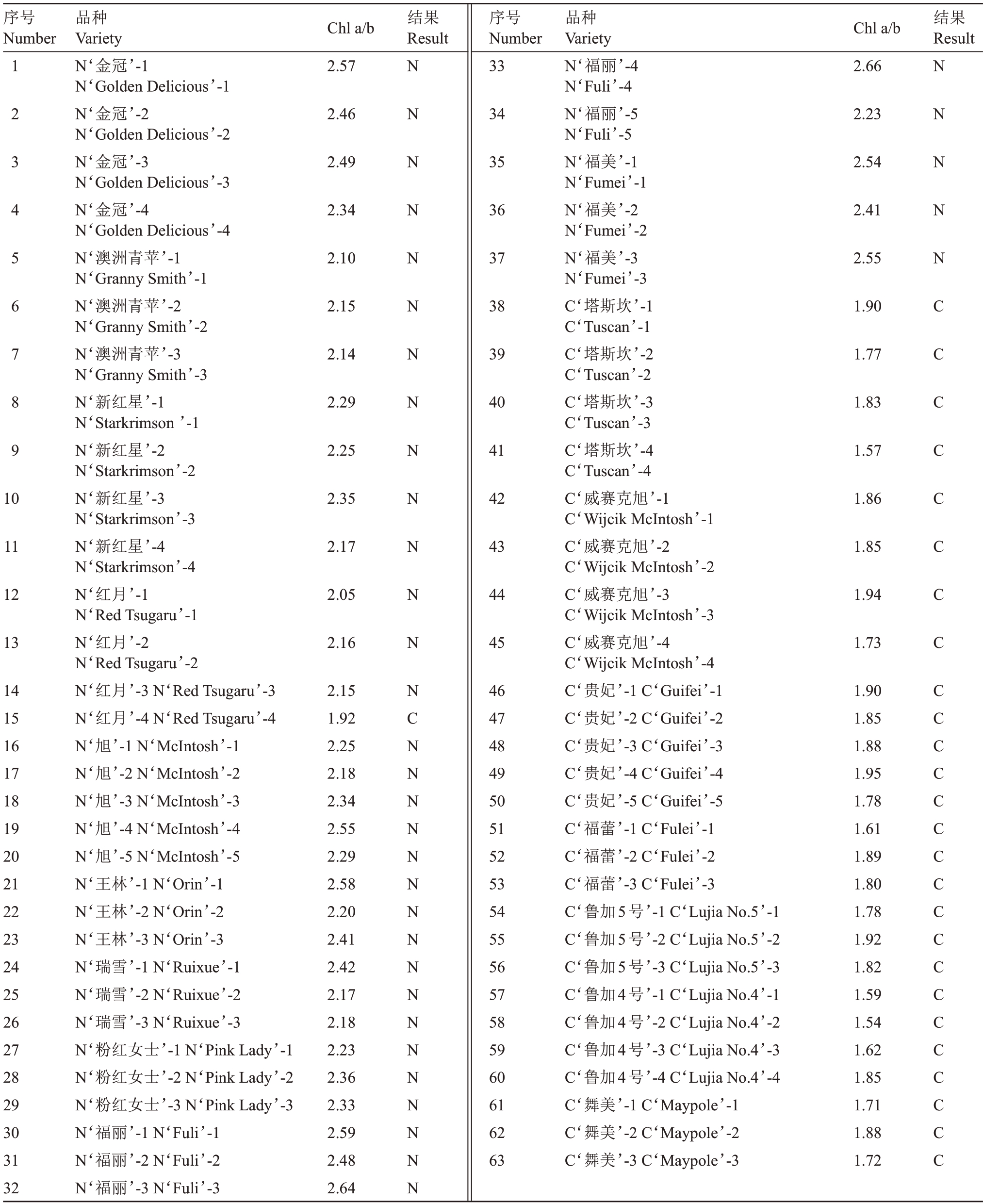
注:品种栏的品种名称前的“C”或“N”和结果栏的“C”或“N”表示该样品是“柱型”或“非柱型”苹果材料;品种名称后的数字表示不同树体的生物学重复(叶片编号);表中Chl a/b为4个Chl a/b数据的平均值。
Note:The“C”or“N”before cultivar names in the“Cultivar”column and the“C”or“N”in the“Result”column indicate whether the sample is from a“columnar”or“non-columnar”apple plant;the numbers following cultivar names represent different biological replicates of individual trees;the Chl a/b ratio in the table is the average of four Chl a/b measurements.
进一步研究发现,柱型苹果的叶绿素含量高于非柱型苹果,叶绿素a和叶绿素b含量均有增加,但叶绿素b含量的增幅较叶绿素a更为显著。柱型苹果Chl a/b平均值为1.79,非柱型苹果Chl a/b平均值为2.33,柱型苹果和非柱型苹果Chl a/b值分离明显。通过分析发现,Chl a/b值在2.00上下分布(图3)。由此确定,以Chl a/b值作为评价指标,柱型苹果和非柱型苹果Chl a/b的分界线为2.00,若Chl a/b<2.00,则该材料为柱型苹果,若Chl a/b≥2.00,则该样品为非柱型苹果。
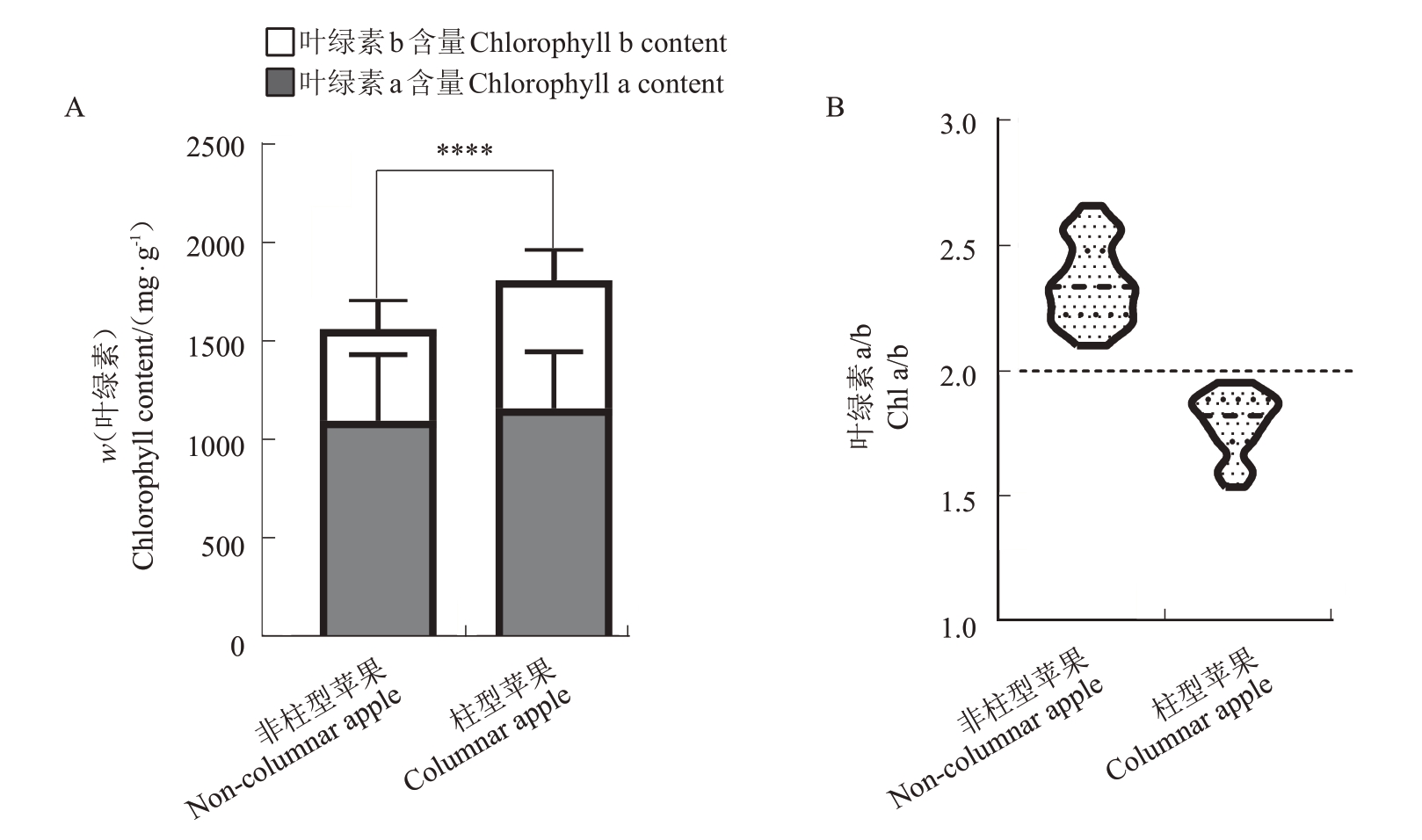
图3 非柱型和柱型苹果叶绿素含量分析
Fig.3 Analysis of chlorophyll content in non-columnar and columnar apple
A.非柱型和柱型苹果叶片的叶绿素含量;B.非柱型和柱型苹果叶片的Chl a/b值分系;差异显著性分析以非株型苹果为对照,t 检验分析,****P<0.000 1。
A.Chlorophyll content in non-columnar and columnar apple leaves;B.Chl a/b ratio in non-columnar apple and columnar apple leaves;Significance analysis of differences was performed using non-columnar apple trees as the control,with t-test,****P<0.000 1.
2.3 利用叶绿素提取分析方法鉴定苹果杂种后代
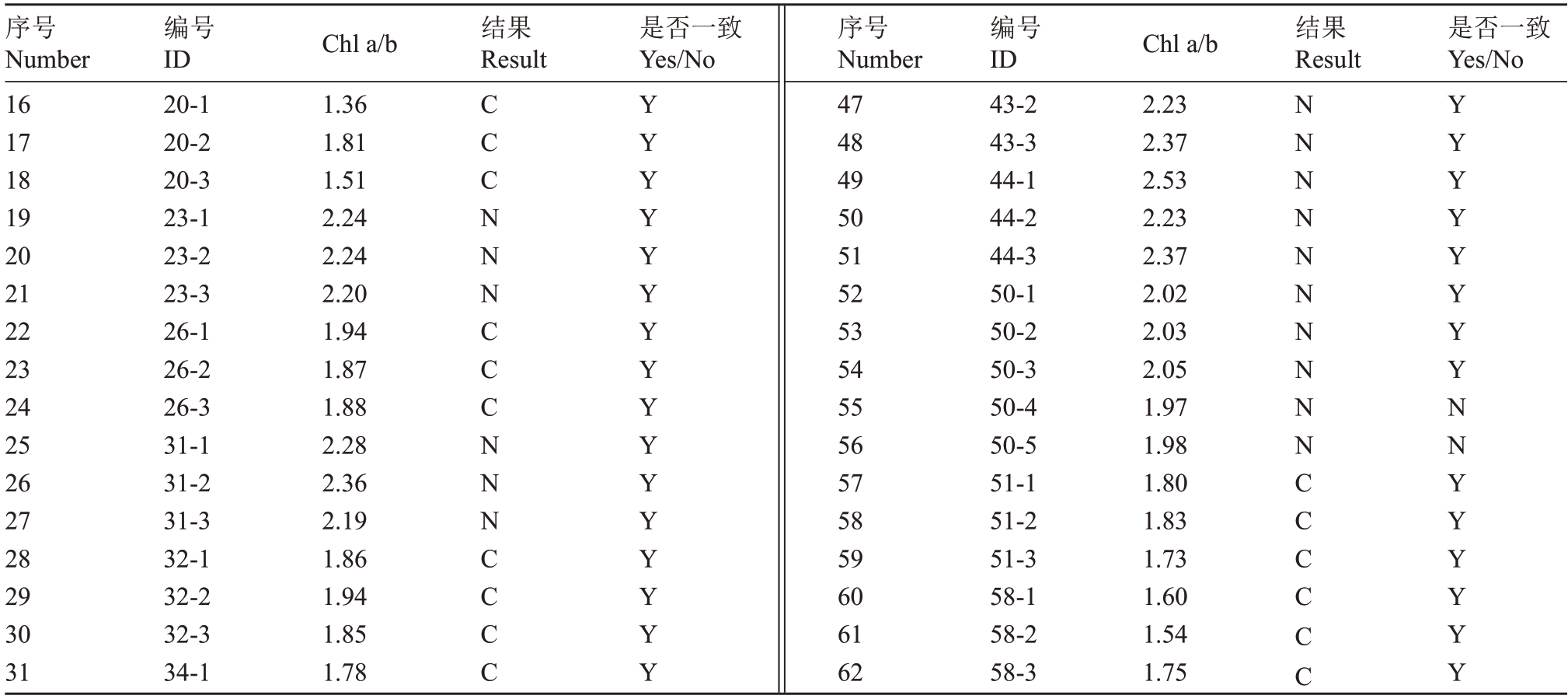
为评价上述叶绿素提取分析方法鉴定柱型苹果的准确性,随机选取青岛农业大学杂种圃内20株柱型和非柱型苹果的杂交后代进行取样,每株取3~5枚树叶,20株杂种后代共取62份材料(一枚叶作为一份材料)作为鉴定试材,并统计分析Chl a/b平均值,8株杂种后代的全部24份试材的Chl a/b<2.0,鉴定为柱型苹果,剩余12株杂种后代的全部38份试材中36份试材的Chl a/b≥2.0,鉴定为非柱型苹果(表4)。
表4 杂种后代中不同柱型和非柱型苹果材料的鉴定结果统计
Table 4 Statistics on the identification results of different columnar and non-columnar apple materials in selected hybrid lines
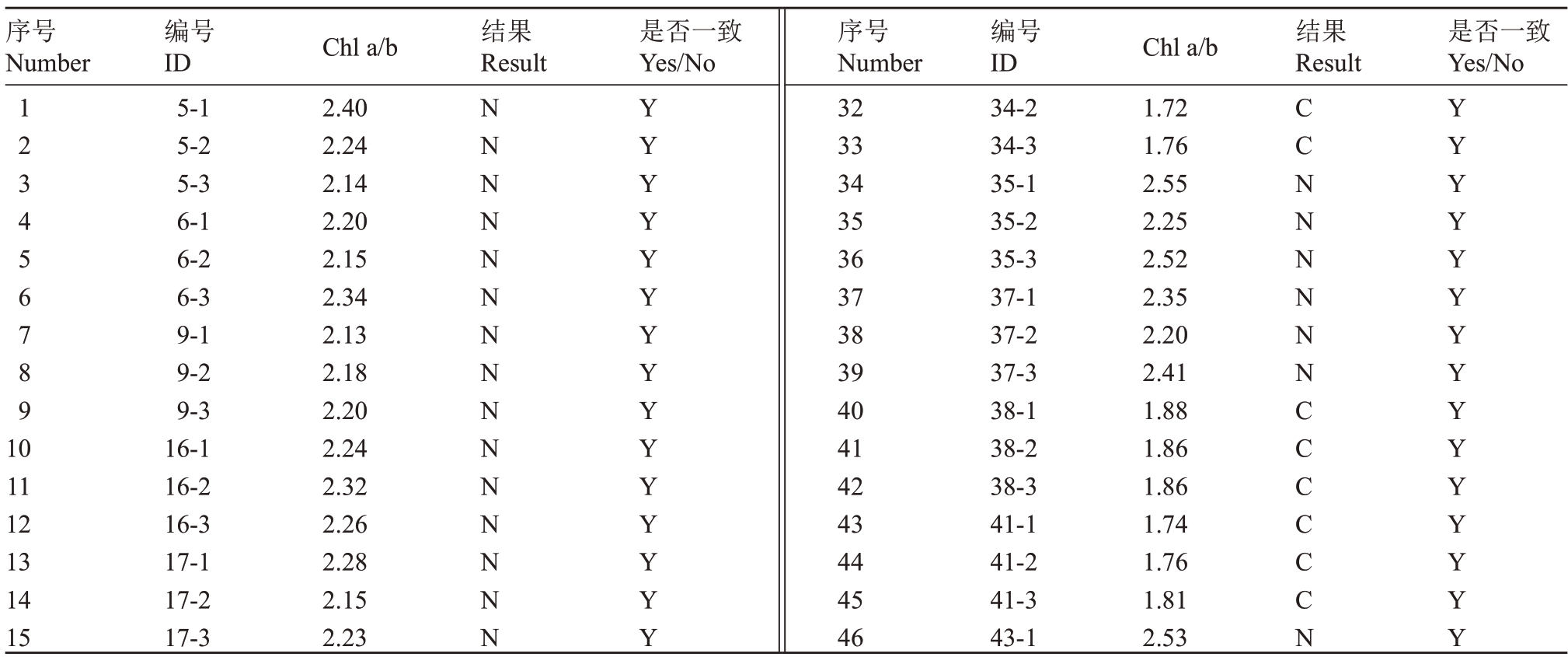
注:编号后面的数字n 表示来自不同树体的第n 个生物学重复,如5-1,表示杂种后代5的第1个生物学重复;表中Chl a/b为4个Chl a/b数据的平均值;结果栏中的“C”或“N”表示用分子标记法鉴定该样品是“柱型”或“非柱型”苹果材料;是否一致栏中的“Y”表示Chl a/b鉴定结果与分子标记鉴定结果一致,“N”表示不一致。
Note:The number“n”following the hybrid identification code indicates the nth biological replicate from different individual trees.For example,“5-1”denotes the first biological replicate of superior hybrid line 5;the Chl a/b ratio in the table represents the average of four Chl a/b measurements;the“C”or“N”in the molecular marker results column indicates whether the sample is from a“columnar”or“non-columnar”apple plant;in the consistency of results column,“Y”indicates that the Chl a/b identification result is consistent with the molecular marker identification result,while“N”indicates inconsistency.
表4 (续)Table 4 (Continued)
2.4 分子标记方法鉴定苹果杂种后代
为进一步明确叶绿素提取分析方法在筛选柱型苹果杂种后代中的准确性,对上述杂种后代和对照品种贵妃、福蕾、福丽和新红星进行DNA提取和分子标记鉴定。结果显示,杂种后代20、26、32、34、37、38、51和58与柱型对照材料贵妃和福蕾的扩增条带一致,确定为柱型苹果;其余12个杂种后代的扩增结果与非柱型对照材料福丽和新红星一致,确定为非柱型苹果(图4)。
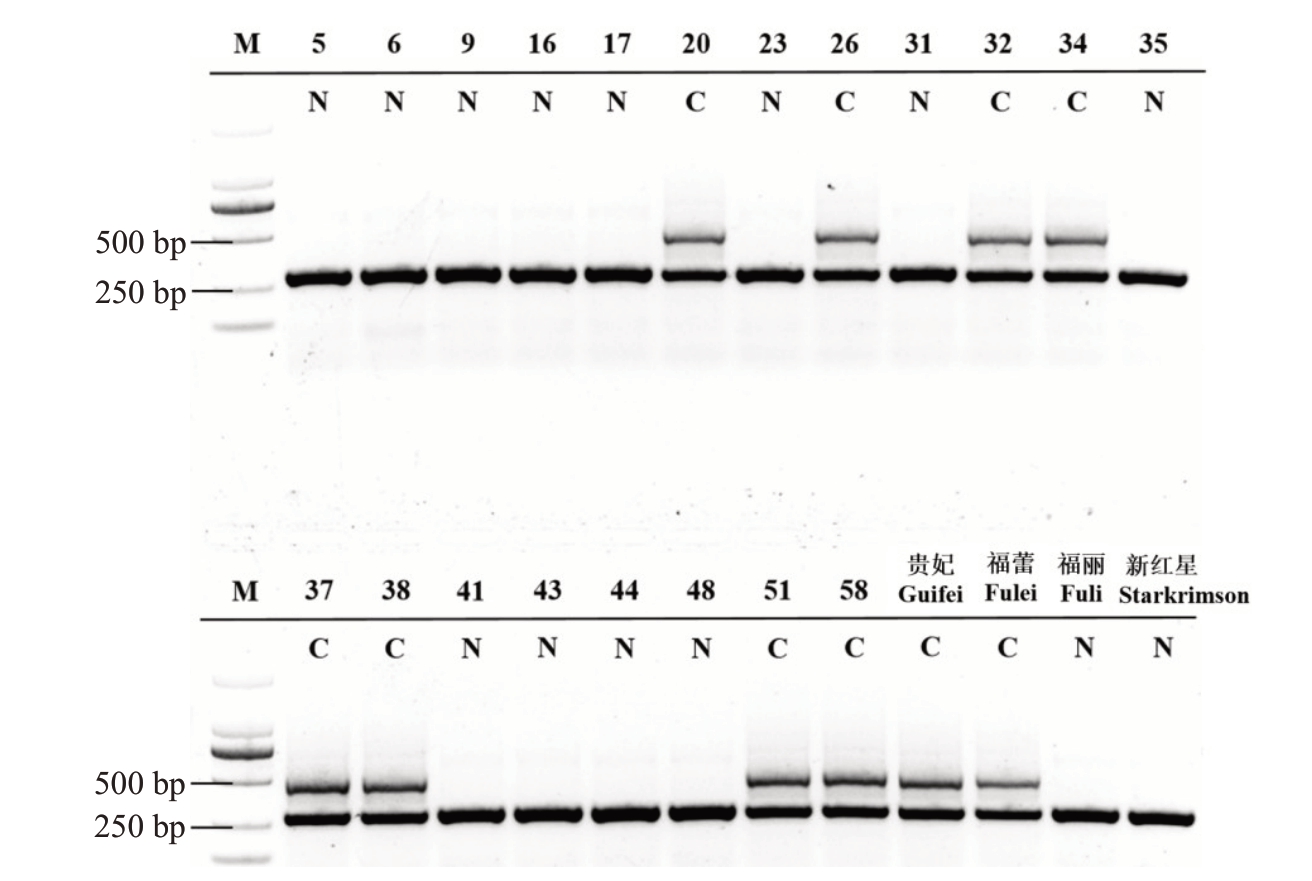
图4 不同苹果杂种的分子标记鉴定结果
Fig.4 Identification results of molecular markers in different apple strains
图中M表示2000 bp DNA marker,“5”等数字表示试验选用杂种的编号名称;“C”或“N”表示该杂种是“柱型”或“非柱型”。
In the figure,“M”represents the 2000 bp DNA marker;numbers such as“5”indicate the identification codes of the superior hybrid lines selected for the experiment;“C”or“N”denotes whether the superior hybrid line is a“columnar”or“non-columnar”apple line.
2.5 叶绿素提取分析和分子标记鉴定结果的比较
采用叶绿素Chl a/b值对62株杂种后代苹果材料进行鉴定,其中60株的鉴定结果与分子鉴定结果相同,准确率高达96.8%,其中鉴定柱型苹果的重合度可达100%。综合分析10个已知非柱型苹果品种和7个已知柱型苹果品种的63份供试材料,以及20株杂种后代的62份供试材料的鉴定结果得出,利用本研究所述的叶绿素分析方法,鉴定柱型材料和非柱型材料的综合准确率可达97.6%(共125株材料,两种鉴定方法一致的为122株),其中鉴定柱型材料的准确率为100%,表明叶绿素分析Chl a/b以快速鉴定柱型苹果的方法是有效的。
3 讨论
在当前中国苹果现代化生产向矮化密植栽培转型的背景下,未来产业发展亟须适宜轻简化与机械化管理的树型。柱型苹果正是这类树型的理想种质,而对其杂种后代进行早期筛选,已成为提升育种效率的关键步骤。杂种后代在苗期形态学特征不明显,分子标记辅助筛选虽然准确率高,但是成本高,对试验人员专业化水平和试验设施要求高,不适于田间快速鉴定柱型苹果,在实际生产中难以大面积推广。根据前期研究,发现柱型苹果的叶绿素含量和光合速率较普通型苹果高[4],并且转MpCoL 杨树叶绿素b含量提高,即叶绿素a/b(Chl a/b)减小(未发表)。本研究发现,MpCoL 表达量高的柱型苹果品种相较于MpCoL表达量低的非柱型苹果品种,其叶片具有光合生理优势,且多个品种Chl a/b值较小;上述结果表明,柱型苹果叶片叶绿素a和叶绿素b含量比例相较于非柱型苹果具有显著差异,以此为基础,开发一种新的更为简便和经济的适于田间筛选柱型后代的方法是可行的。
通过测量分析不同苹果品种/优系的Chl a/b值,该数据反映了柱型苹果和非柱型苹果的遗传差异。20个杂种后代鉴定柱型材料和非柱型材料的准确率高达96.8%,然而仍有非柱型材料50-4和50-5个体的Chl a/b值小于2.0,这可能是环境因素影响导致的。表现型受基因和环境因素共同影响。光照度和温度等环境因素对苹果叶片光合效率和Chl a/b值具有显著影响[19]。传统遗传学研究表明,苹果独特的柱型性状是由反转座子插入诱导邻近基因Mp-CoL 的表达所引起的受显性单基因控制的质量性状[13,20]。现有文章报道了柱型苹果杂种后代幼苗中存在两个隐性抑制基因c2(位于Chr10)和c3(位于Chr9)的遗传定位,这两个基因与反转座子诱导的MpCoL 表达和柱型性状形成的抑制有关[13]。所以,随着柱型苹果遗传机制的不断完善,目前该性状的遗传机制已经难以用简单的单基因显性遗传模型或多基因遗传模型来解释[21]。本研究中Chl a/b以2.0为分界线离散分布于两侧,这种不连续分布特征可能是柱型性状的表型之一,但该性状形成可能的多基因调控分子机制仍需进一步研究。
利用叶绿素分析鉴定柱型苹果,成本低,试验试剂毒性小,操作步骤简单,但是其对苹果幼嫩叶片的鉴定准确率较低,并且除光照外,叶绿素含量尤其是叶绿素a/b还易受干旱等非生物胁迫的影响[22]。为了提高鉴定准确率,需要使用成熟的苹果叶片进行鉴定。因此,想要提高柱型苹果育种效率并降低成本,加速实现苹果轻简化栽培模式,需要综合利用多种鉴定方法。利用苹果叶片Chl a/b的大小快速鉴定柱型苹果,为苗期快速鉴别柱型苹果杂种后代和柱型苹果选育、推广提供了高效的解决方案,具有应用价值和前景。未来的研究应该着重于优化叶绿素提取步骤,并制定更详细的操作规范,提升该方法的普及性。
4 结论
柱型苹果叶绿素b含量所占比例高于非柱型,Chl a/b值小于2.0;在本文所鉴定的所有125株材料中,利用Chl a/b值鉴定柱型苹果的准确性高达100%,可以高效鉴定柱型苹果材料。叶绿素提取分析法为柱型苹果的早期筛选提供了一种全新简便的鉴定方式。
[1] Tobutt K R.Breeding columnar apples at East Malling[J].Acta Horticulturae,1985(159):63-68.
[2] Zhang Y G,Dai H Y.Comparison of photosynthetic and morphological characteristics,and microstructure of roots and shoots,between columnar apple and standard apple trees of hybrid seedlings[J].Phyton,2011,80(1):119-125.
[3] Petersen R,Krost C.Tracing a key player in the regulation of plant architecture:The columnar growth habit of apple trees(Malus×domestica)[J].Planta,2013,238(1):1-22.
[4] 刘伟,孙欣,王鸣枭,柏素花,戴洪义,张玉刚.柱型苹果突变体叶片解剖结构及光合特性观察[J].植物生理学报,2016,52(4):454-460.Liu Wei,Sun Xin,Wang Mingxiao,Bai Suhua,Dai Hongyi,Zhang Yugang.Observation on leaf anatomy structure and photosynthetic characteristics of columnar apple(Malus×domestica Borkh.) mutants[J].Plant Physiology Journal,2016,52(4):454-460.
[5] 梁美霞,乔绪强,郭笑彤,张洪霞.柱型苹果生长特性及Co 基因定位研究进展[J].中国农业科学,2017,50(22):4421-4430.Liang Meixia,Qiao Xuqiang,Guo Xiaotong,Zhang Hongxia.Research progresses in mechanisms of growth habits and Co gene mapping of columnar apple(Malus domestica×Borkh.)[J].Scientia Agricultura Sinica,2017,50(22):4421-4430.
[6] 张玉刚,孙欣,柏素花,孙晓红,侯鸿敏,刘源霞,祝军,戴洪义.一种利用DNA分子标记快速区分柱型苹果苗木的方法:CN201610591825.4[P].2020-01-07.Zhang Yugang,Sun Xin,Bai Suhua,Sun Xiaohong,Hou Hongmin,Liu Yuanxia,Zhu Jun,Dai Hongyi.A method for rapidly distinguishing columnar apple seedlings using DNA molecular markers:CN201610591825.4[P].2020-01-07.
[7] 赵玉军,张文,王涛,李光晨,祝军,崔跃华.柱型苹果几个形态指标的遗传研究[J].中国农业大学学报,1998,3(增刊3):96-98.Zhao Yujun,Zhang Wen,Wang Tao,Li Guangchen,Zhu Jun,Cui Yuehua.Genetic studies on several morphological index of columnar apple trees[J].Journal of China Agricultural University,1998,3(Suppl.3):96-98.
[8] 高华,鲁玉妙,赵政阳,王雷存,袁景军.柱型苹果杂交后代果实性状遗传[J].西北农业学报,2004,13(1):76-79.Gao Hua,Lu Yumiao,Zhao Zhengyang,Wang Leicun,Yuan Jingjun.Fruit genetic characters of hybrid posterity of columnar apple[J].Acta Agriculturae Boreali-occidentalis Sinica,2004,13(1):76-79.
[9] Tobutt K R.Combining apetalous parthenocarpy with columnar growth habit in apple[J].Euphytica,1994,77(1/2):51-54.
[10] Wolters P J,Schouten H J,Velasco R,Si-Ammour A,Baldi P.Evidence for regulation of columnar habit in apple by a putative 2OG-Fe(II) oxygenase[J].New Phytologist,2013,200(4):993-999.
[11] Okada K,Wada M,Moriya S,Katayose Y,Fujisawa H,Wu J Z,Kanamori H,Kurita K,Sasaki H,Fujii H,Terakami S,Iwanami H,Yamamoto T,Abe K.Expression of a putative dioxygenase gene adjacent to an insertion mutation is involved in the short internodes of columnar apples(Malus×domestica)[J].Journal of Plant Research,2016,129(6):1109-1126.
[12] Petersen R,Djozgic H,Rieger B,Rapp S,Schmidt E.Columnar apple primary roots share some features of the columnar-specific gene expression profile of aerial plant parts as evidenced by RNA-Seq analysis[J].BMC Plant Biology,2015,15(1):34.
[13] Okada K,Wada M,Takebayashi Y,Kojima M,Sakakibara H,Nakayasu M,Mizutani M,Nakajima M,Moriya S,Shimizu T,Abe K.Columnar growth phenotype in apple results from gibberellin deficiency by ectopic expression of a dioxygenase gene[J].Tree Physiology,2020,40(9):1205-1216.
[14] 刘培培,李志,华俊凯,齐文硕,吴海英,张玉刚,韩婷婷.利用切片染色分析方法高效鉴定柱型和非柱型苹果[J].植物生理学报,2025,61(5):603-612.Liu Peipei,Li Zhi,Hua Junkai,Qi Wenshuo,Wu Haiying,Zhang Yugang,Han Tingting.Slicing and staining analysis for efficient identification of columnar and non-columnar apples[J].Plant Physiology Communications,2025,61(5):603-612.
[15] 杨文强,林荣呈,端木德强,李磊,卢从明,欧阳敏,王文达,孙韬,田利金,王柏臣,朱新广.近10年光合作用领域若干重要研究进展[J].植物生理学报,2024,60(2):211-247.Yang Wenqiang,Lin Rongcheng,Duanmu Deqiang,Li Lei,LuCongming,Ouyang Min,Wang Wenda,Sun Tao,Tian Lijin,Wang Baichen,Zhu Xinguang.Multiple of important progress on photosynthesis in the last 10 years[J].Plant Physiology Journal,2024,60(2):211-247.
[16] 白团辉,李莉,郑先波,王苗苗,宋尚伟,焦健,宋春晖.柱状苹果Co 基因的筛选与候选基因分析[J].中国农业科学,2019,52(23):4350-4363.Bai Tuanhui,Li Li,Zheng Xianbo,Wang Miaomiao,Song Shangwei,Jiao Jian,Song Chunhui.Screening and expression analysis of Co candidate genes in columnar apple[J].Scientia Agricultura Sinica,2019,52(23):4350-4363.
[17] Halmagyi A,Deliu C,Isac V.Cryopreservation of Malus cultivars:Comparison of two droplet protocols[J].Scientia Horticulturae,2010,124(3):387-392.
[18] Wang L M,Guo J,Chu Y,Pan Q,Zhu Y D.MdCo31 interacts with an RNA polymerase Ⅱtranscription subunit 32 to regulate dwarf growth with short internodes in columnar apple[J].Plant Science,2022,325:111496.
[19] 常浩杰.延安山地富士苹果光合生理特性及生态效应研究[D].延安:延安大学,2021.Chang Haojie.Study on photosynthetic physiological characteristics and ecological effects of Fuji apple in Yan’an mountain[D].Yan’an:Yan’an University,2021.
[20] Conner P J,Brown S K,Weeden N F.Randomly amplified polymorphic DNA-based genetic linkage maps of three apple cultivars[J].Journal of the American Society for Horticultural Science,1997,122(3):350-359.
[21] Dougherty L,Bai T H,Brown S,Xu K N.Exploring DNA variant segregation types enables mapping loci for recessive phenotypic suppression of columnar growth in apple[J].Frontiers in Plant Science,2020,11:692.
[22] 饶德民,董青松,程彤,于德彬,亓立强,赵婧,闫晓燕,孟凡钢,张伟.作物光合效率对逆境适应及提高途径研究进展[J].植物生理学报,2024,60(8):1229-1240.Rao Demin,Dong Qingsong,Cheng Tong,Yu Debin,Qi Liqiang,Zhao Jing,Yan Xiaoyan,Meng Fangang,Zhang Wei.Research progress of crop photosynthetic efficiency adaptation to adversity and improving ways[J].Plant Physiology Journal,2024,60(8):1229-1240.