光周期变化具有规律性,比其他环境因素更稳定,是预测季节变化最可靠的无声信息[1-2]。滞育是昆虫在时间上逃避不利生境的行为,也是在其系统发育中的一种内在、相对稳定的遗传特性,是种群在某种生境下长期与之相适应并得以生存的结果。昆虫通过滞育适应不良环境条件,从而维持种群和个体的生存[3-4]。滞育的诱导和终止受环境因素影响,特别是光周期和温度。国内已有研究报道,光周期对梨小食心虫[Grapholitha molesta(Busck)][5]、苹果蠹蛾(Cydia pomonella)[6]等的滞育诱导具有重要影响,这3种昆虫均属于短日照滞育型。
葡萄花翅小卷蛾(Lobesia botrana Den.&Shiff.),为严重危害多种经济植物花和果实的世界性害虫[7]。2014年6月在新疆吐鲁番市亚尔乡首次发现,在新疆吐鲁番市一年发生5代,蛹在落叶中、藤皮下或土壤缝隙中结茧化蛹越冬[8]。在吐鲁番地区,葡萄花翅小卷蛾第一、二代成虫发生量较少,而到第三、四代突然暴发成灾,可能与该害虫蛹的滞育习性有关。据国外研究报道,Orphanidis[9]最早猜测葡萄花翅小卷蛾可能存在滞育蛹。后续研究发现其以第三代滞育蛹进行越冬,并在翌年2月解除滞育状态[10-12];Komarova[13]首次报道了光周期对该物种滞育诱导的决定性作用。而对诱导滞育的敏感虫期未见报道,光照度对其生长发育的影响有待进一步研究。
为加深对葡萄花翅小卷蛾滞育特性及其影响因子的认识,进一步探究了葡萄花翅小卷蛾的光周期反应类型、临界光周期及敏感虫期,解析该害虫在吐鲁番第一、二代成虫发生量较低,但随着吐鲁番夏季温度的持续上升,日照时数的先增长后缩短,第三、四代成虫突然暴发成灾的原因。研究结果为预测预报和防治工作提供强有力的理论依据和技术支撑。
1 材料和方法
1.1 供试虫源
2019年3—9月在吐鲁番市高昌区葡萄镇巴格日社区(42°56′56.6″N,89°12′37.3″E)、亚尔镇色依提地汗(42°55′45.3″N,89°7′43.8″E)、五道林科技示范园(42°58′42.8″N,89°4′46.9″E)等葡萄园发生区采集带有葡萄花翅小卷蛾幼虫的葡萄,带回室内人工饲养。
1.2 试验方法
1.2.1 光周期对葡萄花翅小卷蛾生长发育的影响将RTOP系列智能人工气候箱(温度误差±0.5 ℃,浙江托普仪器有限公司制造)设定5个光周期,分别为16L∶8D、14L∶10D、12L∶12D、10L∶14D和8L∶16D,光周期梯度的设定参照刘月英等[6]的方法,温度为(28±0.5)℃,相对湿度为(45±5)%,光照度为800~1200 lx。将田间采集的幼虫饲养至化蛹、羽化,待成虫交配产卵后,卵孵化的幼虫使用人工饲料(配方由智利公司提供)饲养,在室温内进行继代饲养,以此作为供试虫源。随机抽取10头葡萄花翅小卷蛾初孵幼虫,放置于培温箱内,3次重复。幼虫饲养于直径90 mm的培养皿内,每皿放置2头幼虫及1/2张润湿滤纸,每隔1 d更换新鲜的人工饲料,观察幼虫的生长发育情况,并记录幼虫的发育历期。待幼虫化蛹后,继续观察直至羽化为成虫。成虫羽化当天按雌雄1∶1配对饲养于养虫笼(20 cm×20 cm×40 cm)内,并保持笼内湿度。每次处理3~5对成虫,3次重复。观察并记录卵、幼虫、蛹的发育历期和存活率,成虫(雌、雄)寿命及雌虫产卵量等。
1.2.2 光周期反应显著性的测定 2019年3—9月,在人工气候箱中进行试验(人工气候箱的玻璃门采用遮光纸进行遮挡,确保试验的严谨性),在温度28 ℃,相对湿度(45±5)%,光照度800~1200 lx的条件下,分别设置16L∶8D、14L∶10D、12L∶12D、10L∶14D和8L∶16D共5个不同的光周期处理,对葡萄花翅小卷蛾从初孵幼虫阶段开始处理直至成虫死亡。将饲养的幼虫接入人工饲料上,放置于养虫盒(17.5 cm×12 cm×7 cm)内,每盒放置10头,盒口用纱布封好以防止幼虫逃逸。每组处理3次重复,共约150头。每天观察并及时更换饲料,饲养至化蛹,观察并记录不同光周期下的蛹质量、蛹长、蛹宽及蛹的滞育情况,统计滞育率。
1.2.3 临界光周期的测定方法 根据1.2.2的测定结果,参考Deseő等[14]的研究方法,获得诱导葡萄花翅小卷蛾滞育的条件为(L∶D=12∶12)h。因此,设置5个不同的光周期处理14L∶10D、13.5L∶10.5D、13L∶11D、12.5L∶11.5D、12L∶12D,测定引起葡萄花翅小卷蛾蛹滞育的临界光周期。其余方法同上。
1.2.4 对光周期敏感虫态的测定方法 参照Pavan等[15]的研究方法,并依据1.2.2的测定结果,在28 ℃下,将光周期16L∶8D和12L∶12D作为敏感虫期测定的试验条件。将葡萄花翅小卷蛾卵、不同日龄幼虫、预蛹分别置于长光照(16L∶8D)和短光照(12L∶12D)下进行交替处理。试验处理分为2组:第一组为先经长光照(L)处理后转入短光照(D)处理,长光照处理时间从卵期开始逐步增长,直至预蛹期全部进行长光照处理(处理1~7);第2组为先经短光照(D)处理后转入长光照(L)处理,短光照处理时间从卵期开始逐步增长,直至预蛹期全部进行短光照处理(处理8~14)。每组处理3次重复,共约500头蛹,观察并记录不同处理的滞育情况。
1.2.5 滞育蛹的判断 当同期羽化的葡萄花翅小卷蛾蛹全部羽化后,尚未羽化的活蛹定义为滞育个体。非滞育蛹一般在9~12 d即可羽化,因此15 d仍未羽化的个体可判断为滞育蛹。通过观察滞育个体与非滞育个体的外部形态特征进行判断。在目前研究中,判断滞育的直接标准是化蛹后蛹复眼的颜色、位置、大小等形态。非滞育蛹在化蛹后5 d复眼颜色开始变暗,随后体色逐渐发生变化;在滞育蛹中,复眼颜色始终呈浅棕色,未见成虫分化迹象[16]。
1.2.6 非滞育蛹与滞育蛹体内自由水含量的测定分别取单头蛹(滞育蛹与非滞育蛹),置于电子天平上称取鲜质量;然后于60 ℃恒温烘箱中烘烤48 h至恒质量,称取干质量,并计算蛹体内自由水含量[17]。以单头蛹为1次重复,雌、雄蛹各15次重复。计算公式如下:

1.3 数据处理及分析
采用SPSS20.0软件对数据进行分析,数据以平均数±标准误表示。对数据进行单因素方差分析(One-way ANOVA),经方差分析显著后,用Duncan氏多重比较法进行差异显著性测定(显著水平P≤0.05);采用Excel软件作图。
2 结果与分析
2.1 不同光周期条件下葡萄花翅小卷蛾的生长发育
2.1.1 不同光周期条件下葡萄花翅小卷蛾各虫态的发育历期 在不同光周期条件下,葡萄花翅小卷蛾各虫态的发育历期存在差异(表1)。卵历期随着光照时间的增加而逐渐增长,光周期8L∶16D与16L∶8D处理下的卵历期存在显著差异(F=1.56,P<0.05)。不同光周期处理对幼虫历期无显著影响(F=1.34,P>0.05);14L∶10D光周期下幼虫历期最长,16L∶8D光周期下幼虫历期最短,仅为10.10 d。10L∶14D光周期下蛹历期最长,16L∶8D光周期下蛹历期最短,仅为6.15 d;且光周期10L∶14D与16L∶8D处理下的蛹历期存在显著差异(F=1.34,P<0.05),其他光周期处理间无显著差异。8L∶16D光周期下成虫历期最长,12L∶12D光周期下成虫历期最短,仅6.77 d;光周期8L∶16D与12L∶12D处理下的成虫历期存在显著差异(F=1.92,P<0.05)。
表1 不同光周期条件下葡萄花翅小卷蛾各虫态的发育历期
Table 1 Developmental duration of various insect states of L.botrana under different photoperiod conditions

注:不同小写字母表示同一发育历期在不同光周期处理间差异显著(P<0.05)。
Note:Different small letters indicate significant differences in the same developmental stage among different photoperiod treatments(P<0.05).
2.1.2 不同光周期条件下的葡萄花翅小卷蛾各虫态存活率 由图1可知,不同光周期处理对葡萄花翅小卷蛾幼虫存活率无显著影响(F=0.94,P>0.05)、对蛹存活率的影响存在显著差异(F=12.90,P<0.05),及对成虫羽化率影响显著(F=8.27,P<0.05)。在10L∶14D光周期下,幼虫的存活率最低,为80.93%;12L∶12D光周期下,蛹存活率和成虫羽化率最低,这是由于该光周期诱导的滞育率最高导致的。在长日照(16L∶8D)条件下,成虫羽化率最高达80.63%;在10L∶14D、14L∶10D光周期条件下葡萄花翅小卷蛾蛹存活率均能达到100%。
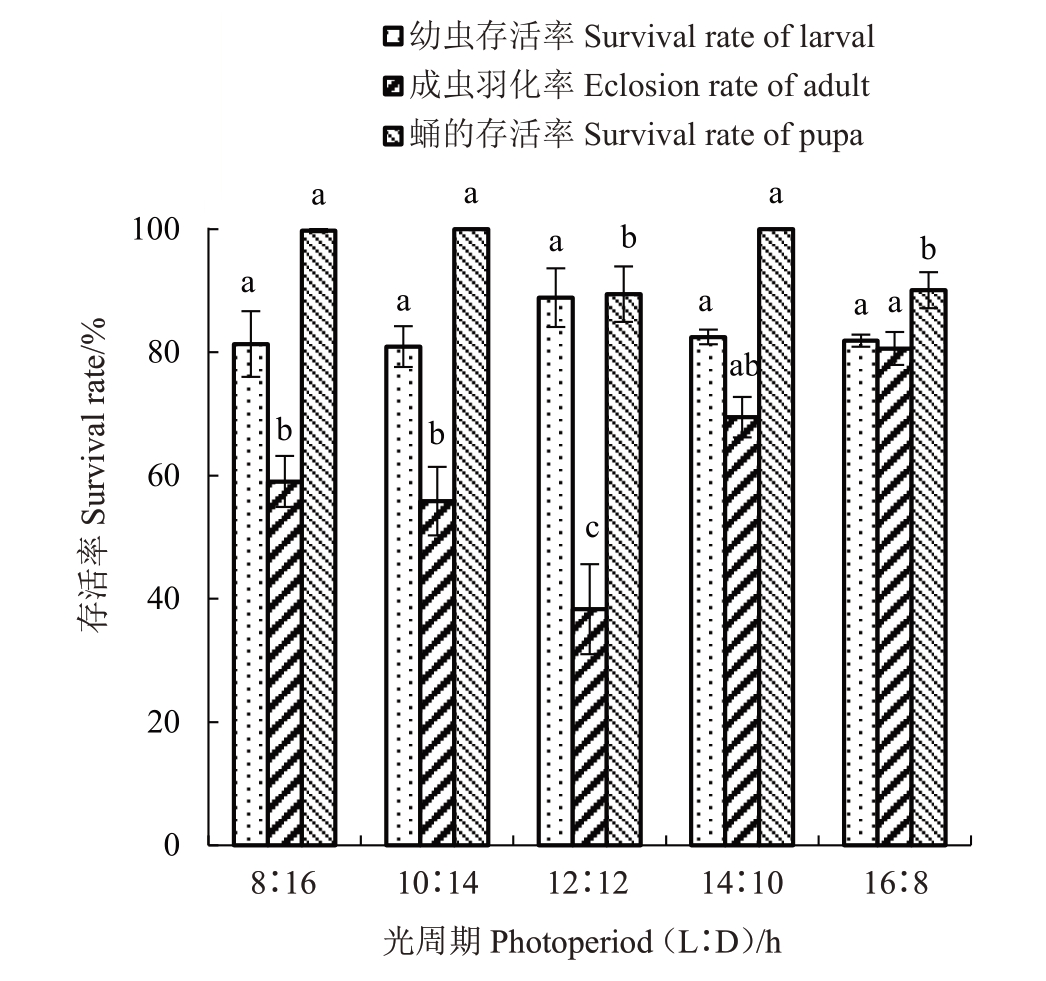
图1 不同光周期条件下葡萄花翅小卷蛾各虫态的存活率
Fig.1 Survival rate of various insect states of L.botrana under different photoperiod conditions
不同小写字母表示同一虫态在不同光周期处理间差异显著(P<0.05)。
Different small letters indicate significant differences in the same larval stage among different light cycle treatments(P<0.05).
2.1.3 不同光周期对葡萄花翅小卷蛾卵的影响 由图2可知,不同光周期处理对葡萄花翅小卷蛾成虫产卵量的影响存在显著差异(F=3.64,P<0.05)。在8L∶16D光周期下单雌平均产卵量最高,达35.28粒;在10L∶14D、12L∶12D、14L∶10D光周期条件下次之,单雌平均产卵量分别为22.20、23.61、19.60粒;在长光照16L∶8D条件下,成虫产卵量最少,仅14.05粒。根据室内不同产卵场所成虫交配情况可知(图3),在养虫盒上(F=1.44,P>0.05)与自制卵卡上(F=0.31,P>0.05)的产卵量无显著差异,而果实表面的产卵量存在显著差异(F=10.05,P<0.05)。进一步观察发现,在养虫盒光滑的内壁和葡萄果实表面的产卵数量较多,符合雌虫喜欢在光滑且具有食物源的场所进行产卵的习性。
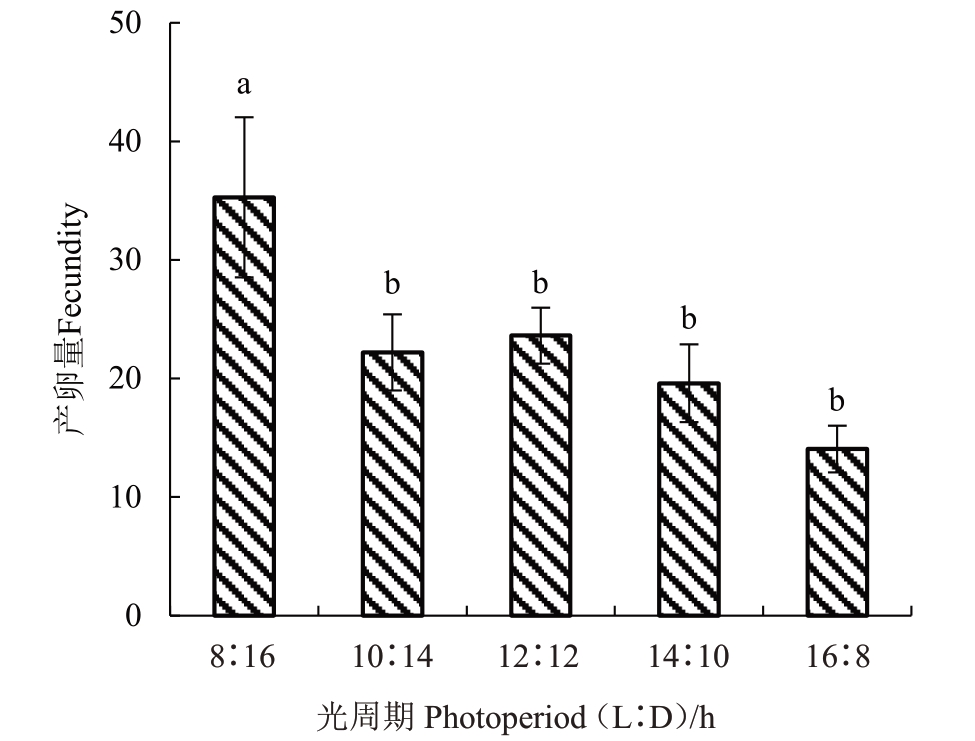
图2 不同光周期对葡萄花翅小卷蛾单雌产卵量的影响
Fig.2 Effects of different photoperiod on the oviposition number of single females in L.botrana
不同小写字母表示在P<0.05差异显著。下同。
Different small letters indicate significant difference at P<0.05.The same below.
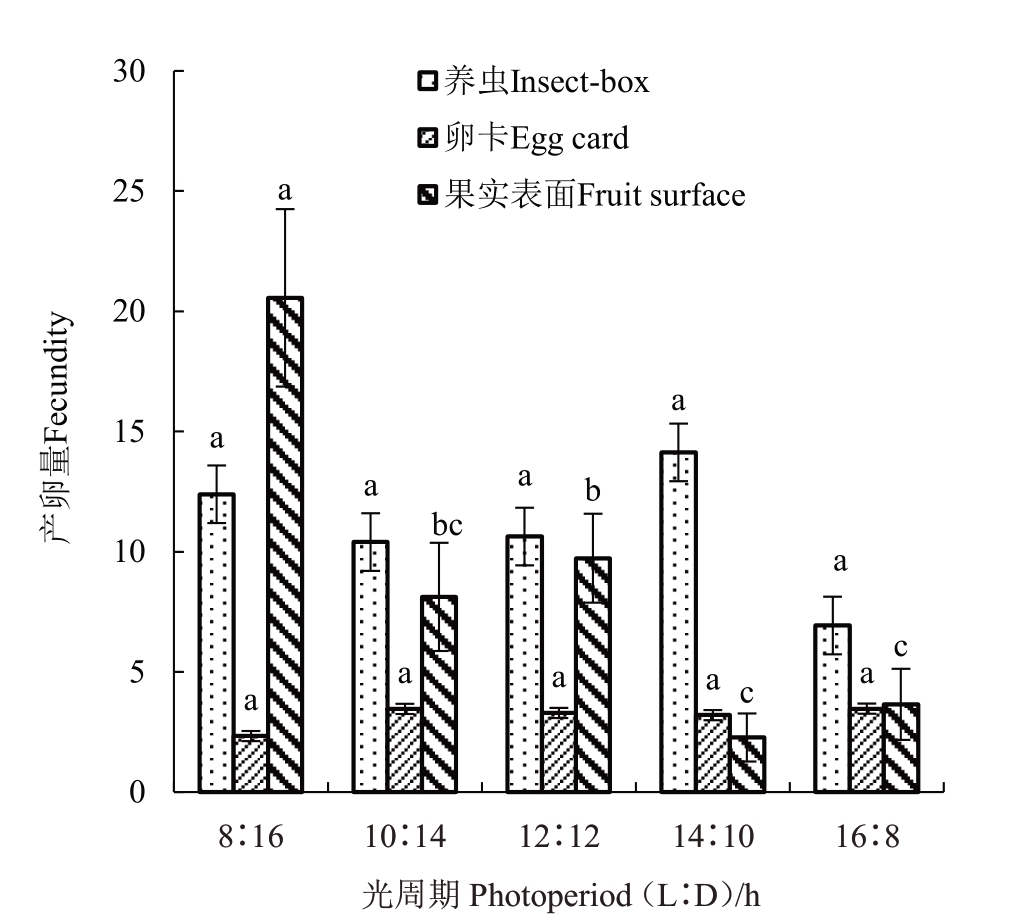
图3 不同光周期对葡萄花翅小卷蛾不同产卵场所产卵量的影响
Fig.3 Effects of different photoperiod on the number of oviposition in different spawning sites of L.botrana
不同小写字母表示同一产卵场所在不同光周期处理间差异显著(P<0.05)。
Different small letters indicate significant differences among different photoperiod treatments of the same spawning ground(P<0.05).
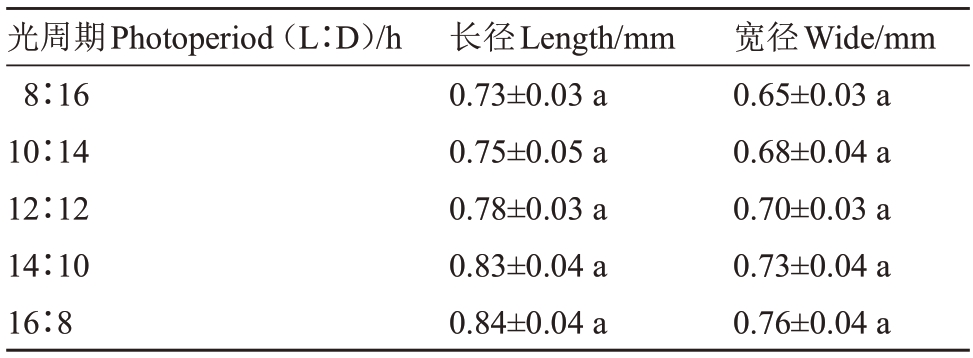
由表2可知,不同光周期对葡萄花翅小卷蛾的卵径大小具有一定影响,但无显著差异(长径:F=1.23,P>0.05;短径:F=1.41,P>0.05)。随着光照时间的增加,卵径随之增大。
表2 不同光周期下对葡萄花翅小卷蛾卵径大小的影响
Table 2 Effects of different photoperiod on the size of egg diameter of L.botrana
由图4可知,不同光周期对葡萄花翅小卷蛾的卵孵化率无显著影响(F=0.40,P>0.05)。其中,16L∶8D光周期下卵孵化率最高,达55.50%;在10L∶14D光周期下卵孵化率最低,仅38.74%。
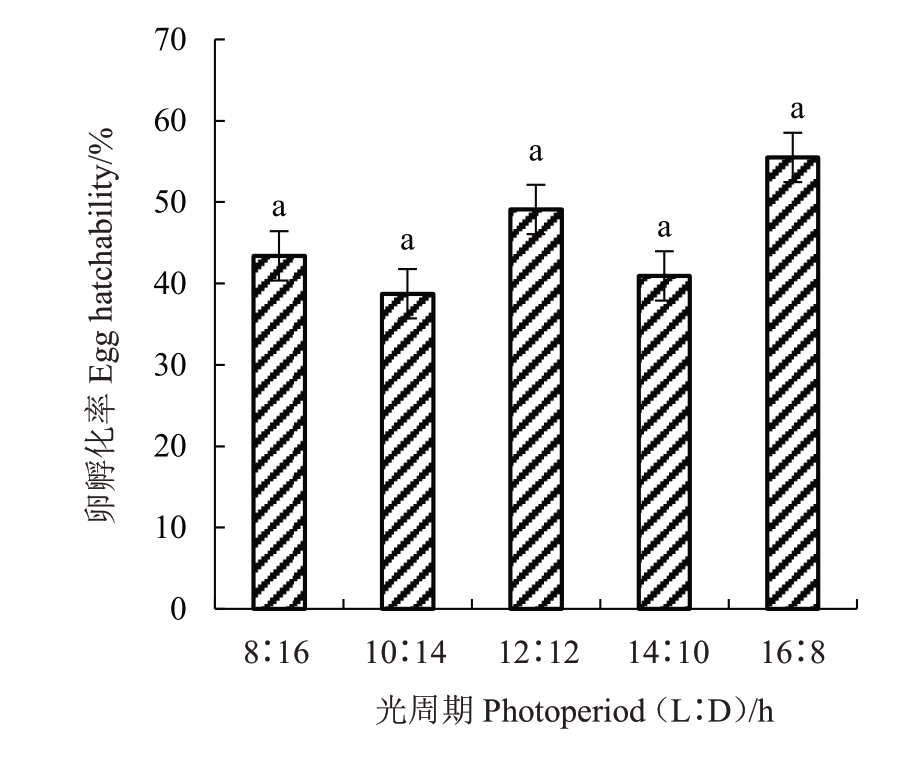
图4 不同光周期对葡萄花翅小卷蛾卵孵化率的影响
Fig.4 Effects of different photoperiod on hatching rate of eggs of L.botrana
2.2 光周期对葡萄花翅小卷蛾滞育的影响
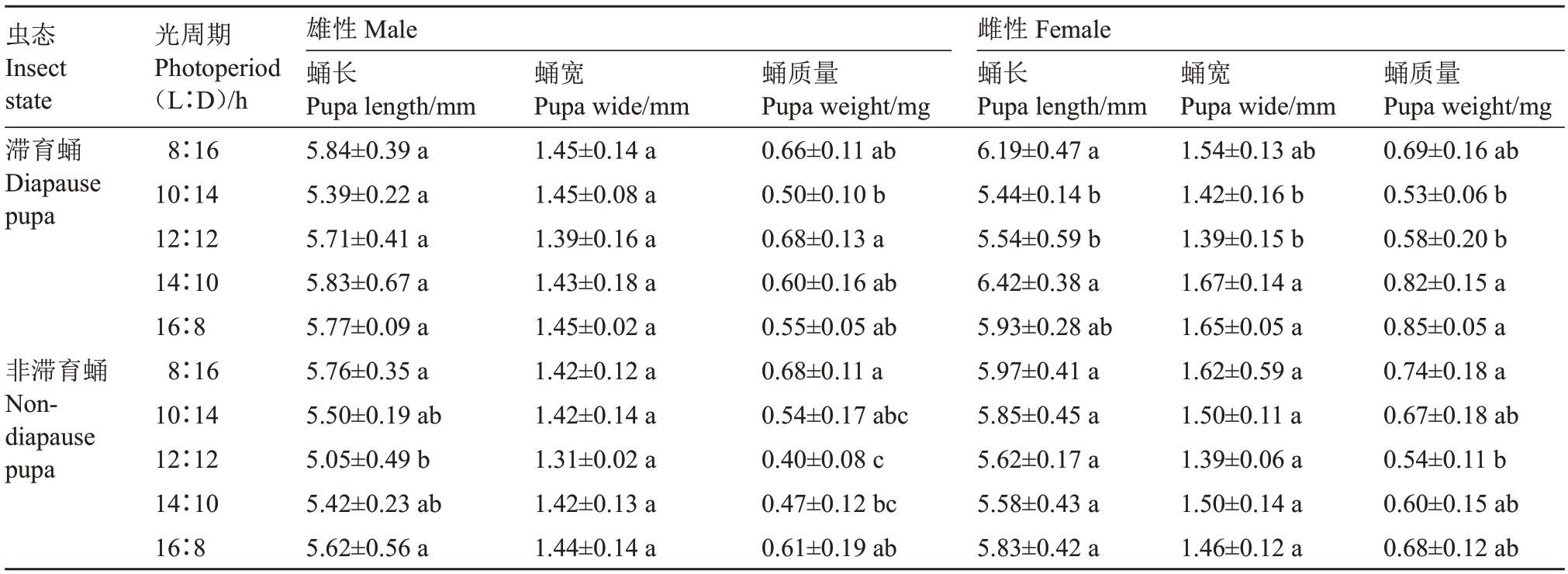
2.2.1 葡萄花翅小卷蛾滞育蛹与非滞育蛹体形差异 将葡萄花翅小卷蛾幼虫置于不同光周期下饲养直至化蛹,分别测量滞育蛹与非滞育蛹中雌性、雄性体型。结果表明,光周期对葡萄花翅小卷蛾滞育蛹与非滞育蛹的影响存在差异(表3)。在滞育蛹体形上,不同光周期对雄蛹的蛹长、蛹宽无显著影响,在光周期10L∶14D与12L∶12 D处理下的蛹质量存在显著差异;不同光周期处理下,雌蛹的蛹长、蛹宽、蛹质量存在显著差异。不同光周期对葡萄花翅小卷蛾非滞育蛹的体形也存在影响。在同一光周期处理下,非滞育雌蛹体型均大于雄蛹。其中,12L∶12D光周期下,滞育雄蛹的体形明显大于非滞育雄蛹,而14L∶10D光周期下,滞育雌蛹的体形更大。因此,在相同温度和光周期下,滞育蛹的体形和质量一般大于非滞育蛹,但差异较小。复眼大小及位置、形态特征的差异有助于区分滞育蛹与非滞育蛹。
表3 不同光周期下葡萄花翅小卷蛾滞育蛹和非滞育蛹体形的差异
Table 3 Differences shape of diapause and non-diapause in different photoperiod of L.botrana
2.2.2 光周期和温度对葡萄花翅小卷蛾滞育的影响 葡萄花翅小卷蛾蛹的滞育发生与光周期密切相关,温度对其滞育诱导具有一定的影响。在相对湿度(45±5)%条件下,不论温度是(25±0.5)℃还是(28±0.5)℃,当光照时数为12~14 h时,滞育率均比较高。由表4可知,在28 ℃、12L∶12D光周期下滞育率高达80.85%,14 L∶10D光周期下滞育率超过50%,当光照时间延长至16 h时,滞育率骤然降低至10.64%。不同温度对滞育率也存在显著影响。同一光周期下,蛹滞育率随温度的升高而下降。根据滞育蛹的雌雄比例可知,在28 ℃、长日照10 h、14 h、16 h下的雌雄比例均为1∶1;长日照8 h下,诱导的雌蛹数量多于雄蛹,雌雄比例为1.78∶1;长日照12 h下,诱导的雄蛹数量多于雌蛹,雌雄比例为1∶2。在25 ℃、12L∶12D光周期下滞育率最高达84.85%,长光照8~14 h下滞育率均超过50%,当光照时间延长至16 h时,滞育率骤然降低至22.22%。根据滞育蛹的雌雄比例可知,低温下光照时间对雌雄比例的影响不显著。长日照16 h下,诱导的雌蛹数量多于雄蛹,雌雄比例为1.16∶1;长日照10 h下,诱导的雄蛹数量稍多于雌蛹,雌雄比例为1∶1.16。
表4 光周期和温度对葡萄花翅小卷蛾滞育的影响
Table 4 Effects of photoperiod and temperature on diapause of L.botrana
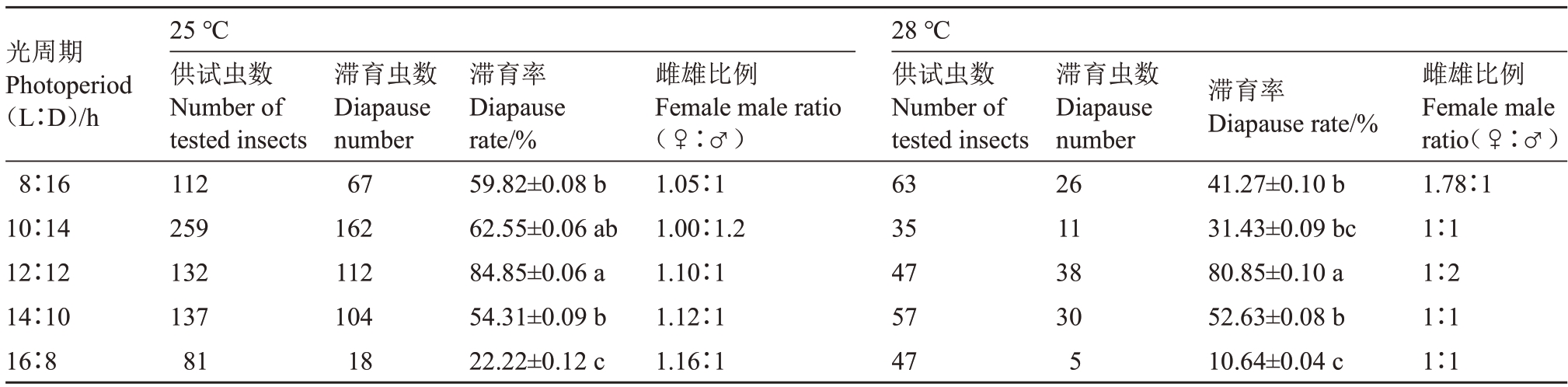
上述研究结果表明,在葡萄花翅小卷蛾的幼虫和蛹发育过程中,常温下绝大多数个体只有处于较短的光照范围(12~14 h)内才能发生滞育,而在较长或较短的光照条件下,滞育率则明显下降。在生态光周期范围内,该虫表现为典型的短日照滞育型种类;而在低温下,8~14 h内均能诱导50%以上的蛹滞育,表现为兼性滞育型。
2.3 葡萄花翅小卷蛾滞育蛹的临界光周期
葡萄花翅小卷蛾滞育率变化趋势与光周期变化呈显著相关(P25℃<0.05,P28℃<0.05)。蛹滞育率在不同温度条件下各光周期之间发生变化(表4)。根据图5,拟合出25 ℃和28 ℃的回归方程分别是y=-13.537x2+338.83x-2 033.6(R2=0.918 6)和y=-15.92x2+400.23x-2 430.5(R2=0.954 1),并根据方程分别求得25 ℃和28 ℃条件下葡萄花翅小卷蛾蛹滞育的临界日长,分别为14.17 h和14.03 h,即临界光周期为L14.17∶D9.83和L14.03∶D9.97。
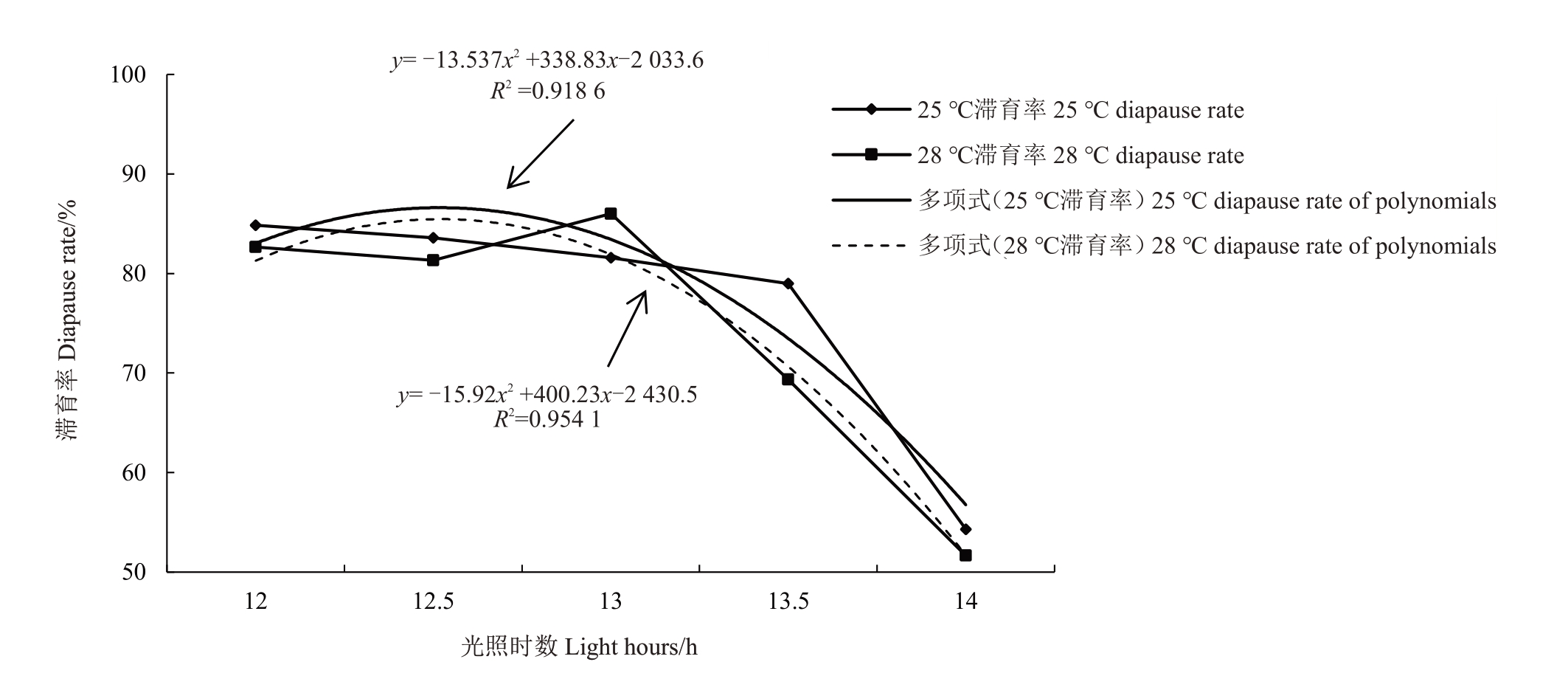
图5 25 ℃和28 ℃时葡萄花翅小卷蛾滞育诱导的临界光周期
Fig.5 The critical photoperiod of diapause induction in L.botrana at 25 ℃and 28 ℃
2.4 葡萄花翅小卷蛾滞育的敏感虫态
在第1组1~7处理中,随着长光照时数的增加,滞育率波动下降,依次为85.71%、33.33%、30.77%、26.67%、20.00%、42.86%和10.53%;在第2组8~14处理中,随着短光照时数的增加,滞育率总体呈上升趋势,依次为12.50%、53.33%、66.67%、60.00%、70.59%、71.11%和93.75%(表5),这一趋势表明短光照对葡萄花翅小卷蛾滞育的诱导具有明显的累积作用。
表5 葡萄花翅小卷蛾不同生长发育阶段感受长光照(16L∶8D)和短光照(12L∶12D)的反应滞育率
Table 5 The diapause rate of L.botrana at different developmental stages under long-day(16L∶8D)and short-day(12L∶12D)conditions

注:“L”指长光照(16L∶8D)处理;“D”指短光照(12L∶12D)处理。
Note:“L”indicates treatment under long-day conditions(16L∶8D);“D”indicates treatment under short-day conditions(12L∶12D).
在葡萄花翅小卷蛾滞育率上升或下降中存在2个跳跃点,一个是1龄期,滞育率从85.71%骤降至33.33%(处理2)或从12.50%增至53.33(处理9);另一个是预蛹期,从42.86%降至10.53%(处理7)或从71.11%升高至93.75%(处理14)。而2、3、4、5龄期在不同光照下的滞育率无显著差异,表明其对光照反应较弱。综上所述,葡萄花翅小卷蛾的敏感时期是幼虫孵化初期和老熟幼虫末期。
2.5 葡萄花翅小卷蛾滞育蛹与非滞育蛹的形态特征和水分含量对比
2.5.1 形态特征对比 通过显微镜观察葡萄花翅小卷蛾的形态特征(图6),结果显示:在体色上,滞育蛹体色为浅黄褐色具光泽,非滞育蛹为浅绿色或褐色等具金属光泽;在复眼位置上,滞育蛹逐渐向侧面移动,色泽逐渐淡化为一个小黑点,而非滞育蛹的复眼大、呈黑褐色。根据其生殖结构骨架所在部位判断雌雄:位于第8节腹板的为雌蛹,位于第9节腹板的为雄蛹。
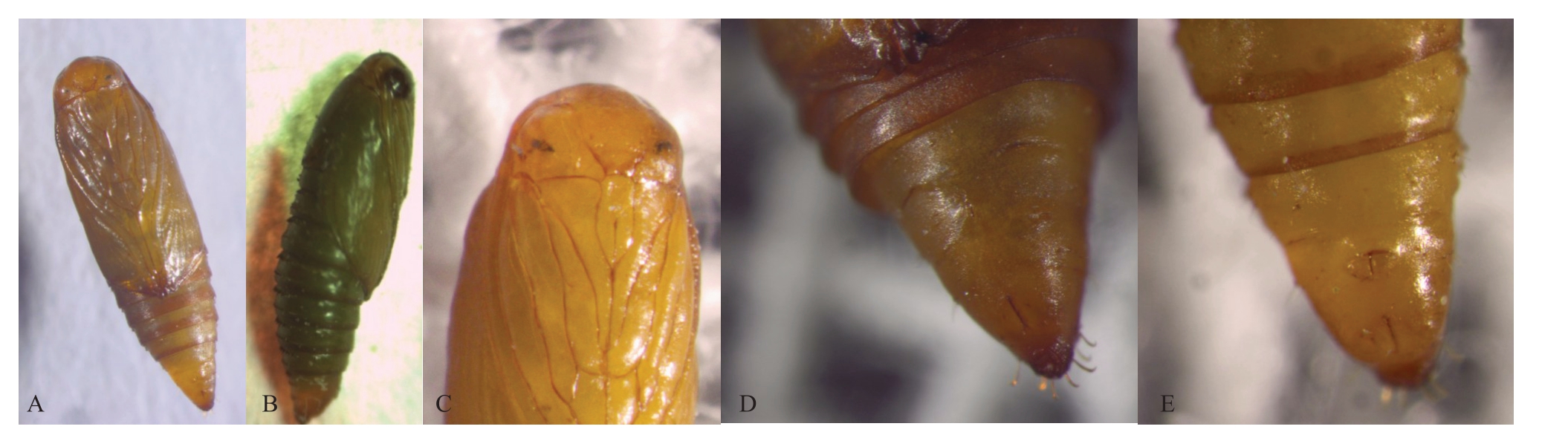
图6 葡萄花翅小卷蛾滞育蛹与非滞育蛹形态特征
Fig.6 Morphological characteristics of diapause and non-diapause in L.botrana
A.滞育蛹;B.非滞育蛹;C.滞育蛹(复眼);D.滞育雌蛹(第8节腹板);E.滞育雄蛹(第9节腹板)。
A.Diapause pupa;B.Non-diapause pupa;C.Diapause pupa (ommateum);D.Diapause female pupa (eighth sternum);E.Diapause male pupa(ninth sternum)
2.5.2 滞育蛹与非滞育蛹体内水分含量的对比 葡萄花翅小卷蛾滞育蛹体内水分含量的测定结果表明,雌雄蛹之间无显著差异(t=79.79,df=45,P=0.06,图7),滞育蛹体内水分含量平均为66.30%。其中,雄蛹体内水分含量为67.88%,雌蛹为64.07%。
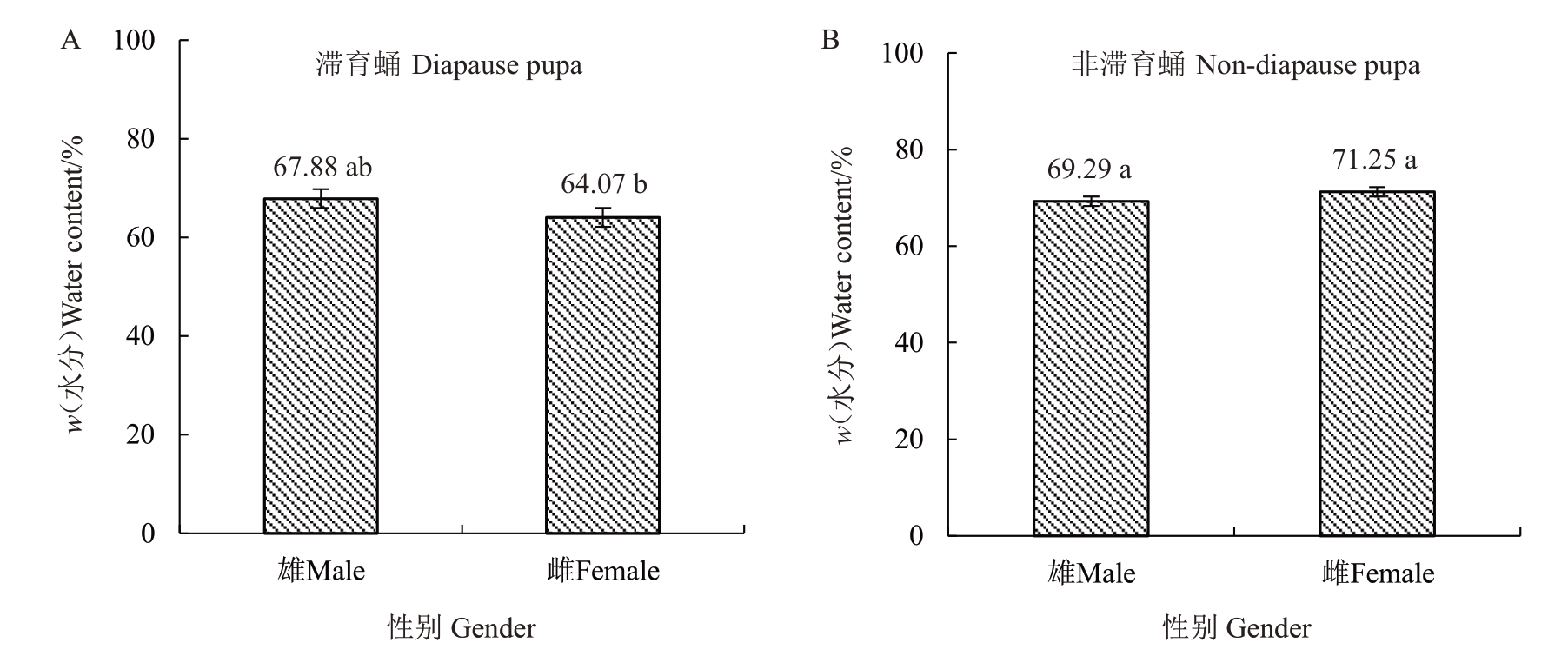
图7 葡萄花翅小卷蛾不同性别蛹体内水分含量
Fig.7 Water content in pupae of different genders of L.botrana
葡萄花翅小卷蛾非滞育蛹体内水分含量的测定结果表明,雌雄蛹之间无显著差异(t=55.01,df=31,P=0.07,图7),非滞育蛹体内水分含量平均为70.27%。其中,雄蛹体内水分含量为69.29%,雌蛹为71.25%。非滞育蛹的体内水分含量高于滞育蛹,方差分析表明,滞育雌蛹和非滞育蛹个体之间存在显著差异,但滞育雌蛹与雄蛹之间则无显著差异。
3 讨论
昆虫的生长发育、取食活动、交配产卵和繁殖等均对光周期表现出强烈反应[18]。Deseő 等[14]研究发现短日照12L∶12D和13L∶11D诱导葡萄花翅小卷蛾幼虫发育历期增长。研究发现,光周期对葡萄花翅小卷蛾的生长发育存在影响。在滞育光周期内,卵历期、卵径大小、幼虫历期、幼虫存活率、蛹死亡率及蛹滞育率均与光照时数呈线性正相关,即随着光照时数的增加而增大(高),这与国外关于葡萄花翅小卷蛾对光周期变化的研究[16]结果基本一致。本研究结果表明,光周期变化对葡萄花翅小卷蛾幼虫历期及卵粒大小无显著影响。其中,在16L∶8D光周期下卵孵化率最高、卵粒最大;在8L∶16D光周期下卵历期最短、成虫寿命最长、产卵量最高。
在新疆,葡萄花翅小卷蛾的分布区域仅在吐鲁番市高昌区和鄯善县,属于独特的暖温带大陆性干旱荒漠气候,四季气候变化特点是春季短暂,升温快;夏季漫长,高温酷热;秋冬季较短,降温急促,具有明显的冷、热季节变化。滞育是适应季节性气候变化的主要机制。Roditakis等[16]研究发现葡萄花翅小卷蛾多发生在春季和秋季,呈现兼性滞育蛹响应曲线,且夏季活动的昆虫大多呈现Ⅰ型光周期响应曲线,不同种类昆虫对其响应存在多种变化方式。本研究结果表明,葡萄花翅小卷蛾的滞育是一种典型的兼性滞育,在28 ℃下只在相当小的范围内(12~14 h)发生滞育,而25 ℃下在8~14 h均可引起50%以上的蛹滞育。Deseő 等[14]对博洛尼亚发生的葡萄花翅小卷蛾研究发现,在12L∶12D的光周期下诱导滞育的比例最大。本文研究表明,葡萄花翅小卷蛾滞育率在12L∶12D光周期下达到最高,可超过80%。Roditakis等[16]研究指出蛹滞育强度通常受滞育前生长阶段所经历的温度和光周期的影响。Roechrich[19]研究认为葡萄花翅小卷蛾的敏感虫期为卵期和幼虫期。本研究进一步表明,葡萄花翅小卷蛾对光照反应存在2个最敏感时期,即幼虫孵化初期和老熟幼虫末期。
国外研究报道,在某些情况下,温度与光周期相互作用,影响滞育的诱导。然而Roditakis等[16]研究发现,温度对希腊克里特岛田间的葡萄花翅小卷蛾(8月)滞育诱导则无显著影响。本研究设置5个光周期梯度和2个温度的交互处理,以探究二者对葡萄花翅小卷蛾滞育诱导的影响。结果表明:光周期是影响葡萄花翅小卷蛾滞育的主导因子,在光照时数长于14 h时,温度对滞育的影响不显著,只有当光照时数短于12 h时,温度对滞育的影响才得以显现,且温度越低,滞育率越高。在25 ℃和28 ℃下,葡萄花翅小卷蛾蛹滞育的临界日长分别为14.17 h和14.03 h,在25 ℃和28 ℃下14 h的滞育率分别为54.31%、52.63%,表明在接近临界日长的光周期内滞育率较低,且温度随着光周期发挥作用,低温促进滞育,而高温削弱光照对滞育的诱导效应。这一结果与国外研究报道略有差异,Roditakis等[16]在希腊克里特岛的研究发现,在20 ℃和25 ℃下葡萄花翅小卷蛾的临界日长均为13 h,该差异可能是纬度和温度不同导致的。
本文对滞育蛹和非滞育蛹的比较分析表明:在体型上,葡萄花翅小卷蛾滞育蛹个体明显大于非滞育蛹,且在12L∶12D和14L∶10D光周期条件下,滞育蛹的蛹质量更重,这是因为滞育蛹的幼虫期发育时间比非滞育蛹更长[16]。因此,幼虫取食时间越长,体内积累的物质储备越多,蛹质量也越重。14L∶10D光周期诱导的滞育雌蛹体形最大,且在同一光周期下滞育雌蛹体形大于雄蛹,具体原因有待进一步研究。在体色上,葡萄花翅小卷蛾滞育蛹体色为浅黄褐色具光泽,非滞育蛹为浅绿色或褐色等具金属光泽;在复眼位置上,滞育蛹的复眼位置逐渐向侧面移动,色泽逐渐淡化为一个小黑点,而非滞育蛹的复眼大、呈黑褐色;且非滞育蛹体内自由水含量高于滞育蛹。
蔡普默等[20]研究指出在我国瓜实蝇始见期随着气候变暖显著延迟,而种群高峰期呈现提早趋势。本试验是在人工气候培养箱的恒定温度和光照条件下进行的,研究结果对葡萄花翅小卷蛾田间自然种群的预测预报具有一定的参考价值。田间调查显示,葡萄花翅小卷蛾在吐鲁番地区一年发生5代,越冬代成虫发生数量较多,第一、二代成虫发生量很少,但随着吐鲁番夏季温度的持续上升和日照时数的变化,第三、四代成虫突然暴发成灾。综合本文研究结果和田间实际光照时长和温度条件,可以阐明该地区葡萄花翅小卷蛾的发生动态规律。在3月中下旬(光照时长为12.5~13.5 h),越冬蛹解除滞育大量羽化,导致成虫数量较高,而第一代幼虫期(光照时长为13.75~14.5 h)诱导部分蛹滞育,导致第一、二代成虫发生量较低;但随着7、8月温度的升高,此时温度发挥主导作用,促进大量蛹解除滞育,导致第三、四代成虫暴发成灾;在8月底(光照时长为13~14 h)第4代蛹大量滞育,表明葡萄花翅小卷蛾以滞育蛹越冬,以抵抗严寒冬季。国外研究表明,滞育蛹在5 ℃、L8∶D16光周期下饲养50 d,随后在10 ℃下连续黑暗10 d能够解除滞育[14],而新疆葡萄花翅小卷蛾蛹解除滞育的条件则有待于进一步深入研究。
4 结论
葡萄花翅小卷蛾属于兼性滞育型昆虫,蛹是其滞育虫态。光周期和温度均对其滞育诱导具有重要影响,其中光周期占主导作用,温度随着光周期发挥作用。不同光周期处理对葡萄花翅小卷蛾卵、蛹和成虫的发育历期及存活率存在显著影响(P<0.05),而对幼虫无显著影响。
[1] Denlinger D L.Regulation of diapause[J].Annual Review of Entomology,2002,47:93-122.
[2] 侯月利,花蕾.昆虫滞育诱导的因素[J].陕西林业科技,2003,31(3):62-67.Hou Yueli,Hua Lei.Factors inducing insect diapause[J].Shaanxi Forest Science and Technology,2003,31(3):62-67.
[3] Tobin P C,Nagarkatti S,Saunders M C.Diapause maintenance and termination in grape berry moth (Lepidoptera:Tortricidae)[J].Environmental Entomology,2002,31(4):708-713.
[4] Filchak K E,Roethele J B,Feder J L.Effects of photoperiod and light intensity on the genetics of diapause in the apple maggot(Diptera:Tephritidae)[J].Annals of the Entomological Society of America,2001,94(6):902-908.
[5] 蔡明飞,刘彦飞,王艳蓉,仵均祥.光周期对梨小食心虫生长发育和生殖的影响[J].西北农业学报,2010,19(11):169-172.Cai Mingfei,Liu Yanfei,Wang Yanrong,Wu Junxiang.Influence of photoperiod on the growth development and fecundity of the oriental fruit moth,Grapholitha molesta (Busck)[J].Acta Agriculturae Boreali-Occidentalis Sinica,2010,19(11):169-172.
[6] 刘月英,罗进仓,周昭旭,张大为,魏玉红.光周期和温度对苹果蠹蛾滞育诱导的影响[J].植物保护学报,2015,42(1):39-44.Liu Yueying,Luo Jincang,Zhou Zhaoxu,Zhang Dawei,Wei Yuhong.Effects of photoperiod and temperature on diapause induction in the codling moth Cydia pomonella (L.)(Lepidoptera:Olethreutidae)[J].Journal of Plant Protection,2015,42(1):39-44.
[7] 中华人民共和国进境植物检疫性有害生物名录[EB].(2007-05-29)[2025-09-28].https://zys.moa.gov.cn/flfg/201904/t20190428_6245344.htm.List of imported plant quarantine pests of the People's Republic of China[EB].(2007-05-29)[2025-09-28].https://zys.moa.gov.cn/flfg/201904/t20190428_6245344.htm.
[8] 陈乃中.中国进境植物检疫性有害生物-昆虫卷[M].北京:中国农业出版社,2009.Chen Naizhong.Quarantine pests of imported plants from China-Insect scroll[M].Beijing:China Agriculture Press,2009.
[9] Orphanidis T.On endemic worm on vines and raisin grapes and its control[J].Geoponika,1872,1:221-232.
[10] Tauber M J,Tauber C A,Masaki S.Seasonal adaptations of insects[M].Oxford:Oxford University Press,1986.
[11] Xiao H J,Wu X F,Wang Y,Zhu X F,Xue F S.Diapause induction and clock mechanism in the cabbage butterfly Pieris melete Ménétriés[J].Journal of Insect Physiology,2009,55(5):488-493.
[12] Salminen T S,Vesala L,Hoikkala A.Photoperiodic regulation of life-history traits before and after eclosion:Egg-to-adult development time,juvenile body mass and reproductive diapause in Drosophila montana[J].Journal of Insect Physiology,2012,58(12):1541-1547.
[13] Komarova O S.Cycle vital et condition de development de Polychrossis botrana Schiff[J].Zoologicheskii Zhurnal,1954,32:102-113.
[14] Deseő K V,Marani F,Brunelli A,Bertaccini A.Observations on the biology and diseases of Lobesia botrana Den.and Schiff.(Lepidoptera,Tortricidae) in central-north Italy[J].Acta Phytopathologia Academia Scientifica Hungarica,1981,16(3/4):405-431.
[15] Pavan F,Floreani C,Barro P,Zandigiacomo P,Montà L D.Influence of generation and photoperiod on larval development of Lobesia botrana (Lepidoptera:Tortricidae)[J].Environmental Entomology,2010,39(5):1652-1658.
[16] Roditakis N E,Karandinos M G.Effects of photoperiod and temperature on pupal diapause induction of grape berry moth Lobesia botrana[J].Physiological Entomology,2001,26(4):329-340.
[17] 郭婷婷,凌飞,张顺益,于毅,李丽莉,许永玉.梨小食心虫滞育与非滞育幼虫过冷却能力与体内主要生化物质含量[J].应用昆虫学报,2013,50(6):1514-1518.Guo Tingting,Ling Fei,Zhang Shunyi,Yu Yi,Li Lili,Xu Yongyu.The super-cooling ability and biochemical substances in diapausing and non-diapausing larvae of Grapholitha molesta(Busck) (Lepidoptera:Tortricidae)[J].Chinese Journal of Applied Entomology,2013,50(6):1514-1518.
[18] 陈广平,郝树广,庞保平,康乐.光周期对内蒙古三种草原蝗虫高龄若虫发育、存活、羽化、生殖的影响[J].昆虫知识,2009,46(1):51-56.Chen Guangping,Hao Shuguang,Pang Baoping,Kang Le.Effect of photoperiod on the development,survival,eclosion and reproduction of 4th instar nymph of three grasshopper species in Inner Mongolia[J].Chinese Bulletin of Entomology,2009,46(1):51-56.
[19] Roechrich R.La diapause de l’eude ´mis de la vigne Lobesia botrana Schiff.(Lepidoptera:Tortricidae)[J].Induction et elimination.Annales de Zoologie,Ecologie,Animales,1969,1:419-431.
[20] 蔡普默,赵梦婷,宋蕴哲,孟李涛,季清娥,林嘉,李焰焰,聂传朋.基于历史数据探究气候变暖对我国瓜实蝇物候的影响[J].中国瓜菜,2022,35(9):64-72.Cai Pumo,Zhao Mengting,Song Yunzhe,Meng Litao,Ji Qing’E,Lin Jia,Li Yanyan,Nie Chuanpeng.Investigating the impacts of climatic warming on phenology of Zeugodacus cucurbitae(Diptera:Tephritidae) in China based on historical data[J].China Cucurbits and Vegetables,2022,35(9):64-72.