葡萄(Vitis vinifera L.)为葡萄科葡萄属木质藤本植物,是世界四大水果之一,也是我国重要的经济果树。据国际葡萄与葡萄酒组织(OIV)统计,2023年我国葡萄种植面积为75.6万hm2,占世界总种植面积的10.5%,仅次于西班牙(94.5万hm2)和法国(79.2万hm2),是世界第三大葡萄种植国家。葡萄枝干病害(grapevine trunk diseases,GTDs)是近年来对葡萄产业危害日益严重的一类葡萄新病害,该病害包含危害葡萄维管束的多种病害,症状主要表现为发芽迟缓(delayed budburst)、叶片黄萎(chlorosis)、发育迟缓(stunted development)、形成溃疡(canker formation)、顶梢枯死(dieback),最终引起葡萄树体的死亡[1-8]。1865年,首个被发现的葡萄枝干病害——葡萄衰枯病(Esca complex disease)在法国被首次报道[9],该类病害开始受到广泛关注,随后多种葡萄枝干病害被分别报道[10-13],目前世界范围内普遍发生的葡萄枝干病害有5种,除葡萄衰枯病外,还有顶枯病(Eutypa dieback)、溃疡病(Botryosphaeria dieback)、黑根病(black foot disease)和蔓枯病(Phomopsis dieback)。该类病害病原菌种类多样,截至目前,全球报道的与葡萄枝干病害发生有关的病原菌属有34个[6],国内报道的有17个[14-20],这些病原菌常发生复合侵染,导致葡萄产量和品质降低、生产成本增加。我国对葡萄枝干病害的研究起步较晚,2007年首次报道了顶枯病[21];2011年首次报道了溃疡病[22];2015年首次报道了蔓枯病[23];随后在2021年发现并报道了黑根病和衰枯病[24-25]。
葡萄枝干病害在全球范围内持续蔓延,已在39个国家及地区报道,近年来由于发病率和危害呈上升趋势,严重威胁世界葡萄产业的发展,引起了主要葡萄栽培国的高度关注[26-29]。2021年西班牙主要葡萄酒产区卡斯蒂利亚枝干病害的发生率高达38.3%[30];摩洛哥的葡萄园每年因葡萄枝干病害会清除一半以上的葡萄树[31];据统计,世界范围内每年由葡萄枝干病害造成的经济损失估计高达83亿美元[32]。2013年,在全国20个省份进行的葡萄枝干病害发生危害情况调查中发现,18个省份有溃疡病发生,其中广西和浙江葡萄溃疡病发生较重,造成10%~20%的产量损失,在一些发病严重的葡萄园中产量损失高达50%,甚至有些葡萄园颗粒无收[14],该病害已经成为威胁我国葡萄产业的重要因素。近年来,葡萄枝干病害在世界葡萄产区的危害日趋严重,但最近十余年其在我国葡萄产区的发生危害情况有待更新。此外,由于仅从田间症状无法对该病害种类和病菌进行准确识别和鉴定,基于此,笔者从2020年到2024年在我国17个省份的葡萄种植地区进行了枝干病害危害程度调查,并采用田间症状观察和室内样品诊断相结合的方法对田间疑似枝干病害症状样品的病因进行精准诊断,更新和明晰了我国葡萄枝干病害的典型症状、种类及危害程度,为葡萄枝干病害的高效防控提供数据支撑。
1 材料和方法
1.1 田间调查
选择葡萄枝干病害田间症状比较明显的时期,包括早春(4—5月)和秋季(8—9月)进行调查。调查地点覆盖我国主要葡萄产区,涉及17个省份。将田间表现为死树、树势弱、发育迟缓、叶片发黄或发红、小叶和根系发育不良等症状的植株统计为疑似发生葡萄枝干病害[14]。田间调查采用五点取样法,在调查葡萄园随机选取五点,每点调查至少100株,记录总植株数及发病株数。发病率/%=病株数/总植株数×100。本次调查数据中个别数据由当地种植合作社或园区技术员提供。
1.2 室内病害病因诊断
1.2.1 样品采集 在进行病害田间调查的同时,采集死树、树势弱、发育迟缓、叶片发黄或发红、叶小和根系发育不良等症状的疑似葡萄枝干病害样品,在实验室进行病原菌分离和初步鉴定。依症状采集葡萄树的茎部和/或根部组织,每份样品单独装入塑封袋中,并注明采集时间、地点、品种及主要田间症状等信息。对样品采取保鲜措施,以便开展后续研究。
1.2.2 病原菌分离鉴定 采用组织分离法获得病组织上的疑似病原菌。选取病健交界处剪5 mm×5 mm的小块备用,剪取20~25个组织块。2%次氯酸钠消毒2 min,无菌水清洗30 s,75%乙醇消毒30 s,无菌水清洗3次,每次清洗时间为30 s,将消毒好的组织块放置于灭菌的滤纸上晾干,待水分晾干后将组织块置于PDA平板上,每个平板上放置3~4个组织块,于25 ℃恒温培养箱中培养。3~5 d后观察组织块上菌丝生长情况并统计分离比。用灭菌牙签选择菌落边缘菌丝体放在新的PDA平板上进一步纯化,并统计分离比。菌落产生孢子后,通过单孢分离获得纯化菌株。根据菌落形态特征并采用ITS4/ITS5引物对菌株ITS基因扩增后测序等手段对病原菌进行初步鉴定。
2 结果与分析
2.1 我国葡萄枝干病害的田间症状
2020—2024年对我国北京、河北、云南、宁夏、山西、陕西、河南、黑龙江、广西、新疆、湖北、江苏、吉林、山东、甘肃、辽宁和福建等17个省份74个葡萄园的葡萄枝干病害发生情况进行调查,结果发现,我国葡萄枝干病害的田间症状主要表现为植株枯死和树势衰弱两大类,同时叶片、果实表现出多种发病症状,造成严重的产量损失和树体寿命缩短。
2.1.1 葡萄枝干病害引起的田间植株枯死症状 田间植株枯死通常在早春较为明显,表现为全株萎蔫死亡和枝梢枯死,树体不能正常发芽,最终整株枯死(图1-A~C);另一种情况是植株能够正常发芽和开花结果,但在幼果期全株萎蔫干枯,树体死亡(图1-D)。受害植株枝干横切面可见维管束变色,且有放射状小黑点(图1-E~G)。有时发病的枝干部位具有黑色及灰黑色的颗粒状子实体,即为病菌的分生孢子器(图1-H~I)。发病植株根系发育不良,新根及毛细根较少(图1-J~K),根系横切面有黑色坏死和黑色小点等(图1-L~M)。
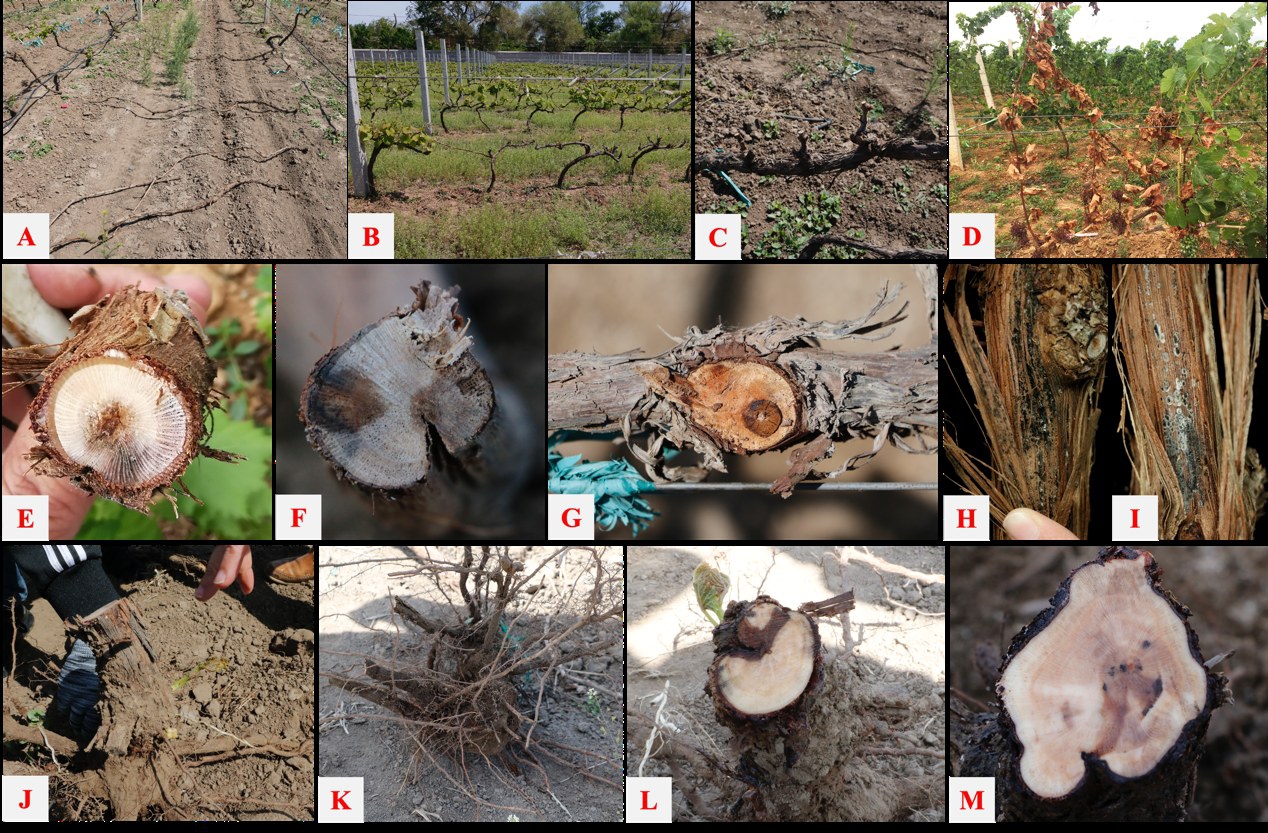
图1 葡萄枝干病害引起的田间植株枯死症状
Fig.1 Illustrates the dieback symptoms of field-grown vines induced by grapevine trunk diseases
A~B.田间连续几棵全株枯死;C.不能正常发芽;D.早春正常生长开花,幼果期全株迅速萎蔫死亡;E~G.受害植株枝干维管束变褐,有放射状黑点;H~I.受害植株枝干表皮下密生分生孢子器(黑色和灰黑色颗粒状物);J~K.根系发育不良,须根少;L~M.受害植株根系横切面有黑色坏死和黑色小点。
A-B.Consecutive plants in the field exhibiting complete plant mortality;C.Failure to sprout normally;D.Normal growth,flowering,and fruit set in early spring,followed by rapid wilting and death of entire plants during the young fruit stage;E-G.Discoloration(browning)of vascular tissues in affected branches with radiating black spots;H-I.Dense formation of conidiomata(black and gray-black granular structures)beneath the bark of infected branches;J-K.Poor root system development with reduced fibrous roots;L-M.Cross-sections of roots from affected plants showing black necrotic lesions and minute black spots.
2.1.2 葡萄枝干病害引起的田间树势衰弱症状 田间树势衰弱症状主要表现为发芽迟缓,生长缓慢,节间缩短,叶片变小,生长中后期叶片发黄、红或紫,有的呈“虎纹斑”(图2-A~F)。果穗干枯(图2-G),果实发育不良,出现提早转色并有大小粒现象(图2-H),果实着色差(图2-I~J),严重影响产量。根茎基部受害时发病部位有病原菌的子实体出现,呈颗粒状小黑点,经常在病斑处有明显的伤口及组织增生(图2-K)。受害植株维管束变色(图2-L~M)。

图2 葡萄枝干病害引起的田间树势衰弱症状
Fig.2 Symptoms of vineyard decline caused by grapevine trunk diseases
A.田间新梢生长异常;B~F.树势弱等病株在生长中后期叶片颜色不正常,变黄、红或紫,有的呈现“虎纹斑”;G.果穗干枯;H.果实发育不良,提早转色及大小粒;I~J.同一地块的病果(I)和健果(J),病果着色差;K.根茎基部受害,有伤口,组织增生,病部出现黑色颗粒状病菌子实体;L~M.受害植株维管束变色。
A.Abnormal shoot growth in the field;B-F.Diseased plants with weakened vigor exhibiting abnormal leaf coloration during mid-to-late growth stages,including yellowing,reddening,or purpling,with some showing“tiger-stripe patterns”;G.Desiccation of fruit clusters;H.Poor fruit development characterized by premature veraison and berry size heterogeneity;I-J.Comparison of diseased (I) and healthy (J) berries from the same vineyard block,showing impaired coloration in diseased fruits;K.Damage at the root crown base presenting wounds,tissue hyperplasia,and black granular fungal fruiting bodies;L-M.Vascular discoloration in affected plants.
2.2 我国葡萄枝干病害的发生情况
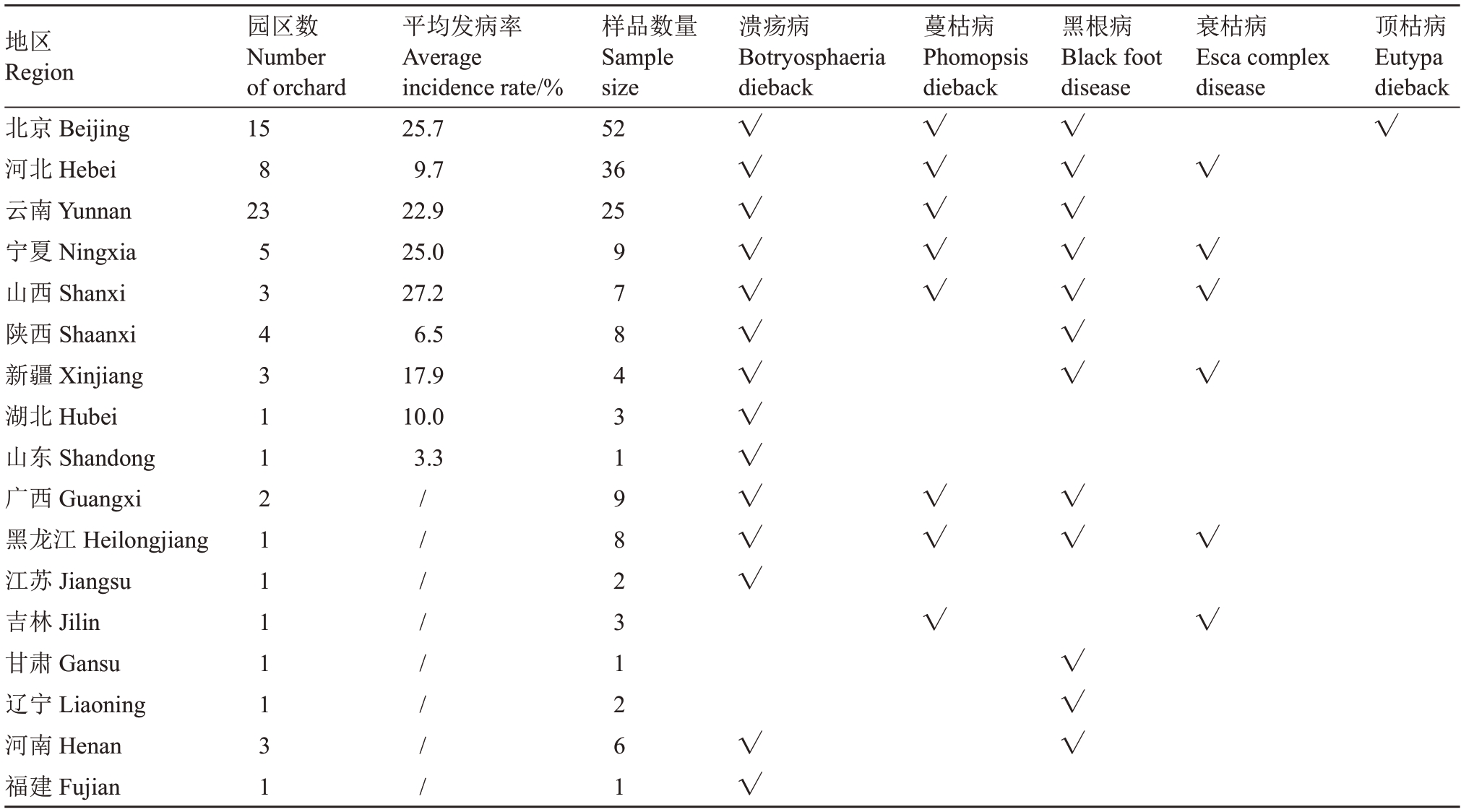
2.2.1 葡萄枝干病害的发病率 调查结果(表1)显示,所调查的17个省份均有葡萄枝干病害的发生,74个葡萄园中葡萄枝干病害的平均发病率为15.25%,发病率超过20%的地区有4个省份,按照由高到低依次是山西、北京、宁夏和云南,山东发病率最低,仅为3.3%。
表1 我国葡萄枝干病害调查地区及样品采集信息表
Table 1 Survey regions and sampling information of grapevine trunk diseases in China
注:“/”表示此省份无发病率调查数据,但采集样品进行了室内诊断。
Note:“/”indicates that no morbidity survey was conducted,but samples were collected for laboratory diagnosis.
2.2.2 葡萄枝干病害的种类分布 溃疡病、黑根病、蔓枯病、衰枯病和顶枯病等5种葡萄枝干病害在调查园区中均有发现,其中,溃疡病、黑根病和蔓枯病在我国发生较为普遍。地理分布显示,溃疡病分布最广,北京、河北、云南、宁夏、陕西、山西、黑龙江、河南、新疆、福建、湖北、广西、江苏、山东14个省份均有发生;黑根病分布次之,在北京、河北、云南、宁夏、山西、黑龙江、陕西、河南、新疆、广西、甘肃、辽宁12个省份发生;蔓枯病发生于北京、河北、云南、山西、宁夏、广西、黑龙江和吉林共8个省份;衰枯病仅在北方地区的河北、宁夏、山西、新疆、黑龙江和吉林6个省份发生;顶枯病仅在北京市发生。各省份葡萄枝干病害的种类多样性差异明显,北京、河北、山西、黑龙江和宁夏等地区葡萄枝干病害构成复杂,涉及4种;云南、新疆、陕西和广西次之,发生3种;河南和吉林发生2种;湖北、福建、江苏、山东、甘肃和辽宁仅发现1种(表2)。
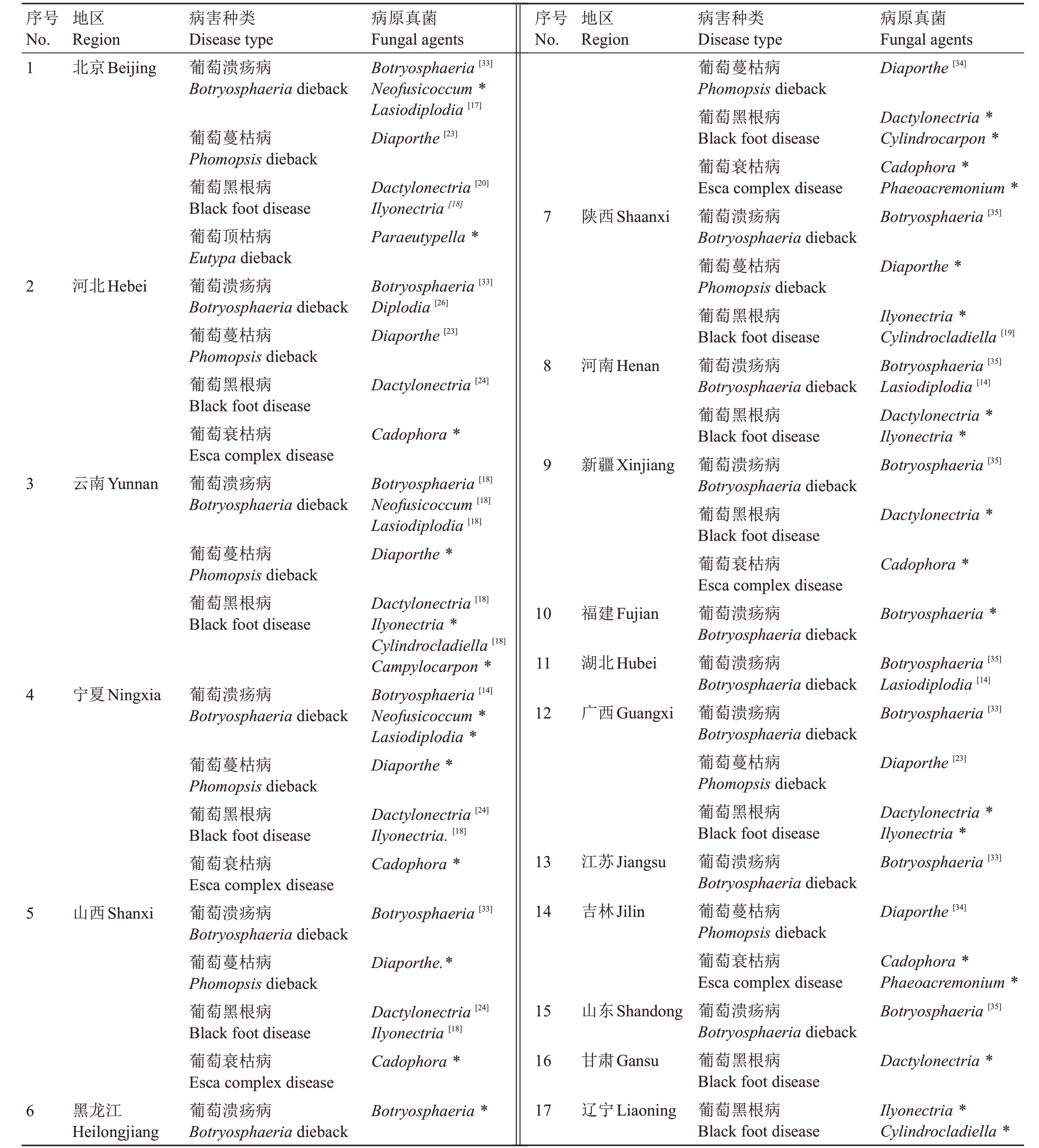
表2 我国不同地区葡萄枝干病害及病原菌种类
Table 2 Pathogen species and associated grapevine trunk diseases across different regions in China
注:*表示此属在该省份新发现。
Note:*indicates newly reported genera in the respective province.
2.2.3 引起我国葡萄枝干病害的主要真菌种类 在病害调查的同时,在调查园区累计采集了177份表现葡萄枝干病害症状的病样,采用组织分离法获得了1096株单孢系真菌菌株。经菌株形态学和ITS序列比对分析,发现单孢系菌株中与葡萄枝干病害有关的真菌有570株,占比52%,涉及13个属。其中,与葡萄溃疡病有关的真菌占20%(Botryosphaeria、Lasiodiplodia、Neofusicoccum、Diplodia);与葡萄黑根病有关的真菌占18%(Ilyonectria、Dactylonectria、Cylindrocladiella、Cylindrocarpon、Campylocarpon);与葡萄蔓枯病有关的真菌占11%(Diaporthe);与葡萄衰枯病有关的真菌占2%(Cadophora、Phaeoacre-monium);与葡萄顶枯病有关的真菌占1%(Paraeutypella)。
对分离自各省份葡萄枝干病害样品的病原菌进行统计分析,结果表明,不同地区出现多个首次检出菌属:在涉及的17个省份中,除山东和甘肃未检出新属外,其余15个省份均存在新发现的属。其中,黑龙江新检出的属数量最多(5个),宁夏次之(4个);其余13个省份新检出属的数量为1~3个不等(表2)。
2.3 我国葡萄枝干病害的发生特点
2.3.1 葡萄枝干病害单独侵染和复合侵染发生情况 葡萄枝干病害在田间常发生2种或多种病害混合发生的情况,对病害样品中病原菌单独侵染和复合侵染的比例进行统计分析,发现葡萄枝干病害存在单独侵染、复合侵染(2种和3种)的情况。在单独侵染中,葡萄溃疡病发生比例最高(35.5%),其他依次是黑根病(23.2%)、蔓枯病(13%)和衰枯病(2.8%),顶枯病未发现单独侵染的情况。2种病害复合侵染类型包括溃疡病+蔓枯病(8.5%)、溃疡病+黑根病(7.9%)、蔓枯病+黑根病(4.0%)、蔓枯病+衰枯病(1.1%)和衰枯病+黑根病(1.1%)。3种病害复合侵染类型包括溃疡病+蔓枯病+黑根病(2.3%)和溃疡病+蔓枯病+顶枯病(1.1%)。黑根病易与衰枯病、蔓枯病和溃疡病发生2种枝干病害的复合侵染,溃疡病和蔓枯病易发生3种枝干病害的复合侵染(图3)。
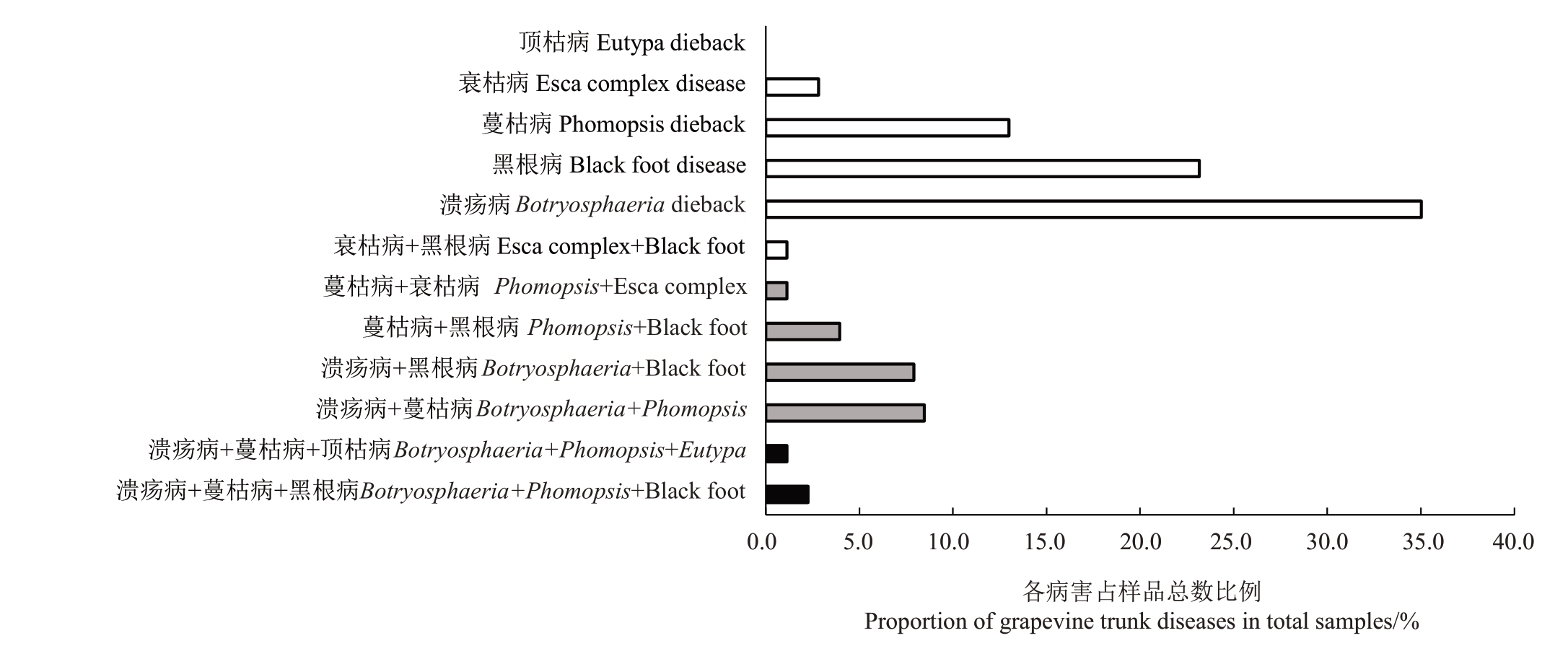
图3 葡萄枝干病害单独侵染和复合侵染情况
Fig.3 Incidence of single and co-infections of grapevine trunk diseases
2.3.2 树龄对葡萄枝干病害发病率的影响 调查发现,同一品种树龄越长,葡萄枝干病害的发生越严重,该现象在马瑟兰、美乐、红地球等多个品种中都有所体现(图4)。0~7 a(年)树龄的葡萄枝干病害发病率相对较低,8~14 a树龄的枝干病害发病率开始升高,14 a以上树龄的葡萄枝干病害发病率进一步升高,且造成严重的产量损失。以云南宾川县主栽品种红地球为例,调查地块8~10 a以上树龄的多数植株出现树势早衰、产量锐减现象,平均666.7 m2产量仅为1500 kg,不到当地相同栽培模式(高密度高产种植模式)下健康园区(5000 kg·666.7 m-2)的三分之一。
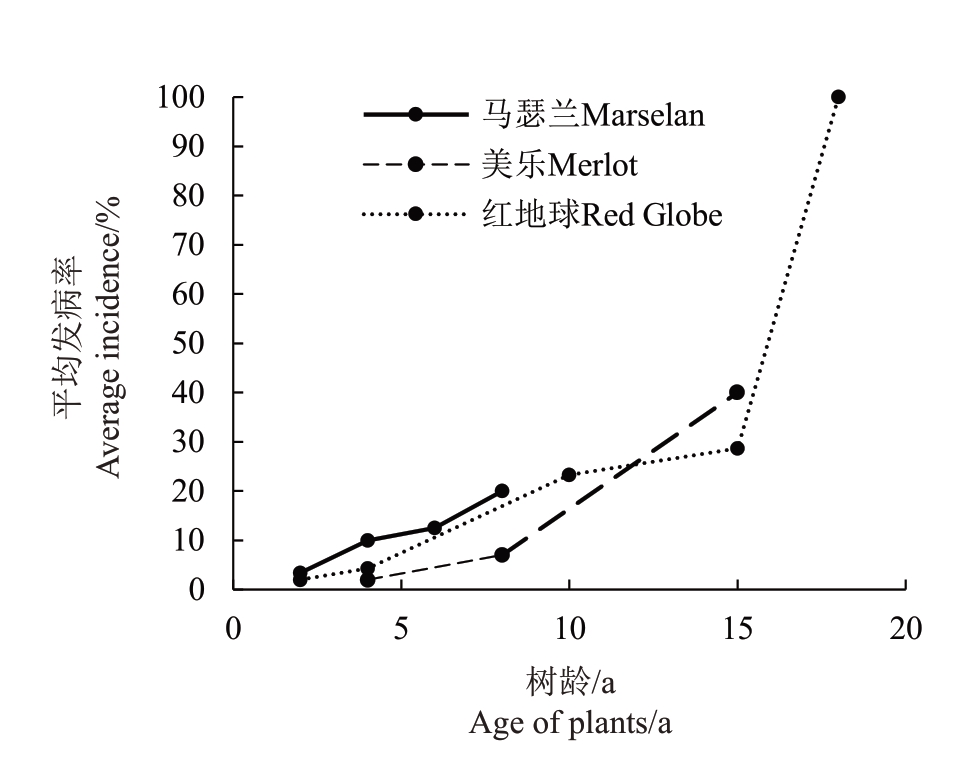
图4 葡萄枝干病害发病率的情况与树龄的关系
Fig.4 Correlation between incidence of grapevine trunk diseases and vine age
3 讨论
本研究于2020—2024年间对我国17个省份74个葡萄园的葡萄枝干病害发生危害情况开展了系统调查。结果表明,葡萄枝干病害在我国发生较为普遍,典型症状包括植株枯死和树势衰弱,多伴随叶片异常、果实发育受阻及维管束变色等复合表现,与国际报道高度一致,同时表现出一定的地域特异性。葡萄枝干病害在上述调查地块的平均发病率为15.25%,区域间差异明显,其中山西、北京、宁夏和云南等地发病率较高,山东省最低。目前在我国已发现5种葡萄枝干病害,分别为溃疡病、黑根病、蔓枯病、衰枯病和顶枯病,以溃疡病(35.5%)、黑根病(23.2%)和蔓枯病(13.0%)为主,不同省份的病害种类存在差异。葡萄溃疡病在我国发生最为普遍,调查的17个省份中有14个省份都有发生,且在新、老葡萄园均有发生,相比之下,葡萄衰枯病和顶枯病的发生较少,衰枯病主要分布在河北、宁夏、山西、新疆、黑龙江和吉林等北方地区,顶枯病仅在北京发现。此外,多个省份都有新发现的菌属,表明我国葡萄枝干病害的病原菌种类具有较高的多样性和复杂性。
同时调查发现,葡萄枝干病害在我国普遍存在复合侵染现象,尤以溃疡病与黑根病、蔓枯病的组合最为常见。不同病原菌可能具有协同致病效应,但不同组合的优势致病菌群尚未见相关报道。此外,树龄与发病率呈明显正相关,与国外的相关研究结果一致[36-37],进一步证明了树体衰老与病原积累是推动病害发生的重要因素。由于引起葡萄枝干病害的病原菌属于典型的植物“机会”病原菌,病原菌侵染后树体是否表现症状与寄主植物抗性、病原菌致病性和环境条件均密切相关,十分复杂,其可在树势较强的树体中长期潜伏存在,当遇到高温、干旱、涝渍等极端环境或在树体生长较弱的情况下,在树体上引起典型症状[6,38-41]。症状重叠及病原潜伏特性进一步增加了田间诊断与防控的难度,与国际上上述病害研究的共识相符。
近年来,国内外对葡萄枝干病害的研究均取得了重要进展,但关注焦点、研究深度及防控策略上存在差异。国际上更侧重于病原多样性和病害的综合防控方面。例如,欧洲研究揭示葡萄衰枯病相关病原在砧木枝条中呈梯度分布(基部检出率100% vs顶端0%~22%),提出利用顶端无病原段进行繁殖和持续清除病株等栽培防病措施[42];防控策略上强调以抗性砧木选育、热疗处理、纳米农药[如银硒纳米颗粒(AgSe NPs)对Diaporthe eres 和Eutypa lata 的抑制率为55.0%~86.9%,且无植物毒性]和微生物调控等绿色技术为核心的综合管理[43]。相比之下,我国除病原学及病害防控技术研发方面外,还重点开展了病害发生机制研究。国内已明确溃疡病在20个葡萄主产省份的发生状况及其与气候区的关联,并在抗病品种筛选评价(如美人指、藤稔对溃疡病病害表现较强抗性)和生物制剂研究(如木霉菌、壳寡糖)方面取得进展[44];在病害发生机制方面,重点关注病原菌致病机制、病菌-寄主互作及微生物组在病害发生中的作用,鉴定了LtCre1、LtScp1、LtLysM2等多个可可毛色二孢效应蛋白,解析了其参与可可毛色二孢致病及调控葡萄免疫反应的分子机制;揭示显症植株与健康植株根系微生物组结构的差异(显症植株根际富集镰刀菌,健康株根际富集芽孢杆菌),为阐释病害发生机制和基于微生物组研究病害防治策略提供了理论依据[45-47]。
4 结论
我国葡萄枝干病害的田间症状主要表现为植株枯死和树势衰弱,不同地区病害的平均发病率为3.3%~27.2%。国际上发生普遍的5种葡萄枝干病害在我国均有发生,其中以葡萄溃疡病、黑根病和蔓枯病为主,但不同病害在不同地区的分布存在差异。葡萄枝干病害多以2种或2种以上病害复合发生,且病害发生还与树龄密切相关。本研究揭示了我国葡萄枝干病害的发生现状、病原组成及分布特点,为制定针对性防控策略提供了科学依据。未来研究应深化对病原-寄主-环境互作机制的解析,拓展抗病种质创新、绿色防控技术研发与智能预警系统应用,并加强国际合作,以实现葡萄枝干病害的可持续治理。
[1] Songy A,Fernandez O,Clément C,Larignon P,Fontaine F.Grapevine trunk diseases under thermal and water stresses[J].Planta,2019,249(6):1655-1679.
[2] Langa-lomba N,González-garcía V,Martín-ramos P,Casanovagascón J.Screening of Vitis vinifera cultivars from the Grapevine Germplasm Bank of Aragon for susceptibility to Botryosphaeria dieback fungi[J].Journal of Plant Diseases and Protection,2023,130(5):999-1006.
[3] Gramaje D,Armengol J.Fungal trunk pathogens in the grapevine propagation process:Potential inoculum sources,detection,identification,and management strategies[J].Plant Disease,2011,95(9):1040-1055.
[4] Úrbez-torres J R.The status of Botryosphaeriaceae species infecting grapevines[J].Phytopathologia Mediterranea,2011,50:S5-S45.
[5] Agustí-brisach C,Armengol J.Black-foot disease of grapevine:An update on taxonomy,epidemiology and management strategies[J].Phytopathologia Mediterranea,2013,52(2):245-261.
[6] Gramaje D,Úrbez-torres J R,Sosnowski M R.Managing grapevine trunk diseases with respect to etiology and epidemiology:Current strategies and future prospects[J].Plant Disease,2018,102(1):12-39.
[7] Mondello V,Songy A,Battiston E,Pinto C,Coppin C,Trotelaziz P,Clément C,Mugnai L,Fontaine F.Grapevine trunk diseases:A review of fifteen years of trials for their control with chemicals and biocontrol agents[J].Plant Disease,2018,102(7):1189-1217.
[8] Billones-baaijens R,Savocchia S.A review of Botryosphaeriaceae species associated with grapevine trunk diseases in Australia and New Zealand[J].Australasian Plant Pathology,2019,48(1):3-18.
[9] Wilcox W F,Gubler W D,Uyemoto J K.Compendium of grape diseases,disorders,and pests,second edition[M].2nd ed.Paul:APS Press,2006.
[10] Reddick D.Necrosis of grapevine[J].Cornell University Agricultural Experiment Station Bulletin,1909,263:323-343.
[11] Grasso S,Di San Lio G M.Infezioni di Cylindrocarpon obtusisporum su piante divite in Sicilia[J].Vitis,1975,14(1):36-39.
[12] Chamberlain G C,Willison R S,Townshend J L,De Ronde J H.Two fungi associated with the dead-arm disease of grapes[J].Canadian Journal of Botany,1964,42(4):351-355.
[13] Carter M V,Price T V. Eutypa armeniacae associated with vascular disease in grapevine and barberry[J].Australian Plant Pathology Society Newsletter,1973,2(4):27.
[14] Yan J Y,Xie Y,Zhang W,Wang Y,Liu J K,Hyde K D,Seem R C,Zhang G Z,Wang Z Y,Yao S W,Bai X J,Dissanayake A J,Peng Y L,Li X H.Species of Botryosphaeriaceae involved in grapevine dieback in China[J].Fungal Diversity,2013,61(1):221-236.
[15] Dissanayake A J,Zhang W,Mei L,Chukeatirote E,Yan J Y,Li X H,Hyde K D. Lasiodiplodia pseudotheobromae causes pedicel and peduncle discolouration of grapes in China[J].Australasian Plant Disease Notes,2015,10(1):21.
[16] Dissanayake A J,Zhang W,Li X H,Zhou Y,Chethana T,Chukeatirote E,Hyde K D,Yan J Y,Zhang G Z,Zhao W S.First report of Neofusicoccum mangiferae associated with grapevine dieback in China[J].Phytopathologia Mediterranea,2015,54(2):414-419.
[17] 吴林娜,李兴红,张玮,周悦妍,燕继晔.北京葡萄溃疡病病原菌Lasiodiplodia citricola 的鉴定和生物学特性初探[J].植物病理学报,2022,52(6):1003-1005.Wu Linna,Li Xinghong,Zhang Wei,Zhou Yueyan,Yan Jiye.Identification and biological characteristics of Lasiodiplodia citricola causing Botryosphaeria dieback of grapes in Beijing[J].Acta Phytopathologica Sinica,2022,52(6):1003-1005.
[18] Zhou Y Y,Zhang W,Wu L N,Zhang J,Tan H Y,Chethana K,Manawasinghe I S,Liu M,Li X H,Hyde K D,Yan J Y.Diversity of fungal communities associated with grapevine trunk diseases in China[J].Mycosphere,2023,14(1):1340-1435.
[19] Wang M,Zhou Y Y,Li X H,Zhang W,Yan J Y.First report of Cylindrocladiella peruviana associated with grapevine black foot disease in China[J].Plant Disease,2023,107(11):3632.
[20] 谭海芸,吴林娜,张玮,陈鹏召,李兴红,燕继晔.引起我国葡萄黑根病的Dactylonectria novozelandica 的鉴定[J].植物病理学报,2023,53(4):725-728.Tan Haiyun,Wu Linna,Zhang Wei,Chen Pengzhao,Li Xinghong,Yan Jiye.Identification of Dactylonectria novozelandica causing black foot disease of grapevine in China[J].Acta Phytopathologica Sinica,2023,53(4):725-728.
[21] 李茹一.葡萄顶枯病在中国的发现与鉴定[D].杨凌:西北农林科技大学,2007.Li Ruyi.Discovery and identification eutypa dieback of grapevine in China[D].Yangling:Northwest A&F University,2007.
[22] Yan J Y,Li X H,Kong F F,Wang Z Y,Gong L Z,He H P.Occurrence of grapevine trunk disease caused by Botryosphaeria rhodina in China[J].Plant Disease,2011,95(2):219.
[23] Dissanayake A J,Liu M,Zhang W,Chen Z,Udayanga D,Chukeatirote E,Li X H,Yan J Y,Hyde K D.Morphological and molecular characterisation of Diaporthe species associated with grapevine trunk disease in China[J].Fungal Biology,2015,119(5):283-294.
[24] Ye Q T,Zhang W,Jia J Y,Li X H,Zhou Y Y,Han C P,Wu X H,Yan J Y.Fungal pathogens associated with black foot of grapevine in China[J].Phytopathologia Mediterranea,2021,60(2):303-319.
[25] Ye Q T,Jia J Y,Manawasinghe I S,Li X H,Zhang W,Mugnai L,Wu X H,Hyde K D,Yan J Y. Fomitiporia punicata and Phaeoacremonium minimum associated with Esca complex of grapevine in China[J].Phytopathology Research,2021,3(1):11.
[26] 叶清桐,李亚萌,周悦妍,李兴红,张玮,孙倩,韩昌坪,燕继晔.国内外葡萄枝干病害的发生危害与病原菌种类[J].果树学报,2021,38(2):278-292.Ye Qingtong,Li Yameng,Zhou Yueyan,Li Xinghong,Zhang Wei,Sun Qian,Han Changping,Yan Jiye.Occurrence of grapevine trunk diseases caused by fungal pathogens in the domestic and overseas[J].Journal of Fruit Science,2021,38(2):278-292.
[27] Makris G,Sandoval-denis M,Crous P W,Kanetis L I.Kalmusia variispora (Didymosphaeriaceae,Dothideomycetes) associated with the grapevine trunk disease complex in Cyprus[J].Pathogens,2025,14(5):428.
[28] Piperkova N,Cabral A,Mohamedova M,Milusheva S,Oliveira H.First report of Dactylonectria pauciseptata associated with black foot of grapevine and root rot of plum in Bulgaria[J].Plant Disease,2017,101(12):2146.
[29] Reis P,Pierron R,Larignon P,Lecomte P,Abou-mansour E,Farine S,Bertsch C,Jacques A,Trotel-aziz P,Rego C,Fontaine F.Vitis methods to understand and develop strategies for diagnosis and sustainable control of grapevine trunk diseases[J].Phytopathology,2019,109(6):916-931.
[30] Chacón-vozmediano J L,Gramaje D,León M,Armengol J,Moral J,Izquierdo-cañas P M,Martínez-gascueña J.Cultivar susceptibility to natural infections caused by fungal grapevine trunk pathogens in La Mancha designation of origin(Spain)[J].Plants,2021,10(6):1171.
[31] Kenfaoui J,Amiri S,Goura K,Radouane N,Mennani M,Belabess Z,Tahiri A,Fontaine F,Barka E A,El Ghadraoui L,Lahlali R.Uncovering the hidden diversity of fungi associated with grapevine trunk diseases in the Moroccan vineyards[J].Tropical Plant Pathology,2024,49(5):662-688.
[32] Ridgway H J,Baskarathevan J,Amponsah N,Jaspers M V,Jones E.The identity,distribution and diversity of Botryosphaeriaceous species in New Zealand vineyards:A national perspective[J].Phytopathologia Mediterranea,2014,53(3):565.
[33] Li X,Yan J,Kong F,Qiao G,Zhang Z,Wang Z. Botryosphaeria dothidea causing canker of grapevine newly reported in China[J].Plant Pathology,2010,59(6):1170.
[34] Manawasinghe I S,Dissanayake A J,Li X H,Liu M,Wanasinghe D N,Xu J P,Zhao W S,Zhang W,Zhou Y Y,Hyde K D,Brooks S,Yan J Y.High genetic diversity and species complexity of Diaporthe associated with grapevine dieback in China[J].Frontiers in Microbiology,2019,10:1936.
[35] Yan J Y,Xie Y,Yao S W,Wang Z Y,Li X H.Characterization of Botryosphaeria dothidea,the causal agent of grapevine canker in China[J].Australasian Plant Pathology,2012,41(4):351-357.
[36] Testempasis S I,Markakis E A,Tavlaki G I,Soultatos S K,Tsoukas C,Gkizi D,Tzima A K,Paplomatas E,Karaoglanidis G S.Grapevine trunk diseases in Greece:Disease incidence and fungi involved in discrete geographical zones and varieties[J].Journal of Fungi,2024,10(1):2.
[37] Gramaje D,Armengol J,Serra S,Luque J,Berlanas C,Urbeztorres J R,Luque F,León M.A meta-analysis of the prevalence of grapevine trunk diseases[J].Phytopathologia Mediterranea,2024,63(3):1-22.
[38] Morales-cruz A,Amrine K C H,Blanco-ulate B,Lawrence D P,Travadon R,Rolshausen P E,Baumgartner K,Cantu D.Distinctive expansion of gene families associated with plant cell wall degradation,secondary metabolism,and nutrient uptake in the genomes of grapevine trunk pathogens[J].BMC Genomics,2015,16(1):469.
[39] Dissanayake A J,Purahong W,Wubet T,Hyde K D,Zhang W,Xu H Y,Zhang G J,Fu C Y,Liu M,Xing Q K,Li X H,Yan J Y.Direct comparison of culture-dependent and culture-independent molecular approaches reveal the diversity of fungal endophytic communities in stems of grapevine (Vitis vinifera)[J].Fungal Diversity,2018,90(1):85-107.
[40] Fesel P H,Zuccaro A.Dissecting endophytic lifestyle along the parasitism/mutualism continuum in Arabidopsis[J].Current Opinion in Microbiology,2016,32:103-112.
[41] Monod V,Hofstetter V,Viret O,Zufferey V,Gindro K,Croll D.Landscape-scale endophytic community analyses in replicated grapevine stands reveal that dieback disease is unlikely to be caused by specific fungal communities[J].Applied and Environmental Microbiology,2025,91(7):e00782-25.
[42] Tsoukas C,Tzima A K,Bakasietas K,Paplomatas E J.Deciphering the distribution patterns of pathogens associated with esca and Petri diseases in rootstock mother vines potentiates the development of alternative control strategies in grapevine nurseries[J].Plant Pathology,2025,74(9):2644-2653.
[43] Štůsková K,Kiss T,Bytešníková Z,Richtera L,Gramaje D,Eichmeier A.Silver-selenium nanoparticles and selected chemical compounds significantly inhibit grapevine trunk disease pathogens[J].Pest Management Science,2025,81(12):7985-7994.
[44] 郭令紫,李兴红,张玮,彭军波,刘梅,周悦妍,李永华,燕继晔.微生物组学在葡萄枝干病害防治中的研究进展[J].中国果树,2021(5):1-6.Guo Lingzi,Li Xinghong,Zhang Wei,Peng Junbo,Liu Mei,Zhou Yueyan,Li Yonghua,Yan Jiye.Research advance of microbiome in control of grapevine trunk diseases[J].China Fruits,2021(5):1-6.
[45] Xing Q K,Zhou X G,Cao Y,Peng J B,Zhang W,Wang X C,Wu J H,Li X H,Yan J Y.The woody plant-degrading pathogen Lasiodiplodia theobromae effector LtCre1 targets the grapevine sugar-signaling protein VvRHIP1 to suppress host immunity[J].Journal of Experimental Botany,2023,74(8):2768-2785.
[46] Peng J B,Li X H,Li Y H,Zhang W,Zhou Y,Yan J Y. Lasiodiplodia theobromae protein LtScp1 contributes to fungal virulence and protects fungal mycelia against hydrolysis by grapevine chitinase[J].Environmental Microbiology,2022,24(10):4670-4683.
[47] Li Y H,Li X H,Zhang W,Zhang J,Wang H,Peng J B,Wang X C,Yan J Y.Belowground microbiota analysis indicates that Fusarium spp.exacerbate grapevine trunk disease[J].Environmental Microbiome,2023,18(1):29.