板栗(Castanea mollissima Bl.)是我国传统的木本粮食作物,具有抗旱耐瘠薄的特性,经济效益和生态效益显著,在我国广泛种植[1]。板栗营养丰富,是少数高淀粉、低油脂的坚果品种,具有药食同源的特性。板栗种仁内积累的糖分含量及其组分是影响板栗商品价值和经济价值的关键因素[2]。多糖是由10种以上醛糖或(和)酮糖通过糖苷键连接而成的高分子聚合物,板栗种仁多糖主要包括葡聚糖、半乳聚糖等[3]。多糖作为板栗种仁的重要功能性成分,具有显著的抗氧化、抗炎及免疫调节功能[4]。近年来,随着功能性食品开发需求的增长,果实多糖的研究已成为热点。
前人研究表明,板栗多糖的积累是一个复杂的生理过程,与品种、成熟度及栽培环境密切相关。邵亭亭等[5]采用亚临界水萃取法提取罗田板栗多糖,发现其主要由葡萄糖、鼠李糖、阿拉伯糖组成,且具有较强的自由基清除活性;李清宇等[6]从陕西镇安板栗中分离纯化得到多糖组分CPS-a和CPS-b,其中CPS-a主要由葡萄糖、甘露糖、木糖和阿拉伯糖组成,CPS-b由葡萄糖、果糖、甘露糖、木糖和阿拉伯糖组成。以上研究结果存在差异,表明板栗多糖组成具有特异性,但其积累规律及驱动因子尚不明确。多糖的生物合成前体主要是尿苷二磷酸葡萄糖(UDPG)等糖核苷酸,其代谢通路由一系列关键酶(如蔗糖磷酸合成酶等)和植物内源激素(如生长素、脱落酸等)协同调控。此外,多糖积累可能与淀粉代谢途径(如α-淀粉酶活性)及细胞壁多糖(如果胶、半纤维素)的降解重构相关[7]。果实成熟过程是碳水化合物代谢与细胞壁重构的动态平衡过程,涉及淀粉合成与降解、糖酵解及多糖类物质的重新分配[8]。因此,探明多糖积累规律和调控机制,有助于了解其遗传稳定性和育种潜力,对发掘、利用、创新种质和实现高多糖育种具有重要指导意义。
板栗果实中总糖、还原糖含量直接决定果实甜度;可溶性固形物含量综合反映了可溶性糖、维生素等物质水平,是评价果实口感和成熟度的重要指标;可溶性淀粉含量则与果实糯性及采后品质变化密切相关。然而,目前对板栗品种间种仁多糖积累差异及其生理调控机制仍缺乏系统研究。本研究以燕山早丰和燕龙为试材,系统分析了坚果成熟阶段(70~100 d)种仁粗多糖含量的动态变化,并结合碳水化合物代谢关键酶活性、细胞壁成分变化,揭示品种间多糖积累差异的生理调控机制。研究结果将为板栗品质改良提供理论依据,并为功能性多糖的定向调控提供新思路,为进一步完善板栗种仁糖分积累理论奠定基础。
1 材料和方法
1.1 试材及取样
2024年,在河北省秦皇岛市河北科技师范学院板栗资源圃开展试验。该地年平均气温11.9 ℃,年平均降水量608.7 mm,年平均相对湿度60%,年平均无霜期174 d,全年日照2742 h。供试材料燕山早丰(C.mollissima‘Yanshanzaofeng’)为早熟品种,于9月9日成熟;燕龙(C.mollissima‘Yanlong’)为晚熟品种,于9月27日成熟,均以2012年播种的燕山短枝子代实生苗为砧木,于2016年完成嫁接。此时,接穗树龄8 a(年),砧木树龄12 a。株行距为2 m×3 m。
选取3个树势中庸、无病虫害、结果正常的树体,于树冠外围东、西、南、北四个方向,选择生长一致、发育良好的结果枝进行挂牌标记。分别于人工套袋授粉后70、80、90、100 d进行取样,同一资源圃中燕紫为花粉供体。每次取样于08:00—10:00进行,每个品种的不同时期分别从3株树的标记果枝上采集大小均匀、无机械损伤的果实共12个(每株树4个果),混合为一次生物学重复,共3次重复。剥出栗仁后立即于液氮中速冻,并储存于-80 ℃超低温冰箱备用。
1.2 试验方法
1.2.1 糖分含量测定 还原糖含量测定:采用3,5-二硝基水杨酸法[9]。
可溶性固形物含量测定:采用折射仪法,参照《水果和蔬菜可溶性固形物含量的测定折射仪法》(NY/T 2637—2014)。
直链淀粉含量测定:采用分光光度法,测定620 nm处的吸光值。
支链淀粉含量测定:采用双波长比色法[10]。
半纤维素含量测定:采用赵玉雪等[11]的方法。
不溶性果胶和可溶性果胶含量测定:采用咔唑硫酸法[12]。
纤维素含量测定:采用蒽酮硫酸比色法[8]。
1.2.2 粗多糖提取、含量及单糖组成测定 多糖提取:采用热水提取法[13],称取0.2 g样品,加入3 mL无水乙醇,振荡混匀;40 ℃水浴提取30 min,离心弃上清,收集沉淀;向沉淀中加入3 mL纯水,70 ℃水浴提取2 h,离心,收集上清提取液,全部冻干得到粗多糖(图1)。

图1 多糖提取步骤和标准品离子色谱图
Fig.1 Polysaccharide extraction steps and standard ion chromatogram
多糖含量测定:采用苯酚-硫酸法[14]。
多糖样品的裂解及单糖组成测定:称取10 mg粗多糖样品,加入1 mL 2 mol·L-1 TFA溶液,121 ℃加热2 h;通入氮气,吹干;加入99.99%甲醇清洗,再吹干,重复清洗2~3次;加入无菌水溶解,转入色谱瓶中待测。色谱系统采用Thermo ICS 5000+离子色谱系统,具体操作步骤参照李洁等[15]的方法进行。用于定性的标准品信息见表1。
表1 多糖提取靶标中标准品信息
Table 1 Standard substance information on the target for polysaccharide extraction
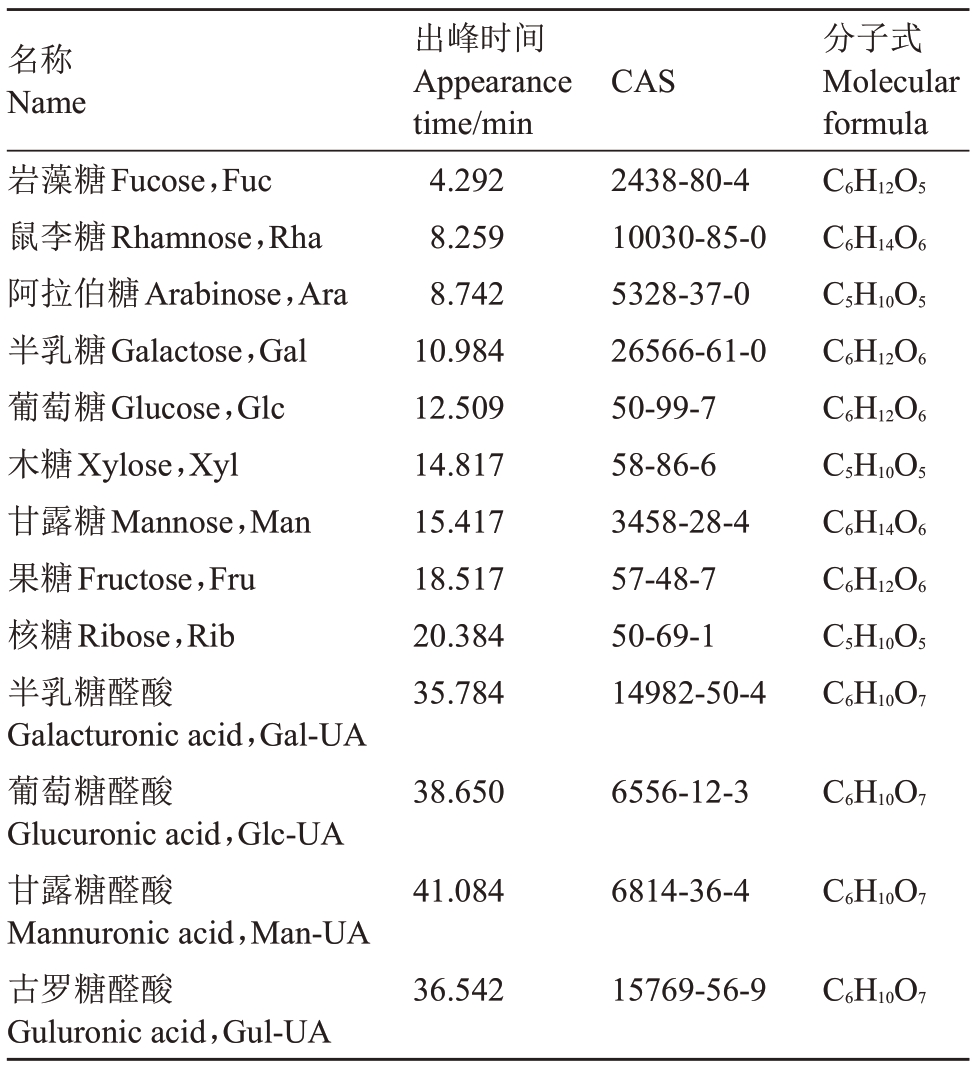
注:标准品来自Sigma公司。
Note:The reference standards are sourced from Sigma-Aldrich Corporation.
1.2.3 酶活性和过氧化物相关指标测定 α-淀粉酶活性测定:采用碘-淀粉比色法[16],在70 ℃水浴中加热15 min后,测定660 nm处的吸光值。
总淀粉酶和β-淀粉酶活性测定:采用碘-淀粉比色法[16]。通过测定总淀粉酶活性,与α-淀粉酶活性相减得到β-淀粉酶的活性。
酸性转化酶活性测定:采用DNS法[9],在pH 5.5下反应后,测定540 nm处的吸光值。
中性转化酶活性测定:采用DNS法[9],在pH 7.5下反应后,测定540 nm处的吸光值。
SPS活性测定:采用蒽酮法[8]。
CAT活性测定:采用紫外分光光度法[17]。
SOD活性测定:采用氮蓝四唑(NBT)光还原法[18]。
POD活性测定:采用邻苯二酚法(Catechol法)[19]。
MDA含量测定:采用硫代巴比妥酸(TBA)法[20]。
过氧化氢含量测定:采用钛盐比色法[21]。
1.3 数据分析
采用Excel 2019、Origin 2024、Graphpad Prism、DPS数据处理系统等对试验数据进行统计、作图以及相关分析。
2 结果与分析
2.1 种仁发育期糖类含量变化
随着板栗果实的发育,授粉后70 d种仁横径约2 cm(图2-A)。2个品种的还原糖含量呈现上升趋势。在90 d时,燕龙还原糖含量显著高于燕山早丰(图2-B)。2个品种的可溶性固形物含量的变化趋势稳定。发育前期,可溶性固形物含量相近且变化平稳,80 d后其含量均呈缓慢上升趋势。在90、100 d时,燕龙可溶性固形物含量显著高于燕山早丰(图2-C)。2个品种的总淀粉、直链淀粉及支链淀粉含量在发育前期含量相近且变化平稳,70 d后其含量均呈缓慢上升趋势。在90 d时,燕龙总淀粉含量占比最大,为60.34%(图2-D~F)。2个品种的多糖含量呈下降-上升-下降的波动趋势,燕山早丰在授粉后90 d时,含量占比最大,为24.07%;而燕龙则在授粉后100 d达到峰值,为34.86%,且显著高于燕山早丰(图2-G)。燕龙可溶性果胶含量(w,后同)在授粉后90 d(4.9 mg·g-1)极显著高于70 d(1.7 mg·g-1)(图2-H),而不溶性果胶含量在授粉后80 d(13.72 mg·g-1)极显著高于70 d(6.26 mg·g-1)(图2-I)。燕龙纤维素含量在授粉后90 d达到最大值,为27.70 mg·g-1(图2-J),而燕山早丰半纤维素含量在授粉后100 d达到峰值(15.53 mg·g-1),且显著高于燕龙(图2-K)。
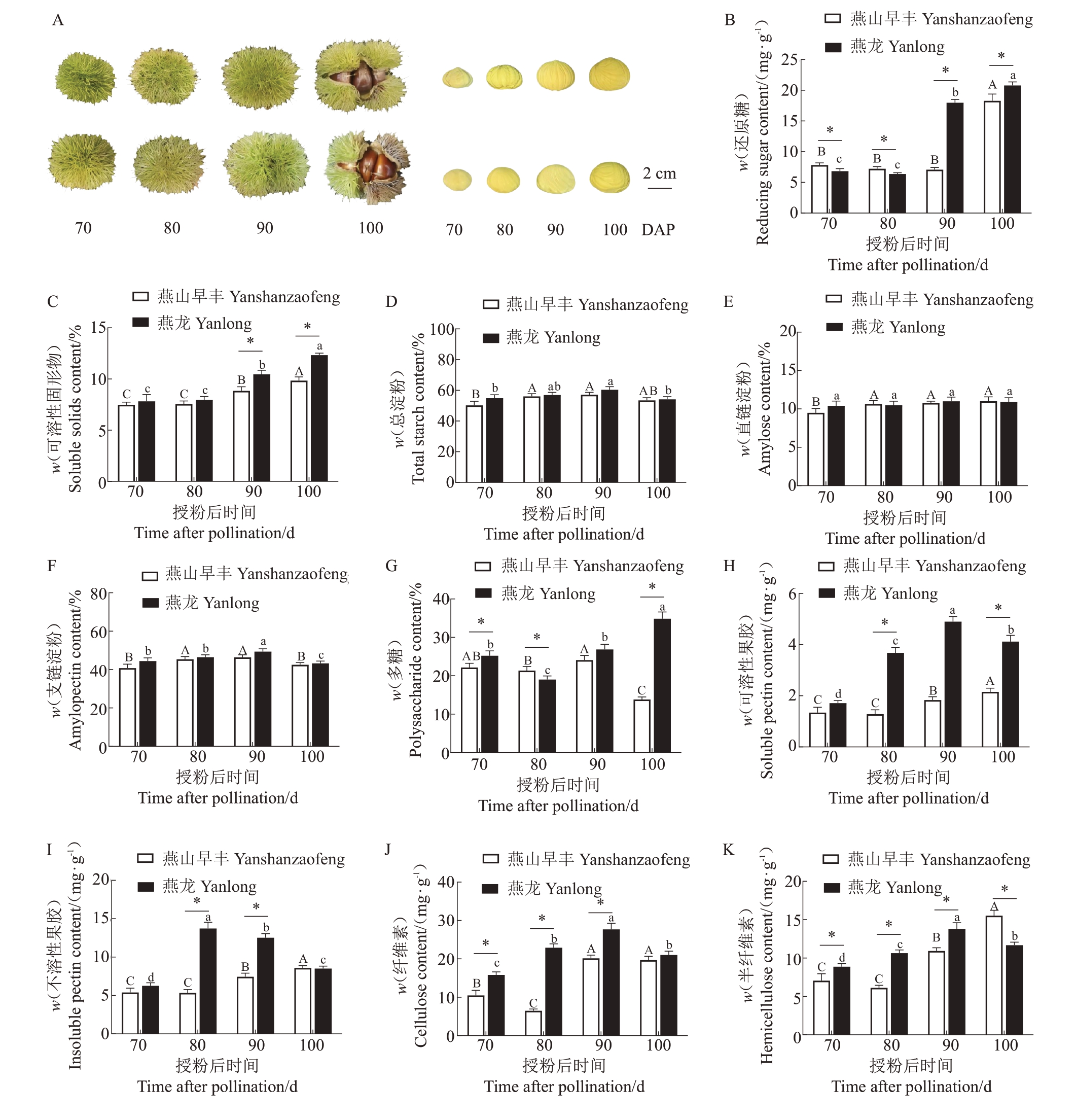
图2 种仁发育期糖类相关指标分析
Fig.2 Analysis of carbohydrate-related indicators during seed development
A.燕龙(第一行)、燕山早丰(第二行)70~100 d形态学观测;B.还原糖含量;C.可溶性固形物含量;D.总淀粉含量;E.直链淀粉含量F.支链淀粉含量;G多糖含量;H.可溶性果胶含量;I.不溶性果胶含量;J.纤维素含量;K.半纤维素含量。同一时期两个品种间的显著性通过t 检验确定(*P<0.05)。同一品种不同时期间的显著性通过单因素方差分析(ANOVA)进行检验,其中大写字母表示燕山早丰处理组,小写字母表示燕龙处理组,同一品种在不同时期使用不同字母表示在P<0.05水平上有显著差异。下同。
A.Morphological observations of Yanlong (first row) and Yanshanzaofeng (second row) for 70-100 days;B.Reducing sugar content;C.Soluble solids content;D.Total starch content;E.Amylose content;F.Amylopectin content;G.Polysaccharide content;H.Soluble pectin content;I.Insoluble pectin content;J.Cellulose content;K.Hemicellulose content.The significance between the two varieties during the same period was determined by t-test(*P<0.05).The significance within the same variety at different periods was examined using one-way ANOVA,where uppercase letters represent the Yanshanzaofeng treatment group,and lowercase letters represent the Yanlong treatment group.Different letters within the same variety at different periods indicate significant differences at P<0.05 level.The same below.
2.2 板栗种仁多糖的单糖组成分析
通过色谱法测定,2个品种的单糖组成及各成分含量变化如图3所示。板栗多糖主要由葡萄糖(89.00%)、半乳糖(9.70%)、阿拉伯糖(0.8%)、鼠李糖(0.42%)共4种单糖组成。其中,葡萄糖占主导地位,燕山早丰于授粉后70 d时葡萄糖含量显著高于燕龙,随后逐渐下降并低于燕龙;燕龙半乳糖含量变化呈单峰曲线,在授粉后90 d时达到峰值;燕山早丰的阿拉伯糖含量在70 d最高,并且在70、80、100 d,燕山早丰阿拉伯糖含量均显著高于燕龙;2个品种鼠李糖含量变化趋势相同,均持续下降。此色谱条件下单糖的分离良好,出峰稳定(图4)。
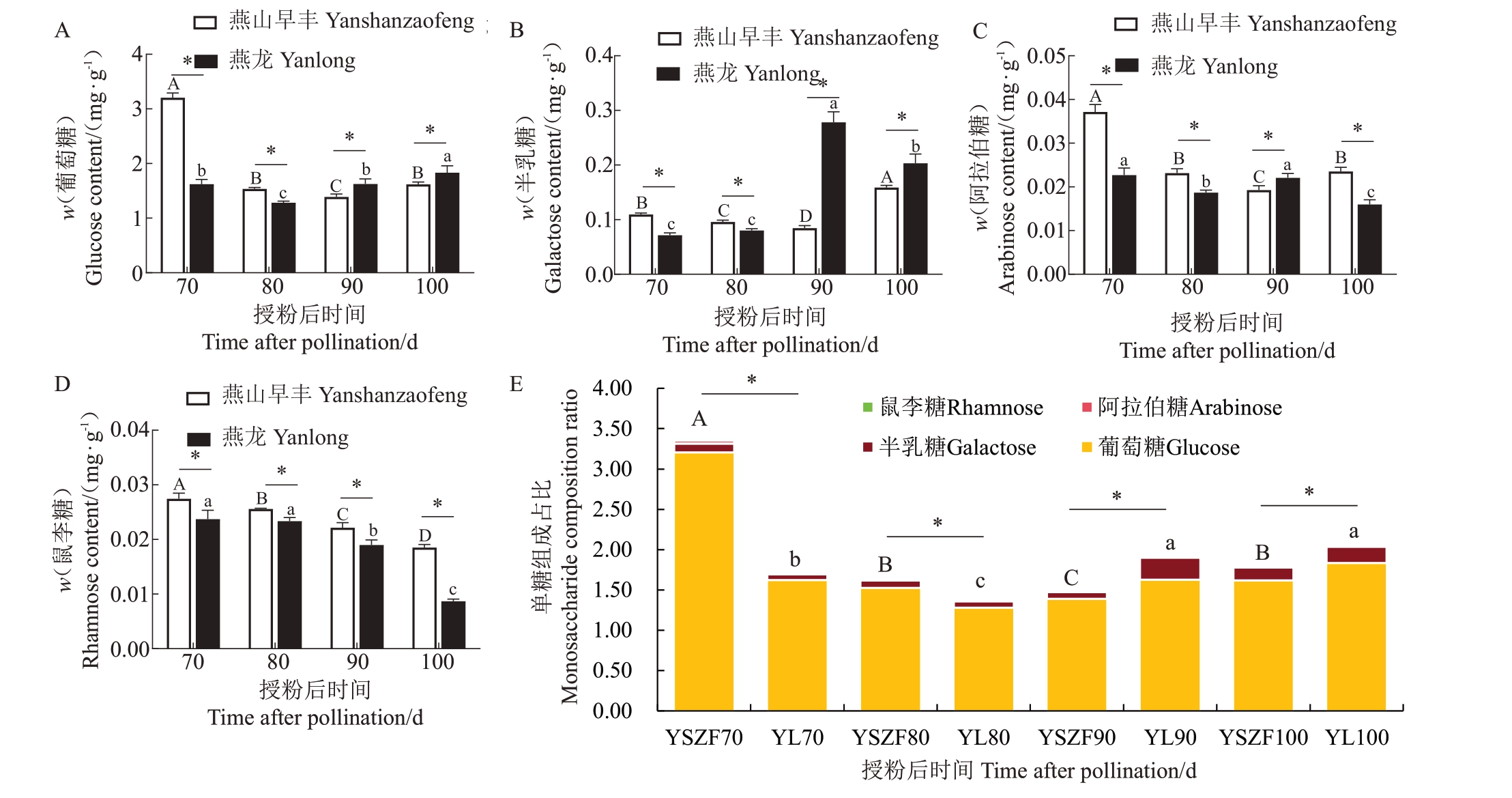
图3 多糖的单糖组成分析
Fig.3 Analysis of monosaccharide composition of polysaccharides
A.葡萄糖含量;B.半乳糖含量;C.阿拉伯糖含量;D.鼠李糖含量;E.单糖组成占比,YSZF.燕山早丰,YL.燕龙。
A.Glucose content;B.Galactose content;C.Arabinose content;D.Rhamnose content;E.Monosaccharide composition ratio,YSZF.Yanshanzaofeng,YL.Yanlong.
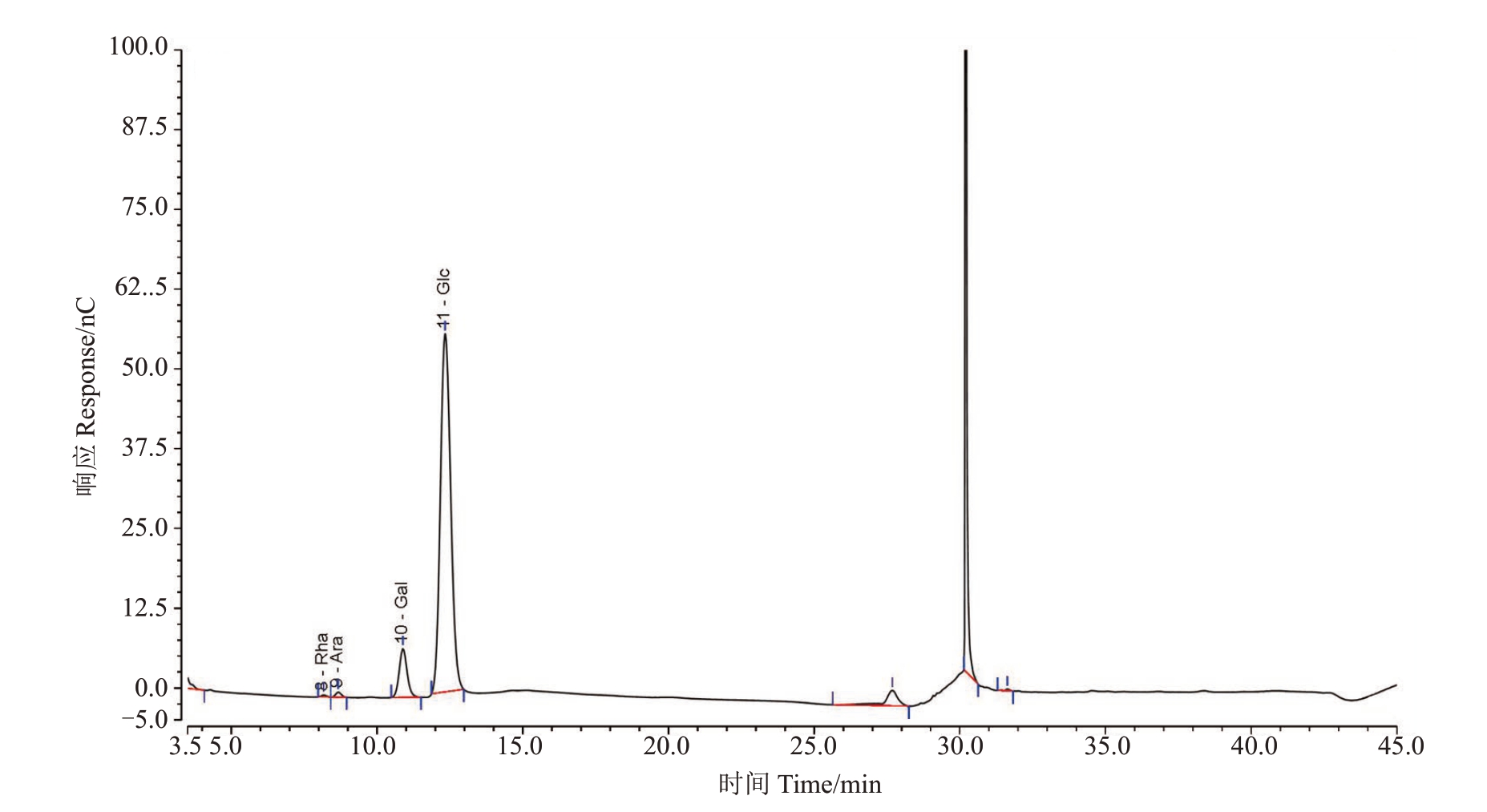
图4 样品离子色谱图
Fig.4 Sample ion chromatogram
色谱图中1号峰为鼠李糖,2号峰为阿拉伯糖,3号峰为半乳糖,4号峰为葡萄糖。
In the chromatogram,Peak 1 represents rhamnose,Peak 2 represents arabinose,Peak 3 represents galactose,and Peak 4 represents glucose.
2.3 种仁发育期酶活性和过氧化物含量的变化
随着果实的发育,相关酶活性及过氧化物含量发生了剧烈变化(图5)。燕山早丰的α-淀粉酶活性随发育持续上升,于100 d达峰值,而燕龙则呈先上升后下降再上升的变化趋势;β-淀粉酶与总淀粉酶活性变化趋势一致:燕山早丰在90 d达到峰值后下降,而燕龙在80 d出现峰值后逐渐降低;转化酶可以将蔗糖分解为葡萄糖和果糖,燕龙酸性转化酶活性在授粉后70 d缓慢上升,80 d达到最高值,随后逐渐下降;而中性转化酶活性始终保持平缓。授粉后80 d,当酸性转化酶活性下降时,中性转化酶活性却有所升高,在一定程度上弥补了酸性转化酶活性下降带来的影响。授粉后90 d至果实成熟,两者活性均趋于稳定。燕龙蔗糖磷酸合成酶活性在授粉70 d达到最大值,随后缓慢下降;而燕山早丰在授粉70 d则持续上升,至90 d后逐渐下降,其活性整体上高于燕龙。

图5 种仁发育期酶活性和过氧化物相关指标分析
Fig.5 Analysis of enzyme activity and peroxide-related indicators during seed kernel development period
A.α 淀粉酶活性;B.β 淀粉酶活性;C.总淀粉酶活性;D.中性转化酶活性;E.酸性转化酶活性;F.蔗糖磷酸合成酶活性;G.过氧化氢酶活性;H.超氧化物歧化酶活性;I.过氧化物酶活性;J.丙二醛含量;K.过氧化氢含量。
A.α-amylase activity;B.β-amylase activity;C.Total amylase activity;D.Neutral invertase activity(NI);E.Acidic invertase activity(AI);F.Sucrose phosphate synthase activity(SPS);G.Catalase activity(CAT);H.Superoxide dismutase activity(SOD);I.Peroxidase activity(POD);J.Malondialdehyde content(MDA);K.Hydrogen peroxide content(H2O2).
燕龙与燕山早丰的过氧化氢酶活性变化趋势基本相同,发育前期缓慢上升,发育后期增长较为迅速,并于100 d时达到峰值,分别为935.71 U·g-1、876.39 U·g-1。2个品种的超氧化物歧化酶活性变化均为单峰曲线,前期变化相对稳定且活性相近;自80 d起,燕山早丰活性逐渐高于燕龙,并在100 d时达到峰值356.13 U·g-1。2个品种的过氧化物酶活性变化趋势相同,与超氧化物歧化酶活性相反,燕龙各个时期过氧化物酶活性均显著高于燕山早丰,且于90 d时达到峰值(454.37 U·g-1)。燕山早丰的丙二醛含量呈先上升后下降的趋势,并于授粉90 d达到峰值(285.86 ng·g-1),而燕龙品种则与之相反,呈先下降后上升的趋势,100 d时含量最高(279.96 ng·g-1)。过氧化氢含量变化差异显著,燕山早丰呈显著的下降趋势,而燕龙呈不规则的波动变化趋势,于授粉后90d时达到峰值(24.91 μg·g-1),并显著高于燕山早丰。
2.4 各指标间相关性分析
通过对糖积累与代谢相关酶等指标性成分进行聚类分析(图6-A)。结果表明,所有指标可明显划分为四类,丙二醛、还原糖、过氧化氢酶、可溶性固形物是第一类;直链淀粉、α-淀粉酶、超氧化物歧化酶、半纤维素是第二类;中性转化酶、蔗糖磷酸合成酶、多糖、过氧化氢是第三类;酸性转化酶、支链淀粉、总淀粉、可溶性果胶、不溶性果胶、纤维素、β-淀粉酶、总淀粉酶、过氧化物酶是第四类。
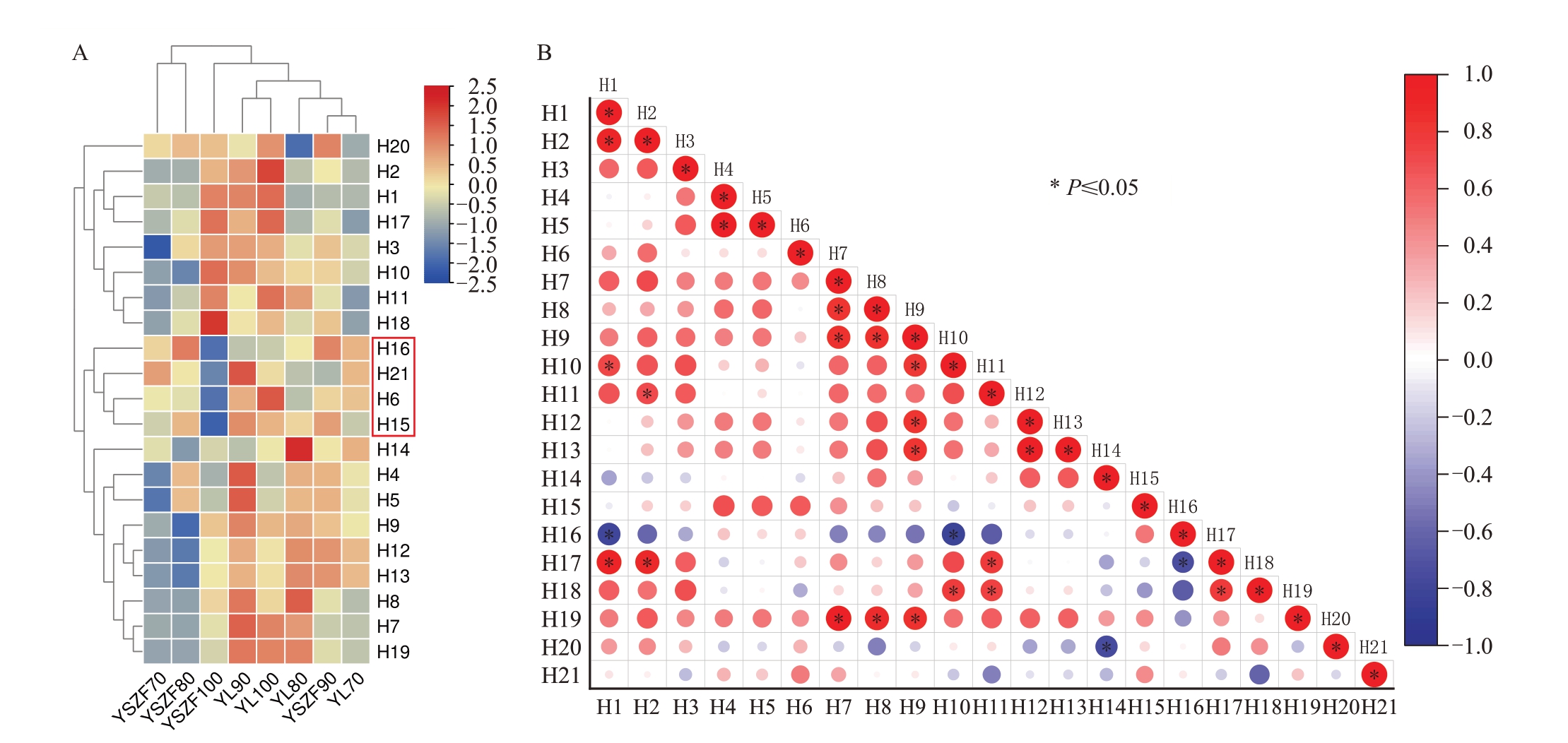
图6 指标间相关性分析
Fig.6 Correlation analysis between indicators
A.多指标聚类热图;B.相关性分析散点图。H1.还原糖含量;H2.可溶性固形物含量;H3.直链淀粉含量;H4.支链淀粉含量;H5.总淀粉含量;H6.多糖含量;H7.可溶性果胶含量;H8.不溶性果胶含量;H9.纤维素含量;H10.半纤维素含量;H11.α 淀粉酶活性;H12.β 淀粉酶活性;H13.总淀粉酶活性;H14.酸性转化酶活性;H15.中性转化酶活性;H16.蔗糖磷酸酶活性;H17.过氧化氢酶活性;H18.超氧化物歧化酶活性;H19.过氧化物酶活性;H20.丙二醛含量;H21.过氧化氢含量。
A.Multi-indicator clustering heat map;B:Correlation analysis scatter plot.H1.Reducing sugar content;H2.Soluble solids content;H3.Amylose content;H4.Amylopectin content;H5.Total Starch content;H6.Polysaccharides content;H7.Soluble pectin content;H8.Insoluble pectin content;H9.Cellulose content;H10.Hemicellulose content;H11.α-amylase activity;H12.β-amylase activity;H13.Total amylase activity;H14.AI activity;H15.NI activity;H16.SPS activity;H17.CAT activity;H18.SOD activity;H19.POD activity;H20.MDA content;H21.H2O2 content.
相关性分析(图6-B)显示,多糖含量与中性转化酶活性、过氧化氢含量呈正相关,还原糖含量与可溶性固形物含量、半纤维素含量、过氧化氢酶活性呈显著正相关,表明上述指标间存在正协同效应。此外,还原糖含量与蔗糖磷酸酶活性呈显著负相关。可溶性果胶、可溶性固形物、纤维素含量均与蔗糖磷酸合成酶活性呈负相关,与不溶性果胶、纤维素含量呈正相关。
3 讨论
本研究系统揭示了燕山早丰和燕龙板栗种仁粗多糖积累规律及其生理调控机制。在整个板栗成熟阶段,可溶性糖和淀粉呈现一个相互转化的过程。研究表明,淀粉水解为还原糖和可溶性糖,为果实发育提供充足的营养物质[22],燕龙在授粉100 d后,可溶性固形物与多糖含量协同上升,暗示不溶性糖组分可能通过降解途径转化为可溶性糖组分。燕龙纤维素含量在授粉后90 d显著升高,而燕山早丰后期半纤维素含量占优,表明两品种可能通过差异化的细胞壁重构策略以调控多糖沉积过程。研究表明,纤维素微纤丝的排列可能影响胞内空间对多糖的容纳能力,而半纤维素降解可能释放游离的单糖参与粗多糖合成[23]。多糖的积累与淀粉密切相关,黄瑞敏等[24]针对燕山板栗研究时发现,燕山早丰和燕龙种仁发育期的直链淀粉、支链淀粉和总淀粉含量的变化趋势相似。同时当板栗接近成熟时,由于支链淀粉的分解,可溶性糖含量快速增加。
本研究通过热水提取法获得的板栗粉粗多糖,其单糖组成主要由葡萄糖、半乳糖、阿拉伯糖、鼠李糖等,并未检测到岩藻糖、木糖、甘露糖、果糖、核糖、甘露糖醛酸、古罗糖醛酸等成分。邵亭亭等[5]从罗田板栗中分离纯化得到多糖组分CP3,主要由葡萄糖、鼠李糖、阿拉伯糖和半乳糖组成,与本试验结果基本一致。而杨利剑[25]通过气相色谱分析发现湖北罗田板栗多糖由葡萄糖、甘露糖、木糖和阿拉伯糖组成。李清宇等[6]从陕西镇安板栗中分离纯化得到多糖组分CPS-a和CPS-b,气相色谱分析表明,CPS-a主要由葡萄糖、甘露糖、木糖和阿拉伯糖组成,CPSb由葡萄糖、果糖、甘露糖、木糖和阿拉伯糖组成,这与本试验结果存在差异,表明板栗种仁中可能存在少量由其他单糖组成的多糖。同时,本研究中未检测到典型果胶组分,可能与果胶含量过低,或热水提取法导致酸性多糖降解有关,后续需结合温和提取技术(如酶解法)进一步验证。
多糖积累与糖代谢酶密切相关,种仁获得同化产物的能力很大程度上由库强决定[26],而蔗糖代谢相关酶活性强弱影响库强和糖卸载能力,进而影响果实糖分积累、糖组分及含量[27]。试验结果表明,在果实发育初期较高的转化酶活性对还原糖积累的影响较大,酸性转化酶活性的升高促进了蔗糖分解,同时蔗糖合成酶的分解方向活性增强[28]。在两者的协同作用下,共同促进了总糖和葡萄糖的迅速积累,既增大了库强,同时也为细胞分裂和生长提供了充足的碳源[29],是种仁发育期间总糖和葡萄糖含量升高的主要原因。蔗糖磷酸合成酶(SPS)是调控蔗糖合成的关键限速酶,也是蔗糖代谢通路的核心调控因子。在油桃和翠冠梨果实发育中,蔗糖磷酸酶活性随果实发育持续上升,在果实发育中后期急剧升高,与蔗糖迅速积累的时期一致[30]。在本研究中,蔗糖磷酸酶活性与可溶性糖含量的变化趋势基本一致,表明蔗糖磷酸酶在板栗可溶性糖的合成过程中也发挥着重要作用。
4 结论
板栗种仁中粗多糖主要由葡萄糖和半乳糖组成,其积累过程受品种特性、蔗糖代谢关键酶活性协同调控。燕龙作为晚熟品种,在成熟期表现出更高的还原糖、可溶性固形物及粗多糖含量,其多糖积累与中性转化酶活性、过氧化氢含量呈正相关。此外,过氧化氢含量变化与可溶性果胶积累趋势相似,进一步揭示了活性氧代谢在糖类物质转化中的作用。研究结果为板栗高糖育种和优质栽培提供了理论依据,并为功能性多糖的定向调控提供了新思路。
[1] 李颖,郭燕,张馨方,张树航,王广鹏.中国板栗主产区果实后熟期可溶性固形物含量变化特征研究[J].云南农业大学学报(自然科学),2022,37(4):655-662.Li Ying,Guo Yan,Zhang Xinfang,Zhang Shuhang,Wang Guangpeng.Study on the variation characteristics of soluble solid content in chestnut at post-ripening stage in Chinese main producing areas[J].Journal of Yunnan Agricultural University,2022,37(4):655-662.
[2] 李颖,张树航,郭燕,张馨方,王广鹏.中国板栗可溶性糖相关性状多样性分析[J].植物遗传资源学报,2023,24(2):493-504.Li Ying,Zhang Shuhang,Guo Yan,Zhang Xinfang,Wang Guangpeng.Diversity analysis of soluble sugar related traits in Chinese chestnut[J].Journal of Plant Genetic Resources,2023,24(2):493-504.
[3] Du B,Peng F,Xie Y,Wang H Y,Wu J H,Liu C,Yang Y D.Optimization extraction and antioxidant activity of crude polysaccharide from chestnut mushroom (Agrocybe aegerita) by accelerated solvent extraction combined with response surface methodology(ASE-RSM)[J].Molecules,2022,27(8):2380.
[4] Li S X,Shi Z G,Zhu Q R,Tao L,Liang W H,Zhao Z H.Transcriptome sequencing and differential expression analysis of seed starch accumulation in Chinese chestnut metaxenia[J].BMC Genomics,2021,22(1):617.
[5] 邵亭亭,张海晖,段玉清,孙桂波,孙晓波,张瑞.亚临界水萃取板栗多糖及其清除自由基活性研究[J].食品科技,2012,37(12):156-160.Shao Tingting,Zhang Haihui,Duan Yuqing,Sun Guibo,Sun Xiaobo,Zhang Rui.Extraction on chestnut polysaccharide by subcritical water and analysis on free radical scavenging capacity[J].Food Science and Technology,2012,37(12):156-160.
[6] 李清宇,杨颖,贾琳斐,彭晶,戴成国,段玉峰.板栗多糖的分离纯化、结构分析及抗疲劳作用的研究[J].食品与生物技术学报,2013,32(7):767-772.Li Qingyu,Yang Ying,Jia Linfei,Peng Jing,Dai Chengguo,Duan Yufeng.Purification,structural analysis and antifatigue assay of polysaccharide from Castanea mollissima Blume[J].Journal of Food Science and Biotechnology,2013,32(7):767-772.
[7] Nai J J,Zhang C,Shao H L,Li B Q,Li H,Gao L,Dai M M,Zhu L Q,Sheng H G.Extraction,structure,pharmacological activities and drug carrier applications of Angelica sinensis polysaccharide[J].International Journal of Biological Macromolecules,2021,183:2337-2353.
[8] Chen F,Huang G L,Yang Z Y,Hou Y P.Antioxidant activity of Momordica charantia polysaccharide and its derivatives[J].International Journal of Biological Macromolecules,2019,138:673-680.
[9] 江建丽.3,5-二硝基水杨酸(DNS)法测定五味子还原糖含量的适宜条件[J].海峡药学,2014,26(1):57-60.Jiang Jianli.Optimum condition for determining reducing sugar content in Schisandra by DNS method[J].Strait Pharmaceutical Journal,2014,26(1):57-60.
[10] 何洁,闫飞燕,黄芳,肖艳妮,谢丽萍.双波长法测定薯芋类农产品中直链淀粉和支链淀粉的含量[J].食品工业科技,2022,43(7):303-309.He Jie,Yan Feiyan,Huang Fang,Xiao Yanni,Xie Liping.Determination of amylose and amylopectin contents in yam and taros by dual-wavelength spectrophotometry[J].Science and Technology of Food Industry,2022,43(7):303-309.
[11] 赵玉雪,朱佳敏,杨霞,娄丽.核桃青皮中木质素、纤维素、半纤维素测定初报[J].贵州林业科技,2021,49(2):7-10.Zhao Yuxue,Zhu Jiamin,Yang Xia,Lou Li.A preliminary report on the determination of lignin,cellulose and hemicellulose in walnut green husk[J].Guizhou Forestry Science and Technology,2021,49(2):7-10.
[12] 庞荣丽,张巧莲,郭琳琳,方金豹,谢汉忠,李君,罗静,吴丰魁.水果及其制品中果胶含量的比色法测定条件优化[J].果树学报,2012,29(2):302-307.Pang Rongli,Zhang Qiaolian,Guo Linlin,Fang Jinbao,Xie Hanzhong,Li Jun,Luo Jing,Wu Fengkui.Study on the colorimetry determination conditions of pectin in fruits and derived products[J].Journal of Fruit Science,2012,29(2):302-307.
[13] 宋磊肖,何俊平,贾晓韩,范得跃,李晓菁.板栗多糖的提取、分离纯化方法及其生物活性[J].落叶果树,2018,50(4):32-35.Song Leixiao,He Junping,Jia Xiaohan,Fan Deyue,Li Xiaojing.Extraction,purification and bioactivity of polysaccharides from Castanea mollissima[J].Deciduous Fruits,2018,50(4):32-35.
[14] 董群,郑丽伊,方积年.改良的苯酚—硫酸法测定多糖和寡糖含量的研究[J].中国药学杂志,1996,31(9):550-553.Dong Qun,Zheng Liyi,Fang Jinian.Modified phenol sulfuric acid method for determination of the content of oligo and polysaccharides[J].Chinese Pharmaceutical Journal,1996,31(9):550-553.
[15] 李洁,姚宝花,宋宇琴,李六林.枣不同品种和果实不同部位糖积累及相关酶活性[J].林业科学,2017,53(12):30-40.Li Jie,Yao Baohua,Song Yuqin,Li Liulin.Sugar accumulation and the relevant enzymes activities in different parts of fruit of three jujube cultivars[J].Scientia Silvae Sinicae,2017,53(12):30-40.
[16] 张维,李高阳,张群,单杨,苏东林,朱向荣.低温预贮对猕猴桃果实糖代谢的影响[J].中国食品学报,2022,22(11):288-298.Zhang Wei,Li Gaoyang,Zhang Qun,Shan Yang,Su Donglin,Zhu Xiangrong.Effects of low temperature conditioning the sugar metabolism of kiwifruit[J].Journal of Chinese Institute of Food Science and Technology,2022,22(11):288-298.
[17] 甘秋娅,段天昊,陈继平,龚英.黑牛肝菌多糖组分对其抗氧化能力的贡献研究[J].云南化工,2024,51(11):94-100.Gan Qiuya,Duan Tianhao,Chen Jiping,Gong Ying.Study on the contribution of polysaccharide components of Phlebopus portentosus to its antioxidant capacity[J].Yunnan Chemical Technology,2024,51(11):94-100.
[18] 李啸云,吕春娜,王舰,王芳.干旱胁迫下马铃薯的生理响应及相关性分析[J].江苏农业科学,2023,51(24):50-59.Li Xiaoyun,Lü Chunna,Wang Jian,Wang Fang.Physiological response and correlation analysis of different potato genotypes to drought stress[J].Jiangsu Agricultural Sciences,2023,51(24):50-59.
[19] 韦珍,向昱,杨兆杏,戴涛涛,李宝深,帅希祥,林泽松,唐雅园,何雪梅.火龙果茎多糖组成及抗氧化稳定性分析[J].食品工业科技,2024,45(22):263-271.Wei Zhen,Xiang Yu,Yang Zhaoxing,Dai Taotao,Li Baoshen,Shuai Xixiang,Lin Zesong,Tang Yayuan,He Xuemei.Analysis of composition and antioxidant stability of pitaya stem polysaccharide[J].Science and Technology of Food Industry,2024,45(22):263-271.
[20] 余甜,张萍,陈韦多.干旱胁迫下3种类型新疆野核桃保护酶和丙二醛含量的变化[J].江苏农业科学,2018,46(16):119-121.Yu Tian,Zhang Ping,Chen Weiduo.Changes of protective enzyme and malondialdehyde content in three types of Xinjiang wild walnut under water stress[J].Jiangsu Agricultural Sciences,2018,46(16):119-121.
[21] 吕俏平,程小爱.探究水涝胁迫下欧李过氧化氢与多酚氧化酶的变化[J].果树资源学报,2020,1(1):1-5.Lü Qiaoping,Cheng Xiaoai.Study on changes of hydrogen peroxide and PPO in Cerasus humilis under waterlogging stress[J].Journal of Fruit Resources,2020,1(1):1-5.
[22] 程华,李琳玲,王少斌,王燕,程水源.板栗八月红花芽分化期相关营养物质含量的变化[J].湖北农业科学,2013,52(22):5502-5505.Cheng Hua,Li Linling,Wang Shaobin,Wang Yan,Cheng Shuiyuan.Changes of nutrient content in Castanea mollissima‘Bayuehong’during the floral bud differentiation stage[J].Hubei Agricultural Sciences,2013,52(22):5502-5505.
[23] 梁皓童,林健颖,袁绍敏,马巧智.熔盐水合物选择性水解纤维素制备葡萄糖[J].高等学校化学学报,2023,44(11):36-46.Liang Haotong,Lin Jianying,Yuan Shaomin,Ma Qiaozhi.Glucose production from cellulose via selective hydrolysis in molten salt hydrate[J].Chemical Journal of Chinese Universities,2023,44(11):36-46.
[24] Huang R M,Peng F,Wang D S,Cao F,Guo C L,Yu L Y,Zhang J Z,Yang Y D.Transcriptome analysis of differential sugar accumulation in the developing embryo of contrasting two Castanea mollissima cultivars[J].Frontiers in Plant Science,2023,14:1206585.
[25] 杨利剑.板栗多糖的提取、成分分析及活性测定[J].武汉理工大学学报,2010,32(11):14-16.Yang Lijian.Extraction of Chinese chestnut polysaccharide andits activity determination[J].Journal of Wuhan University of Technology,2010,32(11):14-16.
[26] 房想.不同采收期枸杞多糖含量及单糖组成的研究[D].银川:宁夏大学,2016.Fang Xiang.Study on the content and composition of polysaccharides in different harvest stage[D].Yinchuan:Ningxia University,2016.
[27] 张婷婷,贾珊,马欢,冯博,王毕妮,孟永宏,杨兴斌,路亚龙.红枣多糖结构鉴定及生物活性研究进展[J].食品科学,2024,45(23):278-287.Zhang Tingting,Jia Shan,Ma Huan,Feng Bo,Wang Bini,Meng Yonghong,Yang Xingbin,Lu Yalong.Research progress on structural identification and biological activity of Chinese jujube polysaccharides[J].Food Science,2024,45(23):278-287.
[28] 杨子琴,李茂,章笑赟,余意,王惠聪,黄旭明.饥饿胁迫对龙眼果实脱落及糖代谢的影响[J].果树学报,2011,28(3):428-432.Yang Ziqin,Li Mao,Zhang Xiaoyun,Yu Yi,Wang Huicong,Huang Xuming.Effects of starvation stress on fruit abscission and sugar metabolism in longan[J].Journal of Fruit Science,2011,28(3):428-432.
[29] 贾如齐.板栗低温糖化研究与多酚氧化酶的纯化表征[D].武汉:华中农业大学,2022.Jia Ruqi.Study on cold-induced sweetening of Chinese chestnut and purification and characterization of polyphenol oxidase[D].Wuhan:Huazhong Agricultural University,2022.
[30] 王恒,王慧,韩伟,王文彬,于立娜.桃果实的代谢途径和糖积累调控生理机制的研究进展[J].北方园艺,2024(15):128-133.Wang Heng,Wang Hui,Han Wei,Wang Wenbin,Yu Lina.Research progress on metabolic pathways and physiological mechanisms of sugar accumulation in peach fruit[J].Northern Horticulture,2024(15):128-133.