DnaJ是一类分子质量为41 kd且兼具分子伴侣和转录调控功能的热激蛋白,因其含有高度保守的J结构域,又称为J-蛋白,属于DnaJ/Hsp40 基因家族[1-2]。J-蛋白通常由N端的J-结构域、富含甘氨酸/苯丙氨酸的G/F结构域、锌指结构域(特征序列为CxxCxGxG)和C端的羧基末端区组成[3]。Hsp70是生物体内一类高度保守的热休克蛋白,在多种生理过程中发挥关键作用[4]。DnaJ蛋白主要通过与热休克蛋白Hsp70协同作用,参与细胞内蛋白质的折叠、修复、降解、应激响应等过程,在植物响应逆境胁迫中发挥重要作用[5-6]。
已有研究表明,DnaJ蛋白分为DNAJD、DNAJF及DNAJ-like三类,有4个亚型,即Ⅰ型、Ⅱ型、Ⅲ型、Ⅳ型[7-9]。DnaJ作为一类重要的应激蛋白,广泛参与植物的抗旱、耐高温、耐盐、抑制激素等逆境响应过程[10]。例如,过表达DnaJ 基因利于提高拟南芥(Arabidopsis thaliana)对NaCl胁迫的耐受性[11];在玉米(Zea mays L.)对高温和干旱胁迫的响应过程中,DnaJ基因家族成员发挥重要作用[12];番茄(Solanum lycopersicum L.)叶绿体靶向DnaJ 基因的过表达增强了转基因烟草对干旱胁迫和青枯病的抗性[13];烟草(Nicotiana tabacum L.)DnaJ 基因在抑制烟草花叶病毒的扩散中发挥作用[14]。目前,DnaJ基因已在多个物种中被鉴定出,但尚未见对酸枣DnaJ基因鉴定的报道。
酸枣(Ziziphus jujuba var. spinosa)为鼠李科枣属的野生祖先种,是我国重要的药食同源植物。酸枣果实营养丰富,可食用;酸枣仁具有安神、抗氧化、增强免疫等功效,常被用作药材[15-16]。酸枣具有极强的抗逆性,尤其在干旱、高温等恶劣环境中表现出显著的适应性。因此,开展酸枣DnaJ基因家族研究,挖掘其抗逆性相关的高表达基因,有助于高抗逆优良酸枣的分子育种。笔者基于前期酸枣GWAS分析得到的抗旱基因[17],鉴定到响应干旱胁迫的DnaJ蛋白。为进一步探究酸枣中DnaJ 基因的进化特征,笔者通过酸枣全基因组鉴定DnaJ 基因家族,系统分析其结构、功能、理化性质等,并结合干旱胁迫转录组数据,筛选高表达的DnaJ 基因家族成员,以期为酸枣抗旱优良品种的选育提供重要候选基因。
1 材料和方法
1.1 材料
供试枣树为生长一致、健康、无病虫害的酸枣实生幼苗[苗龄1 a(年)],在宁夏灵武市千亩设施果业基地大棚中进行盆栽干旱胁迫试验。试验容器为口径31 cm、高27 cm的塑料花盆,每盆装入10 kg干土,浇水后培养30 d,其间定期补充水分。待供试枣树长势稳定后,设置正常供水为对照(土壤相对含水量为70%~75%)、轻度干旱胁迫D1(土壤相对含水量50%~55%)、中度干旱胁迫D2(土壤相对含水量35%~40%)、重度干旱胁迫D3(土壤相对含水量20%~25%)4个梯度,处理20 d。培养期间每5 d采集叶片样品用于生理指标测定,并于第20天采集根、茎、叶样品用于转录组测序。
1.2 酸枣ZjsDnaJ基因家族成员鉴定及理化性质分析
基于酸枣[Genome-NCBI-NLM(nih.gov)]全基因组及前期研究获得的DnaJ基因序列,下载隐马尔可夫模型(HMM)文件(PF00226)。使用HMMER3.1软件对酸枣蛋白序列进行结构域搜索,初步鉴定酸枣DnaJ 基因家族成员,结合CDD [Conserved Domains Database(CDD)and Resources(nih.gov)]、SMART [SMART:Main page(embl.de)]、PFAM [Browse-InterPro(ebi.ac.uk)]数据库筛除假阳性基因,最终确定ZjsDnaJ 基因家族成员。通过TBtools和在线网站WoLF PSORT Prediction(http://wolfpsort.hgc.jp)预测ZjsDnaJ 基因家族成员的理化性质及亚细胞定位,使用R语言进行可视化绘图。
1.3 酸枣ZjsDnaJ保守基序、结构域及基因结构分析
基于酸枣蛋白序列和GFF注释文件,利用在线网站MEME进行保守基序分析,利用NCBI进行结构域分析,利用GSDS进行基因结构分析。利用TBtools软件的可视化功能,绘制进化树、保守基序、结构域、基因结构的组合图。
1.4 系统进化分析
使用MEGA11软件,基于酸枣、冬枣[Ziziphus jujuba genome assembly ASM3175591v1-NCBINLM(nih.gov)]、拟南芥(https://www.ncbi.nlm.nih.gov/datasets/taxonomy/3702/)、番茄(https://www.ncbi.nlm.nih.gov/datasets/taxonomy/4081/)和马铃薯{R1 starch-granule-bound R1 protein [Solanum tuberosum(potato)]-Gene-NCBI}5个物种DnaJ 基因编码的蛋白序列进行多序列比对,采用Neighbor-Joining法构建系统发育树。
1.5 染色体定位及启动子区顺式作用元件分析
根据酸枣GFF注释文件提取DnaJ 基因的位置信息,使用MapChart软件绘制染色体定位图;提取DnaJ 基因家族成员上游2000 bp作为启动子序列,使用Plantcare进行顺式作用元件分析,使用R语言绘制结果图。
1.6 酸枣ZjsDnaJ基因家族表达模式分析
基于干旱胁迫处理下酸枣不同器官的转录组数据(武汉迈维代谢生物科技股份有限公司代测),对ZjsDnaJ 基因进行表达谱分析,使用hiplot绘制热图。
1.7 酸枣ZjsDnaJ基因家族响应干旱胁迫相关成员的qRT-PCR分析
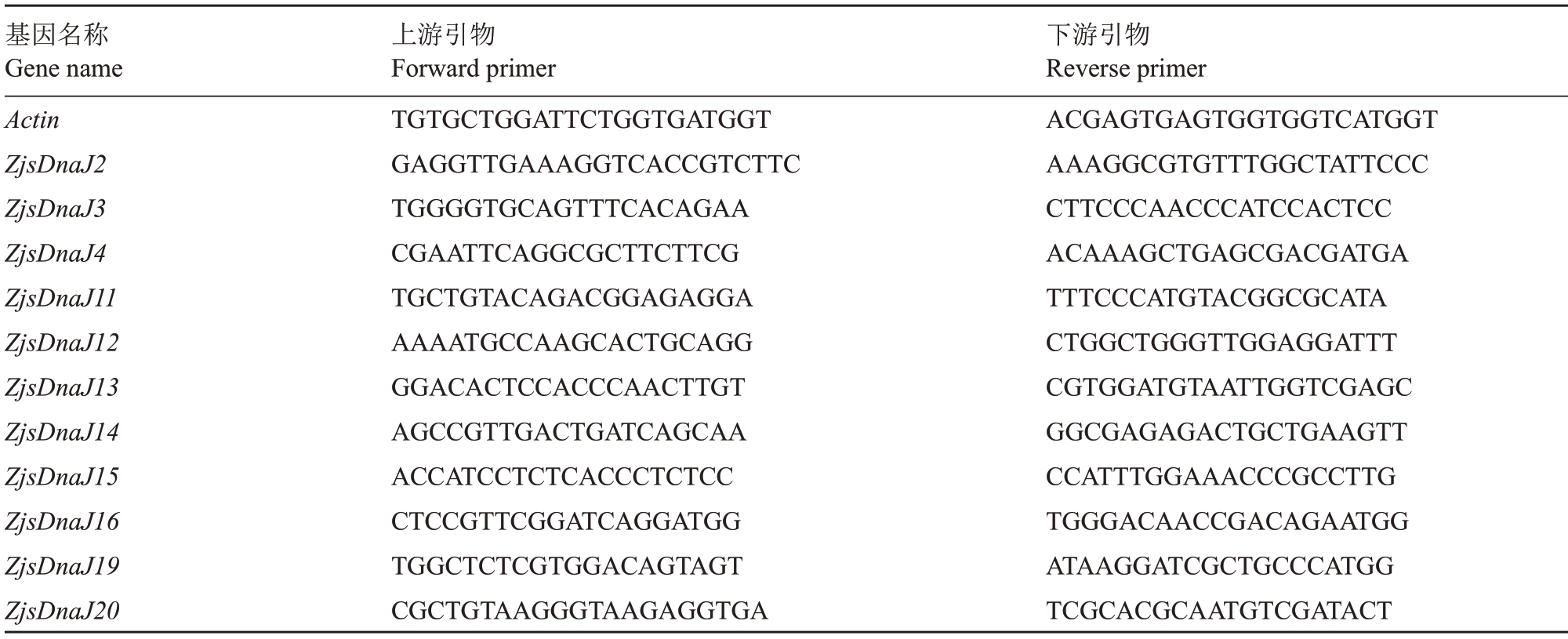
基于转录组数据,对筛选的高表达ZjsDnaJ 基因进行相对表达量测定。使用RNA prep Pure多糖多酚植物总RNA提取试剂盒[天根生化科技(北京)有限公司]分别提取酸枣幼苗根、茎、叶的总RNA,使用试剂盒(康为世纪生物科技有限公司)进行反转录。由上海生工生物工程股份有限公司(www.sangon.com)设计与合成引物,内参基因为Actin[18](表1)。使用MasterSYBR Mixture试剂盒(康为世纪生物科技有限公司)进行qRT-PCR。利用公式2-ΔΔCt计算相对表达量,所有结果均包含3次生物学重复以及3次技术重复,使用Microsoft Excel 2020、Graphpad Prism 10.1.2软件进行数据分析及作图。
表1 实时荧光定量引物序列
Table 1 Primers of real-time quantitative PCR
1.8 干旱胁迫处理下酸枣叶片相关生理指标测定
采用蒽酮比色法测定可溶性糖含量[试剂盒PSS-W96-N(1620)];采用愈创木酚法测定过氧化物酶POD活性[试剂盒POD-W96-N(1620)];采用紫外吸收法测定过氧化氢酶(CAT)活性[试剂盒CATA-W96-N(1620)];采用硫代巴比妥酸法测定丙二醛(MDA)含量[试剂盒MDA-W96-N(1620)];采用黄基水杨酸法测定脯氨酸(PRO)含量[试剂盒PROW96-N(1620)],所有指标均通过分光光度法测定。
2 结果与分析
2.1 ZjsDnaJ基因家族成员鉴定及理化性质分析
基于HUMMER(E<0.001 hmm)分析结果,并结合CDD、SMART、PFAM数据库,从酸枣全基因组中共鉴定出23个DnaJ基因家族成员,即ZjsDnaJ1~Zjs-DnaJ23(图1)。对酸枣ZjsDnaJ 家族的理化性质进行分析时,发现ZjsDnaJ 基因家族编码蛋白的等电点范围为4.59(ZjsDnaJ6)~10.10(ZjsDnaJ17),包含酸性蛋白和碱性蛋白;脂溶指数范围为51.01(ZjsD-naJ19)~94.52(ZjsDnaJ1),平均值达到68.01;亲水性范围为-1.172(ZjsDnaJ5)到-0.265(ZjsDnaJ1),均为亲水性蛋白;不稳定系数范围为30.23(ZjsDnaJ17)~81.24(ZjsDnaJ10),其中8个蛋白表现出热稳定性,其余为不稳定蛋白。亚细胞定位预测结果显示,23个ZjsDnaJ 成员分别定位于叶绿体(10个)、细胞质(3个)、细胞核(9个)及线粒体(1个)。
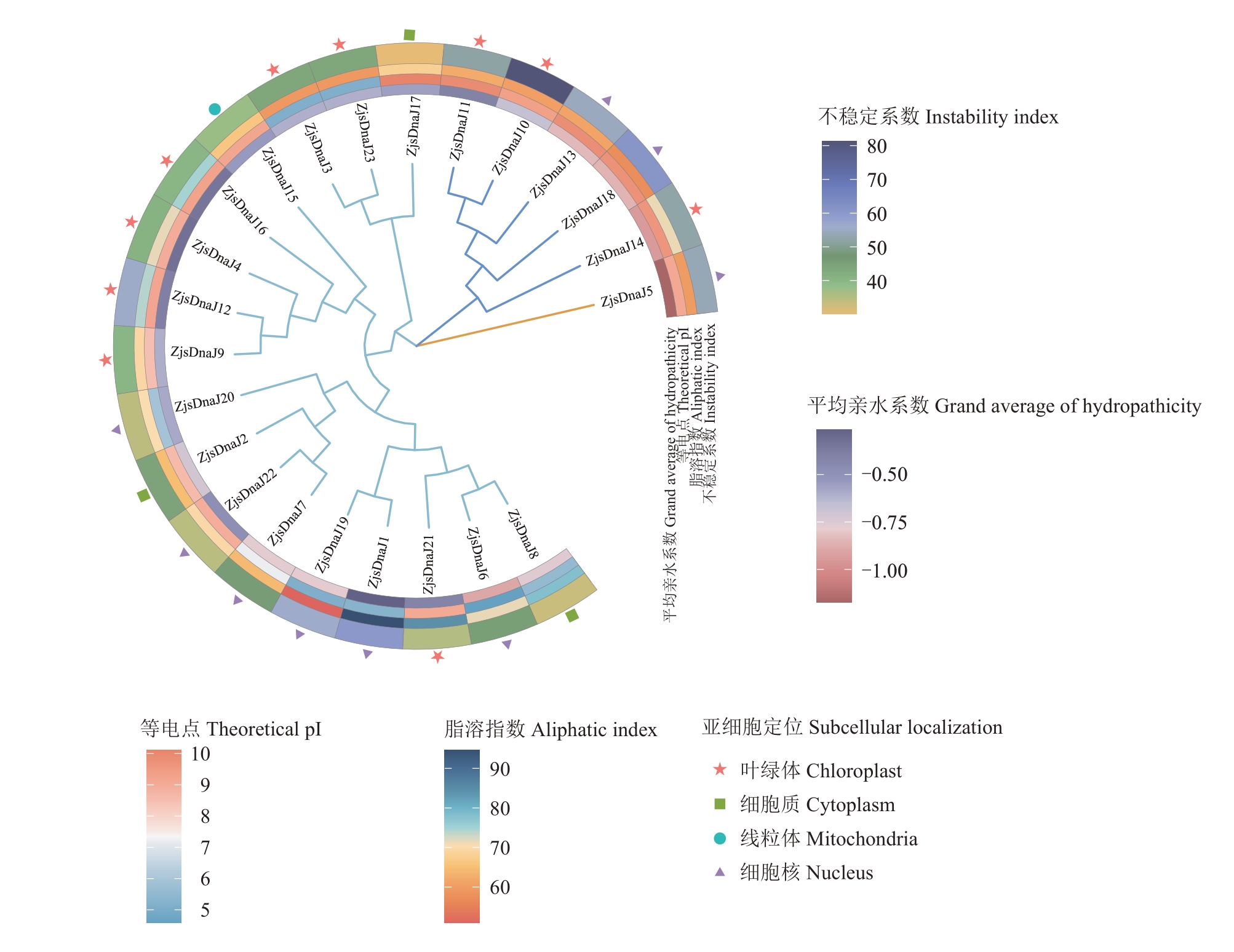
图1 ZjsDnaJ 基因家族编码的蛋白理化性质
Fig.1 Physicochemical properties of proteins coded by ZjsDnaJ gene family
2.2 ZjsDnaJ基因家族成员保守基序、结构域、基因结构分析
根据23个ZjsDnaJ基因的蛋白序列构建系统发育树,将该基因家族分为3个亚家族(图2-A)。在23个ZjsDnaJ 成员中共鉴定到10个保守基序,命名为Motif1~Motif10。所有成员均含有Motif1(含有HPD三钛)和Motif2;此外,除Ⅱd的ZjsDnaJ17 外,其他成员均包含Motif8,表明该基因家族具有一定的保守性(图2-B)。在ZjsDnaJ 基因家族中共鉴定出8个DnaJ相似结构域,其中DnaJ结构域出现频次最高(图2-C),这可能与其特定功能和进化关系相关。ZjsDnaJ 基因家族成员的基因结构类型复杂多样,内含子和外显子数量为3~20个。ZjsDnaJ15 所含外显子和内含子数量最多,为20个;ZjsDnaJ1、ZjsDnaJ10、ZjsDnaJ11、ZjsDnaJ18 所含数量最少,均为3个(图2-D)。ZjsDnaJ基因家族复杂的基因结构揭示了该家族功能的多样性。

图2 ZjsDnaJ 基因的系统发育树(A)、保守基序(B)、结构域(C)、基因结构(D)
Fig.2 Phylogenetic tree(A),motif(B),domain(C),and gene structure(D)of ZjsDnaJ genes
2.3 系统进化分析
利用筛选出的53个马铃薯、30个冬枣、24个番茄及31个拟南芥DnaJ 基因与ZjsDnaJ 家族成员构建系统进化树。系统进化分析表明(图3),5个物种的DnaJ基因均无物种特异性分支,161个DnaJ家族成员被分成4个组,即GroupⅠ~Group Ⅳ。23个ZjsDnaJ基因与其他4个物种的DnaJ成员聚于同一分支,表明酸枣、马铃薯、番茄、拟南芥及冬枣的DnaJ基因间存在同源关系,且在进化过程中展现了一定程度的分化与拓展。

图3 五个物种DnaJ 基因的系统进化树
Fig.3 Phylogenetic tree of the DnaJ genes of five species
AT.拟南芥;St.马铃薯;SL.番茄;Zjd.冬枣;Zjs.酸枣。
AT.Arabidopsis thaliana;St.Solanum tuberosum;SL.Solanum lycopersicum;Zjd.Ziziphus jujuba Mill.cv.Dongzao;Zjs.Ziziphus jujuba var.spinosa.
2.4 酸枣ZjsDnaJ 基因家族染色体定位及启动子顺式作用元件分析
染色体定位结果表明(图4),23个ZjsDnaJ家族成员分布在10条染色体上。其中,1号染色体分布有6个ZjsDnaJ基因,数量最多;3、8、11、12号染色体均分布1个ZjsDnaJ基因。ZjsDnaJ家族成员间未发现串联重复基因,表明该家族可能通过其他机制进行扩增。
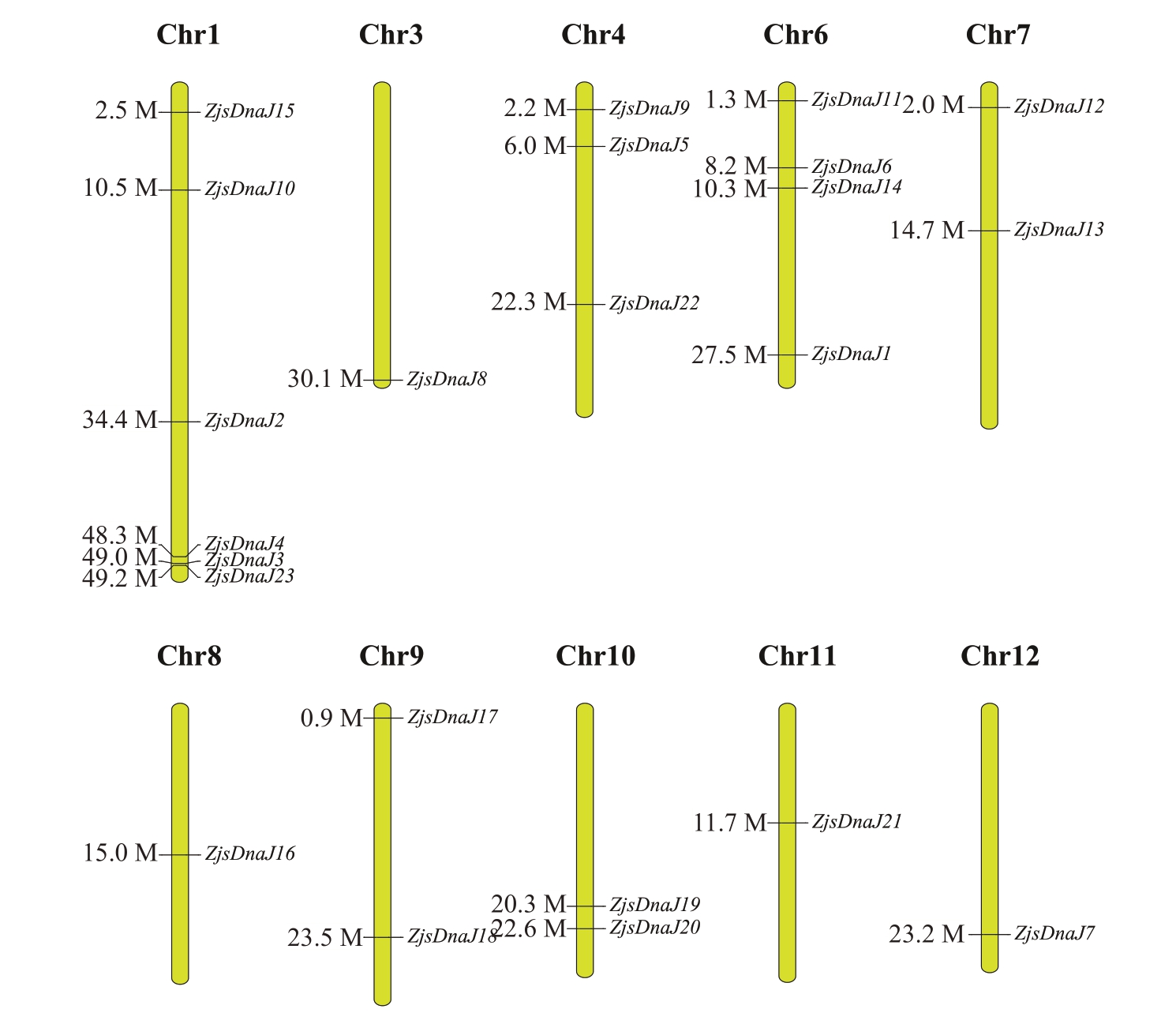
图4 ZjsDnaJ 基因的染色体定位
Fig.4 Chromosomal localization of the ZjsDnaJ genes
在酸枣ZjsDnaJ 基因家族上游2000 bp的启动子区域共鉴定出30个顺式作用元件,主要包括生长发育类、环境胁迫响应、激素响应、光响应等元件(图5),推测ZjsDnaJ 基因家族在生物与非生物胁迫中发挥重要作用。其中,ABRE元件参与脱落酸响应,MBS元件为MYB结合位点,ARE元件响应细胞脱水,均在干旱胁迫响应中发挥作用。
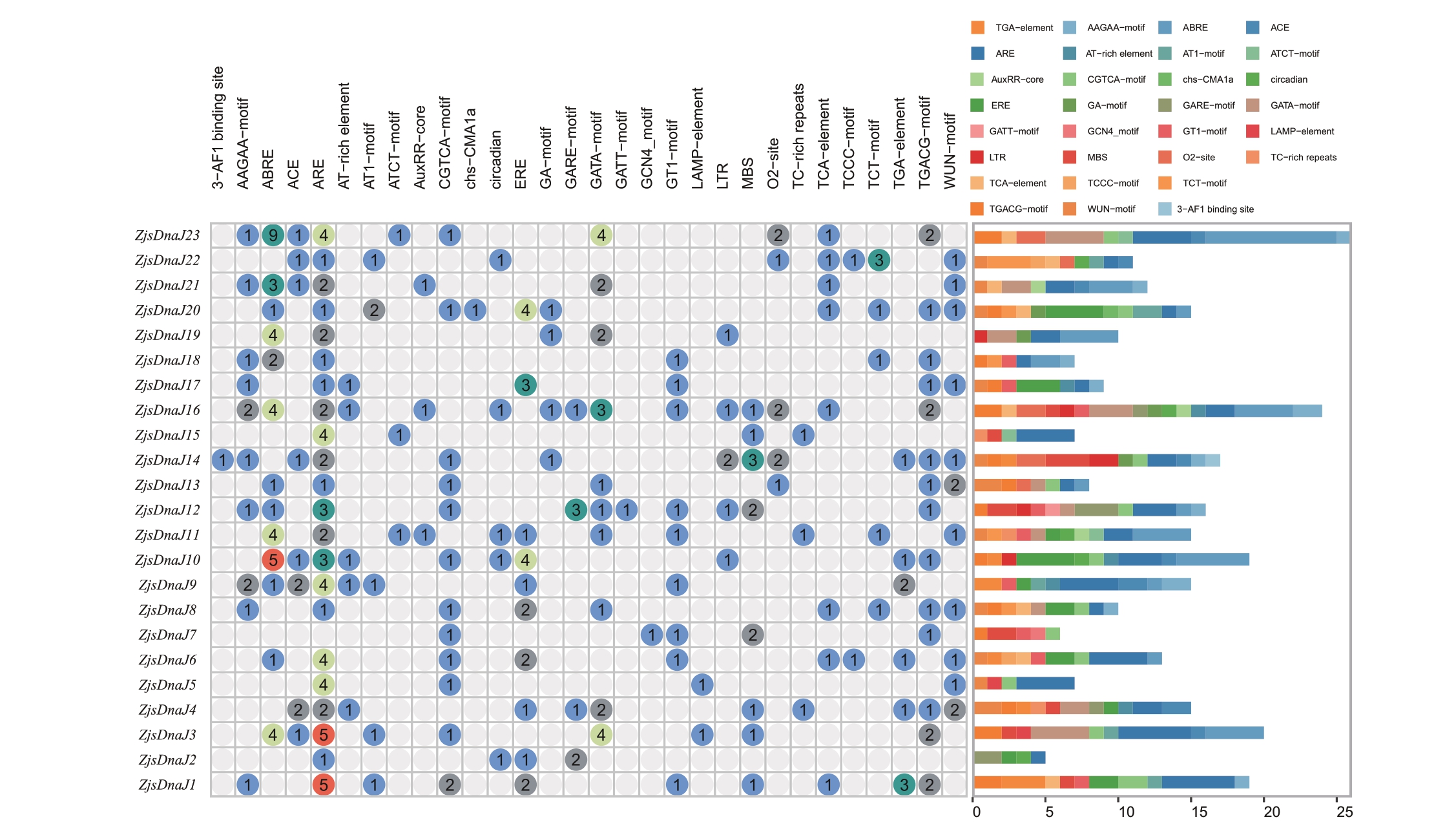
图5 ZjsDnaJ 基因家族顺式作用元件分析
Fig.5 Analysis of cis-acting elements of the ZjsDnaJ gene family
2.5 酸枣ZjsDnaJ基因家族干旱胁迫下的表达模式分析
基于酸枣干旱胁迫下不同组织的转录组数据,标准化处理后绘制表达图谱(图6)。23个ZjsDnaJ基因在酸枣不同组织中呈现差异表达,根据其表达特征分为A、B、C三个组。A组基因集中在酸枣根部高表达,在茎部也有较高表达,而在叶片中表达量相对较低;B组基因集中在酸枣叶片中高表达,在根和茎中表达量较低;C组基因则在酸枣叶和茎中均高表达,而在根部表达量较低。在D1、D2、D3处理下,A组中ZjsDnaJ2在酸枣根部的表达量较对照上调;B组中ZjsDnaJ3、ZjsDnaJ12、ZjsDnaJ14等在酸枣叶片中的表达量均较对照上调,其中ZjsDnaJ12在酸枣茎中也呈上调表达趋势;C组中ZjsDnaJ15、ZjsDnaJ19在酸枣叶片和茎部的表达量均较对照上调。

图6 干旱胁迫下的ZjsDnaJ 基因表达热图
Fig.6 Heat map of ZjsDnaJ genes expression under drought stress
CK-R、CK-S、CK-L为正常供水下的根、茎、叶;D1-R、D1-S、D1-L为轻度干旱胁迫下的根、茎、叶;D2-R、D2-S、D2-L为中度干旱胁迫下的根、茎、叶;D3-R、D3-S、D3-L为重度干旱胁迫下的根、茎、叶。
CK-R,CK-S,and CK-L represent root,stem,and leave under normal water supply condition;D1-R,D1-S,and D1-L represent root,stem,and leave under mild drought stress;D2-R,D2-S,and D2-L represent root,stem,and leave under moderate drought stress;D3-R,D3-S,and D3-L represent root,stem,and leave under severe drought stress.
2.6 干旱胁迫下ZjsDnaJ基因的qRT-PCR表达分析
基于酸枣干旱胁迫下的转录组数据,筛选11个高表达的ZjsDnaJ基因,进行qRT-PCR分析。如图7所示,11个ZjsDnaJ 基因在酸枣不同组织中呈现差异表达,且同一基因在不同程度的干旱胁迫下表达水平存在差异。在干旱胁迫下,ZjsDnaJ2、ZjsDnaJ3、ZjsDnaJ14(D1处理除外)、ZjsDnaJ15 在酸枣幼苗根部的表达量均显著高于对照,其中ZjsDnaJ3、ZjsDnaJ14 分别在D1和D2处理下表达量最高,ZjsDnaJ2、ZjsDnaJ15 则在D3处理下最高;Zjs-DnaJ3、ZjsDnaJ4、ZjsDnaJ12、ZjsDnaJ15、ZjsDnaJ19 在酸枣茎中的表达量均显著高于对照,其中ZjsDnaJ3、ZjsDnaJ4、ZjsDnaJ19 在D1处理下的表达量最高,ZjsDnaJ12、ZjsDnaJ15 则在D3处理下最高;ZjsDnaJ3、ZjsDnaJ12、ZjsDnaJ13、ZjsDnaJ14、ZjsDnaJ15(D3处理除外)、ZjsDnaJ19 在酸枣叶片中的表达量较对照均显著上调,其中ZjsDnaJ12、ZjsDnaJ14、ZjsDnaJ15 在D1处理下的表达量最高,ZjsDnaJ3、ZjsDnaJ13、ZjsDnaJ19 在D2处理下最高。综上所述,ZjsDnaJ 基因积极响应干旱胁迫,但在不同组织及不同程度的干旱胁迫下其功能存在差异。
2.7 干旱胁迫下酸枣幼苗的生理生化响应
在干旱胁迫下,植物体内丙二醛含量升高,同时积累可溶性糖、脯氨酸等渗透调节物质来降低渗透势,并通过POD、CAT等酶的协同作用以抵御干旱胁迫。如图8所示,随着干旱胁迫的持续,各处理下的脯氨酸含量均显著高于对照,分别在第10天、第15天达到峰值,其中D3处理下的脯氨酸含量最高;各处理下的丙二醛含量均高于对照,整体呈先升高后降低的趋势,D3处理下丙二醛含量在第5天、第10天时显著高于其他处理;在第5天、第10天时以D3处理下的可溶性糖含量最高,在第15天时以D2处理最高,而在第20天则以D1处理最高;各处理下POD活性均呈先升高后降低的趋势,D1处理下POD活性第20天达到峰值,D2处理下第15天达到峰值,D3处理下第10天达到峰值;D3处理下CAT活性在第5天和第10天显著高于其他处理,并在第10天达到峰值,而D1和D2处理下的酶活性先升高后降低,于第15天达到峰值。

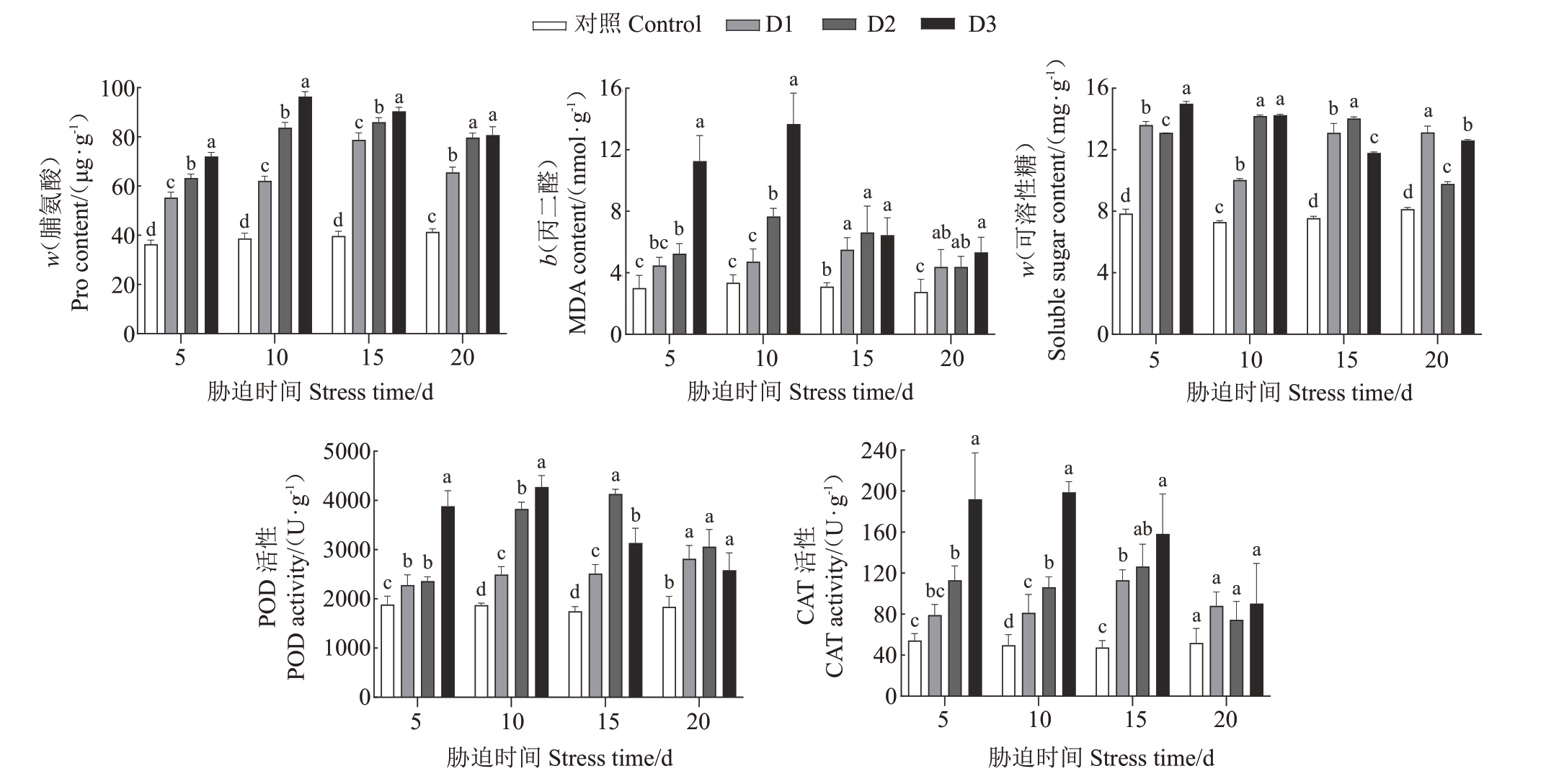
图8 酸枣幼苗对干旱胁迫的生理生化响应
Fig.8 Physiological and biochemical responses of Ziziphus jujuba var.spinosa seedlings to drought stress
不同小写字母表示在P<0.05差异显著。
Different small letters indicate significant difference at P<0.05.
3 讨论
酸枣是典型的耐旱树种,通过维持高水势来减少脱水以抵御干旱[18]。研究显示,DnaJ蛋白作为Hsp70蛋白重要的伴侣蛋白,通过识别底物和激活Hsp70来行使细胞功能,从而广泛参与植物对逆境胁迫的响应[19]。本研究共鉴定到23个DnaJ 基因(ZjsDnaJ1~ZjsDnaJ23),少于黄瓜(Cucumis sativus L.)[20]、拟南芥(Arabidopsis thaliana)[21]、水稻(Oryza sativa L.)[22]和棉花(Gossypium raimondii)[23]的DnaJ家族成员数量,这可能是因为DnaJ基因在不同物种中的扩增程度存在差异。
笔者利用生物信息学方法对酸枣ZjsDnaJ基因家族进行了系统分析。23个ZjsDnaJ基因编码的蛋白在理化性质上存在一定差异,包括碱性蛋白和酸性蛋白,均为亲水性蛋白;亚细胞定位预测表明,23个成员定位于叶绿体、细胞质、细胞核及线粒体中,表明酸枣ZjsDnaJ基因家族具有功能多样性,推测其主要在叶绿体、细胞质、细胞核及线粒体的酸性或碱性水溶液中参与调控反应,这在一定程度上解释了酸枣通过维持高水势来减少脱水以抵御干旱的机制。在酸枣ZjsDnaJ基因家族中共鉴定到10个Motif,所有成员均含有Motif1和Motif2,其中Motif1包含由组氨酸(H)、脯氨酸(P)、天冬氨酸(D)组成的HPD三钛序列,是DnaJ蛋白J结构域的典型特征[21],表明酸枣ZjsDnaJ家族具有高保守性;不同亚家族成员的基序具有一定差异,表明ZjsDnaJ成员间的功能具有多样性[24]。对酸枣ZjsDnaJ家族保守结构域的分析表明,ZjsDnaJ 家族包含DnaJ、DnaJ-C、DnaJ-bact、DnaJ-zf等8个结构域,表明了ZjsDnaJ家族功能的多样性。
DnaJ基因的系统进化树揭示了其在酸枣、马铃薯、冬枣、番茄、拟南芥中的亲缘关系及进化特性,表明DnaJ 基因在5个物种间具有一定的进化保守性。启动子区域的顺式作用元件是决定基因在细胞间表达时空调控模式的重要因素,在逆境胁迫下通过调控抗逆基因的表达,从而提高植物的抗逆性[25-26]。本研究在ZjsDnaJ 基因家族启动子区域鉴定到生长发育类、环境胁迫响应、激素响应、光响应等元件,表明DnaJ 基因可能在酸枣的生长发育、逆境胁迫响应等过程中发挥作用,这与楸树(Catalpa bungei)[27]、丹参(Salvia miltiorrhiza)[28]中的DnaJ 基因功能相似。在干旱胁迫下,植物通过合成脱落酸、活性氧等激活免疫系统以抵御胁迫[29]。本研究在启动子区域鉴定到ABRE、MBS及ARE等元件,与脱落酸、活性氧等合成过程相关,表明它们可能在响应干旱胁迫中发挥作用。
研究表明,DnaJ蛋白在植物响应干旱、高温、低温等多种胁迫过程中发挥作用[30]。ZjsDnaJ 基因家族在干旱胁迫下的转录谱表明,在酸枣幼苗的不同器官及不同干旱胁迫水平下,ZjsDnaJ基因呈现明显的差异表达模式,印证了DnaJ蛋白参与干旱胁迫的应答过程。根系的空间分布、生理活性及渗透调节能力是植物耐旱性的生理基础[31]。在不同干旱胁迫水平下,酸枣根部ZjsDnaJ的表达模式存在差异,其中ZjsDnaJ2 在3个梯度胁迫下的表达量均高于对照。植物茎部通过维管组织变化、渗透调节、肉质化等方式来抵御干旱胁迫[32]。酸枣茎部ZjsDnaJ 在不同干旱胁迫水平下呈明显差异表达,其中ZjsDnaJ12、ZjsDnaJ15、ZjsDnaJ19 在3个梯度干旱胁迫下较对照均呈上调表达。在干旱胁迫下,植物叶片通过气孔调节、渗透势调节、提高抗氧化酶活性等方式来抵御细胞氧化损伤[33-34]。酸枣叶片ZjsDnaJ 在不同干旱胁迫水平下的表达量存在显著差异,其中ZjsDnaJ3、ZjsDnaJ12、ZjsDnaJ14、ZjsDnaJ15、ZjsDnaJ19 在3个梯度干旱胁迫下的表达量均高于对照。ZjsDnaJ2、ZjsDnaJ3、ZjsDnaJ12、ZjsDnaJ14、ZjsDnaJ15、ZjsDnaJ19 在各个梯度胁迫下的酸枣不同组织中呈高表达,在各梯度胁迫下的相对表达量也高于对照,推测它们为酸枣响应干旱胁迫的关键基因。
4 结论
笔者系统鉴定了酸枣ZjsDnaJ 基因家族成员,探究了该基因家族的理化特性、结构组成、系统进化、顺式作用元件等关键特征,明确了ZjsDnaJ基因家族的结构和功能特点。ZjsDnaJ2(根)、ZjsDnaJ12(茎、叶)、ZjsDnaJ15(根、茎)、ZjsDnaJ19(茎)、ZjsDnaJ3(叶)、ZjsDnaJ14(叶)在酸枣响应干旱胁迫过程中均呈高表达,推测上述基因为酸枣响应干旱胁迫的候选关键基因。
[1] 樊芳菲,杨暹,康云艳,柴喜荣,蒙林平.植物DnaJ蛋白的研究进展[J].分子植物育种,2018,16(6):2028-2034.Fan Fangfei,Yang Xian,Kang Yunyan,Chai Xirong,Meng Linping.Research progress on DnaJ proteins in plants[J].Molecular Plant Breeding,2018,16(6):2028-2034.
[2] Georgopoulos C P,Lundquist-heil A,Yochem J,Feiss M.Identification of the E.coli DnaJ gene product[J].Molecular and General Genetics,1980,178(3):583-588.
[3] Silver P A,Way J C.Eukaryotic DnaJ homologs and the specificity of Hsp70 activity[J].Cell,1993,74(1):5-6.
[4] 祁茂冬,谢鑫,魏凤菊.禾本科植物HSP70研究进展[J].植物生理学报,2019,55(8):1054-1062.Qi Maodong,Xie Xin,Wei Fengju.Research progress of HSP70s in Poaceae[J].Plant Physiology Journal,2019,55(8):1054-1062.
[5] Walsh P,Bursać D,Law Y C,Cyr D,Lithgow T.The J-protein family:Modulating protein assembly,disassembly and translocation[J].The EMBO Reports,2004,5(6):567-571.
[6] Xia Z L,Zhang X Q,Li J Q,Su X H,Liu J J.Overexpression of a tobacco J-domain protein enhances drought tolerance in transgenic Arabidopsis[J].Plant Physiology and Biochemistry,2014,83:100-106.
[7] Pulido P,Leister D.Novel DNAJ-related proteins in Arabidopsis thaliana[J].New Phytologist,2018,217(2):480-490.
[8] 陈斯茗,卢山.植物DnaJ-Like锌指蛋白的功能研究[J].植物生理学报,2015,51(5):586-592.Chen Siming,Lu Shan.Recent studies on the DnaJ-like zinc finger proteins[J].Plant Physiology Journal,2015,51(5):586-592.
[9] Verma A K,Tamadaddi C,Tak Y,Lal S S,Cole S J,Hines J K,Sahi C.The expanding world of plant J-domain proteins[J].Critical Reviews in Plant Sciences,2019,38(5/6):382-400.
[10] Jung K H,Gho H J,Nguyen M X,Kim S R,An G.Genomewide expression analysis of HSP70 family genes in rice and identification of a cytosolic HSP70 gene highly induced under heat stress[J].Functional &Integrative Genomics,2013,13(3):391-402.
[11] Zhao Z C,Zhang W R,Yan J P,Zhang J J,Liu Z,Li X F,Yi Y.Over-expression of Arabidopsis DnaJ(Hsp40)contributes to Na-Cl-stress tolerance[J].African Journal of Biotechnology,2010,9(7):972-978.
[12] Cao L R,Wang G R,Fahim A M,Pang Y Y,Zhang Q J,Zhang X,Wang Z H,Lu X M.Comprehensive analysis of the DnaJ/HSP40 gene family in maize (Zea mays L.) reveals that ZmDnaJ96 enhances abiotic stress tolerance[J].Journal of Plant Growth Regulation,2024,43(5):1548-1569.
[13] Wang G D,Cai G H,Kong F Y,Deng Y S,Ma N N,Meng Q W.Overexpression of tomato chloroplast-targeted DnaJ protein enhances tolerance to drought stress and resistance to Pseudomonas solanacearum in transgenic tobacco[J].Plant Physiology and Biochemistry,2014,82:95-104.
[14] Shimizu T,Yoshii A,Sakurai K,Hamada K,Yamaji Y,Suzuki M,Namba S,Hibi T.Identification of a novel tobacco DnaJ-like protein that interacts with the movement protein of tobacco mosaic virus[J].Archives of Virology,2009,154(6):959-967.
[15] 武丽娜,何华容,武延生,牛伟涛.野生酸枣叶中蛋白质、维生素C和矿物质含量的测定[J].现代园艺,2021,44(3):40-41.Wu Lina,He Huarong,Wu Yansheng,Niu Weitao.Determination of protein,vitamin C and mineral content in wild jujube leaves[J].Contemporary Horticulture,2021,44(3):40-41.
[16] 孙耀文,马迎梅,王树森,张宏武,温苏雅勒图,秦素娟.内蒙古西部野生酸枣种质资源的评价与分析[J].北方园艺,2023(17):25-34.Sun Yaowen,Ma Yingmei,Wang Shusen,Zhang Hongwu,Wen Suyaletu,Qin Sujuan.Evaluation and analiysis of wild sour jujube germplasm from west of Inner Mongolia[J].Northern Horticulture,2023(17):25-34.
[17] 张悦.基于SNP基因分型的宁夏野生酸枣抗旱性状QTL定位[D].银川:宁夏大学,2023.Zhang Yue.QTL mapping of drought-resistant traits based on SNP of wild jujube (Ziziphus jujuba Mill.var. spinosa) in Ningxia[D].Yinchuan:Ningxia University,2023.
[18] 武延生,武丽娜,牛伟涛,张鹏飞,刘华梁,李欢,王僧虎.酸枣耐旱性辨析[J].林业科技通讯,2021(3):88-91.Wu Yansheng,Wu Lina,Niu Weitao,Zhang Pengfei,Liu Hualiang,Li Huan,Wang Senghu.Differentiation and analysis on drought-tolerance of Ziziphus jujuba var. spinosa[J].Forest Science and Technology,2021(3):88-91.
[19] 汪涛,嵇泽琳,杜清洁,李娟起,汪虎,王吉庆,肖怀娟,李猛.基于转录组测序的甜瓜DNAJ 基因家族鉴定与表达分析[J].农业生物技术学报,2025,33(6):1234-1245.Wang Tao,Ji Zelin,Du Qingjie,Li Juanqi,Wang Hu,Wang Jiqing,Xiao Huaijuan,Li Meng.Identification and expression analysis of DNAJ gene family in melon (Cucumis melo) based on transcriptome sequencing[J].Journal of Agricultural Biotechnology,2025,33(6):1234-1245.
[20] 宋蒙飞,王星,张开京,陈劲枫,娄群峰.黄瓜DnaJ 基因家族鉴定及对高温胁迫的表达响应[J].南京农业大学学报,2021,44(2):267-277.Song Mengfei,Wang Xing,Zhang Kaijing,Chen Jinfeng,Lou Qunfeng.Identification of DnaJ gene family in cucumber and its expression response to high temperature stress[J].Journal of NanjingAgricultural University,2021,44(2):267-277.
[21] Miernyk J A.The J-domain proteins of Arabidopsis thaliana:An unexpectedly large and diverse family of chaperones[J].Cell Stress&Chaperones,2001,6(3):209-218.
[22] 赵旭,刘向国,王爱荣.水稻DnaJ蛋白的生物信息学分析[J].亚热带农业研究,2011,7(3):206-211.Zhao Xu,Liu Xiangguo,Wang Airong.Bioinformatic analysis of the DnaJ protein family in rice[J].Subtropical Agriculture Research,2011,7(3):206-211.
[23] 徐珍珍,郭琪,刘静,徐鹏,张香桂,沈新莲.雷蒙德氏棉DnaJ蛋白的生物信息学预测及盐胁迫下的表达分析[J].棉花学报,2015,27(5):391-400.Xu Zhenzhen,Guo Qi,Liu Jing,Xu Peng,Zhang Xianggui,Shen Xinlian.Genome-wide identification and expression pattern analysis of the DnaJ protein family in Gossypium raimondii under salt stress using a bioinformatics method[J].Cotton Science,2015,27(5):391-400.
[24] 孙廷珍,疏琴,马玮,史玉滋,张蒙,向成钢,薄凯亮,段颖,王长林.印度南瓜GAox家族基因鉴定及其在不同蔓长种质中的表达[J].园艺学报,2025,52(3):603-622.Sun Tingzhen,Shu Qin,Ma Wei,Shi Yuzi,Zhang Meng,Xiang Chenggang,Bo Kailiang,Duan Ying,Wang Changlin.Identification and phylogenetic analysis of gibberellin oxidase gene family and its expression pattern in main vine growth in Cucurbita maxima[J].Acta Horticulturae Sinica,2025,52(3):603-622.
[25] Jin H Q,Xing M G,Cai C M,Li S.B-box proteins in Arachis duranensis:Genome-wide characterization and expression pro-files analysis[J].Agronomy,2020,10(1):1-17.
[26] 杨柳烟,欧斯扬,张素勤,耿广东.辣椒响应逆境胁迫的诱导型启动子研究进展[J].中国瓜菜,2024,37(12):1-8.Yang Liuyan,Ou Siyang,Zhang Suqin,Geng Guangdong.Research progress on inducible promoters of pepper in response to stresses[J].China Cucurbits and Vegetables,2024,37(12):1-8.
[27] 杨英英.楸树DnaJ 基因家族分析以及CbuDnaJ49 在叶色调控中的功能研究[D].宜昌:三峡大学,2022.Yang Yingying.Identification and evolution analysis of the DnaJ gene family in Catalpa bungei and study on the function of CbuDnaJ49 gene in leaf color regulation[D].Yichang:China Three Gorges University,2022.
[28] 方鑫,杨峥,王晨旭,孙雨欣,张斌,麻鹏达.丹参DnaJ 基因的鉴定及胁迫响应分析[J].南京农业大学学报,2022,45(1):94-102.Fang Xin,Yang Zheng,Wang Chenxu,Sun Yuxin,Zhang Bin,Ma Pengda.Identification and stress response analysis of DnaJ gene in Salvia miltiorrhiza[J].Journal of Nanjing Agricultural University,2022,45(1):94-102.
[29] 尹言言,刘靖,郑炳松,闫道良.脱落酸调控植物非生物胁迫研究进展[J].核农学报,2025,39(9):1916-1927.Yin Yanyan,Liu Jing,Zheng Bingsong,Yan Daoliang.Research progress of abscisic acid in regulating plant abiotic stress[J].Journal of Nuclear Agricultural Sciences,2025,39(9):1916-1927.
[30] Scarpeci T E,Zanor M I,Carrillo N,Mueller-roeber B,Valle E M.Generation of superoxide anion in chloroplasts of Arabidopsis thaliana during active photosynthesis:A focus on rapidly induced genes[J].Plant Molecular Biology,2008,66(4):361-378.
[31] 刘莹.大豆根区逆境耐性的鉴定和相关根系性状的遗传分析与QTL定位[D].南京:南京农业大学,2005.Liu Ying.Identification of tolerance to rhizosperical stresses and inheretance and QTL locatting of related root traits in soybean[Glycine max(L.)Merr.][D].Nanjing:Nanjing Agricultural University,2005.
[32] Mcdowell N,Pockman W T,Allen C D,Breshears D D,Cobb N,Kolb T,Plaut J,Sperry J,West A,Williams D G,Yepez E A.Mechanisms of plant survival and mortality during drought:Why do some plants survive while others succumb to drought[J].New Phytologist,2008,178(4):719-739.
[33] Chaves M M,Flexas J,Pinheiro C.Photosynthesis under drought and salt stress:Regulation mechanisms from whole plant to cell[J].Annals of Botany,2009,103(4):551-560.
[34] 王朝英,方文,陈丽花,马立辉,刘杨,谢英赞.红叶加拿大紫荆对不同强度干旱胁迫的生长及生理响应[J].北方园艺,2020(20):62-69.Wang Chaoying,Fang Wen,Chen Lihua,Ma Lihui,Liu Yang,Xie Yingzan.Growth and physiological response of Cercis canadensis‘Forest Pansy’under different drought stress[J].Northern Horticulture,2020(20):62-69.