γ-氨基丁酸(GABA)是一种广泛存在于植物中的非蛋白氨基酸。研究显示,内源GABA积累会影响杨树的碳氮代谢、激素稳态和信号级联反应,负调控不定根的形成[1]。外源GABA通过抑制苹果中镉的摄取和转运相关基因的表达,进而缓解镉胁迫[2]。干旱条件下,GABA通过负调控ALMT9活性调节拟南芥气孔开放,从而提高其水分利用率和抗旱能力[3]。在烟草中,harpin蛋白通过激活GABA支路增强对病原菌的抗性[4]。可见,GABA在植物生长发育、代谢调控以及生物与非生物胁迫响应中发挥重要作用,而谷氨酸脱羧酶(GAD,EC 4.1.1.15)是催化谷氨酸发生脱羧反应转化为GABA的关键限速酶[5]。GAD是一种典型的磷酸吡哆醛依赖性酶,在其羧基末端普遍存在一个钙调蛋白(calmodulin,CaM)结构域[6-8],其活性受Ca2+/CaM复合体的调控[9]。近年来,GAD基因家族在拟南芥、水稻、棉花、玉米、杨树、苹果等植物的功能研究中已取得显著进展[10-15],但其在柑橘亚科中的进化特征及表达调控机制仍不明确。
柑橘亚科植物包含柑橘属、金柑属、枳属等重要经济作物,在栽培过程中常面临土壤酸化、盐渍化、低温及季节性干旱等非生物胁迫,进而抑制生长。尽管在甜橙等柑橘物种中已有GAD 基因表达的初步报道[16],但柑橘亚科内GAD 基因的系统进化关系、蛋白结构及其对GABA响应的功能保守性尚缺乏系统研究。此外,GABA作为信号分子是否参与及如何反馈调控GAD 表达尚不明确。枳作为柑橘类果树的优良砧木种质资源,其GAD基因的组织特异性及对GABA的响应机制仍有待解析。本研究以柑橘亚科10个已公布基因组的代表性物种为对象,通过全基因组水平的基因鉴定与进化分析,深入解析柑橘亚科植物GAD基因结构及其进化关系,同时结合枳幼苗分析GAD 基因家族的组织特异性及其对GABA的响应,为柑橘砧木抗逆分子育种提供候选基因资源。
1 材料和方法
1.1 试验材料与处理
本研究以枳(Poncirus trifoliata)为试验材料。选取籽粒饱满、大小一致的种子,于室温下蒸馏水浸泡12 h,依次经5% NaClO溶液消毒15 min、75%乙醇消毒90 s,最后用无菌去离子水充分冲洗3~4次。将消毒后的种子置于30 ℃黑暗条件下催芽。待种子露白后,播种于含0.65%琼脂的培养基中,并移入人工气候箱培养。培养条件:昼夜温度28 ℃/28 ℃,光周期16 h光照/8 h黑暗,相对湿度70%。培养10 d后,将幼苗转移至水培盒中进行水培。营养液组成与浓度参照课题组前期确定的配方[17],每2 h通气20 min。预培养4 d后,选取长势一致的健壮幼苗,于营养液中外源添加0.1 mmol·L-1 GABA,该浓度基于课题组前期筛选试验确定[18]。分别于处理0、0.5、2、6、24、48 h后采集新鲜植株根、茎、叶样品,立即用液氮速冻,并于-80 ℃超低温冰箱中保存,用于后续RNA提取及基因表达分析。
1.2 柑橘亚科植物GAD基因鉴定及理化性质分析
从柑橘基因组数据库(http://citrus.hzau.edu.cn/download.php)中下载酒饼簕(Atalantia buxfoliata)、克里曼丁橘(Citrus clementina)、晚白柚(Citrus grandis L.Osbeck.‘Wanbaiyou’)、宜昌橙(Citrus ichangensis)、枸橼(Citrus medica)、宽皮橘(Citrus reticulata)、甜橙(Citrus sinensis)、山金柑(Fortunella hindsii)、枳(Poncirus trifoliata)和马家柚(Citrus grandis L.Osbeck.‘Cupi Majiayou’)的基因组和蛋白质数据。在NCBI数据库(https://www.ncbi.nlm.nih.gov)中检索并下载拟南芥AtGADs蛋白序列作为参考序列,在Pfam数据库(https://www.ebi.ac.uk/interpro/)下载含GAD保守结构域的隐马尔科夫模型(PF00282),使用TBtools[19]的BLAST(E-value阈值:e-10)功能分别进行比对,得到候选基因的蛋白序列,并提交至NCBI保守域数据库(CDD)验证。同时,通过ExPASy ProtParam网站(https://web.expasy.org/protparam/)预测蛋白质分子质量、理论等电点(pI)、不稳定系数等。通过WoLF PSORT网站(https://www.genscript.com/wolf-psort.html)进行亚细胞定位分析。使用SOPMA(http://npsa-pbil.ibcp.fr/cgi-bin/npsa_automat.pl page=npsa_sopma.html)和SWISS-MODEL在线网站(https://swissmodel.expasy.org/)进行蛋白质二级和三级结构预测。通过NetPhos-3.1在线网站(https://services.healthtech.dtu.dk/services/NetPhos-3.1/)进行磷酸化位点预测。
1.3 柑橘亚科植物GAD 基因系统进化、保守基序和结构分析
在Phytozome网站(https://phytozome-next.jgi.doe.gov/)下载小麦(Triticum aestivum)的GAD 基因蛋白序列,在NCBI网站下载拟南芥(Arabidopsis thaliana)、番茄(Solanum lycopersicum)、葡萄(Vitis vinifera)、白杨(Populus alba)、花生(Arachis hypogaea)的GAD 基因蛋白序列,使用MEGA11软件将其与10个柑橘亚科物种的GAD蛋白质序列进行比对,采用邻接法构建系统发育树,bootstrap值设置为1000。蛋白保守基序通过MEME在线网站(https://meme-suite.org/meme/tools/meme)进行分析。基因结构基于GAD 基因组注释文件中的内含子和外显子相关信息,使用TBtools软件进行绘图,随后将系统发育树、基因结构及保守结构基序在TBtools软件中进行整合。
1.4 柑橘亚科植物GAD 基因顺式作用元件及共线性分析
使用TBtools截取GAD 基因起始密码子上游2000 bp的启动子序列,利用PlantCARE在线网站(https://bioinformatics.psb.ugent.be/webtools/plant -care/html/)对启动子区域顺式作用元件进行预测,分析基因功能并使用TBtools软件进行可视化。使用Tbtools软件查找枳PtrGADs 基因中的串联重复与片段复制基因,并使用Advanced Circos绘制基因组内共线性图谱。使用Tbtools软件分析枳、甜橙、拟南芥三个物种间GAD基因的共线性关系。
1.5 RNA提取与qRT-PCR分析
使用Primer Premier 5软件设计PtrGADs 基因qPCR特异性引物,以柑橘ACTIN 为内参基因[20](表1)。总RNA提取与反转录使用北京全式金生物公司的TransZol Up Plus RNA Kit和EasyScript® One-Step gDNA Removal and cDNA Synthesis SuperMix试剂盒,qRT-PCR检测使用荧光定量专用试剂SYBR qPCR Master Mix。利用2-ΔΔCt法计算基因相对表达量,使用SPSS 26.0软件进行显著性分析(P<0.05),并采用Waller Duncan检验方法进行统计分析。
表1 枳GAD 基因qRT-PCR引物
Table 1 qRT-PCR primers of GAD family genes in Poncirus trifoliata

2 结果与分析
2.1 柑橘亚科植物GAD基因鉴定及蛋白理化性质分析
为系统鉴定柑橘亚科植物中GAD基因家族,本研究对10个代表性物种(酒饼簕、克里曼丁橘、晚白柚、宜昌橙、枸橼、宽皮橘、甜橙、山金柑、枳和马家柚)进行了全基因组水平鉴定。由表2可知,共鉴定出21个GAD 基因,除枳含有3个成员(PtrGAD1,PtrGAD2,PtrGAD3)外,其余物种均为2个。根据与拟南芥GAD蛋白的同源性,对鉴定到的GAD 基因进行命名。经NCBI保守结构域数据库分析确认,21个GAD 基因编码蛋白均包含典型Glu-decarb-GAD结构域,表明其功能保守。GAD蛋白理化性质预测结果显示,GAD蛋白序列长度高度保守,为494或498个氨基酸;相对分子质量为56.194~56.294 kDa;理论等电点为5.44~5.97,均为酸性蛋白。除PtrGAD1(40.27)外,其余蛋白的不稳定系数均低于40,表明大部分GAD蛋白性质稳定。平均亲水性系数为-0.296~-0.236,证实GAD蛋白均为亲水性蛋白。亚细胞定位预测结果显示,GAD蛋白均定位于细胞质。上述结果表明,柑橘亚科植物GAD蛋白为一类性质稳定、亲水的酸性蛋白。
表2 柑橘亚科植物GAD 基因理化性质分析
Table 2 Physicochemical properties of GAD genes in aurantioideae

注:Ab.酒饼簕;Ccl.克里曼丁橘;Cg.晚白柚;Ci.宜昌橙;Cm.枸橼;Cre.宽皮橘;Cs.甜橙;sjg.山金柑;Ptr.枳;Cmg.马家柚。下同。
Note:Ab.Atalantia buxfoliata;Ccl.Citrus clementina;Cg.Citrus grandis L.Osbeck.cv.‘Wanbaiyou’;Ci.Citrus ichangensis;Cm.Citrus medica;Cre.Citrus reticulata;Cs.Citrus sinensis;sjg.Fortunella hindsii;Ptr.Poncirus trifoliata;Cmg.Citrus grandis L.Osbeck.cv.‘Cupi Majiayou’.The same below.
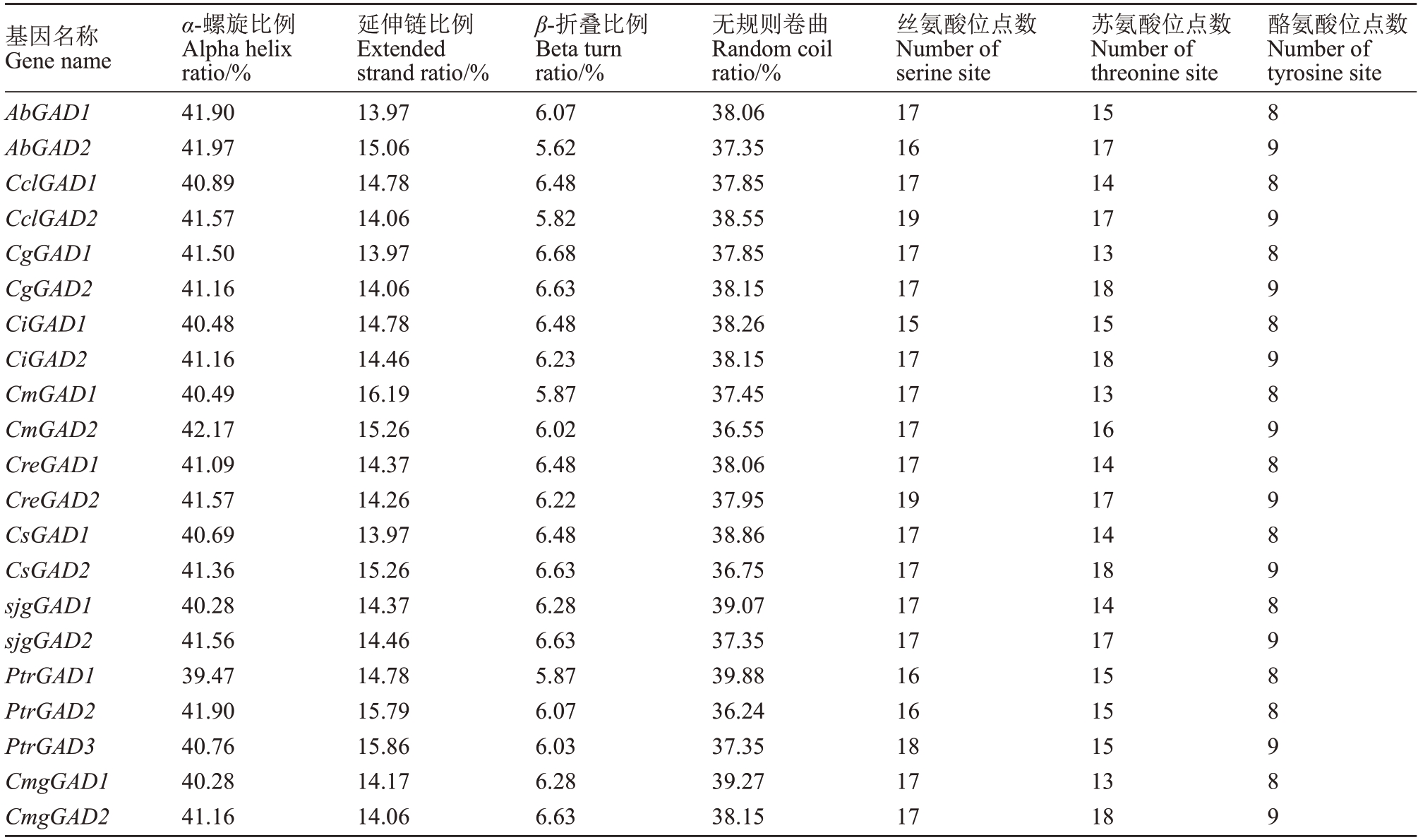
GAD蛋白二级结构预测分析表明(表3),α-螺旋和无规则卷曲是主要结构元件,而β-折叠占比最小。进一步利用同源建模预测三级结构,以枳的PtrGADs蛋白为例,发现3个成员结构相似度高,且均可能形成同源六聚体结构(图1)。此外,磷酸化位点预测显示,GAD蛋白均含有约40个潜在的磷酸化位点。其中,CclGAD2和CreGAD2最多(45个),CgGAD1、CiGAD1、CmGAD1和CmgGAD1最少(38个),暗示其活性可能受到广泛的转录后调控。
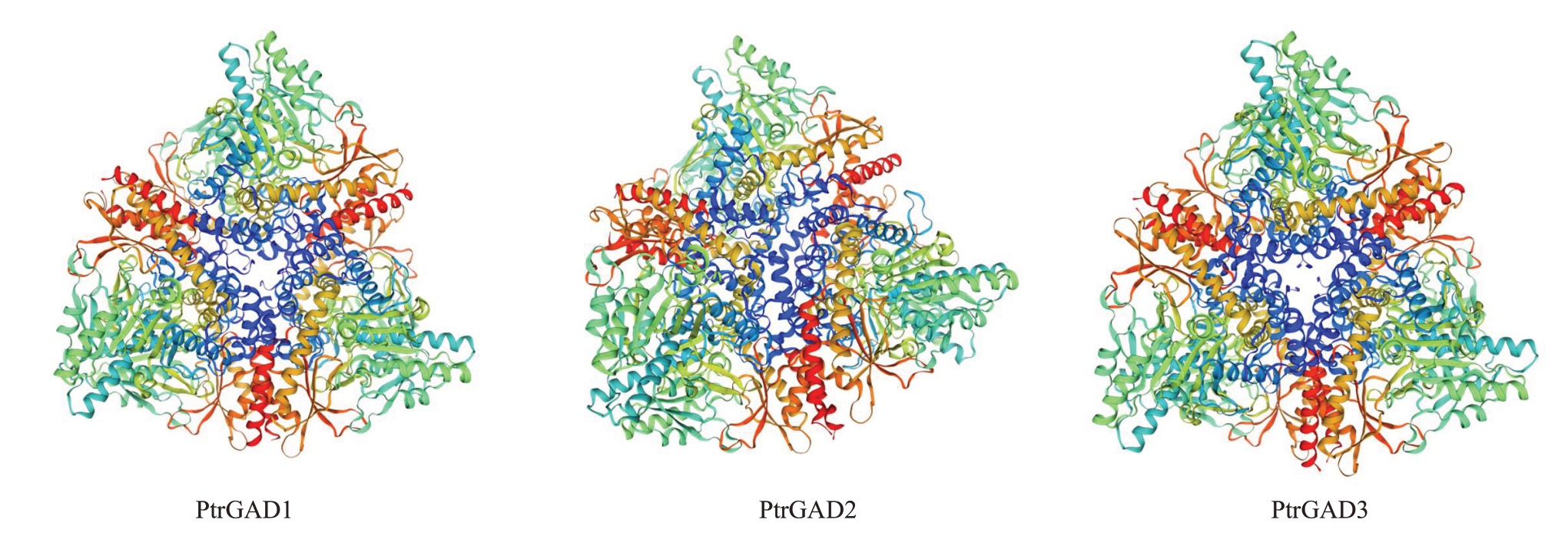
图1 枳PtrGADs蛋白三级结构预测
Fig.1 Tertiary structure of PtrGADs protein in trifoliate orange
表3 柑橘亚科植物GAD 基因二级结构和磷酸化位点
Table 3 Secondary structure and phosphorylation site of GAD genes in aurantioideae
2.2 柑橘亚科植物GAD 基因系统进化、保守基序和结构分析
为阐明柑橘亚科植物GAD基因间的进化关系,对10个物种的21个GAD蛋白序列进行系统进化分析。结果表明,GAD蛋白可被划分为三个亚家族(Ⅰ、Ⅱ、Ⅲ),且每个亚家族均包含来自不同物种的成员,揭示了基因家族的扩张模式(图2-A)。具体而言,第Ⅰ亚家族包含8个成员,其中克里曼丁橘CclGAD1 与甜橙CsGAD1、晚白柚CgGAD1 与马家柚CmgGAD1 分别聚为一支,具有较近的亲缘关系。第Ⅱ亚家族成员数量最少,仅包含3个基因,分别为枳PtrGAD1、PtrGAD2 和宜昌橙CiGAD1。第Ⅲ亚家族是最大的群组,包含10个成员,其进化拓扑结构更为复杂,酒饼簕AbGAD2、枳PtrGAD3、枸橼CmGAD2和山金柑sjgGAD2各自形成独立分支,而宽皮橘CreGAD2 与克里曼丁橘CclGAD2 则聚为一支。
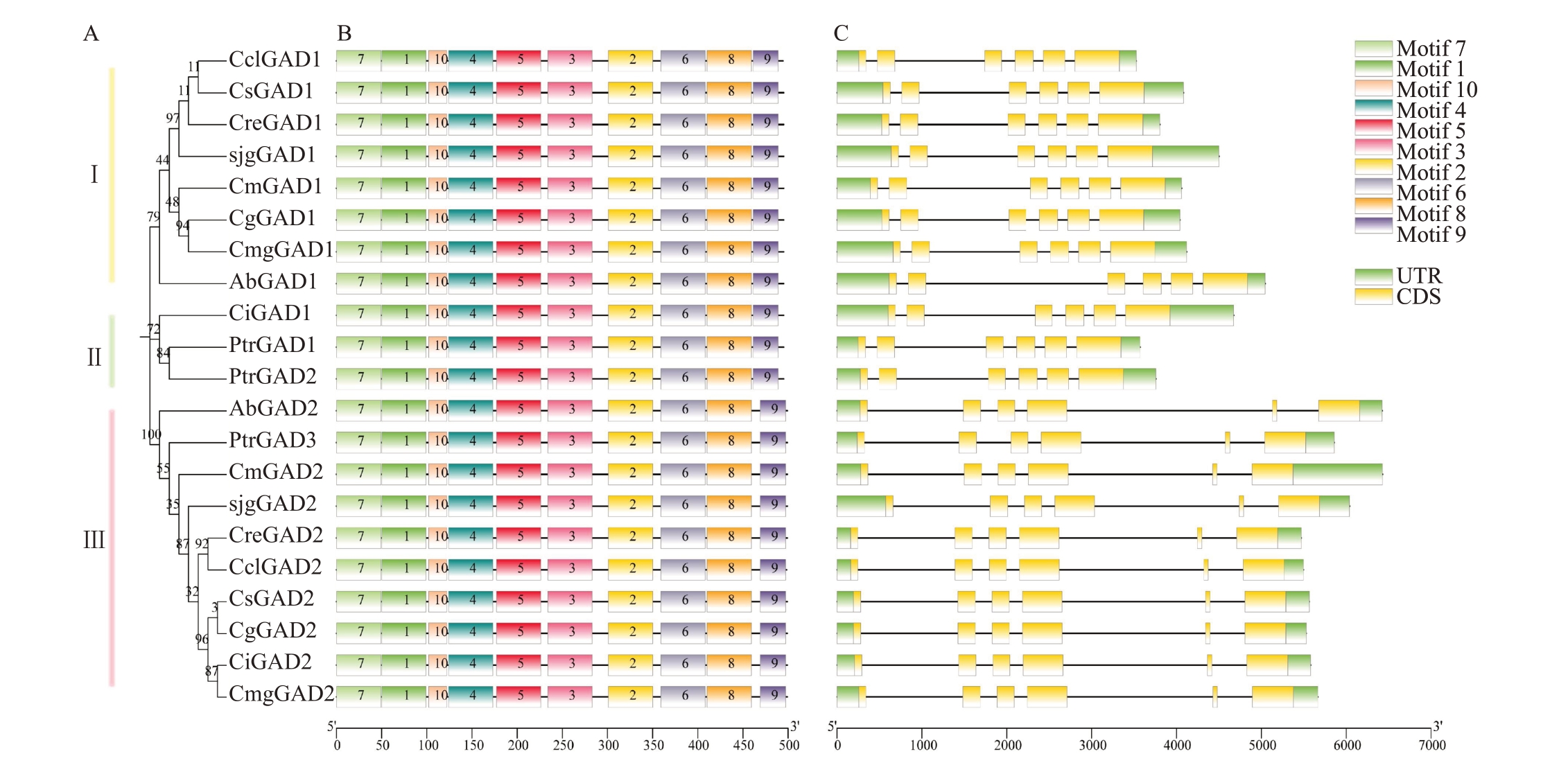
图2 柑橘亚科植物GAD 基因进化树(A)、保守基序(B)和基因结构分析(C)
Fig.2 Phylogenetic tree(A),motif(B)and conserved domain(C)of GAD genes in aurantioideae
Ccl.克里曼丁橘;Cs.甜橙;Cre.宽皮橘;Sjg.山金柑;Cm.枸橼;Cg.晚白柚;Cmg.马家柚;Ab.酒饼簕;Ci.宜昌橙;Ptr.枳。下同。
Ccl.Citrus clementina;Cs.Citrus sinensis;Cre.Citrus reticulata;Sjg.Fortunella hindsii;Cm.Citrus medica;Cg.Citrus grandis L.Osbeck.‘Wanbaiyou’;Cmg.Citrus grandis L.Osbeck.‘Cupi Majiayou’;Ab.Atalantia buxfoliata;Ci.Citrus ichangensis;Ptr.Poncirus trifoliate.The same below.
为进一步探究GAD蛋白的结构保守性,利用MEME程序鉴定其保守基序。共鉴定到10个保守基序,所有GAD家族成员均包含全部10个基序,且排列顺序高度一致(如N端和C端分别为Motif 7和Motif 9),表明该基因家族在柑橘亚科中具有高度的序列保守性(图2-B)。基因结构分析显示(图2-C),所有GAD基因均包含6个外显子和5个内含子,外显子长度在不同成员间差异较小,主要差异体现在内含子长度和非翻译区(UTR):与其他亚族成员相比,第Ⅰ亚家族成员的内含子相对较短而非翻译区较长;与之相反,第Ⅲ亚家族成员的内含子较长而非翻译区较短。蛋白基序和基因结构的分析结果与系统进化关系相互印证,表明同一亚家族的GAD基因在序列和结构上具有较高的相似性。
为在全基因组层面探究GAD 基因的宏观进化关系,笔者进一步将柑橘亚科GAD蛋白与拟南芥、小麦、番茄、葡萄、白杨和花生的GAD蛋白序列共同构建系统发育树。结果显示(图3),GAD 基因分为A、B、C三大进化组。柑橘亚科植物GAD 基因位于A组和B组,并与拟南芥、番茄、白杨等其他双子叶植物的GAD基因亲缘关系更近。

图3 GAD 基因成员演化分析
Fig.3 Evolutionary analysis of GAD genes members
At.拟南芥;Ta.小麦;Sl.番茄;Vv.葡萄;Pa.白杨;Ah.花生。
At.Arabidopsis thaliana;Ta.Triticum aestivum;Sl.Solanum lycopersicum;Vv.Vitis vinifera;Pa.Populus alba;Ah.Arachis hypogaea.
2.3 柑橘亚科植物GAD基因启动子顺式作用元件分析
为探究GAD基因的潜在调控功能,笔者对柑橘亚科21个GAD基因启动子区顺式作用元件进行系统分析。结果表明(图4),启动子区富含多种与激素应答、逆境胁迫及生长发育相关的顺式作用元件。在激素响应元件方面,21个基因的启动子区均含有脱落酸(ABA)响应元件。此外,茉莉酸甲酯(MeJA)和生长素(IAA)响应元件分布广泛:MeJA存在于除CmGAD2 和PtrGAD3 外的19个基因中,IAA存在于除CiGAD2 外的20个基因中。水杨酸(SA)和赤霉素(GA)响应元件的分布相对较少,分别存在于11个和13个基因中。在非生物胁迫响应元件方面,不同类型的元件分布具有特异性。低温响应元件仅在AbGAD2 中存在;干旱响应元件特异性地分布于山金柑sjgGAD1 和sjgGAD2 中;而厌氧响应元件则分布于AbGAD2、PtrGAD3、CreGAD1、CmgGAD2、sjgGAD2、CsGAD2 和CgGAD2 等7个基因。此外,在部分GAD基因启动子中还预测到与植物生长发育相关的调控元件。上述结果表明,柑橘亚科植物GAD 基因可能广泛参与由多种激素信号介导的生物学过程,并响应干旱、低温和缺氧等多种非生物胁迫,在植物激素信号转导和逆境应答调控网络中发挥重要作用。

图4 柑橘亚科植物GAD 基因启动子顺式作用元件分布(A)和数量(B)
Fig.4 Distribution(A)and number(B)of cis-acting elements in the promoter regions of GAD genes in aurantioideae
2.4 柑橘亚科植物GAD基因的共线性分析
为探究柑橘亚科GAD基因的进化机制,本研究对关键物种枳进行了种内以及与拟南芥、甜橙的种间共线性分析。种内共线性分析结果显示(图5),在枳基因组中发现一对片段复制基因,即位于chrUn染色体上的PtrGAD1 与位于chr2染色体上的PtrGAD2,表明基因复制事件在枳GAD基因家族的进化中发挥作用。这对复制基因在系统进化树中共同属于第Ⅱ亚家族(图2-A),表明其在基因结构和功能上可能具有较高的相似性。种间共线性分析进一步揭示了GAD 基因在不同物种间的保守性(图6)。在枳与拟南芥的比较中,鉴定出2对同源基因,分别为枳PtrGAD2 与拟南芥AtGAD4、枳PtrGAD3与拟南芥AtGAD5,且这两对基因在系统进化树上分别聚类于同一分支。在柑橘亚科近缘物种枳与甜橙之间,同样鉴定出2对同源基因,即枳PtrGAD1和PtrGAD2 与甜橙CsGAD1、枳PtrGAD3 与甜橙Cs-GAD2。上述保守的共线性关系表明,这些同源基因对可能保留了相似或互补的生物学功能。
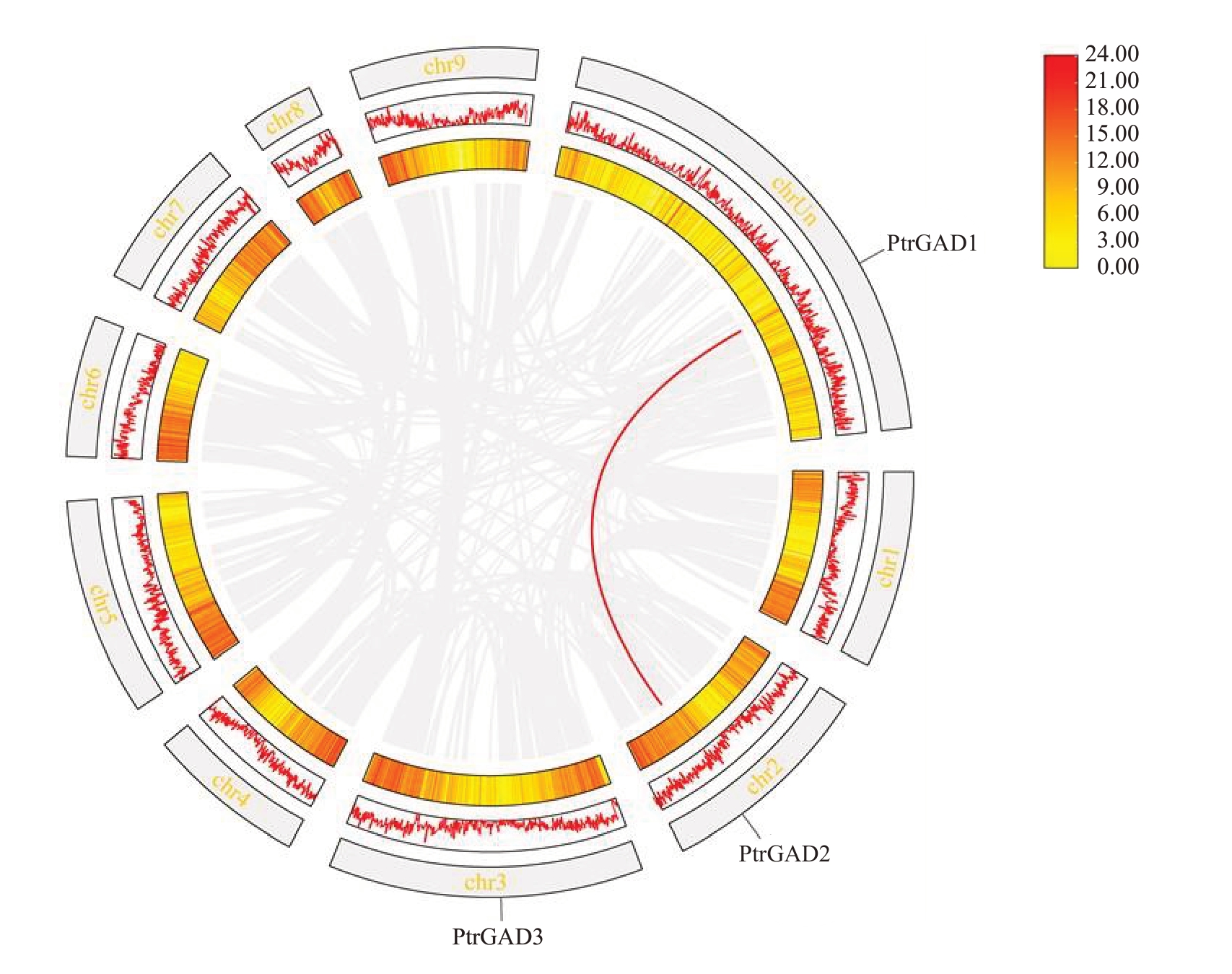
图5 枳GAD 基因物种内共线性分析
Fig.5 Collinear analysis of GAD genes in Poncirus trifoliata
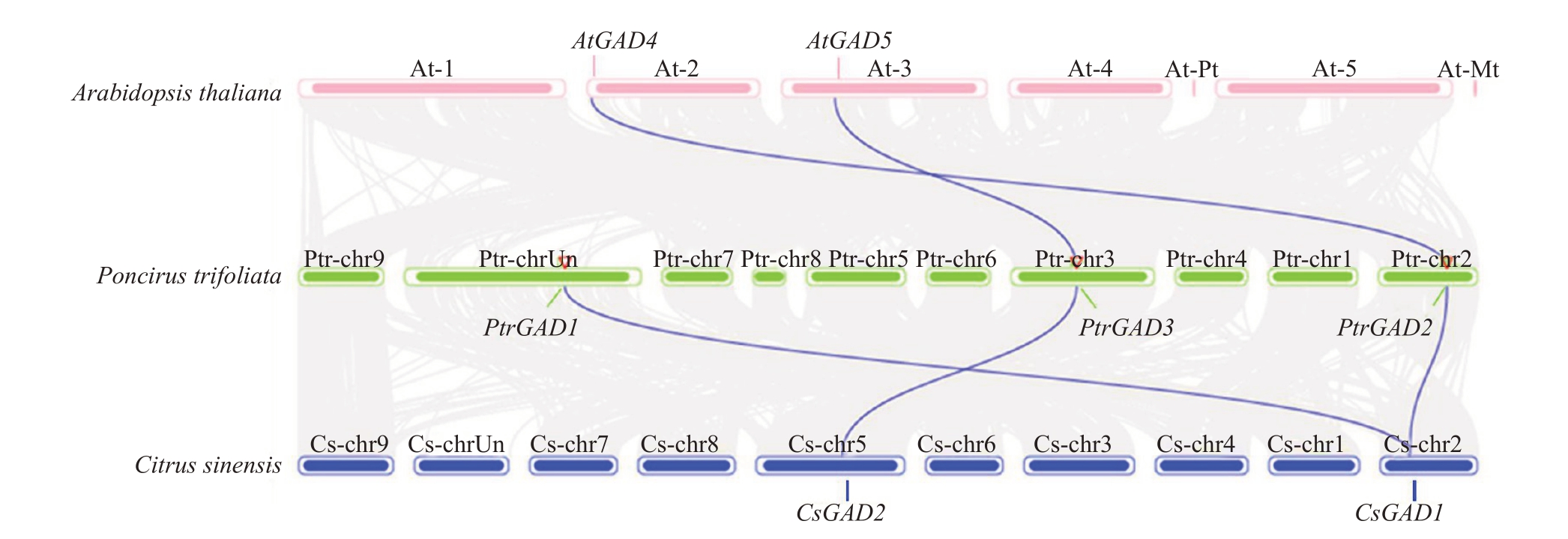
图6 GAD 基因多物种共线性分析
Fig.6 Multi-species collinear analysis of GAD genes
2.5 枳GAD基因成员的组织特异性表达分析
为明确枳GAD 基因成员(PtrGAD1、PtrGAD2和PtrGAD3)在不同组织中的表达水平,采用qRTPCR技术对其在根、茎、叶中的表达模式进行分析。
结果表明(图7),3个基因在根、茎、叶中均能表达,但其表达水平存在显著的组织特异性差异。PtrGAD1 在茎中的表达量显著高于根和叶;PtrGAD2 在叶中表达量最高,而在根中最低;PtrGAD3 则在茎中表达量最高,而在根和叶中的表达水平无显著差异。上述结果表明,GAD基因家族成员在枳不同组织中的功能可能存在差异,推测该家族基因广泛参与并调控枳的生长发育过程。
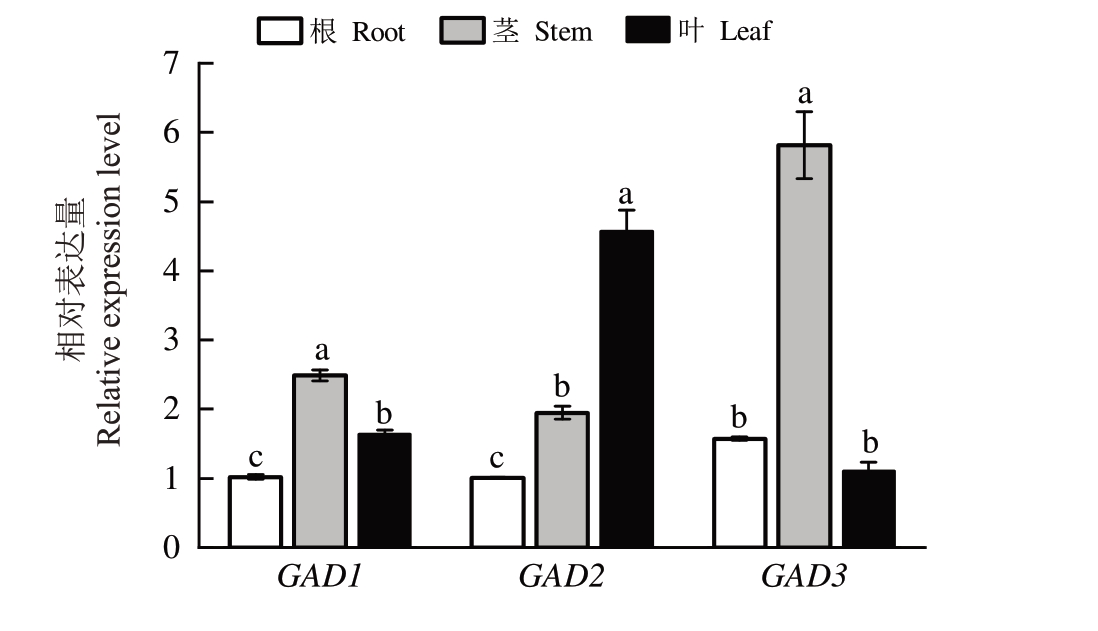
图7 枳GAD 基因组织特异性表达
Fig.7 Tissue-specific expression of GAD genes in Poncirus trifoliata
不同小写字母表示差异显著(P<0.05)。下同。
Different small letters indicate significantly different values (P<0.05).The same below.
2.6 外源GABA对枳GAD基因表达的影响
为探究外源GABA对枳GAD 基因表达的反馈调控作用,分析了GABA处理下枳根、茎、叶中3个 PtrGADs 基因的表达动态。结果表明(图8),外源GABA处理能显著诱导PtrGADs基因表达量发生改变,且不同基因在不同组织中的响应模式存在差异。在根中,PtrGAD1 和PtrGAD2 表达总体呈持续上升趋势,在48 h时表达量分别为处理前的2.41倍和2.43倍;而PtrGAD3表达则呈现先短暂抑制后诱导上升再下降的动态变化,处理0.5 h时表达量降低,2 h后开始回升,24 h时达到峰值(为处理前的2.16倍),48 h后显著回落。在茎和叶中,PtrGAD1与PtrGAD2 表达量均在GABA处理24 h后达到最高,变化趋势相似;PtrGAD3在茎中的表达整体受到抑制,而在叶中则呈现先降低后升高再降低的波动趋势。上述结果综合表明,3个PtrGAD基因均能响应外源GABA处理,但其动力学特征和表达模式存在基因特异性与组织特异性,表明其可能以不同方式参与GABA介导的枳幼苗生理调控网络。
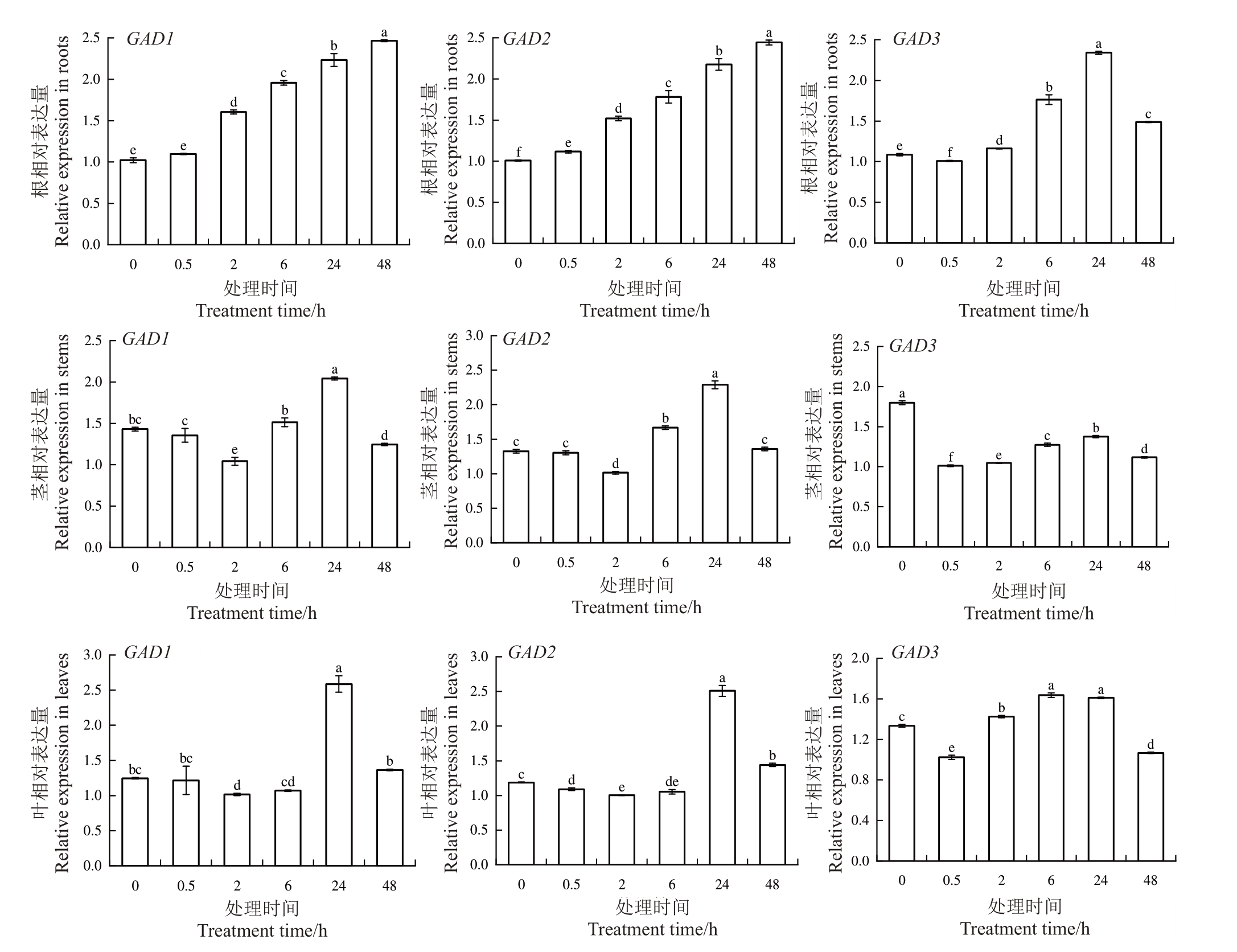
图8 GABA处理后PtrGADs 基因的相对表达分析
Fig.8 Expression analysis of PtrGADs gene after GABA treatments
3 讨论
GAD是催化GABA合成的关键限速酶,在植物生长发育及胁迫响应中发挥重要的调节作用[21-25]。尽管GAD基因家族在拟南芥、水稻等模式植物中已有深入研究,但其在柑橘亚科这一重要果树类群中的进化与功能仍不清楚。本研究首次在柑橘亚科10个代表性物种中系统鉴定了GAD基因家族,共鉴定出21个成员。其中,枳含有3个GAD 基因,其余物种均鉴定出2个成员。这与拟南芥(5个)、水稻(5个)、大豆(5个)、番茄(5个)、西蓝花(9个)等物种存在差异[26-30],暗示了不同植物谱系中GAD 基因家族的进化历程可能存在差异。系统进化分析将柑橘亚科GAD蛋白清晰地划分为3个亚家族,且同一亚家族成员具有相似的保守基序和基因结构(均含6个外显子和5个内含子),证实了分类结果的可靠性。跨物种系统发育树显示,柑橘亚科GAD基因与拟南芥、番茄、杨树等双子叶植物的亲缘关系更近。进化分析在一定程度上反映了物种间的系统发育关系。例如,第Ⅰ亚家族中柑橘属物种的聚类,以及第Ⅱ亚家族中枳与宜昌橙的密切关系,为柑橘亚科的进化分析研究提供了分子证据。另外,在枳中发现PtrGAD1 和PtrGAD2 基因对是由片段复制事件产生的,且二者均属于第Ⅱ亚家族。基因复制是基因家族扩展和新功能进化的重要驱动力[31-32],这一发现为后续探究枳GAD 基因的功能分化提供了关键的进化线索。
生物信息学分析表明,柑橘亚科GAD蛋白的理化性质稳定,均为亲水性酸性蛋白,且均预测定位于细胞质,这与在大豆中的研究结果一致[33]。高级结构预测显示均为高度相似的同源六聚体,与前人在西瓜中的报道吻合[34],揭示了该蛋白在结构上的高度保守性。启动子顺式作用元件分析是推测基因功能的重要手段。本研究发现在柑橘亚科GAD 基因启动子区富含与激素应答(如ABA、IAA、MeJA、SA、GA)和非生物胁迫(如厌氧、干旱)相关的顺式元件。这一结果与GABA被广泛报道参与植物激素互作及逆境响应的功能高度吻合[35-36]。例如,所有GAD 基因均含有ABA响应元件,这与ABA在胁迫信号通路中的核心地位一致,提示GABA的合成可能受ABA信号精密调控,共同应对环境胁迫[37-38]。上述分析结果表明,柑橘亚科GAD基因的表达可能受到复杂的内源激素信号和外界环境因子的协同调控,这与甜橙中的报道一致[16],为其在柑橘砧木抗逆性中的潜在作用提供了理论依据。
表达模式分析进一步揭示了PtrGAD 基因的功能复杂性。组织特异性表达结果显示,3个PtrGAD基因在枳各组织中均能表达,但其表达水平存在明显差异。其中,PtrGAD1 和PtrGAD3 在茎中表达量较高,而PtrGAD2 则在叶片中优势表达,表明其可能通过表达位置的分化,在不同组织中发挥特定功能,从而精细调控各部位GABA稳态。3个PtrGAD基因对外源GABA的响应模式存在显著差异。在GABA处理下,PtrGAD1 和PtrGAD2 在根中表现为持续上调,而PtrGAD3 则呈现先抑制后诱导再回落的动态波动趋势,这一差异暗示PtrGAD1、PtrGAD2与PtrGAD3 可能由不同的转录调控网络调控。启动子区顺式作用元件的种类与数量差异,可能导致3个PtrGAD对GABA、内源激素或胁迫信号的敏感性不同。PtrGAD3的表达在反馈调控中表现出更动态、更精细的调控特性,而PtrGAD1、PtrGAD2 则可能执行更直接、更持久的诱导合成功能。在持续胁迫下,PtrGAD1、PtrGAD2的稳定高表达有助于维持充足的GABA合成,以满足长期抗逆需求;而PtrGAD3的动态响应模式可能使其在应对短暂或波动的胁迫时更具灵活性,有利于避免代谢资源的过度消耗。这种分工协作的调控机制,可能增强了枳对环境变化的适应可塑性。综上所述,本研究不仅揭示了柑橘亚科GAD 基因在转录层面上存在GABA反馈调控,更凸显了不同成员在调控模式与生理功能上的分化。后续可通过鉴定关键转录因子、解析蛋白活性调控及构建遗传材料,进一步阐明各成员在GABA代谢网络与逆境适应中的具体作用,为柑橘抗逆分子育种提供重要的候选基因资源。
4 结论
首次在柑橘亚科中系统鉴定了GAD基因家族,揭示了其在进化上相对保守,但表达与功能呈现分化。枳GAD基因发生串联复制,产生了旁系同源基因PtrGAD1、PtrGAD2;各成员具有组织表达特异性与差异化GABA响应模式,暗示该家族可能通过亚功能化实现调控分工,并在枳中形成多层次的转录调控网络,为解析GABA在柑橘抗逆中的作用提供线索。未来,可通过功能验证、调控机制与互作研究,阐明各成员在胁迫应答中的功能,为柑橘抗逆育种提供科学依据。
[1] Xie T T,Ji J,Chen W,Yue J Y,Du C J,Sun J C,Chen L Z,Jiang Z P,Shi S Q.GABA negatively regulates adventitious root development in poplar[J].Journal of Experimental Botany,2020,71(4):1459-1474.
[2] Li Y X,Li Y H,Cui Y L,Xie Y M,Shi Y J,Shang Y M,Ma F W,Zhang J,Li C Y.GABA-mediated inhibition of cadmium uptake and accumulation in apples[J].Environmental Pollution,2022,300:118867.
[3] Xu B,Long Y,Feng X Y,Zhu X J,Sai N,Chirkova L,Betts A,Herrmann J,Edwards E J,Okamoto M,Hedrich R,Gilliham M.GABA signalling modulates stomatal opening to enhance plant water use efficiency and drought resilience[J].Nature Communications,2021,12:1952.
[4] Dimlioğlu G,Daş Z A,Bor M,Özdemir F,Türkan İ.The impact of GABA in harpin-elicited biotic stress responses in Nicotiana tabaccum[J].Journal of Plant Physiology,2015,188:51-57.
[5] Li L,Dou N,Zhang H,Wu C X.The versatile GABA in plants[J].Plant Signaling&Behavior,2021,16(3):1862565.
[6] Akama K,Akihiro T,Kitagawa M,Takaiwa F.Rice (Oryza sativa) contains a novel isoform of glutamate decarboxylase that lacks an authentic calmodulin-binding domain at the C-terminus[J].Biochimica et Biophysica Acta,2001,1522(3):143-150.
[7] Gut H,Dominici P,Pilati S,Astegno A,Petoukhov M V,Svergun D I,Grütter M G,Capitani G.A common structural basis for pH-and calmodulin-mediated regulation in plant glutamate decarboxylase[J].Journal of Molecular Biology,2009,392(2):334-351.
[8] Zhuang Y L,Ren G J,He C M,Li X Y,Meng Q M,Zhu C F,Wang R C,Zhang J R.Cloning and characterization of a maize cDNA encoding glutamate decarboxylase[J].Plant Molecular Biology Reporter,2010,28(4):620-626.
[9] Zik M,Arazi T,Snedden W A,Fromm H.Two isoforms of glutamate decarboxylase in Arabidopsis are regulated by calcium/calmodulin and differ in organ distribution[J].Plant Molecular Biology,1998,37(6):967-975.
[10] Xu B,Feng X Y,Piechatzek A,Zhang S Q,Konrad K R,Kromdijk J,Hedrich R,Gilliham M.The GABA shunt contributes to ROS homeostasis in guard cells of Arabidopsis[J].New Phytologist,2024,241(1):73-81.
[11] Kulsum U,Akter N,Akama K.Double-truncated version of Os-GADs leads to higher GABA accumulation and stronger stress tolerance in Oryza sativa L.var.Japonica[J].Plant Cell Reports,2025,44(5):95.
[12] Zheng J Y,Zhang Z L,Liang Y J,Gong Z L,Zhang N L,Ditta A,Sang Z W,Wang J D,Li X Y.Whole transcriptome sequencing reveals drought resistance-related genes in upland cotton[J].Genes,2022,13(7):1159.
[13] Aljuaid B S,Ashour H.Exogenous γ-aminobutyric acid (GABA)application mitigates salinity stress in maize plants[J].Life,2022,12(11):1860.
[14] Chen W,Meng C,Ji J,Li M H,Zhang X M,Wu Y Y,Xie T T,Du C J,Sun J C,Jiang Z P,Shi S Q.Exogenous GABA promotes adaptation and growth by altering the carbon and nitrogen metabolic flux in poplar seedlings under low nitrogen conditions[J].Tree Physiology,2020,40(12):1744-1761.
[15] Fan Y T,Li C Y,Zhu J,Sun L,Huang R,Guo M,Wu Y S,Ge Y H.Organic acids metabolism and GABA shunt involved in maintaining quality of Malus domestica by methyl jasmonate treatment[J].Food Research International,2022,160:111741.
[16] Hijaz F,Nehela Y,Killiny N.Application of gamma-aminobutyric acid increased the level of phytohormones in Citrus sinensis[J].Planta,2018,248(4):909-918.
[17] 金天,徐月美,邝冠翎,刘桂东.缺硼胁迫对枳幼苗根系生长及线粒体功能的影响[J].园艺学报,2024,51(1):121-132.Jin Tian,Xu Yuemei,Kuang Guanling,Liu Guidong.Effect of boron deficiency on the root growth and mitochondrial function of trifoliate orange seedlings[J].Acta Horticulturae Sinica,2024,51(1):121-132.
[18] 金天,徐月美,周高峰,管冠,姚锋先,刘桂东.γ-氨基丁酸对枳幼苗生长及矿质元素吸收的影响[J].华中农业大学学报,2023,42(6):116-126.Jin Tian,Xu Yuemei,Zhou Gaofeng,Guan Guan,Yao Fengxian,Liu Guidong.Effects of γ-aminobutyric acid on growth and mineral element uptake of trifoliate orange seedlings[J].Journal of Huazhong Agricultural University,2023,42(6):116-126.
[19] Chen C J,Wu Y,Li J W,Wang X,Zeng Z H,Xu J,Liu Y L,Feng J T,Chen H,He Y H,Xia R.TBtools-Ⅱ:A“one for all,all for one”bioinformatics platform for biological big-data mining[J].Molecular Plant,2023,16(11):1733-1742.
[20] 杨杰,陈蓉,胡文娟,吴巧玲,佟晓楠,李兴涛.枳GRAS基因家族鉴定及其对低温胁迫的响应[J].植物生理学报,2022,58(1):130-140.Yang Jie,Chen Rong,Hu Wenjuan,Wu Qiaoling,Tong Xiaonan,Li Xingtao.Genome-wide identification and low-temperature response analysis of GRAS gene family in Poncirus trifoliata[J].Plant Physiology Journal,2022,58(1):130-140.
[21] Shimajiri Y,Oonishi T,Ozaki K,Kainou K,Akama K.Genetic manipulation of the γ-aminobutyric acid (GABA) shunt in rice:Overexpression of truncated glutamate decarboxylase (GAD2)and knockdown of γ-aminobutyric acid transaminase (GABA-T)lead to sustained and high levels of GABA accumulation in rice kernels[J].Plant Biotechnology Journal,2013,11(5):594-604.
[22] Wang Y Y,Sun D,Duan Y M,Yang A Q,Yang X Y,Zhu T Z,Yan Y X,Li W,Rui W Y,Fang S,Wang B Q,Tian Y M,Wang H M,Chen F J,Jia Z T,Pan Q C,Yang Z F,Yuan L X,Xu C W,Li P C.A variome-transcriptome-metabolome network links GABA biosynthesis to stress resilience in maize[J].The Plant Cell,2025,37(10):koaf221.
[23] Jin Y,Zhi L L,Tang X,Chen Y L,Hancock J T,Hu X Y.The function of GABA in plant cell growth,development and stress response[J].Phyton-International Journal of Experimental Botany,2023,92(8):2211-2225.
[24] Ni W L,Wu Y T,Cao Y Q,Li Q H,Zhang Y K,Zhang Y,Li Z.GAD1-mediated GABA biosynthesis confers salt tolerance in creeping bentgrass and Arabidopsis thaliana by coordinating osmotic adjustment,ion homeostasis,hormonal signaling,and root system architecture[J].Plant Physiology and Biochemistry,2025,229:110661.
[25] Miller G,Suzuki N,Ciftci-Yilmaz S,Mittler R.Reactive oxygen species homeostasis and signalling during drought and salinity stresses[J].Plant,Cell&Environment,2010,33(4):453-467.
[26] Benidickson K H,Raytek L M,Hoover G J,Flaherty E J,Shelp B J,Snedden W A,Plaxton W C.Glutamate decarboxylase-1 is essential for efficient acclimation of Arabidopsis thaliana to nutritional phosphorus deprivation[J].New Phytologist,2023,240(6):2372-2385.
[27] Akter N,Kulsum U,Moniruzzaman M,Yasuda N,Akama K.Truncation of the calmodulin binding domain in rice glutamate decarboxylase 4(OsGAD4)leads to accumulation of γ-aminobutyric acid and confers abiotic stress tolerance in rice seedlings[J].Molecular Breeding,2024,44(3):21.
[28] Hyun T K,Eom S H,Han X,Kim J S.Evolution and expressionanalysis of the soybean glutamate decarboxylase gene family[J].Journal of Biosciences,2014,39(5):899-907.
[29] Nonaka S,Arai C,Takayama M,Matsukura C,Ezura H.Efficient increase of γ-aminobutyric acid(GABA)content in tomato fruits by targeted mutagenesis[J].Scientific Reports,2017,7:7057.
[30] Jiao W H,Wei Q L,Chen J H,Cao S F,Luo M,Qian Y,Chen Y,Wei Y Y,Shao X F,Xu F.Identification analysis of GAD gene family,and the role of BoGAD5 in GABA enrichment in broccoli sprouts[J].Plant Growth Regulation,2024,104(3):1643-1655.
[31] Flagel L E,Wendel J F.Gene duplication and evolutionary novelty in plants[J].New Phytologist,2009,183(3):557-564.
[32] Hastings P J,Lupski J R,Rosenberg S M,Ira G.Mechanisms of change in gene copy number[J].Nature Reviews Genetics,2009,10(8):551-564.
[33] Breitkreuz K E,Shelp B J.Subcellular compartmentation of the 4-aminobutyrate shunt in protoplasts from developing soybean cotyledons[J].Plant Physiology,1995,108(1):99-103.
[34] 李明轩,刘颖,杨柏明,张帆,宋嘉欣,粟柴静,张卫华,吴颖.西瓜谷氨酸脱羧酶GADs的克隆与表达分析[J].华北农学报,2023,38(6):18-25.Li Mingxuan,Liu Ying,Yang Baiming,Zhang Fan,Song Jiaxin,Su Chaijing,Zhang Weihua,Wu Ying.Cloning and expression analysis of glutamate decarboxylase GADs from watermelon[J].Acta Agriculturae Boreali-Sinica,2023,38(6):18-25.
[35] Raza A,Salehi H,Rahman M A,Zahid Z,Madadkar Haghjou M,Najafi-Kakavand S,Charagh S,Osman H S,Albaqami M,Zhuang Y H,Siddique K H M,Zhuang W J.Plant hormones and neurotransmitter interactions mediate antioxidant defenses under induced oxidative stress in plants[J].Frontiers in Plant Science,2022,13:961872.
[36] Wang J R,Zhang Y,Wang J Z,Ma F,Wang L Y,Zhan X Q,Li G B,Hu S S,Khan A,Dang H R,Li T L,Hu X H.Promoting γaminobutyric acid accumulation to enhances saline-alkali tolerance in tomato[J].Plant Physiology,2024,196(3):2089-2104.
[37] Liu C L,Wang H T,Zhang X Z,Ma F W,Guo T L,Li C Y.Activation of the ABA signal pathway mediated by GABA improves the drought resistance of apple seedlings[J].International Journal of Molecular Sciences,2021,22(23):12676.
[38] Kinnersley A M,Turano F J.Gamma aminobutyric acid (GABA) and plant responses to stress[J].Critical Reviews in Plant Sciences,2000,19(6):479-509.