植物由于固着特性无法主动躲避害虫的取食,但在漫长的进化过程中已形成了独特的抗虫机制,主要可以分为两类:一类是组成型防御,指植物通过刺或绒毛等自身生长特性阻碍害虫取食;另一类是诱导型防御,指当害虫取食寄主植物后,植物体内会产生一系列生理生化反应如胼胝质积累、木栓质沉积及活性氧爆发等,从而达到抗虫效果[1]。胼胝质是一种由β-1,3键结合的葡聚糖,主要存在于植物筛管结构周围。当植物受到胁迫时,胼胝质会在筛孔边缘沉积,形成胼胝体堵塞筛孔,调节筛管的物质运输功能,进而限制害虫对寄主植物韧皮部汁液的吸食[2]。木栓质是植物细胞壁发生栓质化时沉积的生物高分子化合物,由甘油、脂肪酸及酚类物质构成[3],主要分布在植物根的内皮层、外皮层和表皮等,其沉积可以增强细胞壁的物理性屏障,进而提高植物的抗虫能力。
桃树是重要的果树树种,中国的栽培面积和产量均居世界首位[4]。桃蚜(Myzus persicae)是春季危害桃树最严重的害虫,繁殖速度快,通常以若虫、成虫群集于桃树新梢幼嫩叶片背面,吸食植物体内的汁液导致叶片卷曲,分泌的蜜露也会污染叶片易诱发煤污病,影响桃果实的产量和品质[5]。目前,蚜虫防治主要依靠喷施农药,所需劳动力和经济成本均较高,长期使用农药还会诱导桃蚜产生抗药性,且对有益昆虫产生负面影响[6]。因此,解析抗蚜品种的抗虫机制将有助于培育桃蚜抗性品种,并对桃产业的绿色发展具有重大意义。
目前,世界范围内已从桃种质资源中鉴定出多份抗蚜材料。法国是已知报道中最早开展桃抗蚜鉴定的国家,先后鉴定出垂枝花桃(WFP)、桃砧木品种Rubira和山桃P1908等抗蚜资源[7-9]。在WFP和Rubira上,蚜虫的取食会诱导植株产生红色或黄色斑点,有时会导致叶尖枯萎,但蚜虫也会在3 d之内离开这些植株,是典型的趋避性抗性;而山桃P1908影响桃蚜取食的生理功能,表现为抗生性抗性。王力荣团队[10]采用田间自然筛选和人工接种相结合的方法,筛选出寿星桃、山桃等抗蚜材料。
农神蟠桃衍生抗蚜材料是本课题组在长期育种工作中发现的具有蚜虫抗性的新种质[11],其亲本没有野生种或近缘种,本身经济性状接近栽培品种,与山桃和寿星桃相比,育种应用价值更突出。现有研究多聚焦于寿星桃[5]和山桃[12]等野生或半野生资源,而对农艺性状优良、育种潜力巨大的栽培种抗性问题缺乏系统解析。本研究以农神蟠桃衍生抗蚜材料为亲本构建分离群体,采用苗期接种桃蚜和组织结构染色的方法进行抗性表型鉴定和代谢物分析,并利用6个群体的感、抗分离比和聚丙烯酰胺凝胶电泳技术对遗传规律进行分析,为后续解析农神蟠桃衍生材料抗蚜机制奠定基础。
1 材料和方法
1.1 试验材料
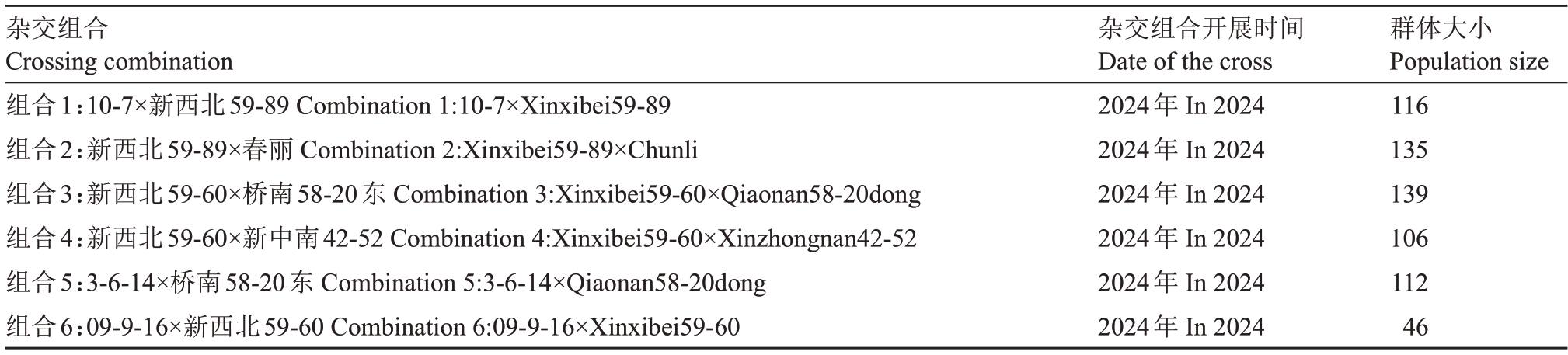
试验地点位于中国农业科学院郑州果树研究所,抗性亲本携带的蚜虫抗性均源自农神蟠桃,6个抗蚜分离群体单株均是2024年培育的杂种实生苗。具体杂交组合信息如表1。
表1 杂交群体信息
Table 1 Information on the crossing population
1.2 抗蚜等级鉴定
在郑州果树研究所桃育种课题组的杂种苗定植圃内对杂交单株进行鉴定。2025年3月下旬,对群体后代每株杂种实生苗接种20头蚜虫,一周内观察单株的感染情况,并对未感染植株及时补接蚜虫,确保抗蚜与感蚜植株表型充分显示。农神蟠桃衍生材料的抗蚜等级鉴定参考牛良[5]的方法并略有改动,根据蚜虫着生数量及叶片卷曲程度分为5个等级(1级:无蚜虫着生及无卷叶;2级:蚜虫少量着生及无卷叶;3级:蚜虫少量着生伴有轻度卷叶;4级:蚜虫数量较多伴有中度卷叶;5级:蚜虫大量着生伴有重度卷叶)。
1.3 组织结构染色
选取抗蚜和感蚜植株健壮新梢,分别接种20头桃蚜,使用80目防虫网袋套住。选取蚜虫叮咬后0、12和24 h三个时间点的幼嫩茎段,每个茎段长2~3 cm,每个时间点设置3个生物学重复。样品放进福尔马林-乙酸-乙醇(FAA)固定液中进行保存,统一由武汉赛维尔公司完成苯胺蓝和荧光黄染色。在苯胺蓝染色中,先将茎段切片,放入1 mol·L-1氢氧化钾溶液中60 ℃孵育过夜,水洗清除残液后,将切片转移至载玻片上,滴加含0.005%苯胺蓝的50%甘油溶液,染色10~15 min后盖上盖玻片在荧光显微镜下观察并拍照,分布在筛管周围的胼胝质呈现亮蓝色;在荧光黄染色中,先将茎段切片放入含0.05%荧光黄的甘油染色溶液中,60 ℃孵育过夜,染色完成后用甘油冲洗切片,放置在载玻片上并滴加一滴甘油,盖上盖玻片在荧光显微镜下观察并拍照,木栓质层将呈现黄色荧光。
1.4 基因组DNA的提取
每个单株取适量嫩叶,装入2.0 mL离心管中,加入3~5个钢珠,液氮研磨后用磁珠法(爱森生物公司)提取DNA。使用Nano Drop1000 spectrophotometer(Themo Scientific)紫外分光光度计和1%琼脂糖凝胶电泳对DNA浓度和纯度进行测定,随后保存至-20 ℃备用。
1.5 分子标记检测
课题组前期发现,农神蟠桃衍生抗蚜材料与感蚜材料相比有20 bp的缺失,可以通过聚丙烯酰胺凝胶电泳检测PCR扩增产物条带大小从而检测单株的基因型[13]。利用BSA定位的第3号染色体上的InDel2410标记对6个分离群体单株进行基因型检测。当PCR扩增产物为190 bp时,待测样本为纯合感蚜单株;当PCR扩增产物为170 bp时,待测样本为纯合抗蚜单株;当PCR扩增产物同时出现190 bp和170 bp两条条带时,待测样本为杂合抗蚜单株。引物(InDel2410-F:CGTGGGACCCTTAGTGACC;InDel2410-R:CGTGCTGATGTAGGCGTTAG)由北京普乐海生物科技有限公司合成,分子标记的PCR扩增体系均为20 μL,包括2×Mix混合液10 μL(南京诺唯赞生物科技股份有限公司,南京),模板DNA 1 μL,上、下游引物各1 μL,ddH2O 7 μL;反应程序为95 ℃预变性3 min;95 ℃变性15 s,57 ℃退火15 s,72 ℃延伸30 s,35个循环;72 ℃终延伸5 min。反应产物经聚丙烯酰胺凝胶电泳进行检测。
1.6 数据分析
使用Excel 2019软件对数据进行统计整理。分子标记准确率/%=基因型与表型一致的单株/群体总数×100。
2 结果与分析
2.1 农神蟠桃后代的抗蚜表型
接种蚜虫后,待表型充分显现时观察发现,感蚜单株嫩梢上着生大量蚜虫,一周内蚜虫数量持续增加,并伴随叶片大量卷曲(图1-A);而农神蟠桃衍生抗蚜单株在接种2 d后,蚜虫数量下降至初始接种量的一半;并在6 d后蚜虫全部离开,在接种部位未观察到桃蚜尸体(图1-B)。与寿星桃相似,农神蟠桃衍生材料表现出典型的趋避性抗性,但蚜虫叮咬取食后,未出现与寿星桃类似的过敏性红色斑点。
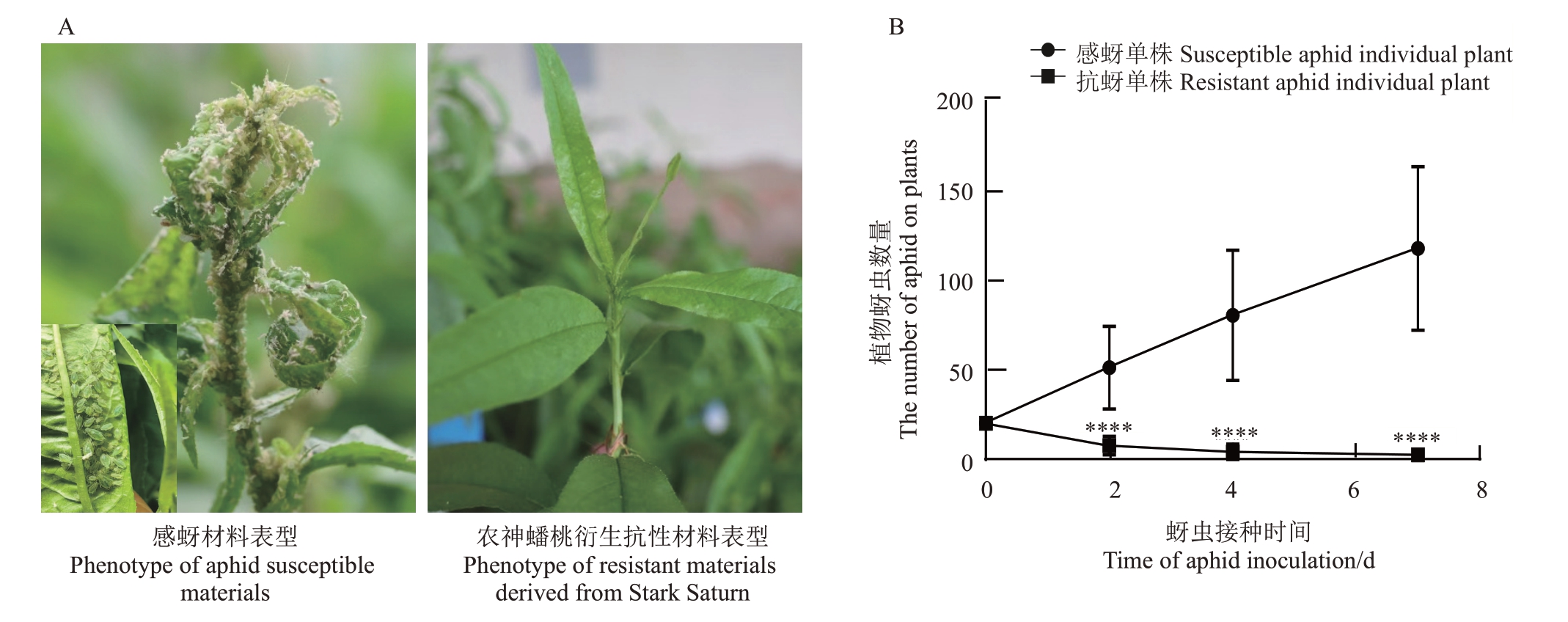
图1 农神蟠桃衍生材料的蚜虫抗性表型
Fig.1 Aphid resistance phenotype of Stark Saturn origin
A.感蚜单株和抗蚜单株接种蚜虫一周后的表型;B.感蚜单株和抗蚜单株上驻留的蚜虫数量。****表示数据差异经过T 检验,达到显著水平(P<0.000 1)。
A.Phenotypes of the aphid-susceptible and aphid-resistant individual plant one week after aphid infestation;B.Number of aphids settled on the aphid-susceptible and aphid-resistant individual plant.****means that the data difference is significant after T test(P<0.000 1).
2.2 组织结构染色
苯胺蓝染色结果显示,0 h时,感蚜单株桥南58-20东、抗蚜单株新西北59-60和3-6-14的胼胝质在筛管周围均有少量沉积,随着蚜虫接种时间的延长,3个单株体内的胼胝质沉积量增多(图2-A);荧光黄染色结果显示,接种蚜虫24 h后,感蚜单株桥南58-20东、抗蚜单株新西北59-60和3-6-14的木栓质含量均高于初始值(图2-B)。

图2 苯胺蓝(A)和荧光黄(B)染色
Fig.2 Aniline blue(A)and fluorescein yellow staining(B)
2.3 农神蟠桃衍生材料的抗性遗传分离规律
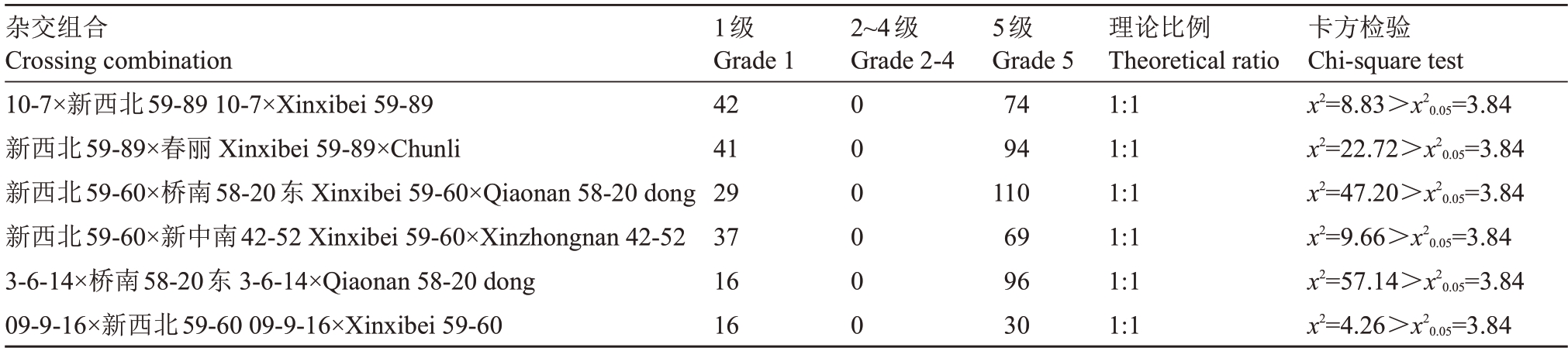
对于单基因调控的质量性状,表型不同的亲本杂交产生的F1代符合孟德尔遗传规律的性状分离;对于多基因调控的数量性状,表型不同的亲本杂交会产生具有中间性状的F1代。为了分析农神蟠桃后代抗性遗传分离规律,对以农神蟠桃衍生抗蚜材料为亲本的6个F1代分离群体进行抗性鉴定。结果表明,分离群体后代抗性均呈现出明显的抗性差异,即鉴定的单株均为1级或5级,没有中间类型。在杂交组合10-7×新西北59-89中,1级单株42株,5级单株74株;新西北59-89×春丽中,1级单株41株,5级单株94株;新西北59-60×桥南58-20东中,1级单株29株,5级单株110株;新西北59-60×新中南42-52中,1级单株37株,5级单株69株;3-6-14×桥南58-20东中,1级单株16株,5级单株96株;09-9-16×新西北59-60中,1级单株16株,5级单株30株(图3)。6个分离群体的抗/感分离数据经卡方检验均不符合0∶1或1∶1的孟德尔理论分离比例(卡方检验值介于8.83~57.14),表明农神蟠桃衍生材料的抗蚜性状由少数主效基因调控(表2)。
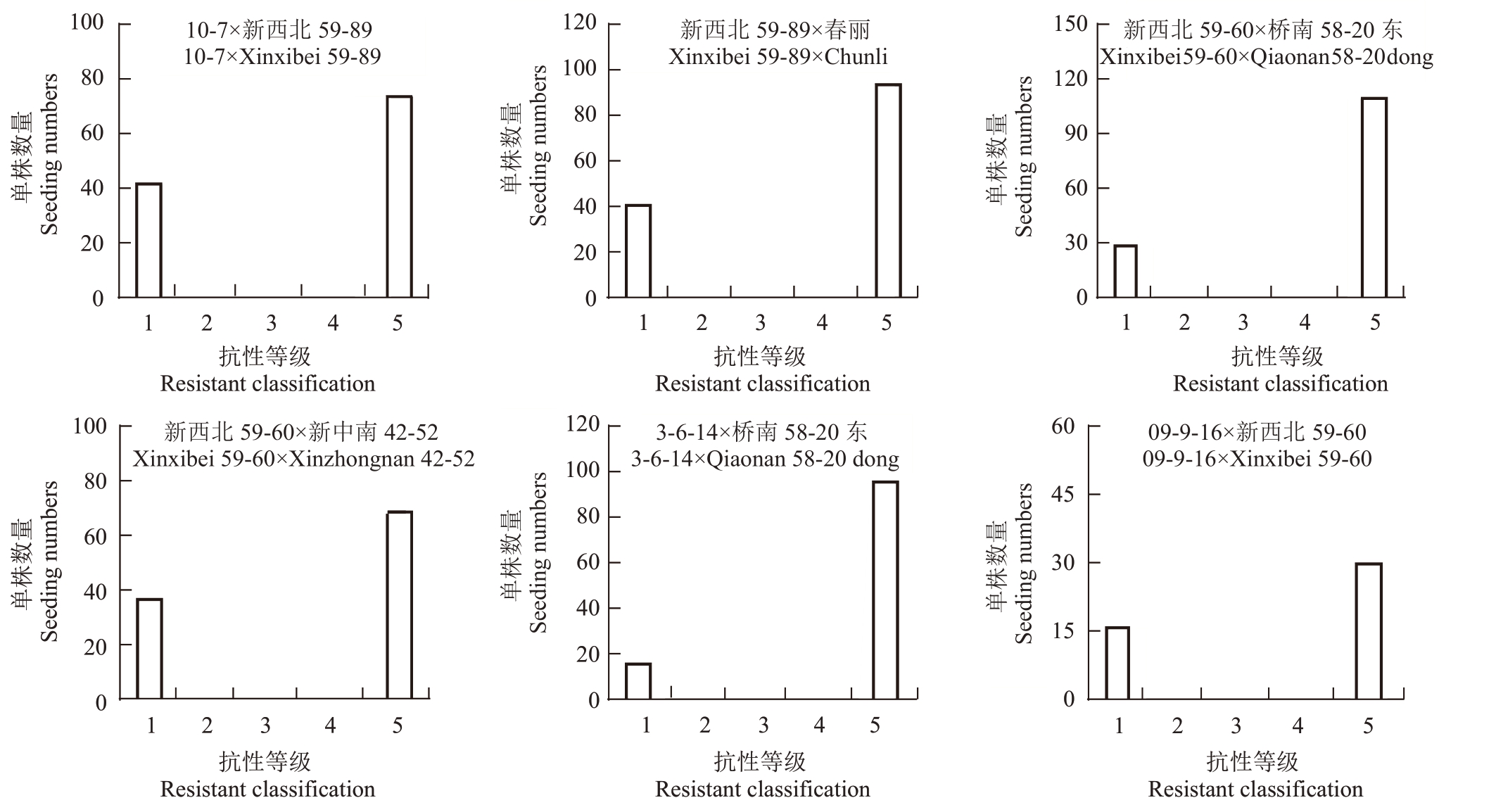
图3 不同组合后代群体中抗蚜性分离
Fig.3 Distribution of resistance grades within different crosses
表2 农神蟠桃衍生材料抗蚜性遗传
Table 2 Inheritance of aphid resistance in materials derived from Stark Saturn
2.4 分子标记检测结果
利用Indel2410对6个组合进行基因型检测。结果显示,在杂交组合10-7×新西北59-89(组合1)群体的116份材料里,有11个单株基因型与表型不一致,分子标记准确率为90.52%;在杂交组合新西北59-89×春丽(组合2)群体的135份材料里,有36个单株基因型与表型不一致,分子标记准确率为73.33%;在杂交组合新西北59-60×桥南58-20东(组合3)群体的139份材料里,有40个单株基因型与表型不一致,分子标记准确率为71.22%;在杂交组合新西北59-60×新中南42-52(组合4)群体的106份材料里,有12个单株基因型与表型不一致,分子标记准确率为88.68%;在杂交组合3-6-14×桥南58-20东(组合5)群体的112份材料里,有32个单株基因型与表型不一致,分子标记准确率为71.43%;在杂交组合09-9-16×新西北59-60(组合6)群体的46份材料里,有3个单株基因型与表型不一致,分子标记准确率为93.48%。6个分离群体的分子标记鉴定正确率并不稳定,证实了农神蟠桃衍生材料的抗蚜性由主效基因控制(图4)。
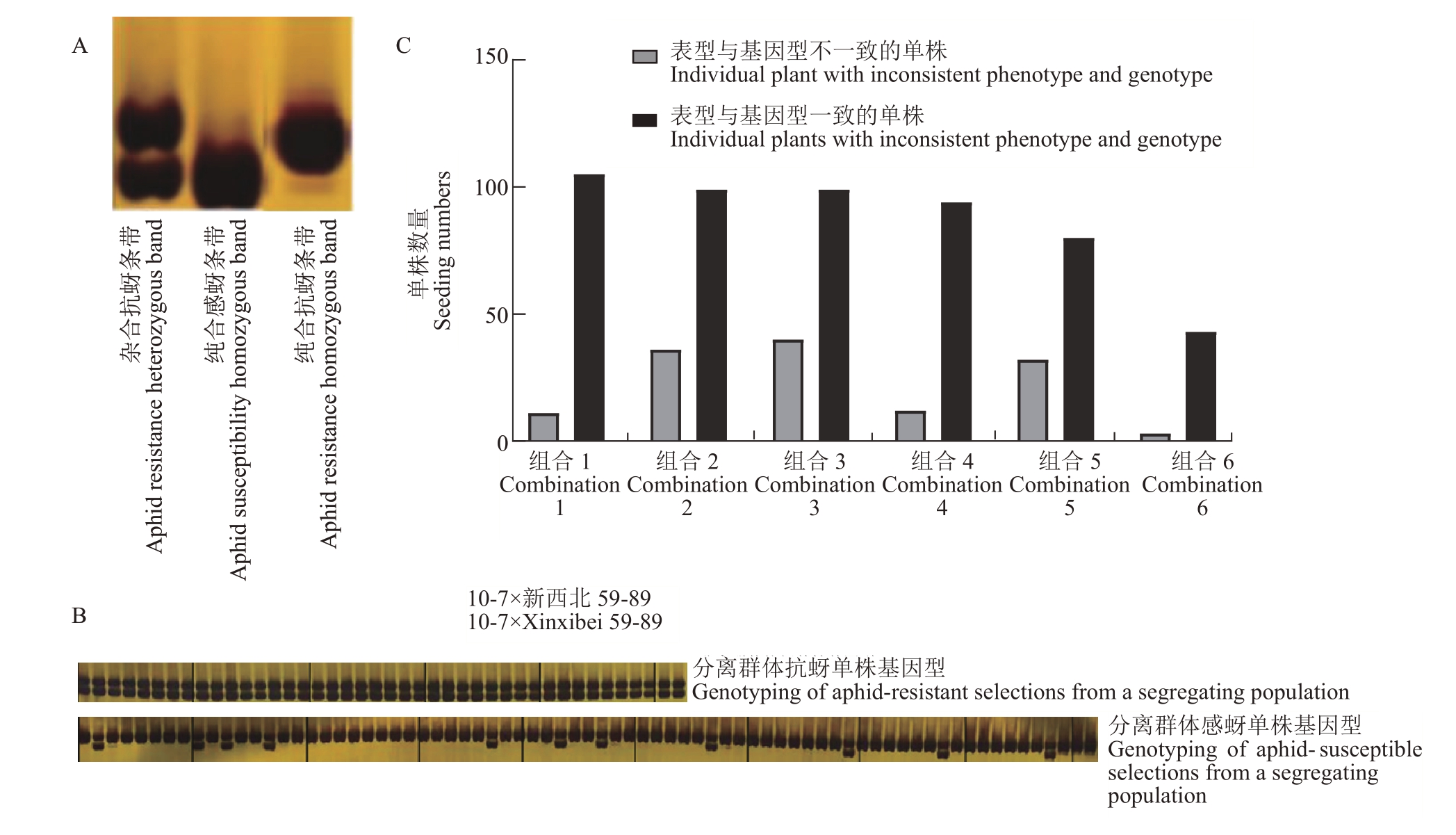
图4 部分群体分子标记条带图
Fig.4 Molecular marker banding pattern of a subset of the population
A.感蚜单株和抗蚜单株的条带;B.Indel2410在10-7×新西北59-89中的条带;C.6个组合中的单株表型与基因一致/不一致的数量。
A.The bands of aphid-susceptible plants and aphid-resistant plants;B.Indel2410 bands in 10-7×Xinxibei59-89;C.The number of single plant phenotypes consistent/inconsistent with genes in 6 combinations.
3 讨论
桃蚜是世界范围内分布最广的刺吸式害虫,对春季桃树产业的危害非常严重。桃蚜繁殖速度快、个体小、生活周期短,在防治时需要多次喷施农药,不仅耗费大量人力财力,还会使桃蚜对农药产生一定的抗性。利用树体自身抗性控制农业害虫的危害,是一种可持续且环境友好型的害虫管理方法。因此,有必要筛选抗性种质资源并解析相关抗性调控机制。
目前,国内外已经鉴定出的桃种质抗蚜资源主要分为两类:第一类是法国的垂枝花桃WFP[14]、桃砧木品种Rubira[15]和中国的寿星桃[16],接种桃蚜后表现出强烈的趋避性抗性并出现过敏性红色斑点;第二类是中国的山桃[10]及法国的山桃P1908[9],表现为多位点调控的抗生性抗性。目前,已鉴定的抗蚜资源均为野生近缘种或半野生种,抗性资源利用困难。因此,在桃树遗传改良中急需易于利用的材料。笔者研究发现农神蟠桃衍生抗蚜材料在接种蚜虫后表现出趋避性抗性,同时未出现过敏性红色斑点,表明该品种的抗性区别于已鉴定品种,是一类新的抗蚜材料。
由于自身特性,植物在抵抗生物胁迫时形成了一系列独特的防御策略,如胼胝质沉积和木栓质积累。赵思阳[17]研究发现接种病原菌后,大豆中胼胝质的沉积量增加。Thangavel等[18]发现马铃薯块茎在抵御病原菌入侵时,周皮木栓化程度升高。本研究的组织结构染色结果显示,相比0 h,桃蚜侵染24 h后,胼胝质和木栓质含量总体呈现上升趋势,表明蚜虫接种能够诱导胼胝质与木栓质的产生。
目前,研究发现植物对蚜虫的抗性遗传机制呈现高度多样性,主要包括单基因遗传和多基因遗传两种模式。不同遗传模式下,抗性基因的分离规律仍遵循孟德尔遗传定律,但会因基因互作、累加效应或一因多效而表现出特殊的性状分离比[19]。Pascal等[20]将桃砧木品种Rubira与感蚜品种杂交,获得的F1代群体抗蚜与感蚜分离比是1∶0,随后F1代自交获得的F2代群体抗蚜与感蚜分离比是3∶1,表明Rubira对桃蚜的抗性由显性单基因控制。虽然单基因抗性在育种工作中便于利用,但当病原生物发生变异时,可能会导致植物抗性失效。Wang等[12]将感蚜品种XPYT和抗蚜品种ZXST杂交构建了一个F2群体,发现ZXST的桃蚜抗性受多基因控制。多基因抗性因具有多个调控位点,植物的抗性不一定在短时间内失效。遗传分析和分子标记结果表明农神蟠桃衍生材料抗性由少数主效基因调控。因此,该品种对桃蚜的抗性可能比野生种或近缘种更具有持久性,因此有更好的应用前景。
农神蟠桃衍生材料是一种源自栽培种的新抗蚜材料,与野生种和近缘种抗蚜资源相比,其丰产性和适应性良好,具有极高的育种应用价值。作为新发现的栽培种衍生抗蚜材料,解析其抗蚜分子机制是下一步的研究重点。挖掘该类材料中的抗蚜调控基因,对桃树抗蚜新品种的培育具有重要的理论意义。
4 结论
农神蟠桃衍生抗蚜材料对桃蚜具有较强的趋避性抗性且蚜虫叮咬部位未出现过敏性红色斑点;遗传分析结合分子标记结果表明,农神蟠桃衍生材料的抗蚜性由少数主效基因调控。
[1] Kessler A.Plant defences against herbivore attack[J].Encyclopedia of Life Sciences,2017:1-11.
[2] 张庆雯,王兆昊,祁静静,谢宇,雷天刚,何永睿,陈善春,姚利晓.植物胼胝质合成酶研究进展[J].园艺学报,2021,48(4):661-675.Zhang Qingwen,Wang Zhaohao,Qi Jingjing,Xie Yu,Lei Tiangang,He Yongrui,Chen Shanchun,Yao Lixiao.The advances of callose synthase in plant[J].Acta Horticulturae Sinica,2021,48(4):661-675.
[3] Franke R,Schreiber L.Suberin:A biopolyester forming apoplastic plant interfaces[J].Current Opinion in Plant Biology,2007,10(3):252-259.
[4] 中华人民共和国农业部.中国农业年鉴-2015[M].北京:中国农业出版社,2016.Ministry of Agriculture,People’s Republic of China.Agricultural Yearbook of China-2015[M].Beijing:China Agriculture Press,2016.
[5] 牛良.寿星桃抗蚜性鉴定及分子机制解析[D].武汉:华中农业大学,2019.Niu Liang.Identification of resistance to green peach aphids of Shouxing peach and its molecular mechanism[D].Wuhan:Huazhong Agricultural University,2019.
[6] Cutler G C,Ramanaidu K,Astatkie T,Isman M B.Green peach aphid,Myzus persicae (Hemiptera:Aphididae),reproduction during exposure to sublethal concentrations of imidacloprid and azadirachtin[J].Pest Management Science,2009,65(2):205-209.
[7] Massonié G,Maison P,Monet R,Grasselly C.Résistance au puceron vert du pêcher,Myzus persicae Sulzer(Homoptera Aphididae) chez Prunus persica (L.) Batsch et d’autres espèces de Prunus[J].Agronomie,1982,2(1):63-70.
[8] Monet R,Massonié G.Déterminisme génétique de la résistance au puceron vert(Myzus persicae)chez le pêcher.Résultats complémentaires[J].Agronomie,1994,14(3):177-182.
[9] Sauge M H,Kervella J,Pascal T.Settling behaviour and reproductive potential of the green peach aphid Myzus persicae on peach varieties and a related wild Prunus[J].Entomologia Experimentalis et Applicata,1998,89(3):233-242.
[10] 王力荣,朱更瑞,方伟超,左覃元,韩立新.桃种质资源对桃蚜的抗性评价[J].果树学报,2001,18(3):145-147.Wang Lirong,Zhu Gengrui,Fang Weichao,Zuo Qinyuan,Han Lixin.Study on the resistance to peach aphid (Myzus persicaeSulzer) of peach germplasm[J].Journal of Fruit Science,2001,18(3):145-147.
[11] 潘磊,闫乐乐,鲁振华,曾文芳,崔国朝,牛良,王志强.一类桃树桃蚜抗性新种质09南3-30[J].果树学报,2021,38(6):895-900.Pan Lei,Yan Lele,Lu Zhenhua,Zeng Wenfang,Cui Guochao,Niu Liang,Wang Zhiqiang.09N3-30,a new peach germplasm with green peach aphid resistance[J].Journal of Fruit Science,2021,38(6):895-900.
[12] Wang J X,Li Y,Wang X W,Cao K,Chen C W,Wu J L,Fang W C,Zhu G R,Chen X J,Guo D D,Wang J,Zhao Y L,Fan J Q,Liu S N,Li W Q,Bie H L,Xu Q,Wang L R.Haplotype-resolved genome of a heterozygous wild peach reveals the PdaWRKY4-PdaCYP716A1 module mediates resistance to aphids by regulating betulin biosynthesis[J].Journal of Integrative Plant Biology,2024,66(12):2716-2735.
[13] 潘磊,王志强,牛良,鲁振华,曾文芳,崔国朝,闫乐乐.与栽培种来源抗桃绿蚜性状紧密连锁的分子标记、引物、应用及品种选育方法:CN202011231906.6[P].2022-08-19.Pan Lei,Wang Zhiqiang,Niu Liang,Lu Zhenghua,Zeng Wenfang,Cui Guochao,Yan Lele.Molecular markers,primers,application and variety breeding methods closely linked to the resistance to green peach aphid from cultivated species:CN202011231906.6[P].2022-08-19.
[14] Sauge M H,Lacroze J P,Poёssel J L,Pascal T,Kervella J.Induced resistance by Myzus persicae in the peach cultivar‘Rubira’[J].Entomologia Experimentalis et Applicata,2002,102(1):29-37.
[15] Sauge M H,Mus F,Lacroze J P,Pascal T,Kervella J,Poёssel J L.Genotypic variation in induced resistance and induced susceptibility in the peach-Myzus persicae aphid system[J].Oikos,2006,113(2):305-313.
[16] 牛良,鲁振华,曾文芳,崔国朝,潘磊,徐强,李国怀,王志强.‘粉寿星’对桃绿蚜抗性的遗传分析[J].果树学报,2016,33(5):578-584.Niu Liang,Lu Zhenhua,Zeng Wenfang,Cui Guochao,Pan Lei,Xu Qiang,Li Guohuai,Wang Zhiqiang.Inheritance analysis of resistance to green peach aphids (Myzus persicae Sulzer) for peach cultivar‘Fen Shouxing’(Prunus persica Sulzer)[J].Journal of Fruit Science,2016,33(5):578-584.
[17] 赵思阳.大豆与胞囊线虫互作中GmPRs 的表达及胼胝质沉积研究[D].沈阳:沈阳农业大学,2017.Zhao Siyang.Expression of GmPRs(Glycine max pathogenesisrelated proteins) in the interactions between soybean and soybean cyst nematode and research of callose deposition[D].Shenyang:Shenyang Agricultural University,2017.
[18] Thangavel T,Tegg R S,Wilson C R.Toughing it out:Disease-resistant potato mutants have enhanced tuber skin defenses[J].Phytopathology®,2016,106(5):474-483.
[19] 吕爱民.孟德尔遗传定律特殊性状分离比例分析[J].生物学教学,2015,40(5):56-58.Lü Aimin.Analysis of special trait segregation ratios in mendelian inheritance[J].Biology Teaching,2015,40(5):56-58.
[20] Pascal T,Pfeiffer F,Kervella J,Lacroze J P,Sauge M H,Weber W E.Inheritance of green peach aphid resistance in the peach cultivar‘Rubira’[J].Plant Breeding,2002,121(5):459-461.