青枣(Ziziphus mauritiana Lam.)为鼠李科(Rhamnaceae)枣属(Ziziphus)植物,是全球栽培历史最为悠久的果树之一,可追溯至约11 000年前的新石器时代印度次大陆[1-2],随后传播至亚洲、非洲、大洋洲及美洲等100多个国家与地区,广泛分布于热带与亚热带区域,在干旱、半干旱乃至湿热等多种气候类型下展现出强适应性(图1)[2-3]。据报道,全球青枣栽培面积达12万hm2[4-6],年产量已超过90万t[5]。其中,印度为全球最大生产国,栽培面积约9万hm2,年产量约70万t[7];巴基斯坦同为重要产区,种植面积约5425 hm2,年产量约2.8万t[8]。上述数据反映了青枣在世界范围内,尤其在发展中国家农业经济中的重要地位。在中国,青枣拥有上千年的栽培与利用历史[1]。目前,全国栽培面积约为2.1万hm2[6],分布在云南、广东、福建、广西、台湾和海南等地,年产量超20万t。青枣已成为南方地区一种高价值热带亚热带优稀水果,具有结果早、产量高、口感佳和经济效益好等特点。作为鼠李科植物家族中经济与生态价值仅次于枣(Ziziphus jujuba Mill.)的重要树种,青枣不仅在中国具有重要的产业地位,在全球干旱、半干旱热带地区,也因其适应性强、易于管理、投入需求少、耐旱、耐涝和耐盐碱以及营养与药用价值高等特性,成为支撑当地民生与生态安全的关键果树作物[3,7,9]。
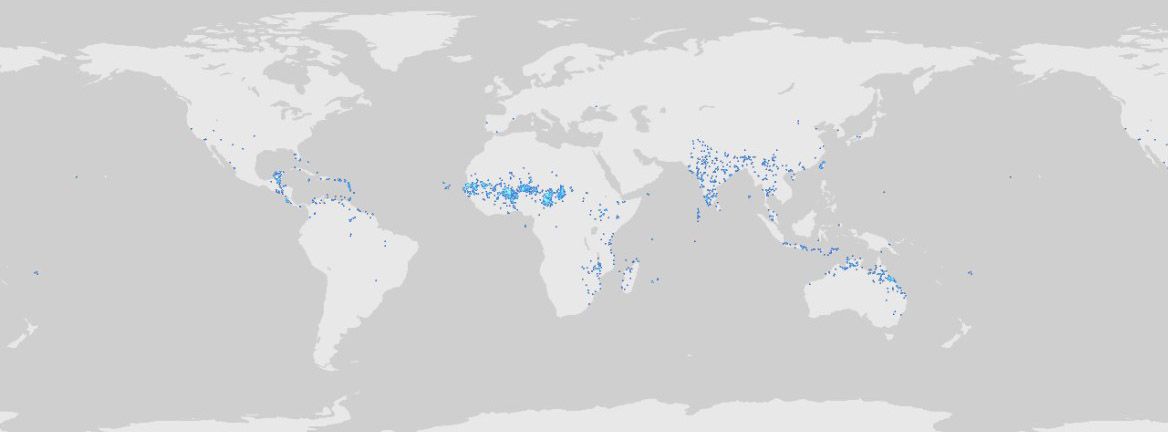
图1 青枣的地理分布
Fig.1 Schematic diagram of the geographical distribution of Ziziphus mauritiana
此图基于全球生物多样性信息设施(GBIF)数据库(https://www.gbif.org/)。
This graph is based on the Global Biodiversity Information Facility(GBIF)database.
尽管拥有广泛的分布与悠久的利用历史,青枣至今仍被归类为“被忽视和未充分利用植物物种”[10],其在全球政策制定、科学研究与产业开发中所获得的关注程度,与其巨大的发展潜力严重不匹配。而这一现状的原因是多方面、系统性的。首先,青枣产业发展有限、规模化与市场化程度低。目前,青枣仅在印度、中国和巴基斯坦大规模商业化种植,在非洲等地区仍被作为一种野生水果,而在澳大利亚被列为入侵物种。其次,社会认知度不足,价值挖掘与传播力度有待提升。在社会认知层面,青枣独特的营养保健成分、在干旱半干旱地区保障粮食安全与生计的潜力以及蕴含的传统文化价值,均未获得有效宣传和科学评估。这使得消费者认可度有限,市场前景不足。再次,基础研究相对薄弱,科技创新支撑不足。与大宗水果相比,青枣在基因组功能解析、重要性状遗传机制、果实采后生理代谢等基础研究领域仍存在显著差距。此外,政策支持缺乏,全球研究合作意识薄弱。各国农业政策与科研资源普遍向大宗商业水果倾斜,致使针对青枣的专项研究计划与系统性资源调查支持不足。综上所述,青枣较少受到政策、研究和开发机构的关注,导致其生产、消费、营养及贸易价值方面的数据往往零散、不完整或仅局限于特定区域,极大地限制了其开发潜力。
然而,在全球炎热干旱地带的不发达农村地区,青枣是当地居民食品、营养和收入的主要来源[11-12]。当前,全球气候变化和食品危机愈发严峻,其中炎热干旱地带的国家和地区面临的威胁最为严重。青枣作为耐旱、耐涝性极强的树种,且果实营养丰富,兼具生态和经济价值,未来将在干旱地区农业系统应对气候变化和食品危机中发挥至关重要的作用[13-14]。因此,有必要系统性总结青枣的驯化栽培历史、当前利用现状和最新科研进展,进而提出对策与建议,以期促进研究人员和专业人士关注青枣、开展相关研究工作,推动青枣产业的持续健康发展。
1 青枣的驯化和栽培历史
1.1 青枣的驯化和栽培历史
青枣的驯化和栽培历史最早可追溯到新石器时代的印度次大陆。印度作为青枣的起源地之一和最早栽培地,在11 000年前已开始驯化栽培青枣[2,15]。而在3200年前,青枣在中国、巴基斯坦以及非洲东部地区逐渐得到进一步驯化和栽培[2]。目前,青枣主要分布于印度北部的拉贾斯坦邦、哈拉亚纳邦以及巴基斯坦的开伯尔-普赫图赫瓦省、旁遮普省和信德省等。
在中国,青枣自然分布于云南、台湾、广西和海南等热带地区,在四川和福建等亚热带地区也有少量分布。然而,最早系统开展青枣引种和选育工作的是台湾地区,其于1944年开展青枣新品种选育工作,并在长期栽培驯化过程中培育出一批优良品种[16-17]。截至目前,台湾地区已选育50多个青枣新品种,成为中国乃至世界的青枣育种中心,因此众多新品种习惯上被称为“台湾青枣”[18-19]。
在20世纪70年代末,云南率先从缅甸引进并种植青枣。20世纪90年代引进台湾青枣品种,其果实香、脆、甜,作为一种经济价值较高的热带地区新型水果,在云南、广东和海南进行开发和推广。2000年,华南地区形成了发展台湾青枣的热潮,当时种植面积已在2000 hm2以上[6]。自2002年起,青枣被引种至辽宁、北京等北方地区进行设施栽培。经过数年的试验研究,青枣能够在北方大棚中正常生长并结实,引种已初获成功[6],然而最终未能实现大规模推广。
1.2 青枣的种群分化
经过长期的自然选择与人工驯化,青枣在不同地理区域和气候条件下发生了显著的种群分化,形成了各具特色的生态型与品种群,展现出鲜明的环境适应性及地域特征(表1)。
表1 中国和印度青枣品种的性状特点
Table 1 Trait characters of Ziziphus mauritiana between China and India
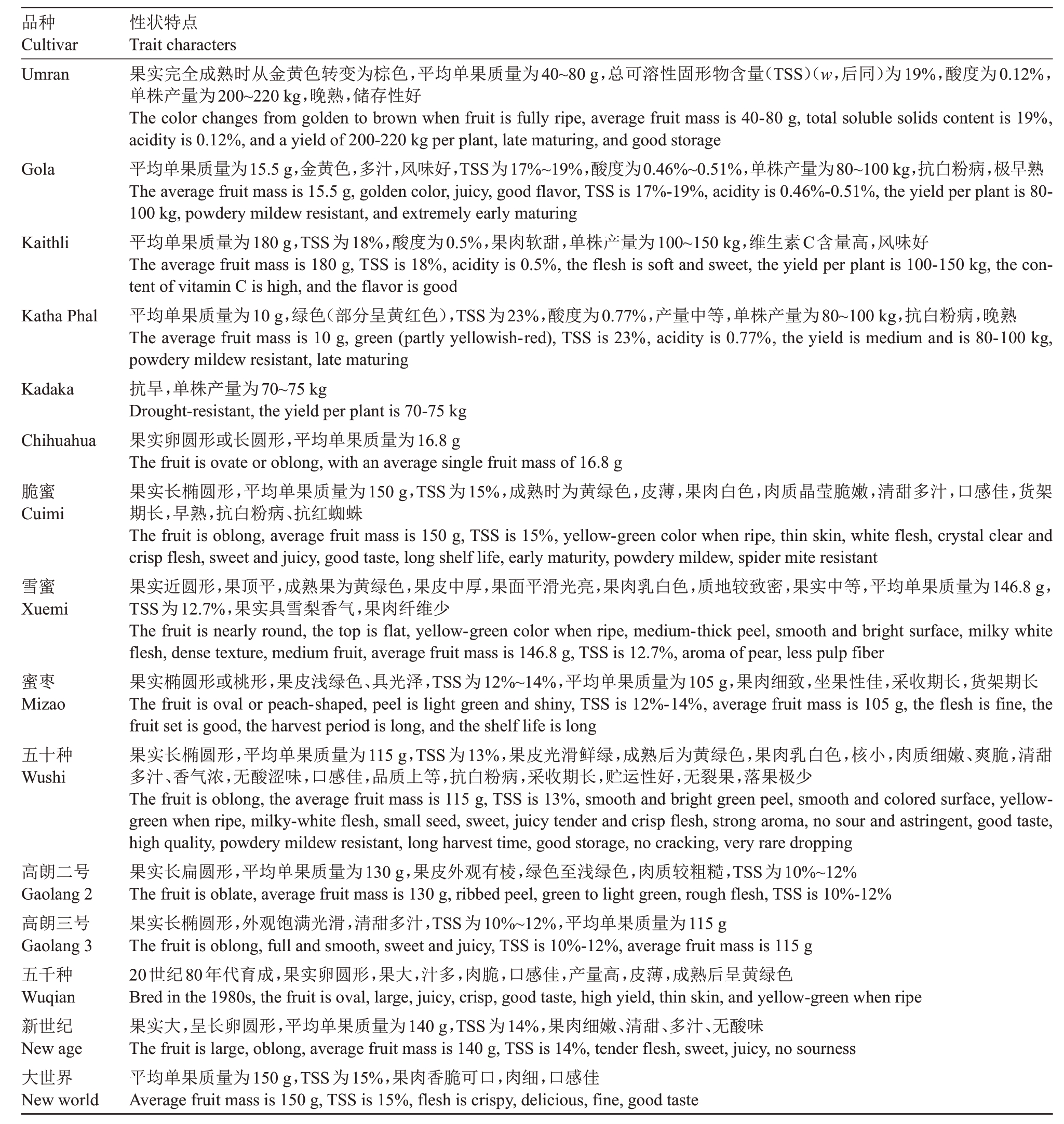
印度次大陆作为青枣的起源与原始多样性中心,其种质资源普遍保留较多的野生性状。当地品种的果实普遍偏小,多数品种(如Gola、Katha Phal等)的平均单果质量低于20 g,仅少数品种(如Umran、Kaithli等)超过50 g。果实糖酸比偏低,略带涩味,需完全成熟软化后方可食用,成熟时果实常呈红色、棕色及金黄色,或部分着色,形态近似于传统枣果。此外,印度青枣种群叶片较小、托刺尖锐,表现出较强的抗旱耐瘠能力,适应粗放式栽培管理[7,20]。
相比之下,中国选育的青枣品种群经历了更为系统化的人工改良,尤其以台湾地区为代表的育种工作,在过去数十年间通过对印度及东南亚种质的引种与杂交选育,逐步培育出在果实性状与栽培习性方面具有显著差异的新型品种群,具体特征表现为叶片增大、托刺退化、单果质量增加及生长迅速。多数品种的单果质量超过60 g,最大可达200 g,约为印度品种的3~6倍[16-17]。果肉脆嫩、味甜无涩,果实在翠绿未完全成熟时即可采收上市,此时风味最佳,故以青枣作为商品名流通[18-19]。尽管完熟后果皮转变为黄色或淡红色,但随着糖酸比下降、果肉软化,其商品价值降低[21-22]。除印度与中国外,巴基斯坦、非洲东部等地区的青枣形成了适应当地生态条件的地方类型,如果实偏小、耐旱性强、多用于鲜食或简单加工,这进一步丰富了该物种的生态型[23-25]。
2 青枣的利用现状
2.1 果品与食品
在中国,青枣是一种鲜食价值极高的热带水果,果实营养价值极高,富含多种营养成分,包括碳水化合物、糖分、蛋白质、脂肪等以及钙、镁、钾、钠和磷等矿物质元素(表2)。此外,青枣还含有类胡萝卜素、氟化物、果胶、柠檬酸、硫胺素、核黄素、烟酸、维生素、马来酸、草酸和槲皮素等有益健康的营养成分[4,23]。研究表明,青枣在矿物质、维生素C和蛋白质含量上均超过苹果,其维生素C含量是大多数水果的2~3倍,磷、钾、钠含量也高于苹果和柑橘等常见水果[5,24]。青枣种子同样富含蛋白质、必需氨基酸和矿物质元素等[19]。
表2 青枣和其他常见水果营养成分的比较
Table 2 The comparison of nutrient value between Ziziphus mauritiana and other common fruits

注:其他水果的营养成分含量取自公共卫生数据中心(https://www.phsciencedata.cn/Share/)。
Note:The nutrient content of other fruits was retrieved from the Public Health Data Center(https://www.phsciencedata.cn/Share/).
青枣具有当年开花当年结果、边开花边结果的特性,且发芽和开花均较晚(中国南方地区9—10月开花),花期长达2个月[16,25],这使得青枣果实分批成熟,挂果期较长且不易脱落,有效延长了鲜果的供应期,便于销售。青枣的成熟期为2—4月,恰逢元旦和春节消费高峰。作为一种珍稀热带水果,青枣有助于填补其他水果产量较低时期的市场空缺[18],因此具有较高的经济价值。青枣的平均单果质量通常超过50 g,部分品种甚至可在200 g以上,其口感清脆、多汁、甘甜可口,风味浓郁,具有独特香气,鲜食价值较高[16-18],是节日礼品的理想选择。
相较于中国,青枣在印度、巴基斯坦以及非洲等地区发挥着更重要的作用,被认为是“干旱地区水果之王”或“穷人的苹果”[2],其鲜食和加工利用历史悠久,是当地传统饮食文化中不可或缺的部分。在这些地区,青枣的食用方式多样。除鲜食和干制外,还常被加工成腌渍、糖渍[7,10]、水果面粉、粥[11-12]、面包、糕点、糖果和果酱等传统食品[13-14]。
2.2 生计方式
青枣凭借卓越的生态适应性能够直接转化为稳定且多元的生计产出,为资源匮乏地区的农户提供食物、饲料、燃料及现金收入,从而形成一种抵御环境与市场风险的韧性生计模式。
青枣对环境的适应性非常强,喜光耐热,对干旱、贫瘠及盐碱胁迫具有极强的耐受能力。青枣在年降雨量200 mm的干旱贫瘠的沙漠或半沙漠地区,以及-2~50 ℃温度范围内能够正常生长;对土壤的要求较低,养分需求量相对较少,能够在酸性黏土、盐碱地以及山岭贫瘠的砂砾土等多种土壤类型中正常开花结果[26]。研究发现,当青枣种植于干旱、高盐土壤中时,其果实品质和产量无明显变化[27-28]。这种内生的生态适应能力,为其广泛栽培和分布提供了坚实的生物学基础,使其能够在普通粮食作物、棉花、油料作物、蔬菜和一般果树等无法正常生长的地方开花结果[29]。
青枣产业为干旱地区提供了稳定的经济收入与就业机会。在印度,青枣产业每年创造就业机会108万人次。由于种植青枣的经济回报高于传统作物,其每公顷净收入25 000~45 000卢比,而其他作物仅为3000~5000卢比。因此,约80%的当地农民倾向于种植青枣。即使在极端干旱导致其他作物绝收的年份,单株青枣仍能稳定产出10~15 kg果实、5~8 kg饲料及8~12 kg燃料,从而成为农户重要的收入来源与生活资料保障[30]。在非洲布基纳法索,从事青枣等野生水果采集与加工的人员超过50万,其中绝大多数人员为女性,这为农村妇女提供了重要的经济独立途径[12]。
青枣产业有助于保障粮食安全与营养补充。在干旱半干旱地区,家庭预算多用于购买主食,对水果蔬菜的购买力有限。青枣因易于获取、价格低廉且营养丰富,成为当地居民补充膳食纤维、维生素和蛋白质等重要营养物质的理想选择[10]。Nyanga等[11]、Ngigi等[10]、Moussa等[13]和Muhammad等[14]研 究指出,在津巴布韦、肯尼亚、埃塞俄比亚、尼日尔及巴基斯坦等地区,青枣对缓解农村地区饥饿、改善营养状况发挥着关键作用。
综上所述,青枣凭借强大的环境适应性,将边际土地有效转化为生产性资产,并通过提供现金收入、就业岗位、食物与饲料等多重产出,在全球多个发展中国家的农村地区构建了一种低成本、高韧性的可持续生计方式,显著提高了农户应对气候波动与经济风险的能力[25]。
3 青枣的研究进展
3.1 光生物学
光生物学(photobiology)是指从光受体、光信号转导、光与其他信号整合、光能利用等方面研究光和生物的相互作用、光环境与植物的互作机制的科学,对指导青枣的栽培和育种改良具有重要意义。
青枣属于C3植物,但其净光合速率高于一般C3树种,光合生产力较高,是高光效植物[31-32]。研究者对青枣不同品种在不同环境下的光合作用特点进行详细分析,发现其光合作用日变化趋势呈“双峰”型,气孔因素是主要影响因子[33-34];进一步探讨了青枣高光效的生理生化基础,发现不同品种青枣叶片中气孔大小、分布及叶绿体数量等存在差异[35-37],这主要受到内在因素(如矿物质元素)及外界环境条件(如光照度、土壤、水分、肥料)等影响[38-39]。
3.2 孢粉学
青枣具有童期短、当年开花、当年结果等生物学特性[16],是适合开展发育生物学研究的果树树种。青枣自然芽变率、自然杂交率、品种间的人工杂交率均较高[17-19],将青枣作为亲本与枣优良鲜食品种进行属间杂交育种以选育新品种是当下青枣育种工作的重心。
孢粉学研究不仅有助于解决枣属植物间杂交育种的问题,还有利于提高青枣果实的坐果率。研究发现,不同青枣品种花粉的大小、生活力、萌发率、萌发条件和贮藏特性等存在差异,尤其是萌发率在品种间存在极显著差异。花粉萌发的最适宜温度是30~32 ℃、冷藏干燥条件下花粉可以贮藏20 d以上[40-42]。
3.3 组织培养
青枣的组织培养相关研究开展较早,涵盖了离体培养[43]、消毒方法[44]、培养基筛选[45]、试管苗移栽[46]以及抗生素对生长的影响[47]等组培快繁技术的多个方面,并取得了一定进展。研究表明,通过筛选生长素、细胞分裂素等不同植物生长调节剂的组合,成功诱导出愈伤组织,并确定了理想的诱导培养基(0.5 mg·L-1二氯苯氧乙酸+0.1 mg·L-1激动素)和继代培养基(0.5 mg·L-1二氯苯氧乙酸+0.1 mg·L-1玉米素)[44];多菌灵[43]、酒精[45]和吐温-20[47]等消毒方法的研究,为组织培养提供了有效降低污染的方法;青枣愈伤组织生长的适宜温度为31 ℃,光照时间为24 h,pH=6.0[47]。
上述研究成果不仅为青枣的快速繁殖和遗传改良提供了理论依据和技术支持,也为其他热带果树的组织培养研究提供了宝贵经验。然而,青枣是组织培养繁殖比较困难的一类树种,面临着生根困难和黄化落叶等问题,相关研究已近乎停滞,亟须进一步研究。
3.4 细胞遗传学
青枣是一种多倍体植物,其倍性复杂。早期细胞学研究报道其染色体数基数是12,最新研究发现青枣群体内存在二倍体[48]、四倍体(2n=4x=48)[49-50]、五倍体(2n=5x=60)[39]、六倍体(2n=6x=72)[51]和八倍体(2n=8x=96)[49-50]等多种倍性水平。Liang等[3]和Guo等[9]推测青枣的驯化过程中经历了高度的多倍体化。最新研究利用荧光原位杂交技术(fluorescence in situ hybridization)从分子层面确认了青枣是四倍体[9]。
染色体倍性的多样化导致青枣表型发生改变,如气孔大小和分布、叶绿体数量以及花粉大小等在不同倍性品种上存在显著差异[39]。此外,多倍化还导致青枣次级代谢产物(维生素C和黄酮类等)含量升高,提升了青枣在生物医药和食品工业中的利用价值;同时也增强了青枣抗旱、抗病等抗逆性,使其能够在更广泛的环境条件下生长,提高了青枣的生态适应性和稳定性。
3.5 分子标记技术
分子标记技术的应用不仅有助于青枣品种的鉴定和亲缘关系的分析,还能为青枣的遗传育种提供重要的分子水平信息,加速育种进程,提高育种效率,推动青枣品种改良和遗传多样性研究的发展。
目前,在青枣中已经开发与应用多种类型的分子标记,如分别利用扩增片段长度多态性(amplified fragment length polymorphism,AFLP)、简单序列重复(simple sequence repeat,SSR)、简单序列间重复(inter-simple sequence repeats,ISSR)、随机扩增多态性DNA(randomly amplified polymorphic DNA,RAPD)、目标起始密码子靶向多态性(start codon targeted polymorphism,SCoT)和单核苷酸多态性(single nucleotide polymorphism,SNP)等[3,51-52],成功区分和鉴定了印度、巴基斯坦、沙特阿拉伯和伊朗等国家的数十份青枣种质资源,系统分析了其遗传关系和多样性。基于下一代测序策略,针对中国(45份)、越南(39份)、巴基斯坦(25份)和缅甸(8份)共117份青枣种质开发了14个新型细胞核SSR(nucleus SSR,nSSR)和50个叶绿体SSR(chloroplast SSR,cpSSR)分子标记,分别检测到137个等位基因和5种单倍型,并构建了相应的DNA指纹图谱。结果表明,大多数种质的聚类结果与其地理来源一致,且母系谱系多样性较低[3,53]。分子标记的研究加深了对现有青枣种质亲缘关系的认识,有效促进了品种选育工作的进一步发展。
3.6 采后生理学
新鲜青枣难以保鲜,常温常湿下贮藏超过8 d即发生软化、褐变、皱缩和腐烂。开发简便易行的青枣保鲜贮藏技术能够降低贮藏环节的损失。
青枣采后生理和保鲜技术已有大量研究。果实采后硬度[54]、色泽[55]、营养成分[56]、呼吸作用[57]、激素[58]、酶活性[59]和细胞膜完整性[60]等采后生理生化的变化已得到较为深入的研究。物理(气调、热处理、冷藏、臭氧和微波等)、化学(1-甲基环丙烯、抗坏血酸、山梨酸钾、氯化钙和苯甲酸钠等)和生物(微生物保鲜剂、壳聚糖、海藻寡糖和剑麻提取液等)等不同保鲜技术在青枣上的应用研究表明,这些技术通过影响果实生理生化、抗病性、细胞膜完整性和能量代谢等,有效延长了青枣保鲜期,减少了采后损失,对青枣产业的发展具有重要意义。
3.7 多组学
组学研究是当前生命科学研究的前沿热点,对于深入开展青枣分子育种和性状调控具有重要指导作用。目前,青枣的组学研究相对较少,且主要集中于基因组、转录组和代谢组方面。
基因组测序是组学研究的基础。多倍体基因组的组装相对困难,尤其是同源多倍体基因组,其序列高度相似[61]。仅有少数几种同源多倍体植物等被组装至单倍型分辨率的染色体水平基因组[9]。虽然青枣叶绿体完整基因组已有报道[62],但直到2024年10月,染色体水平、端粒到端粒的青枣参考基因组才得以完整注释,该参考基因组基于野生型青枣“西双野生”和栽培型青枣“蜜思”,采用“双阶段组装”策略,整合多种测序技术进行组装,是目前最新且准确度最高的基因组[9]。
代谢组和转录组技术分析表明,与野生型青枣相比,栽培型青枣果实中单宁和绿原酸生物合成相关基因的表达水平及其代谢产物的积累显著降低,这是导致果实涩味丧失的主要原因[9];进一步挖掘出与青枣果实着色相关的MYB转录因子(MYB13/14/15/16),以及负调控枣疯病抗性的类钙调素基因(calmodulin-like)[63-64];发现了新的黄酮类化合物和环肽生物碱[65]。未来可利用基因组、转录组和代谢组等技术开展多维度研究,以阐明青枣重要经济性状的形成机制和耐旱抗性的适应机制等,对开展优良品种的选育工作具有重要价值。
3.8 生态学
青枣生长速度快,根系发达,并且耐旱、耐热、耐涝、耐瘠薄、耐盐碱,适应性强,是退耕还林、绿化荒山、水土保持、改良生态环境、抵抗干旱、强风、洪涝和盐碱等气候灾害的优良树种[26,66]。在云南金沙江干热河谷区的试验表明,青枣是当地生态农业和退耕还林的一个理想树种[67]。青枣与其他作物混交的生态模式在提高经济收益、调节局部小气候和土壤改良等生态效益方面表现优异[68],展示了青枣在生态恢复和农林复合生态农业中的潜力。此外,鉴于青枣较强的抗逆性及良好的经济和生态效益,阿拉伯海湾国家已将其引进并在当地开展小规模试验种植,以应对极端高温和干旱气候[2]。
3.9 生物医学
青枣作为一种传统药材,在中国、印度和巴基斯坦等地区的应用历史悠久,其果实、种子、叶、树皮和根均可入药[4]。青枣成熟种子在中国云南及其周边地区被广泛用作传统中药材,一般称为“理枣仁”或“滇枣仁”,其药效与传统中药“酸枣仁”相似[69],具有镇静、催眠、抗焦虑、增强记忆、增强免疫功能等作用[70]。印度阿育吠陀传统医学表明,青枣果实有助于消化和改善心血管;种子具有镇静作用,可用于治疗腹泻、呕吐、恶心和中毒等;叶片可用于治疗出汗过多、儿童伤寒等,具有抗肥胖和解热特性;树皮可用于治疗牙龈炎、疖子、腹泻和痢疾等;根可用于治疗咳嗽、头痛和胆汁分泌过多等[71]。
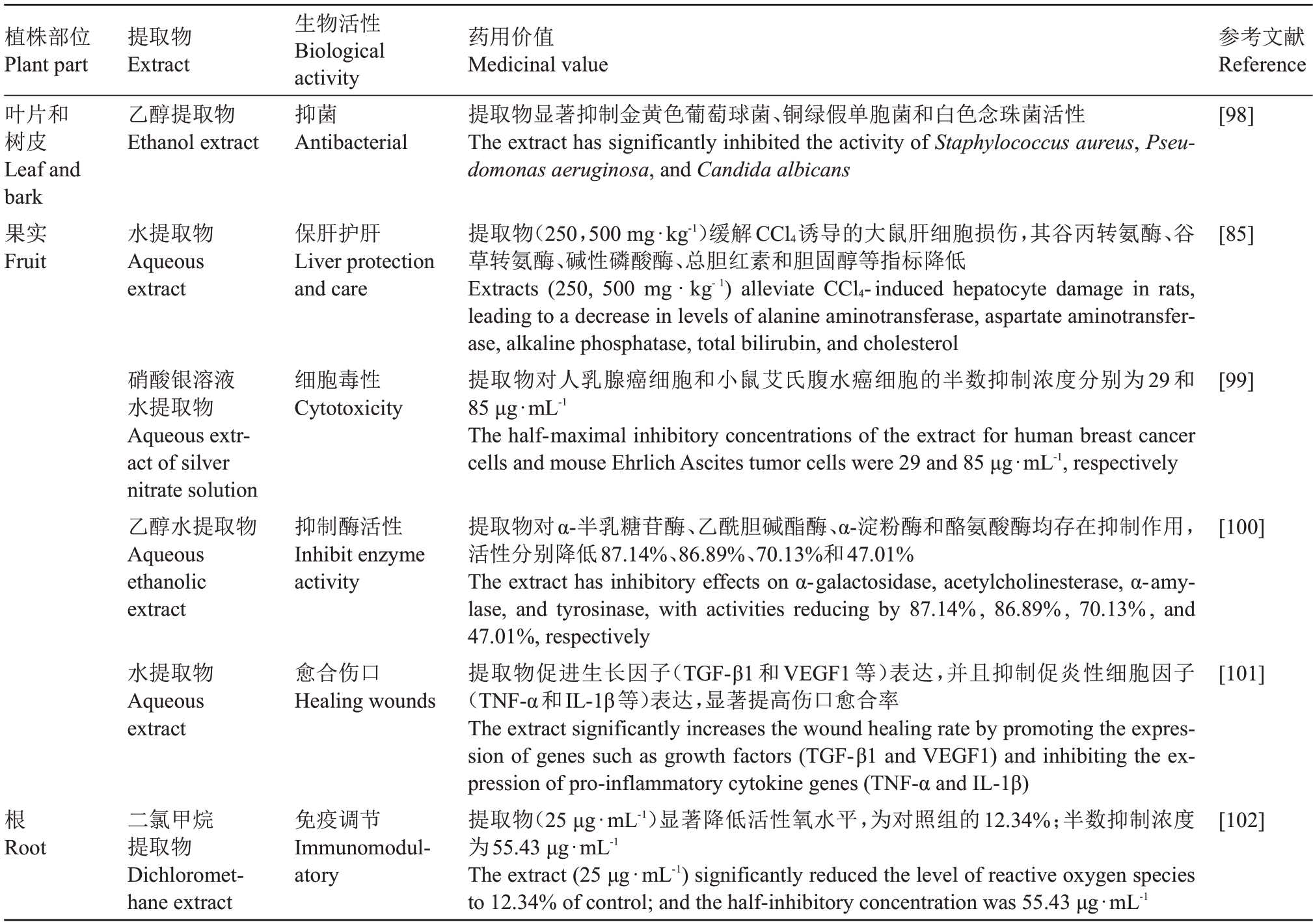
近年来,利用现代化学分析技术解析青枣生物活性成分的研究逐渐增多。在青枣果实[4]、种子[71-72]和树皮[73]等组织和器官中发现了具有抗糖尿病、抗炎和抗菌等药理活性的生物活性物质,如多酚、类黄酮、生物碱、糖苷、单宁和皂苷等(表3)。对青枣不同组织和器官中天然提取物的药理研究表明,其具有抗氧化[4]、抗癌[72]、抗糖尿病[73]、愈合伤口[85]和免疫调节[86]等功能(表4),如果实提取物对大肠杆菌、金黄色葡萄球菌等细菌和黑曲霉、木霉等真菌具有显著的抑制作用[103,99];叶片和树皮提取物具有降低血脂、抗糖尿病和保肝护脾等作用[104-105];种子提取物富含皂苷和白桦脂酸,具有降低胆固醇、抗炎、抗疟疾、抗艾滋病和抗肿瘤等活性[80]。因此,使用高灵敏度和高分辨率的前沿化学分析技术表征青枣植株体内特有的功能化合物及其药用价值,对开发新药物和解析疾病作用机制具有重要意义,显示青枣在生物医学领域具有广阔的应用前景。
表3 青枣植株不同部位的功能成分及其生物活性
Table 3 Functional components and their biological activities from different part of Ziziphus mauritiana plant

表4 青枣植株不同部位提取物的药用价值
Table 4 Medicinal value of extracts from different parts of Ziziphus mauritiana plant

表4 (续)Table 4 (Continued)
3.10 天然产物
青枣含有多种具有生物活性的化学物质,可作为医药健康、石油化工、食品工业和环境保护等产业中人工合成化学品的天然替代品,符合当前绿色环保、可持续发展理念,在工业领域具有较大的应用潜力。例如,青枣果实提取物具有极高的抗氧化活性,可作为天然抗氧化剂替代人工合成抗氧化剂,应用于石化产品的生产[106];种子富含单不饱和脂肪酸、角鲨烯、豆甾醇等功能成分,可用于烘焙食品的生产[78];果实和种子可用于制造重要的医用材料——聚合体生物黏附剂(bioadhesive polymers)[107-108]。众多研究已经证实,青枣的果实、种子和叶片在各个工业领域中用途多样,而且经济效益显著,有望更广泛地应用到多种工业产品的生产过程中(表5)。
表5 青枣中提取的天然产物的工业用途
Table 5 Industrial use of natural products extracted from Ziziphus mauritiana

4 青枣产生的前景展望
青枣凭借卓越的适应力,在干旱、高温、盐碱以及洪涝等极端条件下仍能正常生长,对防止土地退化、减缓气候变化影响具有不可忽视的作用。青枣在中国作为一种热带珍稀水果被广大消费者所熟知,但在印度、巴基斯坦和非洲等热带干旱地区,它是农民补充营养、维持生计和增加收入的重要产业,在维护粮食安全和减少贫困方面扮演着关键角色,被誉为“干旱地区水果之王”或“穷人的苹果”。近年来研究发现,青枣在生物医药、石油化工和食品工业等领域展现出巨大潜力,在未来有望发挥更大作用。因此,青枣的栽培和利用在全球范围内具有重要的生态、经济和社会价值。然而,目前青枣仍然属于“被忽视和未被充分利用植物”,未得到充分重视,面临着众多问题和挑战。
4.1 问题与挑战
自20世纪90年代开始,中国热带地区开始种植青枣,经过30多年的发展历程,青枣的栽培模式、产区布局和主栽品种经历了多次调整与变革,已逐步趋于稳定。然而,青枣是典型的阳性植物,整个生育期都需要充足的阳光。青枣在年平均温度18 ℃以上、极端最低温度不低于0 ℃、霜期不超过15 d的地区均能生长,但在年平均温度20 ℃以上,基本无霜的地区生长较为良好,这极大限制了青枣的适栽范围和产业规模。目前,中国青枣的主要栽培区域为福建、云南、广东、广西、海南和台湾的热带或亚热带地区。虽然在北方地区已有少量大棚引种试栽,但受气候条件影响较大,尚无法大面积推广种植。
我国青枣产业在快速发展过程中,长期缺乏系统性的种质资源调查与评估,对现有品种资源的分布、特性及适应性尚未形成清晰认知,导致苗木品种命名混乱,同物异名等现象普遍存在。多数产区尚未建立科学的品种区域试验制度,品种引进与推广存在较大盲目性,加之政策引导缺位与财政支持不足,导致产业发展整体呈现无序化态势,从而制约了产业标准化与优质化进程。具体而言,我国青枣产业面临以下突出问题:
品种体系不健全,缺乏区域化主导品种。目前,主栽品种多依赖从台湾地区引种,缺乏系统评估与筛选,未能形成与不同生态区相匹配的优良品种结构;同时配套栽培技术研发滞后,制约了品种潜力的充分发挥。
栽培管理粗放,标准化程度低。部分产区仍沿用传统管理模式,水肥管理不科学,病虫害综合防控能力薄弱,导致果实品质参差不齐,产量稳定性差,严重影响产业经济效益。
采后处理与冷链设施严重缺失。青枣采后商品化处理比例低,预冷能力不足,冷链运输与贮藏设施匮乏,导致果实品质迅速劣变,损耗率较高。
保鲜技术研发滞后,货架期短。目前,青枣贮藏保鲜多依赖传统方法,新型保鲜剂、环境调控及包装技术应用不足,果实采后衰老与病害控制效果不佳,限制了销售半径与市场周期。
综上所述,我国青枣产业在品种选育与推广、标准化生产技术与采后保鲜技术等关键环节仍存在明显短板。
4.2 建议与对策
为实现青枣产业的高质量发展与可持续经营,未来需要重点开展以下工作:
加强种质资源收集与新品种选育,推进区域化品种布局。应全面开展青枣种质资源的系统性调查、收集与保存工作,建立资源圃与信息库,为育种研究提供材料基础。在此基础上,强化重要性状(如果实品质、抗逆性、成熟期等)的遗传分析与评价,利用杂交育种、分子标记辅助选择等现代育种手段,加快优质、高产、抗病及适应性强的新品种选育进程。同时,结合不同产区的生态条件与市场需求,推进品种区域化试验与合理布局,明确各区域主栽品种,实现品种结构与区域资源禀赋的有效匹配。
制定并推广标准化生产规程,提升栽培管理水平。应围绕各主栽品种和产区特点,研究集成并推广以水肥一体化、绿色防控、整形修剪等为核心的标准化栽培技术体系。制定涵盖建园、土肥水管理、病虫害综合防治、花果管理等环节的生产技术规范,推动管理模式由粗放向精细转变。加强示范园区与示范基地建设,通过技术培训与现场指导,提高种植户的专业技能与标准化意识,全面提升青枣产量、品质与生产效益。
建立健全采后商品化处理与冷链物流体系,推动保鲜技术研发与产业化应用。应重点建设青枣采后分级、清洗、包装等商品化处理中心,配套预冷设施,发展冷链运输与低温贮藏系统,构建从产地到消费市场的全程冷链流通链条。同时,加强青枣采后生理与衰老机制研究,研发新型保鲜剂、可降解包装材料、精准控温控湿等绿色保鲜技术,推动保鲜技术的集成示范与产业化应用,有效降低采后损耗,延长货架期,提升商品价值。
延伸产业链,推动青枣精深加工与高值化利用。应积极拓展青枣加工途径,鼓励企业开展果汁、果干、果脯等传统加工产品升级,同时研发果酒、果醋、休闲零食、代餐食品和功能性提取物等高附加值产品。推动产学研协同创新,突破加工过程中的营养保持、风味调控等关键技术,提高原料综合利用率和产品市场竞争力。加大在医学保健品和功能食品上的研发力度,积极推动其在生物医药产业中的利用。通过精深加工延伸产业链条,增强产业抗风险能力,构建多元化、可持续的青枣产业发展新格局。
强化基础研究与多组学技术应用,驱动育种与栽培技术创新。应深入开展基于组学的基础研究,为技术革新提供坚实基础。充分利用青枣高分辨率基因组测序的成果,结合基因组学、转录组学、蛋白质组学和代谢组学等多组学联合分析,并与传统的形态学、解剖学、生理学、生物化学等研究方法相结合,系统解析青枣强大的环境适应性、独特的生长结果习性以及富含多种功能活性成分等优异性状的形成机制。相关研究成果将为青枣分子育种、高效栽培和高附加值加工提供强有力的理论支撑(图2),从而全面提升产业竞争力与可持续发展能力。
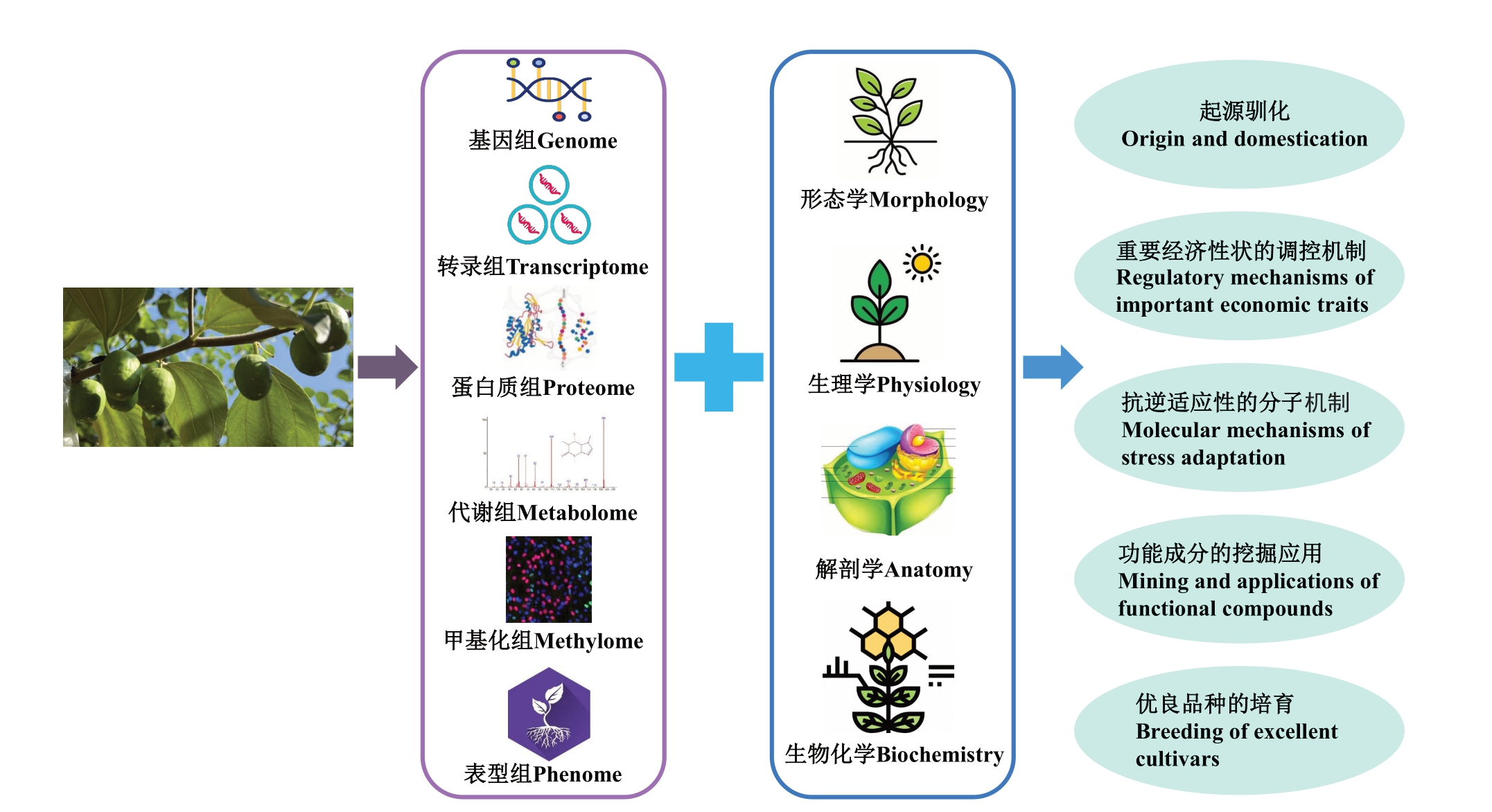
图2 青枣未来的研究展望
Fig.2 Future prospects in the research realm of Ziziphus mauritiana
加强国际合作,推动技术输出与全球农业可持续发展。当前,印度、巴基斯坦及非洲等地区的青枣产业仍面临果实小、产量低、病虫害高发及优良品种与配套技术缺乏等突出问题。相比之下,中国经过30余年的持续研究,已在青枣优良品种选育、高效栽培技术集成及高值化产品开发等方面积累了丰富经验,形成了较为完善的技术体系。在此背景下,应充分发挥中国在青枣产业方面的技术优势,积极推动优良品种、标准化栽培与采后加工等技术体系的对外输出。通过在“南南合作”框架下建立海外示范园区、开展技术培训与联合研发,促进先进适用技术在发展中国家的推广应用。此举不仅有助于改善当地农民生计,增强全球农业产能,也对缓解饥饿与营养不良、推动农村经济发展、支持全球农业可持续转型具有重要的战略意义。
[1] 李义龙.滇刺枣的利用与研究[J].野生植物研究,1985,4(1):12-16.Li Yilong.Utilization and research of Yunnan jujube[J].Wild Plant Research,1985,4(1):12-16.
[2] O’Brien C J,Campbell S,Young A,Vogler W,Galea V J.Chinee apple(Ziziphus mauritiana):A comprehensive review of its weediness,ecological impacts and management approaches[J].Plants,2023,12(18):3213.
[3] Liang T,Sun W S,Ren H,Ahmad I,Vu N,Maryam,Huang J.Genetic diversity of Ziziphus mauritiana germplasm based on SSR markers and ploidy level estimation[J].Planta,2019,249(6):1875-1887.
[4] Prakash O,Usmani S,Singh R,Singh N,Gupta A,Ved A.A panoramic view on phytochemical,nutritional,and therapeutic attributes of Ziziphus mauritiana Lam.:A comprehensive review[J].Phytotherapy Research,2021,35(1):63-77.
[5] Anjum M A,Haram A,Ahmad R,Bashir M A.Physico-chemical attributes of fresh and dried Indian jujube(Zizyphus mauritiana) fruits[J].Pakistan Journal of Agricultural Sciences,2020,57(1):165-176.
[6] 周晨城.中国鲜食枣产业现状调研[D].杨凌:西北农林科技大学,2023.Zhou Chencheng.Investigation on the fresh jujube industry in China[D].Yangling:Northwest A&F University,2023.
[7] Sishu N K,Das U,Selvaraj C I.Indian jujube a potential fruit tree to improve the livelihood[J].Saudi Journal of Biological Sciences,2023,30(9):103769.
[8] Ahmad I,Nafees M,Ashraf I,Maryam,Al-Khayri J M,Yousaf M M,Ahmad B,Qureshi R.Fruit morphological attributes to assess genetic diversity in jujube (Ziziphus mauritiana L.) germplasm of Bahawalpur[J].Pure and Applied Biology,2016,5(4):921-926.
[9] Guo M X,Bi G Q,Wang H,Ren H,Chen J Y,Lian Q,Wang X M,Fang W K,Zhang J J,Dong Z N,Pang Y,Zhang Q L,Huang S W,Yan J B,Zhao X S.Genomes of autotetraploid wild and cultivated Ziziphus mauritiana reveal polyploid evolution and crop domestication[J].Plant Physiology,2024,196(4):2701-2720.
[10] Ngigi P B,Termote C,Pallet D,Amiot M J.Mainstreaming traditional fruits,vegetables and pulses for nutrition,income,and sustainability in sub-Saharan Africa:The case for Kenya and Ethiopia[J].Frontiers in Nutrition,2023,10:1197703.
[11] Nyanga L K,Gadaga T H,Nout M J R,Smid E J,Boekhout T,Zwietering M H.Nutritive value of masau(Ziziphus mauritiana)fruits from Zambezi Valley in Zimbabwe[J].Food Chemistry,2013,138(1):168-172.
[12] Kabré B,Lankoandé B,Belem-Ouédraogo M,Zon A O,Ouédraogo A.Predicting fruit production of Ziziphus mauritiana Lam.according to phytogeographic zones in Burkina Faso:Implications for promoting the use potentials and the sustainable management of the species[J].South African Journal of Botany,2022,147:493-500.
[13] Moussa M,Abasse T,Rabiou H,Aboubacar M,Mahamane L.Analysis of the fruit value chain of two priority food woody species of central southern Niger,west Africa[J].Open Journal of Forestry,2020,10(3):277-292.
[14] Muhammad N,Luo Z,Yang M,Liu Z G,Liu M J.The nutritional,medicinal,and drought-resistance properties of Ziziphus Mill.make it an important candidate for alleviating food insecurity in arid regions:A case of Pakistan[J].Horticulturae,2022,8(10):867.
[15] Gupta A K.Origin of agriculture and domestication of plants and animals linked to early Holocene climate amelioration[J].Current Science,2004,87(1):54-59.
[16] 王小媚,董龙,任惠,方位宽,邱文武,刘业强,苏伟强,黄辉晔.台湾大青枣“雪蜜”在南宁的引种表现及主要栽培技术[J].中国南方果树,2017,46(5):121-124.Wang Xiaomei,Dong Long,Ren Hui,Fang Weikuan,Qiu Wenwu,Liu Yeqiang,Su Weiqiang,Huang Huiye.Introduction performance and main cultivation techniques of“Snow Honey”in Nanning[J].South China Fruits,2017,46(5):121-124.
[17] 王葫青,任惠.18个毛叶枣种质在广西南宁引种的基本农艺性状表现与评价[J].广西农学报,2023,38(3):16-21.Wang Huqing,Ren Hui.Expression and evaluation of basic agronomic traits of 18 Zizyphus mauritiana Lam germplasm introduced in Nanning,Guangxi[J].Journal of Guangxi Agriculture,2023,38(3):16-21.
[18] 陈菁,谢江辉,窦美安.12个毛叶枣品种(种质)园艺性状的评价[J].中国南方果树,2006,35(1):48-49.Chen Jing,Xie Jianghui,Dou Meian.Evaluation of horticultural traits of 12 jujube cultivars[J].South China Fruits,2006,35(1):48-49.
[19] 薛瑾.北京地区台湾青枣不同品种对比试验及栽培技术研究[D].北京:北京林业大学,2008.Xue Jin.Contrast on different varieties of green jujube(Ziziphus mauritiana Lamk)and cultivation techniques in Beijing[D].Beijing:Beijing Forestry University,2008.
[20] Meena V S,Gora J S,Singh A,Ram C,Meena N K,Pratibha,Rouphael Y,Basile B,Kumar P.Underutilized fruit crops of Indian arid and semi-arid regions:Importance,conservation and utilization strategies[J].Horticulturae,2022,8(2):171.
[21] Chiou C Y,Shih H C,Tsai C C,Jin X L,Ko Y Z,Mantiquilla J A,Weng I S,Chiang Y C.The genetic relationships of Indian jujube(Ziziphus mauritiana Lam.)cultivars using SSR markers[J].Heliyon,2020,6(10):e05078.
[22] 冯兰.台湾大青枣在桂西南地区的栽培技术[J].广西热带农业,2010,23(3):43-44.Feng Lan.Cultivation techniques of Taiwan green jujube in the southwestern region of Guangxi[J].Guangxi Tropical Agriculture,2010,23(3):43-44.
[23] Hasan S M K,Kabir M R,Kabir M R,Islam M R,Akhter M J,Moury J Y.Proximate composition,minerals,phytochemicals,and functional activities of jujube fruits grown in Bangladesh[J].Journal of Agriculture and Food Research,2022,8:100302.
[24] Rathore M.Nutrient content of important fruit trees from arid zone of Rajasthan[J].Journal of Horticulture and Forestry,2009,1(7):103-108.
[25] Krishna H,Kumar L,Haldhar S M,Singh D,Saroj P L.Phenological growth stages of Indian jujube (Ziziphus mauritiana Lamk.)according to the BBCH scale[J].Annals of Applied Biology,2019,174(1):106-112.
[26] Singh A,Kumar A,Kumar R,Sheoran P,Yadav R K,Sharma P C.Multivariate analyses discern shared and contrasting ecophysiological responses to salinity stress of Ziziphus rootstocks and budded trees[J].South African Journal of Botany,2022,146:573-584.
[27] Pathan A K,Depar M S,Kalroo M W,Rajput I A,Ahmed R.Response and acclimatization of introduced jujube(Ziziphus mauritiana)variety for the uplift of socio-economic conditions at desert area of Tharparkar,Sindh,Pakistan:PARC-Arid Zone Research Institute,Umerkot,Sindh,Pakistan[J].Pakistan Journal of Agriculture,Agricultural Engineering and Veterinary Sciences,2020,36(1):21-26.
[28] Hesami A,Bazdar L,Shahriari M H.Effect of soil salinity on growth,proline,and some nutrient accumulation in two genotypes seedlings of Ziziphus spina-christi (L.) Willd[J].Communications in Soil Science and Plant Analysis,2020,51(6):804-815.
[29] Maruza I M,Musemwa L,Mapurazi S,Matsika P,Munyati V T,Ndhleve S.Future prospects of Ziziphus mauritiana in alleviating household food insecurity and illnesses in arid and semi-arid areas:A review[J].World Development Perspectives,2017,5:1-6.
[30] Singh A,Singh R K,Kumar A,Kumar A,Kumar R,Kumar N,Sheoran P,Yadav R K,Sharma D K.Adaptation to social-ecological stressors:A case study with Indian jujube(Ziziphus mauritiana Lam.) growers of north-western India[J].Environment,Development and Sustainability,2021,23(3):3265-3288.
[31] 梁开明,曹洪麟,徐志防,叶万辉,刘世平,李武军.台湾青枣及野生种的光合作用日变化及光响应特征[J].园艺学报,2008,35(6):793-798.Liang Kaiming,Cao Honglin,Xu Zhifang,Ye Wanhui,Liu Shiping,Li Wujun.Diurnal variations and light response of photosynthesis in three cultivars and wild type of Ziziphus mauritiana Lam.[J].Acta Horticulturae Sinica,2008,35(6):793-798.
[32] Fu X Y,Zhang J Y,Zhou L Y,Mo W P,Wang H C,Huang X M.Characterizing the development of photosynthetic capacity in relation to chloroplast structure and mineral nutrition in leaves of three woody fruit species[J].Tree Physiology,2022,42(5):989-1001.
[33] Kulkarni M,Schneider B,Raveh E,Tel-Zur N.Leaf anatomical characteristics and physiological responses to short-term drought in Ziziphus mauritiana (Lamk.)[J].Scientia Horticulturae,2010,124(3):316-322.
[34] Agrawal R,Gupta S,Gupta N K,Khandelwal S K,Bhargava R.Effect of sodium chloride on gas exchange,antioxidative defense mechanism and ion accumulation in different cultivars of Indian jujube (Ziziphus mauritiana L.) [J].Photosynthetica,2013,51(1):95-101.
[35] 王春雪,岳学文,史亮涛,李坤,李小英,方海东,潘志贤.元谋干热河谷青枣光合及产量对不同比例有机肥与生物炭配施的响应[J].热带作物学报,2022,43(1):128-136.Wang Chunxue,Yue Xuewen,Shi Liangtao,Li Kun,Li Xiaoying,Fang Haidong,Pan Zhixian.Response of photosynthesis and yield of Zizyphus mauritiana Lam.to different proportion of organic fertilizer with biochar application in Yuanmou dry-hot valley[J].Chinese Journal of Tropical Crops,2022,43(1):128-136.
[36] 陈艺齐,段日汤,张德,米艳华,陆琳,赵俊,木万福,朱红业.云南干热区不同土壤水分条件下青枣光合作用的日变化研究[J].安徽农业科学,2011,39(7):3889-3891.Chen Yiqi,Duan Ritang,Zhang De,Mi Yanhua,Lu Lin,Zhao Jun,Mu Wanfu,Zhu Hongye.Research on diurnal variations of Photosynthesis of Zizyphus mauritiana Lam.under different soil moisture in dry-hot valley of Yunnan[J].Journal of Anhui Agricultural Sciences,2011,39(7):3889-3891.
[37] 姚全胜,雷新涛,苏俊波,王一承,冯文星,邓旭,罗文扬,陈佳瑛.喷施蒸腾抑制剂对毛叶枣叶片光合参数的影响[J].热带作物学报,2009,30(2):131-134.Yao Quansheng,Lei Xintao,Su Junbo,Wang Yicheng,Feng Wenxing,Deng Xu,Luo Wenyang,Chen Jiaying.Effects of antitranspirants on photosynthetic parameters of Ziziphus mauritiana Lam.leaves[J].Chinese Journal of Tropical Crops,2009,30(2):131-134.
[38] 刘世平,李武军,黄小凤,徐志防,曹洪麟.3个台湾青枣品种与野生毛叶枣光合作用及叶绿素荧光特性的比较[J].广东农业科学,2007,34(7):7-10.Liu Shiping,Li Wujun,Huang Xiaofeng,Xu Zhifang,Cao Honglin.Comparison of photosynthesis and chlorophyll fluorescence traits between 3 cultivars and one wild of Ziziphus mauritiana[J].Guangdong Agricultural Sciences,2007,34(7):7-10.
[39] Pradeep T,Jambhale N D.Ploidy level variations for stomata,chloroplast number,pollen size and sterility in ber (Zizhyphus mauritiana Lamk.)[J].Indian Journal of Genetics and Plant Breeding,2000,60(4):519-525.
[40] 李颖岳,续九如,史良,赵斌.大棚栽培台湾青枣不同品种花粉贮藏特性研究[J].林业科技,2007,32(3):47-50.Li Yingyue,Xu Jiuru,Shi Liang,Zhao Bin.Pollen storage property of different cultivars of Ziziphus mauritiana in greenhouse[J].Forestry Science&Technology,2007,32(3):47-50.
[41] 苏新惠.34个毛叶枣品种叶片及花粉形态解剖特征研究[D].南宁:广西大学,2019.Su Xinhui.Anatomical characteristics of leaves and pollen morphology of 34 jujube varieties[D].Nanning:Guangxi University,2019.
[42] 王小媚,任惠,董龙,方位宽,邱文武,黄章保,蔡昭艳,刘业强,苏伟强,李桂芬,黄辉晔.7个毛叶枣品种花粉育性与花粉形态研究[J].中国南方果树,2019,48(6):113-116.Wang Xiaomei,Ren Hui,Dong Long,Fang Weikuan,Qiu Wenwu,Huang Zhangbao,Cai Zhaoyan,Liu Yeqiang,Su Weiqiang,Li Guifen,Huang Huiye.Pollen fertility and morphology of seven varieties of Ziziphus mauritiana Lam.[J].South China Fruits,2019,48(6):113-116.
[43] 王震星,孙宁,冯立云,张文华,许连富.台湾大青枣试管苗入土移栽的研究[J].天津农学院学报,2004,11(4):40-42.Wang Zhenxing,Sun Ning,Feng Liyun,Zhang Wenhua,Xu Lianfu.Study on transplanting into soils of Taiwan green-jujube tube plants[J].Journal of Tianjin Agricultural College,2004,11(4):40-42.
[44] 任敬民,陈跃进,胡民强,周娜芳.台湾青枣的离体培养[J].湖南农业大学学报(自然科学版),2004,30(6):516-518.Ren Jingmin,Chen Yuejin,Hu Minqiang,Zhou Nafang. In vitro culture of Taiwanqingzao[J].Journal of Hunan Agricultural University(Natural Science),2004,30(6):516-518.
[45] 王红梅.台湾青枣组培快繁技术研究[D].北京:北京林业大学,2004.Wang Hongmei.Studies on fast propagation of Zizyphus mauritiana cv.Taiwanqingzao by tissue culture[D].Beijing:Beijing Forestry University,2004.
[46] 任敬民,陈跃进,郭丽明.台湾青枣组织培养的消毒方法[J].湖北农业科学,2004,43(1):65-68.Ren Jingmin,Chen Yuejin,Guo Liming.Sterilized method on tissue culture of Taiwan green jujube[J].Hubei Agricultural Sciences,2004,43(1):65-68.
[47] 任敬民.台湾青枣离体培养研究[D].长沙:湖南农业大学,2003.Ren Jingmin.Study on in vitro culture of Zizyphus mauritiana Lam.(Taiwanqingzao)[D].Changsha:Hunan Agricultural University,2003.
[48] Gupta R B,Sharma S,Sharma J R,Sareen P K.Cytological studies in some varieties of genus Ziziphus[J].National Journal of Plant Improvement,2003,5(1):19-21.
[49] Liu M J,Liu P.Artificial autopolyploidization in jujube[J].Scientia Horticulturae,2023,314:111916.
[50] Sakhanokho H F,Islam-Faridi N,Smith B J.Determination of genome size and chromosome number of a Ziziphus species (Z.mauritiana Lam.) from eastern Senegal[J].HortScience,2022,57(3):349-352.
[51] Zarei A,Rezaei A,Esmailpour M,Ebrahimi A.A comparative assessment of morphological and molecular characterization among three Ziziphus species[J].Physiology and Molecular Biology of Plants,2021,27(5):1007-1025.
[52] Obeed R S,Harhash M M,Abdel-Mawg A L.Fruit properties and genetic diversity of five ber(Ziziphus mauritiana Lamk)cultivars[J].Pakistan Journal of Biological Sciences,2008,11(6):888-893.
[53] Sareen A,Sharma V,Gupta R C.Assessment of genetic diversity and population structure in wild Ziziphus species from northwest India using SSR marker technique[J].Journal of Genetic Engineering and Biotechnology,2023,21(1):4.
[54] 陈莲,王璐璐,林河通,林艺芬,陈艺晖.1-甲基环丙烯处理对台湾青枣果实采后病害的抑制[J].中国食品学报,2020,20(1):196-204.Chen Lian,Wang Lulu,Lin Hetong,Lin Yifen,Chen Yihui.Inhibitory effects of 1-methylcyclopropene on postharvest disease of Indian jujube fruit during storage[J].Journal of Chinese Institute of Food Science and Technology,2020,20(1):196-204.
[55] Kumar S,Yadav P,Jain V,Malhotra S P.Isozymes of antioxidative enzymes during ripening and storage of ber(Ziziphus mauritiana Lamk.)[J].Journal of Food Science and Technology,2014,51(2):329-334.
[56] Jat L,Pareek S,Shukla K B.Physiological responses of Indian jujube (Ziziphus mauritiana Lamk.) fruit to storage temperature under modified atmosphere packaging[J].Journal of the Science of Food and Agriculture,2013,93(8):1940-1944.
[57] Tsegaye M,Alemu T,Dilnessa A,Tolessa A,Tantu T,Bekalu Y,Haile F.Effect of storage condition on the nutritional and antinutritional composition of kurkura (Ziziphus mauritiana Lam.)fruit from North-Eastern Ethiopia[J].Heliyon,2023,9(6):e17380.
[58] Shanbehpour F,Rastegar S,Ghasemi M.Effect of preharvest application of calcium chloride,putrescine,and salicylic acid on antioxidant system and biochemical changes of two Indian jujube genotypes[J].Journal of Food Biochemistry,2020,44(11):e13474.
[59] Rao T V R,Baraiya N S,Vyas P B,Patel D M.Composite coating of alginate-olive oil enriched with antioxidants enhances postharvest quality and shelf life of Ber fruit(Ziziphus mauritiana Lamk.var.Gola)[J].Journal of Food Science and Technology,2016,53(1):748-756.
[60] Jain V,Chawla S,Choudhary P,Jain S.Post-harvest calcium chloride treatments influence fruit firmness,cell wall components and cell wall hydrolyzing enzymes of Ber(Ziziphus mauritiana Lamk.) fruits during storage[J].Journal of Food Science and Technology,2019,56(10):4535-4542.
[61] Kyriakidou M,Tai H H,Anglin N L,Ellis D,Strömvik M V.Current strategies of polyploid plant genome sequence assembly[J].Frontiers in Plant Science,2018,9:1660.
[62] Huang J,Chen R H,Li X G.Comparative analysis of the complete chloroplast genome of four known Ziziphus species[J].Genes,2017,8(12):340.
[63] Xu Y R,Wang C,Kong D C,Cao M,Zhang Q,Tahir M,Yang Y,Yang S,Bo W H,Pang X M.Identification of high tolerance to jujube witches’broom in Indian jujube (Ziziphus mauritiana Lam.) and mining differentially expressed genes related to the tolerance through transcriptome analysis[J].Plants,2023,12(11):2082.
[64] Muhammad N,Luo Z,Meng X W,Zhao X,Wang J R,Yang M,Liu Z G,Liu M J.Comparative transcriptome profiling unveils the potential key genes involved in peel coloration between Ziziphus mauritiana Lam.and Z.jujuba Mill.[J].Scientia Horticulturae,2023,319:112175.
[65] Sakna S T,Mocan A,Sultani H N,El-fiky N M,Wessjohann LA,Farag M A.Metabolites profiling of Ziziphus leaf taxa via UHPLC/PDA/ESI-MS in relation to their biological activities[J].Food Chemistry,2019,293:233-246.
[66] Ahmad R,Muhammad H M D,Naz S,Manzoor M,Altaf M A.Biochemical mechanism unlocking their potential role in salt tolerance mechanism of Zizyphus germplasm[J].Phyton,2023,92(5):1539-1553.
[67] 赵培仙.金沙江干热河谷区退耕地生态经济林种植模式效益研究[J].水土保持研究,2014,21(4):229-232.Zhao Peixian.Research on the benefits of land and tree planting modes of ecological economy in dry hot valley region of Jinsha River[J].Research of Soil and Water Conservation,2014,21(4):229-232.
[68] 苏银玲,孔维喜,赵琼玲,吕维梧,杨子祥.云南干热河谷区台湾青枣—芝麻间作栽培技术及效益分析[J].农业科技通讯,2020(4):214-216.Su Yinling,Kong Weixi,Zhao Qiongling,Lü Weiwu,Yang Zixiang.Analysis of jujube-sesame intercropping technology and benefits in the dry-hot valley of Yunnan province[J].Bulletin of Agricultural Science and Technology,2020(4):214-216.
[69] 郭盛,严辉,钱大玮,赵明,唐志书,段金廒.枣属药用植物资源产业化过程副产物及废弃物的资源价值发现与循环利用策略构建[J].南京中医药大学学报,2019,35(5):579-584.Guo Sheng,Yan Hui,Qian Dawei,Zhao Ming,Tang Zhishu,Duan Jin’ao.Resource value discovery and recycling strategy construction of by-products and wastes in industrialization of medicinal plant resources of Ziziphus genus[J].Journal of Nanjing University of Traditional Chinese Medicine,2019,35(5):579-584.
[70] 张婷,郭怀满,胡丹东,王静茹.滇枣仁与酸枣仁的药理作用研究进展比对[J].首都食品与医药,2016,23(10):23-24.Zhang Ting,Guo Huaiman,Hu Dandong,Wang Jingru.Comparison of research progress on the pharmacological effects of Yunnan jujube seed and Sour jujube seed[J].Capital Food Medicine,2016,23(10):23-24.
[71] Imran S,Bibi Y,Munawar T,Yousaf A M,Hasnain M,Mashwani Z U R.A panoramic review on ethnomedicinal,therapeutic,phytochemical,and advance attributes,of the genus Ziziphus Mill.,native to Pakistan[J].Ethnobotany Research and Applications,2023,25:1-32.
[72] Mbahi M A,Mbahi A M,Umar I A,Ameh D A,Joseph I,Ameh D A,Joseph I.Phytochemical screening and antimicrobial activity of the pulp extract and fractions of Ziziphus mauritiana[J].Biochemistry&Analytical Biochemistry,2017,7(2):1000352.
[73] Butt S Z,Hussain S,Munawar K S,Tajammal A,Muazzam M A.Phytochemistry of Ziziphus mauritiana;its nutritional and pharmaceutical potential[J].Scientific Inquiry and Review,2021,5(2):1-15.
[74] Soraya S,Sukara E,Sinaga E.Identification of chemical compounds in Ziziphus mauritiana fruit juice by GC-MS and LCMS/MS analysis[J].International Journal of Biological,Physical and Chemical Studies,2022,4(2):11-19.
[75] Karim M A,Hossain M K,Al-Mansur M A,Shajib M S,Rashid M A.Isolation of zizyberenalic acid and biological studies of Ziziphus mauritiana Lam.growing in Bangladesh[J].Bangladesh Journal of Botany,2020,48(1):163-168.
[76] Kushwaha P,Yadav S S,Singh V,Dwivedi L K.GC-MS analysis of bio-active compounds in methanolic extract of Ziziphus mauritiana fruit[J].International Journal of Pharmaceutical Sciences and Research,2019,10(6):2911-2916.
[77] Memon A A,Memon N,Bhanger M I,Luthria D L.Assay of phenolic compounds from four species of ber(Ziziphus mauritiana L.) fruits:Comparison of three base hydrolysis procedure for quantification of total phenolic acids[J].Food Chemistry,2013,139(1/2/3/4):496-502.
[78] Memon A,Memon N,Luthria D,Pitafi A,Bhanger M.Phenolic compounds and seed oil composition of Ziziphus mauritiana L.fruit[J].Polish Journal of Food and Nutrition Sciences,2012,62(1):15-21.
[79] Yahia Y,Benabderrahim M A,Tlili N,Bagues M,Nagaz K.Bioactive compounds,antioxidant and antimicrobial activities of extracts from different plant parts of two Ziziphus Mill.species[J].PLoS One,2020,15(5):e0232599.
[80] 郭盛,段金廒,赵金龙,钱大玮,张雯洁.滇枣仁化学成分研究[J].中药材,2014,37(3):432-435.Guo Sheng,Duan Jin’ao,Zhao Jinlong,Qian Dawei,Zhang Wenjie.Chemical constituents from seeds of Ziziphus mauritiana[J].Journal of Chinese Medicinal Materials,2014,37(3):432-435.
[81] Shivakumar S S,Mohana K N S.Ziziphus mauritiana leaves extracts as corrosion inhibitor for mild steel in H2SO4 and HCl solutions[J].European Journal of Chemistry,2012,3(4):426-432.
[82] Ashraf A,Sarfraz R A,Anwar F,Shahid S A,Alkharfy K M.Chemical composition and biological activities of leaves of Ziziphus mauritiana L.native to Pakistan[J].Pakistan Journal of Botany,2015,47(1):367-376.
[83] Ji C J,Zeng G Z,Han J,He W J,Zhang Y M,Tan N H.Zizimauritic acids A-C,three novel nortriterpenes from Ziziphus mauritiana[J].Bioorganic &Medicinal Chemistry Letters,2012,22(20):6377-6380.
[84] Panseeta P,Lomchoey K,Prabpai S,Kongsaeree P,Suksamrarn A,Ruchirawat S,Suksamrarn S.Antiplasmodial and antimycobacterial cyclopeptide alkaloids from the root of Ziziphus mauritiana[J].Phytochemistry,2011,72(9):909-915.
[85] Dahiru D,Mamman D N,Wakawa H Y. Ziziphus mauritiana fruit extract inhibits carbon tetrachloride-induced hepatotoxicity in male rats[J].Pakistan Journal of Nutrition,2010,9(10):990-993.
[86] Ramar M K,Henry L J K,Ramachandran S,Chidambaram K,Kandasamy R. Ziziphus mauritiana Lam.attenuates inflammation via downregulating NFκB pathway in LPS-stimulated RAW 264.7 macrophages &OVA-induced airway inflammation in mice models[J].Journal of Ethnopharmacology,2022,295:115445.
[87] Bhatia A,Mishra T.Hypoglycemic activity of Ziziphus mauritiana aqueous ethanol seed extract in alloxan-induced diabetic mice[J].Pharmaceutical Biology,2010,48(6):604-610.
[88] Mishra T,Khullar M,Bhatia A.Anticancer potential of aqueous ethanol seed extract of Ziziphus mauritiana against cancer cell lines and Ehrlich ascites carcinoma[J].Evidence-Based Complementary and Alternative Medicine,2011,2011:765029.
[89] Butle A B,Talmale S A,Jadhao V V,Patil M B,Lambat T L.Immunostimulatory and anti-allergic potential of novel heterotrimeric lectin from seeds of Zizyphus mauritiana Lam.[J].International Journal of Biological Macromolecules,2021,171:389-397.
[90] San A M M,Thongpraditchote S,Sithisarn P,Gritsanapan W.Total phenolics and total flavonoids contents and hypnotic effect in mice of Ziziphus mauritiana Lam.seed extract[J].Evidence-Based Complementary and Alternative Medicine,2013,2013:835854.
[91] El Maaiden E,El Kharrassi Y,Qarah N A S,Essamadi A K,Moustaid K,Nasser B.Genus Ziziphus:A comprehensive review on ethnopharmacological,phytochemical and pharmacological properties[J].Journal of Ethnopharmacology,2020,259:112950.
[92] Dahiru D,Obidoa O.Evaluation of the antioxidant effects of Ziziphus mauritiana Lam.leaf extracts against chronic ethanolinduced hepatotoxicity in rat liver[J].African Journal of Traditional,Complementary and Alternative Medicines,2008,5(1):39-45.
[93] Mohankumar R,Prakash S E L,Irfan N,Mohanraj S,Kumarappan C.Evaluation of analgesic,anti-inflammatory,and antipyretic activities of Ziziphus mauritania Lam.leaves in animal models[J].Pharmacological Research-Modern Chinese Medicine,2022,4:100153.
[94] Akanda M K M,Hasan A H M N.Characterization of pharmacological properties of methanolic seed and stem bark extracts of Ziziphus mauritiana (BAU Kul) using in-vitro and in-vivo animal (Swiss albino male mice) model[J].Clinical Phytoscience,2021,7:1-13.
[95] Tagne R S,Telefo B P,Talla E,Nyemb J N,Njina S N,Asrar M,Mukhtar F,Kamdje A H N,Moundipa P F,Farooq A D,Choudhary M I.Bio-guided fractionation of methanol extract of Ziziphus mauritiana Lam.(Bark) and effect of the most active fraction on cancer cell lines[J].Asian Pacific Journal of Tropical Disease,2015,5(4):307-312.
[96] Talmale S,Bhujade A,Patil M.Immunostimulatory activity of flavonoids isolated from stem bark of Zizyphus mauritiana[J].International Journal of Innovative Research in Science,Engineering and Technology 2014,3:14285-14296.
[97] Yadav S M,Sharma V K,Sharma P K,Sharma J.Pharmacognostical,phytochemical,antimicrobial and hepatoprotective screening of some plants of family Rhamnaceae[J].International Journal of Health Sciences,2022:4890-4911.
[98] Mohamadou S,James B,Roger D D,Steve N S F,Leopold T N.Phytochemical screening and antimicrobial activity of Ziziphus mauritiana Lam.and Ziziphus mucronate Lam.extracts[J].Journal of Advances in Medical and Pharmaceutical Sciences,2021,23(8):25-37.
[99] Kabir S R,Asaduzzaman A,Amin R,Haque A T,Ghose R,Rahman M M,Islam J,Amin M B,Hasan I,Debnath T,Chun B S,Zhao X D,Rahman Khan M K,Alam M T.Zizyphus mauritiana fruit extract-mediated synthesized silver/silver chloride nanoparticles retain antimicrobial activity and induce apoptosis in MCF-7 cells through the FAS pathway[J].ACS Omega,2020,5(32):20599-20608.
[100] Sangeethapriya M,Siddhuraju P.Health related functional characteristics and antioxidant potential of mucilage (dietary fiber)from Zizyphus mauritiana fruits[J].Food Science and Human Wellness,2014,3(2):79-88.
[101] Shady N H,Soltane R,Maher S A,Saber E A,Elrehany M A,Mostafa Y A,Sayed A M,Abdelmohsen U R.Wound healing and antioxidant capabilities of Zizyphus mauritiana fruits:In-vi-tro,in-vivo,and molecular modeling study[J].Plants,2022,11(11):1392.
[102] Afzal S,Batool M,Ch B,Ahmad A,Uzair M,Afzal K.Immunomodulatory,cytotoxicity,and antioxidant activities of roots of Ziziphus mauritiana[J].Pharmacognosy Magazine,2017,13(50s):s262-s265.
[103] Poongodi T,Paulpandi M,Kavithaa K,Kalaiarasi G,Rajaganesh R,Dhayalan S,Ramabhai V,Sharmila C.Reduced graphene oxide nanoplatelets derived from the Ziziphus mauritiana:Bio-mediated synthesis and antimicrobial and anticancer activities[J].Biocatalysis and Agricultural Biotechnology,2024,56:103038.
[104] Dubey K,Dubey R,Gupta R A,Gupta A K.Anti-diabetic and antioxidant potential of saponin extract of leaves of Ziziphus mauritiana[J].Journal of Drug Delivery and Therapeutics,2019,9(2-A):75-77.
[105] El Asely A,Amin A,Abd El-Naby A S,Samir F,El-Ashram A,Dawood M A O.Ziziphus mauritiana supplementation of Nile tilapia (Oreochromis niloticus) diet for improvement of immune response to Aeromonas hydrophila infection[J].Fish Physiology and Biochemistry,2020,46(4):1561-1575.
[106] Sabariraj R V,Kasiraman G.Novel Ziziphus mauritiana biodiesel-fuelled DICI engine characteristics enhancement by camphor oil blend and EGR[J].Journal of Thermal Analysis and Calorimetry,2024,149(21):12367-12383.
[107] Ribeiro C,Marinho C,Teixeira S.Uncovering the neglected floral secretory structures of Rhamnaceae and their functional and systematic significance[J].Plants,2021,10(4):736.
[108] Jolly R,Furkan M,Khan A A,Ahmed S S,Khan R H,Singh N,Shakir M. Zizyphus mauritiana seed extract:Paving the way for next-generation bone constructs with nano-fluorohydroxyapatite/carboxymethyl chitosan nanocomposite scaffold[J].International Journal of Biological Macromolecules,2024,254:127913.
[109] Keita S,Wele M,Ciss C,Togola I,Diarra N,Baba-Moussa L.Phytochemistry and biological activities of leaves and pulp extracts from Ziziphus mauritiana (Lam.) collected in Mali[J].Journal of Advances in Biology &Biotechnology,2020,23(1):1-10.
[110] Togarepi E,Mapiye C,Muchanyereyi N,Dzomba P.Optimization of fermentation parameters for ethanol production from Ziziphus mauritiana fruit pulp using Saccharomyces cerevisiae(NA33)[J].International Journal of Biochemistry Research &Review,2012,2(2):60-69.
[111] Dairou S,Biyanzi P,Pallet D,Ndjouenkeu R.Traditional production,processing and quality attributes of Ziziphus mauritiana in savannah region of Cameroon[J].Journal of Scientific Research and Reports,2014,3(5):686-699.
[112] Ray P,Chatterjee S,Saha P.Screening of polysaccharides from fruit pulp of Ziziphus mauritiana L.and Artocarpus heterophyllus L.as natural mucoadhesives[J].Future Journal of Pharmaceutical Sciences,2021,7:1-10.
[113] Delfanian M,Kenari R E,Sahari M A.Utilization of jujube fruit(Ziziphus mauritiana Lam.) extracts as natural antioxidants in stability of frying oil[J].International Journal of Food Properties,2016,19(4):789-801.
[114] Sarkar A,Roy P,Alam M,Hossain M A,Biswas G C.Dietary fiber concentrates of BAU Kul (Ziziphus mauritiana) peel and pulp:Processing,modification and utilization as functional ingredients[J].Journal of Food Measurement and Characterization,2022,16(4):2838-2848.
[115] Abubakar S,Osuji C,Etim V A,Gbolahan G M.Proximate,minerals and antioxidant prospective of sub-Saharan processed local biscuit (Akuri) from wild edible fruit Ziziphus mauritiana(Lam.)[J].Journal of Environmental Sciences,2017,2(1):1-6.
[116] Gangurde A B,Perumal P,Malpure P S,Natraja J K K.Characterization of Ziziphus mauritiana Lam.Seed (jujube) mucilage for physicochemical and mucoadhesive properties[J].International Journal of PharmTech Research,2012,4(1):150-155.
[117] Pandey J,Gaire S S,Sharma K,Pun D,Gyawali A,Lamichhane G,Budean D,Devkota H P.Exploring the potentials of Ziziphus mauritiana Lam.seed kernel oil as pharmaceutical oil base:Physicochemical characterization and ketoconazole soap formulation[J].Heliyon,2023,9(11):e21034.
[118] Pandey N,Gusain R,Suthar S.Exploring the efficacy of powered guar gum(Cyamopsis tetragonoloba)seeds,duckweed(Spirodela polyrhiza),and Indian plum (Ziziphus mauritiana) leaves in urban wastewater treatment[J].Journal of Cleaner Production,2020,264:121680.
[119] Bilal M,Ihsanullah I,Shah M U H,Younas M.Enhanced removal of cadmium from water using bio-sorbents synthesized from branches and leaves of Capparis decidua and Ziziphus mauritiana[J].Environmental Technology &Innovation,2021,24:101922.