柑橘是世界第一大类水果,也是我国南方栽培面积最广、经济地位最重要的果树[1]。我国柑橘主要用于鲜食,提升果实品质是柑橘品种改良的首要目标。化渣性是评价柑橘果实鲜食品质的重要指标[2],也是决定柑橘果实口感和消费者购买意愿的重要因素[3]。据报道,囊衣厚度是影响柑橘化渣性的重要因素[2-3]。汤雨晴等[4]通过对南丰蜜橘不同品系化渣性进行比较,发现化渣等级和囊衣厚度存在极显著相关性;Lian等[5]对宫本温州蜜柑和橘湘早冰糖橙化渣性评价时发现,囊衣越厚、细胞层数越多,化渣性就越差。柑橘囊衣细胞壁成分主要包括纤维素、半纤维素、果胶和木质素等,相关研究认为囊衣细胞壁成分及其含量对果实化渣性产生较大影响。高婧斐等[6]认为囊衣中高含量水溶性果胶和低含量木质素、纤维素、半纤维素是清见橘橙化渣性良好的原因。吴迪等[7]则认为南丰蜜橘囊衣中原果胶含量与其化渣性密切相关,原果胶含量低、水溶性果胶含量高的品种化渣性更好。曹惠祥等[8]通过对2个柑橘三倍体果实的化渣性评价表明,囊衣中较高的纤维素、半纤维素和果胶含量可能是导致部分柑橘三倍体果实化渣性较差的重要因素。目前,柑橘化渣性研究集中在一些商业品种,且结果存在较大差异,对不同倍性间柑橘果实化渣性评价鲜有报道。
与柑橘二倍体相比,四倍体(双二倍体)通常表现出适应范围广、抗性强、果实大、无核或少核、营养丰富等优点,创制或发掘柑橘四倍体已成为柑橘遗传改良的重要方向。过去10年以来,华中农业大学基于柑橘多胚品种存在珠心细胞自然加倍的特点,从10余个砧木和60余个接穗品种中发掘出400余株四倍体[9-11],为选育多抗、广适的柑橘砧木和三倍体无核育种提供了丰富的育种材料。其中,鄂柑1号椪柑、默科特橘橙四倍体已连续多年开花结果。连续多年果实品质和育性评价结果表明,上述四倍体不仅可作为育种亲本创制三倍体,其自身也具备直接开发为新品种的潜力,但仍缺乏对其果实化渣性的系统评价。因此,本研究以鄂柑1号椪柑、默科特橘橙四倍体及其二倍体亲本为试材,通过对果实不同发育时期囊衣结构进行细胞学观察,测定其硬度、剪切功及细胞壁组分和含量,并结合成熟期果实感官评价,拟从细胞和生理水平系统阐明柑橘四倍体与其二倍体亲本在果实化渣性上的差异,探究基因组加倍对果实化渣性的影响,为柑橘四倍体果实化渣性品质改良提供科学依据。
1 材料和方法
1.1 试验材料
鄂柑1号椪柑(Citrus reticulata Blanco)和默科特橘橙(C.reticulata Blanco × C.paradise Macf.)四倍体(简称4x-PK和4x-MCK)分别是从其相应二倍体亲本(简称2x-PK和2x-MCK)实生苗中发掘获得,且已开花结果多年。上述四倍体及其二倍体亲本均定植于华中农业大学柑橘研究所种质资源圃,株行距3 m×3 m。2023年,自花后60 d开始,每隔30 d或60 d采样1次,直至果实成熟(花后240 d)。每次采样时,在树冠外围不同方向均匀采集24个大小一致的健康果实。其中,12个果实用于囊衣结构的细胞学观察及硬度、剪切功测定,剩余12个果实用于分离囊衣和细胞壁成分及其含量测定。
1.2 成熟期果实感官评价
果实感官评价在华中农业大学果蔬园艺作物种质创新与利用全国重点实验室进行,招募健康、无感官缺陷且具有柑橘消费经历的消费者作为评价小组成员,要求感官评价前2 h内禁烟、酒和辛辣等刺激性食物。感官评价前对评价员进行培训,介绍本次感官评价的试验目的、流程及注意事项等。感官评价的品质指标包括:酸度、甜度、风味、剥皮难易度、化渣性、出汁量、苦味、商品满意度等8项,均采用0~4分打分制。其中,酸度和苦味平均得分越低,表明该项指标表现越好;而甜度、风味、化渣性等其余6项指标平均得分越高,表明该项指标表现越好。评价员品尝完样品后,基于个人喜好对样品各项指标进行评价并打分。在感官评价过程中,为缓解评价员的感官疲劳,每个样品间隔3~5 min呈递,同时为评价员提供足量纯净水以清除样品余味。
1.3 果实不同发育时期囊衣超微结构的细胞学观察
使用扫描电子显微镜(JSM-6390LV,NTC,日本)对2个四倍体及其二倍体亲本花后60、90、150、210和240 d果实囊衣的超微结构进行细胞学观察,拍照并测量囊衣厚度。果实样品采集后,将果实赤道面附近的囊衣分离并将其切割成横切面长度为3~5 mm的小块,之后迅速转入2.5%戊二醛溶液中固定。随后,将固定好的样品送至华中农业大学电镜中心对样品进行预处理和制片,并使用扫描电子显微镜进行观察、记录和拍照,每个材料至少观察3个囊衣横截面用于囊衣厚度的统计分析。
1.4 果实不同发育时期囊衣纤维素、半纤维素、木质素和果胶含量测定
对于花后90、150、210和240 d的果实样品,随机挑选12个果实用于测定囊衣纤维素、半纤维素、木质素和果胶含量,每4个果实的囊衣混样为1次生物学重复,共3次生物学重复。囊衣纤维素、半纤维素、木质素、原果胶和水溶性果胶含量分别参照纤维素、半纤维素、木质素、原果胶和水溶性果胶检测试剂盒(北京盒子生物科技有限公司)说明书测定。
1.5 囊衣硬度和囊瓣剪切功测定
使用质构仪(TA.XAplus,Stable Micro Systems,美国)测定囊衣硬度和囊瓣剪切力,详细参照Zheng等[12]的方法。对于花后150、210和240 d的果实样品,随机选取8~12个果实进行测定。每个果实为1次重复,每个果实测定3~4个囊瓣。测定结束后,利用质构仪自带的Texture Exponent软件对数据进行分析。
1.6 数据分析
使用Excel 2016软件对数据进行整理和分析,并进行T检测;使用image J软件对囊衣厚度进行统计;使用Graphad prism 9软件对数据进行整理并绘图。
2 结果与分析
2.1 四倍体及其二倍体亲本成熟期果实化渣性比较
23名感官评价员对鄂柑1号椪柑(4x-PK)、默科特橘橙四倍体(4x-MCK)及其二倍体亲本(2x-PK、2x-MCK)成熟期果实进行感官评价,结果显示除酸度和苦味外,其余各项指标(包括化渣性)均为二倍体亲本得分更高(图1,表1),表明二倍体亲本的化渣性等品质指标优于其对应四倍体。
表1 椪柑、默科特橘橙四倍体及其二倍体亲本成熟果实感官评价
Table 1 Sensory evaluation of two tetraploids with their diploid parents at fruit ripening stage
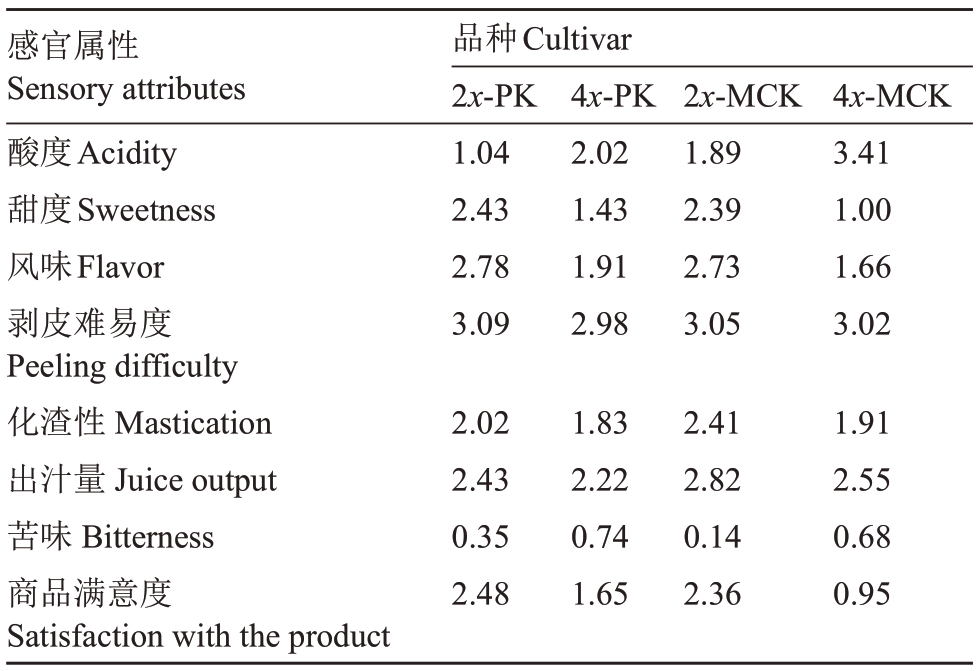
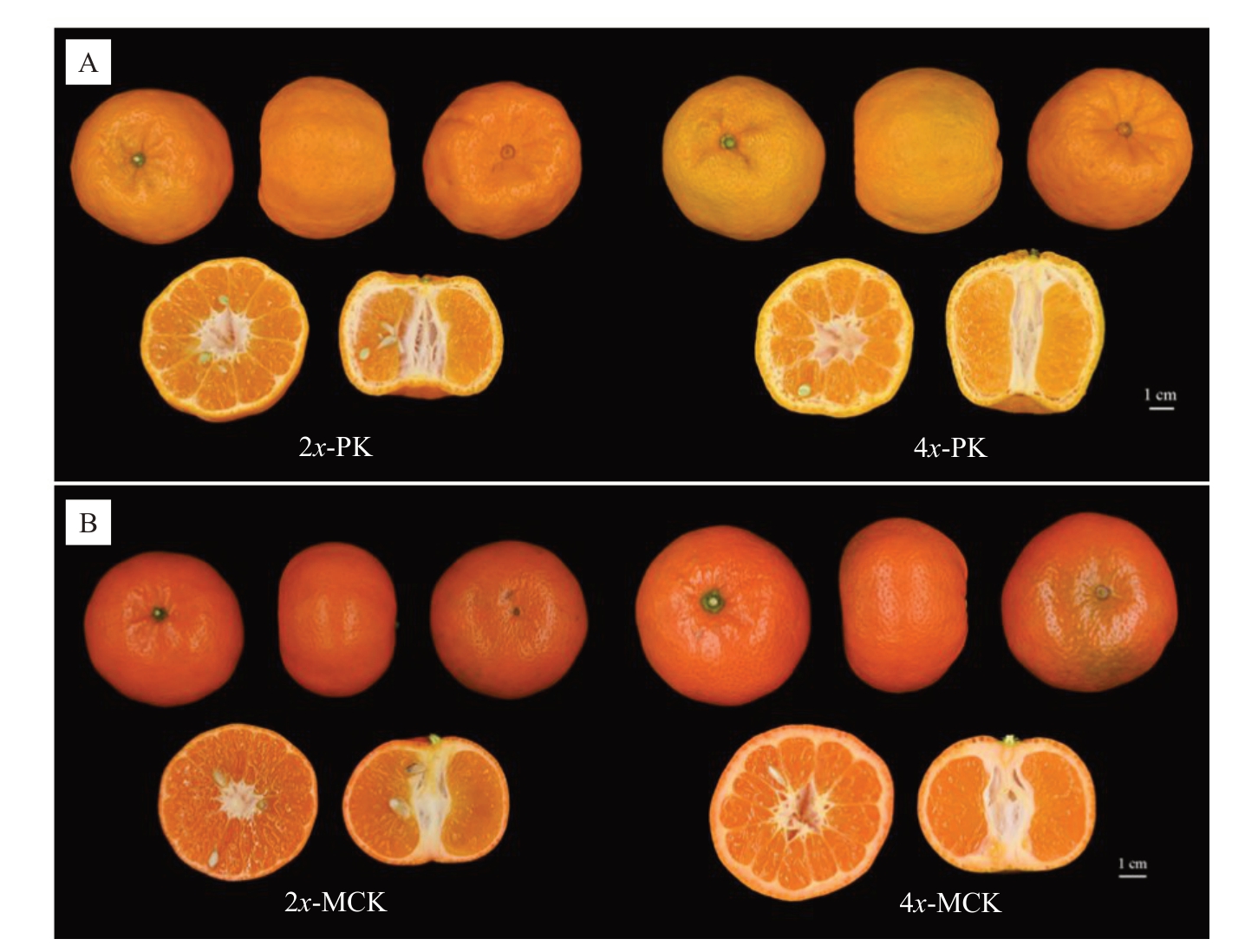
图1 鄂柑1号椪柑(A)、默科特橘橙(B)四倍体(4x-PK、4x-MCK)及其二倍体亲本(2x-PK、2x-MCK)成熟果实
Fig.1 Mature fruits of two tetraploids(4x-PK,4x-MCK)from Ponkan mandarin(A)and Nadorcott tangor(B)with their diploids(2x-PK,2x-MCK)
2.2 四倍体及其二倍体亲本囊衣不同发育时期硬度和剪切功比较
囊衣的机械性能可用囊衣硬度和囊衣剪切功衡量,是评价柑橘果实化渣性的重要指标。利用质构仪对2个四倍体及其相应二倍体亲本花后150、210和240 d的囊衣硬度和囊瓣剪切功进行测定,结果显示(图2):随着果实发育,囊衣硬度和囊瓣剪切功在2个四倍体及其二倍体亲本中变化趋势一致。囊衣硬度呈现逐渐下降的趋势,而囊瓣剪切功总体呈现先下降后上升趋势。在果实各个发育时期,4x-MCK的囊衣硬度和囊瓣剪切功均显著高于2x-MCK;而4x-PK仅在花后150 d时囊衣硬度显著高于2x-PK,其余时期两者在两项指标上均无显著差异。从囊衣机械性能可知,2x-MCK的化渣性优于4x-MCK,但4x-PK的化渣性与其二倍体亲本无明显差异。
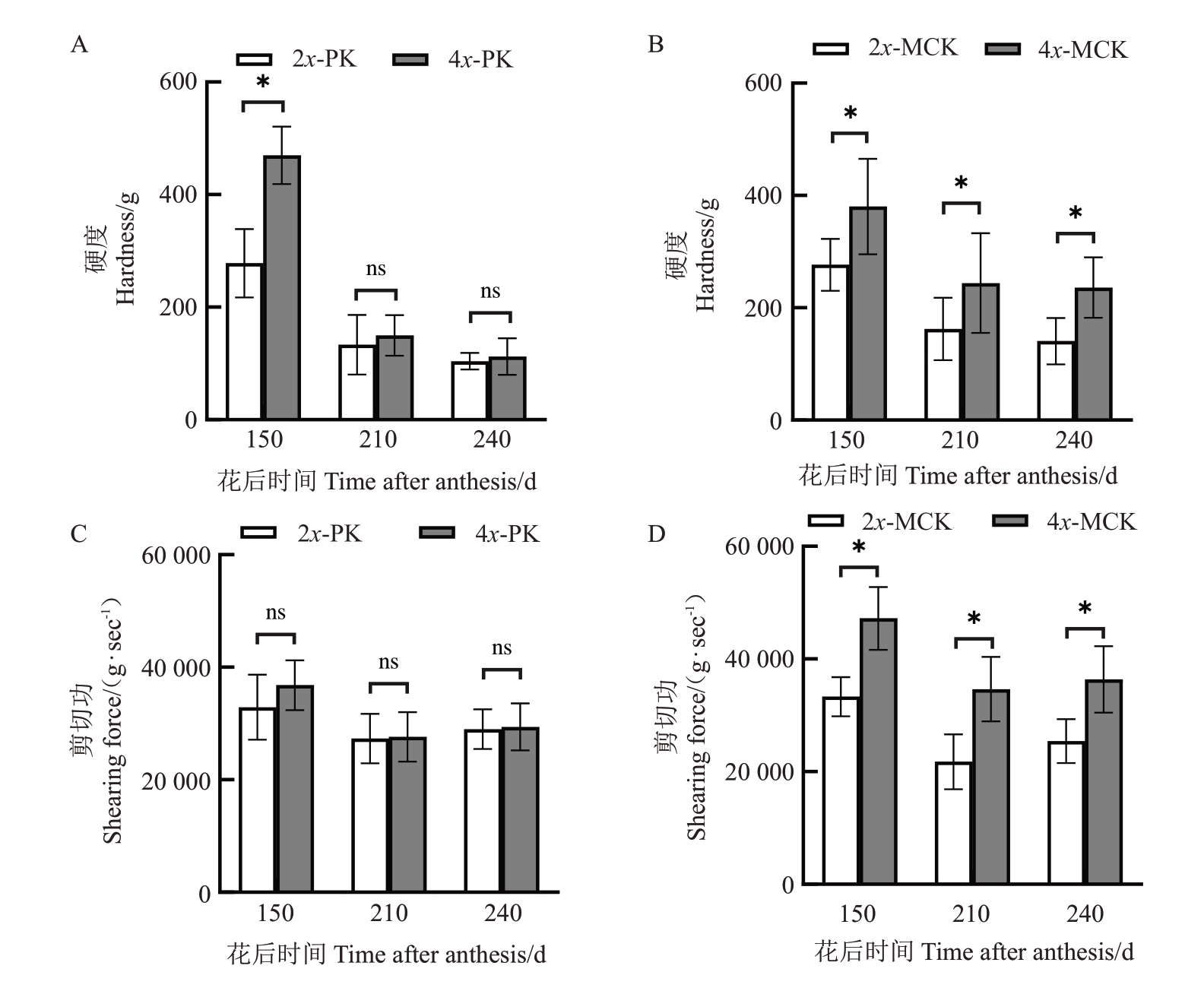
图2 鄂柑1号椪柑、默科特橘橙四倍体(4x-PK、4x-MCK)及其二倍体亲本(2x-PK、2x-MCK)花后150~240 d果实囊衣硬度(A~B)和囊瓣剪切功(C~D)测定
Fig.2 The segmental membrane hardness(A-B)and shearing force(C-D)of two tetraploids(4x-PK,4x-MCK)compared with their diploid parents(2x-PK,2x-MCK)at 150-240 d after anthesis
*表示在P<0.05差异显著,ns表示差异不显著。下同。
*indicates significant difference at P<0.05,ns indicates that the difference is not significant.The same below.
2.3 四倍体及其二倍体亲本囊衣不同发育期结构观察和厚度测定
利用扫描电镜对2个四倍体及其相应二倍体亲本花后60、90、150、210和240 d果实的囊衣超微结构进行观察。结果显示:随着果实发育,2个四倍体与其二倍体亲本囊衣厚度总体表现为由厚变薄,且相邻囊衣呈现出由无法分离到逐渐分离的趋势;但在各发育时期,2个四倍体的囊衣均较其二倍体亲本更厚;4x-PK在花后210 d时相邻囊瓣间的囊衣已完全分离,而2x-PK、2x-MCK和4x-MCK均在花后240 d时才完全分离(图3)。经统计,果实成熟期时,四倍体4x-PK和4x-MCK囊衣厚度分别为61.852 μm和64.068 μm,分别比其二倍体亲本厚56.6%和78.7%(图4)。
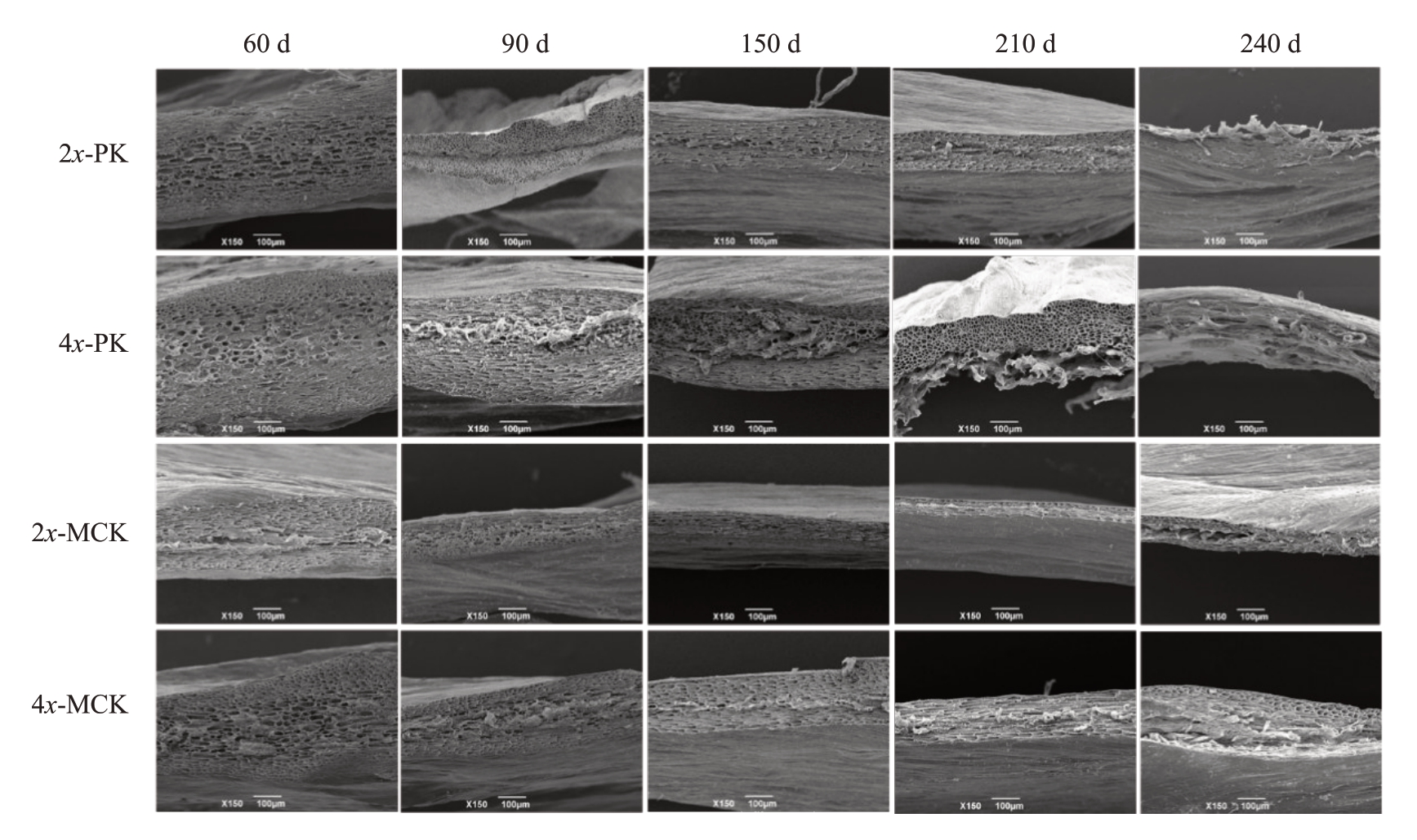
图3 鄂柑1号椪柑、默科特橘橙四倍体(4x-PK、4x-MCK)及其二倍体亲本(2x-PK、2x-MCK)花后60~240 d的果实囊衣发育动态的细胞学观察
Fig.3 Developmental dynamics of segmental membrane of two tetraploids(4x-PK,4x-MCK)compared with their diploid parents(2x-PK,2x-MCK)at 60-240 d after anthesis
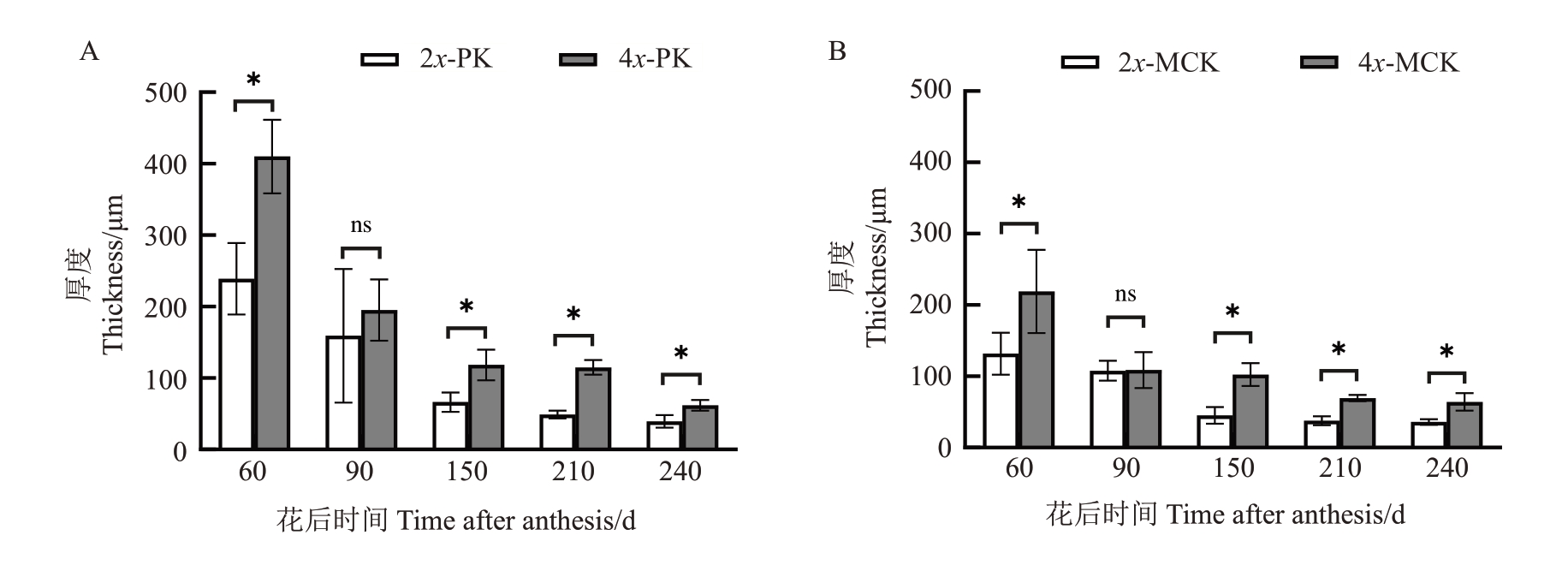
图4 鄂柑1号椪柑、默科特橘橙四倍体(4x-PK、4x-MCK)及其二倍体亲本(2x-PK、2x-MCK)花后60~240 d的果实囊衣厚度测定
Fig.4 Thickness of segmental membrane of two tetraploids(4x-PK,4x-MCK)compared with their diploid parents(2x-PK,2x-MCK)at 60-240 d after anthesis
2.4 四倍体及其二倍体亲本果实不同发育时期囊衣细胞壁成分含量测定
囊衣中纤维素、半纤维素、木质素、水溶性果胶、原果胶和总果胶含量在2个四倍体及其相应二倍体亲本不同发育时期均呈现出一致的变化趋势。纤维素含量呈现先升高后降低的趋势(图5-A~B);而半纤维素含量则相反,呈现先降低后升高的趋势(图5-C~D);木质素、原果胶、水溶性果胶和总果胶含量则持续升高(图5-E~I)。
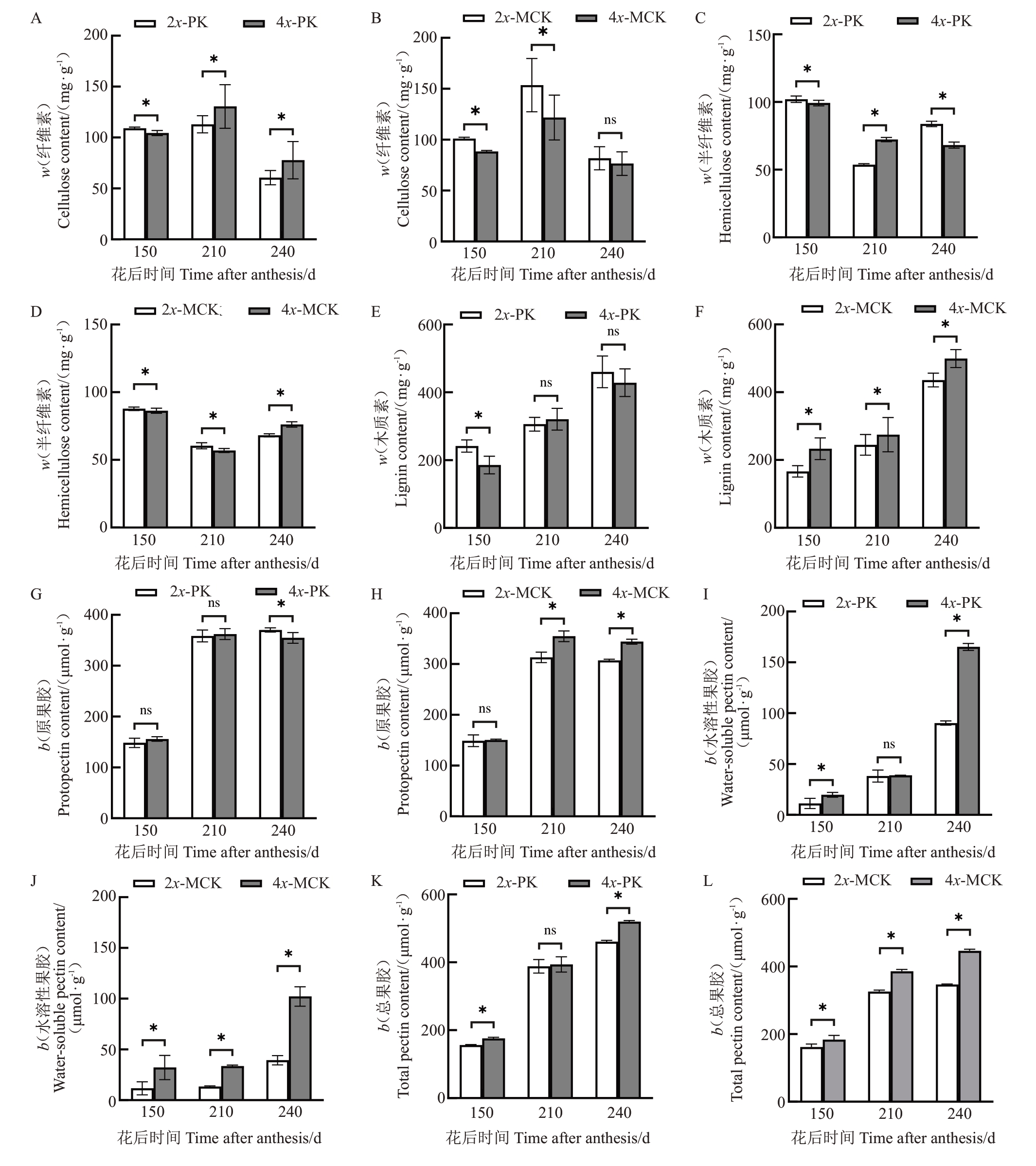
图5 鄂柑1号椪柑、默科特橘橙四倍体(4x-PK、4x-MCK)及其二倍体亲本(2x-PK、2x-MCK)花后150~240 d的果实囊衣纤维素(A~B)、半纤维素(C~D)、木质素(E~F)、原果胶(G~H)、水溶性果胶(I~J)及总果胶(K~L)含量
Fig.5 The contents of cellulose(A-B),hemicellulose(C-D),lignin(E-F),protopectin(G-H),water-soluble pectin(I-J)and total pectin(K-L)in the segmental membrane of two tetraploids(4x-PK,4x-MCK)and their diploid parents(2x-PK,2x-MCK)at 150-240 d after anthesis
4x-PK的囊衣纤维素含量在花后150 d显著低于2x-PK,在210 d和240 d时显著高于2x-PK(图5-A);与之相反,4x-MCK则在花后150 d和210 d时显著低于2x-MCK,但在240 d时两者无显著差异(图5-B)。4x-PK的半纤维素含量在花后150 d和240 d显著低于2x-PK,但在210 d时显著高于2x-PK(图5-C);而4x-MCK在花后150 d和210 d显著低于2x-MCK,但在240 d时显著高于2x-MCK(图5-D)。4x-PK的木质素含量在花后150 d时显著低于2x-PK,其余2个时期两者无显著差异(图5-E);但4x-MCK在囊衣整个发育时期均显著高于2x-MCK(图5-F)。在果胶含量方面,4x-PK的水溶性果胶和总果胶含量在花后150 d和240 d显著高于2x-PK,但在210 d时两者无显著差异;4x-PK和2x-PK囊衣中的原果胶含量总体差异较小(图5-G,I,K);而4x-MCK的水溶性果胶、原果胶和总果胶含量则在整个发育时期均显著高于2x-MCK(图5-H,J,I)。
3 讨论
柑橘果实化渣性是由多因子共同决定的动态过程,属于果实品质的质地范畴,是衡量柑橘品质的重要指标之一。目前,评价柑橘果实化渣性的方法主要包括两种:感官评价法和质构仪测定法。感官评价法是一种较为主观的评价方法,可利用该方法进行初步定性评价[13-14]。感官评价法结合质构仪化渣指标测定,不仅可将化渣性指标量化,同时感官评价结果也能反映质构仪测定的准确性。汪妙秋等[15]和魏清江等[16]对南丰蜜橘果实化渣性进行研究,发现果实化渣性和囊瓣剪切功、囊衣硬度、咀嚼度等指标存在相关性,囊瓣剪切功、硬度和阻嚼度越小,果实化渣性越好。严敏等[17]对南丰蜜橘和蜜广橘果实的化渣性进行比较,发现南丰蜜橘果实化渣性较差,主要原因是其囊衣硬度高。本研究利用质构仪测定了四倍体及其二倍体亲本不同发育时期果实囊衣硬度和囊瓣剪切功。结果显示,4x-MCK的质构仪测定数据与感官评价基本一致,而4x-PK存在差异,主要原因可能是品种间的化渣性较为接近时,不同评价员的感官评价存在差异,且评价员人数较少时导致数据与真实值之间存在偏差。因此,未来可通过扩大感官评价人员数量或批次,以缩小感官评价误差,并结合质构仪测定法对柑橘果实化渣性进行综合评价,以保障对柑橘四倍体群体化渣性的精准评价。
柑橘果实化渣性与囊衣细胞壁成分及其含量密切相关。植物细胞壁在果实生长发育过程中具有增加植物机械强度和维持细胞形态的功能,囊衣细胞壁成分及其含量变化直接影响果实质地[18-22]。囊衣细胞壁主要由纤维素、半纤维素、木质素和果胶构成。相关研究表明,果实化渣性与细胞壁物质合成代谢相关[23-25]。曾秀丽等[26]比较不同生长环境下脐橙果实的化渣性后发现,与化渣性较差的伏令夏橙相比,化渣性较好的罗脐纤维素含量较低,而水溶性果胶和水溶性膳食纤维含量较高。唐红英等[27]对南丰蜜橘果实化渣性研究时发现,果实囊衣中高含量纤维素和半纤维素是其化渣性差的主要因素。果胶作为细胞壁的重要组成部分,在果实未成熟之前主要以原果胶形成存在。随着果实成熟,原果胶降解为水溶性果胶,细胞结构随之受损,果实硬度逐渐下降[24]。研究表明,柑橘果实的化渣性与囊衣中原果胶含量相关。Wang等[28]指出化渣性差的南丰蜜橘囊衣细胞中的原果胶含量显著高于化渣性好的南丰蜜广;雷莹[2]认为果胶含量可能是影响柑橘果实化渣性的主要成分;李菲菲等[3]也认为囊衣中果胶含量是反映柑橘果实化渣性的潜在生化标志物。本文通过对四倍体及其二倍体亲本囊衣的细胞壁成分及其含量进行测定,发现2个四倍体囊衣中的纤维素、半纤维素和木质素含量与二倍体亲本呈现明显一致的变化规律,而4x-MCK囊衣的原果胶含量在果实发育后期显著高于其二倍体亲本,4x-PK与其二倍体亲本则差异较小,与质构仪测定数据基本一致。上述结果表明,四倍体囊衣中原果胶含量可能与其化渣性直接相关,而纤维素、半纤维素和木质素含量不是影响四倍体化渣性的主要因素。
囊衣厚度是影响柑橘果实化渣性的重要因素。前人研究发现,果实化渣性越差,囊衣细胞壁纤维丝密度越高、细胞壁结构越致密[2,29]。陈红等[30]通过分析柑橘感官评价与化渣性定量评价指标之间的相关性,发现囊衣厚度与化渣性感官评价结果的相关性最显著。曹惠祥等[8]对2个三倍体柑橘的化渣性进行评价,发现囊衣厚度是部分三倍体化渣性差的重要因素。本研究通过对2个四倍体及其二倍体亲本的囊衣结构进行观察,发现囊衣厚度随着果实发育逐渐变薄;但在多数发育时期,四倍体的囊衣厚度显著大于其二倍体亲本,与果实感官评价结果一致,表明囊衣厚度可能是影响柑橘四倍体化渣性的重要因素。
目前,柑橘化渣性的报道主要集中在不同柑橘品种,而不同倍性柑橘果实化渣性的评价较少。本文通过对2个四倍体及其二倍体亲本不同发育时期的囊衣发育动态进行超微结构观察,揭示了四倍体及其二倍体亲本的囊衣厚度随着果实发育均呈逐渐变薄的趋势;基于成熟期果实的感官评价、囊衣厚度测定结果和细胞壁成分及含量的比较分析,推断四倍体果实的化渣性主要由囊衣厚度和囊衣中原果胶含量决定。该规律为研究基因组加倍对柑橘果实化渣性的影响提供了重要依据,同时为柑橘多倍体果实化渣性品质改良提供了理论参考。未来,可通过整合不同技术手段,挖掘调控柑橘化渣性的关键基因,优化育种策略,以实现多倍体柑橘果实品质的综合提升。
4 结论
本文对成熟期果实进行质构仪测定与感官评价,并结合囊衣不同发育时期的细胞学观察以及细胞壁组分及其含量,对2个柑橘四倍体及其二倍体亲本果实化渣性进行系统评价,结果表明四倍体果实的化渣性主要由囊衣厚度及囊衣中原果胶含量决定,这为研究基因组加倍对柑橘果实化渣性的影响提供了科学依据。
[1] 郭文武,叶俊丽,邓秀新.新中国果树科学研究70年:柑橘[J].果树学报,2019,36(10):1264-1272.Guo Wenwu,Ye Junli,Deng Xiuxin.Fruit scientific research in New China in the past 70 years:Citrus[J].Journal of Fruit Science,2019,36(10):1264-1272.
[2] 雷莹.柑橘果实化渣性研究[D].武汉:华中农业大学,2010.Lei Ying.Mastication of citrus fruit[D].Wuhan:Huazhong Agricultural University,2010.
[3] 李菲菲,廉雪菲,尹韬,常媛媛,金燕,马小川,陈岳文,叶丽,李云松,卢晓鹏.柑橘果实囊衣发育与化渣性的形成[J].中国农业科学,2023,56(2):333-344.Li Feifei,Lian Xuefei,Yin Tao,Chang Yuanyuan,Jin Yan,Ma Xiaochuan,Chen Yuewen,Ye Li,Li Yunsong,Lu Xiaopeng.The relationship between mastication and development of segment membranes in citrus fruits[J].Scientia Agricultura Sinica,2023,56(2):333-344.
[4] 汤雨晴,刘心澄,杨惠栋,徐超,王四斌,胡钟东.南丰蜜橘不同品种(系)果实化渣性比较[J].南方农业学报,2023,54(12):3657-3664.Tang Yuqing,Liu Xincheng,Yang Huidong,Xu Chao,Wang Sibin,Hu Zhongdong.Comparison of fruit mastication trait among different Citrus reticulata Blanco cv.Kinokuni varieties(lines)[J].Journal of Southern Agriculture,2023,54(12):3657-3664.
[5] Lian X F,Li F F,Chang Y Y,Zhou T,Chen Y W,Yin T,Li Y S,Ye L,Jin Y,Lu X P.Physiological and ultrastructural alterations linked to intrinsic mastication inferiority of segment membranes in Satsuma mandarin (Citrus unshiu Marc.) fruits[J].Plants,2022,11(1):39.
[6] 高婧斐,汪志辉,熊博,石冬冬,张婷婷,曾海琼,廖玲,曹淑燕,古咸杰,李清南.细胞壁组分及酶活性与清见果实囊衣绵韧的相关性[J].食品科学,2015,36(23):131-135.Gao Jingfei,Wang Zhihui,Xiong Bo,Shi Dongdong,Zhang Tingting,Zeng Haiqiong,Liao Ling,Cao Shuyan,Gu Xianjie,Li Qingnan.Correlations of albedo fracture toughness with cell wall substances and enzyme activities in kiyomi fruits[J].Food Science,2015,36(23):131-135.
[7] 吴迪,田志娇,周秋蓉,陈秋佑,高志键,葛聪,李江波,李延,王平.纤维素和果胶代谢相关基因调控南丰蜜橘化渣性[J/OL].分子植物育种,2023:1-12(2023-03-22).https://kns.cnki.net/kcms/detail/46.1068.s.20230321.0955.002.html.Wu Di,Tian Zhijiao,Zhou Qiurong,Chen Qiuyou,Gao Zhijian,Ge Cong,Li Jiangbo,Li Yan,Wang Ping.Cellulose and pectin metabolism-related genes regulate the masticaton of Citrus reticulita Blanco cv.Nanfeng tangerine[J/OL].Molecular Plant Breeding,2023:1-12(2023-03-22).https://kns.cnki.net/kcms/detail/46.1068.s.20230321.0955.002.html.
[8] 曹惠祥,罗鑫,刘婉荣,管书萍,王婷婷,伍小萌,郭文武,解凯东.柑橘2个三倍体果实囊衣发育与化渣性评价[J].园艺学报,2024,51(6):1179-1188.Cao Huixiang,Luo Xin,Liu Wanrong,Guan Shuping,Wang Tingting,Wu Xiaomeng,Guo Wenwu,Xie Kaidong.Evaluation of fruit segmental membrane development and mastication in two citrus triploids[J].Acta Horticulturae Sinica,2024,51(6):1179-1188.
[9] 洪柳,刘永忠,邓秀新.椪柑成熟种子胚培养获得四倍体植株[J].园艺学报,2005,32(4):688-690.Hong Liu,Liu Yongzhong,Deng Xiuxin.Obtaining of ponkan(Citrus reticulata Blanco)tetraploid by culturing embryos of mature seeds[J].Acta Horticulturae Sinica,2005,32(4):688-690.
[10] 梁武军,解凯东,郭大勇,谢宗周,徐强,伊华林,郭文武.柑橘10个品种实生后代多倍体的发掘及SSR鉴定[J].园艺学报,2014,41(3):409-416.Liang Wujun,Xie Kaidong,Guo Dayong,Xie Zongzhou,Xu Qiang,Yi Hualin,Guo Wenwu.Spontaneous generation and SSR characterization of polyploids from ten citrus cultivars[J].Acta Horticulturae Sinica,2014,41(3):409-416.
[11] 陈昊,谢善鹏,解凯东,肖公傲,周锐,伍小萌,吴群,邓家锐,敖义俊,刘高平,郭文武.柑橘13个多胚品种同源四倍体高效发掘与分子鉴定[J].果树学报,2023,40(11):2297-2306.Chen Hao,Xie Shanpeng,Xie Kaidong,Xiao Gongao,Zhou Rui,Wu Xiaomeng,Wu Qun,Deng Jiarui,Ao Yijun,Liu Gaoping,Guo Wenwu.Efficient exploration and SSR identification of autotetraploids from the seedlings of thirteen apomictic citrus genotypes[J].Journal of Fruit Science,2023,40(11):2297-2306.
[12] Zheng C S,Lan X,Tan Q L,Zhang Y,Gui H P,Hu C X.Soil application of calcium and magnesium fertilizer influences the fruit pulp mastication characteristics of Nanfeng tangerine (Citrus reticulata Blanco cv.Kinokuni)[J].Scientia Horticulturae,2015,191:121-126.
[13] 魏张奎.基于质构特性的夏橙化渣性研究[D].武汉:华中农业大学,2013.WEI Zhangkui.Research on mastication of late orange base on textural properties[D].Wuhan:Huazhong Agricultural University,2013.
[14] 郑苍松.南丰蜜橘果实品质与土壤-树体营养的关系及其调控[D].武汉:华中农业大学,2015.Zheng Cangsong.Relationships between fruit quality and soilplant nutrients of Nanfeng tangerine and regulation by fertilization application[D].Wuhan:Huazhong Agricultural University,2015.
[15] 汪妙秋.南丰蜜橘生长与结实方式对果实品质的影响[D].武汉:华中农业大学,2013.Wang Miaoqiu.Impact of tree growth and fruit bearing on fruit qualities of Nanfengmiju[D].Wuhan:Huazhong Agricultural University,2013.
[16] 魏清江,汪妙秋,曾知富,杨成泉,彭抒昂,刘永忠.南丰蜜橘化渣性评价及不同结果习性果实的品质比较[J].中国农业科学,2014,47(6):1162-1170.Wei Qingjiang,Wang Miaoqiu,Zeng Zhifu,Yang Chengquan,Peng Shu’Ang,Liu Yongzhong.Evaluation of the mastication and comparison of fruit quality with different bearing habits in Nanfeng tangerine (Citrus reticulata Blanco cv.Kinokuni)[J].Scientia Agricultura Sinica,2014,47(6):1162-1170.
[17] 严敏,罗丽娟,韩忠星,袁野,李江波,杜威,刘永忠.南丰蜜橘和南丰蜜广果实质构特性、细胞壁成分及营养元素比较研究[J].农业科学,2019,9(8):689-696.Yan Min,Luo Lijuan,Han Zhongxing,Yuan Ye,Li Jiangbo,Du Wei,Liu Yongzhong.Comparative study on fruit texture,cell wall structural components and nutrient content between“Nanfengmiju”and“Nanfengmiguang”[J].Hans Journal of Agricultural Sciences,2019,9(8):689-696.
[18] Karakurt Y,Huber D J,Sherman W B.Quality characteristics of melting and non-melting flesh peach genotypes[J].Journal of the Science of Food and Agriculture,2000,80(13):1848-1853.
[19] Brummell D A,Harpster M H.Cell wall metabolism in fruit softening and quality and its manipulation in transgenic plants[J].Plant Molecular Biology,2001,47(1/2):311-339.
[20] 魏建梅,马锋旺,关军锋,袁军伟,朱向秋.京白梨果实后熟软化过程中细胞壁代谢及其调控[J].中国农业科学,2009,42(8):2987-2996.Wei Jianmei,Ma Fengwang,Guan Junfeng,Yuan Junwei,Zhu Xiangqiu.Cell wall metabolism and its regulation in harvested Pyrus ussuriensis Maxin.cv.Jingbaili fruit during ripening[J].Scientia Agricultura Sinica,2009,42(8):2987-2996.
[21] 艾静.‘山农脆’梨果实硬度及其相关酶活性的初步研究[D].泰安:山东农业大学,2014.Ai Jing.Preliminary study on the firmness and related enzyme activity of‘Shannongcu’pear[D].Tai’an:Shandong Agricultural University,2014.
[22] 高滋艺,范献光,杨惠娟,蒋小兵,杨亚州,赵政阳,党智宏.苹果发育过程中细胞壁代谢及果肉质地的变化[J].食品科学,2016,37(19):70-75.Gao Ziyi,Fan Xianguang,Yang Huijuan,Jiang Xiaobing,YangYazhou,Zhao Zhengyang,Dang Zhihong.Correlation among cell wall components,related enzyme activities and texture of developing fruits of different apple (Malus × domestica) cultivars[J].Food Science,2016,37(19):70-75.
[23] 李春燕,张光伦,曾秀丽,罗楠,胡强.细胞壁酶活性与甜橙果实质地的相关性研究[J].四川农业大学学报,2006,24(1):73-76.Li Chunyan,Zhang Guanglun,Zeng Xiuli,Luo Nan,Hu Qiang.The relationship between the activity of enzyme in cell wall and sweet orange [Citrus sinesis (L.) Osbeck] fruit texture[J].Journal of Sichuan Agricultural University,2006,24(1):73-76.
[24] 张丽芳.南丰蜜橘果胶代谢与化渣性关系研究[D].南昌:江西农业大学,2014.Zhang Lifang.Correlation analysis on pectic metabolism and mastication of Nanfeng tangerine fruit[D].Nanchang:Jiangxi Agricultural University,2014.
[25] 朱学亮.琯溪蜜柚果实木质素代谢研究[D].福州:福建农林大学,2009.Zhu Xueliang.Studies on the metabolism of lignin in Citrus grandis(L.)Osbeck.cv.Guanxi-Miyou fruit[D].Fuzhou:Fujian Agriculture and Forestry University,2009.
[26] 曾秀丽,张光伦,吕秀兰,龚荣高,罗楠,胡强.3类生境下脐橙果实细胞壁酶、瓤囊壁超微结构和品质变化的研究[J].果树学报,2006,23(5):670-675.Zeng Xiuli,Zhang Guanglun,Lü Xiulan,Gong Ronggao,LUO Nan,HU Qiang.Cell wall enzyme activity,cell ultrastructure and fruit quality of Robertson Navel orange grown in three different habitats[J].Journal of Fruit Science,2006,23(5):670-675.
[27] 唐红英.南丰蜜橘纤维素、半纤维素代谢与化渣性关系研究[D].南昌:江西农业大学,2015.Tang Hongying.Study on the relationship between cellulose,hemicellulose metabolism and mastication of Nanfeng tangerine[D].Nanchang:Jiangxi Agricultural University,2015.
[28] Wang X,Lin L J,Tang Y,Xia H,Zhang X C,Yue M L,Qiu X,Xu K,Wang Z H.Transcriptomic insights into citrus segment membrane’s cell wall components relating to fruit sensory texture[J].BMC Genomics,2018,19(1):280.
[29] 辜青青,唐红英,魏清江,古湘,冯芳芳,罗正荣.南丰蜜橘果实纤维素代谢与化渣的关系研究[J].园艺学报,2016,43(5):867-875.Gu Qingqing,Tang Hongying,Wei Qingjiang,Gu Xiang,Feng Fangfang,Luo Zhengrong.Studies on the relationship between cellulose metabolism and fruit mastication trait of Nanfeng tangerine[J].Acta Horticulturae Sinica,2016,43(5):867-875.
[30] 陈红,李孝贤,周少秀,蔡欣睿,王秋丰,田皓予,汪鑫茂,陈寅.柑橘化渣性量化指标参数优化及模型建立[J].农业工程学报,2025,41(1):330-338.Chen Hong,Li Xiaoxian,Zhou Shaoxiu,Cai Xinrui,Wang Qiufeng,Tian Haoyu,Wang Xinmao,Chen Yin.Parameter optimization and modeling for the quantitative indicators of citrus mastication[J].Transactions of the Chinese Society of Agricultural Engineering,2025,41(1):330-338.