蓝莓,杜鹃花科(Ericaceae)越橘亚科(Vaccinioideae)越橘属(Vaccinium L.)植物[1]。蓝莓含有的抗氧化类物质能够清除体内多余的自由基,对延缓衰老具有一定作用;同时还能改善视力、增强免疫力、提升记忆力并具有抗癌活性[2]。据FAOSTAT与IBO统计,2013—2022年全球蓝莓种植面积增幅达2.1倍,产量增长率达到3.2倍[3]。目前,我国已成为全球最大的蓝莓生产国,种植面积与产量均居全球首位[4]。
随着蓝莓产业的迅猛发展,消费市场对新品种的需求日趋多元化,尤其对果实内在及外在品质提出了更高标准[5]。根据美国农业部(USDA-ARS)公布的数据,2020—2022年全球研发蓝莓品种共计137个。其中,北高丛蓝莓品种数量由18个增加至30个,培育数量稳健增长[1,6]。北高丛蓝莓作为商业化栽培历史最悠久、经济价值最为突出的栽培种类,近年来在我国仍有良好的发展势头[4,7],其具有错峰生产、果实品质优良、果肉质地脆硬、耐储性和适应性强等特性,在长江流域以北及以南高海拔地区均可种植,对促进产业发展具有重要作用。因此,开展北高丛蓝莓新品种选育工作极其必要。新品种盈蓝具有果粉厚度适中、果蒂痕小且干燥、果实硬度中等、质地脆等优良性状,是北高丛蓝莓鲜食市场的优良品种,未来将在我国蓝莓产业中发挥重要作用。
1 选育过程
试验所用红利蓝莓种子于2010年7月采自大连森茂现代农业有限公司的蓝莓种质资源圃。2011年春季将种子播种于大连森茂现代农业有限公司;2012年春季,从中选取178株生长健壮的实生苗,移栽至大连普世蓝农业科技有限公司完成定植。2015年7月,果实进入成熟期后,经人工选育(3次生物重复)筛选出子代优良、长势强的单株(编号为SMN-226)。经过多轮品鉴和DUS测试,其果实扁圆形,单果质量较大,果面覆有一层中等厚度果粉,且质地不均匀,果实在光照下呈蓝色(102-D),果蒂痕较小且干燥,果肉质地脆,硬度中等,口感甜酸适中,具清香,丰产性中等,综合性状优良,适宜鲜食。多点试种结果表明,该品种果实品质表现稳定且优异。2018—2020年,经综合评价证实,该优良品系及其无性系在植株形态、物候期、果实产量与品质等核心性状上均表现稳定。2024年12月,该品系获得国家林业和草原局授予植物新品种权,命名为盈蓝(图1),品种权号为20240462。
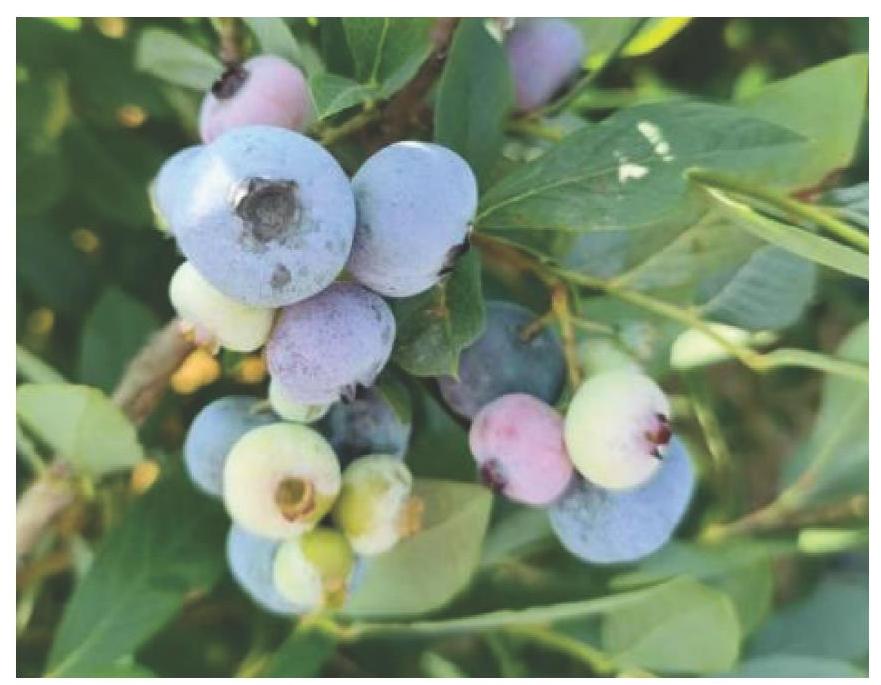
图1 蓝莓新品种盈蓝
Fig.1 A new blueberry cultivar Yinglan(SMN-226)
2 主要性状
2.1 植物学特征
盈蓝,北高丛蓝莓,树体直立型,树势中等。叶片长椭圆形,绿色,平均叶面积15.62cm2,叶形指数为2.08,叶缘锯齿状;新生结果枝平均长度为8.33 cm,单枝结果数量10个。
2.2 果实性状
果穗密度大,果实扁圆形,平均单果质量达2.90g,最大可达到3.53g,果实平均纵横径为1.46cm× 1.98 cm(表1)。果皮蓝色(102-D),果粉厚度中等,质地不均匀。该品种果蒂痕较小且较为干燥,果实硬度中等(2.80 kg·cm-2),具有良好的耐储性,其可溶性固形物含量(w)为12.17%,酸度低,口感酸甜,质地脆,具香味,产量中等。
表1 盈蓝与红利的果实品质特征
Table 1 Quality characteristics of fruits from Yinglan and Bonus

果实硬度 成熟期 平均单果质量 w(可溶性固形物) 果粉厚度及质地品种 果实形状 Frui hardness/果实颜色 Maturation Soluble solid Fruit wax thickness Cultivar Average singleFruit shape Fruit color(kg·cm-2) period fruit mass/g content/% and texture盈蓝 扁圆形 2.80 蓝色 7月上旬 2.90 12.17 中等且质地不均匀Yinglan Oblateness Blue Early July Medium thickness and non-uniform texture红利 扁圆形 2.77 深蓝色 7月下旬 2.43 11.50 薄且质地均匀Bonus Oblateness Dark blue Late July Thin and uniform texture
2.3 物候期
在大连地区露地栽培条件下,该品种于3月上旬进入萌芽阶段,4月中旬为盛花期,花期约20d,6月15日前后果实开始转色,7月上旬果实成熟,为中熟种,最佳采摘期为7月12日前后,采摘期约30d。
2.4 植株适应性
经田间试验和连续观测,盈蓝具有较强的抗寒性和抗病性,适宜在辽宁大连等北方地区种植。
3 分子鉴定
在本研究中,选用自主开发的SSR核心引物SSR347(F:TCCCGCACCGTAGAAAGTGG,R:ACAGCCCAAATGGCGGC),对母本红利、盈蓝等14个蓝莓主栽品种开展了SSR分子水平的鉴定工作。由图2可知,该引物能够清晰区分盈蓝、红利等14个蓝莓主栽品种间的基因型差异。
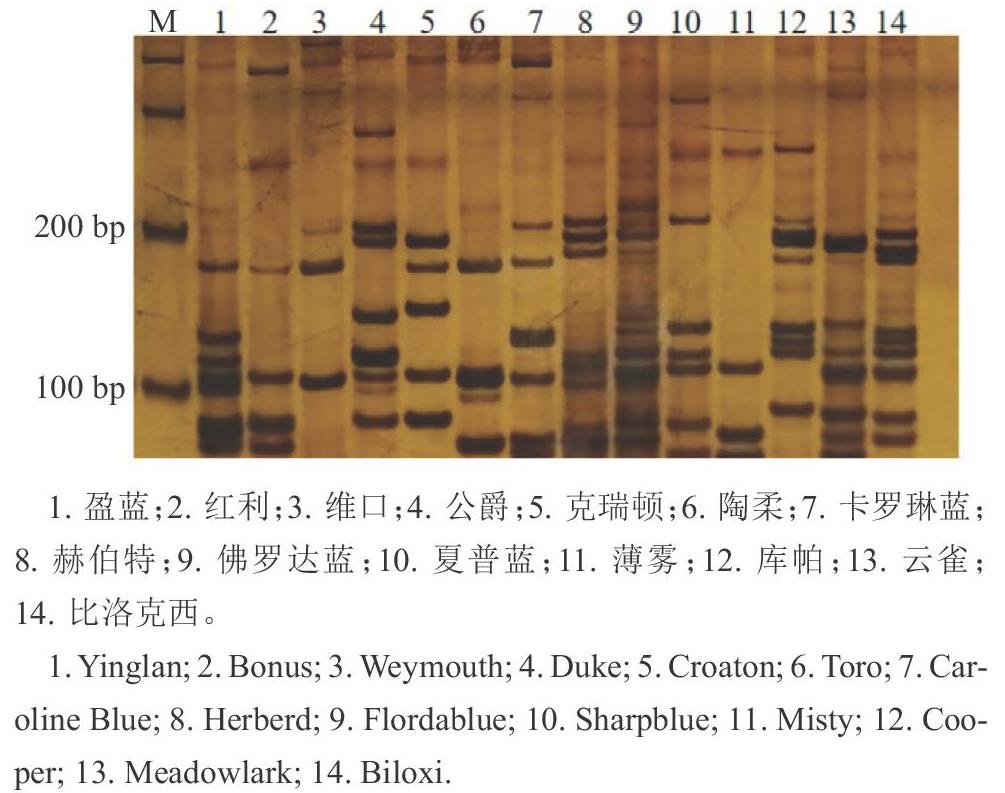
图2 引物347对14个蓝莓品种的扩增结果
Fig.2 Specific amplification by primer347across 14 blueberry cultivars
4 栽培技术要点
4.1 适宜种植范围
盈蓝适宜栽培区域为长江中下游以北地区及高海拔地带;适宜生长在疏松、深厚、肥沃且湿润不积水的壤土或壤砂土,pH=4.0~5.5,有机质含量>3.0%。种植区域需冷量要求为600~1200h。若种植区域土质需要改良,应添加适量硫黄粉和松针等酸性基质,以降低pH或提高有机质含量。
4.2 建园定植
定植前需对土壤进行耕翻和平整,耕深20~30cm,做垄以南北走向为宜。坡地建园时,需按等高线实施带状定植。植株最佳株行距为1.5 m×2.0 m。建议选择2~3年生钵苗或裸根苗进行园林建设,要求植株高度≥40cm,主茎基部直径≥0.4cm。
4.3 水肥管理
采用厚度超过10 cm的秸秆、稻草、木屑、松针等有机物料进行全园覆盖,可保湿、增肥并改善土壤理化性状。树冠下铺设黑色地膜可抑制杂草生长,在膜下埋设滴灌管。定植前施入足量充分腐熟的有机肥,是保障苗木成活率及早期生长的关键环节。
4.4 病虫害防治
缺素症、溃疡病、灰霉病、炭疽病及枝枯病等是蓝莓栽培中常见病害。叶片黄化主要由缺铁或镁引起,多与土壤pH偏高或干旱相关,通过土壤调酸和适当灌溉等方法进行改良。蓝莓溃疡病多发于高湿环境,常危害个别枝条,建议在春季萌芽期前完成病枝修剪工作,以有效降低初侵染源。
主要虫害类型包括地下害虫、蛀干类害虫及鸟类啄食等,防治时应优先采用生物防治(如白僵菌)与机械捕杀措施,严格控制化学农药的施用;针对鸟类危害,建议采取防鸟网覆盖的防控手段。
4.5 植株整形与修剪
定干时,主干保留高度控制在20~30 cm。在果树生长过程中,培养8~10条主干枝,以多主干、自然形、丛生灌丛为主。一年四季均需修剪,其中夏剪在果实采收后进行,主要采用回缩短截与疏删修剪(清除过密枝、病虫枝及弱势枝)相结合的方式;冬剪在白露时节进行,以促进花芽分化为核心目标。
4.6 防寒措施
北高丛蓝莓的越冬防寒措施应根据具体地区进行调整,在山东胶东半岛、中原等气候较温暖区域,盈蓝一般无需进行防寒处理;而在辽东半岛等气候寒冷地区,亟须建立防寒技术体系,包括埋土防寒,以及应用镀铝反光膜袋、填充稻草的黑色塑料袋等套袋材料,以保障蓝莓安全越冬。
[1] 徐国辉,黄子莹,李逸斐,杜乾慧,王丽,侯义龙,王贺新.2020年全球蓝莓新品种特征及其育种趋势分析[J].中国南方果树,2022,51(5):207-213.XU Guohui,HUANG Ziying,LI Yifei,DU Qianhui,WANG Li,HOU Yilong,WANG Hexin. Analysis of the characteristics of new blueberry varieties worldwide and their breeding trends in2020[J]. South China Fruits,2022,51(5):207-213.
[2] 公旭彤,杜乾慧,刘桂婷,卢雅妮,李雨彤,宋清秋,吕梓茜,王楠,张文基,王贺新,赵丽娜,刘国玲,徐国辉.近30年世界蓝莓新品种资源及育种趋势分析[J].植物遗传资源学报,2025,26(2):218-236.GONG Xutong,DU Qianhui,LIU Guiting,LU Yani,LI Yutong,SONG Qingqiu,LÜ Zixi,WANG Nan,ZHANG Wenji,WANG Hexin,ZHAO Lina,LIU Guoling,XU Guohui. Analysis of new blueberry varieties and breeding trends in the world in recent 30 years[J]. Journal of Plant Genetic Resources,2025,26(2):218-236.
[3] 刘庆忠,崔冬冬,朱东姿.世界及中国蓝莓产业现状[J].落叶果树,2024,56(4):1-7.LIU Qingzhong,CUI Dongdong,ZHU Dongzi. Current situation of blueberry industry in the world and China[J]. Deciduous Fruits,2024,56(4):1-7.
[4] 李亚东,刘成,魏鑫,刘佳欣,郝佳,陈丽,孙海悦.2024年中国蓝莓产业发展报告[J].吉林农业大学学报,2025,47(1):1-14.LI Yadong,LIU Cheng,WEI Xin,LIU Jiaxin,HAO Jia,CHEN Li,SUN Haiyue. Development report of 2024 China blueberry industry[J]. Journal of Jilin Agricultural University,2025,47(1):1-14.
[5] 李晓谊,陆晓莹,黄巧玉,李永强,宗宇,徐丽珊,郭卫东.蓝莓不同硬度果实VcPLs基因克隆和功能研究[J].果树学报,2024,41(1):1-11.LI Xiaoyi,LU Xiaoying,HUANG Qiaoyu,LI Yongqiang,ZONG Yu,XU Lishan,GUO Weidong. Gene cloning and function analysis of VcPLs genes in blueberries with different fruit firmness[J]. Journal of Fruit Science,2024,41(1):1-11.
[6] 刘桂婷,卢雅妮,邓艳琼,李其煊,吕梓茜,王一帆,徐国辉.2022年公布的全球蓝莓新品种及其育种趋势分析[J].中国南方果树,2025,54(1):178-186.LIU Guiting,LU Yani,DENG Yanqiong,LI Qixuan,LÜ Zixi,WANG Yifan,XU Guohui. Global new blueberry varieties published in2022 and their breeding trends analysis[J]. South China Fruits,2025,54(1):178-186.
[7] 李亚东,裴嘉博,孙海悦.全球蓝莓产业发展现状及展望[J].吉林农业大学学报,2018,40(4):421-432.LI Yadong,PEI Jiabo,SUN Haiyue. Status and prospect of global blueberry industry[J]. Journal of Jilin Agricultural University,2018,40(4):421-432.