枇杷叶为蔷薇科(Rosaceae)植物枇杷Eriobotrya japonica(Thunb.)Lindl.的干燥叶[1]。现代药理研究表明,枇杷叶具有祛痰、止咳、抗肺纤维化[2]、抗氧化[3]、抗炎[4]、清肺热[5]、生津止渴[6]等作用。《中国药典》(2020年版)一部规定,以齐墩果酸与熊果酸等三萜酸类作为质量评价指标。三萜酸类是枇杷叶抗炎止咳的药效成分[7],6种三萜酸类成分还具有一定的降血糖增效作用[8]。目前,多数研究集中于枇杷叶的提取工艺[9],采收期[10]及炮制[11]等方面,关于枇杷叶中关键酶基因表达调控和三萜酸代谢通路的分子机制研究却鲜见报道。本研究从分子层面建立枇杷叶的转录组数据库[12],通过分析早钟和大钟枇杷叶的差异表达基因,为枇杷叶的三萜酸类成分分子机制研究及资源的开发利用提供重要的理论基础。
1 材料和方法
1.1 材料
于福建省漳州市云霄县火田镇采集6年生大钟与早钟2个品种的枇杷叶,每品种各取1株。2024年11月2日18:00—19:00,采集芽萌发后第12天位于枝梢顶端、长度1~3 cm、尚未完全展开的幼叶。最高温度25.7 ℃,最低温度16 ℃,阴,东北风3级,日照时长7.7 h。新鲜嫩叶经液氮急速冷冻,并于-80 ℃冰箱中保存备用[9]。PPYZ为早钟枇杷叶,PPYD为大钟枇杷叶。
1.2 RNA提取及测序
委托上海伟寰生物科技有限公司对枇杷叶进行RNA提取及检测,并进行文库制备和转录组测序。
1.3 数据质控
为了保证数据质量,对原始数据进行过滤,去除低质量reads(质量值Q≤20的碱基数占整条read的50%以上),最终得到符合质量要求的reads。
1.4 基因组组装
使用Trinity进行组装,利用cd-hit根据序列的相似度对序列进行聚类以去除冗余的序列。
1.5 Unigene功能注释
使用BLAST工具,将枇杷叶的Unigene序列与NR、eggNOG、PFAM、Swiss-Prot、GO、KEGG数据库进行比对分析,并进行功能注释。
1.6 表达差异分析
采用DESeq进行表达差异分析,基于分析结果,筛选标准为padj<0.05且|log2FoldChange|>1。应用超几何检验对DESeq进行GO富集分析和KEGG通路分析。
1.7 采用高效液相色谱(HPLC)法测定不同品种枇杷叶的三萜酸含量
1.7.1 色谱条件 色谱柱:Shim-pack Scepter HD-C18-80(250.0 mm×4.6 mm,5.0 μm);流动相:乙腈(A)-甲醇(B)-0.5%乙酸铵溶液(C),梯度洗脱(0~20 min,3%→15% A,76%→64% B,21% C;>20~35 min,15%→30% A,64%→49% B,21%C;>35~50 min,30%→40%A,49%→39% B,21% C);进样量:20 μL;流速:1.0 mL·min-1;检测波长:210 nm;柱温:40 ℃[13]。
1.7.2 混合对照品溶液的制备 分别精确称取野鸦椿酸、山楂酸、科罗索酸、齐墩果酸和熊果酸对照品适量,置于10mL容量瓶中,加入乙醇超声溶解并定容至刻度,制成质量浓度分别为272.50、188.75、337.50、68.75、378.75µg·mL-1的混合对照品溶液,备用[13]。
1.7.3 供试品溶液的制备 分别取不同品种的枇杷叶粗粉约1 g,精确称定,置于具塞锥形瓶中,精确加入乙醇50mL,称定质量,超声(功率250W,频率50kHz)处理30min,放冷,再称定质量,加入乙醇补足减失的质量,摇匀,过滤,取续滤液,过0.45 μm微孔滤膜,备用[13]。
1.7.4 三萜酸含量测定 分别取不同样品,按照“1.7.3”方法制备供试品溶液,按照“1.7.1”色谱条件测定。采用GraphPad Prism 8.0软件对三萜酸含量进行统计分析,数据表达方式为平均值±标准差。对于两组数据的差异检验,均采用独立样本t检验,若P<0.05时,则判定两组间具有显著性差异。
2 结果与分析
2.1 枇杷叶RNA测序与拼装
分别构建早钟和大钟枇杷叶的cDNA文库,采用PE150模式进行高通量测序,获得的转录组数据质量良好,完全满足建库测序需求(表1),共组装拼接117 921条unigene序列,N50为1681 bp,平均长度为1 166.52bp(图1)。
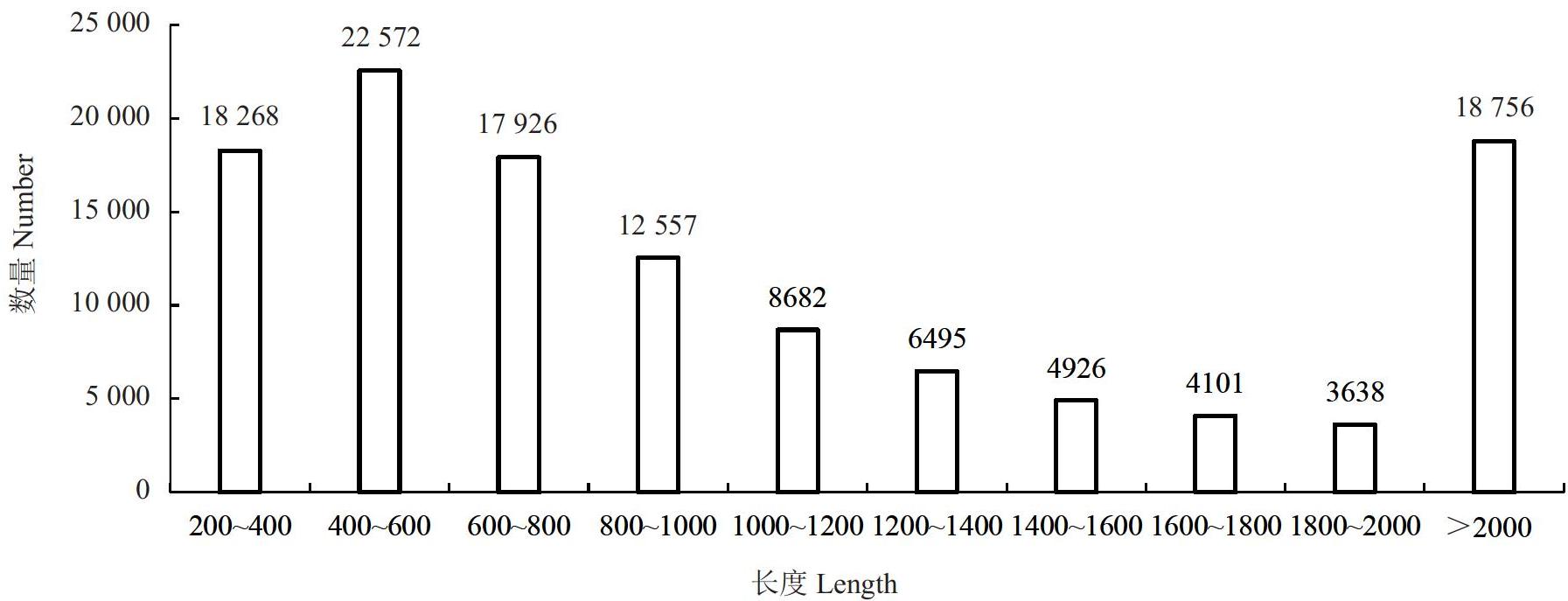
图1 枇杷叶unigenes长度分布图
Fig.1 Distribution diagram of the length of unigenes of loquat leaves
表1 枇杷叶转录组数据统计和质量控制
Table 1 Transcriptome data statistics and quality control of loquat leaves
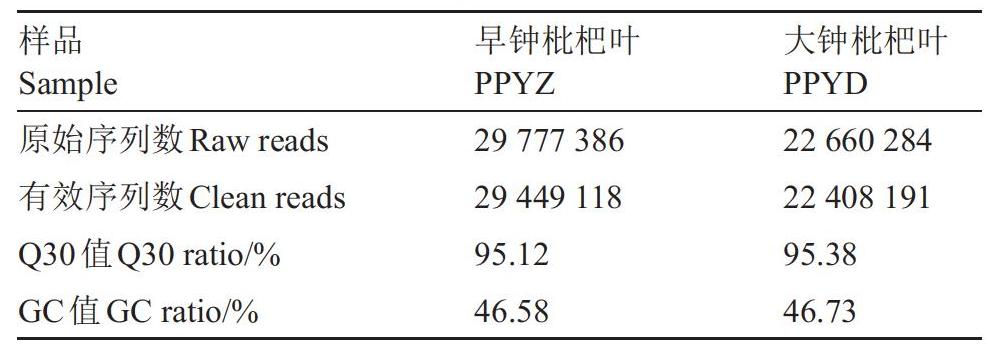
样品 早钟枇杷叶 大钟枇杷叶Sample PPYZ PPYDQ30值Q30ratio/%95.12 95.38 GC值GC ratio/%46.58 46.73原始序列数Raw reads 29777386 22660284有效序列数Clean reads 29449 118 22408 191
2.2 枇杷叶unigene的功能注释
使用Swiss-Prot、NR、Pfam、GO、KEGG和egg-NOG六种权威数据库进行注释。结果显示(表2),GO数据库中注释成功的转录本最多,经Swiss-Prot数据库BLASTX比对注释的次之,KEGG数据库注释成功的数量最少。
表2 枇杷叶unigene在各数据库注释比例统计
Table2 Statistics on the annotation proportion of loquat leaves unigene in each database
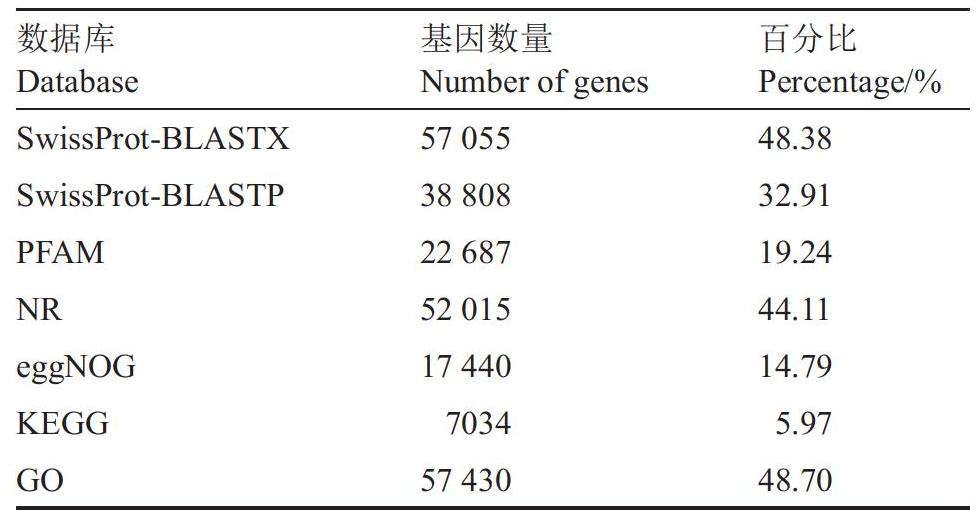
数据库 基因数量 百分比Database Number of genes Percentage/%SwissProt-BLASTX 57055 48.38 SwissProt-BLASTP 38 808 32.91 PFAM 22687 19.24 NR 52015 44.11 eggNOG 17440 14.79 KEGG 7034 5.97 GO 57430 48.70
2.3 枇杷叶unigene的NR注释
将获得的基因序列和NR数据库的物种注释比对,可知枇杷与近缘物种基因序列的相似性。结果显示共有52 015个基因获得注释,比例为44.11%。枇杷与苹果(Malus domestica)、白梨(Pyrus× bretschneideri)、山荆子(Malus baccata)、乌苏里梨×普通梨(Pyrus ussuriensis×Pyrus communis)、桃金娘科玫瑰木属(Rhodamnia argentea)的基因序列均存在相似性,mapping rate分别为29.21%、15.37%、14.55%、11.91%和3.85%。
2.4 枇杷叶unigene的GO注释
将获得的基因序列和GO数据库进行注释比对,注释成功的57430个unigenes被分为生物过程、细胞组分、分子功能三个类别,占比48.70%(图2)。其中,生物过程类别中,蛋白质磷酸化亚类有3297个,占比17.23%;细胞组分类别中细胞核亚类有16 255个,占比18.65%;分子功能类别中,ATP结合亚类有10492个,占比17.32%。
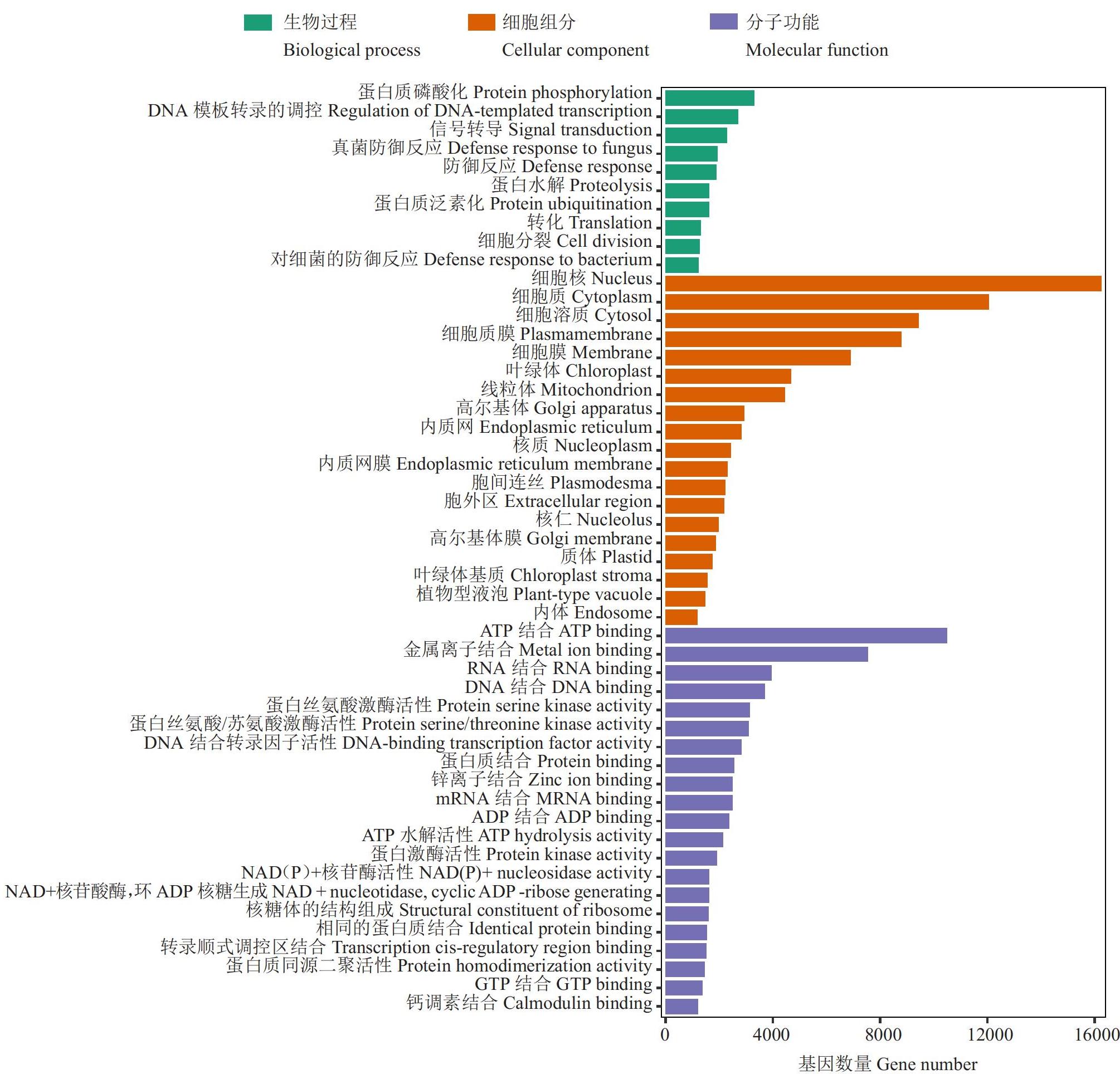
图2 枇杷叶unigene GO注释
Fig.2 GO annotation of loquat leaves unigenes
2.5 枇杷叶unigene的KEGG注释
将获得的基因序列和KEGG数据库进行注释比对,结果显示在全球和概览图、碳水化合物代谢、转化、运输和分解代谢通路获得较高注释(图3)。
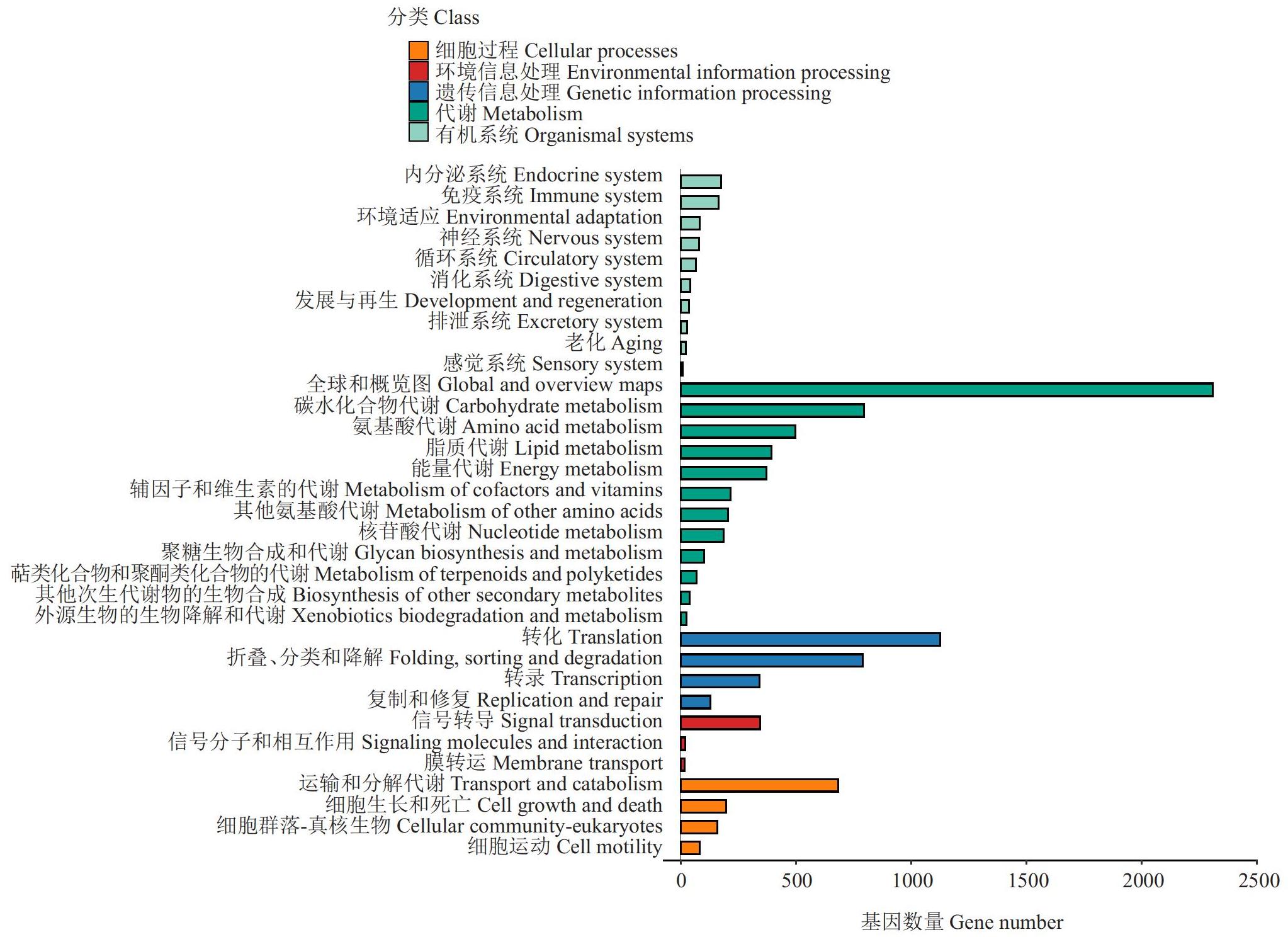
图3 枇杷叶unigene KEGG注释
Fig.3 Unigene KEGG annotation of loquat leaves
2.6 枇杷叶unigene的eggNOG注释
将获得的基因序列和eggNOG数据库进行注释比对,共注释17440个unigenes,占比14.79%。根据功能可将其分为24类,并对每一类的基因数量进行统计(图4)。其中,功能未知的unigenes数量最多,为5429个;其次是翻译后修饰、蛋白质周转、分子伴侣,为1729个;细胞运动最少,仅有2个unigenes注释。
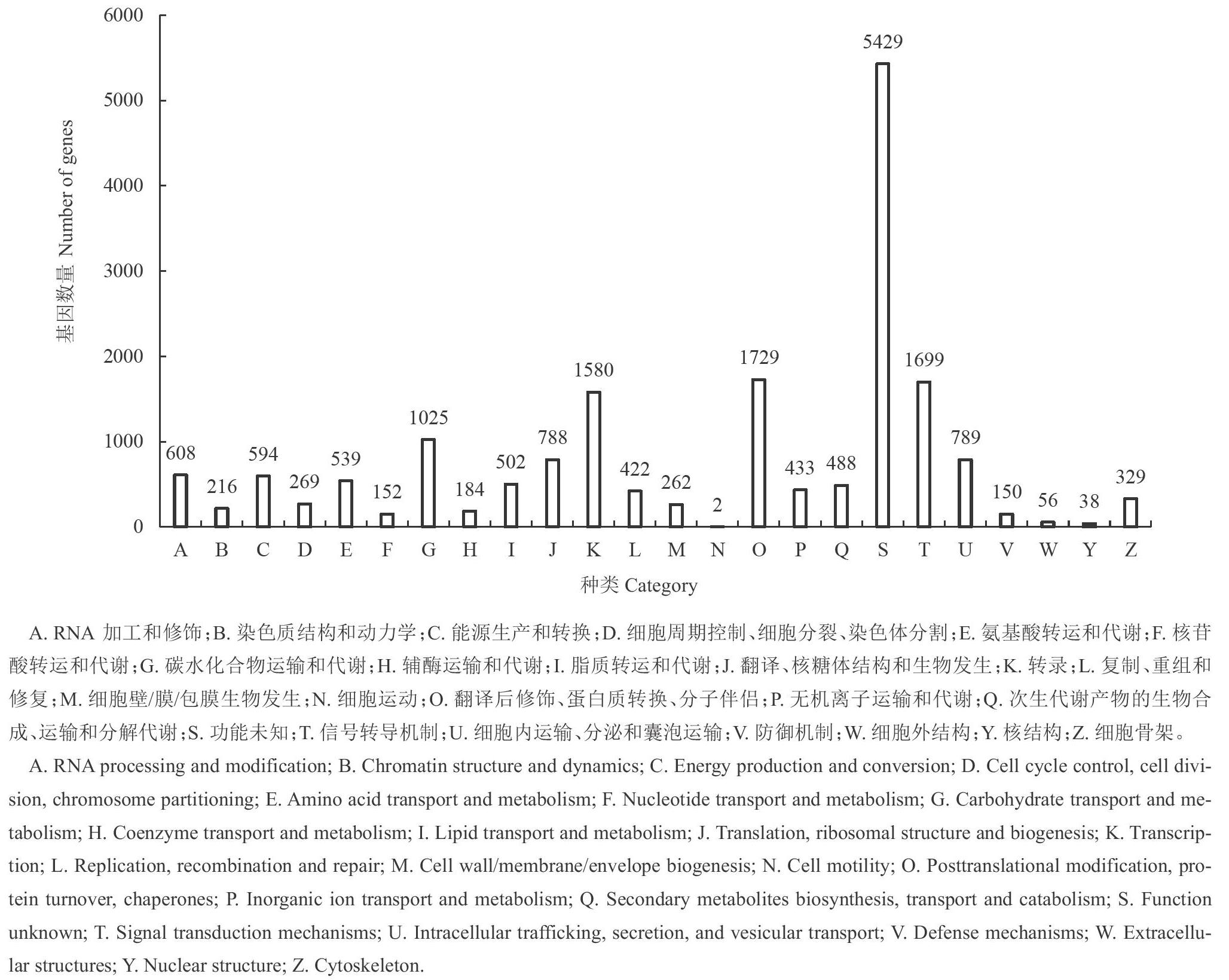
图4 枇杷叶unigene eggNOG注释
Fig.4 Loquat leaves unigene eggNOG annotation
2.7 枇杷叶表达量丰度分布
枇杷叶不同样本中基因的表达分布情况通过各基因的TPM表达量分布展示,如图5所示。6个样品具有相似的表达量分布模式,差异表达基因占整体基因的比例较小,少量差异表达基因对样品的表达量分布未产生明显影响。
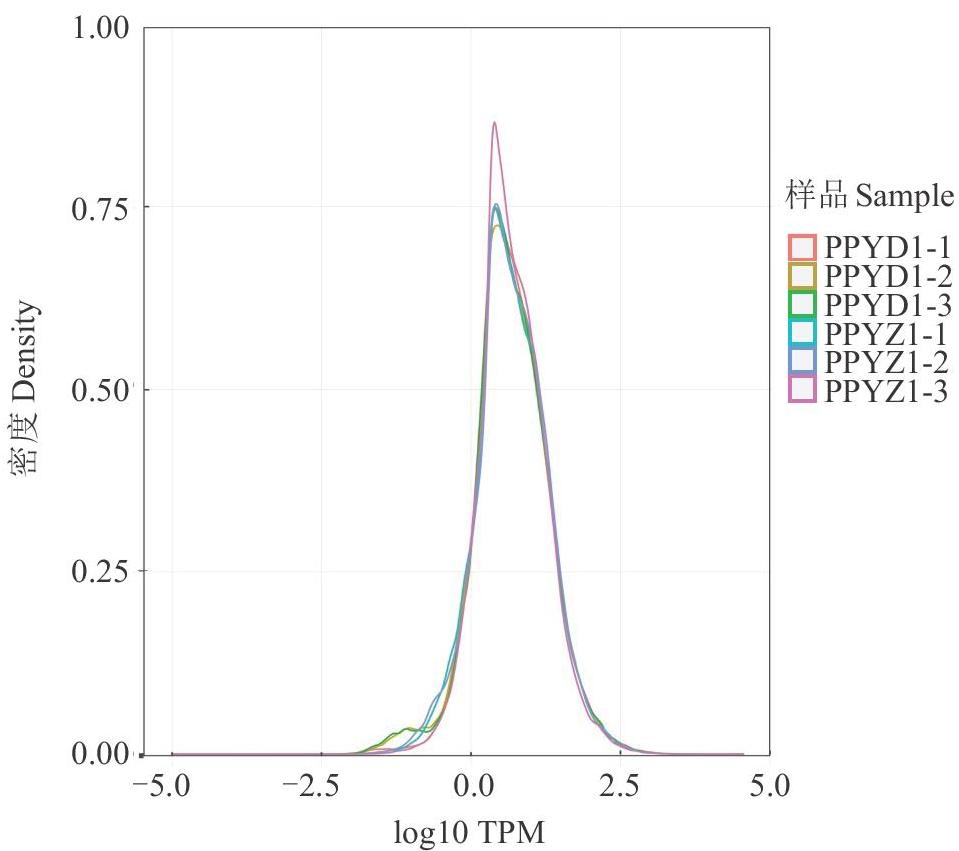
图5 枇杷叶表达量丰度分布
Fig.5 Distribution of expression abundance in loquat leaves
2.8 枇杷叶表达量聚类图
基于枇杷叶中所有基因的表达模式进行层级聚类分析,对各个样本的基因表达量进行log2(TPM+1)处理,并通过热图呈现聚类结果。如图6所示,表达模式相近的基因可能具有相同功能,或参与共同的代谢途径及信号通路。
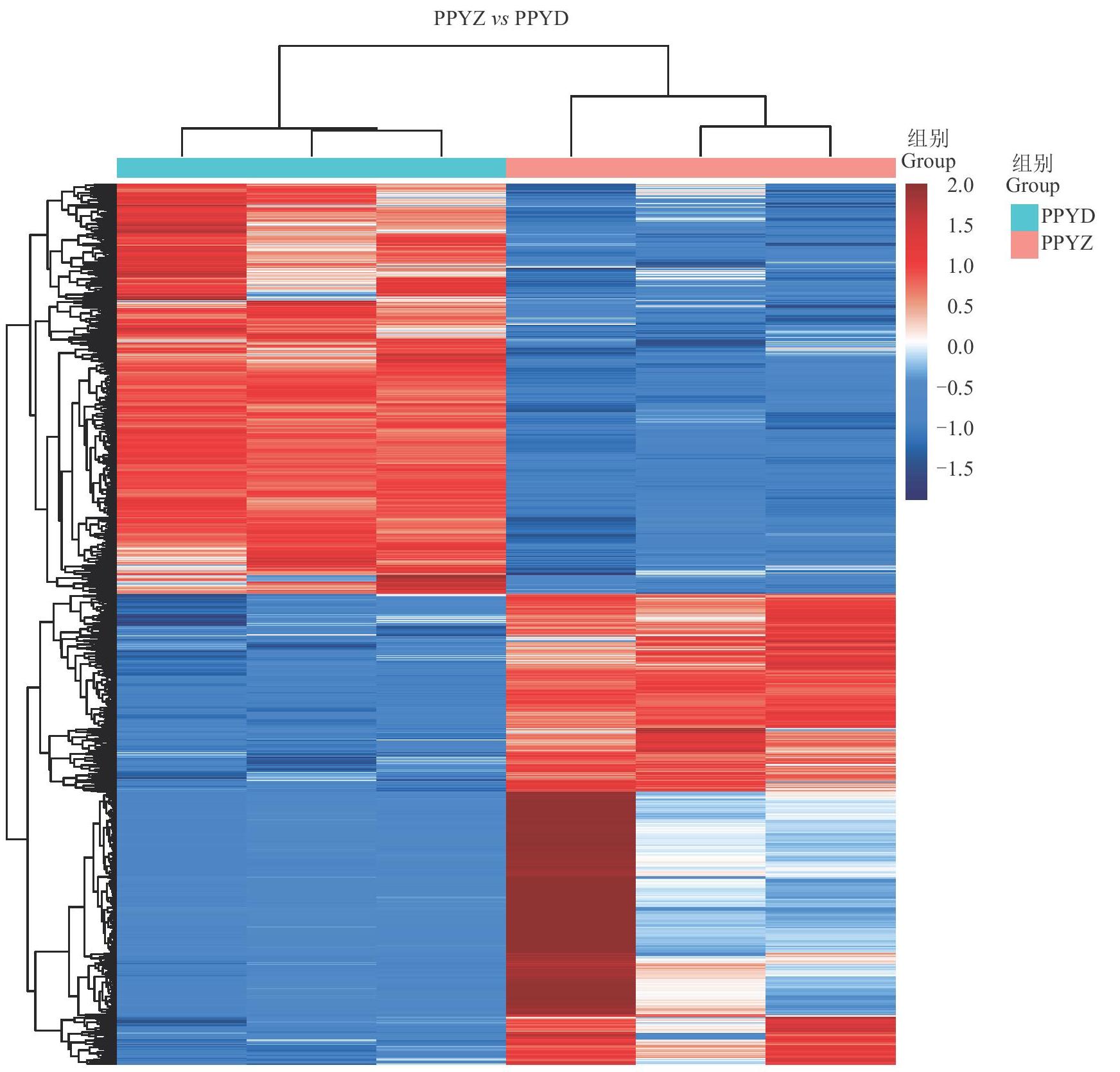
图6 枇杷叶表达量聚类图
Fig.6 Cluster diagram of expression levels in loquat leaves
2.9 PCA分析
PCA分析的原理是利用降维思想,将复杂的样本组成关系反映到特征值上,选取方差较大的两个主要特征值,获得样本间距离关系。对枇杷叶PPYD与PPYZ两组样本进行PCA分析,结果显示(图7)两组样本完全分离,无交叉重叠。PPYD组内样本(PPYD1-1、PPYD1-2、PPYD1-3)集中分布于PC1负半轴区域,PPYZ组内样本(PPYZ1-1、PPYZ1-2、PPYZ1-3)则集中分布于PC1正半轴区域。PC1解释了46.6%的变异,PC2解释了17.1%的变异,累计解释率为63.7%,表明两组样本成分特征存在显著差异,PCA模型可有效区分两类枇杷叶样本。
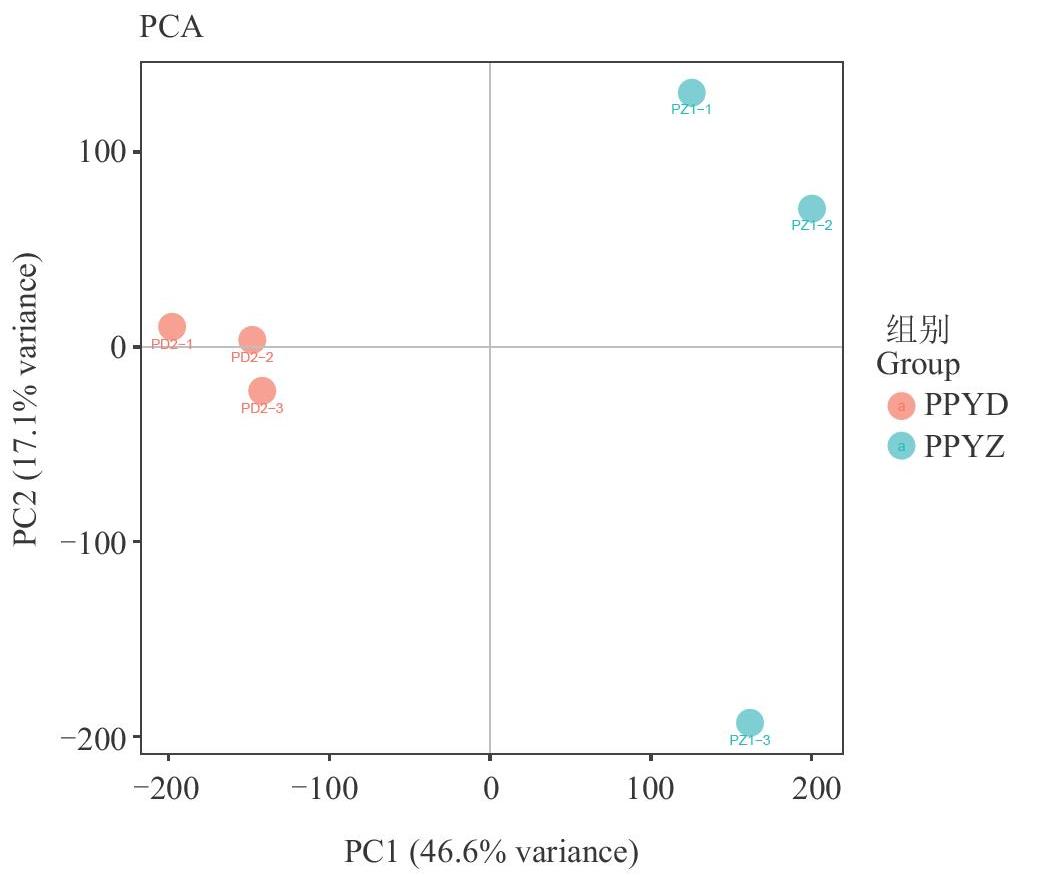
图7 PCA分析
Fig.7 PCA analysis
2.10 早钟和大钟枇杷叶差异表达基因的KO富集分析
KO富集分析结果显示,早钟和大钟枇杷叶共有14571个差异表达unigenes,富集到127条代谢通路。为直观展示早钟和大钟枇杷叶之间的差异表达基因,利用火山图对显著差异表达基因进行分析。如图8所示,PPYZ相对PPYD存在大量差异代谢物。红色点代表PPYZ中显著上调的代谢物,数量多且富集程度高;蓝色点代表显著下调的代谢物,数量较少。多数差异代谢物集中于log2(fold change)>0区域,表明PPYZ中代谢物整体呈上调趋势,两组代谢谱差异显著。
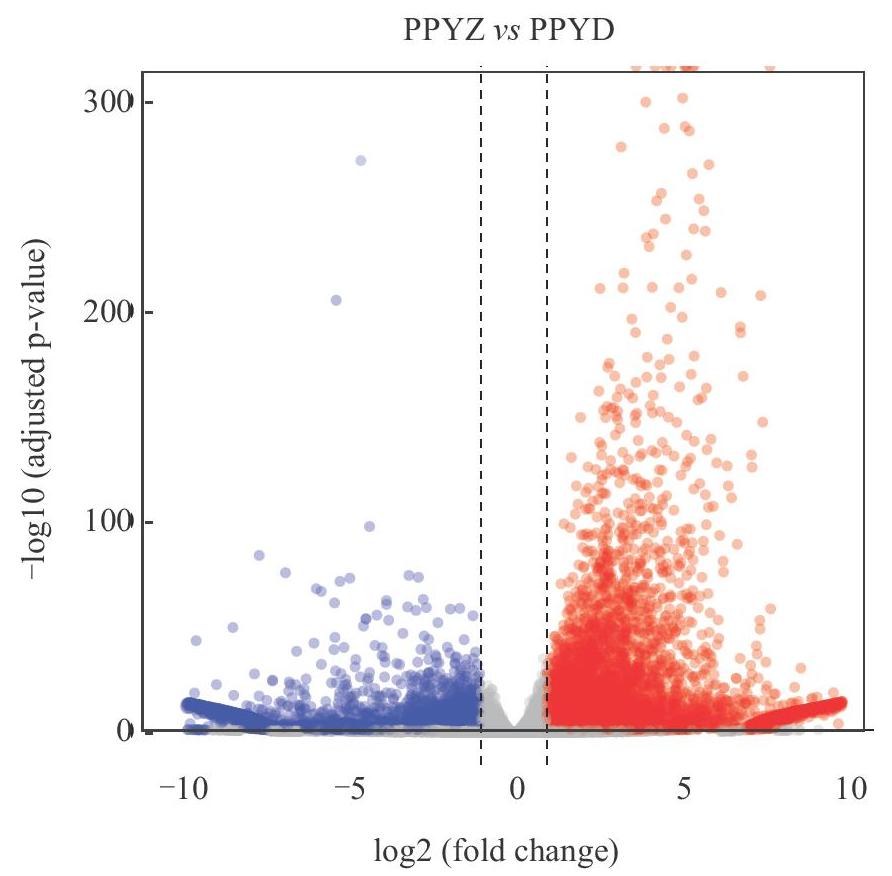
图8 枇杷叶差异基因火山图
Fig.8 Volcanic map of differential genes in loquat leaves
2.11 早钟和大钟枇杷叶差异表达基因的KEGG分析
图9展示了20条主要通路的富集信息。其中,富集数量最多的是植物-病原体相互作用通路,其次为MAPK信号通路-植物通路,最少的是角质层、木栓层和蜡的生物合成通路。与药效有关的通路包括倍半萜和三萜生物合成,单萜类生物合成,托烷、哌啶和吡啶生物碱生物合成,异喹啉生物碱生物合成,油菜素内酯生物合成,苯丙素的生物合成等。
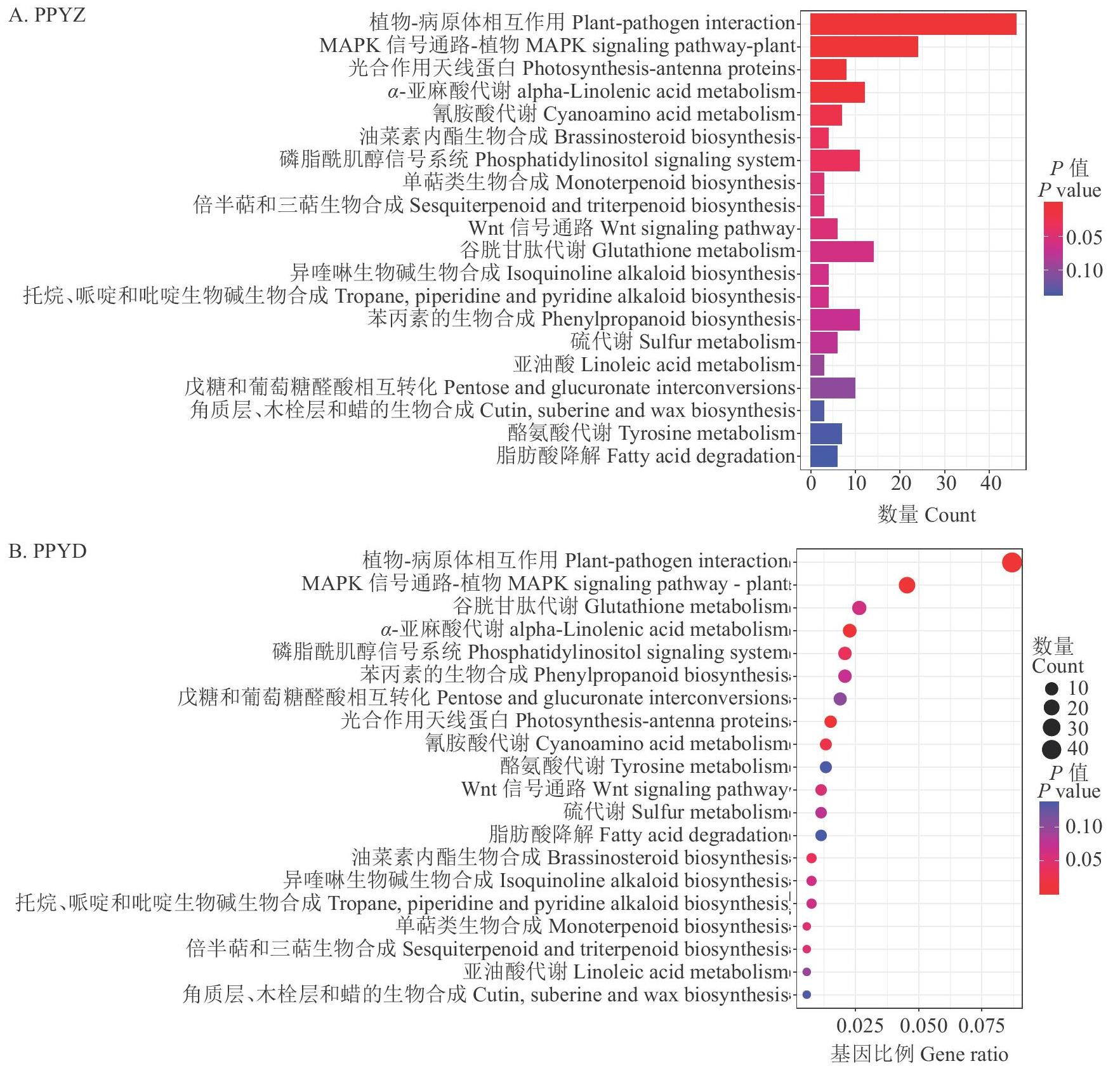
图9 KO富集PPYZ (A) 与PPYD (B) 的前20名
Fig.9 Top20of KO enrichment PPYZ(A) vs PPYD(B)
2.12 枇杷叶倍半萜和三萜生物合成途径分析
枇杷叶中的次生代谢产物如三萜酸类物质是主要有效成分,而倍半萜和三萜生物合成途径是重要的合成途径之一(图10)。KEGG代谢通路分析结果表明,参与倍半萜和三萜生物合成的unigenes有10个,其中3个显著差异表达,且均为上调(表3)。其中与角鲨烯单加氧酶有关的unigenes为2个,与(3S,6E)-橙花叔醇合酶有关的unigenes为1个。
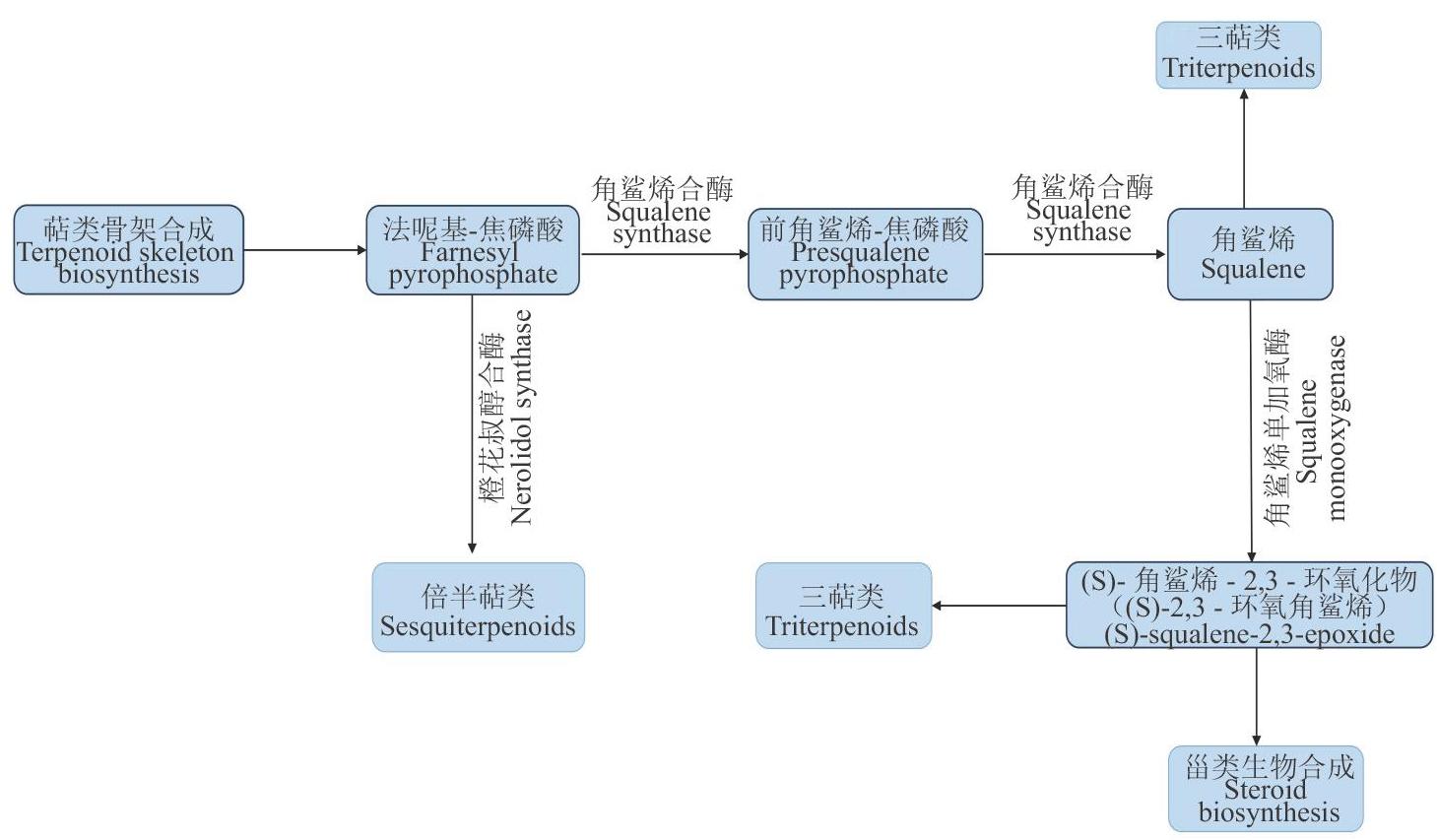
图10 三萜酸合成调控通路
Fig.10 Regulatory pathway of triterpene acid synthesis
表3 枇杷叶倍半萜和三萜生物合成通路相关基因
Table3 Unigenes related to sesquiterpenoid and triterpenoid biosynthesis pathway in loquat leaves
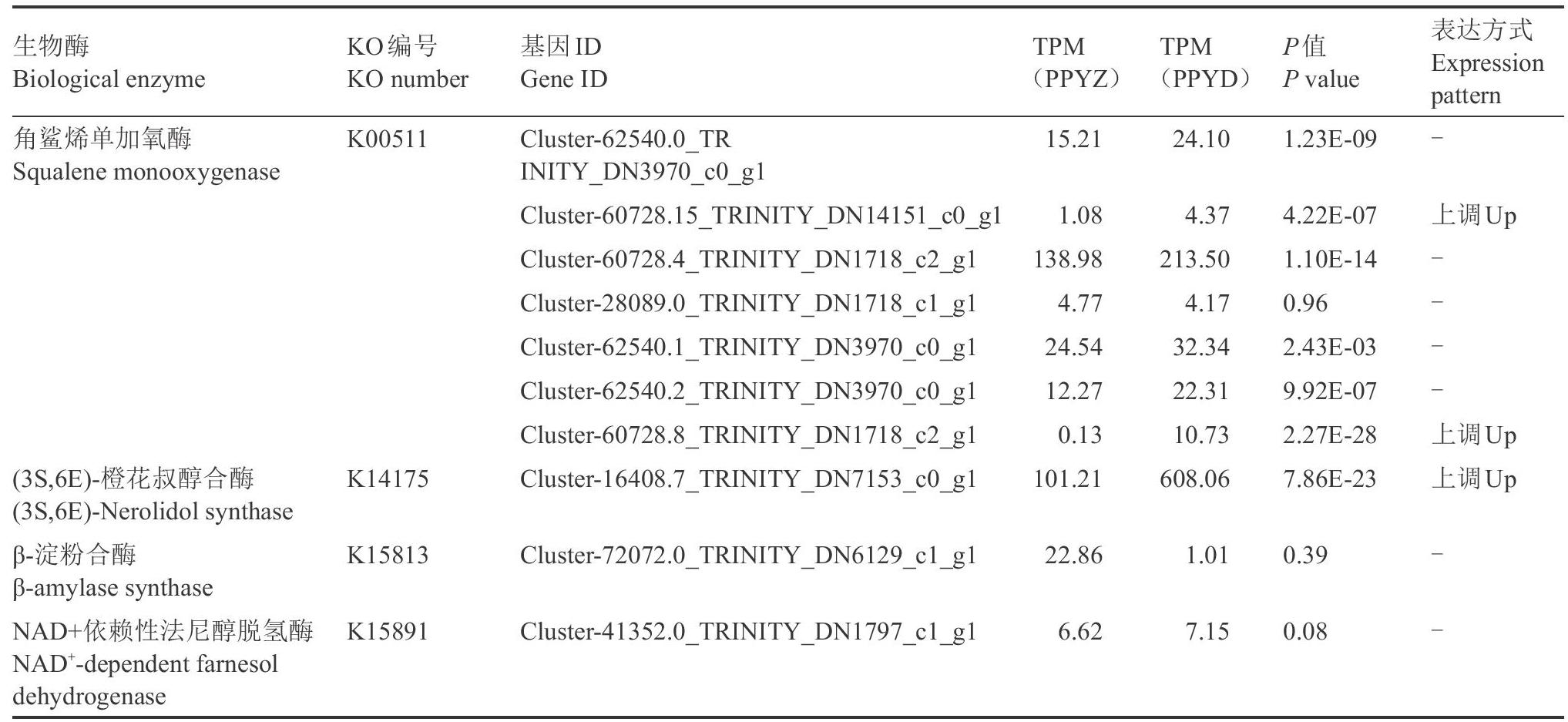
表达方式生物酶 KO编号 基因ID TPM TPM P值 Expression Biological enzyme KO number Gene ID (PPYZ)(PPYD) P value pattern角鲨烯单加氧酶 K00511 Cluster-62540.0_TR 15.21 24.10 1.23E-09-Squalene monooxygenase INITY_DN3970_c0_g1 Cluster-60728.15_TRINITY_DN14151_c0_g1 1.08 4.37 4.22E-07 上调Up Cluster-60728.4_TRINITY_DN1718_c2_g1 138.98 213.50 1.10E-14-Cluster-28089.0_TRINITY_DN1718_c1_g1 4.77 4.17 0.96-Cluster-62540.1_TRINITY_DN3970_c0_g1 24.54 32.34 2.43E-03-Cluster-62540.2_TRINITY_DN3970_c0_g1 12.27 22.31 9.92E-07-Cluster-60728.8_TRINITY_DN1718_c2_g1 0.13 10.73 2.27E-28 上调Up(3S,6E)-橙花叔醇合酶 K14175 Cluster-16408.7_TRINITY_DN7153_c0_g1 101.21 608.06 7.86E-23 上调Up(3S,6E)-Nerolidol synthaseβ-淀粉合酶 K15813 Cluster-72072.0_TRINITY_DN6129_c1_g1 22.86 1.01 0.39-β-amylase synthase NAD+依赖性法尼醇脱氢酶 K15891 Cluster-41352.0_TRINITY_DN1797_c1_g1 6.62 7.15 0.08-NAD+-dependent farnesol dehydrogenase
注:“-”表示基因表达方式无显著差异。
Note:“-” indicates that there is no significant difference in gene expression patterns.
¯表4 枇杷叶5个三萜酸的平均含量(x±s,mg·g-1,n=5)
Table4 Average content of five triterpene acids in loquat leaves

样品 w(野鸦椿酸) w(山楂酸) w(科罗索酸) w(齐墩果酸) w(熊果酸)Sample Euscaphic acid content Maslinic acid content Coros-olic acid content Oleanolic acid content Ursolic acid content早钟枇杷叶PPYZ 3.86±0.06b 2.40±0.02b 6.84±0.17b 1.24±0.02a 8.78±0.05b大钟枇杷叶PPYD 4.84±0.09a 2.66±0.07a 9.18±0.23 a 1.25±0.02a 9.71±0.02a P<0.0001<0.0001<0.0001 0.9298<0.0001
注:不同小写字母表示同一列处理之间的差异显著(P<0.05)
Note:Different lowercase letters indicate significant differences within the same treatment column(P<0.05)
2.13 枇杷叶中主要三萜酸的含量测定
枇杷叶中主要的三萜酸包含野鸦椿酸、山楂酸、科罗索酸、齐墩果酸、熊果酸。由表4和图11可知,在早钟枇杷叶中,野鸦椿酸、山楂酸、科罗索酸及熊果酸含量与大钟枇杷叶存在显著差异,而两者中的齐墩果酸含量则无显著差异。
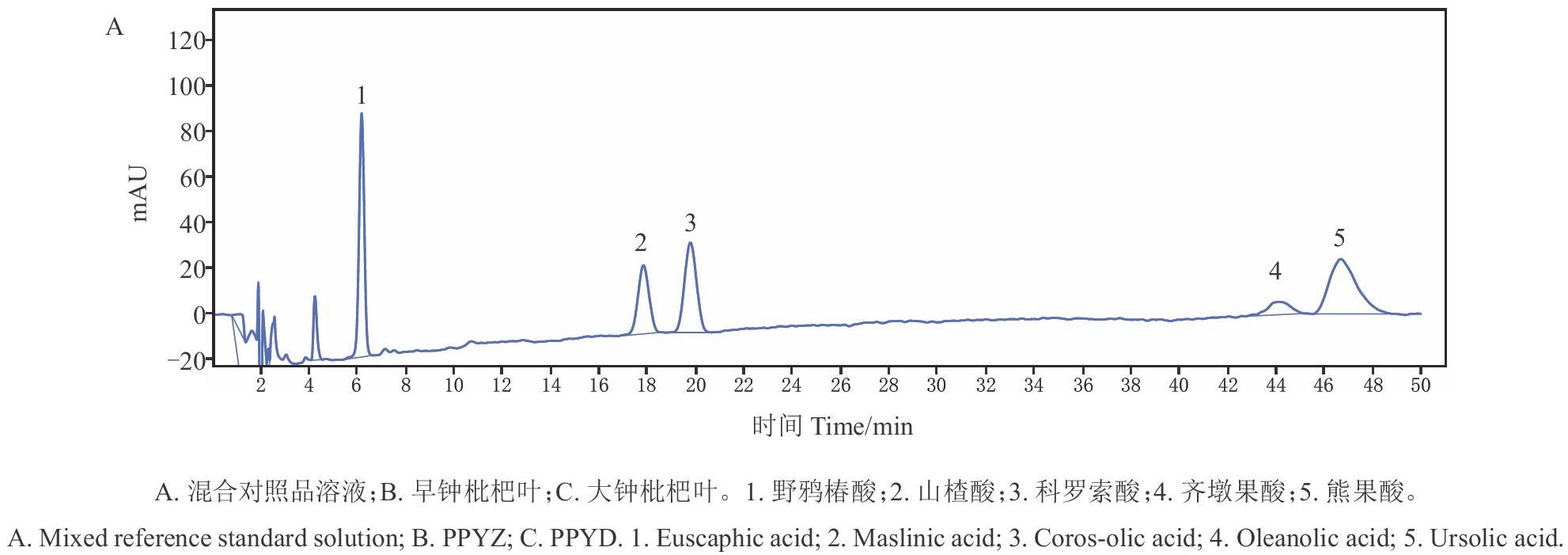
图11 枇杷叶主要三萜酸HPLC图
Fig.11 HPLC chromatogram of main triterpene acids in loquat leaves
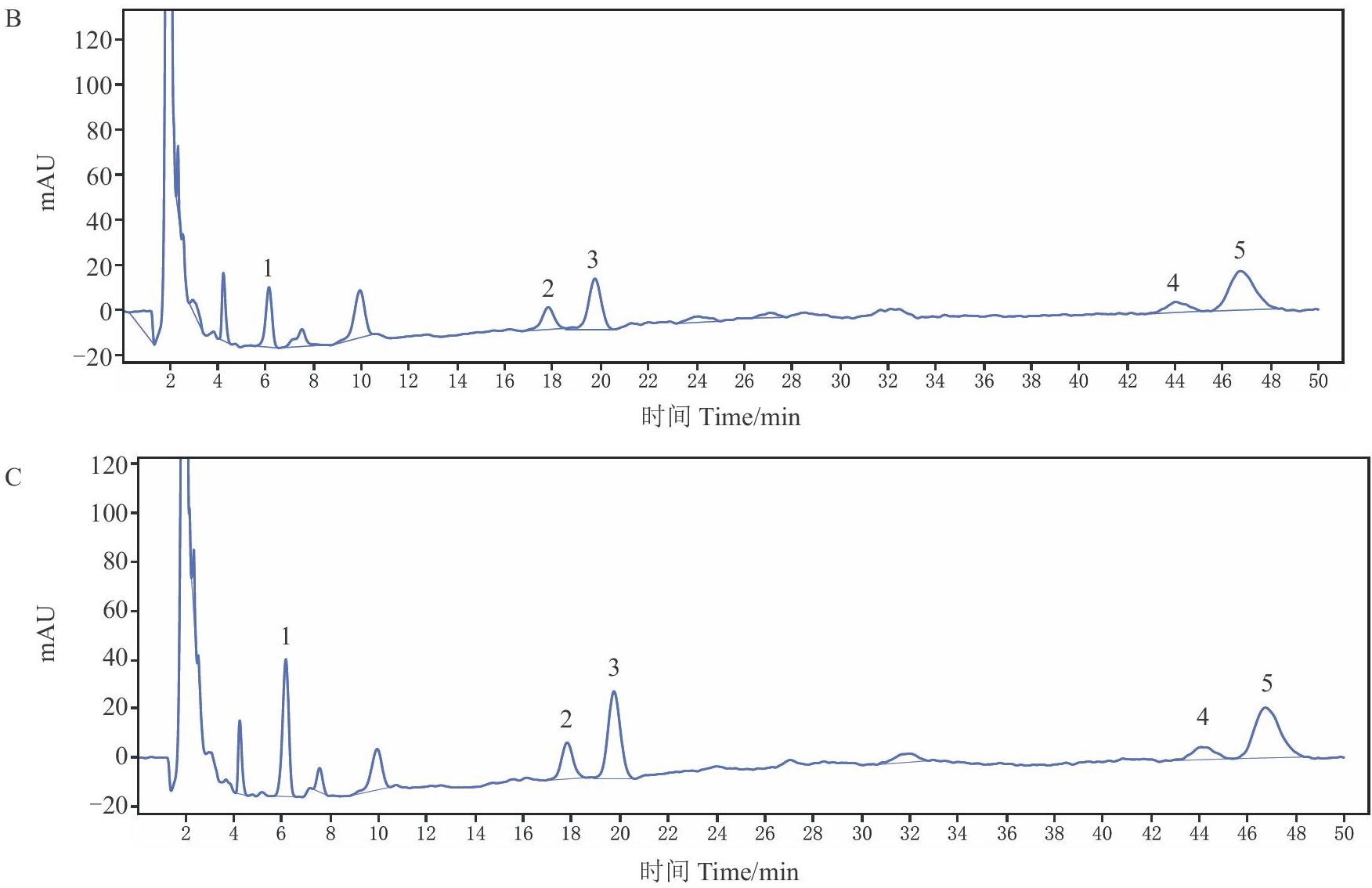
图11 (续) Fig.11(Continued)
3 讨 论
枇杷具有极高的营养和药用价值[14]。随着枇杷转录组数据库的日趋完善,越来越多重要基因得以鉴定。然而,研究多集中于果实和花,对于叶药用价值的分子机制研究少见报道。杨芩等[15]采用Illumina NovaSeq6000对高糖枇杷果实发育后期5个阶段的果肉转录组进行测序,发现生长素、细胞分裂素、赤霉素、脱落酸、乙烯、油菜素内酯、茉莉酸和水杨酸可能协同调控枇杷果实后期发育,调控糖分积累。李惠华等[16]利用转录组测序技术整体上分析了枇杷五环三萜类化合物代谢途径中的关键性酶AACT、SQS、SQE、AS、CYP450及UGT的基因表达水平。王丹等[17]采用实时荧光定量技术对枇杷叶中的差异表达基因进行验证,其中双萜类、油菜素类固醇和类胡萝卜素3条生物合成途径中的差异基因呈现出较为一致的表达模式。徐红霞等[18]研究表明枇杷花不同发育时期差异基因显著富集于植物激素代谢与信号转导通路,这类基因与MADS-box家族基因共同调控枇杷花发育。付燕等[19]利用Primer 3软件设计SSR引物,结果表明枇杷花转录组SSR位点出现频率高、分布密度大,具有良好的多态性潜能,能提供丰富的重复类型。
枇杷叶作为常见植物叶子,也是中药中常用的药材,其主要成分包括三萜酸、总黄酮等[20]。研究表明,枇杷叶中作为主要成分的三萜酸含量仅次于枇杷花[21]。而三萜酸类物质,比如熊果酸、齐墩果酸等具有抗炎、抗氧化、抗病毒、抑制细菌等作用[22]。因此,枇杷叶具有极高的研究价值。本研究利用高通量测序技术,以早钟和大钟枇杷叶为对象,建立转录组数据库。在枇杷叶代谢通路中,与药效有关的次生代谢通路包括倍半萜和三萜生物合成、苯丙素生物合成。在三萜酸合成通路中筛选出3个差异表达基因:2个角鲨烯单加氧酶编码基因和1个橙花叔醇合酶编码基因。其中,角鲨烯单加氧酶是催化三萜合成关键前体(角鲨烯)转化为2,3-氧化角鲨烯的核心限速酶,其基因上调表达可定向促进三萜酸(齐墩果酸、熊果酸)及三萜皂苷的积累;橙花叔醇合酶是倍半萜合成的关键酶,其基因上调表达可显著提高橙花叔醇及倍半萜衍生物含量。枇杷叶转录组测序结果较为丰富,获得的unigenes涉及植物生长发育过程中的各类生命活动,且仍有大量unigenes功能未知,主要归因于数据库注释的局限性、枇杷叶在长期进化中形成的独特功能基因和部分基因的低表达水平。这些未知unigenes可能包含调控枇杷叶特有性状的关键基因,而非普遍存在的管家基因,也可能包含未被预测的编码基因等,是完善枇杷叶转录组信息、解析基因调控网络的重要补充,具有极高的物种专属研究价值。本研究所用枇杷叶(大钟与早钟)分别取自同一棵树的多个叶片,缺乏生物学重复性,无法区分是品种间的真实差异还是个体差异造成的结果差异。
4 结 论
通过对早钟、大钟枇杷叶进行转录组测序与差异表达分析,筛选出3个三萜酸代谢相关差异基因,并测定了5种三萜酸成分含量。在枇杷叶(早钟)中,野鸦椿酸、山楂酸、科罗索酸及熊果酸含量和枇杷叶(大钟)存在显著差异;角鲨烯单加氧酶、橙花叔醇合酶基因上调表达不一定提高三萜酸含量,前者受底物限制,后者因底物分流而产生抑制作用,表明该代谢通路调控复杂,对枇杷叶开发利用具有重要意义。
[1] 国家药典委员会.中华人民共和国药典-一部:2020年版[M].北京:中国医药科技出版社,2020:213-214.Chinese Pharmacopoeia Commission. Pharmacopoeia of the people’ s republic of china,A department:2020[M]. Beijing:The Medicine Science and Technology Press of China,2020:213-214.
[2] 肖旭坤,王翰华,阮洪生.枇杷叶化学成分和药理活性研究进展[J].中医药导报,2019,25(21):60-66.XIAO Xukun,WANG Hanhua,RUAN Hongsheng. Research progress on chemical constituents and pharmacological activities of Pipaye (eriobotryae folium)[J]. Guiding Journal of Traditional Chinese Medicine and Pharmacy,2019,25(21):60-66.
[3] 张元波,李颂,魏庆红,王涛.枇杷叶抗氧化谱效相关质量评价指标研究[J].延边大学农学学报,2024,46(4):47-53.ZHANG Yuanbo,LI Song,WEI Qinghong,WANG Tao. Research on quality evaluation indicators related to the antioxidant spectrum and efficacy of loquat leaves[J]. Agricultural Science Journal of Yanbian University,2024,46(4):47-53.
[4] 姚莹,张杰.枇杷叶三萜酸联合重组人表皮生长因子对激素依赖性皮炎豚鼠皮肤屏障功能的修复及免疫失衡的影响[J].中国中西医结合皮肤性病学杂志,2024,23(1):29-33.YAO Ying,ZHANG Jie. Effects of loquat leaf triterpene acid combined with recombinant human epidermal growth factor onskin barrier function repair and immune imbalance in guinea pigs with hormone-dependent dermatitis[J]. Chinese Journal of Dermatovenerology of Integrated Traditional and Western Medicine,2024,23(1):29-33.
[5] 王晶,陈莹莹,焦辉进,周浓,史虎军,张弦飞.不同采收期枇杷叶总酚、总黄酮含量及抗氧化活性研究[J].中国野生植物资源,2024,43(12):52-57.WANG Jing,CHEN Yingying,JIAO Huijin,ZHOU Nong,SHI Hujun,ZHANG Xianfei. Evaluation of total polyphenols and flavonoids contents and antioxidant activity of loquat leaves atdifferent harvesting periods[J]. Chinese Wild Plant Resources,2024,43(12):52-57.
[6] 张新博,汪芸兰,雷璇,张颖,宋逍.基于指纹图谱及化学模式识别方法优选蜜枇杷叶药材产地[J].药物分析杂志,2024,44(2):340-350.ZHANG Xinbo,WANG Yunlan,LEI Xuan,ZHANG Ying,SONG Xiao. Fingerprinting and chemical pattern recognition methods for preferential selection of the habitat of honeyed Eriobotryae Folium[J]. Chinese Journal of Pharmaceutical Analysis,2024,44(2):340-350.
[7] 鞠建华,周亮,林耕,刘东,王立为,杨峻山.枇杷叶中三萜酸类成分及其抗炎、镇咳活性研究[J].中国药学杂志,2003,38(10):752-757.JU Jianhua,ZHOU Liang,LIN Geng,LIU Dong,WANG Liwei,YANG Junshan. Studies on constituents of triterpene acids from Eriobotrya japonica and their anti-inflammatory and antitussive effects[J]. Chinese Pharmaceutical Journal,2003,38(10):752-757.
[8] 陈剑,赵磊,黄晓杰,潘胤安,马丽,刘艳.枇杷叶6种三萜酸的人肠道菌群生物转化及其抑制α-葡萄糖苷酶活性研究[J].时珍国医国药,2022,33(2):270-272.CHEN Jian,ZHAO Lei,HUANG Xiaojie,PAN Yin’an,MA Li,LIU Yan. Biotransformation of six triterpene acids from Eriobotrya japonica leaves by human intes-tinal bacteria and their relation to in vitro α-glucosidase inhibitory activity[J]. Lishizhen Medicine and Materia Medica Research,2022,33(2):270-272.
[9] 高伟城,王小平,黄建军,王二丽,谢伟容,黄醒梅,林小晴,陈羽晴.响应面法优化云霄产枇杷叶三萜酸类成分的提取工艺[J].中国现代中药,2021,23(12):2132-2140.GAO Weicheng,WANG Xiaoping,HUANG Jianjun,WANG Erli,XIE Weirong,HUANG Xingmei,LIN Xiaoqing,CHEN Yuqing. Optimization of extraction of triterpenic acids in eriobotryae folium from Yunxiao by response surface methodology[J]. Modern Chinese Medicine,2021,23(12):2132-2140.
[10] 高伟城,王小平,陈荣珠,丁其春,李雪煌.不同采收期枇杷叶中氨基酸的组成与分析[J].医药导报,2024,43(9):1461-1469.GAO Weicheng,WANG Xiaoping,CHEN Rongzhu,DING Qichun,LI Xuehuang. Composition and analysis of amino acids in eriobotryae folium at different harvesting stages[J]. Herald of Medicine,2024,43(9):1461-1469.
[11] 高伟城,王小平,何丽珊.枇杷叶生品及不同炮制品质量评价[J].中国药房,2022,33(2):196-202.GAO Weicheng,WANG Xiaoping,HE Lishan. Quality evaluation of crude drug and different processed products of Eriobotryae Folium[J]. China Pharmacy,2022,33(2):196-202.
[12] 黄建军,谢伟容,郑晓艳.白凤菜转录组学分析及类黄酮基因的剖析[J].分子植物育种,2024,22(16):5252-5260.HUANG Jianjun,XIE Weirong,ZHENG Xiaoyan. Transcriptome analysis and flavonoid gene analysis of Gynura formosana Kitam[J]. Molecular Plant Breeding,2024,22(16):5252-5260.
[13] 高伟城,王小平,陈荣珠,陈羽晴,林小晴,黄醒梅.基于化学模式识别和熵权TOPSIS法的不同品种枇杷叶品质分析研究[J].甘肃中医药大学学报,2023,40(5):33-39.GAO Weicheng,WANG Xiaoping,CHEN Rongzhu,CHEN Yuqing,LIN Xiaoqing,HUANG Xingmei. Quality analysis of Folia Eriobotryae of different varieties based on chemical pattern recognition and entropy weight TOPSIS method[J]. Journal of Gansu University of Chinese Medicine,2023,40(5):33-39.
[14] SUN B,XIE Z P,XUE Y H,ZHANG Z P,HU S T,MOU X,WU J P. Study on damage characteristics of loquat based on test and finite element method[J]. Journal of Food Process Engineering,2025,48(7):e70195.
[15] 杨芩,付燕,刘雅兰,张婷渟,彭舒,邓洁.枇杷高糖果实发育后期植物激素信号转导的转录组分析[J].西南农业学报,2024,37(11):2402-2413.YANG Qin,FU Yan,LIU Yalan,ZHANG Tingting,PENG Shu,DENG Jie. Transcriptome analysis of phytohormone signal transduction during late development period of high-sugar loquat fruits[J]. Southwest China Journal of Agricultural Sciences,2024,37(11):2402-2413.
[16] 李惠华,常强,王伟,曾碧玉,徐剑,苏明华.基于转录组测序的枇杷五环三萜合成途径差异基因的分析[J].农业生物技术学报,2018,26(2):222-233.LI Huihua,CHANG Qiang,WANG Wei,ZENG Biyu,XU Jian,SU Minghua. Differential genes analysis of pentacyclic triterpenoid synthesis pathway based on loquat (Eriobotrya japonica)transcriptome sequencing[J]. Journal of Agricultural Biotechnology,2018,26(2):222-233.
[17] 王丹,龚荣高.干旱胁迫下枇杷叶片的转录组分析[J].华北农学报,2017,32(1):60-67.WANG Dan,GONG Ronggao. Transcriptome profiling of loquat leaves under drought stress[J]. Acta Agriculturae Boreali-Sinica,2017,32(1):60-67.
[18] 徐红霞,李晓颖,葛航,朱启轩,陈俊伟.基于转录组分析内源激素在调控枇杷花发育进程中的作用[J].浙江农业学报,2023,35(7):1648-1661.XU Hongxia,LI Xiaoying,GE Hang,ZHU Qixuan,CHEN Junwei. Transcriptome-based analysis of the role of endogenous hormones in regulating flower development in loquat (Eriobotrya japonica Lindl.)[J]. Acta Agriculturae Zhejiangensis,2023,35(7):1648-1661.
[19] 付燕,杨芩.枇杷花转录组SSR位点信息分析[J].分子植物育种,2021,19(18):6080-6087.FU Yan,YANG Qin. Analysis of SSR loci information of flower transcriptome in loquat[J]. Molecular Plant Breeding,2021,19(18):6080-6087.
[20] KALAM M A,AHMAD B,AHMAD R,AVID M,AKHTAR F,RAZA M A. Lokāt (Eriobotrya japonica;Family:Rosaceae):Nutritional and medicinal properties,in the light of unani medicine and scientific studies[J]. European Journal of Medicinal Plants,2024,35(6):94-104.
[21] 王洋,汪兰,李怡诺,庞同汇,包俊文,鲁周民.基于主要功能成分含量的不同品种枇杷叶评价[J].食品工业科技,2021,42(14):93-98.WANG Yang,WANG Lan,LI Yinuo,PANG Tonghui,BAO Junwen,LU Zhoumin. Evaluation of loquat leaves of different varieties based on the content of main functional components[J]. Science and Technology of Food Industry,2021,42(14):93-98.
[22] 何凤金,严艳芳,梁前程,陶仙,李昊东,龙腾相,李良群,邓廷飞,潘雄,陈发菊,杨小生.基于代谢组(LC-MS/MS)与转录组学的刺梨三萜类化合物关键基因比较分析[J].现代食品科技,2025,41(6):129-136.HE Fengjin,YAN Yanfang,LIANG Qiancheng,TAO Xian,LI Haodong,LONG Tengxiang,LI Liangqun,DENG Tingfei,PAN Xiong,CHEN Faju,YANG Xiaosheng. Comparative analysis of the key genes of triterpenoids in Rosa roxburghii based on metabolomics (LC-MS/MS) and transcriptomics[J]. Modern Food Science and Technology,2025,41(6):129-136.