橄榄[Canarium album(Lour.)Raeusch.]属于橄榄科(Burseraceae)橄榄属(Canarium L.)常绿乔木,为亚热带果树[1]。橄榄是国家卫生健康委员会公布的药食同源原料,第一批进入《中国药典》的果品类,具有较高经济价值和药用价值[2]。橄榄资源丰富,按照其用途可分为鲜食型、加工型、鲜食加工兼宜型。据不完全统计,全国鲜食橄榄的消费群体有3500 万人,潜在40 亿元的消费市场[3]。我国橄榄多以实生苗繁殖,绝大部分品种因口味苦涩,只能用于加工,缺少品质优良、适宜鲜食的品种[4]。
1 选育过程和遗传鉴定
2003 年,项目组在橄榄资源调查中,在梅州市丰顺县留隍镇石九村的村甜种橄榄群体中发现一株20 余年生种子繁殖的甜种榄,表现叶片明显比普通甜种榄小,丰产性能好,成花率高,花穗(果穗)短而紧凑,果实晚熟、品质优良,榄味浓郁,甘甜,涩味轻、质脆爽口,编号为优选3 号。经多年观察鉴定,嫁接后代遗传性稳定,均能保持母株的优良性状,鲜食口感优异,各项综合性状优良,定名为晚嘉橄榄。利用SCoT 分子标记技术对12 份橄榄种质资源的亲缘关系进行鉴定,从80 对引物中最终筛选出13 对特异性引物,扩增出108 对清晰条带,以第11 对引物(SCoT-11)为例,结果显示晚嘉橄榄(11 号泳道)与甜种橄榄(4 号泳道)在1000 bp 处存在共有条带,且在1000~2000 bp 区间存在较亮的特异条带,表明二者在品种间存在真实差异(图1)。2024 年获得广东省农作物品种审定委员会颁发的非主要农作物品种评定证书(评定编号:粤评果20240008)。
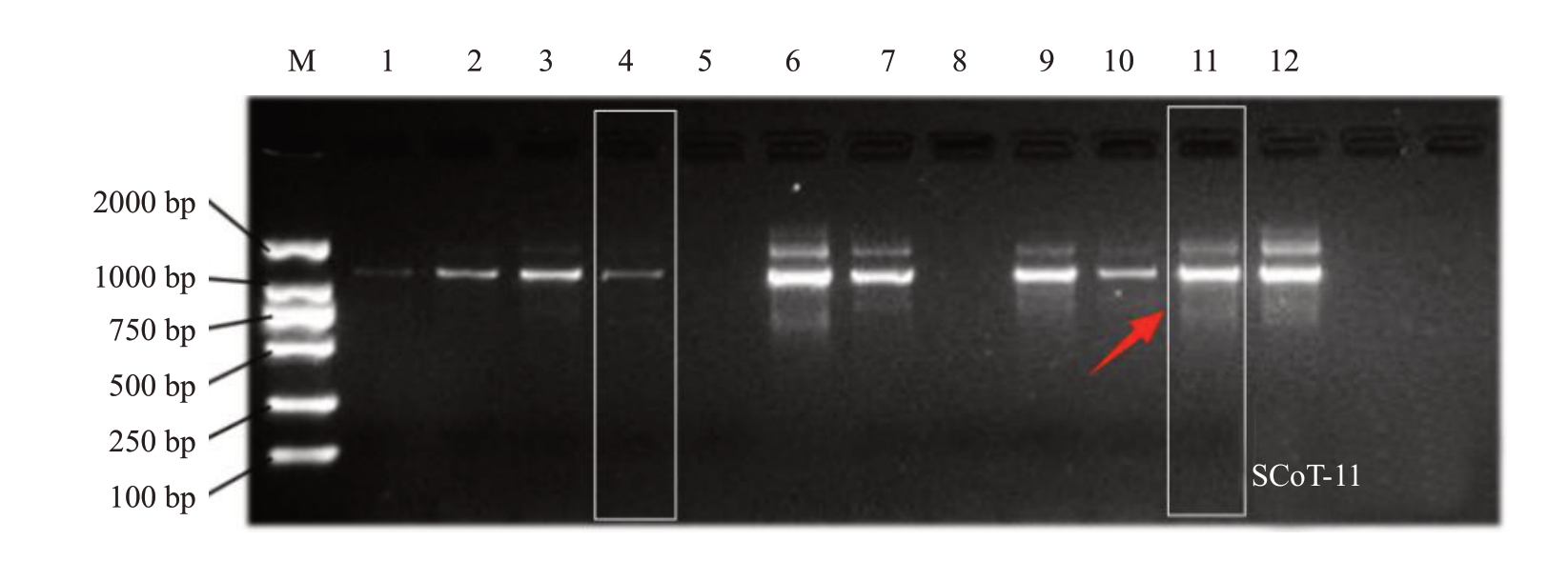
图1 引物SCoT-11 对12 份橄榄种质的PCR 扩增电泳图
Fig.1 PCR amplification electrophoresis of primer SCoT-11 on 12 olive germplasms
M.DL2000 DNA Mark;1. 早嘉橄榄;2. 呐种橄榄;3. 丁香榄;4. 甜种橄榄;5. 早熟2 号;6. 香种橄榄;7. 三棱榄;8. 土种橄榄;9. 早熟1 号;10. 薄皮橄榄;11. 晚嘉橄榄;12. 早熟3 号。
M.DL2000 DNA Mark;1.Zaojiaganlan;2.Nazhongganlan;3.Dingxianglan;4.Tianzhongganlan;5.Zaoshu No.2;6.Xiangzhongganlan;7.Sanlenglan;8.Tuzhongganlan;9.Zaoshu No.1;10.Baopiganlan;11.Wanjiaganlan;12.Zaoshu No.3.
2 主要性状
2.1 植物学特征
树冠呈阔圆形,树姿较开张,生长势较强,主枝与中心干角度为45°~60°。叶片为羽状复叶,复叶主轴长30.5~37.1 cm,小叶数7~10 枚,对生;小叶长椭圆形,叶尖渐尖,基部圆形略斜歪,叶缘全缘,主侧脉明显;嫩叶黄绿色,成熟后转为绿色。花为总状花序,花序长8.6 cm、宽3.1 cm,花白色,完全花,花瓣3枚。
2.2 果实特征及经济性状
晚嘉橄榄果穗紧密(图2)。如图3所示,果实椭圆形,果顶圆突,果基浑圆,果面无明显沟纹;果实纵横径3.5 cm×2.2 cm;果皮光滑,成熟期果皮颜色由青绿色转为黄绿色;果实较甜种橄榄大,平均单果质量8.60 g,可食率82.0%;果肉黄白色,肉质较脆,且果肉较厚,榄味浓郁,涩味淡,可溶性固形物含量(w,后同)9.7%,糖含量2.8 g·100 g-1,总酸含量8.73 g·kg-1,维生素C含量18.8 mg·100 g-1,粗纤维含量2.7%,钙含量888 mg·kg-1(表1)。
表1 晚嘉橄榄与甜种橄榄主要果实经济性状对比
Table 1 Comparison of the fruit economic traits between Wanjiaganlan and Tianzhongganlan

品种Cultivar甜种橄榄Tianzhongganlan晚嘉橄榄Wanjiaganlan单果质量Single fruit mass/g 5.99±0.31 8.60±0.51果肉厚度Pulp thickness/mm 5.3±0.1 5.4±0.5可食率Edible rate/%78.4 82.0 w(可溶性固形物)Soluble solid content/%9.4 9.7 w(维生素C)Vitamin C content/(mg·100 g-1)17.4 18.8 w(钙)Calcium content/(mg·kg-1)800 888 w(糖)Sugar content/(g·100 g-1)2.3 2.8 w(总酸)Total acid content/(g·kg-1)8.95 8.73
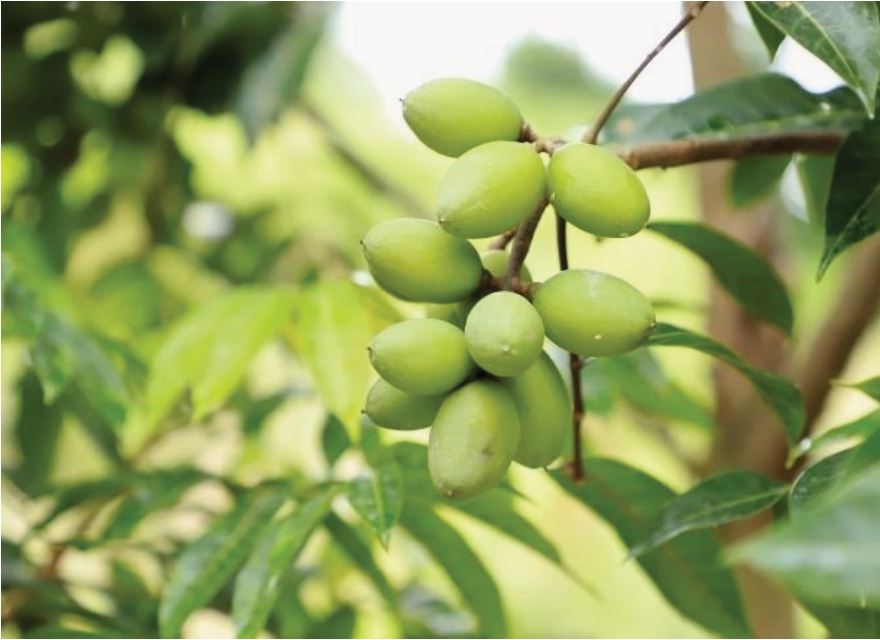
图2 晚嘉橄榄的果穗
Fig.2 Fruit clusters of Wanjiaganlan
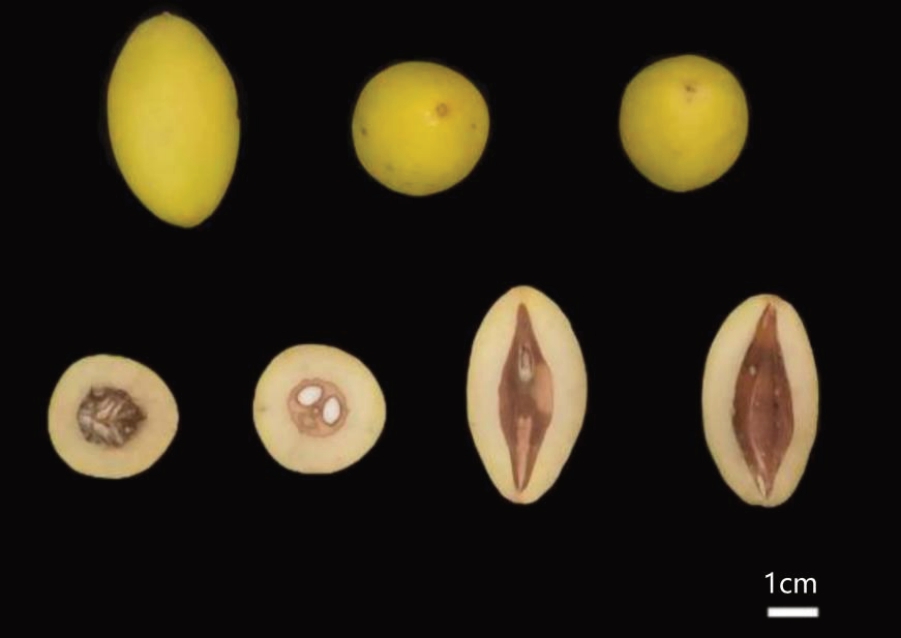
图3 晚嘉橄榄的果实
Fig.3 Fruit of Wanjiaganlan
2.3 物候期
在广东省梅州市,晚嘉橄榄于3 月上中旬抽春梢,6 月上旬至6 月下旬萌抽夏梢,8 月上旬萌发秋梢,11月中下旬抽生冬梢。3月下旬为现花蕾期,4月上旬为始花期,4月下旬为盛花期,5月中旬为谢花期,花期持续30 d 以上;6 月上旬至7 月上旬果实膨大期与生理落果期交错,8 月中旬至10 月上旬为果实硬核期,果实品质在1月上旬表现最优。
2.4 抗逆性与适应性
晚嘉橄榄抗旱性强,生长力强,适应范围广,易管理,在丘陵山地、河滩、洲地、旱坡地以及房前屋后、零星杂地均可种植。该品种喜温暖,在生长期需适当高温才能生长旺盛,结果良好,适宜在年平均气温20 ℃以上、冬季无严霜冻害的地区生长,可短期忍受-3 ℃的低温。因此,该品种适宜在橄榄生产区域推广种植。
3 栽培技术要点
3.1 园地选择与定植
选择坡度≤25°、土层深厚疏松的丘陵山地或地下水位1 m以下的旱地。每666.7 m2种植10~25株,平地缓坡株行距为(5~8)m×(6~8)m,山坡贫瘠地株行距为5 m×6 m。挖1 m×1 m×(0.6~0.8)m定植穴,每穴施入农家肥15 kg、过磷酸钙1 kg、石灰1 kg 作为基肥。每年2—4月定植。
3.2 土肥水管理
幼树采用“少量多次,一梢两肥”的方法以促梢,每年每株施入复合肥、花生麸各0.5~1 kg,并于10—11 月施入长效有机肥。结果树每年施肥3~4 次:3 月花前施入钾肥、农家肥;8—9 月壮果肥施入磷钾肥,并配施氮肥;采果前后每株深施农家肥10~30 kg、石灰1 kg、过磷酸钙5 kg;11—12月入冬施入有机肥、磷钾肥。关键期注意遇旱灌水,雨季排水。
3.3 整形修剪
幼树在0.7 m 处定干,选留2~3 主枝,逐级培养自然开心形树冠。结果树冬采及花前进行轻剪,剪除长枝以促生侧枝;盛产期需剪除密、叠、荫、弱、枯及病虫枝。
3.4 花果管理技术
在新梢期、花蕾期、幼果期防治病虫。在花前花后,喷施硼砂、磷酸二氢钾等保花保果;在幼果期喷施叶面肥促进果实膨大;6 月重施钾肥以壮果;8 月中下旬每株施入有机肥20 kg、石灰0.5 kg,并配施磷钾肥以减少落果。可通过配置授粉树或放蜂提高坐果率。
3.5 病虫草管理
针对炭疽病、煤烟病,应及时剪除烧毁病枝,并在新梢期、幼果期喷药防治。虫害防治遵循“预防为主,综合防治”的原则;冬季清园应剪除病虫枝并喷药;保护与利用天敌;利用灯光诱杀害虫;梢期重点防治木虱等虫害。幼龄橄榄园可采取覆膜、人工除草或套种等措施。
3.6 采收贮藏
在1 月上旬分批采收果实,以避免冻害。采后须进行分级并去除劣果,使用薄膜袋包装,于阴凉通风处贮藏。
[1] 池毓斌,朱丽娟,黄敏杰,彭真汾,叶清华,张静芳,陈清西,许长同.鲜食橄榄品质综合评价模型的建立与验证[J].果树学报,2017,34(8):1051-1060.CHI Yubin,ZHU Lijuan,HUANG Minjie,PENG Zhenfen,YE Qinghua,ZHANG Jingfang,CHEN Qingxi,XU Changtong. Establishment and verification of a comprehensive evaluation model for quality of fresh Chinese olive[J].Journal of Fruit Science,2017,34(8):1051-1060.
[2] 肖维强,匡石滋,赖多,邵雪花,刘传和,贺涵.广东橄榄产业发展优势、问题与对策[J].广东农业科学,2019,46(12):139-146.XIAO Weiqiang,KUANG Shizi,LAI Duo,SHAO Xuehua,LIU Chuanhe,HE Han. Advantages,problems and countermeasures for development of olive (Canarium album Raeusch.) industry in Guangdong Province[J]. Guangdong Agricultural Sciences,2019,46(12):139-146.
[3] 许长同. 福州发展橄榄百亿产业的调查报告[J]. 东南园艺,2019,7(2):44-48.XU Changtong. nvestigation report on the development of ten billions of olive industry in Fuzhou[J]. Southeast Horticulture,2019,7(2):44-48.
[4] 池毓斌,谢倩,陈清西.几个鲜食橄榄品种(系)及良种繁育方法简介[J].中国南方果树,2016,45(3):154-156.CHI Yubin,XIE Qian,CHEN Qingxi. Introduction to several fresh Chinese olive varieties(lines)and breeding methods for superior varieties[J].South China Fruits,2016,45(3):154-156.