我国作为世界猕猴桃种植面积最大、产量最高的生产国,猕猴桃品种结构多样化,但绿肉猕猴桃品种相对占比较高(40%),尤其在全国产业规模最大、效益最好的秦岭北麓百万亩核心产区,其绿肉猕猴桃品种占比高达70%,且以栽培15年以上的徐香、翠香、海沃德等为主[1]。随着猕猴桃产业高质量发展需求的持续增强,以及人们生活水平和消费质量的不断提高,新兴优质绿肉猕猴桃新品种的选育与推广种植,可为陕西产区乃至全国猕猴桃产业品种迭代更新奠定良好基础。
1 选育过程
农大青猕是由徐冠经自然授粉后实生选育而来。2005 年,收集徐冠自然授粉果实的种子并播种,于2006 年获得实生后代群体。经过10 年(2007—2016 年)的观察与筛选评价,初选出1 个风味佳、产量高、抗性较强的优良株系。2017—2022年,采集优系接穗,在陕西眉县、岐山、杨凌地区进行大树高接,以陕西主栽品种徐香为对照,进行品种比较试验。结果表明,该优系遗传性状稳定、特异性状表现突出[2]。2024年获得陕西省果树品种登记证书(证书编号:2025-03-103),定名为农大青猕(图1)。
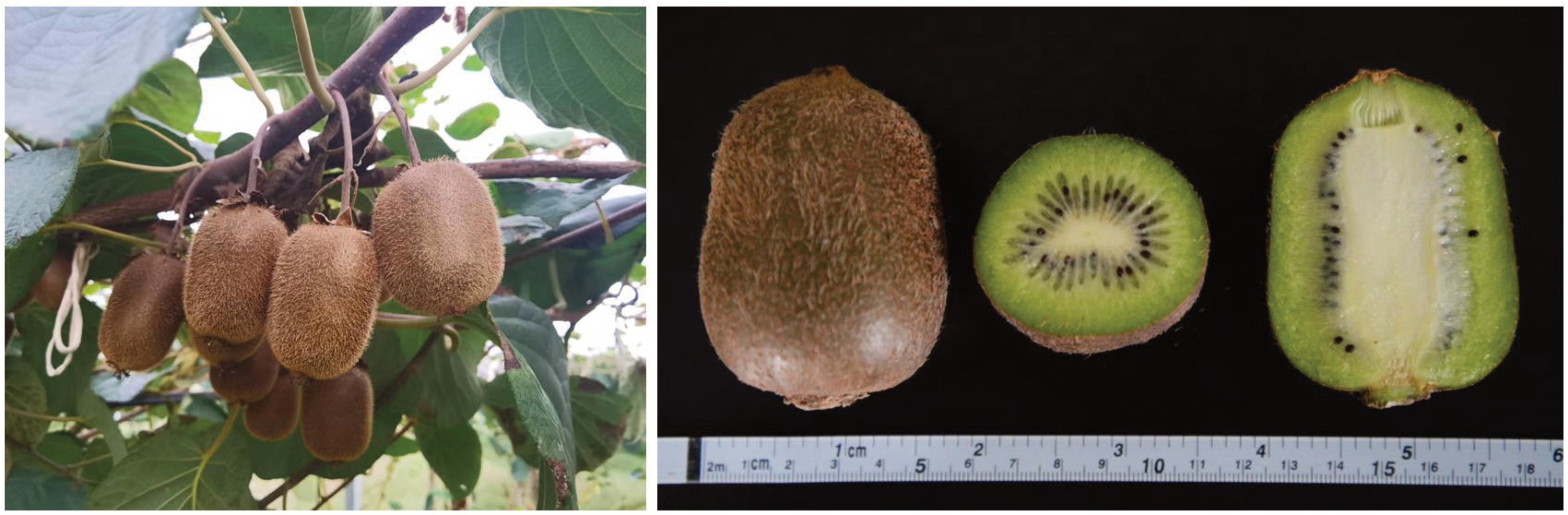
图1 猕猴桃新品种农大青猕
Fig.1 A new kiwifruit cultivar Nongda Qingmi
2 主要特征特性
2.1 植物学特征
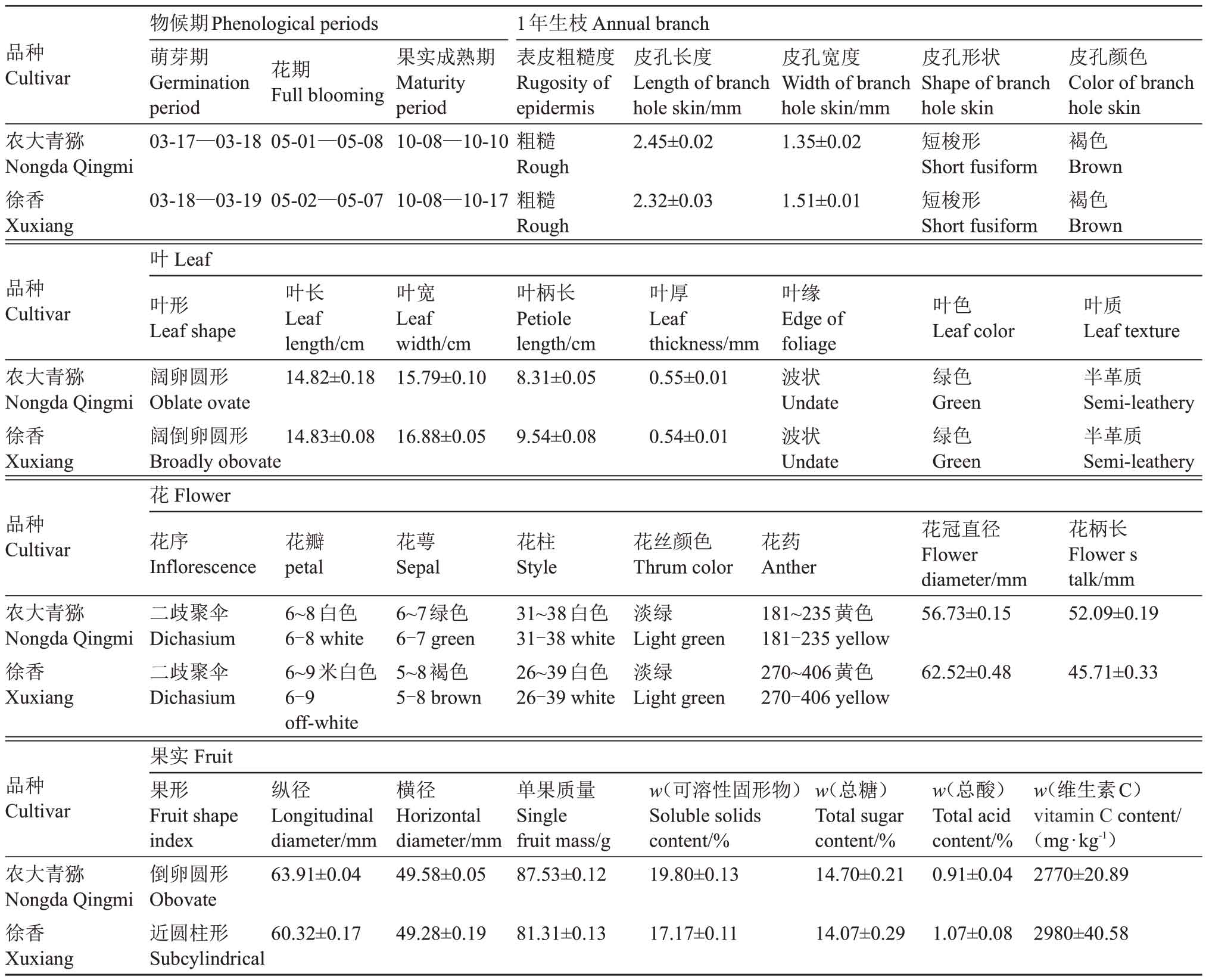
1 年生枝表皮粗糙,表面附有硬质短毛;皮孔褐色、短梭形;叶片阔卵圆形、绿色、半革质、叶缘波状;二歧聚伞花序,花柄长52.09 mm,花冠直径56.73 mm;花萼6~7 枚,绿色;花瓣6~8 枚,白色;花柱斜生,31~38枚,白色(表1)。
表1 农大青猕和徐香的植物学性状特性比较
Table 1 Comparison of botanical characteristics of Nongda Qingmi and Xuxiang
品种Cultivar农大青猕Nongda Qingmi徐香Xuxiang物候期Phenological periods萌芽期Germination period 03-17—03-18花期Full blooming 05-01—05-08果实成熟期Maturity period 10-08—10-10皮孔长度Length of branch hole skin/mm 2.45±0.02皮孔宽度Width of branch hole skin/mm 1.35±0.02 03-18—03-19 05-02—05-07 10-08—10-17 1年生枝Annual branch表皮粗糙度Rugosity of epidermis粗糙Rough粗糙Rough 2.32±0.03 1.51±0.01皮孔形状Shape of branch hole skin短梭形Short fusiform短梭形Short fusiform皮孔颜色Color of branch hole skin褐色Brown褐色Brown品种Cultivar农大青猕Nongda Qingmi徐香Xuxiang叶长Leaf length/cm 14.82±0.18叶宽Leaf width/cm 15.79±0.10叶Leaf叶形Leaf shape阔卵圆形Oblate ovate阔倒卵圆形Broadly obovate花Flower花序Inflorescence二歧聚伞Dichasium二歧聚伞Dichasium叶柄长Petiole length/cm 8.31±0.05叶厚Leaf thickness/mm 0.55±0.01 14.83±0.08 16.88±0.05 9.54±0.08 0.54±0.01叶缘Edge of foliage波状Undate波状Undate叶色Leaf color绿色Green绿色Green叶质Leaf texture半革质Semi-leathery半革质Semi-leathery品种Cultivar农大青猕Nongda Qingmi徐香Xuxiang花瓣petal 6~8白色6-8 white 6~9米白色6-9 off-white花萼Sepal 6~7绿色6-7 green 5~8褐色5-8 brown花柱Style 31~38白色31-38 white 26~39白色26-39 white花丝颜色Thrum color淡绿Light green淡绿Light green花药Anther 181~235黄色181-235 yellow 270~406黄色270-406 yellow花冠直径Flower diameter/mm 56.73±0.15花柄长Flower s talk/mm 52.09±0.19 62.52±0.48 45.71±0.33品种Cultivar农大青猕Nongda Qingmi徐香Xuxiang果实Fruit果形Fruit shape index倒卵圆形Obovate近圆柱形Subcylindrical纵径Longitudinal diameter/mm 63.91±0.04横径Horizontal diameter/mm 49.58±0.05单果质量Single fruit mass/g 87.53±0.12 w(可溶性固形物)Soluble solids content/%19.80±0.13 w(总糖)Total sugar content/%14.70±0.21 w(总酸)Total acid content/%0.91±0.04 w(维生素C)vitamin C content/(mg·kg-1)2770±20.89 60.32±0.17 49.28±0.19 81.31±0.13 17.17±0.11 14.07±0.29 1.07±0.08 2980±40.58
2.2 果实经济性状
果实倒卵圆形,果皮黑褐色,果肉深绿色(图1)。果个较大,平均单果质量87.53 g;果实纵径63.91 mm,横径49.58 mm,果形指数为1.29。软熟时(硬度8~10 N),果实可溶性固形物含量(w,后同)19.80%,总糖含量14.70%,总酸含量0.91%,维生素C 含量2770 mg·kg-1(表1)。果实贮藏性与对照品种徐香相似,常温下可存放30 d 以上,在(1.0±0.5)℃低温贮藏条件下可存放140~150 d。
2.3 生长结果习性与物候期
树势强健,萌芽率79.22%,成枝率58.69%,结果枝率64.38%,坐果率96.84%,以长果枝结果为主(69.00%)。盛产期产量30.38 t·hm-2。在陕西关中地区,3月中旬萌芽,5月上旬开花,10月上旬果实成熟,果实生长发育期为145~155 d。
2.4 DNA指纹图谱鉴定
以绿肉猕猴桃品种徐香、海沃德、秦美等作为对照,利用6对SSR分子标记引物(F1/R1:GATTTCAGCCGTAGATAGCG/TGTGGGTGGTAGCCAAGAT;F2/R2:CTTCTCGGCAATGCTTTC/GACGATGAATACGGAGTTGAC;F3/R3:ATTCTCCCACAGGACCAAAC/CCACTTTACAACTTGCTCGC;F4/R4:AGGGTTTGGTTGTTGGAATC/AGAGCGGGAGATCAAGGAG; F5/R5:CGGGTATGCTCTTTTCTTTT/GAAGATTGAGGTTCTGTTTGG;F6/R6:AAACACGATTGGGTTCTCCTT/GTAGACTTGGAGGATGGGAGG),对农大青猕进行DNA 鉴定,并构建分子身份证和DNA指纹图谱(表2,图2)。结果表明,农大青猕在DNA 水平上与3 个对照品种均存在显著差异。
表2 基于SSR 分子标记的分子身份证
Table 2 Molecular ID cards based on SSR molecular markers

品种Cultivar农大青猕Nongda Qingmi徐香Xuxiang海沃德Hayward海沃德Hayward SSR-P1 01100010110 00011000110 01010101110 01100011111 SSR-P2 1110110011 0001000011 1110100100 0010010010 SSR-P3 1110011010011 1110001010000 1001011110011 1010001110001 SSR-P4 010110111100 010000111100 010010111100 010110011100 SSR-P5 010011111111111 000011011110101 000001001011011 000001000111001 SSR-P6 00010011 00110111 00111111 00010111

图2 基于SSR 分子标记的DNA 指纹图谱
Fig.2 DNA finger printings based on SSR molecular markers
3 栽培技术要点
3.1 优化选址、高标准建园
该品种适宜在陕西秦岭北麓、陕南地区及同类型气候区栽植。选择具有排涝和灌溉条件的轻壤、中壤及沙壤土质,土层1 m 以上,土壤pH=6.5~7.5,有机质含量≥1%的地区建园。定植苗木选用优质嫁接成品苗,株行距(2.5~3.0)m×(3.5~4.0)m,授粉雄株为NWM39,雌雄比例(6~8)∶1[3]。
3.2 整形修剪
采用水平大棚架为宜,培养“单主干双主蔓”树形。冬季修剪以长放为主,主要疏除过密枝、细弱衰老枝和病虫枝;夏季以摘心为主[4]。
3.3 花果管理
为确保充分授粉,提高坐果率,花期要及时进行人工辅助授粉或机械授粉。在花蕾期,及时疏除畸形、过密、有病虫的花蕾;花后15~20 d进行疏果,疏除过密果、小果、畸形果、病虫果等不符合质量要求的果实。
3.4 肥水管理
根据该品种不同生长阶段的肥水需求,加强肥水管理。基肥以充分腐熟的饼肥、农家肥等有机肥为主,配施磷钾肥和生物菌肥。灌溉可选择喷灌、滴灌或者水肥一体化等方式。在生长季节,可结合行间生草,改善果园环境条件并增加养分。
3.5 病虫害防治
遵循“预防为主、综合防治”的植保方针,依据病虫害发生规律及预测预报,优先采用农业防治、物理防治和生物防治,合理辅以化学防治。冬季修剪后,喷施石硫合剂进行清园。在生长季,重点防治茶翅蝽等虫害;采用“两前两后”绿色防控技术防治猕猴桃溃疡病。
[1] 钟彩虹,黄文俊,李大卫,张琼,李黎.世界猕猴桃产业发展及鲜果贸易动态分析[J].中国果树,2021(7):101-108.ZHONG Caihong,HUANG Wenjun,LI Dawei,ZHANG Qiong,LI Li. Dynamic analysis of global kiwifruit industry development and fresh fruit trade[J].China Fruits,2021(7):101-108.
[2] 刘艳飞,何昕,田爱林,刘占德. 优质耐贮猕猴桃新品种‘金福’[J].园艺学报,2024,51(9):2219-2220.LIU Yanfei,HE Xin,TIAN Ailin,LIU Zhande.A new high-quality kiwifruit cultivar with better storability‘Jinfu’[J].Acta Horticulturae Sinica,2024,51(9):2219-2220.
[3] 郁俊谊,刘占德,姚春潮,周攀峰,刘军禄,王林青,丁文龙.猕猴桃新品种‘农大郁香’[J].园艺学报,2018,45(2):399-400.YU Junyi,LIU Zhande,YAO Chunchao,ZHOU Panfeng,LIU Junlu,WANG Linqing,DING Wenlong. A new kiwifruit cultivar‘Nongda Yuxiang’[J]. Acta Horticulturae Sinica,2018,45(2):399-400.
[4] 郁俊谊,刘占德,姚春潮,刘军禄,王林青.猕猴桃新品种‘农大猕香’的选育[J].中国果树,2017(6):74-75.YU Junyi,LIU Zhande,YAO Chunchao,LIU Junlu,WANG Linqing.Breeding of a new kiwifruit variety‘Nongda Mixiang’[J].China Fruits,2017(6):74-75.