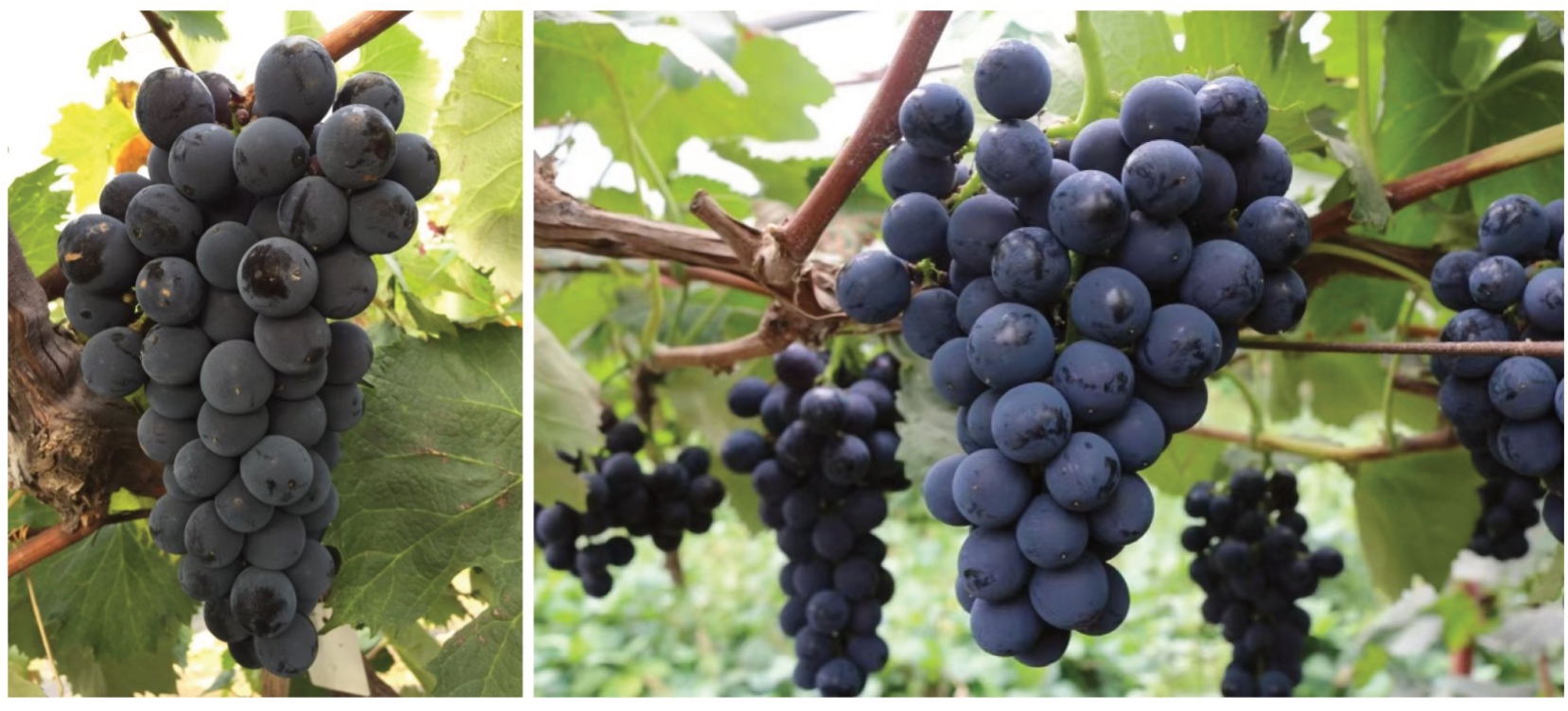
葡萄作为我国果树产业的重要经济树种,其品种自主创新是产业可持续发展的核心驱动力[1-2]。长期以来,我国制汁葡萄产业面临种源依赖进口、制汁专用品种匮乏、产业链条脱节等瓶颈,而国内制汁专用品种的选育进程滞后,缺乏可替代国外引进的康可、康拜尔等进口种源的自育新品种,导致制汁葡萄产业面临结构不合理、风味单一、推广规模小等诸多现实问题,无法满足当前国内市场对高品质葡萄汁日益增加的迫切需求[3]。面对国际竞争加剧与国内消费升级的双重挑战,培育具有国内自主知识产权的制汁专用品种成为破局关键[4]。沈阳农业大学自20 世纪90 年代便开展了大规模的葡萄杂交育种工作,历经20 余年,通过对杂交后代群体的经济性状进行鉴定,最终选育出香味浓郁、丰产、果汁丰富、抗寒性强的优质中早熟葡萄新品种玉露香(原代号:19-10,图1)。该品种在出汁率、可溶性固形物含量和固酸比均衡性等方面优于国内外主栽制汁品种康可和康拜尔,特别是其浓郁的草莓香型更符合国内消费者喜好,是兼具加工品质与市场潜力的制汁葡萄新品种。
1 选育过程
1995 年6 月上旬,在沈阳农业大学葡萄试验园内以欧美杂交葡萄品种紫珍香为母本、欧亚种葡萄瑞必尔为父本,进行人工去雄及授粉,当年秋季收获杂交种子并进行沙藏层积。1996年春季播种,获得杂交实生苗,于5月下旬移栽定植,对定植实生苗进行编号并开展常规水肥管理。2000年,实生苗首次结果,系统观测各株系的植物学特征及果实经济性状,以香气浓郁、果汁丰富为核心指标,筛选出优良单株19-10。2007 年,该单株因出汁率高、草莓香气浓郁、丰产、高抗寒性等特性被初选为优系,并嫁接于贝达砧木进行扩繁与性状观察。经连续多年的观测和系统评估,充分证实嫁接苗生长结果习性稳定、果实经济性状一致,所以在2013年将该优良单株确定为复选优系,2019 年确定为终选优系。2025 年3月26日通过农业农村部非主要农作物品种登记[登记编号:GPD 葡萄(2025)210005],定名为玉露香。
2 品种特性
2.1 植物学特征
玉露香为四倍体欧美杂交种,两性花。嫩梢梢尖半开张,梢尖密被匍匐茸毛与直立茸毛,梢尖匍匐茸毛花青苷显色程度中等;新梢半直立生长,节间腹背两侧均呈绿色,节间直立茸毛无或极疏;成熟枝条深褐色,卷须长8.0 cm。幼叶正面绿色,背面主脉上直立茸毛密度中等,主脉间匍匐茸毛密度中等;成龄叶近五角形,叶面泡状凸起无或极弱,横截面形状为外卷,叶面积696.0 cm2,五裂,上裂刻深、裂片开张,下裂刻开张,锯齿形状为两侧直与两侧凸混合型,锯齿长度2.5 cm,长宽比为1.25,叶正面主脉花青苷显色无或极弱,叶背面主脉上直立茸毛密度中,主脉间匍匐茸毛密度密,叶柄不受叶脉限制,叶柄与中脉的长度比为1,叶柄洼开张。
2.2 果实主要经济性状
果穗圆锥形,无歧肩,平均长度18.48 cm,平均宽度15.24 cm,穗梗长度7.0 cm。果粒近圆形,平均长度2.5 cm,平均宽度2.5 cm,平均单粒质量8.2 g;果皮紫黑色、较厚,涩味适中;果肉质地软,花青苷显色弱,果粒与果柄分离程度中等,含种子1~2 粒,果粒密集程度适中;可溶性固形物含量(w,后同)为19.2%,可滴定酸含量0.53%,出汁率70.2%,草莓香味浓郁。2021—2022 年的产量统计结果表明,玉露香具备一定的丰产能力,定植后一年平均产量为7200 kg·hm-2,丰产期平均产量为26 475 kg·hm-2,与母本紫珍香相比分别增产10.6%和6.1%。玉露香在果穗大小、出汁率、糖度和产量等方面优于亲本,且果实成熟度一致性好(表1)。
表1 玉露香与父母本果实主要性状比较
Table 1 Comparison of main fruit characters among Yuluxiang and its two parents
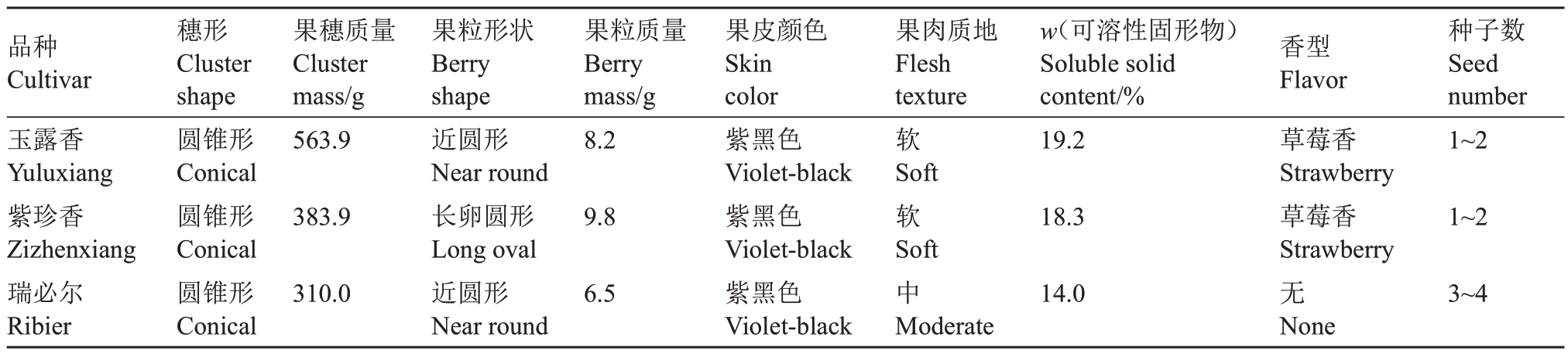
品种Cultivar玉露香Yuluxiang紫珍香Zizhenxiang瑞必尔Ribier穗形Cluster shape圆锥形Conical圆锥形Conical圆锥形Conical果穗质量Cluster mass/g 563.9果粒质量Berry mass/g 8.2 w(可溶性固形物)Soluble solid content/%19.2种子数Seed number 1~2 383.9 9.8 18.3 1~2 310.0果粒形状Berry shape近圆形Near round长卵圆形Long oval近圆形Near round 6.5果皮颜色Skin color紫黑色Violet-black紫黑色Violet-black紫黑色Violet-black果肉质地Flesh texture软Soft软Soft中Moderate 14.0香型Flavor草莓香Strawberry草莓香Strawberry无None 3~4
2.3 物候期
在沈阳地区露地栽培条件下,该品种的萌芽期约为4 月23 日,浆果始熟期约为9 月6 日,从萌芽至果实完全成熟约为136 d,为中早熟制汁葡萄品种。
2.4 适应性及抗逆性
该品种适应性强,其多年生枝条的平均冰点温度为-25.7 ℃,抗寒性强,适宜在辽宁省沈阳市及气候相近地区春季种植。
3 栽培技术要点
3.1 架式与整形
玉露香葡萄可采用露地栽培或设施栽培。在北方地区宜选用根系发达的贝达砧木,株行距以0.5 m×4.0 m 或1.0 m×4.0 m 为宜,采用小棚架,龙干形树形。定植当年幼树冬季修剪时,主蔓剪留长度应依据架高与枝条成熟度确定,通常可剪留当年成熟枝段长度的2/3 或剪留到成熟枝段基部以上第3~4 个芽眼处,建议剪留长度为1.5~2.0 m,剪口下枝条粗度应在1.0 cm以上,结果母枝采用短梢修剪。
3.2 花果管理
玉露香在沈阳及其周边地区栽植后成花性强,应在花前10~15 d 进行疏花,以减少树体养分消耗。健壮果枝保留2个花序,中庸枝保留1个花序,细弱枝不保留花序。
3.3 肥水管理
以有机肥及生物菌肥为主,于果实采收后或春季萌芽前施用有机肥(75 t·hm-2),并以适量生物菌肥为基肥,生长季适时进行追肥。萌芽前和花前7~10 d 各灌透水1 次,果实膨大期每10 d 灌溉1 次,着色期后每10~15 d 灌溉1 次,采收前约10 d 停止灌水,并于越冬防寒前灌封冻水。
3.4 病虫害防治
玉露香中抗霜霉病,应遵循预防为主、综合防治的原则进行病虫害防治。进入雨季后,选用生产无公害果品允许的药剂,每10~15 d喷施1次。交替喷施嘧霉胺和倍速克灵可防治灰霉病;轮换施用甲基托布津、大生M-45可有效防治白腐病;防控透翅蛾等虫害可喷施菊酯类药物,在采收前7~10 d停止用药。
参考文献References:
[1] 武曦,郭华,王越,王勇.我国省际葡萄产业竞争力评价[J].北方园艺,2023(22):138-145.WU Xi,GUO Hua,WANG Yue,WANG Yong.Evaluation of the competitiveness of China’s interprovincial grape industry[J].Northern Horticulture,2023(22):138-145.
[2] 刘俊,晁无疾,亓桂梅,刘寅喆,汉瑞峰.蓬勃发展的中国葡萄产业[J].中外葡萄与葡萄酒,2020(1):1-8.LIU Jun,CHAO Wuji,QI Guimei,LIU Yinzhe,HAN Ruifeng.Booming development of Chinese grape industry[J]. Sino-Overseas Grapevine&Wine,2020(1):1-8.
[3] 荀志丽,马小河,黄丽萍,王敏,刘晓婷,赵旗峰.6 个制汁葡萄果实品质差异分析[J].果树学报,2023,40(8):1717-1727.XUN Zhili,MA Xiaohe,HUANG Liping,WANG Min,LIU Xiaoting,ZHAO Qifeng. Difference analysis on the berry quality among six juicing grape cultivars[J].Journal of Fruit Science,2023,40(8):1717-1727.
[4] 郭秋余,林洪,张吉照,杜婷婷,郭修武,郭印山.葡萄品种(系)制汁特性评价[J].中外葡萄与葡萄酒,2023(3):32-39.GUO Qiuyu,LIN Hong,ZHANG Jizhao,DU Tingting,GUO Xiuwu,GUO Yinshan. Evaluation of juice making characteristics of grape cultivars (lines)[J]. Sino-Overseas Grapevine & Wine,2023(3):32-39.
Breeding report of a new juice grape cultivar Yuluxiang
JIANG Changyue1,LIN Hong1,ZHAO Yuhui1,GAO Mingyu1,HU Xiaoying1,GUO Xiuwu1,GUO Yinshan1,2,3*
(1College of Horticulture, Shenyang Agricultural University, Shenyang 110866, Liaoning, China;2National & Local Joint Engineering Research Center of Northern Horticultural Facilities Design &Application Technology, Shenyang 110866, Liaoning, China;3Key Laboratory of Protected Horticulture,Ministry of Education,Shenyang 110866,Liaoning,China)
Abstract:Yuluxiang is a mid-early ripening juice grape cultivar with a rich strawberry aroma, selected in 1995 from the hybrid progeny of grape varieties between Zizhenxiang and Ribier. Seeds were sown in the greenhouse of Shenyang Agricultural University in the spring of 1996, and the hybrid seedlings first fruited in 2000.Due to their superior botanical traits and fruit economic characteristics,an elite individual (code 19-10) was identified as a preliminary superior line in 2007. This line exhibited high juice yield and distinct strawberry aroma, prompting grafting propagation onto Beta rootstocks for regional trials. After multi-year observation of grafted seedlings’growth and fruiting habits, the 19-10 vines demonstrated stable berry economic traits,high yield,and premium quality,leading to final selection in 2019 and official naming as Yuluxiang.This tetraploid cultivar is a perennial vine fruit crop with vigorous growth. Its new canes are semi-erect with semi-open tips, densely covered with appressed tomentum, and exhibit medium anthocyanin color intensity. Young leaves have green adaxial surfaces with medium appressed tomentum between the veins abaxially; the ventral sides at internodes are green,and the flowers are bisexual.Tendrils are 8.0 cm in length on average.Mature leaves are pentagonal and five-lobed, with an average area of 696.0 cm2, open petiolar sinuses, closed overlapping lobes,deeply incised and open upper sinuses, open lower sinuses, and mixed straight and convex-sided serrations approximately 2.5 cm long. Mature canes are dark brown. Inflorescences are conical, lack shoulders,moderately compact without wings,averaging length of 18.48 cm and width 15.24 cm in area and 563.9 g in weight, with peduncles averaging 7.0 cm. Berries are round, with an average length of 2.5 cm and an average width of 2.5 cm, thick purple-black skins with medium astringency, soft flesh with weak anthocyanin color intensity, and contain 1-2 seeds per berry. The average berry weight is 8.2 g,soluble solids content 19.2%, and titratable acidity 0.53%. Compared to the maternal parent Zizhenxiang,it demonstrates superior juice yield,enhanced strawberry aroma,and premium overall quality.Under open-field cultivation in Shenyang,the budbreak occurs approximately on April 23 and berry ripening begins approximately on September 6.This grape cultivar exhibits strong cold resistance and is suitable for open-field or protected cultivation in northern China.It bears fruit the year after planting,yields an average of 480 kg per mu,and achieves approximately 1765 kg per 666.7 m2 during peak production,representing yield increases of 10.6%and 6.1%over the maternal parent,respectively,with significantly higher yield potential.For cultivation in northern China,vigorous-rooted Beta rootstock seedlings are recommended with spacing configurations of 0.5 m×4.0 m or 1.0 m×4.0 m, and dragon-vine training system should be adopted by retaining one-year-old canes exceeding 1.0 cm in diameter during pruning to facilitate the binding of canes in spring.In cold regions with prolific flower bud differentiation,inflorescence thinning should be performed 10-15 days before flowering to reduce nutrient depletion.Fertilizer and water management prioritizes organic and bio-bacterial fertilizers.Apply 5000 kg per 666.7 m2 of organic fertilizer supplemented with appropriate bio-bacterial fertilizer as basal dressing annually after fruit harvest or before spring budbreak. Conduct timely topdressing during the growing season. Irrigate thoroughly once before budbreak and once 7-10 days before flowering.Irrigate every 10 days during fruit enlargement, apply light irrigation every 10-15 days after veraison, cease irrigation approximately 10 days before harvest,and apply final irrigation before winter protection measures.Pest and disease control follows prevention-first and integrated management principles.After rainy season onset,apply pesticides approved for residue-free fruit production every 10-15 days while rotating multiple agents. Discontinue applications 7-10 days before harvest to maximize pest and disease control while achieving the goal of pollution-free production.
Key words:Grape;New cultivar;Yuluxiang;Juice making
中图分类号:S663.1
文献标志码:A
文章编号:1009-9980(2026)04-0998-04
DOI:10.13925/j.cnki.gsxb.20250418
收稿日期:2025-07-29
接受日期:2025-08-27
基金项目:国家自然科学基金项目(32402494);国家现代葡萄产业技术体系岗位专家项目(CARS-29-yc-6);辽宁省科技厅农业重大专项课题(2023JH1/10200004);辽宁省科技计划项目(2023-BSBA-278);新疆天池英才支持计划(2023-02-06);沈阳市科技计划项目(23-410-2-03)
作者简介:姜长岳,男,讲师,博士,主要从事葡萄分子遗传育种研究。E-mail:jiangcy07@syau.edu.cn
*通信作者 Author for correspondence.E-mail:guoyinshan77@syau.edu.cn