中熟优质桃新品种霞晖10号的选育

张妤艳,许建兰,张斌斌,严 娟,宋宏峰,郭绍雷,张圆圆,俞明亮,沈江海,马瑞娟*

(江苏省农业科学院果树研究所·江苏省高效园艺作物遗传改良重点实验室,南京 210014)

摘 要:霞晖10号是以白凤为母本、瑞光28号为父本经人工杂交培育而成的中熟水蜜桃新品种。该品种果实圆形,果顶稍凹陷,缝合线浅,两半部对称;平均单果质量243.4 g,大果质量397 g;果皮底色白色,果面80%以上着红色,茸毛中等。果肉白色,风味甜,可溶性固形物含量(w,后同)为13.75%,可滴定酸含量0.19%,品质优;肉质细密,果肉软化慢,黏核。采收期约10 d,较耐贮运。花蔷薇型,具花粉;自花结实,自然坐果率高,丰产稳产。树势健壮,树姿半开张。在南京地区,该品种于3月中旬开花,7月上中旬果实成熟,果实发育期约116 d。霞晖10号在江苏南京、无锡、镇江、苏州、徐州等地生长结果良好,适宜在以上地区以及气候相似地区种植。

关键词:桃;新品种;霞晖10号;中熟;白肉;慢软

水蜜桃肉质柔软、风味甜香,是消费者喜爱的夏季时令鲜果之一,但存在成熟快、采收期短、不耐贮运、损耗大等问题,难以适应现代大流通的销售模式。慢软型(slow softening)桃由意大利学者于2017年提出[1],该类品种果肉软化慢,采收期与货架期长,果实成熟后能维持相对稳定的硬度,经过一定时间的软化后释放出桃果的甜香风味,可以满足“采时硬”的生产需求和“吃时软甜香”的消费需求。因此,培育具有桃香味的慢软型品种[2]是今后桃新品种选育的方向。

霞晖10 号是由江苏省农业科学院培育的水蜜桃新品种。该品种果形端正、外观美丽、果实挂树时间长、软化慢、风味品质佳,在江苏省桃主产区性状表现优良。国家桃产业技术体系区试结果表明,该品种在浙江杭州、甘肃兰州、山东泰安、安徽六安等地均表现良好。

1 选育过程

2006年,以日本优质品种白凤[3]为母本,以北京农林科学院林业果树研究所选育的中熟油桃品种瑞光28 号[4]为父本进行常规杂交授粉,杂交种子经培养后获得46株实生苗。2007年春季,将实生苗定植于江苏省农业科学院桃选种圃,株行距为1.0 m×4.0 m,按照田间常规管理模式进行日常管理。2009 年春季,杂交单株相继开花,其中06-24-10单株果实于7 月15 日成熟,其果形圆整,果顶稍凹陷,果皮底色白色,果面80%着红色,肉质致密、风味甜,黏核。经过连续3 年的观察与性状调查,该单株被选为优良单株。2014—2015 年,以毛桃为砧木繁殖苗木,陆续在江苏苏州、无锡、镇江、南京、徐州等地进行区域试验。经连续多年观察比较,06-24-10 单株果实经济性状、丰产性等表现稳定,综合性状优良(图1),2020 年命名为霞晖10 号。2024 年获得国家植物新品种权证书(品种权号:CNA20201007515),并通过非主要农作物品种登记[登记号:GPD 桃(2024)320065]。
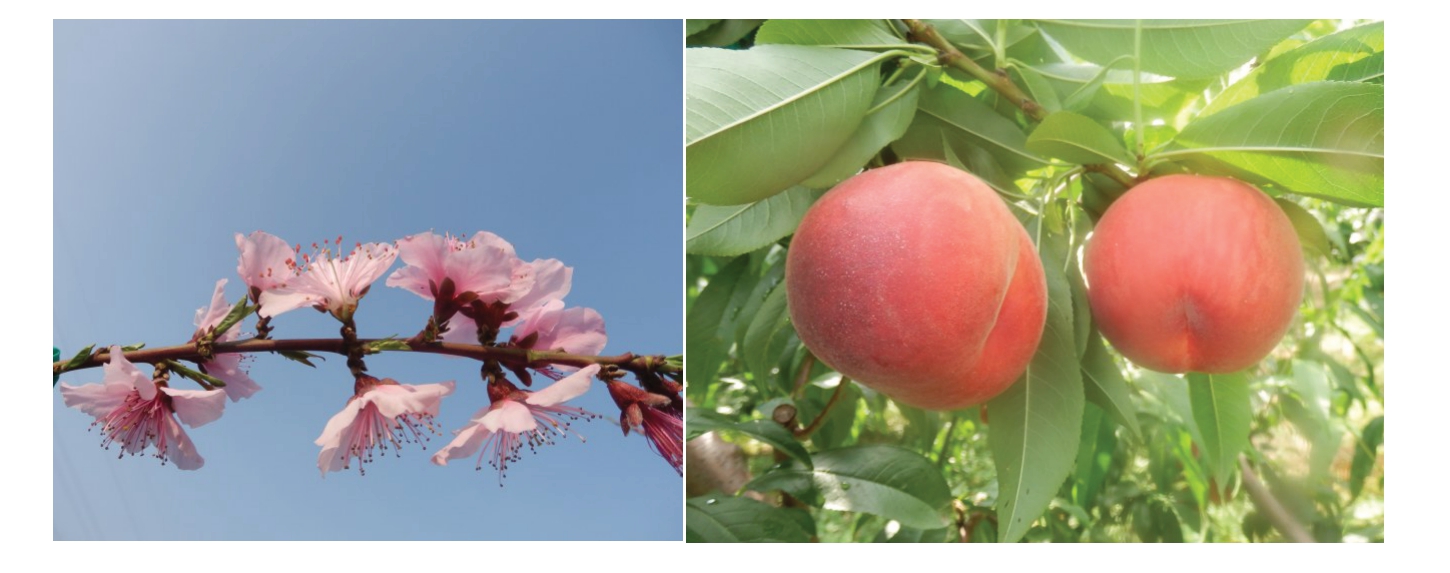
图1 霞晖10 号的花及结果性状
Fig.1 Flower and ripe fruit of Xiahui No.10

2 主要性状

2.1 植物学特征

霞晖10 号树势中庸,树姿半开张。1 年生枝向阳面呈紫红色,长果枝平均节间长度2.6 cm,花密度为40.3朵·m-1。叶片长椭圆披针形,叶长19.9 cm,叶宽4.4 cm,叶柄长1.0 cm;叶尖渐尖,叶基楔形,叶缘钝锯齿状;蜜腺肾形,2~4 个,平均2.4 个。花蔷薇型,花冠粉色,雌蕊与雄蕊近等高,萼筒内壁绿黄色,花药橘红色,具花粉。

2.2 果实经济性状

霞晖10号果实圆形,果顶稍凹陷;两半部对称,缝合线浅,梗洼中等。平均单果质量243.4 g,大果质量397.0 g;果皮底色白色,果面80%以上着红色,茸毛中等,果皮厚度中等。果肉白色,慢软型,果肉硬度为(22±3)N,纤维中等,风味甜,可溶性固形物含量(w,后同)13.75%,平均可滴定酸含量0.19%。白凤平均可溶性固形物和可滴定酸含量分别为12.35%和0.23%,霞晖10号可溶性固形物含量高于白凤,可滴定酸含量稍低于白凤,综合品质较好(表1)。

表1 霞晖10 号与白凤果实经济性状比较(南京)
Table 1 Comparation of main economic characters between Xiahui No.10 and Hakuho(Nanjing)

品种Cultivar霞晖10号Xiahui No.10白凤Hakuho年份Year 2022 2023 2022 2023果形Fruit shape圆形Round圆形Round圆形Round圆形Round平均单果质量Average single fruit mass/g 228.0 258.8 174.2 188.9果肉颜色Flesh color白色White白色White白色White白色White肉质Flesh texture慢软型Slow-ripening慢软型Slow-ripening硬溶质Hard-melting硬溶质Hard-melting风味Flavor甜Sweet甜Sweet甜Sweet甜Sweet w(可滴定酸)Titratable acidity content/%0.18 0.19 0.25 0.21 w(可溶性固形物Soluble solid content/%14.7 12.8 12.6 12.1)

2.3 生长结果习性

霞晖10号长、中、短果枝均能良好结果,幼树以中、长果枝结果为主。在江苏省农业科学院院本部试验园的5年生树上,徒长性果枝、长果枝、中果枝、短果枝、花束枝占比分别为0.5%、47.2%、22.7%、27.3%和2.3%。花芽起始节位为第2~3节,以复花芽为主,单花芽/复花芽为20.7%,自然坐果率62.6%,能够自花结实。

1 年生苗春季定植后,当年即能形成花芽,第3年开始正常结果,第5年进入盛果期,早果、丰产性好。

2.4 物候期

在江苏南京地区,霞晖10号于3月上旬萌芽,花期集中在3 月中旬,持续约7 d,早于白凤(3 月下旬)。果实约在7 月10 日成熟,果实发育期约116 d(表2)。11月中旬开始落叶,12月上旬落叶结束,全年生育期约265 d。

表2 霞晖10 号与白凤的物候期观察(南京)
Table 2 Phonological phases of Xiahui No.10 and Hakuho(Nanjing)

品种Cultivar霞晖10号Xiahui No.10白凤Hakuho年份Year 2022 2023 2022 2023萌芽期Leaf bud burst date 3月9日Mar.9 3月9日Mar.9 3月15日Mar.15 3月11日Mar.11始花期First blooming data 3月15日Mar.15 3月12日Mar.12 3月24日Mar.24 3月22日Mar.22盛花期Full bloom date 3月16日Mar.16 3月13日Mar.13 3月26日Mar.26 3月23日Mar.23末花期Ending bloom date 3月21日Mar.21 3月19日Mar.19 3月30日Mar.30 3月28日Mar.28果实成熟期Ripening date 7月10日July 10 7月9日July 9 7月7日July 7 7月6日July 6果实发育期Fruit development period/d 116 118 103 105

2.5 适应性与抗逆性

经多年观察,霞晖10 号在江苏无锡、镇江、苏州、南京、徐州等地均生长结果良好,适应能力强。树体生长健壮,幼树成形快。至今未发现特殊病虫及缩叶病发生,细菌性穿孔病危害较轻;未发现炭疽病、褐腐病危害果实。与白凤等品种相似,在南方产区随着树龄增大,流胶病逐渐加重,苏北徐州地区则很少发生流胶。经国家桃产业技术体系综合试验站反馈,当冬季极端低温低于-20 ℃时,该品种存在一定的冻害风险。

3 栽培技术要点

3.1 建园

以毛桃为砧木嫁接培育苗木。选择交通方便、地势较高、土地平坦、土壤肥沃(有机质含量≥1.0%)、土层深厚(耕作层≥50 cm)、排灌方便、地下水位≤0.8 m、pH 值6.0~7.5 的地块建园。建议采用宽行起垄种植,行距(5~6)m,垄宽1.2 m。自然开心形株距为3~4 m,两主枝Y形株距为2.5~3 m。

3.2 整形修剪

自然开心形保留3~4 个主枝,主枝延长头伸向行间;两主枝Y形主枝间夹角为50°~60°。夏季修剪一般在5—8 月进行,根据树体生长情况,及时剪除竞争枝、内膛直立枝和过密枝,以改善内膛光照,提高果实品质。果实采收后仍需加强管理,进一步改善通风透光条件,促进花芽分化,提高花芽质量。

3.3 花果管理

霞晖10 号自然坐果率高,为增大单果质量,提高优质果率,需及时进行疏花疏果。在冬季无冻害,春季天气晴好时,可适当进行疏花,以减少养分的消耗。疏果时合理控制负载,树冠中上部、外围多留果,下部及内膛少留果,盛果期每666.7 m2产量控制在2000 kg以内。果实着色早、软化慢,采收期约10 d,根据销售方式与运输距离适时采收果实。

3.4 土肥水管理

桃园建议采用生草栽培,及时清除高秆、攀爬类杂草。基肥于每年秋季9—10 月施入,以有机肥为主,结合增施生物菌肥、缓释肥或腐殖酸钾等。花后一周每株施用约0.5 kg 尿素,果实膨大期每株施用约1.0 kg 磷钾复合肥。雨季注意及时排水防涝,果实采收前控制水分供应。

3.5 病虫害防治

在病虫害防治方面,萌芽前喷施石硫合剂、花后及时防治蚜虫以及定果后、套袋前喷施杀虫杀菌剂。推荐采用杀虫灯、糖醋液和黄板、性诱剂、人工捕杀等物理方法。注意预防穿孔病、褐腐病以及蚜虫、梨小食心虫等。

做好冬春季清园工作,注重在萌芽前喷施3~5 °Bé 石硫合剂。花期前后采用杀虫杀菌剂防治病虫,近年来螺虫乙酯等对蚜虫的防治效果较好;防治梨小食心虫,可悬挂迷向胶条(丝),在发生高峰后的第2~4天及时进行药物防治。病害防治可在花后喷施吡唑醚菌酯、苯醚甲环唑等药剂。在采收前15 d,停止使用化学农药,提高果实安全性。

参考文献References:

[1] CIACCIULLI A,CHIOZZOTTO R,ATTANASIO G,CIRILLI M,BASSI D. Identification of a melting type variant among peach(P.persica L.Batsch)fruit textures by a digital penetrometer[J].Journal of Texture Studies,2018,49(4):370-377.

[2] 俞明亮,王力荣,王志强,彭福田,张帆,叶正文.新中国果树科学研究70 年:桃[J].果树学报,2019,36(10):1283-1291.YU Mingliang,WANG Lirong,WANG Zhiqiang,PENG Futian,ZHANG Fan,YE Zhengwen. Fruit scientific research in New China in the past 70 years:Peach[J]. Journal of Fruit Science,2019,36(10):1283-1291.

[3] 汪祖华,庄恩及.中国果树志-桃卷[M].北京:中国林业出版社,2001.WANG Zuhua,ZHUANG Enji. The China fruit plant monograph- Peach flora[M]. Beijing:China Forestry Publishing House,2001.

[4] 郭继英,姜全,赵剑波,陈青华,刘巍,郑书旗.油桃新品种瑞光28 号[J].中国果树,2004(1):1-2.GUO Jiying,JIANG Quan,ZHAO Jianbo,CHEN Qinghua,LIU Wei,ZHENG Shuqi. New variety of nectarine,Ruiguang 28[J].China Fruits,2004(1):1-2.

Breeding report of a new mid-season peach cultivar Xiahui No.10

ZHANG Yuyan, XU Jianlan, ZHANG Binbin, YAN Juan, SONG Hongfeng, GUO Shaolei, ZHANG Yuanyuan,YU Mingliang,SHEN Jianghai,MA Ruijuan*

(Institute of Pomology, Jiangsu Academy of Agricultural Sciences/Jiangsu Key Laboratory of Horticultural Crop Genetic Improvement,Nanjing 210014,Jiangsu,China)

Abstract:A new mid-season honey peach cultivar Xiahui No. 10 was selected from a cross between Hakuho and nectarine Ruiguang 28 made in 2006.The seeds were sowed in a greenhouse in late winter 2006. 46 seedlings were planted in the Peach Experimental Field of Jiangsu Academy of Agricultural Sciences in Nanjing in spring of 2007.The seedlings started to bear fruits in 2009. Based on the germplasm evaluation of fruit quality and yield from 2010 to 2013, the strain 06-24-10 was identified as an excellent individual in 2013 for slow-softening flesh,attractive appearance,high degree of red blush,excellent peach flavor and stable and high yield.The selected plant was asexually propagated for field trials in Suzhou, Wuxi, Zhenjiang, Nanjing, Xuzhou and other places of Jiangsu Province in 2014 and 2015. From 2017 to 2019, the propagated plants maintained all characteristics of the original seedling without any phenotypic aberrations. It was officially named Xiahui No. 10 and applied for new variety certification from Office of Plant Variety Protection, Ministry of Agriculture in 2020. It was granted a plant variety protection certificate (No. CNA20201007515) and registered as GPD Peach (2024)320065 in 2024.The tree exhinited middle vigor, with a moderate bud burst rate and branching ability.The leaves were long elliptic-lanceolate,green,with an average length of 19.9 cm,width of 4.4 cm,and petiole length of 1.0 cm. The average internode length was 2.6 cm. The leaf tips were acuminate, leaf bases cuneate, and leaf margins blunt-serrate. The reniform nectaries were present, with an average of 2.4 per leaf.The average branch diameter of 5-and 6-year-old trees was 0.7 cm.The flowers were pink with 5 petals,and the inner wall of the calyx tube was green-yellow The cultivar was self-fertile,with a flower density of 40.3 flowers per meter. The mature fruits were round in shape with symmetrical halves,a flat apex,a shallow central cavity,and a faint suture.The fruit skin was glabrous,with a white background color and over 80%red blush at maturity.The average fruit weight was 243.4 g,and maximum fruit weight was 397 g under fruit thinning condition.The flesh was white,firm,and slow-softening,with moderate juiciness.At 80%maturity,the fruit firmness was 22±3 N.The cultivar exhibited excellent fruit quality:the soluble solids content ranged from 12.8% to 14.7%, and titratable acid content averaged 0.19%at harvest.Compared with its maternal parent Hakuho,Xiahui No.10 had a higher average soluble solids content and a slightly lower titratable acid content. In Nanjing, blooming occured in mid-March,with a flowering duration of 7-8 days.The fruit ripened from July 8 to July 19,with a total fruit development period of 116 d.The fruits matured slowly and had a long shelf life:over 7 days at room temperature and over 3 weeks at 4 ℃when full mature,with no quality deterioration.Three scaffold limbs or Y shape training should be recommended. In full bearing period, the yield should be controlled at the level of 2000 kg per 666.7 m-2.The cultivar had no particular susceptibility to the pests and diseases but showed mild sensitivity to bacterial spot.According to the conclusion from the Comprehensive Experiment Station of China Agriculture Research System of Peach (CARS-30), there would be a risk of frost damage when winter extreme low temperature drops below-20 ℃.It would be suitable for cultivation in Jiangsu province and other areas with similar climatic conditions.

Key words:Prunus persica;New cultivar;Xiahui No.10;Mid-season;White flesh;Slow-softening

中图分类号:S662.1

文献标志码:A

文章编号:1009-9980(2026)04-0994-04

DOI:10.13925/j.cnki.gsxb.20250417

收稿日期:2025-07-29

接受日期:2025-09-05

基金项目:国家重点研发技术子课题(2019YFD1000801-02);现代农业产业技术体系建设专项(编号:CARS-30);江苏省种业振兴“揭榜挂帅”项目(编号:JBGS[2021}082)

作者简介:张妤艳,女,研究员,主要从事果树遗传育种和新品种选育研究。E-mail:zhangyuyan@jaas.ac.cn

*通信作者 Author for correspondence.E-mail:19850017@jaas.ac.cn