果实品质是决定园艺作物经济价值和消费者接受程度的关键指标,而糖分含量和组成则是评价果实风味品质的核心指标。在果实发育过程中,光合产物主要以单糖形式通过韧皮部长距离运输至果实,随后在质外体或共质体途径中被卸载,最终储存于果肉细胞的液泡中[1-4]。这一复杂过程涉及多种糖转运蛋白的协同作用,包括蔗糖转运蛋白(sucrose transporters,SUT)、液泡糖转运蛋白(tonoplast sugar transporter,TST)以及近年来发现的SWEET(sugars will eventually be exported transporters)蛋白[5-6]。这些转运蛋白通过调控糖分的跨膜运输,直接影响果实的糖分积累和品质形成。特别是SWEET蛋白家族,作为一类新型糖转运蛋白,已被证明在果实糖分积累中发挥关键作用,其功能多样性从绿藻到高等植物的进化过程中逐渐完善[7-9]。近期研究发现,某些SWEET 成员如PaSWEET1 能够特异性转运蔗糖,调控杏果实中糖分的积累[10];柑橘中CsSWEET17 通过钙信号通路被转录因子CsMYB36 调控,特异性促进蔗糖转运[11]。此外,苹果中的SnRK2.3-AREB1-TST1/2级联反应也被证实受胞质葡萄糖信号诱导,协同调控液泡中糖分的积累[12]。这些发现为改良果实糖分含量提供了理论依据。
糖转运蛋白作为糖分跨膜运输的分子载体,在源库器官间的糖分分配和果实糖分积累过程中发挥着不可替代的作用。近年来,随着分子生物学和基因组学技术的发展,研究者已在多种果树中鉴定出大量糖转运蛋白基因,并初步揭示了其在果实发育过程中的表达模式和功能特性。特别是在苹果、葡萄、柑橘、草莓、火龙果和番茄等园艺作物中,糖转运蛋白基因家族的全基因组鉴定和功能分析为理解果实糖分积累的分子机制提供了重要线索[13-19]。然而,目前对于不同类型糖转运蛋白在果实发育不同阶段的精确调控网络,以及它们与环境因素的互作机制仍缺乏系统认识。
本文综合了近年来糖转运蛋白研究的最新进展,重点探讨了SWEET、SUT 和TST 三大类转运蛋白在果实糖分积累中的作用机制,分析了转录调控和翻译后修饰对糖转运蛋白活性的影响,并展望了基于糖转运蛋白基因改良果实品质的分子育种策略。通过系统梳理糖转运蛋白调控果实品质形成的分子机制,旨在为果树品质改良提供理论依据和技术参考。
1 糖转运蛋白的结构特征与功能分化
植物进化出了复杂的糖转运蛋白系统以适应不同组织和发育阶段的糖分转运需求。根据底物特异性、转运方向和亚细胞定位的差异,糖转运蛋白主要分为SWEET 蛋白、蔗糖转运蛋白和液泡糖转运蛋白三大类,它们通过功能分化共同构成了糖分转运的分子基础[20-21]。这些蛋白家族在果实发育过程中表现出独特的表达模式和功能特征,直接影响糖分从源器官向果实的分配效率[22]。
1.1 SWEET家族
SWEET家族作为一类新型的糖单向转运蛋白,在植物中广泛存在并呈现出显著的功能多样性。该家族成员含有7 个跨膜结构域,通过形成二聚体实现糖分的跨膜转运[23-24]。系统发育分析将SWEET蛋白分为四个进化支,各进化支在底物选择性和生理功能上表现出明显分化[8]。Clade Ⅰ~Ⅲ主要定位于质膜,分别偏好转运己糖和蔗糖;而Clade Ⅳ成员则特异性地定位在液泡膜上,参与细胞内糖分的区室化分布[9]。在果实发育过程中,不同进化支的SWEET 成员通过时空特异性表达参与糖分卸载和分配的调控。西瓜中研究发现,Clade Ⅲ成员ClSWEET3在果实发育中期高表达,负责将蔗糖从韧皮部伴胞卸载到质外体空间[25]。与此相反,番茄SlSWEET15 在果实成熟阶段上调表达,可能通过促进蔗糖向果肉细胞的转运而增加糖分积累[26]。值得注意的是,一些SWEET成员如葡萄VvSWEET4还被发现参与植物-病原菌互作,其诱导表达可能导致糖分向感染部位泄漏,为病原菌提供营养[27]。
1.2 SUT家族
与SWEET 家族不同,SUT 家族蛋白属于H+/蔗糖共转运体,以质子梯度为驱动力实现蔗糖的主动运输。该家族成员通常含有12个跨膜结构域,通过高度保守的基序识别和转运蔗糖分子[28-31]。根据系统发育关系和转运特性,SUT 家族可分为三类:Ⅰ型(高亲和力)、Ⅱ型(低亲和力)和Ⅲ型(中等亲和力),它们在植物不同组织和发育阶段发挥特定功能[24,32-35]。在果实发育过程中,SUT家族成员在韧皮部装载和卸载中发挥关键作用。甘蔗中研究表明,SUT1和SUT1_T1特异性地表达于厚壁细胞中,负责将渗漏到质外体的蔗糖重新回收进入共质体途径,从而促进蔗糖向贮藏薄壁细胞的输送[30,33]。类似的,番茄LeSUT2 在果实维管组织中的表达与蔗糖卸载效率密切相关,其功能缺失导致果实发育受阻[36]。这些发现表明,SUT 蛋白通过空间特异性表达模式,精确调控蔗糖在果实不同组织间的分配。
1.3 TST家族
TST 家族蛋白定位于液泡膜,负责将糖分转运进入液泡中。在结构上,TSTs也含有12个跨膜结构域,属于主要协助转运蛋白超家族成员,通过独特的氨基酸残基实现糖分识别和转运[37-38]。系统发育分析表明,TST 家族可分为两个亚家族:STPs(sugar transport proteins)/HTs(hexose transporters)主要转运单糖,而TSTs/TMTs(tonoplast monosaccharide transporters)亚家族则偏好蔗糖[24,39-41]。在果实糖分积累过程中,TST 蛋白起着“最后关卡”的作用。甜菜中BvTST2.1和西瓜中ClTST2的研究表明,这些液泡转运蛋白的活性与贮藏器官的糖含量呈正相关[42-43]。特别是在西瓜驯化过程中,ClTST2 启动子区域的自然变异导致表达量增加,是果实甜度提高的重要原因[43]。类似地,过表达甜瓜CmTST2 可显著提高果实的糖含量,证实了该家族在糖分贮藏中的关键作用[44]。苹果MdERDL6通过上调TSTs表达促进糖分在液泡中的积累[45]。这些研究表明,TSTs是调控果实糖分储存的重要靶点。
2 糖转运蛋白在果实糖分转运中的作用
2.1 质外体卸载途径中的糖转运蛋白
在质外体卸载途径的果实(如苹果、西瓜和葡萄)中,糖分从筛分子-伴胞复合体(SE-CC)释放到质外体空间需要SWEET和SUT家族成员的协同作用[23]。研究表明,苹果果实中MdSWEET9b的表达量与蔗糖积累量呈正相关,可能参与早期果实发育中的糖分卸载[46]。类似地,西瓜果实发育过程中,CiSWEET3在韧皮部伴细胞中高表达,负责将蔗糖从伴细胞输出到质外体,沉默CiSWEET3 导致果实糖含量显著降低,证实了该基因在糖分卸载中的关键作用[25]。葡萄果实的研究为质外体卸载机制提供了更多证据,VvSWEET10 在转色期后表达量急剧上升,与果实糖分快速积累时期一致[47]。同时,液泡糖转运蛋白VvTST2的表达模式也与果实糖分积累相关,表明糖分跨液泡膜的运输同样是品质形成的关键环节[48]。这些发现说明,从韧皮部卸载到液泡储存的整个糖分转运链条需要多种转运蛋白的精确配合。在质外体卸载途径中,释放到质外体的蔗糖可被细胞壁转化酶(CWINV)水解为葡萄糖和果糖,或被SUTs 重新吸收[49]。番茄果实中,LeSUT1 和LeSUT2在果皮和维管组织中表达,负责蔗糖的吸收和分配,并且LeSUT1 和LeSUT2 的功能存在分化,其中,LeSUT1 主要参与早期果实发育中的蔗糖吸收,而leSUT2则在果实成熟期发挥更重要作用[36]。这种时空表达差异反映了SUT 家族成员在果实发育不同阶段的精细调控能力。
2.2 共质体卸载途径中的糖转运蛋白
与质外体卸载不同,共质体卸载途径的果实中,糖分通过胞间连丝在细胞间扩散,减少了质膜转运的需求。然而,即使在这些果实中,糖转运蛋白仍对糖分的最终分配和储存起关键作用[9,50]。例如,番茄果实中Solyc05g024260(SWEET 基因)在质外体和共质体中表达,可能参与调控糖分在两种途径间的平衡。遗传分析发现,该基因的自然变异与果实己糖含量相关,表明其在决定糖分组成中的作用[51]。在共质体卸载的果实中,液泡糖转运蛋白的作用尤为突出,甜瓜CmTST2 的过表达不仅增加果实糖含量,还改变了糖分组成比例,说明液泡糖转运蛋白可同时调控糖分含量和品质[44]。SWEET 蛋白在共质体卸载果实中也具有重要功能。番茄SlSWEET7a与SlSWEET14 在果实维管束及薄壁细胞中均高表达,二者协同介导蔗糖从共质体向质外体的释放,从而完成韧皮部卸载。值得注意的是,SlSWEET14 的表达受乙烯显著诱导,在果实转色期及红熟期达到峰值,这种激素驱动的表达模式为糖分积累与成熟进程耦合提供了分子基础[52]。在甘蔗茎中研究发现,共质体卸载是主要的糖分运输途径,ShSWEET1a在甘蔗维管束高表达,可能通过调节胞内糖浓度促进共质体运输[53]。类似地,苹果Md-SWEET9b在果实维管束表达,可能参与共质体卸载的调控[54]。
2.3 糖转运蛋白的协同作用机制
在园艺作物果实糖分积累过程中,糖转运蛋白家族成员之间形成的功能互补与协同调控网络,是一种跨物种保守的重要机制。以番茄为例,液泡膜糖转运蛋白SlTST1 与SlTST3a 通过功能冗余和竞争性抑制动态地调节糖储存,SlTST1蛋白具有高转运活性,而SlTST3a 通过阻碍SlTST1 与激酶SlVIK互作,抑制其液泡膜定位,从而精细调控糖分在胞质与液泡间的分配平衡[55]。类似地,在草莓中,FvTST1过表达不仅提高糖含量,还通过激活生长素信号促进果实成熟,体现了糖转运蛋白在代谢与发育中的多效协同[56]。葡萄果实中糖积累则依赖于VvSWEET15 与VvSUT1 的时空协同表达。转色前,VvERF105抑制VvSWEET15启动子活性以限制糖输入;转色后,VvNAC72 激活VvSWEET15 表达,同时VvSUT1 持续介导蔗糖卸载,共同促进葡萄糖和果糖快速积累,使浆果含糖量显著提升[57]。苹果中质膜蔗糖转运蛋白MdSUT2.1 与液泡膜糖转运蛋白MdTST1/2形成级联调控通路,MdSUT2.1负责蔗糖转运,MdTST1/2 则在SnRK2.3-AREB1 通路的激活下,负责将糖分转运至液泡中储存。液泡外排蛋白ERDL6 与MdTST 构成“无效循环”,通过葡萄糖信号反馈调节MdAREB1 磷酸化,实现糖积累与细胞扩增的协调[11]。黄瓜中的CsHT1则通过影响花粉管糖吸收间接调控果实发育与糖分配,体现了糖转运在生殖生长中的协同作用[58]。西瓜中也存在典型的协同机制,ClVST1负责蔗糖卸载,CsSUT1同源蛋白负责细胞吸收,ClTST2 则介导液泡储存,三者构成“卸载-吸收-储存”级联通路,是实现果实高糖积累的关键[41,59]。这些例证共同说明,糖转运蛋白通过功能分工、时空协作与信号交叉介导,系统调控多种园艺作物的果实糖分分配与积累效率。
3 糖转运蛋白在果实糖分积累中的作用
3.1 糖转运蛋白在果实组织中的分布特征
果实内部糖分分布的空间异质性受糖转运蛋白的精确调控。在西瓜果实中,液泡膜糖转运蛋白基因ClTST2在果肉细胞的表达量显著高于其他组织,其启动子区SNP(-1368 bp)的A/C变异与栽培品种的高糖积累直接相关,亚细胞定位证实ClTST2定位于液泡膜,负责将蔗糖和己糖转运至液泡储存,形成果实中心的高糖区域[41]。葡萄浆果的糖分配呈现从果柄到果尖的梯度变化,与VvSWEET15的表达模式一致。转录因子VvNAC72 在转色期通过结合启动子CACATG 元件激活VvSWEET15 的表达,促进己糖在果肉细胞中的积累,而VvERF105 在转色前通过LTR元件(CCGAAA)抑制其表达,形成时空调控网络。外源葡萄糖处理可反馈增强VvSWEET15 表达,进一步优化糖分配效率[57]。苹果果实中,液泡糖外排蛋白MdERDL6 与内吸蛋白MdTST1/2 形成协同调控模块。MdERDL6 介导的葡萄糖外排增加胞质糖浓度,通过SnRK2.3-AREB1 信号通路上调MdTST1/2表达,促进液泡糖储存。该机制解释了苹果果肉糖含量可达鲜质量10%的现象,而叶片等器官含量不高[60]。这些研究清晰地表明,糖转运蛋白的表达具有严格的组织与细胞特异性,这是形成果实内部糖分空间异质性的根本原因之一。研究策略已从单纯的基因克隆定位,深入到利用自然变异(如SNP)和调控网络(如转录因子-顺式元件)来解析这种特异性表达的遗传基础。未来研究应注重绘制更多园艺作物果实发育全程的单细胞水平糖转运蛋白表达图谱,这将为精准操控糖分在特定果肉细胞中的积累提供前所未有的分辨率。同时,不同物种间(如西瓜果实中心高糖区与葡萄的梯度分布)积累模式的差异,暗示了其背后调控网络的多样化,是比较生物学研究的重点。
3.2 TST是液泡糖分储存的关键转运蛋白
液泡糖转运蛋白的活性是果实糖分积累的关键限速步骤,其功能多样性和精密调控机制在多种作物中得到印证(图1)。甜瓜中,CmTST2基因直接调控液泡储糖,其过表达使果糖和葡萄糖含量提高30%~40%,而抑制表达则导致糖积累受阻[44]。西瓜驯化过程中,ClTST2 启动子被选择性强化,通过与转录因子SUSIWM1互作显著提升多种糖分在液泡中的储存能力,体现了该机制的进化保守性[43]。苹果中液泡糖转运蛋白的功能进一步分化,MdTST1偏好葡萄糖,MdTST2则对果糖和蔗糖更具亲和力,它们受SnRK2.3-AREB1通路精密调控:胞质葡萄糖激活激酶SnRK2.3,促使AREB1 磷酸化并激活MdTST1/2 表达,实现糖分动态分配。外排蛋白MdERDL6与MdTST构成的“无效循环”可通过反馈调节储糖效率[60]。物种间调控策略呈现显著多样性,栽培西瓜通过ClTST2启动子突变实现果肉特异性高表达,而野生种仅限维管束表达[43];柑橘中CsCBL1-CsCIPK23 复合物通过磷酸化修饰增强CsTST2活性,使含糖量提高15%~20%[61]。这些研究不仅证实了TST 的功能,更揭示了其调控的精密性与复杂性:包括启动子驯化(如西瓜ClTST2)、转录调控(如苹果SnRK2.3-AREB1 模块)、蛋白磷酸化(如柑橘CBL-CIPK模块)以及成员间的功能分化与协同(如苹果MdTST1/2)。在育种实践中,对TST的改良不能仅限于基因拷贝数,更应关注其上游调控序列和翻译后修饰系统。此外,液泡糖“无效循环”概念的提出,刷新了对液泡糖分稳态维持机制的认识,为通过动态调控(而非单纯增强)储糖能力来优化品质提供了新思路。
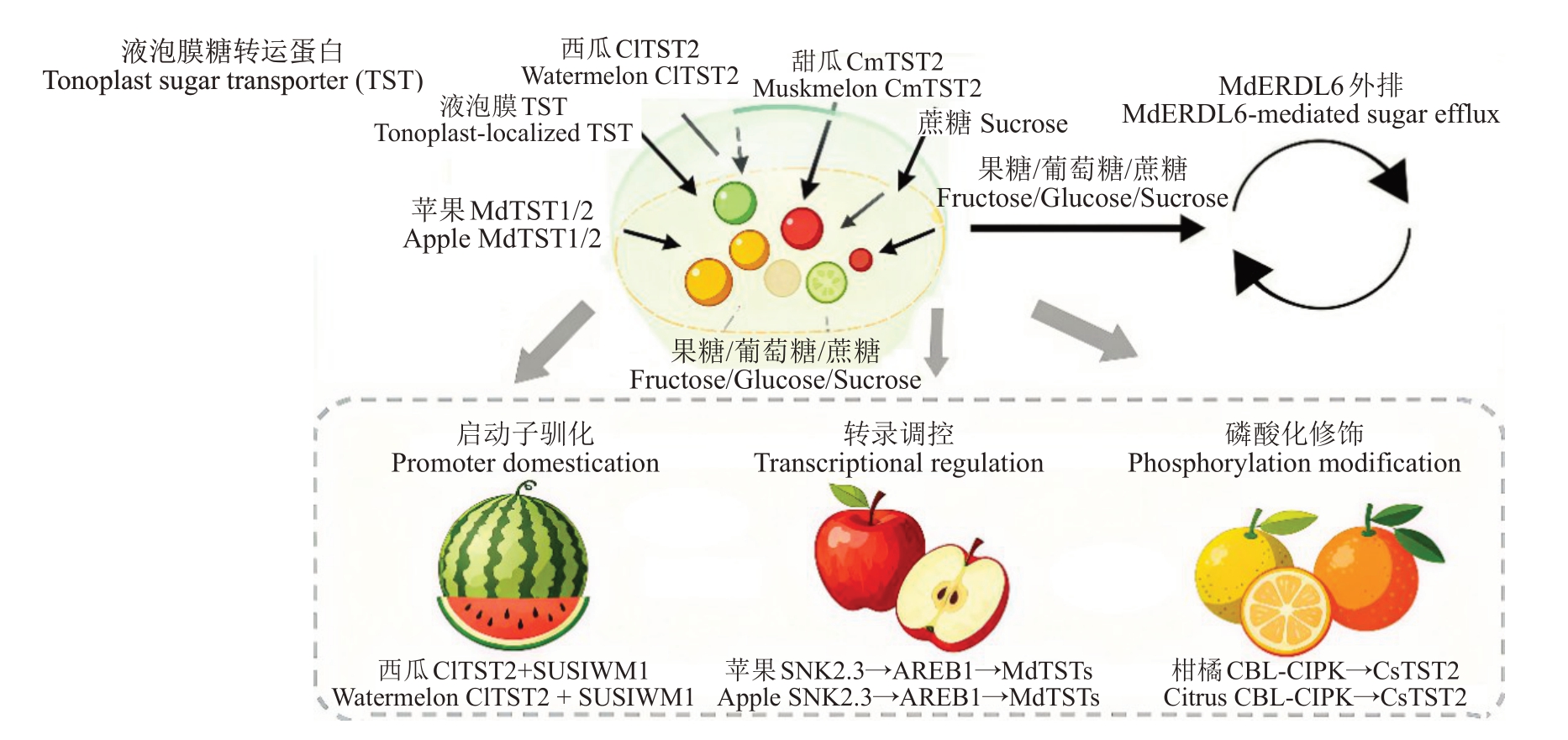
图1 TST 是液泡糖分积累的关键质子驱动转运蛋白
Fig.1 TST is a key proton-driven transporter for sugar accumulation in the vacuole
3.3 糖转运蛋白与糖代谢酶的协同调控
糖转运蛋白与糖代谢酶的协同作用是决定果实糖分含量与组成的重要机制(图2)。在番茄果实发育过程中,细胞壁转化酶SlCWIN 活性的升高可显著上调己糖转运蛋白SlHT2 和蔗糖外排蛋白SlSWEET12c的表达。SlCWIN通过水解蔗糖生成葡萄糖和果糖,产生的己糖信号进一步激活SlHT2和SlSWEET12c的转录,从而促进糖分向发育中的果实运输,驱动果实早期膨大,揭示了代谢酶与转运蛋白之间的级联调控网络[62]。类似地,番茄中蔗糖转运蛋白SlSUT1/SlSUT2 与细胞壁转化酶SlLIN5 在质外体卸载途径中紧密配合,SlLIN5水解胞外蔗糖生成己糖,SlSUT 可能参与蔗糖的吸收或再捕获,而Sl-HT2 则负责将己糖转入细胞内,共同增强果实库强与糖积累[63]。在葡萄浆果转色期后,VvNAC72转录因子同时激活蔗糖外排蛋白VvSWEET15和蔗糖磷酸合成酶VvSPS的表达。VvSWEET15蛋白促进己糖的跨膜转运,VvSPS 则增强蔗糖合成能力,两者协同作用驱动葡萄糖和果糖在浆果中的快速积累,使总糖含量显著提升[40]。苹果中的己糖转运蛋白MdHT2.2除负责将质外体己糖转运至果肉细胞外,还能正向调控细胞壁转化酶的活性及其关键基因LIN5的表达,在异源转化体系中证实可协同促进番茄果实中的己糖积累[64]。柑橘转录因子CitZAT5 通过协同激活蔗糖合酶CitSUS5 和果糖转运蛋白CitSWEET6,促进蔗糖裂解并加速果糖向液泡富集,从而显著提高果实可溶性糖含量并优化糖组分[65]。“代谢-转运”偶联是果实高效积累糖分的核心,以上研究有力地证明,糖转运蛋白与代谢酶(如CWINV,SPS,SUS)在转录层面常被共同调控(如由同一转录因子激活),在功能上形成正反馈循环(如代谢产物作为信号激活转运蛋白)。因此,在育种改良中,单独操控一个转运蛋白或代谢酶基因的效果可能有限,甚至会被系统补偿。未来的遗传改良策略应着眼于调控这些协同模块的上游主效转录因子,或通过多基因叠加策略,同时优化“卸载-代谢-储存”整个通路,从而实现对库强的根本性增强。
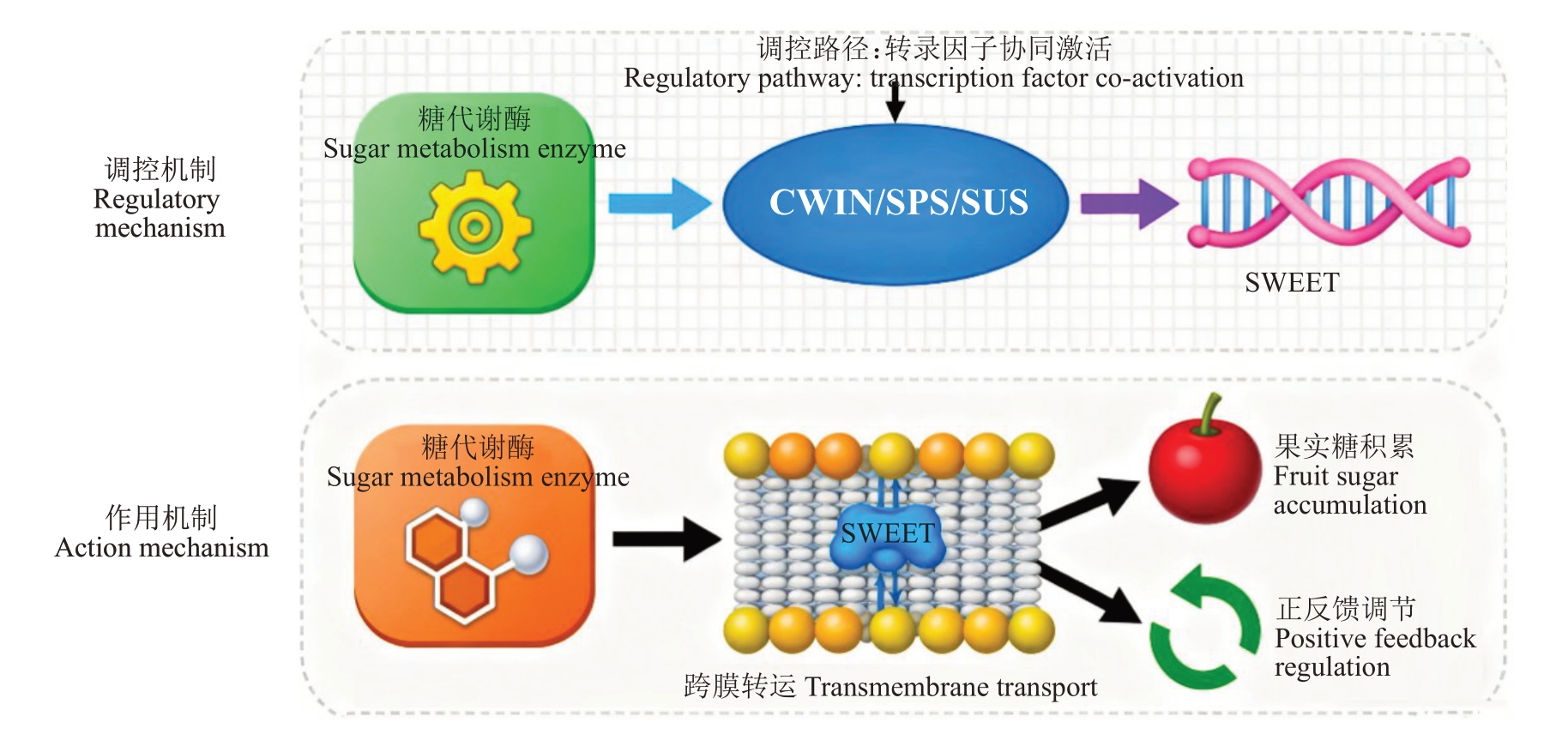
图2 糖转运与代谢酶的协同互作
Fig.2 Coordinated interaction between sugar transporters and metabolic enzymes
3.4 糖转运蛋白通过糖信号间接协同影响其他品质性状
糖转运蛋白不仅直接调控果实糖分的积累,还通过多种机制协同影响果实大小、酸度、色泽、香气及质地等关键品质性状(图3)。在番茄中,SlSWEET12c(属于SWEET 家族Ⅲ亚类)的过表达可显著提高果实中葡萄糖和果糖含量,并通过激活转录因子SlMYB1R1促进糖代谢相关基因的表达;相反,CRISPR/Cas9 介导的SlSWEET12c 基因敲除导致糖含量下降约20%,并伴随果实体积减小,表明该基因在协同调控糖积累与细胞扩张中具有双重功能[66]。除SWEET家族外,蔗糖转运蛋白也广泛参与品质形成。例如,拟南芥中SUC1 纯合突变体幼苗中花青苷与原花色苷的积累显著减少,表明AtSUC1 在调控次级代谢产物积累中发挥间接作用[67];类似地,苹果中过表达MdSUT2不仅增加蔗糖和葡萄糖含量,还可通过糖信号途径激活花青苷合成相关基因的表达,从而促进果实的着色[68]。在翻译后层面,钙调素依赖蛋白激酶SlCPK27通过磷酸化修饰蔗糖合酶SlSUS3 并促进其降解,从而抑制葡萄糖和果糖的积累;而利用基因编辑技术敲除SlCPK27/26 则可使果实糖含量提高30%,且单果质量未受影响,从蛋白修饰角度揭示了糖代谢酶与转运蛋白协同调控果实品质的分子机制[69]。糖转运蛋白通过改变胞内糖水平,广泛地作为代谢信号前体影响下游品质通路,这解释了果实品质性状间的高度相关性(如高糖常伴随深色和特定香气)。SlSWEET12c 等基因的“一因多效”现象,一方面展示了通过调控单个关键转运蛋白实现多品质性状协同改良的潜力,另一方面也警示其可能带来不可预见的负面效应(如果实变小)。因此,在利用此类基因时,必须精细控制其表达时空与强度。未来需要更多研究来解析糖信号如何特异性地搭建花青素、香气物质或有机酸等合成通路的具体分子桥梁,这将为打破不良连锁、实现品质性状的“按需定制”奠定基础。
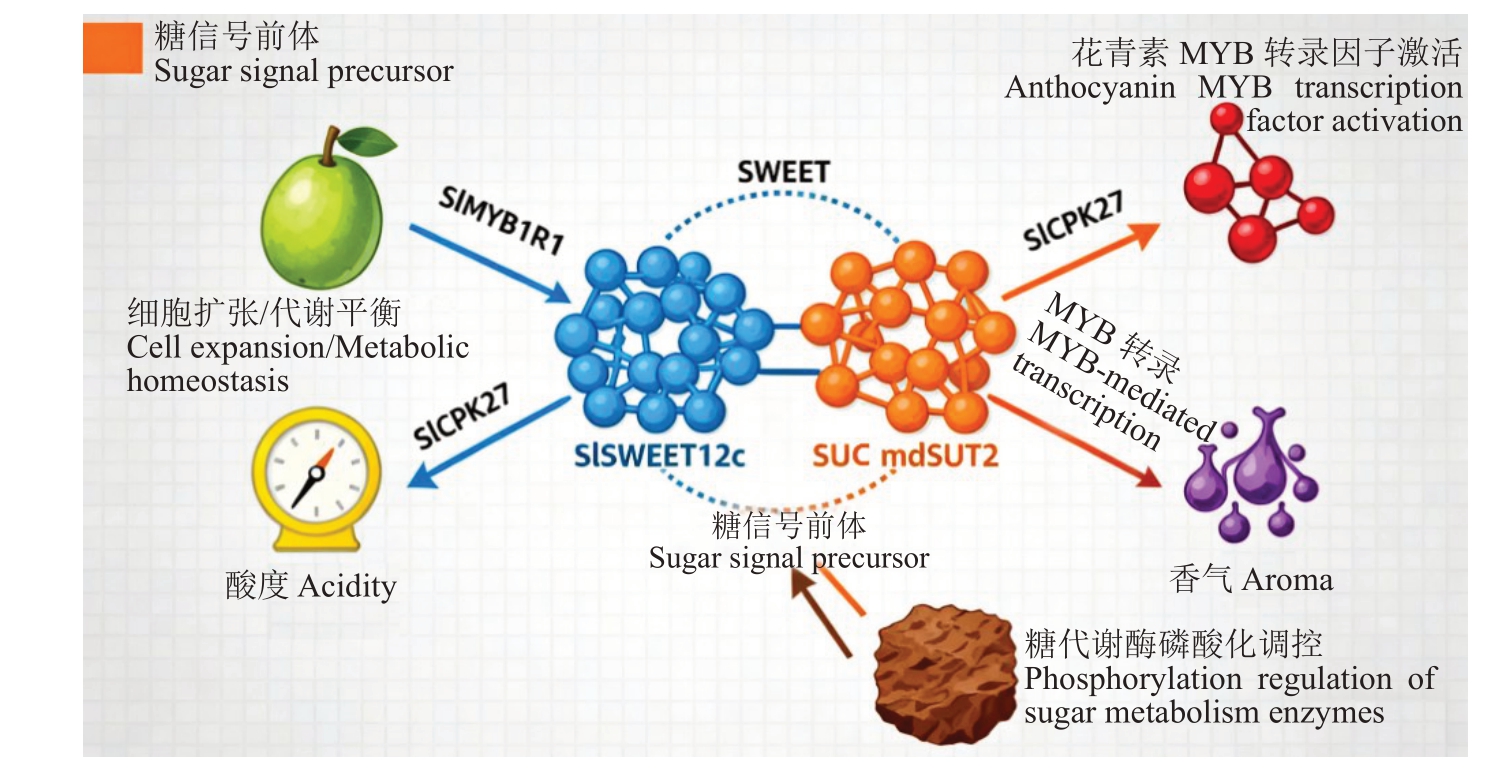
图3 糖转运蛋白通过糖信号通路间接调控果实多种品质性状
Fig.3 Sugar signaling mediates the pleiotropic effects of sugar transporters on fruit quality
4 糖转运蛋白的多层次调控网络
4.1 转录水平调控
糖转运蛋白的转录调控是表达调控中最直接且研究最为深入的层面,该过程主要依赖于转录因子与顺式作用元件的特异性互作。大量研究表明,不同植物物种中糖转运蛋白的表达受到精细的多层次转录网络控制[70]。
在调控机制层面,多种内外信号通过特定转录因子参与该过程。例如,在番茄中,SlMYB76 转录因子通过结合赤霉素合成基因Sl20ox1和SlKO的启动子,在高蔗糖条件下抑制其表达,进而调控Sl-SUT4的表达并影响开花时间[71-72]。苹果中的研究表明,在干旱胁迫条件下,MdDOF3 转录因子通过结合MdHT1.2启动子区的AAAG元件,直接调控该己糖转运蛋白的表达,促进根系葡萄糖吸收[73]。此外,拟南芥AtSUC4 的启动子含有光响应元件,其表达受光信号途径调控[74];而AtSWEET5 启动子中的Wbox 顺式元件可被WRKY 家族转录因子识别,在叶片发育过程中调控可溶性糖积累[75]。
在果实特异性调控方面,研究发现了多个精细调控模块。甜橙中的CsbHLH122/CsMYBS3转录模块在果实成熟阶段直接促进蔗糖转运蛋白CsSUT2的表达,显著增强蔗糖积累[76]。柑橘中的CitZAT5则通过双重机制协调糖代谢:一方面直接激活CitSWEET6 的表达促进果糖积累;另一方面通过与Cit-NAC47 蛋白互作调控CitSUS5 的表达,促进蔗糖向己糖的分解,从而优化果实糖组分[77]。
目前,尽管已在多个物种中鉴定出能直接调控糖转运蛋白的关键转录因子,为基因编辑育种提供了优质靶点,但这些转录因子如何整合发育信号(如果实成熟)、激素信号(如ABA、乙烯)和环境信号(如光照)的机制仍不清楚。未来研究需要构建以关键转录因子为节点的调控网络图谱,并利用染色质可及性测序(ATAC-seq)等技术,系统性发掘在果实中特异性起作用的顺式元件,为设计高特异性、高强度的人工启动子提供核心元件库。
4.2 转录后和翻译后调控
除转录调控外,糖转运蛋白的活性与稳定性还受到多种转录后及翻译后修饰层次的精密调控,共同构成其功能调节网络。在翻译后修饰层面,磷酸化是其中最为典型的调控方式,可动态调节蛋白活性与亚细胞定位。研究表明,拟南芥AtSWEET11/12的磷酸化状态受干旱胁迫调控,进而影响其转运功能[78];葡萄VvSWEET10特定磷酸化位点的突变也显著削弱糖转运能力,显示该修饰对其活性的关键作用[47]。除磷酸化外,泛素化修饰亦参与调控糖转运蛋白的稳定性。例如,马铃薯E3 泛素连接酶StRFP1 可通过泛素化途径降解StSWEET10c 和StSWEET11,从而在病原菌侵染过程中调控寄主糖分的再分配[79]。在转录后调控层面,多种机制共同参与对糖转运蛋白表达的精细调节。一方面,miRNA可通过靶向糖转运蛋白或其上游调控基因的mRNA 以影响其表达。例如在葡萄中,Vv-miR156通过抑制转录因子VvSPL9 的表达,间接削弱其对蔗糖转运蛋白基因VvSUC27的激活作用,从而调控果实成熟过程中的糖分积累[80]。另一方面,mRNA稳定性与选择性剪接也在多个物种中发挥关键作用。番茄LeSUT1 基因通过内含子依赖型选择性剪接生成长型(LeSUT1-L)与短型(LeSUT1-S)两种异构体,其中LeSUT1-L 的mRNA 借助3′UTR 与RBP45 蛋白结合维持稳定,在果实膨大期高表达;而LeSUT1-S因缺乏该结合位点易被降解,在成熟期占主导地位[81]。类似机制亦存在于苹果中,MdTST1基因经选择性剪接产生功能完整型(MdTST1a)与截短型(MdTST1b)变体,在干旱胁迫下,MdTST1a 通过3′UTR 与MdRBP1 结合维持mRNA 稳定,而MdTST1b 则因无义介导的mRNA 降解(NMD)途径被迅速清除[82]。综上所述,转录后与翻译后调控通过影响糖转运蛋白的mRNA 稳定性、翻译效率、蛋白活性及降解速率,实现对糖分跨膜运输过程的动态与精准调控,为园艺作物在不同发育阶段及环境条件下的糖分分配提供分子基础。
4.3 表观遗传调控
表观遗传修饰主要包括DNA 甲基化与组蛋白修饰两大类,是调控糖转运蛋白时空表达的关键机制,在果实糖分积累过程中发挥重要作用。在DNA甲基化层面,研究发现甜瓜液泡糖转运蛋白基因CmTST2的表达受其启动子区甲基化水平的动态调控,成熟期的低甲基化状态可显著增强其表达,从而促进蔗糖积累[44]。类似地,柑橘CsTST2的表达也受DNA 甲基化调控,并且与钙信号通路存在交互作用——CsCBL1-CsCIPK23 复合体通过磷酸化修饰直接增强该转运蛋白活性,而甲基化修饰则可能通过调控该信号通路间接影响糖积累过程[61]。在组蛋白修饰方面,多种修饰方式共同构成了精细的表达调控网络。例如,拟南芥中AtSUC2 基因的表达通过抑制性标记H3K27me3 与激活性标记H3K4me3之间的拮抗作用,实现其组织特异性表达模式[83]。在梨果实中,组蛋白去乙酰化酶PuHDAC9-like通过降低蔗糖转运蛋白PuSUT4-like 启动子区的H3K9乙酰化水平,进而抑制其表达,最终导致蔗糖积累减少[84]。此外,番茄SlSUT1基因的表达动态也被证实与H3K27me3 修饰水平密切相关[85]。综上所述,由DNA 甲基化与组蛋白修饰共同构成的表观遗传调控网络,通过精确调控糖转运蛋白的时空表达,深刻影响果实的糖分积累,为深入解析植物糖代谢调控机制提供了新的理论视角。
4.4 激素对糖转运蛋白的调控
植物激素通过复杂的信号网络整合内源发育信号与外源环境因子信号,精确调控糖转运蛋白的表达与活性,从而协调糖分的运输、分配和最终积累。不同激素通过独特且互作的分子通路参与这一调控过程。在促进糖分积累方面,脱落酸(ABA)发挥重要作用。研究表明,ABA在番茄果实中能够增强转录因子AREB2 的活性,进而促进可溶性糖的积累[86];在柑橘果实成熟过程中,ABA 通过直接激活液泡糖转运蛋白基因CsSUC3 的表达,促进糖分向液泡的运输与储存[87]。赤霉素(GA)则通过多层次的调控机制影响糖分配。在番茄中,GA 信号通路核心抑制因子SlPRO 的降解会释放转录因子SlJKD,后者直接抑制蔗糖转运蛋白SlSUT1的表达,减少叶片蔗糖输出,促进果实蔗糖积累,形成完整的“PROCERA-JACKDAW-SlSUT1”调控模块[88]。值得注意的是,糖转运蛋白亦可反馈调控激素合成,如番茄SlSUT4 通过调控茎尖蔗糖水平抑制GA 合成基因Sl20ox1的表达,进而影响开花时间[71]。其他激素也展现出独特的调控模式。细胞分裂素通过激活SlRR1等响应因子促进光合基因(如SlRBCS)表达以增加蔗糖合成量,但其过量表达会抑制SlSUT1,导致源叶蔗糖滞留,揭示其在糖代谢中的双重角色[89]。乙烯则通过稳定EIN3 蛋白抑制蔗糖转运子SUC2 的表达,促使蔗糖在子叶中积累,从而调控黄化苗的转绿过程[90]。这些研究揭示了一个多维度的调控网络:不同激素通过特异性转录因子及蛋白修饰机制,在时空维度上精确控制糖转运蛋白的功能,实现对糖代谢的精细调控。未来研究需进一步解析这些激素信号通路之间的交叉对话机制,以及它们如何协同响应环境变化,共同调控果实品质形成。
4.5 环境因素对糖转运蛋白的调控
环境因素(如干旱、盐碱、低温等)通过调控糖转运蛋白的表达与活性,在园艺作物抗逆性与果实品质形成中发挥关键作用。不同胁迫通过特定信号通路重编程糖转运蛋白功能,实现“抗逆保产”或“逆境优质”的生理目标。在干旱胁迫下,植物主要依赖ABA信号通路调控糖转运蛋白。苹果中ABA激活激酶MdCIPK22,促使蔗糖转运蛋白MdSUT2.2 Ser381位点磷酸化,增强其稳定性与转运活性,促进果实蔗糖积累[91]。拟南芥中SnRK2激酶磷酸化AtSWEET11/12的C端,增强其寡聚化与蔗糖转运能力,优化干旱条件下糖分的根冠分配[78]。番茄中Slb-HLH96 通过抑制ABA 降解基因SlCYP707A2 的表达,维持ABA信号强度,间接上调糖转运蛋白表达,协同响应干旱[92]。盐胁迫则通过离子稳态与渗透调节协同调控糖转运蛋白功能。辣椒中CabHLH035转录因子同时激活离子外排蛋白CaSOS1与脯氨酸合成关键酶基因CaP5CS的表达,在降低胞内Na+浓度的同时促进糖分转运,增强植株耐盐性[93]。菊花通过青蒿砧木嫁接限制Na+向上运输,并上调糖转运蛋白表达,促进可溶性糖积累以维持渗透平衡,体现了砧穗互作在盐胁迫下的调控价值[94]。低温胁迫通过多种机制调控糖代谢。苹果中miR164g-Ms-NAC022模块通过上调过氧化物酶与糖转运蛋白基因表达,同步增强活性氧清除能力与糖分积累,提高低温耐受性[95]。番茄中SlCIPK-SlCBL 钙信号复合体通过磷酸化液泡糖转运蛋白SlTST,促进葡萄糖储入液泡,从而降低冰点,增强果实抗寒能力[40]。综上所述,环境胁迫通过激素信号(如ABA)、第二信使(如Ca2+、ROS)及转录调控网络,精确调控糖转运蛋白的表达与活性,这一机制不仅深化了对植物逆境生理的理解,也为制定提质增效的栽培策略(如可控胁迫栽培)和培育气候抗逆性品种提供了重要的理论依据与育种方向。
5 展 望
5.1 面向品质育种的靶向基因挖掘与调控机制解析
深入挖掘种质资源中的等位变异,运用群体遗传学方法,系统筛选核心种质资源中调控关键糖转运蛋白(如SWEETs、TSTs)表达与活性的自然等位变异。重点阐明这些变异对果实糖分含量、糖酸比及糖积累模式多样性的影响,并将其转化为可用于分子标记辅助选择(MAS)的有效工具。解析品质性状协同调控网络,重点揭示糖转运蛋白作为调控枢纽,在糖信号与有机酸代谢、色泽形成及香气合成等途径之间的互作机制。识别介导上述协同效应的关键转录因子或信号蛋白,为实现果实综合品质的协同提升提供新的调控靶点。
5.2 创新遗传改良策略与技术体系构建
启动子精准编辑与调控元件设计,突破传统基因过表达策略,利用CRISPR/Cas9 等技术对糖转运蛋白基因的启动子区域进行精准编辑,如引入增强子元件或修饰转录因子结合位点,或将其替换为果实特异性或发育阶段特异性的人工启动子,从而实现对糖转运蛋白表达时空动态的精确调控,避免源库关系失衡等负面效应。模块化育种策略的探索与应用,在明确“代谢-转运”协同模块(如SPSSWEET、SUS-TST)功能的基础上,尝试将整个功能模块作为育种单元,通过多基因共转化或优良等位基因聚合,系统提升果实库强与糖分卸载效率。
5.3 新型糖转运蛋白的发掘与功能探索
除经典的SUT、SWEET 和TST 家族外,一系列功能待解析的新型糖转运蛋白为果实品质调控网络提供了新的组件,正受到日益广泛的关注。例如,质子耦合糖转运蛋白(H+-coupled glucose transporters,HGT)虽在模式植物中研究较早,但在园艺作物果实中的功能研究仍处于前沿。其利用质子梯度驱动单糖转运的机制,可能为果实早期发育或逆境胁迫下糖分的主动吸收提供一条重要的“备用路径”。另一类蔗糖转运相关蛋白(sucrose transport-related proteins,SRT)的遗传学证据也暗示在蔗糖运输分配中扮演非冗余角色。然而,目前对这些新型转运蛋白在果实中的表达模式、底物特异性及生理功能的认识仍非常有限。未来研究亟须结合基因组学、结构生物学与基因编辑技术,系统鉴定其家族成员并解析其精确的生化功能与调控机制,从而揭示它们在果实糖分积累网络中的独特贡献,为品质改良提供新的理论依据与遗传靶点。
5.4 栽培生理调控与抗逆育种创新
指导优化栽培管理措施,将糖转运蛋白的基础理论成果应用于果树栽培实践。通过研究不同光质、水分胁迫等环境因子对糖转运蛋白表达的影响,为制定提质增效的光照与水肥管理方案(如特定生育期的控水与补光策略)提供理论支撑,实现良种与良法相结合。培育具气候韧性的果树品种,重点关注在高温、干旱等逆境条件下仍能维持糖分正常转运与分配的关键基因及其调控因子。将这些抗逆相关等位变异纳入育种体系,培育在气候变化背景下仍能保持高产、优质的果树新种质,保障果树产业的可持续发展。
[1] REN Y,LIAO S J,XU Y.An update on sugar allocation and accumulation in fruits[J]. Plant Physiology,2023,193(2):888-899.
[2] BRAUN D M. Phloem loading and unloading of sucrose:What a long,strange trip from source to sink[J]. Annual Review of Plant Biology,2022,73:553-584.
[3] JIA B L,ZHU X F,PU Z J,DUAN Y X,HAO L J,ZHANG J,CHEN L Q,JEON C O,XUAN Y H.Integrative view of the diversity and evolution of SWEET and SemiSWEET sugar transporters[J].Frontiers in Plant Science,2017,8:2178.
[4] RUAN Y L.Sucrose metabolism:Gateway to diverse carbon use and sugar signaling[J].Annual Review of Plant Biology,2014,65:33-67.
[5] JULIUS B T,LEACH K A,TRAN T M,MERTZ R A,BRAUN D M.Sugar transporters in plants:New insights and discoveries[J].Plant&Cell Physiology,2017,58(9):1442-1460.
[6] ANJALI A,FATIMA U,MANU M S,RAMASAMY S,SENTHIL-KUMAR M.Structure and regulation of SWEET transporters in plants:An update[J]. Plant Physiology and Biochemistry,2020,156:1-6.
[7] CHEN L Q,CHEUNG L S,FENG L,TANNER W,FROMMER W B. Transport of sugars[J]. Annual Review of Biochemistry,2015,84:865-894.
[8] EOM J S,CHEN L Q,SOSSO D,JULIUS B T,LIN I,QU X Q,BRAUN D M,FROMMER W B. SWEETs,transporters for intracellular and intercellular sugar translocation[J].Current Opinion in Plant Biology,2015,25:53-62.
[9] LI X Y,REN Z Y,ZHANG Z Q,LIU Y G,HE K L,ZHANG F,GUO J F,WEI S H,YANG D G,LI W.Evolutionary trajectory and functional diversity of SWEET sugar transporters in plants[J].The Plant Journal,2025,123(1):e70334.
[10] JIANG F C,YANG L,ZHANG J H,ZHANG M L,YU W J,SUN H Y. Integrated QTL mapping and transcriptomic profiling elucidate molecular determinants of sucrose accumulation in apricot (Prunus armeniaca L.)[J]. Current Plant Biology,2025,43:100500.
[11] SHENG X W,LI M D,LUO Y R,MAO Z L,ZHAI X W,LIU J H,LI C L. The CsMYB36-CsSWEET17 module mediates the calcium-induced sucrose accumulation in citrus[J]. Horticulture Research,2025,12(10):uhaf175.
[12] ZHU L C,LI Y Z,WANG C C,WANG Z Q,CAO W J,SU J,PENG Y J,LI B Y,MA B Q,MA F W,RUAN Y L,LI M J.The SnRK2.3-AREB1-TST1/2 cascade activated by cytosolic glucose regulates sugar accumulation across tonoplasts in apple and tomato[J].Nature Plants,2023,9(6):951-964.
[13] LI B Y,QU S T,KANG J Y,PENG Y J,YANG N X,MA B Q,RUAN Y L,MA F W,LI M J,ZHU L C. The MdCBF1/2-MdTST1/2 module regulates sugar accumulation in response to low temperature in apple[J]. The Plant Journal,2024,118(3):787-801.
[14] ZHANG B,LI Y N,WU B H,YUAN Y Y,ZHAO Z Y. Plasma membrane-localized transporter MdSWEET12 is involved in sucrose unloading in apple fruit[J]. Journal of Agricultural and Food Chemistry,2022,70(49):15517-15530.
[15] XU Y,LIU S,SUN H Y,ZANG J,ZHANG C,GUO W,ZHANG Z H. Sucrose transport gene FaSWEET9a regulated by FaDOF2 transcription factor promotes sucrose accumulation in strawberry[J].Plant Cell Reports,2025,44(6):138.
[16] DAI Z W,LÉON C,FEIL R,LUNN J E,DELROT S,GOMÈS E. Metabolic profiling reveals coordinated switches in primary carbohydrate metabolism in grape berry(Vitis vinifera L.),a nonclimacteric fleshy fruit[J]. Journal of Experimental Botany,2013,64(5):1345-1355.
[17] SAVOI S,TORREGROSA L,ROMIEU C. Transcripts switched off at the stop of phloem unloading highlight the energy efficiency of sugar import in the ripening V. vinifera fruit[J]. Horticulture Research,2021,8:193.
[18] ZHENG Q M,WANG H L,YAN S,XIE P,QI Y. Functional characterization of tonoplast sugar transporter gene HpTST1 involved in soluble sugars accumulation during fruit development process of red pitaya(Hylocereus polyrhizus)[J].Plant Physiology and Biochemistry,2025,228:110228.
[19] FENG C Y,HAN J X,HAN X X,JIANG J.Genome-wide identification,phylogeny,and expression analysis of the SWEET gene family in tomato[J].Gene,2015,573(2):261-272.
[20] XUE X Y,WANG J,SHUKLA D,CHEUNG L S,CHEN L Q.When SWEETs turn tweens:Updates and perspectives[J].Annual Review of Plant Biology,2022,73:379-403.
[21] 祝令成,苏静,彭云静,曹文静,马锋旺,马百全,李明军.糖转运蛋白与果实糖积累的关系研究进展[J].园艺学报,2022,49(12):2529-2542.ZHU Lingcheng,SU Jing,PENG Yunjing,CAO Wenjing,MA Fengwang,MA Baiquan,LI Mingjun. Research progress on the relationship between sugar transporters and fruits sugar accumulation[J].Acta Horticulturae Sinica,2022,49(12):2529-2542.
[22] WU K J,HU C X,LIAO P Y,HU Y L,SUN X C,TAN Q L,PAN Z Y,XU S J,DONG Z H,WU S W. Potassium stimulates fruit sugar accumulation by increasing carbon flow in Citrus sinensis[J].Horticulture Research,2024,11(11):uhae240.
[23] CHEN L Q,QU X Q,HOU B H,SOSSO D,OSORIO S,FERNIE A R,FROMMER W B. Sucrose efflux mediated by SWEET proteins as a key step for phloem transport[J].Science,2012,335(6065):207-211.
[24] WEN S Y,NEUHAUS H E,CHENG J T,BIE Z L. Contributions of sugar transporters to crop yield and fruit quality[J].Journal of Experimental Botany,2022,73(8):2275-2289.
[25] REN Y,LI M Y,GUO S G,SUN H H,ZHAO J Y,ZHANG J,LIU G M,HE H J,TIAN S W,YU Y T,GONG G Y,ZHANG H Y,ZHANG X L,ALSEEKH S,FERNIE A R,SCHELLER H V,XU Y. Evolutionary gain of oligosaccharide hydrolysis and sugar transport enhanced carbohydrate partitioning in sweet watermelon fruits[J].The Plant Cell,2021,33(5):1554-1573.
[26] KO H Y,HO L H,NEUHAUS H E,GUO W J.Transporter SlSWEET15 unloads sucrose from phloem and seed coat for fruit and seed development in tomato[J].Plant Physiology,2021,187(4):2230-2245.
[27] CHONG J L,PIRON M C,MEYER S,MERDINOGLU D,BERTSCH C,MESTRE P. The SWEET family of sugar transporters in grapevine:VvSWEET4 is involved in the interaction with Botrytis cinerea[J]. Journal of Experimental Botany,2014,65(22):6589-6601.
[28] BARKER L,KÜHN C,WEISE A,SCHULZ A,GEBHARDT C,HIRNER B,HELLMANN H,SCHULZE W,WARD J M,FROMMER W B. SUT2,a putative sucrose sensor in sieve elements[J].The Plant Cell,2000,12(7):1153-1164.
[29] REINDERS A,SCHULZE W,KÜHN C,BARKER L,SCHULZ A,WARD J M,FROMMER W B. Protein-protein interactions between sucrose transporters of different affinities colocalized in the same enucleate sieve element[J].The Plant Cell,2002,14(7):1567-1577.
[30] KÜHN C,GROF C P. Sucrose transporters of higher plants[J].Current Opinion in Plant Biology,2010,13(3):287-297.
[31] ZHANG Z B,FAN T Y,WU L H,YE Z Y,YE F. Plant SUT sucrose transporters:Structure,evolution and biological functions[J].Current Protein&Peptide Science,2025.
[32] REINDERS A,SIVITZ A B,WARD J M.Evolution of plant sucrose uptake transporters[J].Frontiers in Plant Science,2012,3:22.
[33] ZHANG Q,HUA X T,LIU H,YUAN Y,SHI Y,WANG Z C,ZHANG M Q,MING R,ZHANG J S. Evolutionary expansion and functional divergence of sugar transporters in Saccharum(S.spontaneum and S.officinarum)[J].The Plant Journal,2021,105(4):884-906.
[34] DE SCHEPPER V,DE SWAEF T,BAUWERAERTS I,STEPPE K.Phloem transport:A review of mechanisms and controls[J]. Journal of Experimental Botany,2013,64(16):4839-4850.
[35] LAUSCHKE A,ROHWEDDER H,GARG V,KÜHN C.New insights into the interaction network of plant sugar transporters[J].Journal of Experimental Botany,2025:eraf366.
[36] HACKEL A,SCHAUER N,CARRARI F,FERNIE A R,GRIMM B,KÜHN C.Sucrose transporter LeSUT1 and LeSUT2 inhibition affects tomato fruit development in different ways[J].The Plant Journal,2006,45(2):180-192.
[37] MAESHIMA M. TONOPLAST TRANSPORTERS:Organization and function[J]. Annual Review of Plant Physiology and Plant Molecular Biology,2001,52:469-497.
[38] HUANG W F,HU B,LIU J L,ZHOU Y,LIU S Q. Identification and characterization of tonoplast sugar transporter (TST)gene family in cucumber[J]. Horticultural Plant Journal,2020,6(3):145-157.
[39] WANG L,LI X R,LIAN H,NI D,HE Y K,CHEN X Y,RUAN Y L.Evidence that high activity of vacuolar invertase is required for cotton fiber and Arabidopsis root elongation through osmotic dependent and independent pathways,respectively[J]. Plant Physiology,2010,154(2):744-756.
[40] ZHU L C,LAN J C,ZHAO T,LI M J,RUAN Y L.How vacuolar sugar transporters evolve and control cellular sugar homeostasis,organ development and crop yield[J]. Nature Plants,2025,11(6):1102-1115.
[41] GEIGER D. Plant glucose transporter structure and function[J].Pflügers Archiv-European Journal of Physiology,2020,472(9):1111-1128.
[42] JUNG B,LUDEWIG F,SCHULZ A,MEIßNER G,WÖSTEFELD N,FLÜGGE U I,POMMERRENIG B,WIRSCHING P,SAUER N,KOCH W,SOMMER F,MÜHLHAUS T,SCHRODA M,CUIN T A,GRAUS D,MARTEN I,HEDRICH R,NEUHAUS H E. Identification of the transporter responsible for sucrose accumulation in sugar beet taproots[J]. Nature Plants,2015,1:14001.
[43] REN Y,GUO S G,ZHANG J,HE H J,SUN H H,TIAN S W,GONG G Y,ZHANG H Y,LEVI A,TADMOR Y,XU Y.A tonoplast sugar transporter underlies a sugar accumulation QTL in watermelon[J].Plant Physiology,2018,176(1):836-850.
[44] CHENG J T,WEN S Y,XIAO S,LU B Y,MA M R,BIE Z L.Overexpression of the tonoplast sugar transporter CmTST2 in melon fruit increases sugar accumulation[J]. Journal of Experimental Botany,2018,69(3):511-523.
[45] ZHU L C,LI B Y,WU L M,LI H X,WANG Z Y,WEI X Y,MA B Q,ZHANG Y F,MA F W,RUAN Y L,LI M J.MdERDL6-mediated glucose efflux to the cytosol promotes sugar accumulation in the vacuole through up-regulating TSTs in apple and tomato[J].Proceedings of the National Academy of Sciences of the United States of America,2021,118(1):e2022788118.
[46] ZHEN Q L,FANG T,PENG Q,LIAO L,ZHAO L,OWITI A,HAN Y P.Developing gene-tagged molecular markers for evaluation of genetic association of apple SWEET genes with fruit sugar accumulation[J].Horticulture Research,2018,5:14.
[47] ZHANG Z,ZOU L M,REN C,REN F R,WANG Y,FAN P G,LI S H,LIANG Z C.VvSWEET10 mediates sugar accumulation in grapes[J].Genes,2019,10(4):255.
[48] 王悦. 液泡膜糖转运蛋白对葡萄果实糖积累的调控机制研究[D].北京:中国科学院大学,2022.WANG Yue. Study on the regulatory mechanism of tonoplast sugar transporters on sugar accumulation in grape berries[D].Beijing:University of Chinese Academy of Sciences,2022.
[49] LI J,WU L M,FOSTER R,RUAN Y L.Molecular regulation of sucrose catabolism and sugar transport for development,defence and phloem function[J]. Journal of Integrative Plant Biology,2017,59(5):322-335.
[50] LUO M,JIA M X,PAN L,CHEN W F,ZHOU K,XI W P.Sugar transporters PpSWEET9a and PpSWEET14 synergistically mediate peach sucrose allocation from source leaves to fruit[J].Communications Biology,2024,7:1068.
[51] SHAMMAI A,PETREIKOV M,YESELSON Y,FAIGENBOIM A,MOY-KOMEMI M,COHEN S,COHEN D,BESAULOV E,EFRATI A,HOUMINER N,BAR M,AST T,SCHULDINER M,KLEMENS P A W,NEUHAUS E,BAXTER C J,RICKETT D,BONNET J,WHITE R,GIOVANNONI J J,LEVIN I,SCHAFFER A. Natural genetic variation for expression of a SWEET transporter among wild species of Solanum lycopersicum (tomato) determines the hexose composition of ripening tomato fruit[J].The Plant Journal,2018,96(2):343-357.
[52] ZHANG X S,FENG C Y,WANG M N,LI T L,LIU X,JIANG J. Plasma membrane-localized SlSWEET7a and SlSWEET14 regulate sugar transport and storage in tomato fruits[J].Horticulture Research,2021,8:186.
[53] HU W C,HUA X T,ZHANG Q,WANG J P,SHEN Q C,ZHANG X T,WANG K,YU Q Y,LIN Y R,MING R,ZHANG J S. New insights into the evolution and functional divergence of the SWEET family in Saccharum based on comparative genomics[J].BMC Plant Biology,2018,18(1):270.
[54] ZHANG S H,WANG H,WANG T,ZHANG J,LIU W J,FANG H C,ZHANG Z Y,PENG F T,CHEN X S,WANG N.Abscisic acid and regulation of the sugar transporter gene MdSWEET9b promote apple sugar accumulation[J]. Plant Physiology,2023,192(3):2081-2101.
[55] CAI H X,LIANG M Y,QIN X,DONG R R,WANG X T,WANG H J,SUN S,CUI X,YANG W C,LI R.Tonoplast sugar transporters coordinately regulate tomato fruit development and quality[J].Plant Communications,2025,6(5):101314.
[56] RASHID A,RUAN H X,WANG Y S. The gene FvTST1 from strawberry modulates endogenous sugars enhancing plant growth and fruit ripening[J]. Frontiers in Plant Science,2022,12:774582.
[57] LU L Z,DELROT S,FAN P G,ZHANG Z,WU D,DONG F Q,GARCÍA-CAPARROS P,LI S H,DAI Z W,LIANG Z C. The transcription factors ERF105 and NAC72 regulate expression of a sugar transporter gene and hexose accumulation in grape[J].The Plant Cell,2024,37(1):koae326.
[58] CHENG J T,WANG Z Y,YAO F Z,GAO L H,MA S,SUI X L,ZHANG Z X. Down-regulating CsHT1,a cucumber pollenspecific hexose transporter,inhibits pollen germination,tube growth,and seed development[J]. Plant Physiology,2015,168(2):635-647.
[59] REN Y,SUN H H,ZONG M,GUO S G,REN Z J,ZHAO J Y,LI M Y,ZHANG J,TIAN S W,WANG J F,YU Y T,GONG G Y,ZHANG H Y,HE H J,LI L G,ZHANG X L,LIU F,FEI Z J,XU Y. Localization shift of a sugar transporter contributes to phloem unloading in sweet watermelons[J]. New Phytologist,2020,227(6):1858-1871.
[60] LI B Y,ZHU L C,JIN Y R,PENG Y J,FENG Z M,YANG N X,MA F W,MA B Q,LI M J. Effects of two apple tonoplast sugar transporters,MdTST1 and MdTST2,on the accumulation of sugar[J].Scientia Horticulturae,2022,293:110719.
[61] LI M D,MAO Z L,ZHAO Z Q,GAO S Y,LUO Y R,LIU Z Y,SHENG X W,ZHAI X W,LIU J H,LI C L. CBL1/CIPK23 phosphorylates tonoplast sugar transporter TST2 to enhance sugar accumulation in sweet orange (Citrus sinensis)[J]. Journal of Integrative Plant Biology,2025,67(2):327-344.
[62] RU L,HE Y,ZHU Z J,PATRICK J W,RUAN Y L. Integrating sugar metabolism with transport:Elevation of endogenous cell wall invertase activity up-regulates SlHT2 and SlSWEET12c expression for early fruit development in tomato[J]. Frontiers in Genetics,2020,11:592596.
[63] ZHANG Q Q,WANG X,ZHAO T Y,LUO J F,LIU X,JIANG J. CYTOSOLIC INVERTASE2 regulates flowering and reactive oxygen species-triggered programmed cell death in tomato[J].Plant Physiology,2024,196(2):1110-1125.
[64] WANG Z Y,WEI X Y,YANG J J,LI H X,MA B Q,ZHANG K K,ZHANG Y F,CHENG L L,MA F W,LI M J. Heterologous expression of the apple hexose transporter MdHT2.2 altered sugar concentration with increasing cell wall invertase activity in tomato fruit[J]. Plant Biotechnology Journal,2020,18(2):540-552.
[65] KU Y S.How sweet!Transcription factor CitZAT5 regulates Cit-SUS5 and CitSWEET6 to promote sugar accumulation in citrus fruit[J].Plant Physiology,2023,192(3):1669-1670.
[66] LIU H,ZHANG J Q,ZHANG R R,CHEN C,TAO J P,XIONG J S,XIONG A S. SlMYB1R1-SlSWEET12c module synergistically promotes sugar accumulation in tomato fruits[J].The Plant Journal,2025,121(4):e70062.
[67] SIVITZ A B,REINDERS A,WARD J M. Arabidopsis sucrose transporter AtSUC1 is important for pollen germination and sucrose-induced anthocyanin accumulation[J]. Plant Physiology,2008,147(1):92-100.
[68] 路静,马齐军,刘晓,康慧,刘亚静,郝玉金,由春香.苹果蔗糖转运蛋白MdSUT2 调控花青苷积累的研究[J]. 园艺学报,2019,46(1):1-10.LU Jing,MA Qijun,LIU Xiao,KANG Hui,LIU Yajing,HAO Yujin,YOU Chunxiang. Studies on the regulation of anthocyanin accumulation by apple sucrose transporter MdSUT2[J]. Acta Horticulturae Sinica,2019,46(1):1-10.
[69] ZHANG J Z,LYU H J,CHEN J,CAO X,DU R,MA L,WANG N,ZHU Z G,RAO J L,WANG J,ZHONG K,LYU Y Q,WANG Y L,LIN T,ZHOU Y,ZHOU Y F,ZHU G T,FEI Z J,KLEE H,HUANG S W. Releasing a sugar brake generates sweeter tomato without yield penalty[J]. Nature,2024,635(8039):647-656.
[70] SALVI P,AGARRWAL R,KAJAL,GANDASS N,MANNA M,KAUR H,DESHMUKH R. Sugar transporters and their molecular tradeoffs during abiotic stress responses in plants[J].Physiologia Plantarum,2022,174(2):e13652.
[71] LIANG Y F,BAI J Y,XIE Z L,LIAN Z Y,GUO J,ZHAO F Y,LIANG Y,HUO H Q,GONG H J. Tomato sucrose transporter SlSUT4 participates in flowering regulation by modulating gibberellin biosynthesis[J]. Plant Physiology,2023,192(2):1080-1098.
[72] WANG Q,LIN C T. Mechanisms of cryptochrome-mediated photoresponses in plants[J]. Annual Review of Plant Biology,2020,71:103-129.
[73] TIAN X C,LI Y X,WANG S T,ZOU H,XIAO Q,MA B Q,MA F W,LI M J. Glucose uptake from the rhizosphere mediated by MdDOF3- MdHT1.2 regulates drought resistance in apple[J].Plant Biotechnology Journal,2024,22(6):1566-1581.
[74] SAUER N. Molecular physiology of higher plant sucrose transporters[J].FEBS Letters,2007,581(12):2309-2317.
[75] MA Q J,XU S,SUN Y,ZUO K J. Transcription factor At-WRKY43 enhances drought tolerance by positively regulating the expression of AtSWEET5[J].Plant Physiology and Biochemistry,2025,221:109576.
[76] ZHAI X W,YU X X,MAO Z L,LI M D,ZHAO Z Q,CAI C L,DAHRO B,LIU J H,LI C L. CsbHLH122/CsMYBS3-CsSUT2 contributes to the rapid accumulation of sugar in the ripening stage of sweet orange (Citrus sinensis)[J]. The Plant Journal,2025,122(1):e70156.
[77] FANG H T,SHI Y N,LIU S C,JIN R,SUN J,GRIERSON D,LI S J,CHEN K S. The transcription factor CitZAT5 modifies sugar accumulation and hexose proportion in citrus fruit[J].Plant Physiology,2023,192(3):1858-1876.
[78] CHEN Q C,HU T,LI X H,SONG C P,ZHU J K,CHEN L Q,ZHAO Y.Phosphorylation of SWEET sucrose transporters regulates plant root:Shoot ratio under drought[J]. Nature Plants,2022,8(1):68-77.
[79] WU X T,LIN T Y,ZHOU X S,ZHANG W J,LIU S X,QIU H S,BIRCH P R J,TIAN Z D. Potato E3 ubiquitin ligase StRFP1 positively regulates late blight resistance by degrading sugar transporters StSWEET10c and StSWEET11[J].The New Phytologist,2024,243(2):688-704.
[80] CUI M J,WANG C,ZHANG W Y,PERVAIZ T,HAIDER M S,TANG W,FANG J G. Characterization of Vv-miR156:Vv-SPL pairs involved in the modulation of grape berry development and ripening[J]. Molecular Genetics and Genomics,2018,293(6):1333-1354.
[81] WEISE A,LALONDE S,KÜHN C,FROMMER W B,WARD J M. Introns control expression of sucrose transporter LeSUT1 in trichomes,companion cells and in guard cells[J]. Plant Molecular Biology,2008,68(3):251-262.
[82] ZHU L C,ZHANG C X,YANG N X,CAO W J,LI Y Z,PENG Y J,WEI X Y,MA B Q,MA F W,RUAN Y L,LI M J.Apple vacuolar sugar transporters regulated by MdDREB2A enhance drought resistance by promoting accumulation of soluble sugars and activating ABA signaling[J]. Horticulture Research,2024,11(12):uhae251.
[83] XU Q Y,YIN S J,MA Y,SONG M,SONG Y J,MU S C,LI Y S,LIU X H,REN Y J,GAO C,CHEN S L,LIESCHE J.Carbon export from leaves is controlled via ubiquitination and phosphorylation of sucrose transporter SUC2[J]. Proceedings of the National Academy of Sciences of the United States of America,2020,117(11):6223-6230.
[84] GAO S Y,YIN M X,XU M Y,ZHANG H,LI S,HAN Y X,JI S J,LI X Y,DU G D.Transcription factors PuPRE6/PuMYB12 and histone deacetylase PuHDAC9-like regulate sucrose levels in pear[J].Plant Physiology,2024,194(3):1577-1592.
[85] ECKER J R. Epigenetic trigger for tomato ripening[J]. Nature Biotechnology,2013,31(2):119-120.
[86] MA Q J,SUN M H,LU J,LIU Y J,HU D G,HAO Y J. Transcription factor AREB2 is involved in soluble sugar accumulation by activating sugar transporter and amylase genes[J]. Plant Physiology,2017,174(4):2348-2362.
[87] 刘翔宇,李娟,黄敏,梁春辉,陈杰忠.柑橘砧木对砂糖橘果实糖积累的影响[J].中国农业科学,2015,48(11):2217-2228.LIU Xiangyu,LI Juan,HUANG Min,LIANG Chunhui,CHEN Jiezhong. Research on influences of rootstock on sugar accumulation in‘Shatangju’tangerine fruits[J].Scientia Agricultura Sinica,2015,48(11):2217-2228.
[88] LIANG Y F,ZHAO J Y,YANG R,BAI J Y,HU W X,GU L X,LIAN Z Y,HUO H Q,GUO J,GONG H J.PROCERA interacts with JACKDAW in gibberellin-enhanced source-sink sucrose partitioning in tomato[J]. Plant Physiology,2024,197(1):kiaf024.
[89] ZHAO J Z,WANG J Q,LIU J,ZHANG P H,KUDOYAROVA G,LIU C J,ZHANG K W. Spatially distributed cytokinins:Metabolism,signaling,and transport[J]. Plant Communications,2024,5(7):100936.
[90] MU X R,TONG C,FANG X T,BAO Q X,XUE L N,MENG W Y,LIU C Y,LOAKE G J,CAO X Y,JIANG J H,MENG L S. Feedback loop promotes sucrose accumulation in cotyledons to facilitate sugar-ethylene signaling-mediated,etiolated-seedling greening[J].Cell Reports,2022,38(11):110529.
[91] MA Q J,SUN M H,LU J,KANG H,YOU C X,HAO Y J.An apple sucrose transporter MdSUT2.2 is a phosphorylation target for protein kinase MdCIPK22 in response to drought[J]. Plant Biotechnology Journal,2019,17(3):625-637.
[92] LIANG Y F,MA F,LI B Y,GUO C,HU T X,ZHANG M K,LIANG Y,ZHU J H,ZHAN X Q. A bHLH transcription factor,SlbHLH96,promotes drought tolerance in tomato[J]. Horticulture Research,2022,9:uhac198.
[93] ZHANG H F,GUO J B,CHEN X Q,ZHOU Y Y,PEI Y P,CHEN L,UL HAQ S,LU M H,GONG H J,CHEN R G.Pepper bHLH transcription factor CabHLH035 contributes to salt tolerance by modulating ion homeostasis and proline biosynthesis[J].Horticulture Research,2022,9:uhac203.
[94] LI W J,MENG R,LIU Y,CHEN S M,JIANG J F,WANG L K,ZHAO S,WANG Z X,FANG W M,CHEN F D,GUAN Z Y.Heterografted chrysanthemums enhance salt stress tolerance by integrating reactive oxygen species,soluble sugar,and proline[J].Horticulture Research,2022,9:uhac073.
[95] PENG X,FENG C,WANG Y T,ZHANG X,WANG Y Y,SUN Y T,XIAO Y Q,ZHAI Z F,ZHOU X,DU B Y,WANG C,LIU Y,LI T H.miR164g-MsNAC022 acts as a novel module mediating drought response by transcriptional regulation of reactive oxygen species scavenging systems in apple[J]. Horticulture Research,2022,9:uhac192.