基因组编辑技术的发展促进基因组工程迈入新时代,这一技术能够更加有效、精确和快速地对植物基因组进行工程设计。基因编辑是指利用生物技术手段对生物体基因序列进行定点添加、删除或替换的过程,其发展历程经历了随机突变与基因插入、同源重组、锌指核酸酶(ZFNs)、转录激活因子效应物核酸酶(TALENs),直至当前广泛应用的CRISPR/Cas9 系统[1]。成簇规则间隔短回文重复序列(clustered regularly interspaced short palindromic repeats,CRISPR)/Cas 相关蛋白9(Cas9)系统,是一种基于细菌对噬菌体的适应性免疫机制的基因组编辑技术。2012 年,加州大学伯克利分校的Jennifer A. Doudna 团队和瑞典于默奥植物科学中心的Emmanuelle Charpentier 团队首次报道了来源于化脓性链球菌的DNA 核酸内切酶Cas9。这种酶在单向导RNA(sgRNA)的引导下,能够精确地切割基因组特定位点的双链DNA。此后,研究人员对CRISPR/Cas9技术在真核生物基因组编辑中的应用进行了深入研究,并成功构建了适用于基因转化过程的Cas9 核酸酶和sgRNA[2-3]。CRISPR/Cas9 已经成为一种多功能的基因组编辑工具,能够对特定基因进行精准的敲除、插入或修饰操作,进而助力科学家快速确定基因功能,在医学、农业以及基因功能研究等领域具有重要意义。
CRISPR/Cas9 技术正在迅速发展,以适应包括多重基因突变、转录调控和基因替换在内的多种应用,并正在成为靶向植物等多种生物体中基因修饰的有效工具[4-7]。2013 年,研究报告详细介绍了CRISPR/Cas9技术在植物基因组编辑中的应用[8-12],该技术在植物遗传领域受到了极大的关注,并在模式植物拟南芥[13]、烟草[14]、番茄[15]以及作物物种如水稻[16]、玉米[17]、小麦[18]等的基因组编辑中得到广泛应用,这些物种,尤其是模式植物,因其个体小、易操作且基因组已完全测序,为研究基因编辑在植物中的功能与效应提供了理想体系。此外,CRISPR/Cas9 基因组编辑技术在木本果树性状改良领域展现出巨大潜力,目前已成功应用于调控果树生长、代谢物合成、抗病性等多个方面[17]。研究发现通过编辑关键基因,能够调控蓝莓的白化表型[19]、葡萄的花青素合成[20]以及苹果皮的褐变过程[21]。虽然CRISPR/Cas9基因组编辑技术已成为植物改良领域的一项成熟且前沿的生物技术工具,但其在木本果树中的应用鲜见系统报道。本文聚焦CRISPR/Cas9技术在木本果树中的应用,系统归纳总结,以期为植物基因组工程的发展提供理论依据。
1 基因编辑工具概述
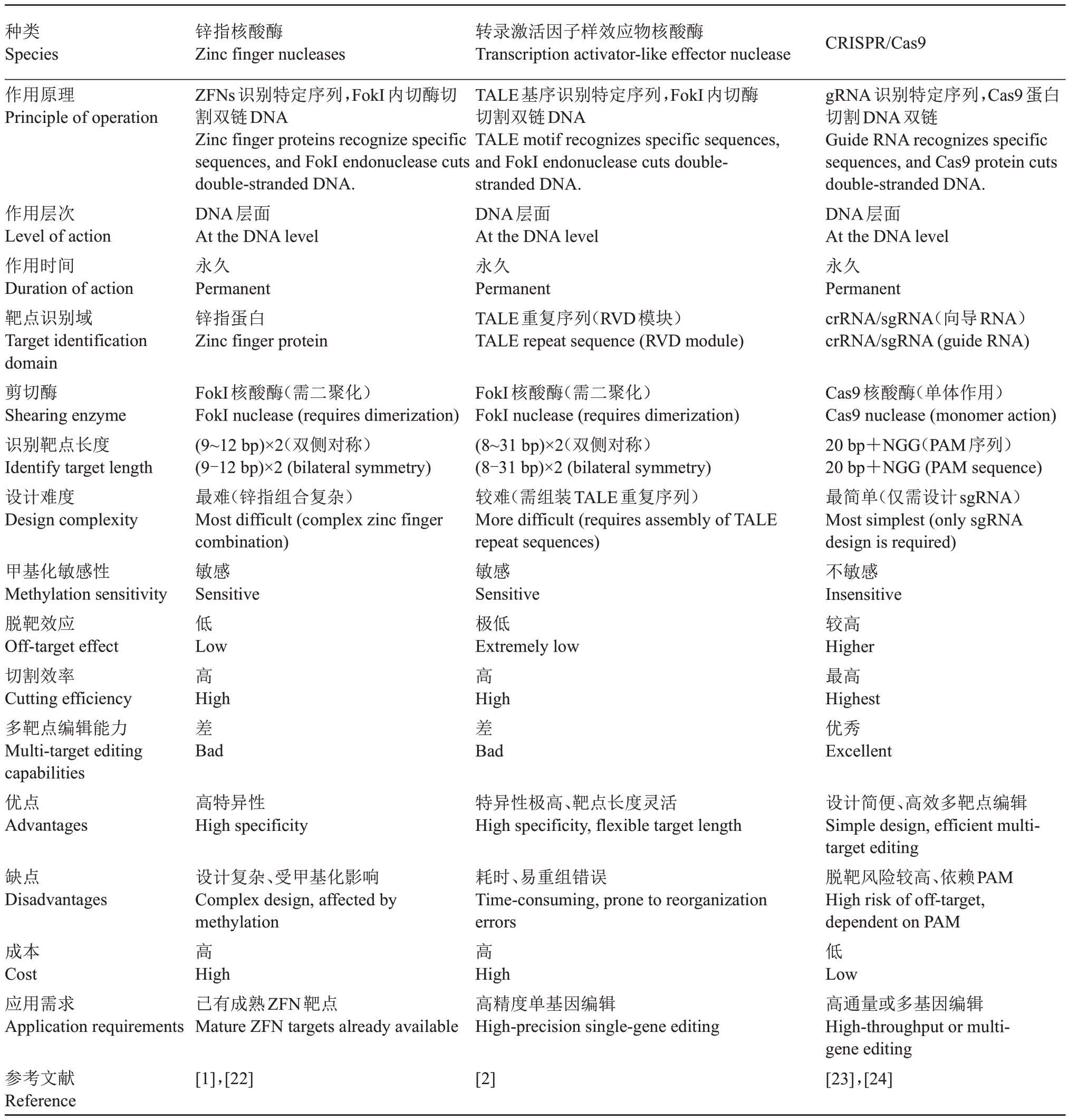
近年来,基因组编辑工具的开发与应用取得了显著进展。多种基因编辑技术相继出现,为基因功能研究提供了强大工具[1]。表1 归纳了锌指核酸酶(ZFNs)、转录激活因子样效应物核酸酶(TALENs)和CRISPR/Cas9 三代基因组编辑系统的原理及应用。研究人员正对不同工具的编辑活性、编辑范围及特异性等关键性能指标进行优化,使其应用场景更加广泛且技术体系日趋多样化。
表1 三代基因组编辑系统的原理及应用
Table 1 Principles and applications of three-generation genome editing systems
种类Species作用原理Principle of operation CRISPR/Cas9作用层次Level of action作用时间Duration of action靶点识别域Target identification domain剪切酶Shearing enzyme识别靶点长度Identify target length设计难度Design complexity锌指核酸酶Zinc finger nucleases ZFNs识别特定序列,FokI内切酶切割双链DNA Zinc finger proteins recognize specific sequences,and FokI endonuclease cuts double-stranded DNA.DNA层面At the DNA level永久Permanent锌指蛋白Zinc finger protein转录激活因子样效应物核酸酶Transcription activator-like effector nuclease TALE基序识别特定序列,FokI内切酶切割双链DNA TALE motif recognizes specific sequences,and FokI endonuclease cuts doublestranded DNA.DNA层面At the DNA level永久Permanent TALE重复序列(RVD模块)TALE repeat sequence(RVD module)gRNA识别特定序列,Cas9蛋白切割DNA双链Guide RNA recognizes specific sequences,and Cas9 protein cuts double-stranded DNA.DNA层面At the DNA level永久Permanent crRNA/sgRNA(向导RNA)crRNA/sgRNA(guide RNA)甲基化敏感性Methylation sensitivity脱靶效应Off-target effect切割效率Cutting efficiency多靶点编辑能力Multi-target editing capabilities优点Advantages FokI核酸酶(需二聚化)FokI nuclease(requires dimerization)(9~12 bp)×2(双侧对称)(9-12 bp)×2(bilateral symmetry)最难(锌指组合复杂)Most difficult(complex zinc finger combination)敏感Sensitive低Low高High差Bad FokI核酸酶(需二聚化)FokI nuclease(requires dimerization)(8~31 bp)×2(双侧对称)(8-31 bp)×2(bilateral symmetry)较难(需组装TALE重复序列)More difficult(requires assembly of TALE repeat sequences)敏感Sensitive极低Extremely low高High差Bad Cas9核酸酶(单体作用)Cas9 nuclease(monomer action)20 bp+NGG(PAM序列)20 bp+NGG(PAM sequence)最简单(仅需设计sgRNA)Most simplest(only sgRNA design is required)不敏感Insensitive较高Higher最高Highest优秀Excellent高特异性High specificity特异性极高、靶点长度灵活High specificity,flexible target length缺点Disadvantages成本Cost应用需求Application requirements设计复杂、受甲基化影响Complex design,affected by methylation高High已有成熟ZFN靶点Mature ZFN targets already available耗时、易重组错误Time-consuming,prone to reorganization errors高High高精度单基因编辑High-precision single-gene editing参考文献Reference[1],[22][2]设计简便、高效多靶点编辑Simple design,efficient multitarget editing脱靶风险较高、依赖PAM High risk of off-target,dependent on PAM低Low高通量或多基因编辑High-throughput or multigene editing[23],[24]
1.1 三代基因组编辑技术
20世纪末,锌指核酸酶和转录激活因子样效应物核酸酶的出现,首次实现了对特定DNA序列的靶向切割,但二者存在设计复杂、成本高、效率有限等问题,限制了大规模应用。锌指核酸酶(zinc finger nuclease,ZFN),作为人工改造的核酸内切酶,其锌指结构域可特异性地识别DNA 三联体序列。FokI核酸酶结构域则介导DNA 双链断裂(DSBs),该技术虽已在动物、植物和人类细胞中广泛应用,但FokI结构域二聚化易形成非特异性异源二聚体,导致脱靶效应和非预期DNA修饰,限制了应用效率[22]。虽然通过优化锌指模块连接接头等策略可部分提高其特异性,但在获得高精准度基因编辑产物方面仍面临挑战。TAL 效应因子核酸酶(TALEN)是基于植物病原菌黄单胞菌(Xanthomonas sp.)中的天然TAL效应因子开发的核酸内切酶。通过人工设计的TALE 蛋白与FokI 核酸酶融合,利用TALE 蛋白对DNA 序列的特异性识别能力实现靶向基因编辑[2]。与ZFNs 相比,TALENs 设计简便、可靶向任意DNA序列,但需为每个靶点碱基设计对应的TALE 识别模块,构建过程繁琐,限制了应用效率。CRISPR系统源于细菌抵抗噬菌体的适应性免疫机制,借助sgRNA 介导的DNA 靶向识别和Cas 蛋白的核酸酶活性实现基因组编辑[23]。相比ZFNs 和TALENs 技术,CRISPR/Cas9 利用RNA-DNA 识别机制的操作流程较为简化,编辑效率和特异性显著提高[24]。
1.2 新型基因组编辑工具
单碱基编辑器(base editors,BEs)无需DSBs 或外源DNA即可实现靶点精准突变,作用机制独立于同源重组修复(HDR)途径[25]。虽其在编辑效率、特异性和递送系统等方面有待改进,但因不依赖DSBs和外源DNA的特性,已成为植物基因组编辑中比传统HDR 更有效的工具[26-27],近年来在多种植物中展现出较高的编辑效率,为木本果树的精准分子育种提供了支持。
引导编辑器(prime editor,PE)为突破性的基因组编辑技术,无需DSBs 或外源模板即可实现12 种碱基替换及小片段编辑[28]。相比Cas核酸酶和BEs,PE的编辑范围更广且PAM序列限制更有限。通过优化植物引导编辑系统(PPE)的密码子、启动子和编辑条件,将植物编辑效率提升至21.8%,展现了其在木本果树育种和功能研究中的巨大潜力[29]。
2 CRISPR/Cas系统及其应用
1987 年,CRISPR 基因座在大肠杆菌中首次被发现,学者对大肠杆菌中的iap 酶进行了深入研究。在iap 基因下游的细菌DNA 中发现29 个核苷酸重复序列,且这些重复序列之间还交替分布着32个核苷酸非重复序列[30]。随着测序技术的进步,研究发现超过40%的细菌和90%的古细菌基因组中存在类似的模式[31]。2002—2009 年,与这些重复序列相关的大多数蛋白质被确认是一种获得性免疫机制的核心组分,可使细菌能够在遭受病毒(噬菌体)感染后保留记忆,并在再次感染时迅速产生强烈免疫反应[31],该防御机制的基本单元是细菌基因组中的CRISPR 阵列,由20~50 bp 的重复序列和独特的间隔序列交替组成。间隔区域记录了入侵噬菌体的基因组片段,与已有间隔序列匹配的外来DNA序列被称为原间隔序列。当遭受新的噬菌体感染时,噬菌体基因组中的新间隔序列会被添加到CRISPR阵列中,作为未来入侵的标记[32]。Cas 基因则位于CRISPR 基因附近或分散于基因组其他地方,能够在特定位置切割基因组中DNA;而CRISPR 系统中的gRNA 是一段与目标DNA 序列互补的RNA,能够引导Cas9蛋白到达指定位置。细胞在修复DNA的过程中,可能会引入突变或插入新基因片段,从而实现基因编辑。
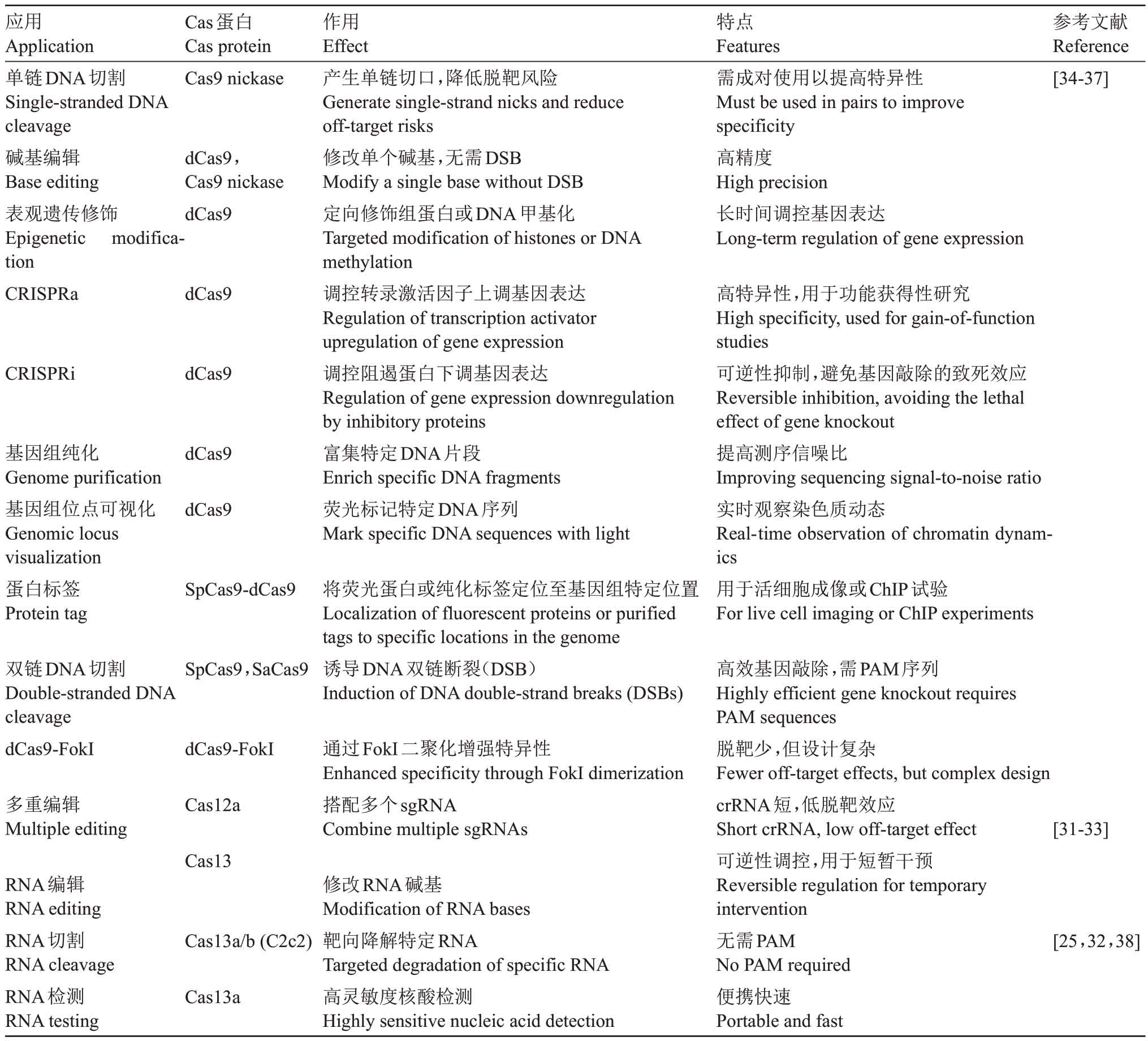
根据Cas蛋白的复杂程度,将CRISPR-Cas系统分为两大类。Ⅰ类:多个Cas蛋白组成的效应模块;Ⅱ类:RNA 介导的单一多结构域的Cas 蛋白系统。其中,第Ⅱ类系统(Ⅱ型Cas9、Ⅴ型Cas12 和Ⅵ型Cas13)在基因编辑中应用最为广泛[33]。不同Cas蛋白的核酸识别和切割特性为基因组精准编辑提供了多样选择。表2 归纳了不同类型CRISPR/Cas 系统的特点及应用。
表2 CRISPR-Cas 系统的应用
Table 2 Application of the CRISPR/Cas system
应用Application单链DNA切割Single-stranded DNA cleavage碱基编辑Base editing表观遗传修饰Epigenetic modification CRISPRa Cas蛋白Cas protein Cas9 nickase参考文献Reference[34-37]dCas9,Cas9 nickase dCas9特点Features需成对使用以提高特异性Must be used in pairs to improve specificity高精度High precision长时间调控基因表达Long-term regulation of gene expression dCas9 CRISPRi dCas9基因组纯化Genome purification基因组位点可视化Genomic locus visualization蛋白标签Protein tag dCas9 dCas9作用Effect产生单链切口,降低脱靶风险Generate single-strand nicks and reduce off-target risks修改单个碱基,无需DSB Modify a single base without DSB定向修饰组蛋白或DNA甲基化Targeted modification of histones or DNA methylation调控转录激活因子上调基因表达Regulation of transcription activator upregulation of gene expression调控阻遏蛋白下调基因表达Regulation of gene expression downregulation by inhibitory proteins富集特定DNA片段Enrich specific DNA fragments荧光标记特定DNA序列Mark specific DNA sequences with light SpCas9-dCas9高特异性,用于功能获得性研究High specificity,used for gain-of-function studies可逆性抑制,避免基因敲除的致死效应Reversible inhibition,avoiding the lethal effect of gene knockout提高测序信噪比Improving sequencing signal-to-noise ratio实时观察染色质动态Real-time observation of chromatin dynamics用于活细胞成像或ChIP试验For live cell imaging or ChIP experiments双链DNA切割Double-stranded DNA cleavage dCas9-FokI SpCas9,SaCas9将荧光蛋白或纯化标签定位至基因组特定位置Localization of fluorescent proteins or purified tags to specific locations in the genome诱导DNA双链断裂(DSB)Induction of DNA double-strand breaks(DSBs)dCas9-FokI多重编辑Multiple editing Cas12a通过FokI二聚化增强特异性Enhanced specificity through FokI dimerization搭配多个sgRNA Combine multiple sgRNAs [31-33]Cas13 RNA编辑RNA editing RNA切割RNA cleavage RNA检测RNA testing Cas13a/b(C2c2)[25,32,38]Cas13a修改RNA碱基Modification of RNA bases靶向降解特定RNA Targeted degradation of specific RNA高灵敏度核酸检测Highly sensitive nucleic acid detection高效基因敲除,需PAM序列Highly efficient gene knockout requires PAM sequences脱靶少,但设计复杂Fewer off-target effects,but complex design crRNA短,低脱靶效应Short crRNA,low off-target effect可逆性调控,用于短暂干预Reversible regulation for temporary intervention无需PAM No PAM required便携快速Portable and fast
2.1 不同类型CRISPR/Cas系统特点与应用
不同类型的CRISPR/Cas 系统作用机制与Cas9相似,但各具优势。Cas12(Ⅴ型系统)的crRNA 更短且蛋白分子质量更小,这有利于构建紧凑载体并进行多基因编辑,已应用于柑橘、苹果和葡萄等果树的精准基因组编辑[38]。Cas12b 体积更小且缺乏HNH结构域,表现出更低的脱靶效应和更高的靶标修饰敏感性[39]。此外,Cas12 在切割靶标DNA 后会激活非特异性单链DNA酶活性,已成功应用于核酸检测领域,通过切割荧光标记的报告分子实现信号输出[40]。Cas13(Ⅵ型系统)作为RNA 靶向效应蛋白,可非特异性地切割周围RNA 分子,基于此特性融合Cas13 与脱氨酶开发出RESCUE 等RNA 碱基编辑系统。这类技术不改变基因组序列,具有可逆性,既能瞬时调控基因表达,又可校正RNA 水平的突变,安全性优势显著。近年来,应用热点聚焦于病毒RNA 干扰领域,其中针对葡萄藤病毒A(grapevine virus A,GVA)的靶向干预成为代表性研究方向[41]。Cas14(Ⅶ型系统)是目前最小的效应蛋白之一,具有单链DNA 特异性的识别能力,其紧凑结构便于病毒载体递送,且不依赖PAM序列的特性显著扩展了靶向范围。2024 年,研究首次揭示Cas14 能够识别细胞内RNA 并调控基因表达[42]。Cas14R 通过检测miR156a 的表达水平来评估香蕉成熟度,为果树基因功能研究提供了高灵敏度工具[43]。
2.2 CRISPR/Cas9系统
CRISPR/Cas9系统是最早广泛应用的基于Ⅱ型原核CRISPR/Cas系统的一类基因编辑技术[44],本质上是微生物的适应性免疫反应,利用RNA引导的核酸酶对外源DNA 进行切割[32]。细菌的CRISPR/Cas9 系统由Cas9 核酸酶、CRISPR RNA(crRNA)和反式激活crRNA(trRNA)3 个部分组成。crRNA 和trRNA通过碱基配对形成复合物,将Cas9引导至与crRNA的20个核苷酸序列互补的靶位点;Cas9作为一种DNA核酸内切酶,具有2个核酸酶结构域HNH和RuvC,用于剪切目标双链DNA。HNH 结构域裂解互补链,而RuvC 结构域裂解相同链。除了序列互补性外,Cas9还需识别1个短的保守序列,即原始间隔区相邻基序(PAM),位于crRNA互补序列的3´端[34]。细菌CRISPR/Cas 免疫系统通过PAM 识别来区分自身和非自身序列[45]。为了简化系统,将trRNA 和crRNA 组合成单个向导RNA(sgRNA)。目前的CRISPR/Cas9系统是对细菌CRISPR/Cas9的改造,由修饰的Cas9 核酸内切酶和sgRNA 组成。CRISPR/Cas9 系统的功能依赖于RNA 序列的靶标特异性以及Cas9的分子能力。
CRISPR/Cas9系统已成功应用于多种单子叶和双子叶植物中[35,46-48]。若要在目标DNA中实现精准的基因敲除或基因组编辑,首先,在目标DNA 中选择合适的前间隔区序列;其次,设计有效的sgRNA并将其插入Cas9 表达载体。CRISPR/Cas9 介导的基因组编辑技术可以通过稳定转化或瞬时转化的方式应用于多种植物。其中,典型方法是由农杆菌介导的稳定转化,将包含T-DNA 的sgRNA/Cas9 转化到植物细胞中[49]。另外,聚乙二醇(PEG)和粒子轰击介导的瞬时转化,可将含sgRNA/Cas9 的质粒或核糖核蛋白(RNP)转化到植物细胞[50]。目前,已有多种商业化的CRISPR基因编辑载体可供选择,广泛应用于单子叶与双子叶植物的遗传学研究。Addgene(https://www.addgene.org/)平台通过向世界各地非营利性实验室提供载体和相关克隆数据,极大地促进了遗传物质的交流。Addgene平台已构建了1100多种植物特异性CRISPR载体。植物生物学家和研究人员只需将靶基因的原始间隔序列插入这些载体中,便可构建CRISPR介导的基因组编辑载体。
2.3 CRISPR/Cas9系统优化与新进展
CRISPR/Cas9 系统自2012 年应用以来,其作用机制、系统构建与突变体筛选策略经历了持续发展和优化。在实际应用中,研究者需要根据具体的研究目的和需求,选择适宜的操作方法,以提高编辑效率和准确性。
针对CRISPR/Cas9 系统产生的突变体,已开发出多种筛选方法。其中,聚合酶链式反应(PCR)结合限制性内切酶(RE)分析虽操作简单灵敏,但受限于靶序列附近可用的限制性内切酶位点;T7核酸内切酶Ⅰ(T7EⅠ)分析和Surveyor核酸酶分析因能识别并消化错配的异源双链DNA,适用于任何靶序列,已广泛应用;基于聚丙烯酰胺凝胶电泳(PAGE)的基因型分析,可通过天然PAGE 检测跨越突变位点的PCR 扩增产物形成异源双链体和同源双链体DNA;基于高分辨率熔解(HRM)分析的方法,利用熔解温度(Tm)的差异筛选诱变;临界温度退火PCR(ACT-PCR)结合实时荧光定量PCR技术,可准确定量培养细胞中的突变频率[23,36,51-54]。
在系统优化方面,最初使用的SpCas9蛋白因严格的NGG-PAM 限制而应用受限。2016—2018 年,开发的10 余种SpCas9 突变体拓展了PAM 识别范围,但编辑效率普遍下降。2017年发现的嗜热脂肪芽孢杆菌GeoCas9,虽具有优异热稳定性但编辑活性低;2024 年,通过蛋白质工程改造获得的iGeo-Cas9变体,在保持热稳定性的同时将编辑活性提升100 倍以上,为开发高性能基因编辑工具提供了新方向[37]。
近年来,CRISPR 系统的小型化研究取得重要进展。2015 年,张锋团队鉴定的Cas12a(约1300 个氨基酸)虽编辑活性略低于Cas9,但特异性更优;随后鉴定的Cas12f(400~700 个氨基酸)尤为突出。2021年多项研究证实,多个实验室开发的Cas12f变体不仅保持高效的编辑活性,还能包装至AAV载体中,为小型化基因编辑器的开发和应用提供了一个新的选择[37]。
3 CRISPR/Cas9编辑技术在木本果树中的应用
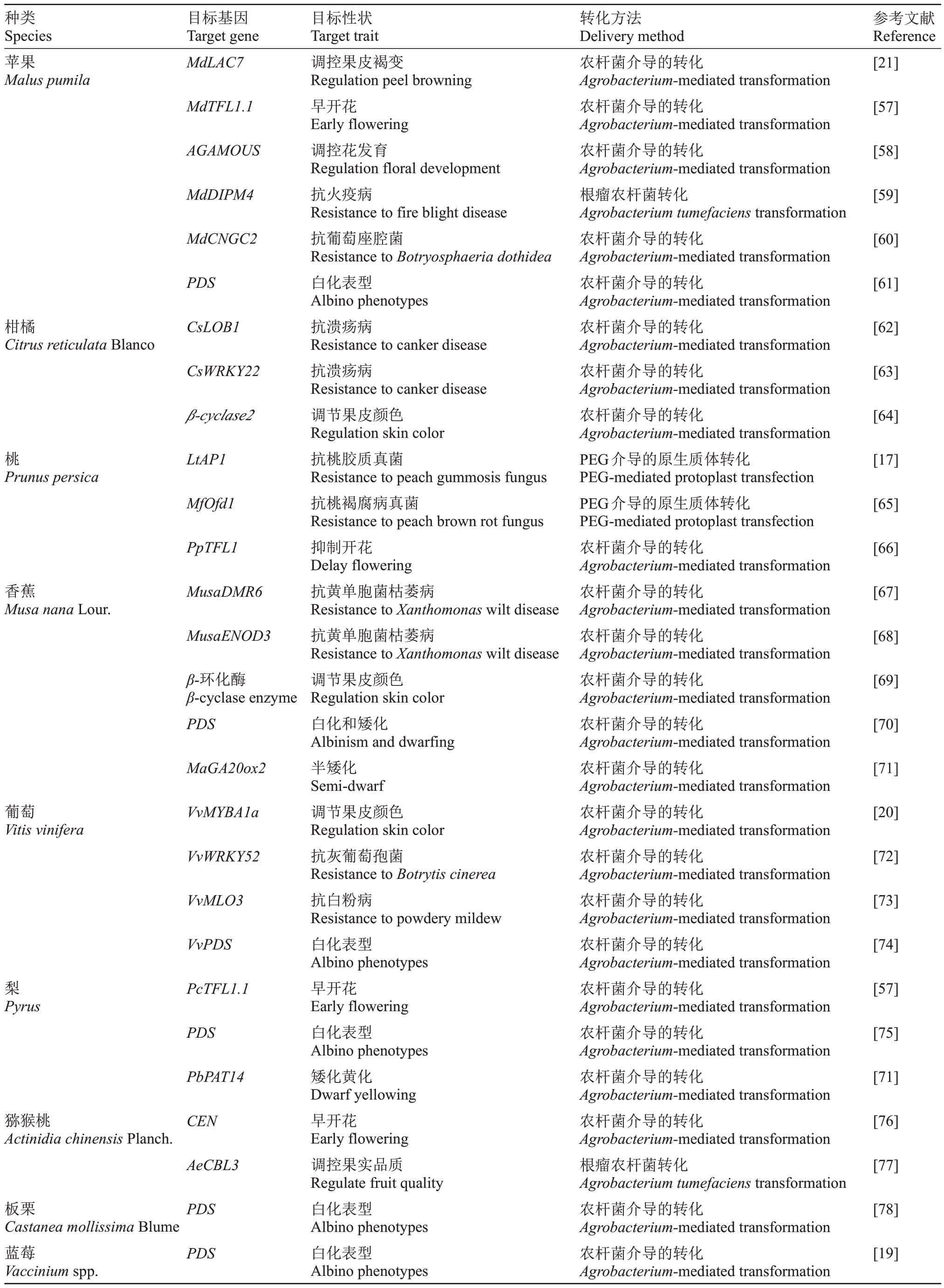
农业为生物体提供生存所需的物质基础,然而非生物和生物胁迫对全球农业构成了威胁。植物育种者一直致力于提高作物产量、品质、抗逆性和抗病性,以应对粮食短缺和环境退化等挑战[55]。CRISPR/Cas9基因组编辑技术已成为植物改良领域的一项成熟且前沿的生物技术工具,广泛应用于木本果树的性状改良,如花期、果实品质、发育和形态、病原体抗性等。图1 展示了CRISPR/Cas9 技术在木本果树育种过程中的关键作用[56]。CRISPR/Cas9介导的基因编辑技术已在苹果、梨、猕猴桃、香蕉、蓝莓和板栗等多种木本果树中成功应用(表3)。尽管CRISPR/Cas9技术在木本植物基因组编辑方面是一个新兴的研究领域,但目前相关报道较少,且缺乏系统总结。本文将回顾利用CRISPR/Cas9技术改良木本果树性状的研究现状与未来发展前景。
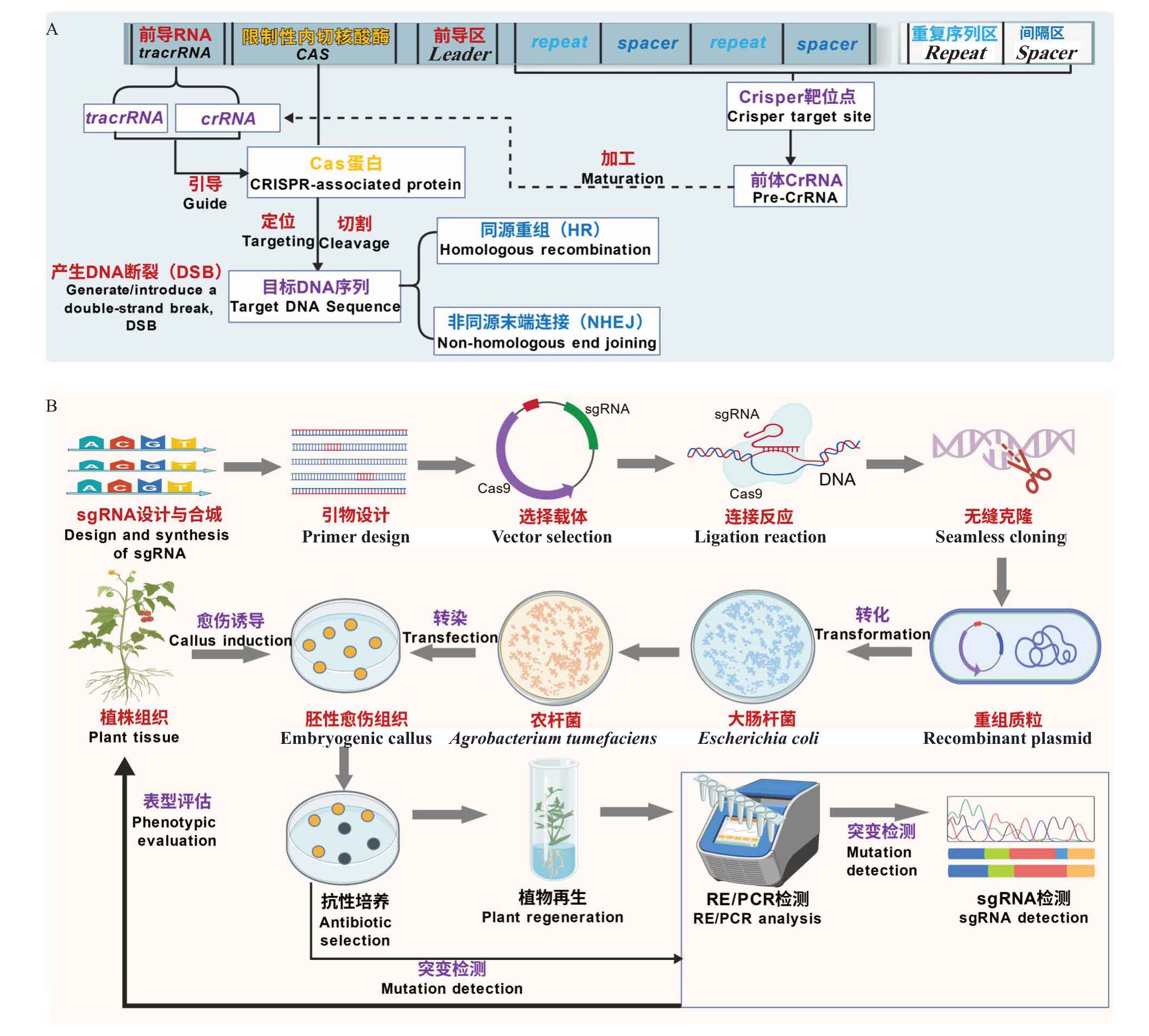
图1 CRISPR/Cas9 技术在木本果树育种流程中的作用
Fig.1 The role of CRISPR/Cas9 technology in the breeding process of woody fruit trees
A.CRISPR/Cas9 的组成和工作机制;B.CRISPR/Cas9 介导的木本果树基因编辑技术模式图。
A.Composition and working mechanism of CRISPR/Cas9;B.Schematic diagram of CRISPR/Cas9-mediated gene editing in woody fruit trees.
表3 CRISPR/Cas9 基因编辑技术在木本果树中的应用
Table 3 Application of CRISPR/Cas9 gene editing technology in woody fruit trees
种类Species苹果Malus pumila目标基因Target gene MdLAC7参考文献Reference[21]MdTFL1.1[57]AGAMOUS [58]MdDIPM4[59]MdCNGC2[60]PDS [61]柑橘Citrus reticulata Blanco CsLOB1[62]CsWRKY22[63]β-cyclase2[64]桃LtAP1[17]Prunus persica MfOfd1[65]PpTFL1[66]香蕉Musa nana Lour.MusaDMR6[67]MusaENOD3[68]β-环化酶β-cyclase enzyme PDS[69][70]MaGA20ox2[71]葡萄Vitis vinifera VvMYBA1a [20]VvWRKY52[72]VvMLO3[73]VvPDS [74]梨PcTFL1.1[57]Pyrus PDS [75]PbPAT14[71]猕猴桃Actinidia chinensis Planch.CEN [76]AeCBL3[77]板栗Castanea mollissima Blume蓝莓Vaccinium spp.PDS [78]PDS目标性状Target trait调控果皮褐变Regulation peel browning早开花Early flowering调控花发育Regulation floral development抗火疫病Resistance to fire blight disease抗葡萄座腔菌Resistance to Botryosphaeria dothidea白化表型Albino phenotypes抗溃疡病Resistance to canker disease抗溃疡病Resistance to canker disease调节果皮颜色Regulation skin color抗桃胶质真菌Resistance to peach gummosis fungus抗桃褐腐病真菌Resistance to peach brown rot fungus抑制开花Delay flowering抗黄单胞菌枯萎病Resistance to Xanthomonas wilt disease抗黄单胞菌枯萎病Resistance to Xanthomonas wilt disease调节果皮颜色Regulation skin color白化和矮化Albinism and dwarfing半矮化Semi-dwarf调节果皮颜色Regulation skin color抗灰葡萄孢菌Resistance to Botrytis cinerea抗白粉病Resistance to powdery mildew白化表型Albino phenotypes早开花Early flowering白化表型Albino phenotypes矮化黄化Dwarf yellowing早开花Early flowering调控果实品质Regulate fruit quality白化表型Albino phenotypes白化表型Albino phenotypes转化方法Delivery method农杆菌介导的转化Agrobacterium-mediated transformation农杆菌介导的转化Agrobacterium-mediated transformation农杆菌介导的转化Agrobacterium-mediated transformation根瘤农杆菌转化Agrobacterium tumefaciens transformation农杆菌介导的转化Agrobacterium-mediated transformation农杆菌介导的转化Agrobacterium-mediated transformation农杆菌介导的转化Agrobacterium-mediated transformation农杆菌介导的转化Agrobacterium-mediated transformation农杆菌介导的转化Agrobacterium-mediated transformation PEG介导的原生质体转化PEG-mediated protoplast transfection PEG介导的原生质体转化PEG-mediated protoplast transfection农杆菌介导的转化Agrobacterium-mediated transformation农杆菌介导的转化Agrobacterium-mediated transformation农杆菌介导的转化Agrobacterium-mediated transformation农杆菌介导的转化Agrobacterium-mediated transformation农杆菌介导的转化Agrobacterium-mediated transformation农杆菌介导的转化Agrobacterium-mediated transformation农杆菌介导的转化Agrobacterium-mediated transformation农杆菌介导的转化Agrobacterium-mediated transformation农杆菌介导的转化Agrobacterium-mediated transformation农杆菌介导的转化Agrobacterium-mediated transformation农杆菌介导的转化Agrobacterium-mediated transformation农杆菌介导的转化Agrobacterium-mediated transformation农杆菌介导的转化Agrobacterium-mediated transformation农杆菌介导的转化Agrobacterium-mediated transformation根瘤农杆菌转化Agrobacterium tumefaciens transformation农杆菌介导的转化Agrobacterium-mediated transformation农杆菌介导的转化Agrobacterium-mediated transformation[19]
3.1 调节果树花期
FT基因是决定开花时间的关键因子,而其拮抗剂TFL1 和CEN(CENTRORADIALIS)基因则是保守的开花抑制因子[79]。93%靶向MdTFL1.1 基因的苹果转基因品系和9%靶向PcTFL1.1基因的梨转基因品系均表现出早花现象[57]。在针对桃、李的研究中,学者构建了一种基于双病毒的GFP-Cas9 双gRNA载体pGEF-TFL1,并将其转化至胚外植体中,成功实现了对PpTFL1 基因的精准编辑;通过对转化后的胚外植体进行扩增子克隆和测序分析,证实了基因编辑的有效性。然而,这些转化胚外植体的基因型和表型特征还需进一步系统评估[66]。在猕猴桃中,通过CRISPR/Cas9 介导的CEN-like 候选基因诱变,成功培育出具有决定性快速开花特性的品系,使这类木本多年生果树能够在1 年内完成生命周期。另外,研究者发现使用U6-CEN4构建体进行基因组编辑是相对有效的策略,能够检测到较高的突变率[76]。在苹果中,利用CRISPR/Cas9 靶向花发育关键基因AG(AGAMOUS)的两个同源基因,结果显示总体编辑率较高,其中89%品系至少编辑了1 个目标等位基因,而37%品系则成功编辑了4 个等位基因[58]。
3.2 培育抗病虫害果树
通过设计针对苹果易感性相关蛋白MdDIPM4的sgRNA来介导Cas9对靶基因进行编辑,实现了高达75%的突变效率,并成功获得了火疫病易感性显著降低的植株[59]。在苹果中,敲除环核苷酸门控离子通道(CNGCs)的MdCNGC2 基因,可显著提高苹果愈伤组织和果实对葡萄座腔菌(Botryosphaeria dothidea)的抗性[60]。柑橘溃疡病的易感基因CsLOB1在促进病原体生长和脓疱形成方面发挥关键作用[80]。基于此,在葡萄柚和柑橘中对CsLOB1编码区进行突变,成功培育出抗溃疡病植株[62],并进一步证实CsWRKY22 能够在CsLOB1 上游发挥调控作用。CRISPR/Cas9介导的CsWRKY22基因编辑有效降低了万金城橙对柑橘黄单胞菌的易感性[63]。
在葡萄中,针对VvWRKY52 转录因子共设计了4种gRNA,通过Ⅱ型CRISPR/Cas9系统对葡萄悬浮细胞进行高效的基因组编辑,可增强对灰葡萄孢菌侵染的抗性[72]。鉴于白粉病的致病性依赖于功能性宿主MLO基因[81],利用CRISPR/Cas9技术靶向编辑2 个葡萄藤MLO 基因VvMLO3 和VvMLO4,成功获得了抗白粉病性增强的VvMLO3葡萄藤品系[73]。在草莓中,研究者基于Benihope 品种,建立了一种组织培养体系,并利用CRISPR/Cas9 编辑成功获得了其MLO 家族基因(Fvb7-1、Fvb7-2、Fvb7-3 及Fvb7-4)发生部分或全部编辑的植株[82]。通过整合同源重组和CRISPR/Cas9技术成功敲除MfOfd1基因,相比传统的PEG介导转化法,获得了更多转化体。与野生型相比,MfOfd1敲除转化体的分生孢子产量显著减少,推测MfOfd1基因可能会影响分生孢子相关基因的表达,从而导致分生孢子数量下降[65]。此外,利用该技术对桃胶质病相关基因LtAP1进行了功能表征,致病性测试结果表明,与野生型相比,突变体诱导的坏死病灶减小,树胶释放量减少,病原体生物量降低,这表明LtAP1 在桃树芽坏死真菌(L.theobromae)的生长和毒力中发挥重要作用[17]。通过农杆菌介导的胚发生细胞转化体系,利用多重CRISPR/Cas9技术成功敲除香蕉MusaDMR6和MusaENOD3基因。结果表明,突变体对黄单胞菌引起的枯萎病表现出更高的抗性,并且未观察到任何形态学缺陷[67-68]。除了MusaDMR6和MusaENOD3之外,为进一步发掘更多抗病靶点,通过对黄单胞菌枯萎病敏感品种与抗性野生品种进行RNA-seq对比分析,鉴定出多个潜在基因,这些基因均可通过CRISPR/Cas9 技术进行编辑以增强对黄单胞菌枯萎病的抗性[83]。
3.3 改善果实的品质
果皮褐变是一种自然生理现象,但会影响果实的外观品质。利用CRISPR/Cas9 技术敲除苹果果实和愈伤组织中的MdLAC7 基因,可有效抑制果皮褐变,从而提高果实品质[21]。基因组编辑技术已应用于提高果实品质,部分研究聚焦于番茄红素的积累途径,相关报道表明通过编辑相关基因促进番茄红素生物合成,可抑制番茄红素向β-胡萝卜素和α-胡萝卜素的转化[84-85]。通过编辑香蕉中的β-环化酶基因,培育出富含β-胡萝卜素的香蕉品种[69]。在梨的研究中,利用CRISPR/Cas9技术编辑Grand Naine品种中的番茄红素ε 环化酶(LCYε)基因,可显著提高果肉中β-胡萝卜素含量,其积累量(24 μg·g-1)较未编辑植物增加了约6 倍[69]。此外,在甜橙中通过双sgRNA策略靶向编辑β-LCY2获得功能丧失突变体,促进了番茄红素的积累[64]。在猕猴桃中,通过根茎曲霉介导的CRISPR/Cas9 系统编辑CEN4 和AeCBL3,编辑效率分别达到55%和50%。表型分析结果表明,过表达AeCBL3 可促进CaOx 晶体形成,而敲除AeCBL3则显著抑制晶体形成[77]。
果实颜色通常由果皮中的花青素决定。在葡萄中,通过CRISPR/Cas9 技术介导的长末端重复序列(LTR)切割,可切除葡萄反转录转座子Gret1,从而抑制与花青素生物合成相关的VvMYBA1 转录因子的表达。然而,在经编辑的植株叶片中仍能检测到Gret1残留,表明这些基因编辑植株是Gret1切除和未切除细胞的嵌合体。因此,为了获得红皮葡萄果实,必须在VvMYBA1a启动子区域获得不含Gret1的非嵌合植株[20]。在优化的CRISPR/Cas9 载体中,zCas9 由2 个串联的组成型35S 启动子驱动,2 个sgRNA 分别由拟南芥U6-26 和U6-29 启动子驱动。在栽培草莓中,该载体已被证明能够有效敲除多个RAP同源基因,从而导致果实颜色变为白色[86-87]。
3.4 诱导果树产生白化表型
PDS 基因的缺失会导致叶绿素、类胡萝卜素和赤霉素生物合成受阻从而导致植株产生白化和侏儒表型,因此可作为基因组编辑的可见标记[87]。在苹果中,首次在砧木JM2中成功敲除PDS基因,通过将Cas9蛋白置于CaMV35S启动子驱动下,并将多种长度(18 bp或20 bp)的gRNA置于AtU6-1启动子驱动下进行表达,试验获得了31.8%的白化表型编辑效率[61]。同时,研究使用分别由苹果U3和U6启动子驱动的两个gRNA,对MdPDS基因进行靶向编辑,结果显示85%的转基因苹果品系出现了典型的白化表型[57]。在香蕉中,利用CRISPR/Cas9 技术敲除PDS基因,63%的植株发生三等位基因的破坏性修饰,并出现白化病和矮化现象[70]。目前,CRISPR/Cas9介导的PDS基因敲除已在多种果树作物中成功诱导出白化表型,如葡萄[74]、板栗[78]、蓝莓[19]和梨[75]。
3.5 诱导果树产生矮化表型
鉴于矮化砧木能够简化果园管理并降低生产成本,培育优良矮化砧木并阐明其矮化机制已成为研究焦点。在梨的研究中,通过构建PbPAT1基因敲除突变体pbpat14,发现其矮化和黄化表型与细胞数量减少、叶绿素含量下降有关,该过程受脱落酸积累调控[88]。此外,在香蕉中,则利用分别由香蕉U3 和U6a 启动子驱动的双gRNA 编辑系统,对Ma-GA20ox2 基因进行有效编辑,成功获得了半矮化突变体[71]。
4 结论和展望
CRISPR/Cas9基因编辑技术为木本果树的研究和改良提供了强大推动力。该技术不仅为基因功能研究提供了高效工具,通过精确敲除或修饰特定基因,深入揭示其在木本植物生长发育、抗逆性等过程中的作用机制;同时在性状改良方面也发挥了重要作用,能够调控木本植物生长特性、增强抗逆性及提升果实品质。与传统的基因编辑技术相比,CRISPR/Cas9 技术具有更高的编辑效率和准确性,能够在较短时间内获得大量编辑植株,同时减少非特异性影响进而选择理想的生物性状。合理利用CRISPR/Cas9 技术编辑与植物激素合成、花器官发育和果实发育等相关基因,可进一步提高木本果树的产量。
尽管CRISPR/Cas9 基因编辑在木本果树的应用方面展现出巨大的潜力,但由于木本果树生长周期长、基因组复杂、多胚性、高杂合性、自交不亲和以及遗传转化系统具有基因型特异性等特点,该技术在木本果树中的应用仍存在一些挑战亟待克服。
4.1 提高基因编辑效率
CRISPR/Cas9技术在木本果树中的应用受到基因组复杂性的显著影响,物种间编辑效率的差异主要源于sgRNA靶向效率、染色体结构特征和表观遗传特异性,以及物种的遗传特性等。为克服这些挑战,当前研究重点聚焦于CRISPR/Cas9 表达系统的优化、编辑效率的提升以及编辑特异性的增强等关键策略。
4.2 提高遗传转化体系的效率
木本果树遗传转化体系的发展呈现显著的不均衡性:桃、李等核果类已初步建立遗传转化体系但尚未成熟,柑橘、葡萄、苹果和梨等遗传转化体系相对完善,而油梨、番石榴、莲雾和杨桃等优稀果树的遗传转化体系则明显滞后。当前农杆菌介导的遗传转化技术普遍面临体细胞再生效率低和转化周期长的瓶颈。未来研究应着力构建基于原生质体瞬时表达的编辑效率预筛系统,开发纳米载体或病毒载体等新型递送技术,并同步优化体细胞再生体系,从而系统提升遗传转化效率。
4.3 降低脱靶效率
CRISPR/Cas9系统在果树基因组编辑中仍面临脱靶效应引发的安全性问题。通过优化sgRNA 设计、采用高保真Cas 突变体及完善脱靶检测技术可有效降低非靶标编辑风险。未来研究需重点突破复杂性状基因调控网络解析和多基因同步编辑技术,在确保编辑安全性的同时提升木本果树育种精准度。
4.4 突破基因编辑果树的商业困境
目前,基因编辑水果的商业化应用仍面临多重挑战,主要包括国际监管政策差异导致的技术推广障碍、精准编辑技术仍需完善的系统性安全评估要求以及决定市场接受度的公众认知水平。上述问题的解决需要建立统一的国际监管框架,开展严谨的安全性验证研究,并通过多方协作的科普宣传提升公众理解与接受度。只有在监管协调、安全评估和公众认知三个关键维度实现突破,才能推动基因编辑水果的广泛应用。
4.5 开发T-DNA free的基因编辑方法
木本果树因多年生和多倍体特性,难以通过传统杂交育种技术去除CRISPR/Cas9转基因元件。目前,热激诱导的FLP/FRT 重组系统是当前最主要的可有效去除T-DNA 的技术,能获得仅含微量外源DNA的编辑植株。因此,开发高效的转基因去除技术对推动果树基因组编辑应用至关重要,是实现无转基因编辑果树商业化种植的关键前提。
[1] WADA N,UETA R,OSAKABE Y,OSAKABE K.Precision genome editing in plants:State-of-the-art in CRISPR/Cas9-based genome engineering[J].BMC Plant Biology,2020,20(1):234.
[2] JINEK M,CHYLINSKI K,FONFARA I,HAUER M,DOUDNA J A,CHARPENTIER E.A programmable dual-RNA-guided DNA endonuclease in adaptive bacterial immunity[J]. Science,2012,337(6096):816-821.
[3] EL-MOUNADI K,MORALES-FLORIANO M L,GARCIARUIZ H. Principles,applications,and biosafety of plant genome editing using CRISPR-Cas9[J].Frontiers in Plant Science,2020,11:56.
[4] BOUBAKRI H. Recent progress in CRISPR/Cas9-based genome editing for enhancing plant disease resistance[J]. Gene,2023,866:147334.
[5] ABDULLA M F,MOSTAFA K,KAVAS M. CRISPR/Cas9-mediated mutagenesis of FT/TFL1 in petunia improves plant architecture and early flowering[J]. Plant Molecular Biology,2024,114(3):69.
[6] GUO Y X,ZHAO G D,GAO X,ZHANG L,ZHANG Y N,CAI X M,YUAN X J,GUO X Q.CRISPR/Cas9 gene editing technology:A precise and efficient tool for crop quality improvement[J].Planta,2023,258(2):36.
[7] MIRANDA S,PIAZZA S,NUZZO F,LI M G,LAGRÈZE J,MITHÖFER A,CESTARO A,TARKOWSKA D,ESPLEY R,DARE A,MALNOY M,MARTENS S. CRISPR/Cas9 genomeediting applied to MdPGT1 in apple results in reduced foliar phloridzin without impacting plant growth[J].The Plant Journal,2023,113(1):92-105.
[8] FENG Z Y,ZHANG B T,DING W N,LIU X D,YANG D L,WEI P L,CAO F Q,ZHU S H,ZHANG F,MAO Y F,ZHU J K. Efficient genome editing in plants using a CRISPR/Cas system[J].Cell Research,2013,23(10):1229-1232.
[9] LI J F,NORVILLE J E,AACH J,MCCORMACK M,ZHANG D D,BUSH J,CHURCH G M,SHEEN J.Multiplex and homologous recombination-mediated genome editing in Arabidopsis and Nicotiana benthamiana using guide RNA and Cas9[J]. Nature Biotechnology,2013,31(8):688-691.
[10] NEKRASOV V,STASKAWICZ B,WEIGEL D,JONES J D G,KAMOUN S. Targeted mutagenesis in the model plant Nicotiana benthamiana using Cas9 RNA-guided endonuclease[J]. Nature Biotechnology,2013,31(8):691-693.
[11] SHAN Q W,WANG Y P,LI J,ZHANG Y,CHEN K L,LIANG Z,ZHANG K,LIU J X,XI J J,QIU J L,GAO C X.Targeted genome modification of crop plants using a CRISPR-Cas system[J].Nature Biotechnology,2013,31(8):686-688.
[12] XIE K B,YANG Y N.RNA-guided genome editing in plants using a CRISPR-Cas system[J].Molecular Plant,2013,6(6):1975-1983.
[13] MIKI D,ZINTA G,ZHANG W X,PENG F N,FENG Z Y,ZHU J K.CRISPR/Cas9-based genome editing toolbox for Arabidopsis thaliana[J]. Methods in Molecular Biology,2021,2200:121-146.
[14] CHANG Y Z,LIU B L,JIANG Y Y,CAO D,LIU Y J,LI Y.Induce male sterility by CRISPR/Cas9-mediated mitochondrial genome editing in tobacco[J].Functional&Integrative Genomics,2023,23(3):205.
[15] CHANDRASEKARAN M,BOOPATHI T,PARAMASIVAN M.A status-quo review on CRISPR-Cas9 gene editing applications in tomato[J].International Journal of Biological Macromolecules,2021,190:120-129.
[16] IMRAN M,SHAFIQ S,TANG X R.CRISPR-Cas9-mediated editing of BADH2 gene triggered fragrance revolution in rice[J].Physiologia Plantarum,2023,175(1):e13871.
[17] ZHANG H,SHEN W Q,ZHANG D M,SHEN X Y,WANG F,HSIANG T,LIU J W,LI G H. The bZIP transcription factor LtAP1 modulates oxidative stress tolerance and virulence in the peach gummosis fungus Lasiodiplodia theobromae[J]. Frontiers in Microbiology,2021,12:741842.
[18] ELSHARAWY H,REFAT M. CRISPR/Cas9 genome editing in wheat:Enhancing quality and productivity for global food security:A review[J]. Functional & Integrative Genomics,2023,23(3):265.
[19] VAIA G,PAVESE V,MOGLIA A,CRISTOFORI V,SILVESTRI C. Knockout of phytoene desaturase gene using CRISPR/Cas9 in highbush blueberry[J].Frontiers in Plant Science,2022,13:1074541.
[20] NAKAJIMA I,KAWAHIGASHI H,NISHITANI C,AZUMAA,HAJI T,TOKI S,ENDO M. Targeted deletion of grape retrotransposon associated with fruit skin color via CRISPR/Cas9 in Vitis labrascana‘Shine Muscat’[J]. PLoS One,2023,18(6):e0286698.
[21] WANG H,ZHANG S H,FU Q Q,WANG Z D,LIU X J,SUN L L,ZHAO Z Y.Transcriptomic and metabolomic analysis reveals a protein module involved in preharvest apple peel browning[J].Plant Physiology,2023,192(3):2102-2122.
[22] SZCZEPEK M,BRONDANI V,BÜCHEL J,SERRANO L,SEGAL D J,CATHOMEN T.Structure-based redesign of the dimerization interface reduces the toxicity of zinc-finger nucleases[J].Nature Biotechnology,2007,25(7):786-793.
[23] CONG L,RAN F A,COX D,LIN S L,BARRETTO R,HABIB N,HSU P D,WU X B,JIANG W Y,MARRAFFINI L A,ZHANG F. Multiplex genome engineering using CRISPR/Cas systems[J].Science,2013,339(6121):819-823.
[24] RICHTER H,RANDAU L,PLAGENS A. Exploiting CRISPR/Cas:Interference mechanisms and applications[J]. International Journal of Molecular Sciences,2013,14(7):14518-14531.
[25] CHENG H T,HAO M Y,DING B L,MEI D S,WANG W X,WANG H,ZHOU R J,LIU J,LI C,HU Q. Base editing with high efficiency in allotetraploid oilseed rape by A3A-PBE system[J].Plant Biotechnology Journal,2021,19(1):87-97.
[26] ZHAO D D,LI J,LI S W,XIN X Q,HU M Z,PRICE M A,ROSSER S J,BI C H,ZHANG X L. Glycosylase base editors enable C-to-A and C-to-G base changes[J].Nature Biotechnology,2021,39(1):35-40.
[27] YAO T,YUAN G L,LU H W,LIU Y,ZHANG J,TUSKAN G A,MUCHERO W,CHEN J G,YANG X H. CRISPR/Cas9-based gene activation and base editing in Populus[J]. Horticulture Research,2023,10(6):uhad085.
[28] LIU T T,ZOU J P,YANG X,WANG K J,RAO Y C,WANG C.Development and application of prime editing in plants[J]. Rice Science,2023,30(6):509-522.
[29] LIN Q P,ZONG Y,XUE C X,WANG S X,JIN S,ZHU Z X,WANG Y P,ANZALONE A V,RAGURAM A,DOMAN J L,LIU D R,GAO C X.Prime genome editing in rice and wheat[J].Nature Biotechnology,2020,38(5):582-585.
[30] ISHINO Y,SHINAGAWA H,MAKINO K,AMEMURA M,NAKATA A. Nucleotide sequence of the iap gene,responsible for alkaline phosphatase isozyme conversion in Escherichia coli,and identification of the gene product[J].Journal of Bacteriology,1987,169(12):5429-5433.
[31] MOJICA F J M,DÍEZ-VILLASEÑOR C,SORIA E,JUEZ G.Biological significance of a family of regularly spaced repeats in the genomes of archaea,bacteria and mitochondria[J]. Molecular Microbiology,2000,36(1):244-246.
[32] SINGH A,CHAKRABORTY D,MAITI S. CRISPR/Cas9:A historical and chemical biology perspective of targeted genome engineering[J]. Chemical Society Reviews,2016,45(24):6666-6684.
[33] KOONIN E V,MAKAROVA K S,ZHANG F. Diversity,classification and evolution of CRISPR-Cas systems[J].Current Opinion in Microbiology,2017,37:67-78.
[34] MOJICA F J M,DÍEZ-VILLASEÑOR C,GARCÍA-MARTÍNEZ J,ALMENDROS C. Short motif sequences determine the targets of the prokaryotic CRISPR defence system[J]. Microbiology,2009,155(Pt 3):733-740.
[35] HASSAN M M,ZHANG Y X,YUAN G L,DE K,CHEN J G,MUCHERO W,TUSKAN G A,QI Y P,YANG X H. Construct design for CRISPR/Cas-based genome editing in plants[J].Trends in Plant Science,2021,26(11):1133-1152.
[36] HUA Y F,WANG C,HUANG J,WANG K J.A simple and efficient method for CRISPR/Cas9-induced mutant screening[J].Journal of Genetics and Genomics,2017,44(4):207-213.
[37] CHEN K,HAN H S,ZHAO S,XU B,YIN B Y,LAWANPRASERT A,TRINIDAD M,BURGSTONE B W,MURTHY N,DOUDNA J A. Lung and liver editing by lipid nanoparticle delivery of a stable CRISPR-Cas9 ribonucleoprotein[J]. Nature Biotechnology,2025,43(9):1445-1457.
[38] REN C,GATHUNGA E K,LI X,LI H Y,KONG J H,DAI Z W,LIANG Z C. Efficient genome editing in grapevine using CRISPR/LbCas12a system[J]. Molecular Horticulture,2023,3(1):21.
[39] MANGHWAR H,LINDSEY K,ZHANG X L,JIN S X. CRISPR/Cas system:Recent advances and future prospects for genome editing[J]. Trends in Plant Science,2019,24(12):1102-1125.
[40] WU F,QIAO X Y,ZHAO Y F,ZHANG Z Y,GAO Y F,SHI L F,DU H K,WANG L L,ZHANG Y J,ZHANG Y,LIU L Y,WANG Q,KONG D J. Targeted mutagenesis in Arabidopsis thaliana using CRISPR-Cas12b/C2c1[J]. Journal of Integrative Plant Biology,2020,62(11):1653-1658.
[41] SPENCER K P,BURGER J T,CAMPA M. CRISPR-based resistance to grapevine virus A[J]. Frontiers in Plant Science,2023,14:1296251.
[42] YANG J,LI X,HE Q Q,WANG X S,TANG J J,WANG T Y,ZHANG Y,YU F Y,ZHANG S Q,LIU Z K,ZHANG L L,LIAO F M,YIN H,ZHAO H Y,DENG Z Q,ZHANG H.Structural basis for the activity of the type VII CRISPR-Cas system[J].Nature,2024,633(8029):465-472.
[43] YANG H,CHEN J B,YANG S,ZHANG T,XIA X H,ZHANG K X,DENG S,HE G P,GAO H,HE Q,DENG R J. CRISPR/Cas14a-based isothermal amplification for profiling plant microRNAs[J].Analytical Chemistry,2021,93(37):12602-12608.
[44] GARNEAU J E,DUPUIS M È,VILLION M,ROMERO D A,BARRANGOU R,BOYAVAL P,FREMAUX C,HORVATH P,MAGADÁN A H,MOINEAU S.The CRISPR/Cas bacterial immune system cleaves bacteriophage and plasmid DNA[J]. Nature,2010,468(7320):67-71.
[45] DOUDNA J A,CHARPENTIER E.The new frontier of genome engineering with CRISPR-Cas9[J]. Science,2014,346(6213):1258096.
[46] YUE J J,HONG C Y,WEI P C,TSAI Y C,LIN C S. How to start your monocot CRISPR/Cas project:Plasmid design,efficiency detection,and offspring analysis[J].Rice,2020,13(1):9.
[47] 崔娜,姚佳羽,张杨,于洋,张彤彤,商亦聪,庞舒予,范海延.植物中CRISPR/Cas 系统的应用研究进展[J].西北植物学报,2017,37(1):196-202.CUI Na,YAO Jiayu,ZHANG Yang,YU Yang,ZHANG Tongtong,SHANG Yicong,PANG Shuyu,FAN Haiyan. Research progress of CRISPR/Cas system in plant[J].Acta Botanica Boreali-Occidentalia Sinica,2017,37(1):196-202.
[48] 何玉坤,欧阳嫣惟,张秀梅,林文秋,潘晓璐,张红娜.CRISPR/Cas9 基因编辑技术在果树作物中的应用研究进展[J].果树学报,2022,39(5):870-881.HE Yukun,OUYANG Yanwei,ZHANG Xiumei,LIN Wenqiu,PAN Xiaolu,ZHANG Hongna. Application of CRISPR/Cas9 gene editing technology in fruit trees[J]. Journal of Fruit Science,2022,39(5):870-881.
[49] MIKI D,ZHANG W X,ZENG W J,FENG Z Y,ZHU J K.CRISPR/Cas9-mediated gene targeting in Arabidopsis using sequential transformation[J]. Nature Communications,2018,9:1967.
[50] ZHANG Z J,MAO Y F,HA S,LIU W S,BOTELLA J R,ZHU J K.A multiplex CRISPR/Cas9 platform for fast and efficient editing of multiple genes in Arabidopsis[J]. Plant Cell Reports,2016,35(7):1519-1533.
[51] MONTGOMERY J,WITTWER C T,PALAIS R,ZHOU L M.Simultaneous mutation scanning and genotyping by high-resolution DNA melting analysis[J]. Nature Protocols,2007,2(1):59-66.
[52] SHAN Q W,WANG Y P,LI J,GAO C X. Genome editing in rice and wheat using the CRISPR/Cas system[J]. Nature Protocols,2014,9(10):2395-2410.
[53] THOMAS H R,PERCIVAL S M,YODER B K,PARANT J M.High-throughput genome editing and phenotyping facilitated by high resolution melting curve analysis[J]. PLoS One,2014,9(12):e114632.
[54] ZHU X X,XU Y J,YU S S,LU L,DING M Q,CHENG J,SONG G X,GAO X,YAO L M,FAN D D,MENG S,ZHANG X W,HU S D,TIAN Y.An efficient genotyping method for genome-modified animals and human cells generated with CRISPR/Cas9 system[J].Scientific Reports,2014,4:6420.
[55] ZHANG Q F. Strategies for developing green super rice[J]. Proceedings of the National Academy of Sciences of the United States of America,2007,104(42):16402-16409.
[56] JIANG S,LI H Q,ZHANG L,MU W P,ZHANG Y,CHEN T J,WU J X,TANG H Y,ZHENG S X,LIU Y F,WU Y X,LUO X T,XIE Y B,REN J. Generic diagramming platform (GDP):A comprehensive database of high-quality biomedical graphics[J].Nucleic Acids Research,2025,53(D1):D1670-D1676.
[57] CHARRIER A,VERGNE E,DOUSSET N,RICHER A,PETITEAU A,CHEVREAU E. Efficient targeted mutagenesis in apple and first time edition of pear using the CRISPR-Cas9 system[J].Frontiers in Plant Science,2019,10:40.
[58] JACOBSON S,BONDARCHUK N,NGUYEN T A,CANADA A,MCCORD L,ARTLIP T S,WELSER P,KLOCKO A L.Apple CRISPR-Cas9-a recipe for successful targeting of AGAMOUS-like genes in domestic apple[J]. Plants,2023,12(21):3693.
[59] POMPILI V,DALLA COSTA L,PIAZZA S,PINDO M,MALNOY M.Reduced fire blight susceptibility in apple cultivars using a high-efficiency CRISPR/Cas9-FLP/FRT-based gene editing system[J]. Plant Biotechnology Journal,2020,18(3):845-858.
[60] ZHOU H J,BAI S H,WANG N,SUN X H,ZHANG Y G,ZHU J,DONG C H. CRISPR/Cas9- mediated mutagenesis of MdCNGC2 in apple callus and VIGS-mediated silencing of MdCNGC2 in fruits improve resistance to Botryosphaeria dothidea[J].Frontiers in Plant Science,2020,11:575477.
[61] QIN G J,GU H Y,MA L G,PENG Y B,DENG X W,CHEN Z L,QU L J. Disruption of phytoene desaturase gene results in albino and dwarf phenotypes in Arabidopsis by impairing chlorophyll,carotenoid,and gibberellin biosynthesis[J]. Cell Research,2007,17(5):471-482.
[62] PENG A H,CHEN S C,LEI T G,XU L Z,HE Y R,WU L,YAO L X,ZOU X P. Engineering canker- resistant plants through CRISPR/Cas9- targeted editing of the susceptibility gene CsLOB1 promoter in citrus[J]. Plant Biotechnology Journal,2017,15(12):1509-1519.
[63] LONG Q,DU M X,LONG J H,XIE Y,ZHANG J Y,XU L Z,HE Y R,LI Q,CHEN S C,ZOU X P. Transcription factor WRKY22 regulates canker susceptibility in sweet orange (Citrus sinensis Osbeck) by enhancing cell enlargement and Cs-LOB1 expression[J].Horticulture Research,2021,8:50.
[64] SALONIA F,CIACCIULLI A,PAPPALARDO H D,POLES L,PINDO M,LARGER S,CARUSO P,CARUSO M,LICCIARDELLO C. A dual sgRNA-directed CRISPR/Cas9 construct for editing the fruit-specific β-cyclase 2 gene in pigmented citrus fruits[J].Frontiers in Plant Science,2022,13:975917.
[65] ZHANG M M,WANG Z Q,XU X,HUANG S,YIN W X,LUO C X. MfOfd1 is crucial for stress responses and virulence in the peach brown rot fungus Monilinia fructicola[J].Molecular Plant Pathology,2020,21(6):820-833.
[66] VERGARA R,OLIVARES F,OLMEDO B,TORO C,MUÑOZ M,ZÚÑIGA C,MORA R,PLANTAT P,MICCONO M,LOYOLA R,AGUIRRE C,PRIETO H. Gene editing in Prunus Spp.:The challenge of adapting regular gene transfer procedures for precision breeding[M]//KÜDEN A B,KÜDEN A.Prunus-Recent Advances.London:IntechOpen,2022.
[67] TRIPATHI J N,NTUI V O,SHAH T,TRIPATHI L. CRISPR/Cas9-mediated editing of DMR6 orthologue in banana (Musa spp.) confers enhanced resistance to bacterial disease[J]. Plant Biotechnology Journal,2021,19(7):1291-1293.
[68] NTUI V O,TRIPATHI J N,SHAH T,TRIPATHI L. Targeted knockout of early nodulin-like 3 (MusaENODL3) gene in banana reveals its function in resistance to Xanthomonas wilt disease[J].Plant Biotechnology Journal,2024,22(5):1101-1112.
[69] KAUR N,ALOK A,KUMAR P,KAUR N,AWASTHI P,CHATURVEDI S,PANDEY P,PANDEY A,PANDEY A K,TIWARI S. CRISPR/Cas9 directed editing of lycopene epsilon-cyclase modulates metabolic flux for β-carotene biosynthesis in banana fruit[J].Metabolic Engineering,2020,59:76-86.
[70] NISHITANI C,HIRAI N,KOMORI S,WADA M,OKADA K,OSAKABE K,YAMAMOTO T,OSAKABE Y. Efficient genome editing in apple using a CRISPR/Cas9 system[J]. Scientific Reports,2016,6:31481.
[71] PANG H G,YAN Q,ZHAO S L,HE F,XU J F,QI B X,ZHANG Y X. Knockout of the S-acyltransferase gene,Pb-PAT14,confers the dwarf yellowing phenotype in first generation pear by ABA accumulation[J]. International Journal of Molecular Sciences,2019,20(24):6347.
[72] WANG X H,TU M X,WANG D J,LIU J W,LI Y J,LI Z,WANG Y J,WANG X P. CRISPR/Cas9-mediated efficient targeted mutagenesis in grape in the first generation[J]. Plant Biotechnology Journal,2018,16(4):844-855.
[73] WAN D Y,GUO Y,CHENG Y,HU Y,XIAO S Y,WANG Y J,WEN Y Q.CRISPR/Cas9-mediated mutagenesis of VvMLO3 results in enhanced resistance to powdery mildew in grapevine(Vitis vinifera)[J].Horticulture Research,2020,7:116.
[74] NAIM F,DUGDALE B,KLEIDON J,BRININ A,SHAND K,WATERHOUSE P,DALE J. Gene editing the phytoene desaturase alleles of Cavendish banana using CRISPR/Cas9[J]. Transgenic Research,2018,27(5):451-460.
[75] PAVESE V,MOGLIA A,CORREDOIRA E,MARTÍNEZ M T,MARINONI D T,BOTTA R. First report of CRISPR/Cas9 gene editing in Castanea sativa Mill.[J]. Frontiers in Plant Science,2021,12:728516.
[76] VARKONYI-GASIC E,WANG T C,VOOGD C,JEON S,DRUMMOND R S M,GLEAVE A P,ALLAN A C. Mutagenesis of kiwifruit CENTRORADIALIS- like genes transforms a climbing woody perennial with long juvenility and axillary flowering into a compact plant with rapid terminal flowering[J].Plant Biotechnology Journal,2019,17(5):869-880.
[77] LI P W,ZHANG Y L,LIANG J,HU X F,HE Y,MIAO T H,OUYANG Z Y,YANG Z C,AMIN A K,LING C C,LIU Y Z,ZHOU X H,LV X R,WANG R Z,LIU Y J,HUO H Q,LIU Y S,TANG W,WANG S H. Agrobacterium rhizogenes-mediated marker-free transformation and gene editing system revealed that AeCBL3 mediates the formation of calcium oxalate crystal in kiwifruit[J].Molecular Horticulture,2024,4(1):1.
[78] NAKAJIMA I,BAN Y,AZUMA A,ONOUE N,MORIGUCHI T,YAMAMOTO T,TOKI S,ENDO M. CRISPR/Cas9-mediated targeted mutagenesis in grape[J]. PLoS One,2017,12(5):e0177966.
[79] SHANNON S,MEEKS-WAGNER D R.A mutation in the Arabidopsis TFL1 gene affects inflorescence meristem development[J].The Plant Cell,1991,3(9):877-892.
[80] HU Y,ZHANG J L,JIA H G,SOSSO D,LI T,FROMMER W B,YANG B,WHITE F F,WANG N,JONES J B. Lateral organ boundaries 1 is a disease susceptibility gene for citrus bacterial canker disease[J]. Proceedings of the National Academy of Sciences of the United States of America,2014,111(4):E521-E529.
[81] CONSONNI C,HUMPHRY M E,HARTMANN H A,LIVAJA M,DURNER J,WESTPHAL L,VOGEL J,LIPKA V,KEMMERLING B,SCHULZE-LEFERT P,SOMERVILLE S C,PANSTRUGA R. Conserved requirement for a plant host cell protein in powdery mildew pathogenesis[J]. Nature Genetics,2006,38(6):716-720.
[82] AKTER F,WU S T,ISLAM M S,KYAW H,YANG J W,LI M Y,FU Y X,WU J X.An efficient Agrobacterium-mediated genetic transformation system for gene editing in strawberry(Fragaria×ananassa)[J].Plants,2024,13(5):563.
[83] TRIPATHI L,TRIPATHI J N,SHAH T,MUIRURI K S,KATARI M. Molecular basis of disease resistance in banana progenitor Musa balbisiana against Xanthomonas campestris pv.musacearum[J].Scientific Reports,2019,9:7007.
[84] LI R,LI R,LI X D,FU D Q,ZHU B Z,TIAN H Q,LUO Y B,ZHU H L. Multiplexed CRISPR/Cas9-mediated metabolic engineering of γ-aminobutyric acid levels in Solanum lycopersicum[J].Plant Biotechnology Journal,2018,16(2):415-427.
[85] LI J,SCARANO A,GONZALEZ N M,D’ORSO F,YUE Y J,NEMETH K,SAALBACH G,HILL L,DE OLIVEIRA MARTINS C,MORAN R,SANTINO A,MARTIN C.Biofortified tomatoes provide a new route to vitamin D sufficiency[J]. Nature Plants,2022,8(6):611-616.
[86] GAO Q,LUO H F,LI Y P,LIU Z C,KANG C Y.Genetic modulation of RAP alters fruit coloration in both wild and cultivated strawberry[J]. Plant Biotechnology Journal,2020,18(7):1550-1561.
[87] QIAN T,WANG X S,LIU J J,SHI M Y,ZHAO J,SUN P P,ZHENG G H,FANG C B,XIE X B.ATP-binding cassette protein ABCC8 promotes anthocyanin accumulation in strawberry fruits[J].Plant Physiology and Biochemistry,2023,203:108037.
[88] MALABARBA J,CHEVREAU E,DOUSSET N,VEILLET F,MOIZAN J,VERGNE E. New strategies to overcome present CRISPR/Cas9 limitations in apple and pear:Efficient dechimerization and base editing[J]. International Journal of Molecular Sciences,2021,22(1):319.