橘小实蝇[Bactrocera dorsalis(Hendel)]隶属双翅目(Diptera)实蝇科(Tephritidae)果实蝇属(Bactrocera),是亚热带水果的重大蛀果类害虫,被视为全球果蔬生产的“第一杀手”,具有适应性强、繁殖率高、寄主范围广以及转主危害等特点,防治难度极大,是我国水果产业发展的关键制约因素。橘小实蝇已被广西、广东、海南、贵州、湖南、江西、福建、四川等省区列入《二类农作物病虫害名录》,实施加强防控管理[1-5]。广西地处亚热带季风气候区,其气候条件适宜水果生长发育,是我国重要的水果产区。据文献报道,橘小实蝇在广西全境均有分布,丰富的水果种类提供了充足的食物来源,促进了其传播和繁殖[6-11]。橘小实蝇幼虫主要在果实内部或果皮下活动,生活方式高度隐蔽,传统化学防治难以靶标到位且对环境造成污染[12]。因此,基于引诱剂的诱杀技术已成为国内外防控实蝇类害虫的主要措施。
寄主植物释放的挥发性气味物质(如甾醇类、萜类化合物)在昆虫定位寄主、取食和产卵等生理行为中发挥关键作用。昆虫依赖嗅觉系统完成寄主定位与配偶寻找等行为,嗅觉系统在适应环境和种群繁衍中具有重要作用[13-14]。昆虫对果实挥发物的行为反应测定是化学生态学研究的重要技术手段,可用于定量评估植物挥发物对昆虫行为的调控效能。该体系通过系统分析昆虫对寄主气味的定向选择行为,不仅可揭示植物化学信号在寄主定位中的引诱或趋避阈值,还可为开发新型昆虫行为调控剂提供理论依据。早期学者发现,橘小实蝇雌虫对完整果实的着陆偏好显著高于木质对照组,而果实表面损伤可提高其产卵定位效率[15];杜袁文[16]通过双选择嗅觉仪试验证实,感病斜纹夜蛾幼虫对健康辣椒叶片的回避行为与健康叶片挥发物组成的变化显著相关;姚其[17]基于气相色谱-触角电位联用技术分析,结果表明茶小绿叶蝉的性别特异性趋性与其生殖状态密切相关;白泽珍[18]通过代谢组学分析表明,在虫害胁迫下,扁蓿豆释放的茉莉酸甲酯等诱导子的含量升高。目前,国内针对橘小实蝇寄主选择行为的研究多集中于以下几方面:(1)觅食与交配行为转换的化学生态机制;(2)产卵偏好与果实理化性质(如果实硬度)的相关性(李媛等[19]发现果实硬度与产卵选择性呈显著负相关);(3)视觉刺激(如颜色、形状)与化学信号的协同作用。然而,针对寄主不同生理状态(如机械损伤、生物胁迫、发育阶段等)所引发的挥发性物质动态变化及其行为调控效应仍缺乏系统研究,尤其是对关键化感物质的行为阈值与剂量效应尚未开展定量分析。
本研究利用Y 型嗅觉仪,测定了广西本地10种特色寄主果实在不同生理状态下,对交配及未交配橘小实蝇雌雄成虫的引诱效果,旨在筛选出能显著影响橘小实蝇产卵选择行为的水果品种,为深入挖掘其关键挥发性物质及开发高效引诱剂奠定基础。
1 材料和方法
1.1 供试材料
1.1.1 供试虫源与饲养 橘小实蝇采自广西南亚热带作物研究所百果园,已在室内经人工饲养约72代,建立了相对稳定的室内试验种群。养虫笼:45 cm×45 cm×45 cm 不锈钢骨架与0.1 mm 不锈钢筛网;饲养和趋性试验均在室温(26±1)℃、光周期L∶D=14 h∶10 h、相对湿度(RH)65%±5%的室内进行。
1.1.2 供试果实 供试果实:番石榴(Psidium guajava)、砂糖橘(Citrus reticulata)、木瓜(Carica papaya)、橙(Citrus sinensis)、香蕉(Musa balbisiana)、李(Prunus salicina)、火龙果(Hylocereus undulatus)、杧果(Mangifera indica)、杨桃(Averrhoa carambola)、柿(Diospyros kaki),均为购自农贸市场的成熟果实,且为广西本地种植种类。选取各果实约200 g,经纯净水冲洗干净后用于试验。
1.2 主要仪器设备
Y 型嗅觉仪由Y 型管、味源瓶、带通气管瓶塞、硅胶管、空气过滤瓶、流速计和气泵等组成。Y 型管为无色透明的玻璃管,两臂长10 cm,直管臂长22 cm,内径2.9 cm,外径3.2 cm,两臂夹角75°。Y型嗅觉仪两臂分别通过硅胶管与味源瓶相连,气流在进入味源瓶之前,先经过活性炭和蒸馏水(加湿器)过滤,通过大气采样器调节气体流速,确保管道中气体持续稳定。双路大气采样器由江苏盐城天悦仪器仪表有限公司生产,型号TQ-1000。
1.3 试验设计
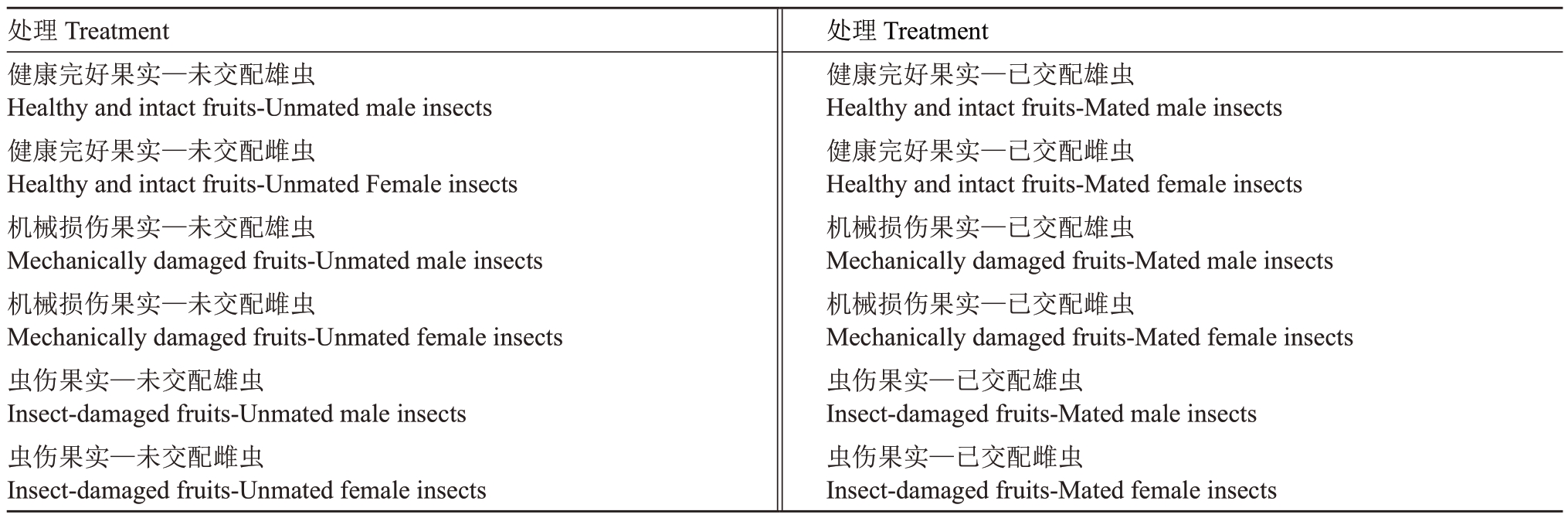
试验设置健康完好、机械损伤和虫伤3 种果实状态,分别与未交配、已交配的雌、雄虫进行组合,共计构成12 种试验处理(表1)。空白对照:味源瓶中不添加任何物质。
表1 试验处理设计
Table 1 Experimental treatments design
处理Treatment健康完好果实—未交配雄虫Healthy and intact fruits-Unmated male insects健康完好果实—未交配雌虫Healthy and intact fruits-Unmated Female insects机械损伤果实—未交配雄虫Mechanically damaged fruits-Unmated male insects机械损伤果实—未交配雌虫Mechanically damaged fruits-Unmated female insects虫伤果实—未交配雄虫Insect-damaged fruits-Unmated male insects虫伤果实—未交配雌虫Insect-damaged fruits-Unmated female insects处理Treatment健康完好果实—已交配雄虫Healthy and intact fruits-Mated male insects健康完好果实—已交配雌虫Healthy and intact fruits-Mated female insects机械损伤果实—已交配雄虫Mechanically damaged fruits-Mated male insects机械损伤果实—已交配雌虫Mechanically damaged fruits-Mated female insects虫伤果实—已交配雄虫Insect-damaged fruits-Mated male insects虫伤果实—已交配雌虫Insect-damaged fruits-Mated female insects
机械损伤果实:使用无菌针在健康果实表面(距离果柄和果蒂均≥2 cm)刺扎3 个独立伤口,孔径约0.5 mm(与针尖直径一致),孔深(2.0±0.2)mm。刺扎后果肉微微凸起但未外露,且无明显汁液渗出。
虫伤果实:使用无菌针刺在果实赤道面(中部最宽处)轻扎1 个浅孔,孔径约0.5 mm,深度以穿透果皮、触及表层果肉为宜[(2.0±0.2)mm]。每颗果实可选取2~3 个接卵位点,位点间距≥3 cm。使用无菌细毛笔蘸取少量无菌生理盐水(避免卵粒脱水),轻轻挑起约10 粒橘小实蝇卵,缓慢将其移入提前扎好的浅孔内,确保卵粒全部嵌入孔中,贴近果肉。将接卵后的果实放入恒温培养箱,保持光周期L∶D=14 h∶10 h,培养期间每天观察1 次,避免果实腐烂或卵粒干燥。待培养至第4 天,孵化出2 龄幼虫用于试验。
1.4 趋性反应测定方法
使用Y型嗅觉仪测定橘小实蝇对不同处理果实挥发物的行为选择反应。测定时,Y 型管一臂连接含处理果实的味源瓶(样品),另一臂连接空白对照。挑选大小、虫龄一致的成虫引入Y型管主管。
正式观测前,试虫在嗅觉仪内适应1 min。单头试虫观察时长设置为15 min,若15 min 内未做出选择,则视为无反应,淘汰该数据。选择标准:试虫爬入Y 型管某一臂超过2/3 长度(约6.7 cm)并停留至少1 min,即记为对该臂气味做出选择。
测定气体速度统一设置为80 mL·min-1。每完成1头试虫测定后,调换Y型管两臂位置,以削除方位误差。每个处理至少10 次重复,每次重复20 头虫,每头虫仅使用1 次。不同处理测试间隙,使用95%乙醇超声波清洗Y型管,并于烘箱中烘干,以消除残留气味干扰。试验于每日8:30—17:30,在温度(26±1)℃、光照均匀的室内进行。统计做出选择的试虫数,并按照下式计算选择反应率。

1.5 数据分析
试验数据均采用Excel 软件进行整理,并采用DPS(18.10高级版)软件进行统计分析。
2 结果与分析
2.1 橘小实蝇雌雄成虫对不同果实的趋性反应
选取广西本地10种典型寄主果实,利用Y型嗅觉仪测定橘小实蝇雌雄成虫对各果实挥发性物质的嗅觉行为反应。结果显示,所有供试果实的挥发物均对橘小实蝇两性成虫具有一定引诱作用,但引诱效果存在差异。从成虫被引诱的数量分析,李对试虫的引诱效果最佳,其次为香蕉、橙和火龙果等(图1-A 和表2)。而相对引诱强度分析表明,杧果的相对引诱强度最高,其次为火龙果、砂糖橘和木瓜等(图1-B)。
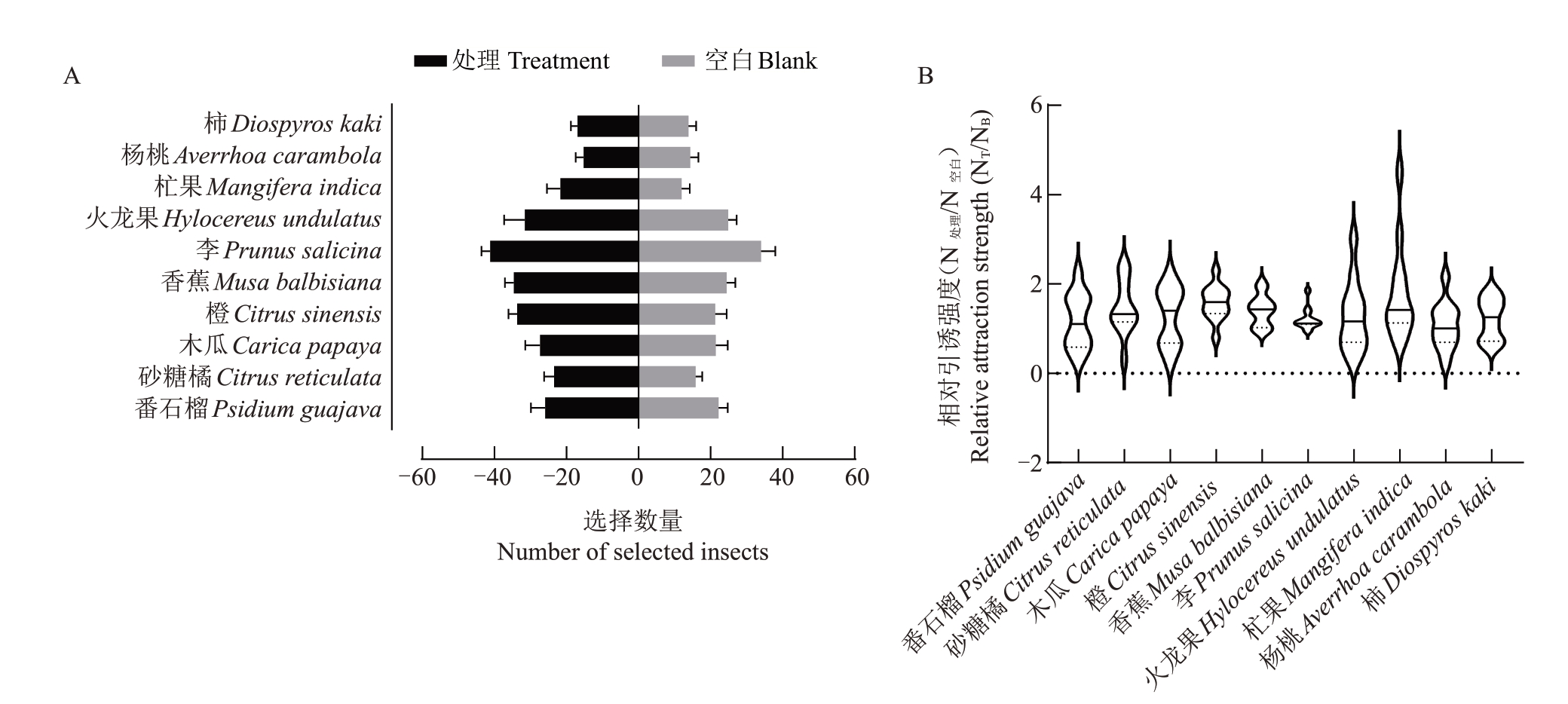
图1 不同果实对橘小实蝇的引诱效果
Fig.1 Attraction effects of different fruits on B.dorsalis
A. 不同果实对橘小实蝇的引诱数量;B.不同果实对橘小实蝇的相对引诱强度。
A.Attraction number of different fruits on B.dorsalis;B.Relative attraction intensity of different fruits to B.dorsalis.
表2 橘小实蝇雄虫对不同生理状态果实挥发物的行为反应
Table 2 Behavioral trends of male B.dorsalis on volatile compounds in different physiological states of mature fruits
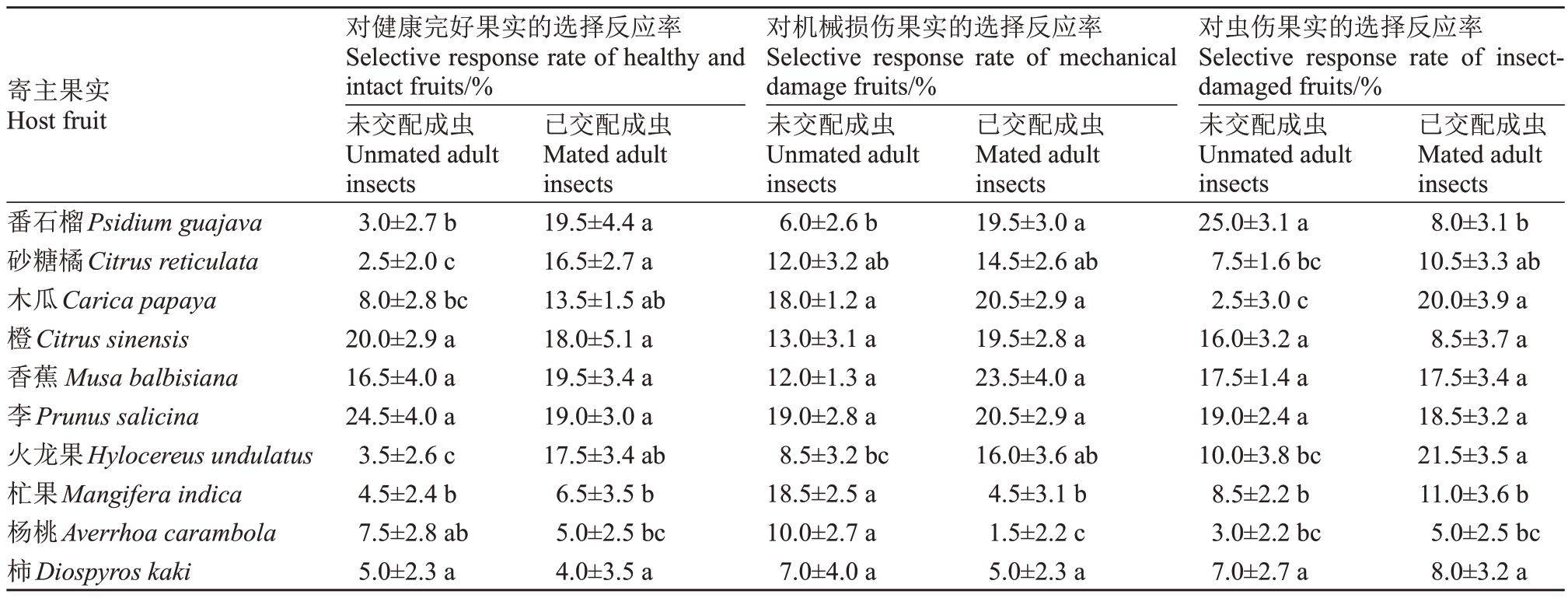
注:结果采用邓肯氏新复极差(DMRT)法进行分析,同行不同小写字母表示在5%水平上差异显著。下同。
Note:All data were statistically analyzed using Duncan’s new multiple range test(DMRT).Different small letters in the same row indicate significant differences at the P<0.05 level.The same below.
寄主果实Host fruit 已交配成虫Mated adult insects 8.0±3.1 b 10.5±3.3 ab 20.0±3.9 a 8.5±3.7 a 17.5±3.4 a 18.5±3.2 a 21.5±3.5 a 11.0±3.6 b 5.0±2.5 bc 8.0±3.2 a番石榴Psidium guajava砂糖橘Citrus reticulata木瓜Carica papaya橙Citrus sinensis香蕉Musa balbisiana李Prunus salicina火龙果Hylocereus undulatus杧果Mangifera indica杨桃Averrhoa carambola柿Diospyros kaki对健康完好果实的选择反应率Selective response rate of healthy and intact fruits/%未交配成虫Unmated adult insects 3.0±2.7 b 2.5±2.0 c 8.0±2.8 bc 20.0±2.9 a 16.5±4.0 a 24.5±4.0 a 3.5±2.6 c 4.5±2.4 b 7.5±2.8 ab 5.0±2.3 a已交配成虫Mated adult insects 19.5±4.4 a 16.5±2.7 a 13.5±1.5 ab 18.0±5.1 a 19.5±3.4 a 19.0±3.0 a 17.5±3.4 ab 6.5±3.5 b 5.0±2.5 bc 4.0±3.5 a对机械损伤果实的选择反应率Selective response rate of mechanical damage fruits/%未交配成虫Unmated adult insects 6.0±2.6 b 12.0±3.2 ab 18.0±1.2 a 13.0±3.1 a 12.0±1.3 a 19.0±2.8 a 8.5±3.2 bc 18.5±2.5 a 10.0±2.7 a 7.0±4.0 a已交配成虫Mated adult insects 19.5±3.0 a 14.5±2.6 ab 20.5±2.9 a 19.5±2.8 a 23.5±4.0 a 20.5±2.9 a 16.0±3.6 ab 4.5±3.1 b 1.5±2.2 c 5.0±2.3 a对虫伤果实的选择反应率Selective response rate of insectdamaged fruits/%未交配成虫Unmated adult insects 25.0±3.1 a 7.5±1.6 bc 2.5±3.0 c 16.0±3.2 a 17.5±1.4 a 19.0±2.4 a 10.0±3.8 bc 8.5±2.2 b 3.0±2.2 bc 7.0±2.7 a
性别统计分析表明,雌虫对各果实挥发物的平均趋性反应率(29.28%±2.37%)高于雄虫(25.02%±3.00%),但差异未达到显著水平(P = 0.279)(图2)。该结果与涂蓉[20]的研究一致,进一步支持“雌虫在寄主定位过程中发挥主导作用”的假设。
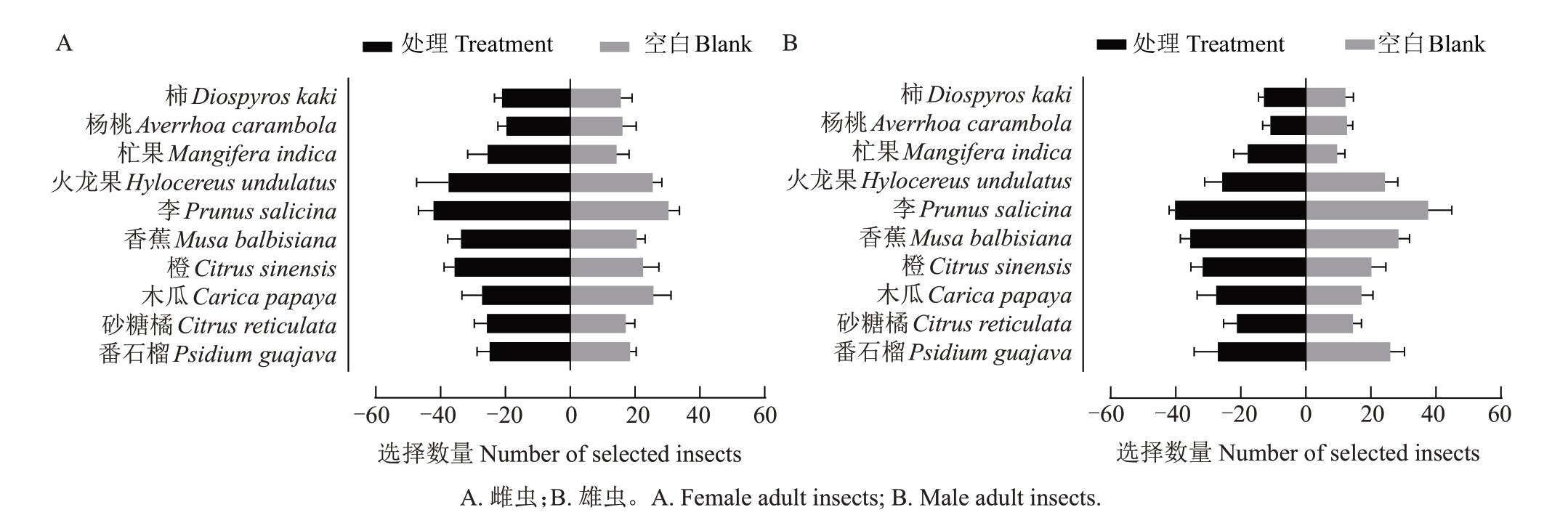
图2 橘小实蝇雌雄成虫对不同果实的趋性反应
Fig.2 Tropism responses of male and female adult insects of B.dorsalis to different fruits
2.2 橘小实蝇雌雄成虫对不同处理状态寄主果实的趋性反应
为探究果实不同处理状态对橘小实蝇选择行为的影响,本研究比较了健康完好果实、机械损伤果实和虫伤果实对成虫的引诱效果。结果显示,机械损伤果实对成虫的引诱作用最强,平均选择反应率为14.89%±0.98%;健康完好果实和虫伤果实的引诱效果次之,平均选择反应率分别为13.17%±1.09%和12.69%±1.14%(表3)。
表3 橘小实蝇雌虫对不同生理状态果实挥发物的行为反应
Table 3 Behavioral tendencies of female B.dorsalis towards volatile compounds in different physiological states of mature fruits
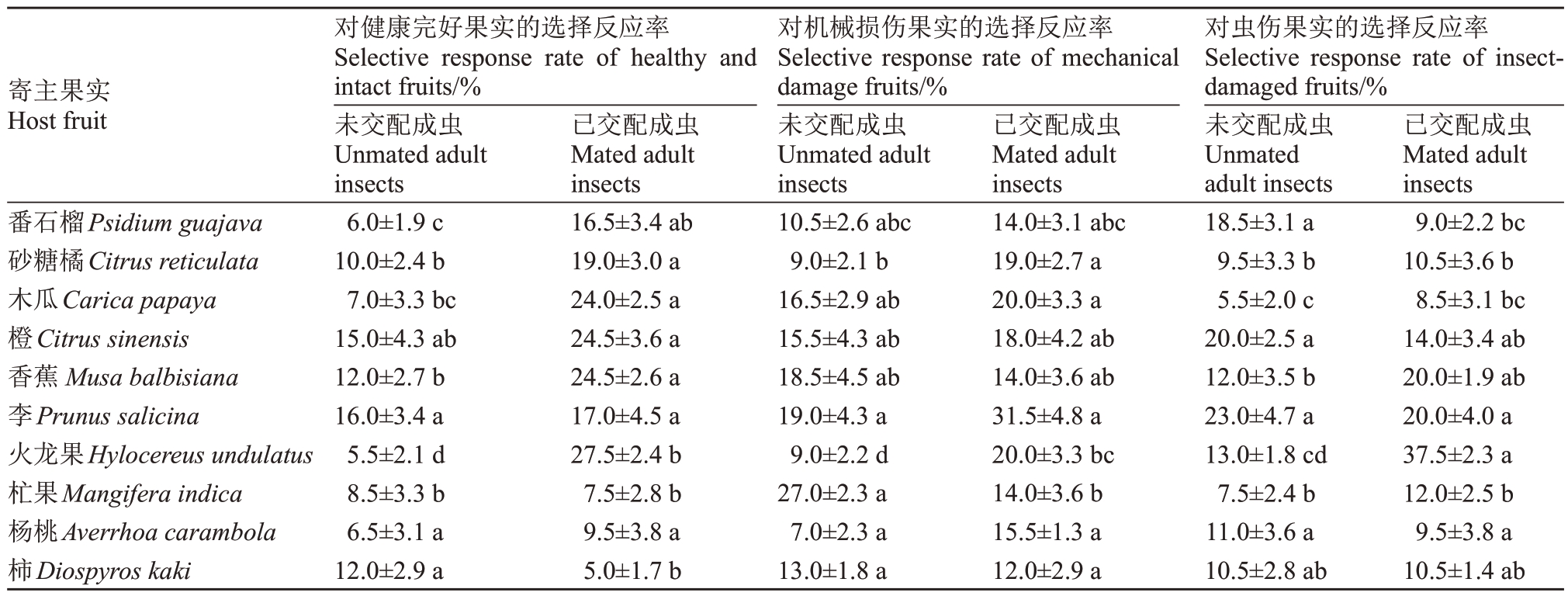
寄主果实Host fruit番石榴Psidium guajava砂糖橘Citrus reticulata木瓜Carica papaya橙Citrus sinensis香蕉Musa balbisiana李Prunus salicina火龙果Hylocereus undulatus杧果Mangifera indica杨桃Averrhoa carambola柿Diospyros kaki对健康完好果实的选择反应率Selective response rate of healthy and intact fruits/%未交配成虫Unmated adult insects 6.0±1.9 c 10.0±2.4 b 7.0±3.3 bc 15.0±4.3 ab 12.0±2.7 b 16.0±3.4 a 5.5±2.1 d 8.5±3.3 b 6.5±3.1 a 12.0±2.9 a已交配成虫Mated adult insects 16.5±3.4 ab 19.0±3.0 a 24.0±2.5 a 24.5±3.6 a 24.5±2.6 a 17.0±4.5 a 27.5±2.4 b 7.5±2.8 b 9.5±3.8 a 5.0±1.7 b对机械损伤果实的选择反应率Selective response rate of mechanical damage fruits/%未交配成虫Unmated adult insects 10.5±2.6 abc 9.0±2.1 b 16.5±2.9 ab 15.5±4.3 ab 18.5±4.5 ab 19.0±4.3 a 9.0±2.2 d 27.0±2.3 a 7.0±2.3 a 13.0±1.8 a已交配成虫Mated adult insects 14.0±3.1 abc 19.0±2.7 a 20.0±3.3 a 18.0±4.2 ab 14.0±3.6 ab 31.5±4.8 a 20.0±3.3 bc 14.0±3.6 b 15.5±1.3 a 12.0±2.9 a对虫伤果实的选择反应率Selective response rate of insectdamaged fruits/%未交配成虫Unmated adult insects 18.5±3.1 a 9.5±3.3 b 5.5±2.0 c 20.0±2.5 a 12.0±3.5 b 23.0±4.7 a 13.0±1.8 cd 7.5±2.4 b 11.0±3.6 a 10.5±2.8 ab已交配成虫Mated adult insects 9.0±2.2 bc 10.5±3.6 b 8.5±3.1 bc 14.0±3.4 ab 20.0±1.9 ab 20.0±4.0 a 37.5±2.3 a 12.0±2.5 b 9.5±3.8 a 10.5±1.4 ab
性别分析(图3)进一步表明,雌虫对机械损伤果实的平均趋性反应率(16.15%±1.32%)强于雄虫(13.5%±1.41%)。雌虫对损伤果实的较强趋性可能与其生殖需求相关的寄主定位策略有关,该结果与涂蓉[20]提出的雌虫寄主选择行为的理论观点相吻合。
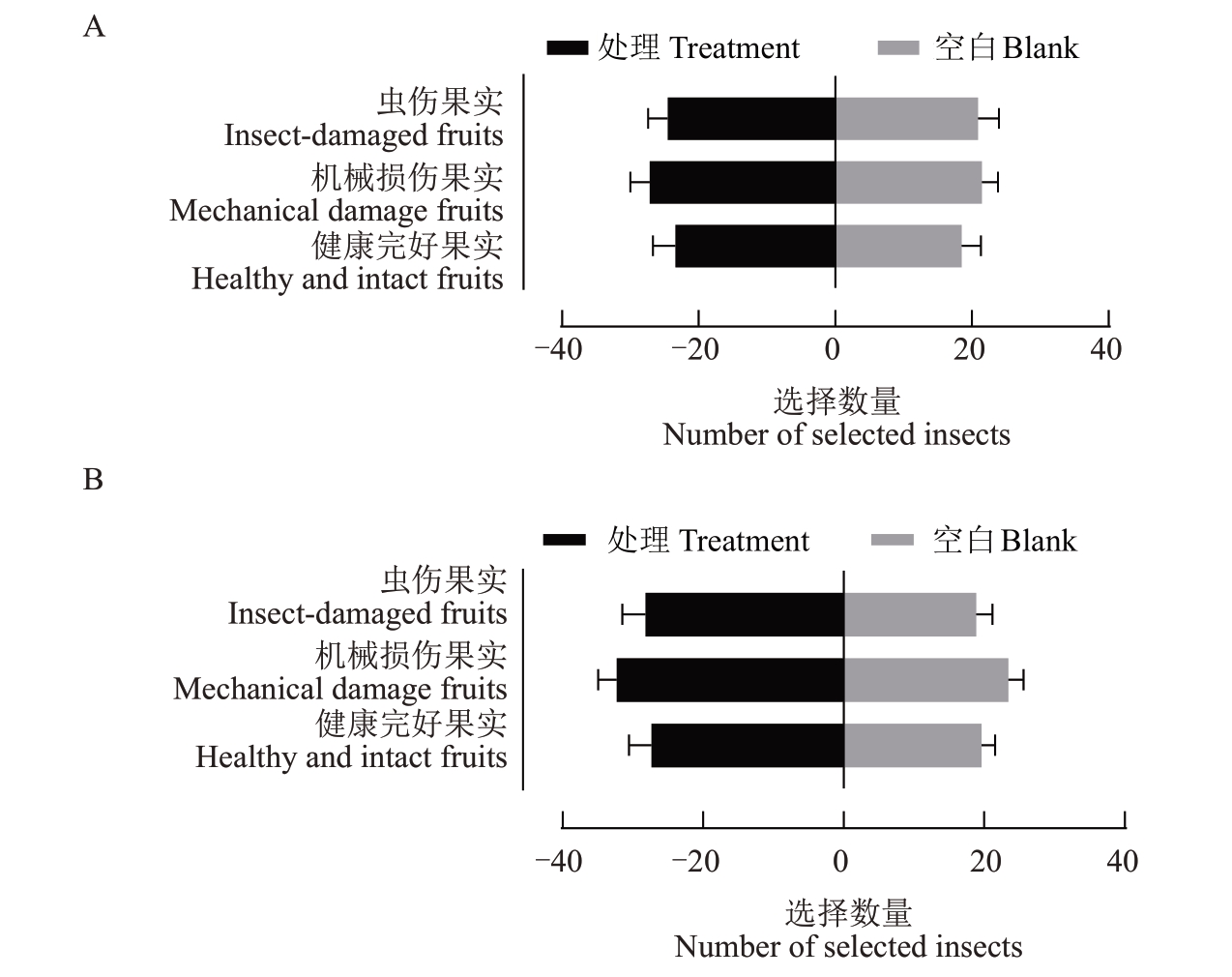
图3 橘小实蝇雌雄成虫对不同果实状态的趋性反应
Fig.3 Tropism responses of male and female adult insects of B.dorsalis to differently fruits states
A.雄虫;B.雌虫。A.Male adult insects;B.Female adult insects.
2.3 橘小实蝇交配与未交配成虫对不同果实的趋性反应
交配状态是影响橘小实蝇寄主选择行为的重要因素之一。本研究分析了交配与未交配成虫对不同果实挥发物的趋性反应。结果表明,无论成虫是否交配,均对供试水果表现出一定的趋性。已交配成虫的整体趋性反应率为15.72%±0.92%,其中对火龙果、李、香蕉、番石榴和木瓜的挥发物反应较强,而对柿、杨桃和杧果的反应较弱。未交配成虫的整体趋性反应率为11.42%±0.74%,其中对李、橙和香蕉的挥发物反应较强(图4)。
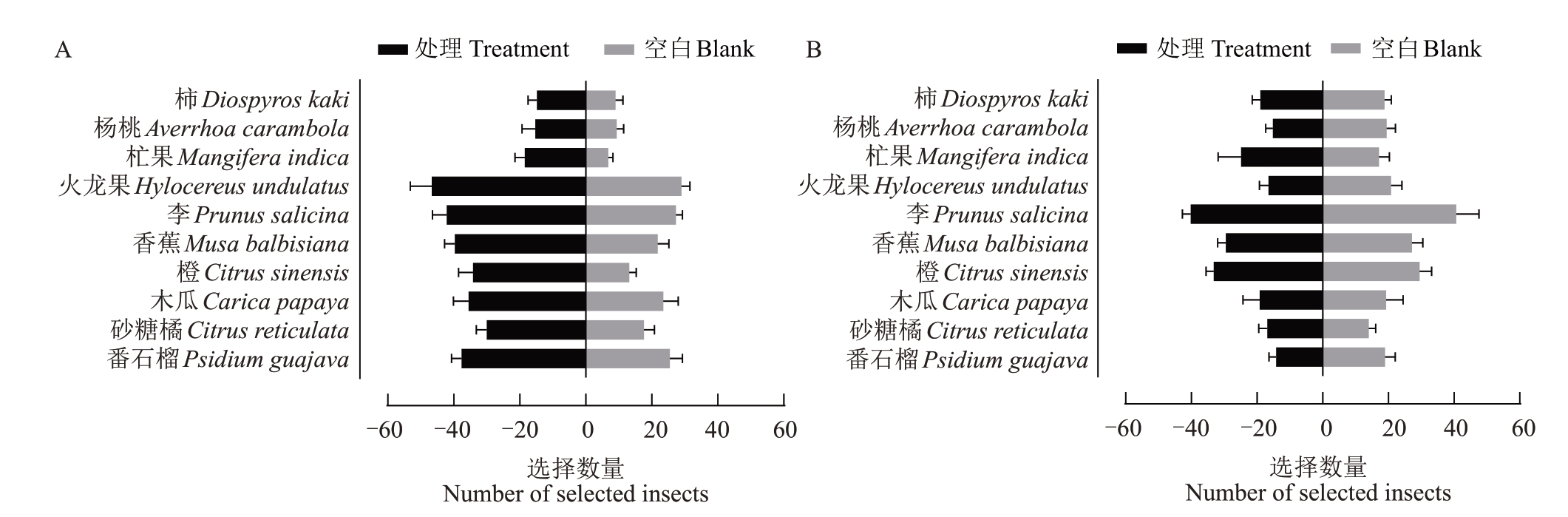
图4 橘小实蝇成虫状态对不同果实的趋性反应
Fig.4 Tropism responses of B.dorsalis adult insects in different mating statuses to various fruits
A.已交配成虫;B. 未交配成虫。A.Mated adult insects;B.Unmated adult insects.
已交配成虫的性别分析进一步表明,雌虫的平均趋性反应率(17.13%±1.33%)高于雄虫(14.31%±1.23%)。以上结果表明,已交配成虫,尤其是已交配雌虫更易对果实挥发物产生趋性选择行为。
3 讨 论
本研究通过测定橘小实蝇雌雄成虫对广西本地10种果实挥发物的行为反应,系统比较了不同寄主果实、果实生理状态以及成虫交配状态对其趋性行为的影响。结果表明,不同寄主果实挥发物对橘小实蝇两性成虫均具有引诱作用,但引诱效果存在明显差异,该差异很可能源于各果实挥发性物质的组分与含量不同。与雄虫相比,雌虫对不同果实气味展现出更高的敏感性,该结果与姚其[17]在茶小绿叶蝉中关于不同性别及生理状态昆虫趋性反应的研究结果一致,进一步支持了“雌虫在寄主定位中发挥主导作用”的观点。
本研究表明,机械损伤果实对橘小实蝇的引诱作用最强,这可能是由于机械损伤导致果实组织破裂,挥发物释放量增加,同时在微生物作用下产生或积累了某些特异性引诱成分。该现象与白泽珍[18]在扁蓿豆中关于机械损伤可诱导更多化合物释放的研究结论相符,表明损伤诱导的挥发物变化是影响昆虫寄主选择的重要信号。
在交配状态方面,已交配成虫,尤其是已交配雌虫对果实挥发物的趋性反应显著强于未交配个体,其生理机制可能在于交配后雌虫为满足卵巢发育和产卵需求,强化了对适宜寄主的搜寻动机,从而对潜在产卵寄主释放的挥发物表现敏感。这一行为有助于提高后代的定殖概率。
从生态演化方面,植物挥发物作为重要的化学信号,在植食性昆虫寄主识别与定位过程中具有关键作用[21]。本研究表明,橘小实蝇已交配雌虫对果实不同生理状态(如健康、机械损伤、虫伤)所释放的挥发物具有高度敏感性,推测挥发物中可能存在引导其产卵行为的关键活性成分。因此,系统鉴定挥发物中具有显著引诱效应的化合物,对开发针对橘小实蝇的高效行为调控技术具有重要理论意义。基于广西本地特色果实挥发物开展橘小实蝇引诱剂研发,不仅有助于深化对橘小实蝇寄主选择机制的解析,也可为研发区域性、专化性绿色防控技术提供物质基础与理论支撑,对推进橘小实蝇的生态治理具有广阔的应用前景。
4 结 论
橘小实蝇的寄主选择行为受果实生理状态与其自身交配状态的双重调控。其中,机械损伤果实的挥发物引诱效果最强,且已交配雌虫的趋性反应最显著。本研究明晰了关键行为规律,构建了“虫-果”互作行为谱,为发展以寄主挥发物为核心、靶向已交配雌虫的绿色防控技术(如“性信息素+寄主挥发物”协同诱剂)奠定了理论基础。后续研究将聚焦于鉴定关键活性挥发物,以优化诱剂配方。
[1] 林进添,曾玲,陆永跃,梁广文,许益镌.橘小实蝇的生物学特性及防治研究进展[J].仲恺农业技术学院学报,2004,17(1):60-67.LIN Jintian,ZENG Ling,LU Yongyue,LIANG Guangwen,XU Yijuan. Research advances in biology and control of Bactrocera(Bactrocera) dorsalis (Hendel)[J]. Journal of Zhongkai Agrotechnical College,2004,17(1):60-67.
[2] 梁靓,李毅然.陕西省橘小实蝇的风险性分析[J].陕西林业科技,2017,45(2):46-48.LIANG Liang,LI Yiran. Risk analysis of Bactrocera dorsalis(Hendel) in Shaanxi Province[J]. Shaanxi Forest Science and Technology,2017,45(2):46-48.
[3] 毛红彦,赵岩,丁华锋,焦永吉,孙国强,陆春显,韩世平.河南省重要实蝇的种群动态监测[J].中国植保导刊,2019,39(11):77-83.MAO Hongyan,ZHAO Yan,DING Huafeng,JIAO Yongji,SUN Guoqiang,LU Chunxian,HAN Shiping.Monitoring on the population dynamics of major fruit flies in Henan Province[J].China Plant Protection,2019,39(11):77-83.
[4] 巫辅民.广西柿子主产区橘小实蝇的发生及转移为害规律研究[D].南宁:广西大学,2019.WU Fumin. Study on the occurrence regulation of Bactrocera dorsalis (Hendel) in the major persimmon producing areas of Guangxi[D].Nanning:Guangxi University,2019.
[5] 王涤非.橘小实蝇危害区域北移的原因及防控对策[J].中国果树,2019(3):102-104.WANG Difei. Causes and prevention strategies for the northward migration of Bactrocera dorsalis damage areas[J]. China Fruits,2019(3):102-104.
[6] 张格成,李继祥.柑橘小实蝇主要生物生态学和综合治理综述[J].广西柑桔,1997(3):10-11.ZHANG Gecheng,LI Jixiang. Review on main bioecology and integrated management of Bactrocera dorsalis[J]. Guangxi Citrus,1997(3):10-11.
[7] 梁光红,罗金水,徐晓新,王智伟,侯伟荣.橘小实蝇及其综合防治[J].福建热作科技,2005,30(1):29-32.LIANG Guanghong,LUO Jinshui,XU Xiaoxin,WANG Zhiwei,HOU Weirong. Bactrocera dorsalis and its integrated control[J].Fujian Science&Technology of Tropical Crops,2005,30(1):29-32.
[8] 谢琦,张润杰.橘小实蝇生物学特点及其防治研究概述[J].生态科学,2005,24(1):52-56.XIE Qi,ZHANG Runjie.Study advance on biology and ecology of Bactrocera dorsalis (Hendel) and its control[J]. Ecological Science,2005,24(1):52-56.
[9] 吴广超,张岳峰,龚洪斌,叶军,裴正伟.橘小实蝇的发生为害规律及防治[J].林业科技开发,2007,21(4):92-93.WU Guangchao,ZHANG Yuefeng,GONG Hongbin,YE Jun,PEI Zhengwei. Occurrence regularity and control of Bactrocera dorsalis in Shanghai[J]. China Forestry Science and Technology,2007,21(4):92-93.
[10] SALMAH M,ADAM N A,MUHAMAD R,LAU W H,AHMAD H. Infestation of fruit fly,Bactrocera (Diptera:Tephritidae) on mango (Mangifera indica L.) in Peninsular Malaysia[J].Journal of Fundamental and Applied Sciences,2018,9(2S):799.
[11] WEI D D,HE W,LANG N,MIAO Z Q,XIAO L F,DOU W,WANG J J. Recent research status of Bactrocera dorsalis:Insights from resistance mechanisms and population structure[J].Archives of Insect Biochemistry and Physiology,2019,102(3):e21601.
[12] WANG Z Z,LIU Y Q,SHI M,HUANG J H,CHEN X X. Parasitoid wasps as effective biological control agents[J]. Journal of Integrative Agriculture,2019,18(4):705-715.
[13] KNOLHOFF L M,HECKEL D G.Behavioral assays for studies of host plant choice and adaptation in herbivorous insects[J].Annual Review of Entomology,2014,59:263-278.
[14] HELMS A M,DE MORAES C M,TRÖGER A,ALBORN H T,FRANCKE W,TOOKER J F,MESCHER M C.Identification of an insect-produced olfactory cue that primes plant defenses[J].Nature Communications,2017,8:337.
[15] PROKOPY R J,GREEN T A,VARGAS R I. Dacus dorsalis flies can learn to find and accept host fruit[J]. Journal of Insect Behavior,1990,3(5):663-672.
[16] 杜袁文.昆虫囊泡病毒介导斜纹夜蛾幼虫取食选择行为的研究[D].长沙:湖南农业大学,2022.DU Yuanwen. Insect Heliothis virescens ascovirus mediated feeding selection behavior of Spodoptera litura larva[D].Changsha:Hunan Agricultural University,2022.
[17] 姚其.茶小绿叶蝉产卵选择行为机制及其理化基础研究[D].武汉:华中农业大学,2022.YAO Qi. Selective mechanism of behavior and physicochemical basis on the oviposition of tea green leafhopper,Empoasca onukii Matsuda (Hemiptera:Cicadellidae) [D]. Wuhan:Huazhong Agricultural University,2022.
[18] 白泽珍.几种豆科植物挥发物组分鉴定及草地螟植物源引诱剂研究[D].太谷:山西农业大学,2021.BAI Zezhen.Identification of the volatile components of several Leguminosae sp.plants and study on plant-derived attractants of Loxostege sticticalis L.[D]. Taigu:Shanxi Agricultural University,2021.
[19] 李媛,黄爱玲,黄慧欣,王小云,郑霞林,陆温.橘小实蝇对三华李果实的产卵选择[J].南方农业学报,2020,51(2):319-326.LI Yuan,HUANG Ailing,HUANG Huixin,WANG Xiaoyun,ZHENG Xialin,LU Wen. Oviposition selectivity of Bactrocera dorsalia(Hendel)to Prunus salicina[J].Journal of Southern Agriculture,2020,51(2):319-326.
[20] 涂蓉.橘小实蝇及其幼虫寄生蜂的嗅觉行为研究[D].福州:福建农林大学,2012.TU Rong. Study on behavior responses of Bactrocera dorsalis(Hendel) ant its larval parasitoids to their host volatiles[D]. Fuzhou:Fujian Agriculture and Forestry University,2012.
[21] ALUJA M,PROKOPY R J. Host Search behaviour by Rhagoletis pomonella files:Inter-tree movement patterns in response to wind-borne fruit volatiles under filed conditions[J]. Physiological Entomology,1992,17(1):1-8.