黄冠梨具有稳产高产、抗病能力强等优点,果面光洁、脆甜多汁、营养丰富,深受市场青睐[1]。近年来,随着农业现代化水平的不断提升,农机装备与果园栽培技术持续升级,果园机械化水平显著提高,省力化、轻简化已成为现代果园的核心特征[2]。宜机化的栽培模式与配套树形是实现果园机械化的关键,双干平面树形作为高效宜机化的二维结构树形之一,树体冠幅小,生长势分散到两主干上,形成薄的结果墙,有利于提高中短枝比例与光能截获率,便于均匀分布叶面肥和农药,且土地产出效益好,果实品质稳定,同时支持机械化管理与机器人采摘,大幅节约劳动力成本,在欧美地区广泛应用[3-4]。马小龙等[5]研究发现,采用双干平面树形的矮化自根砧富士系幼树,树体矮与冠幅小,长枝比例低,成花率高,单株产量上升快。梨树顶端优势明显,科学整形可缓和树势,促进营养生长向生殖生长转化,生产上普遍采用摘心、拉枝等技术调控枝叶数量,从而提升光能利用效率,增加有机物积累[6-7]。聂晗宇等[8]研究表明,拉枝处理可显著促进玉露香梨的花芽分化与成花率。孟令松等[9]、李辉等[10]研究发现,摘心可提高葡萄叶片的净光合速率和水分利用效率,有利于叶片光合作用产物集中供应果实生长发育,但摘心、拉枝等技术存在费工费力、人工成本高等缺点,不适合规模化果园大量使用。植物生长抑制剂因便捷高效、用量少等特点已广泛应用于生产。其中,调环酸钙具有低毒、低残留、光降解和生物降解迅速等特性,能够抑制枝条旺长、促进花芽分化并提升果实品质[11]。张冲等[12]、靳韦等[13]研究证实,留枝量差异对植株冠层结构、枝条发育及叶片光合特性具有显著影响。目前,关于双干平面树形的系统整形研究报道较少。鉴于此,笔者以两年生双干平面树形黄冠梨为试材,探究不同留枝量与整形方式对新梢生长、冠层结构及光合特性的影响,并通过熵值法综合评价,明确该树形的适配整形方案,旨在为双干平面树形的标准化整形提供理论支撑,便于梨园轻简化管理。
1 材料和方法
1.1 材料及试验设计
本试验于2024年6月至2025年6月在辽宁省葫芦岛市兴城市中国农业科学院果树研究所温泉试验基地开展。试验区属温带季风气候,年平均气温9.2 ℃,极端高温37.2 ℃,最低温-21.6 ℃,年降水量603 mm,平均日照时数2 792.2 h,无霜期175 d。
供试材料为两年生长势一致的黄冠梨,采用双干平面树形,主干分枝高度为50 cm,两主干之间角度为60°,树高2.5~2.8 m,冠幅1.1~1.2 m,株行距为1.2 m×3.0 m,栽植方向均为南北行向,地势平坦,田间常规管理一致。试验设置单干留枝梢量6、8、10个,每种留枝梢量下分别设置3种整形方式:新梢长到20 cm左右时,进行化学控梢、摘心、拉枝处理,如表1所示。具体处理方法如下:
表1 试验处理
Table 1 Experiment treatment
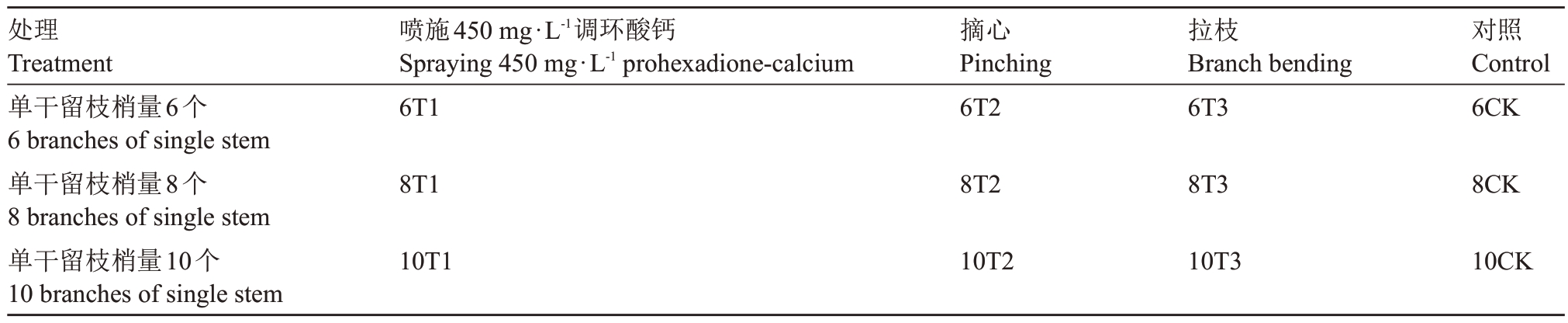
处理Treatment单干留枝梢量6个6 branches of single stem单干留枝梢量8个8 branches of single stem单干留枝梢量10个10 branches of single stem喷施450 mg·L-1调环酸钙Spraying 450 mg·L-1 prohexadione-calcium 6T1摘心Pinching 6T2拉枝Branch bending 6T3对照Control 6CK 8T1 8T2 8T3 8CK 10T1 10T2 10T3 10CK
化学控梢:药剂为施必达品牌调环酸钙,生产公司为安阳新全丰生物科技有限公司,产地为河南省安阳市北关区民航路街道创业大道中段路北11号,有效成分含量为5%,每次称取45 g 药品,加水定容至5 L,配置450 mg·L-1调环酸钙,对处理的9株树进行整株喷施至叶片滴水为止,每隔15 d喷布1次,连续喷布3次。
摘心:第1 次摘心,摘除顶端生长点,之后每增长20 cm,保留基部4片叶重复摘心,连续摘心3次。
拉枝:利用开角器使新梢与主干之间的角度保持在80°,对不适用开角器处理的,在新梢基部与主干间用牙签撑开,在新梢顶部位置利用小竹夹使其承重,相互辅助进行开角,待其成型后及时调整小竹夹数量及位置,防止大风导致新梢断裂。以自然生长未处理作为对照,每个处理组合单株重复,3次重复。于落花后30 d测定新梢生长量与光合色素含量等试验指标,每间隔7 d测定1次,共测定5次。
1.2 测定指标与方法
1.2.1 新梢生长量的测定 采用卷尺和游标卡尺分别测量新梢长度(cm)和粗度(mm),其中长度测量范围为新梢基部至顶端生长点,粗度测量范围为距新梢基部5 cm处。
1.2.2 光合参数的测定 利用LI-6400 光合仪与Handy PEA 植物效率分析仪,于晴天09:00—11:00选择高度范围为1.5~1.8 m的新梢,测定其基部往上数第6~10 片叶的净光合速率(Pn)及最大光化学效率(Fv/Fm)。
1.2.3 冠层参数的测定 选择在阴天或多云天气的傍晚时段,应用冠层分析仪采集植株冠层图像,基于冠层/半球影像分析系统(Canopy Analysis With Fish-Eye Imaging)测定总孔隙度、开度、叶面积指数及光能截获率。
1.2.4 光合色素含量的测定 按照不同处理组合及冠层位置(上、中、下3 层)采集自基部往上第6~10片叶,每个冠层取5 片,装袋冷藏带回实验室,用打孔器打孔取样后测定叶绿素和类胡萝卜素含量。采用95%乙醇暗浸提法提取叶绿素,在黑暗环境下放置48 h,每12 h摇匀1次,通过紫外分光光度计测定含量。
1.2.5 成花率统计 梨树盛花期前,统计树体各处理的花芽数与叶芽数,计算成花率。成花率/%=花芽数/(花芽数+叶芽数)×100。
1.2.6 熵值法 对于某项指标,可以用熵值来判断某个指标的离散程度,其信息熵值越小,指标的离散程度越大,该指标对综合评价的影响即权重就越大。因此,可利用信息熵这个工具,计算出各个指标的权重,为多指标综合评价提供依据。评价对象数为m,指标数为n,构建决策矩阵:B=(bik)m×n,其中B为多指标综合评价原始决策矩阵,blk 代表第l 个评价对象在第k个评价指标下的原始观测数据值。
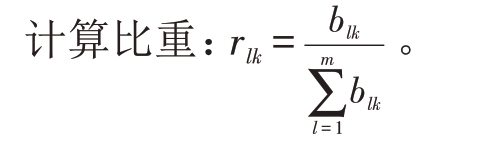
rlk为第l个评价对象、第k个指标的标准化比重,规定rlk=0 时rlk ln rlk=0 ,计算Hk为第k 个评价指标的信息熵值: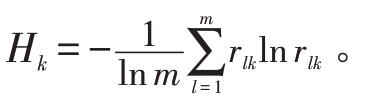
通过差异系数归一化计算wk为第k个指标的熵权(即综合评价权重)权重: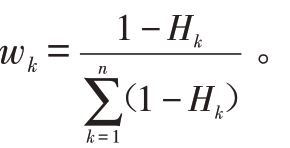
计算各样本综合得分: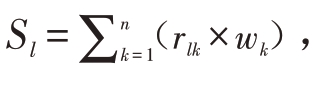 得分越高代表该评价对象综合表现越优。
1.3 数据处理
采用Excel 2024 与SPSS 28.0 软件进行数据整理与统计分析,采用Origin 2024软件作图。
2 结果与分析
2.1 不同整形方式对新梢生长量的影响
不同留枝梢量与整形方式对新梢长度的影响如图1 所示。单干留枝梢量为10 个时,拉枝的新梢长度为54.40 cm,比对照显著降低17.24%;单干留枝梢量为6个和8个时,喷施调环酸钙的新梢长度分别为55.31、50.48 cm,分别比对照显著降低26.06%、22.60%;所有整形方式对新梢长度的抑制效果均显著优于对照,单干留枝梢量为10 个条件下,拉枝处理的控旺效果突出,单干留枝梢量为6个和8个条件下,喷施调环酸钙对新梢控旺效果最优。
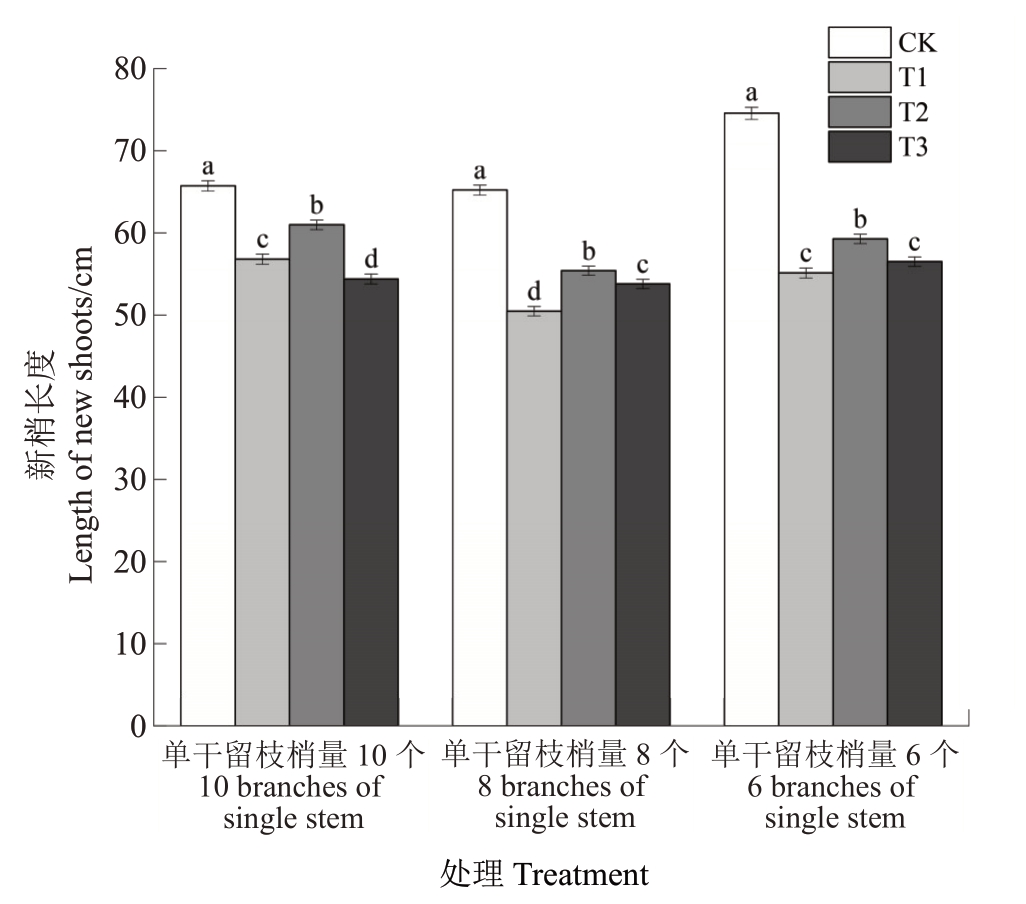
图1 不同整形方式对新梢长度的影响
Fig.1 Effects of different training systems on length of new shoots
不同小写字母表示处理间差异显著(P<0.05)。下同。
Different small letters indicate significant difference between treatments(P<0.05).The same below.
不同留枝梢量与整形方式对新梢粗度的影响如图2 所示。单干留枝梢量为8 个和10 个时,拉枝处理能有效促进新梢粗度生长,新梢粗度分别为7.77和7.66 mm,分别比对照显著提高5.00%和4.22%。单干留枝梢量为6个时,3种处理均显著减小新梢粗度,其中摘心处理对新梢粗度的抑制效果最大,粗度为6.98 mm,比对照显著降低10.63%。
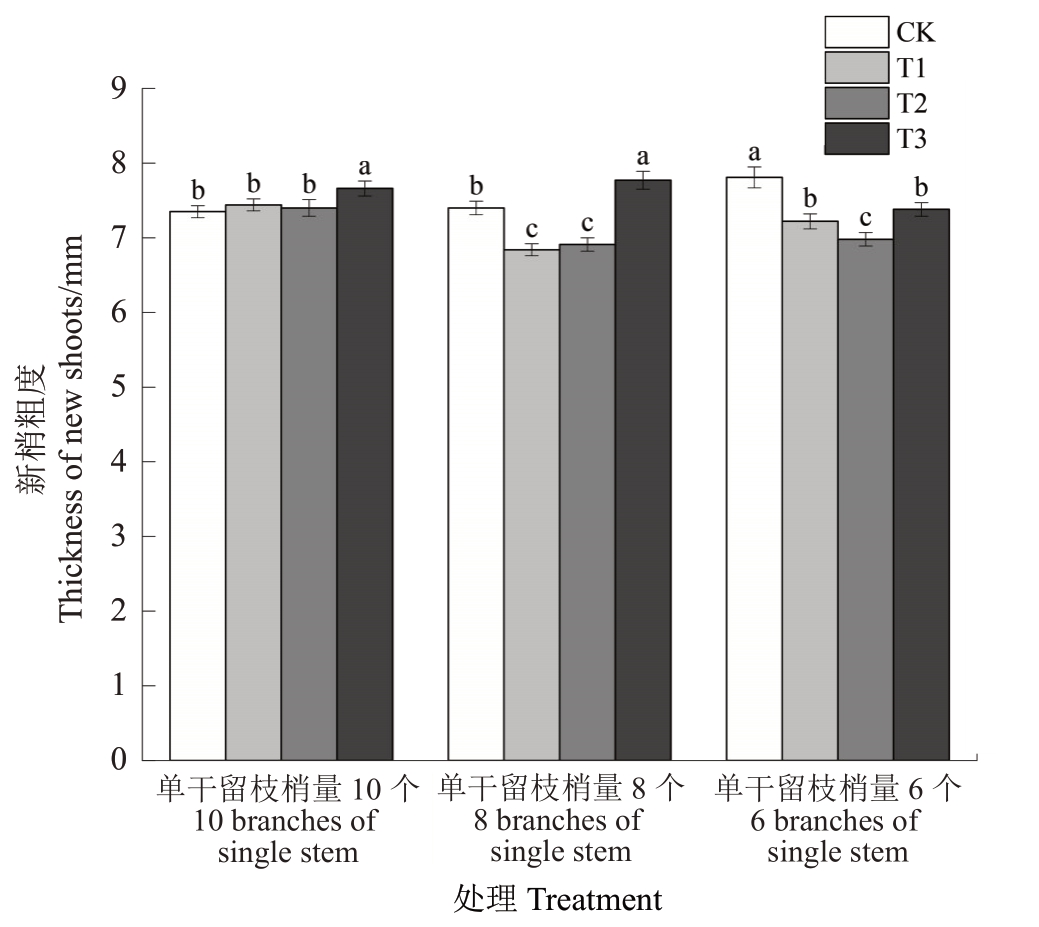
图2 不同整形方式对新梢粗度的影响
Fig.2 Effects of different training systems on thickness of new shoots
2.2 不同整形方式对梨冠层结构的影响
由表2可知,单干留枝梢量为10个时,所有处理与对照的冠层总孔隙度均表现为先升后降再升的变化趋势,落花后58 d,拉枝和摘心处理的总孔隙度分别为81.88%和79.95%,较对照显著提高4.43和2.50百分点。单干留枝梢量为8个时,拉枝和摘心处理的总孔隙度呈持续上升态势,喷施调环酸钙处理的总孔隙度表现为先升后降再升的变化趋势,落花后58 d,3种整形方式的总孔隙度较对照分别显著提高2.68、2.82和2.51百分点。单干留枝梢量为6个时,拉枝和摘心处理的总孔隙度呈先升高后降低的变化趋势,喷施调环酸钙处理的总孔隙度表现为先升后降再升的变化趋势,对照则持续上升,落花后58 d,3种整形方式的总孔隙度均显著低于对照,其中摘心的总孔隙度最小,为73.89%,较对照显著降低5.30百分点。
表2 不同整形方式对冠层总孔隙度的影响
Table 2 Effects of different training systems on gap fraction of canopy %
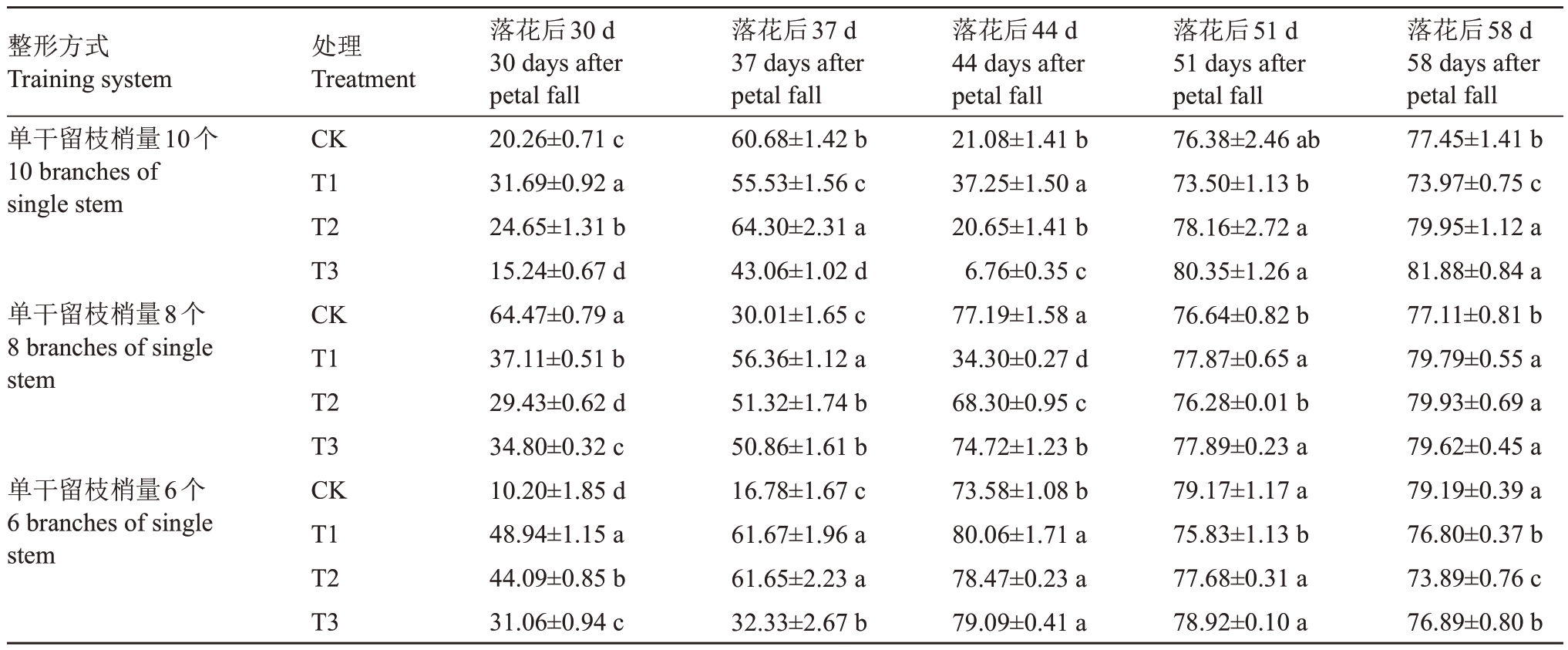
注:同列不同小写字母表示相同枝梢量的不同处理间差异显著(P<0.05)。下同。
Note:Different small letters in the same column indicate significant difference between treatments of the same branch number (P<0.05). The same below.
落花后58 d 58 days after petal fall 77.45±1.41 b 73.97±0.75 c 79.95±1.12 a 81.88±0.84 a 77.11±0.81 b 79.79±0.55 a 79.93±0.69 a 79.62±0.45 a 79.19±0.39 a 76.80±0.37 b 73.89±0.76 c 76.89±0.80 b整形方式Training system单干留枝梢量10个10 branches of single stem单干留枝梢量8个8 branches of single stem单干留枝梢量6个6 branches of single stem处理Treatment CK T1 T2 T3 CK T1 T2 T3 CK T1 T2 T3落花后30 d 30 days after petal fall 20.26±0.71 c 31.69±0.92 a 24.65±1.31 b 15.24±0.67 d 64.47±0.79 a 37.11±0.51 b 29.43±0.62 d 34.80±0.32 c 10.20±1.85 d 48.94±1.15 a 44.09±0.85 b 31.06±0.94 c落花后37 d 37 days after petal fall 60.68±1.42 b 55.53±1.56 c 64.30±2.31 a 43.06±1.02 d 30.01±1.65 c 56.36±1.12 a 51.32±1.74 b 50.86±1.61 b 16.78±1.67 c 61.67±1.96 a 61.65±2.23 a 32.33±2.67 b落花后44 d 44 days after petal fall 21.08±1.41 b 37.25±1.50 a 20.65±1.41 b 6.76±0.35 c 77.19±1.58 a 34.30±0.27 d 68.30±0.95 c 74.72±1.23 b 73.58±1.08 b 80.06±1.71 a 78.47±0.23 a 79.09±0.41 a落花后51 d 51 days after petal fall 76.38±2.46 ab 73.50±1.13 b 78.16±2.72 a 80.35±1.26 a 76.64±0.82 b 77.87±0.65 a 76.28±0.01 b 77.89±0.23 a 79.17±1.17 a 75.83±1.13 b 77.68±0.31 a 78.92±0.10 a
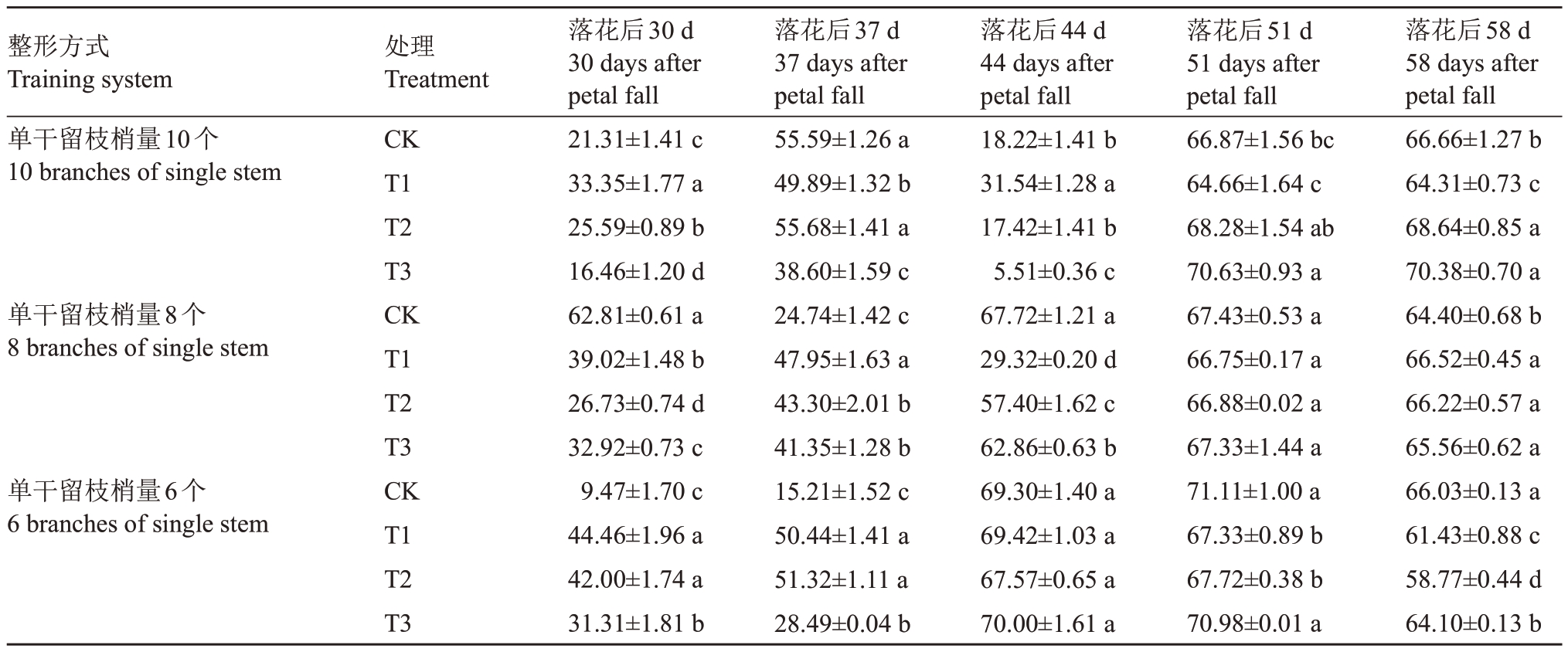
由表3 可知,各整形方式的冠层开度变化趋势与总孔隙度基本一致。单干留枝梢量为10个时,落花后58 d,摘心和拉枝处理的冠层开度分别为68.64%和70.38%,较对照分别显著提高1.98和3.72百分点。单干留枝梢量为8 个时,落花后58 d,3 种整形方式的冠层开度较对照分别显著提高2.12、1.82 和1.16 百分点。单干留枝梢量为6 个时,所有处理与对照整体上均呈先升后降的变化趋势,在落花后58 d,冠层开度较对照分别显著降低4.60、11.00和1.93百分点。
表3 不同整形方式对冠层开度的影响
Table 3 Effects of different training systems on openness of canopy%
整形方式Training system单干留枝梢量10个10 branches of single stem单干留枝梢量8个8 branches of single stem单干留枝梢量6个6 branches of single stem处理Treatment CK T1 T2 T3 CK T1 T2 T3 CK T1 T2 T3落花后30 d 30 days after petal fall 21.31±1.41 c 33.35±1.77 a 25.59±0.89 b 16.46±1.20 d 62.81±0.61 a 39.02±1.48 b 26.73±0.74 d 32.92±0.73 c 9.47±1.70 c 44.46±1.96 a 42.00±1.74 a 31.31±1.81 b落花后37 d 37 days after petal fall 55.59±1.26 a 49.89±1.32 b 55.68±1.41 a 38.60±1.59 c 24.74±1.42 c 47.95±1.63 a 43.30±2.01 b 41.35±1.28 b 15.21±1.52 c 50.44±1.41 a 51.32±1.11 a 28.49±0.04 b落花后44 d 44 days after petal fall 18.22±1.41 b 31.54±1.28 a 17.42±1.41 b 5.51±0.36 c 67.72±1.21 a 29.32±0.20 d 57.40±1.62 c 62.86±0.63 b 69.30±1.40 a 69.42±1.03 a 67.57±0.65 a 70.00±1.61 a落花后51 d 51 days after petal fall 66.87±1.56 bc 64.66±1.64 c 68.28±1.54 ab 70.63±0.93 a 67.43±0.53 a 66.75±0.17 a 66.88±0.02 a 67.33±1.44 a 71.11±1.00 a 67.33±0.89 b 67.72±0.38 b 70.98±0.01 a落花后58 d 58 days after petal fall 66.66±1.27 b 64.31±0.73 c 68.64±0.85 a 70.38±0.70 a 64.40±0.68 b 66.52±0.45 a 66.22±0.57 a 65.56±0.62 a 66.03±0.13 a 61.43±0.88 c 58.77±0.44 d 64.10±0.13 b
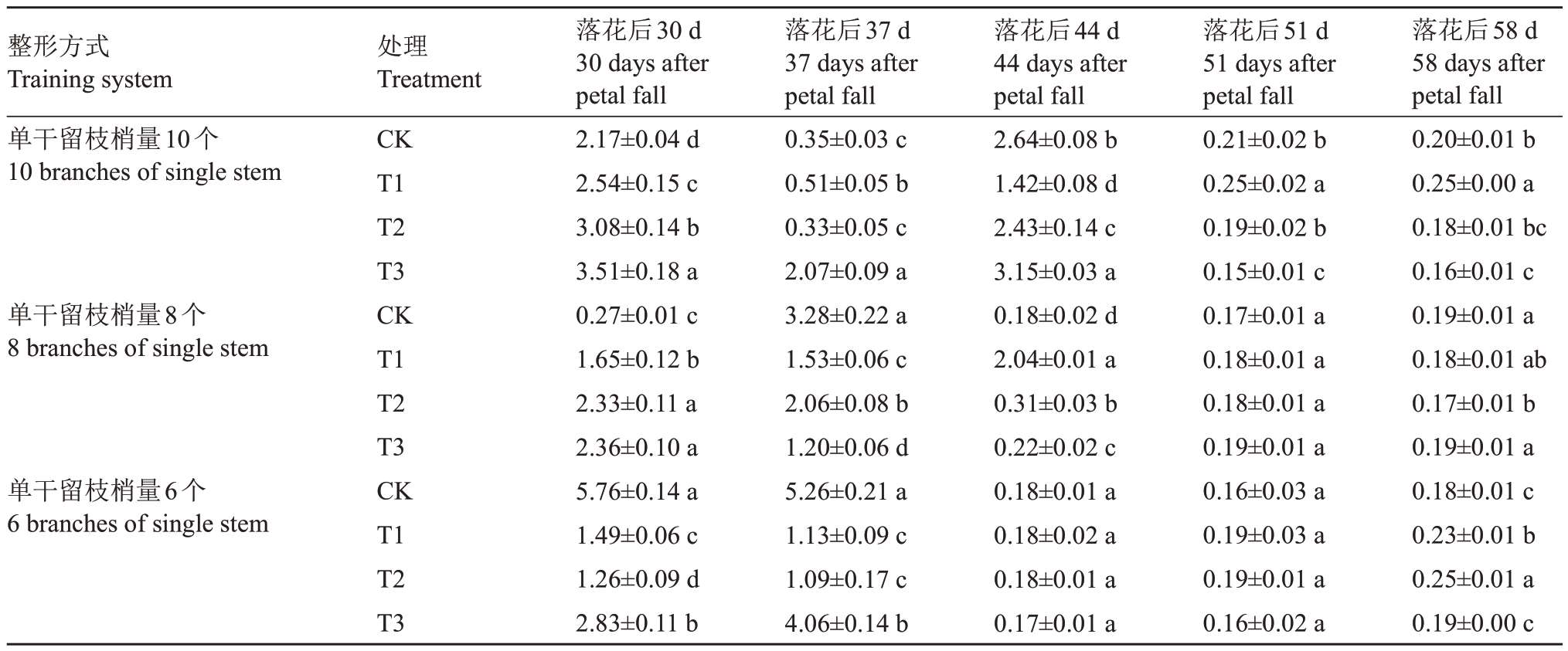
由表4 可知,各整形方式冠层的叶面积指数与总孔隙度、开度大致呈现相反趋势。单干留枝梢量为10 个时,落花后58 d,喷施调环酸钙处理的叶面积指数最大,为0.25 m2·m-2,比对照显著提高25.00%,摘心和拉枝处理的叶面积指数则分别降低10.00%和20.00%。单干留枝梢量为8 个时,落花后58 d,摘心处理的叶面积指数最小,为0.17 m2·m-2,比对照显著降低10.53%。单干留枝梢量为6 个时,所有处理与对照的叶面积指数均于花后50 d趋于稳定,落花后58 d,摘心处理的叶面积指数最大,为0.25 m2·m-2,较对照显著提高38.89%,喷施调环酸钙处理次之,较对照显著提高27.78%。
表4 不同整形方式对叶面积指数的影响
Table 4 Effects of different training systems on LAI(m2·m-2)
整形方式Training system单干留枝梢量10个10 branches of single stem单干留枝梢量8个8 branches of single stem单干留枝梢量6个6 branches of single stem处理Treatment CK T1 T2 T3 CK T1 T2 T3 CK T1 T2 T3落花后30 d 30 days after petal fall 2.17±0.04 d 2.54±0.15 c 3.08±0.14 b 3.51±0.18 a 0.27±0.01 c 1.65±0.12 b 2.33±0.11 a 2.36±0.10 a 5.76±0.14 a 1.49±0.06 c 1.26±0.09 d 2.83±0.11 b落花后37 d 37 days after petal fall 0.35±0.03 c 0.51±0.05 b 0.33±0.05 c 2.07±0.09 a 3.28±0.22 a 1.53±0.06 c 2.06±0.08 b 1.20±0.06 d 5.26±0.21 a 1.13±0.09 c 1.09±0.17 c 4.06±0.14 b落花后44 d 44 days after petal fall 2.64±0.08 b 1.42±0.08 d 2.43±0.14 c 3.15±0.03 a 0.18±0.02 d 2.04±0.01 a 0.31±0.03 b 0.22±0.02 c 0.18±0.01 a 0.18±0.02 a 0.18±0.01 a 0.17±0.01 a落花后51 d 51 days after petal fall 0.21±0.02 b 0.25±0.02 a 0.19±0.02 b 0.15±0.01 c 0.17±0.01 a 0.18±0.01 a 0.18±0.01 a 0.19±0.01 a 0.16±0.03 a 0.19±0.03 a 0.19±0.01 a 0.16±0.02 a落花后58 d 58 days after petal fall 0.20±0.01 b 0.25±0.00 a 0.18±0.01 bc 0.16±0.01 c 0.19±0.01 a 0.18±0.01 ab 0.17±0.01 b 0.19±0.01 a 0.18±0.01 c 0.23±0.01 b 0.25±0.01 a 0.19±0.00 c
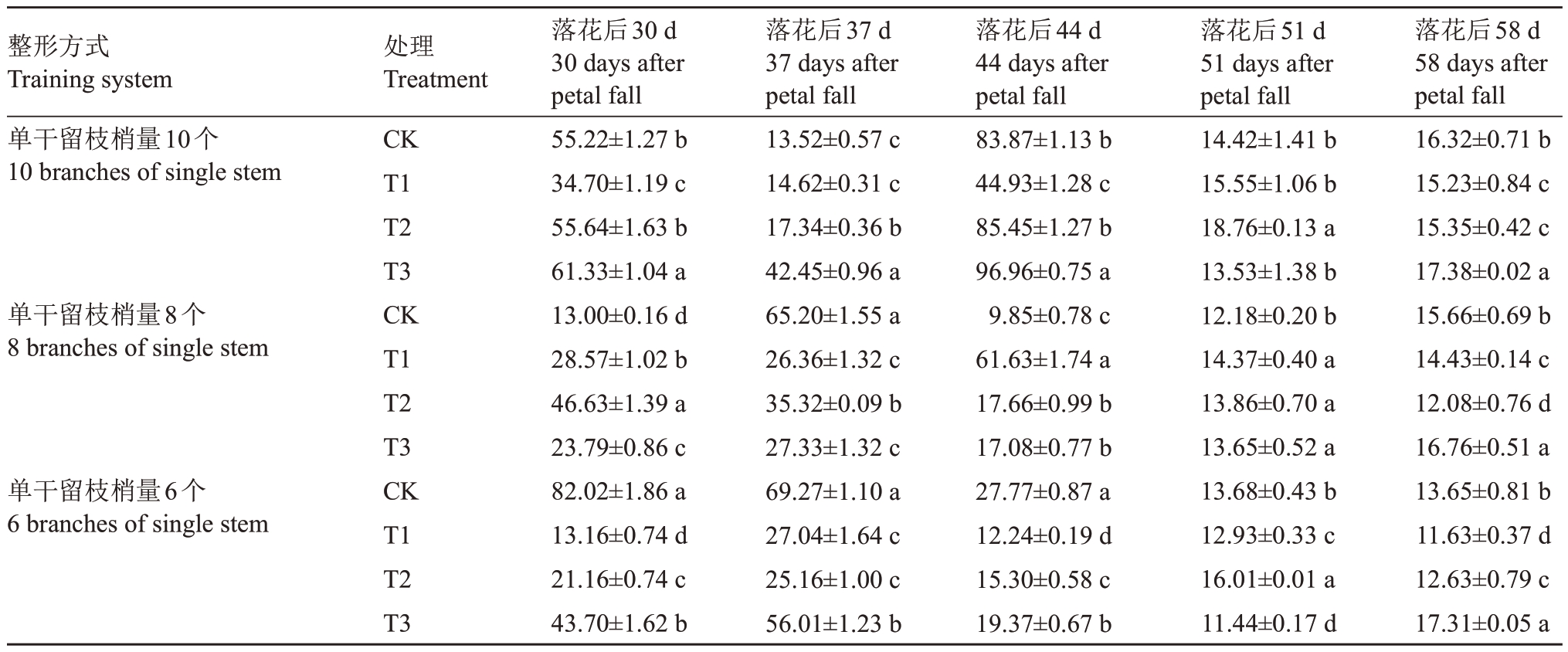
由表5 可知,叶幕光能截获率与叶面积指数的变化趋势基本一致。单干留枝梢量为10个时,落花后58 d,拉枝处理的光能截获率最高,为17.38%,较对照显著提高1.06 百分点。单干留枝梢量为8 个时,落花后58 d,拉枝处理的光能截获率最高,为16.76%,较对照显著提高1.10 百分点。单干留枝梢量为6个时,落花后58 d,拉枝处理的光能截获率最高,为17.31%,较对照显著提高3.66百分点。
表5 不同整形方式对叶幕光能截获率的影响
Table 5 Effects of different training systems on light interception rate %
整形方式Training system单干留枝梢量10个10 branches of single stem单干留枝梢量8个8 branches of single stem单干留枝梢量6个6 branches of single stem处理Treatment CK T1 T2 T3 CK T1 T2 T3 CK T1 T2 T3落花后30 d 30 days after petal fall 55.22±1.27 b 34.70±1.19 c 55.64±1.63 b 61.33±1.04 a 13.00±0.16 d 28.57±1.02 b 46.63±1.39 a 23.79±0.86 c 82.02±1.86 a 13.16±0.74 d 21.16±0.74 c 43.70±1.62 b落花后37 d 37 days after petal fall 13.52±0.57 c 14.62±0.31 c 17.34±0.36 b 42.45±0.96 a 65.20±1.55 a 26.36±1.32 c 35.32±0.09 b 27.33±1.32 c 69.27±1.10 a 27.04±1.64 c 25.16±1.00 c 56.01±1.23 b落花后44 d 44 days after petal fall 83.87±1.13 b 44.93±1.28 c 85.45±1.27 b 96.96±0.75 a 9.85±0.78 c 61.63±1.74 a 17.66±0.99 b 17.08±0.77 b 27.77±0.87 a 12.24±0.19 d 15.30±0.58 c 19.37±0.67 b落花后51 d 51 days after petal fall 14.42±1.41 b 15.55±1.06 b 18.76±0.13 a 13.53±1.38 b 12.18±0.20 b 14.37±0.40 a 13.86±0.70 a 13.65±0.52 a 13.68±0.43 b 12.93±0.33 c 16.01±0.01 a 11.44±0.17 d落花后58 d 58 days after petal fall 16.32±0.71 b 15.23±0.84 c 15.35±0.42 c 17.38±0.02 a 15.66±0.69 b 14.43±0.14 c 12.08±0.76 d 16.76±0.51 a 13.65±0.81 b 11.63±0.37 d 12.63±0.79 c 17.31±0.05 a
2.3 不同整形方式对叶片光合色素含量的影响
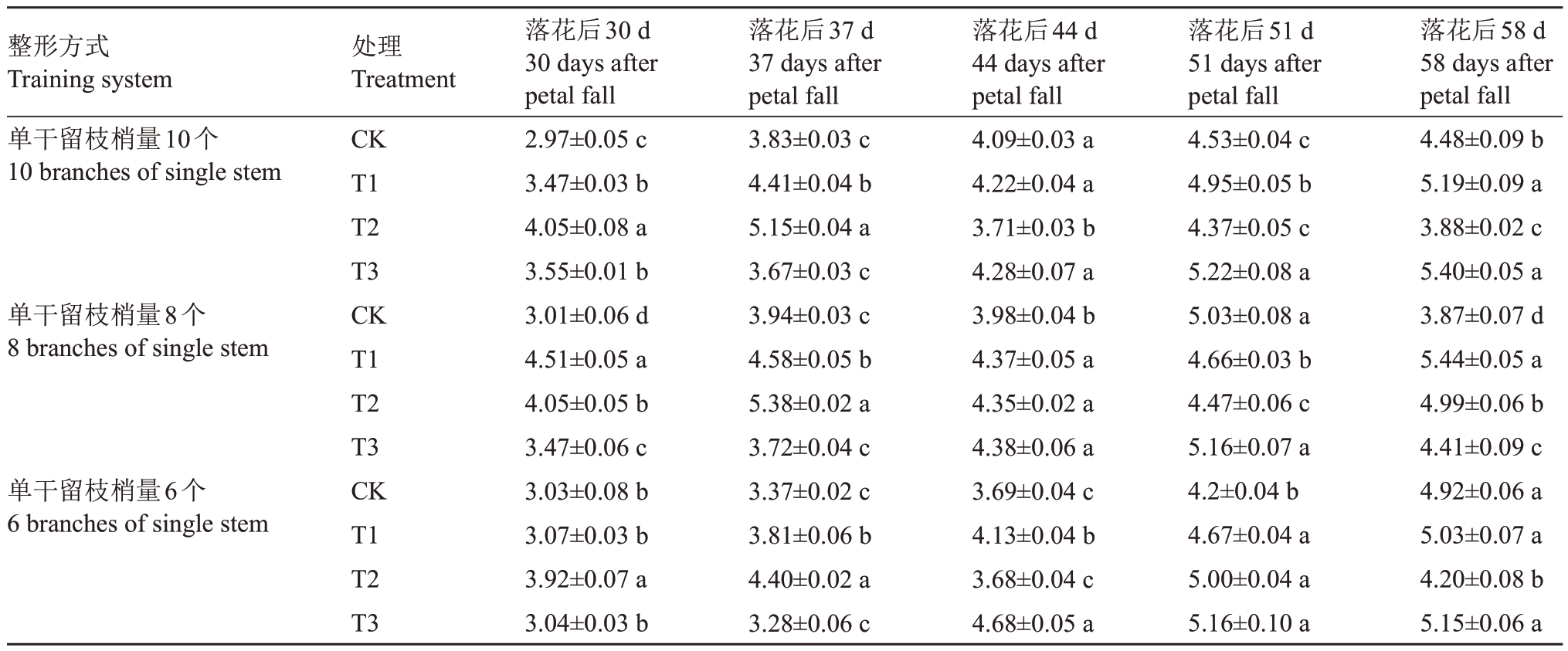
由表6 可知,3 种留枝梢量处理下,不同处理的叶片叶绿素含量随着果实发育呈不同的变化趋势。单干留枝梢量为10 个时,落花后58 d,喷施调环酸钙和拉枝处理的叶片叶绿素含量较对照分别显著提高15.85%和20.54%。单干留枝梢量为8个时,落花后58 d,喷施调环酸钙、摘心和拉枝处理的叶片叶绿素含量较对照分别显著提高40.56%、28.94%和13.95%。单干留枝梢量为6 个时,摘心处理的叶片叶绿素含量较对照显著降低14.63%。
表6 不同整形方式对叶绿素含量的影响
Table 6 Effects of different training systems on chlorophyll content(mg·g-1)
整形方式Training system单干留枝梢量10个10 branches of single stem单干留枝梢量8个8 branches of single stem单干留枝梢量6个6 branches of single stem处理Treatment CK T1 T2 T3 CK T1 T2 T3 CK T1 T2 T3落花后30 d 30 days after petal fall 2.97±0.05 c 3.47±0.03 b 4.05±0.08 a 3.55±0.01 b 3.01±0.06 d 4.51±0.05 a 4.05±0.05 b 3.47±0.06 c 3.03±0.08 b 3.07±0.03 b 3.92±0.07 a 3.04±0.03 b落花后37 d 37 days after petal fall 3.83±0.03 c 4.41±0.04 b 5.15±0.04 a 3.67±0.03 c 3.94±0.03 c 4.58±0.05 b 5.38±0.02 a 3.72±0.04 c 3.37±0.02 c 3.81±0.06 b 4.40±0.02 a 3.28±0.06 c落花后44 d 44 days after petal fall 4.09±0.03 a 4.22±0.04 a 3.71±0.03 b 4.28±0.07 a 3.98±0.04 b 4.37±0.05 a 4.35±0.02 a 4.38±0.06 a 3.69±0.04 c 4.13±0.04 b 3.68±0.04 c 4.68±0.05 a落花后51 d 51 days after petal fall 4.53±0.04 c 4.95±0.05 b 4.37±0.05 c 5.22±0.08 a 5.03±0.08 a 4.66±0.03 b 4.47±0.06 c 5.16±0.07 a 4.2±0.04 b 4.67±0.04 a 5.00±0.04 a 5.16±0.10 a落花后58 d 58 days after petal fall 4.48±0.09 b 5.19±0.09 a 3.88±0.02 c 5.40±0.05 a 3.87±0.07 d 5.44±0.05 a 4.99±0.06 b 4.41±0.09 c 4.92±0.06 a 5.03±0.07 a 4.20±0.08 b 5.15±0.06 a
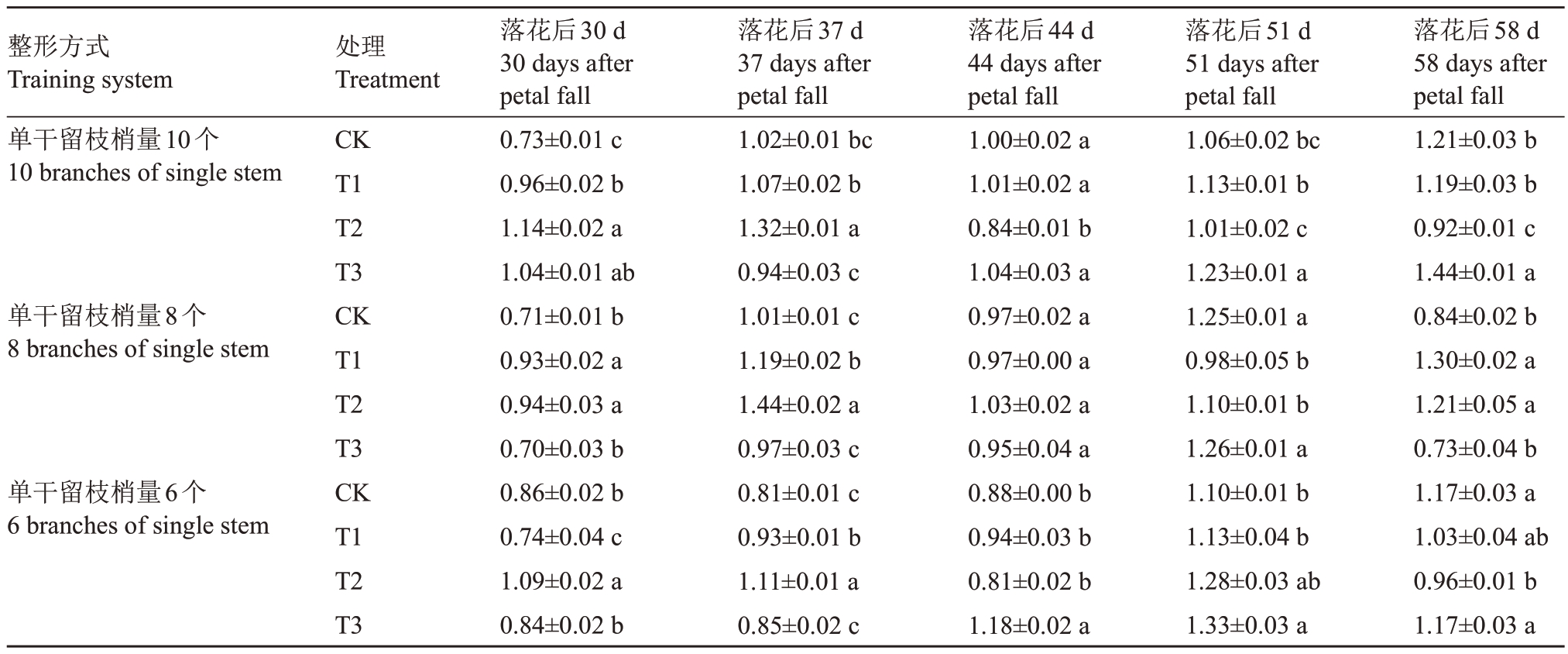
由表7可知,单干留枝梢量为10个时,喷施调环酸钙处理的叶片类胡萝卜素含量呈先升高后降低再升高的变化趋势,摘心处理呈波动式下降,拉枝处理呈先降低后升高的变化趋势,落花后58 d,拉枝处理较对照显著提高19.01%。单干留枝梢量为8 个时,喷施调环酸钙和摘心处理的叶片类胡萝卜素含量呈先升高后降低再升高的变化趋势,拉枝处理呈“升-降-升-降”的变化趋势,落花后58 d,喷施调环酸钙和摘心处理分别较对照显著提高54.76%和44.05%。单干留枝梢量为6 个时,喷施调环酸钙和拉枝处理的叶片类胡萝卜素含量呈先升高后降低的趋势,摘心处理呈“升-降-升-降”的变化趋势,落花后58 d,摘心处理较对照显著降低17.95%。
表7 不同整形方式对类胡萝卜素含量的影响
Table 7 Effects of different training systems on carotenoid content(mg·g-1)
整形方式Training system单干留枝梢量10个10 branches of single stem单干留枝梢量8个8 branches of single stem单干留枝梢量6个6 branches of single stem处理Treatment CK T1 T2 T3 CK T1 T2 T3 CK T1 T2 T3落花后30 d 30 days after petal fall 0.73±0.01 c 0.96±0.02 b 1.14±0.02 a 1.04±0.01 ab 0.71±0.01 b 0.93±0.02 a 0.94±0.03 a 0.70±0.03 b 0.86±0.02 b 0.74±0.04 c 1.09±0.02 a 0.84±0.02 b落花后37 d 37 days after petal fall 1.02±0.01 bc 1.07±0.02 b 1.32±0.01 a 0.94±0.03 c 1.01±0.01 c 1.19±0.02 b 1.44±0.02 a 0.97±0.03 c 0.81±0.01 c 0.93±0.01 b 1.11±0.01 a 0.85±0.02 c落花后44 d 44 days after petal fall 1.00±0.02 a 1.01±0.02 a 0.84±0.01 b 1.04±0.03 a 0.97±0.02 a 0.97±0.00 a 1.03±0.02 a 0.95±0.04 a 0.88±0.00 b 0.94±0.03 b 0.81±0.02 b 1.18±0.02 a落花后51 d 51 days after petal fall 1.06±0.02 bc 1.13±0.01 b 1.01±0.02 c 1.23±0.01 a 1.25±0.01 a 0.98±0.05 b 1.10±0.01 b 1.26±0.01 a 1.10±0.01 b 1.13±0.04 b 1.28±0.03 ab 1.33±0.03 a落花后58 d 58 days after petal fall 1.21±0.03 b 1.19±0.03 b 0.92±0.01 c 1.44±0.01 a 0.84±0.02 b 1.30±0.02 a 1.21±0.05 a 0.73±0.04 b 1.17±0.03 a 1.03±0.04 ab 0.96±0.01 b 1.17±0.03 a
2.4 不同整形方式对光合特性的影响
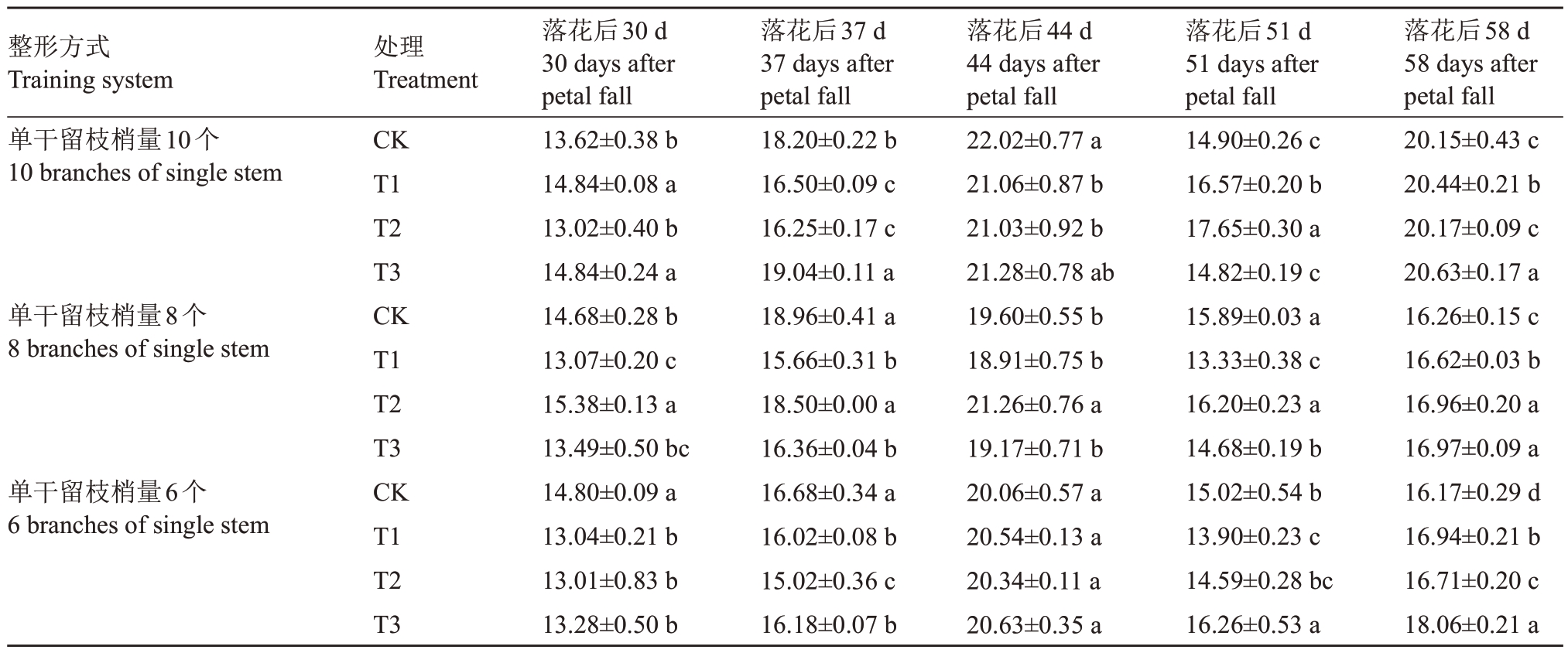
由表8 可知,所有处理的净光合速率均呈先升高后降低再升高的变化趋势。落花后58 d,单干留枝梢量为10个时,喷施调环酸钙与拉枝处理的Pn较对照分别显著提高1.44%、2.38%。单干留枝梢量为8个时,喷施调环酸钙、摘心与拉枝处理的Pn较对照分别显著提高2.21%、4.30%和4.37%。单干留枝梢量为6个时,喷施调环酸钙、摘心与拉枝处理的Pn较对照分别显著提高4.76%、3.34%和11.69%。
表8 不同整形方式对净光合速率的影响
Table 8 Effects of different training systems on net photosynthetic rate(μmol·m-2·s-1)
整形方式Training system单干留枝梢量10个10 branches of single stem单干留枝梢量8个8 branches of single stem单干留枝梢量6个6 branches of single stem处理Treatment CK T1 T2 T3 CK T1 T2 T3 CK T1 T2 T3落花后30 d 30 days after petal fall 13.62±0.38 b 14.84±0.08 a 13.02±0.40 b 14.84±0.24 a 14.68±0.28 b 13.07±0.20 c 15.38±0.13 a 13.49±0.50 bc 14.80±0.09 a 13.04±0.21 b 13.01±0.83 b 13.28±0.50 b落花后37 d 37 days after petal fall 18.20±0.22 b 16.50±0.09 c 16.25±0.17 c 19.04±0.11 a 18.96±0.41 a 15.66±0.31 b 18.50±0.00 a 16.36±0.04 b 16.68±0.34 a 16.02±0.08 b 15.02±0.36 c 16.18±0.07 b落花后44 d 44 days after petal fall 22.02±0.77 a 21.06±0.87 b 21.03±0.92 b 21.28±0.78 ab 19.60±0.55 b 18.91±0.75 b 21.26±0.76 a 19.17±0.71 b 20.06±0.57 a 20.54±0.13 a 20.34±0.11 a 20.63±0.35 a落花后51 d 51 days after petal fall 14.90±0.26 c 16.57±0.20 b 17.65±0.30 a 14.82±0.19 c 15.89±0.03 a 13.33±0.38 c 16.20±0.23 a 14.68±0.19 b 15.02±0.54 b 13.90±0.23 c 14.59±0.28 bc 16.26±0.53 a落花后58 d 58 days after petal fall 20.15±0.43 c 20.44±0.21 b 20.17±0.09 c 20.63±0.17 a 16.26±0.15 c 16.62±0.03 b 16.96±0.20 a 16.97±0.09 a 16.17±0.29 d 16.94±0.21 b 16.71±0.20 c 18.06±0.21 a
由表9可知,单干留枝梢量为10个时,喷施调环酸钙和摘心处理的Fv/Fm均呈先升高后降低再升高的趋势,拉枝处理呈先降低再升高的趋势,落花后58 d,拉枝处理的Fv/Fm较对照显著降低7.69%。单干留枝梢量为8个时,喷施调环酸钙处理的Fv/Fm呈先降低再升高的趋势,摘心与拉枝处理均呈先降低后升高再降低的趋势,落花后58 d,摘心与拉枝处理的Fv/Fm较对照均显著降低8.70%。单干留枝梢量为6个时,喷施调环酸钙与摘心处理的Fv/Fm均呈先降低后升高再降低的趋势,拉枝处理呈现波动式变化,落花后58 d,摘心处理的Fv/Fm较对照显著降低5.97%。
表9 不同整形方式对最大光化学效率的影响
Table 9 Effects of different training systems on maximal photochemical efficiency

整形方式Training system单干留枝梢量10个10 branches of single stem单干留枝梢量8个8 branches of single stem单干留枝梢量6个6 branches of single stem处理Treatment CK T1 T2 T3 CK T1 T2 T3 CK T1 T2 T3落花后30 d 30 days after petal fall 0.63±0.04 c 0.66±0.03 b 0.62±0.04 c 0.72±0.01 a 0.69±0.05 b 0.63±0.03 c 0.74±0.01 a 0.65±0.05 c 0.66±0.03 c 0.64±0.05 c 0.68±0.01 b 0.71±0.02 a落花后37 d 37 days after petal fall 0.59±0.02 c 0.70±0.01 a 0.67±0.02 b 0.67±0.01 b 0.64±0.04 a 0.63±0.01 a 0.62±0.01 ab 0.61±0.03 b 0.65±0.01 a 0.63±0.04 ab 0.61±0.03 b 0.64±0.01 ab落花后44 d 44 days after petal fall 0.69±0.06 a 0.65±0.01 b 0.64±0.03 b 0.66±0.02 b 0.68±0.02 a 0.55±0.02 c 0.59±0.01 b 0.66±0.01 a 0.57±0.02 c 0.61±0.01 b 0.69±0.02 a 0.68±0.01 a落花后51 d 51 days after petal fall 0.59±0.03 b 0.63±0.05 a 0.59±0.01 b 0.65±0.04 a 0.68±0.01 a 0.69±0.05 a 0.68±0.02 a 0.67±0.03 a 0.68±0.03 b 0.71±0.01 a 0.68±0.02 b 0.63±0.00 c落花后58 d 58 days after petal fall 0.78±0.02 a 0.76±0.03 a 0.78±0.02 a 0.72±0.01 b 0.69±0.02 a 0.69±0.01 a 0.63±0.01 b 0.63±0.00 b 0.67±0.02 a 0.67±0.02 a 0.63±0.01 b 0.68±0.03 a
2.5 成花率
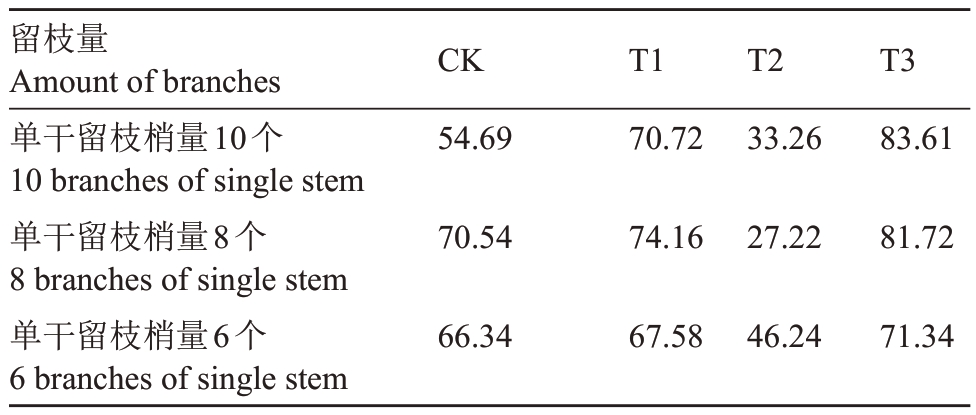
由表10 和图3 可知,不同整形方式3 种留枝量处理的成花情况基本一致,拉枝处理的成花率最高,调环酸钙的成花率次之,摘心处理的成花率最低。单干留枝梢量为10个时,拉枝和喷施调环酸钙处理的成花率较对照分别提高28.92 和16.03 百分点;单干留枝梢量为8 个时,拉枝和喷施调环酸钙处理的成花率较对照分别提高11.18和3.62百分点;单干留枝梢量为6 个时,拉枝和喷施调环酸钙处理的成花率较对照分别提高5.00 和1.24 百分点;摘心处理的成花率均低于对照。
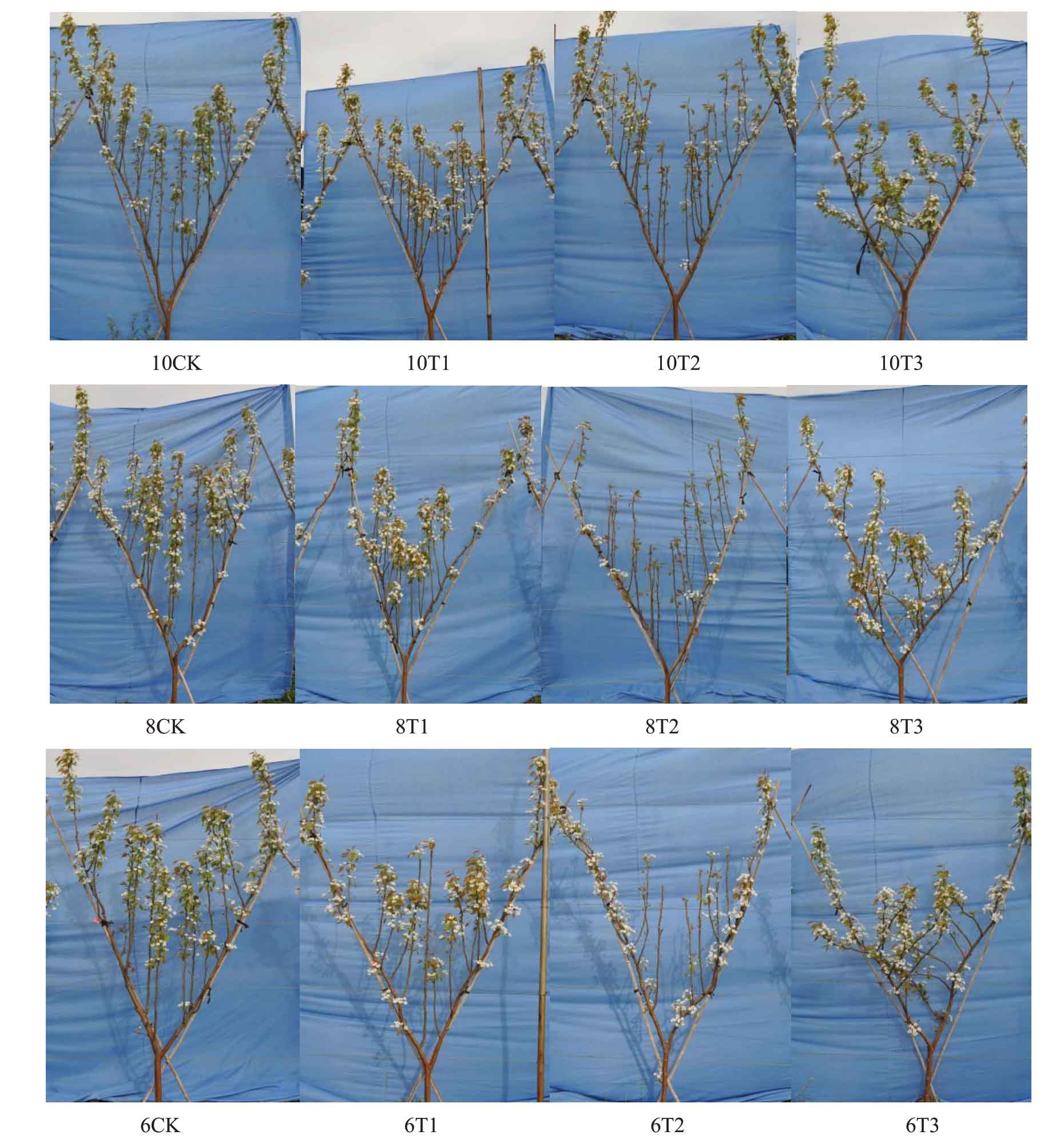
图3 不同整形方式对成花率的影响
Fig.3 Effects of different training systems on flower formation rate
表10 不同整形方式对成花率的影响
Table 10 Effects of different training systems on flower formation rate %
留枝量Amount of branches单干留枝梢量10个10 branches of single stem单干留枝梢量8个8 branches of single stem单干留枝梢量6个6 branches of single stem CK 54.69 T1 70.72 T2 33.26 T3 83.61 70.54 74.16 27.22 81.72 66.34 67.58 46.24 71.34
2.6 综合评价
采用熵值法对上述测量的指标进行综合评价,利用SPSS 软件计算各指标的权重(表11),再根据各指标的权重计算不同留枝量与整形方式组合的综合得分(表12)。综合得分的高低代表整形树体的优劣,可知12 种组合的优劣顺序为10T3>10T1>10CK>10T2>6T3>8T1>8T3>6T1>6CK>8CK>8T2>6T2。
表11 权重分析计算结果
Table 11 Weight analysis calculation results
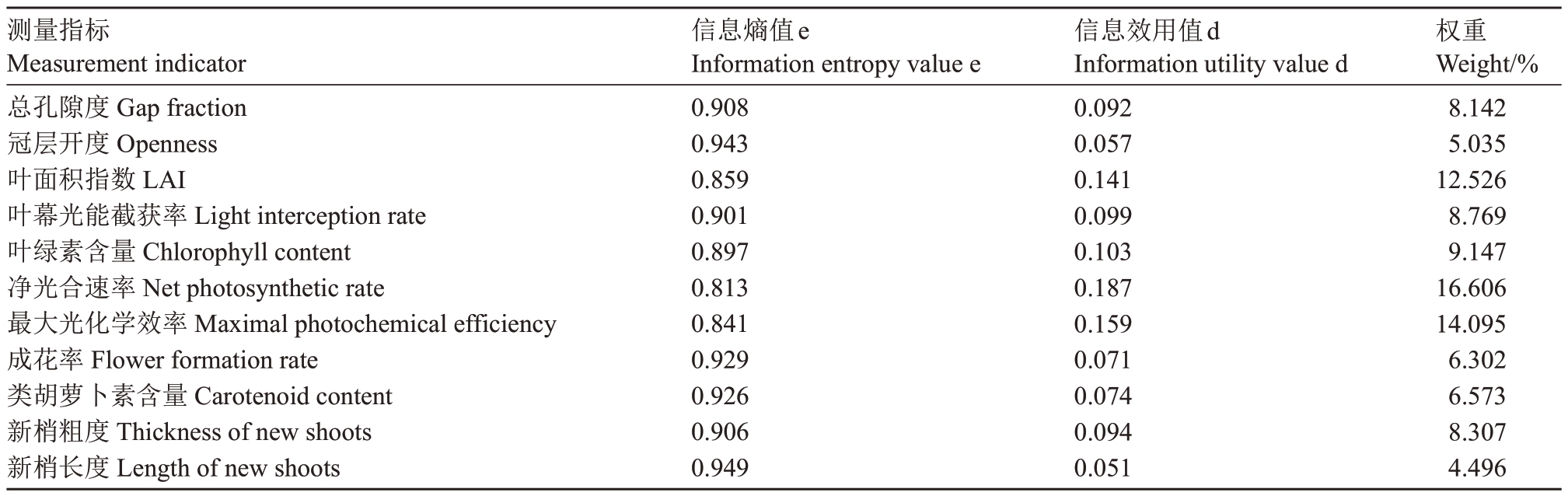
测量指标Measurement indicator总孔隙度Gap fraction冠层开度Openness叶面积指数LAI叶幕光能截获率Light interception rate叶绿素含量Chlorophyll content净光合速率Net photosynthetic rate最大光化学效率Maximal photochemical efficiency成花率Flower formation rate类胡萝卜素含量Carotenoid content新梢粗度Thickness of new shoots新梢长度Length of new shoots信息熵值e Information entropy value e 0.908 0.943 0.859 0.901 0.897 0.813 0.841 0.929 0.926 0.906 0.949信息效用值d Information utility value d 0.092 0.057 0.141 0.099 0.103 0.187 0.159 0.071 0.074 0.094 0.051权重Weight/%8.142 5.035 12.526 8.769 9.147 16.606 14.095 6.302 6.573 8.307 4.496
表12 综合得分
Table 12 Comprehensive score
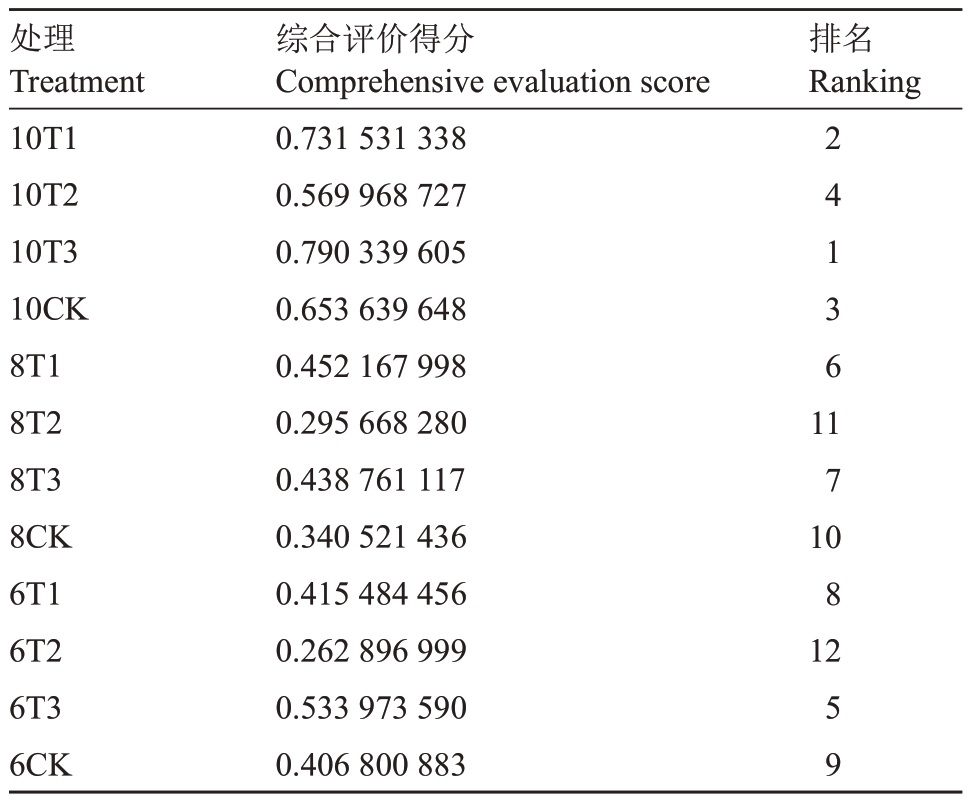
处理Treatment 10T1 10T2 10T3 10CK 8T1 8T2 8T3 8CK 6T1 6T2 6T3 6CK综合评价得分Comprehensive evaluation score 0.731 531 338 0.569 968 727 0.790 339 605 0.653 639 648 0.452 167 998 0.295 668 280 0.438 761 117 0.340 521 436 0.415 484 456 0.262 896 999 0.533 973 590 0.406 800 883排名Ranking 2 4 1 3 6 1 1 7 10 8 12 5 9
3 讨 论
3.1 不同整形方式对梨树新梢生长的影响
新梢控旺是实现果树幼树由营养生长转向生殖生长的关键,能够促进树体积累足够养分,以支持花芽分化和果实发育等生理过程,从而达到优质高产的生产目的[14]。喷施调环酸钙、摘心、拉枝3种整形方式均能有效抑制果树新梢加长生长,与韩佳宇等[15]、玄志友[16]、于祎飞等[17]的研究结果一致。然而,喷施调环酸钙对新梢粗度的调控存在分歧,王钰菲等[18]、万艳玲[19]研究表明,喷施调环酸钙可促进苹果树新梢加粗生长,但本试验中调环酸钙处理对梨新梢粗度生长无明显影响,甚至表现出抑制效应,这一矛盾可能源于调环酸钙对植物体内赤霉素生物合成的抑制作用,通过降低形成层细胞的分裂与分化活性,进而阻碍新梢横向生长。该机制与贺强等[20]在草莓中的研究结果相印证,低浓度调环酸钙同样抑制草莓根茎的粗度生长。
3.2 不同整形方式对梨树冠层结构的影响
冠层总孔隙度、开度、叶面积指数和光能截获率等冠层参数与树体的光合能力紧密相关,良好的冠层结构可改善冠内通风条件,提升树体光能利用效率,进而影响树势和果实品质[21]。单干留枝梢量为10 个和8 个时,摘心与拉枝处理均能显著提高冠层总孔隙度和开度,而单干留枝梢量为6 个时,3 种整形方式均显著降低冠层孔隙度和开度,原因可能是留枝量较少时,未整形前的冠层总孔隙度和开度已经处于较高水平。本试验中的叶面积指数在生育中后期均呈下降趋势,而冠层总孔隙度和开度表现出相反的变化规律,此现象与张雯[22]和刘珊珊等[23]的研究结果基本一致。3 种留枝量下,拉枝处理的冠层光能截获率均显著高于对照,但喷施调环酸钙与摘心处理的冠层光能截获率显著低于对照,与马婧[24]的研究结果存在差异,但与Medjdoub 等[25]、Zhang 等[26]的研究结果一致,该矛盾可能源于整形处理抑制了新梢萌发和叶片扩展,导致总叶面积增长受限。由于光能截获率在一定范围内与LAI呈正相关,当LAI 不足时,即使冠层透光性改善,总截光量仍偏低,最终导致光能截获率下降。
3.3 不同整形方式对梨树叶片质量的影响
叶片质量直接影响光合作用效能,其中叶绿素作为光合作用的关键色素物质,其含量显著影响植物的光合能力,类胡萝卜素不仅参与光能捕获,还具有抗氧化等生理功能[27-28]。留枝量的改变通过调控植株间的光照分布与通风条件,进一步影响叶绿素与类胡萝卜素的生物合成过程[12]。当单干留枝梢量为10 个时,拉枝处理能有效促进叶片叶绿素积累;而单干留枝梢量为8 个时,喷施调环酸钙可显著提高叶片叶绿素含量,与杨三奎[29]、蔡虎等[30]的研究结论一致。值得注意的是,当单干留枝梢量降为6 个时,喷施调环酸钙和拉枝处理对叶绿素与类胡萝卜素含量均未产生显著影响,与前述留枝量较高时的研究结果存在差异,但与Medjdoub 等[25]、宋艳荣[31]的研究结果相吻合,其内在原因可能是低留枝量条件下,树体合成的光合产物总量不足以支撑叶片合成更多的叶绿素和类胡萝卜素。
3.4 不同整形方式对梨树光合特性的影响
就光合特性而言,3种留枝量下,喷施调环酸钙与拉枝处理能显著提高叶片净光合速率,与崔梅鹤[32]和崔慧敏[33]的研究结果一致。当单干留枝梢量为10个时,摘心处理对叶片的净光合速率未表现出显著促进作用,与时晓芳等[34]的研究结果存在差异,这种矛盾可能源于留枝量较高时叶片相互遮挡加剧,导致光能吸收与利用效率降低,进而减弱光合作用效能。最大光化学效率作为衡量光系统Ⅱ(PSⅡ)反应中心活性及植物抗逆能力的关键指标,其动态变化反映了植物对光能利用效率的适应性调节机制[35]。对于多种植物而言,未受到胁迫时,Fv/Fm值通常维持在0.80~0.85 区间,但本试验中3 种整形方式及对照的Fv/Fm值均低于0.80,推测树体可能遭受强光与高温协同胁迫,该胁迫抑制光合酶活性,破坏类囊体膜结构,致使PSⅡ反应中心失活或损伤、最终削弱PSⅡ功能。
4 结 论
综上所述,单干留枝梢量为10 个配合拉枝整形,能有效控制新梢旺长,显著提升冠层总孔隙度和开度,光分布显著优化;叶片叶绿素及类胡萝卜素含量达到最高,光合色素积累充分;净光合速率维持较高水平,光合转化效率稳定;成花率明显提高,该处理组合综合评分最高。但考虑拉枝的经济性与操作可行性,排名第2 位的单干留枝梢量为10 个与喷施450 mg·L-1调环酸钙的处理组合更适宜作为双干平面树形黄冠梨幼树的轻简化整形方式进行规模化推广应用。
[1] 刘芳.黄冠梨丰产栽培技术[J].中国果业信息,2024,41(11):97-98.LIU Fang. High yield cultivation techniques for Huangguan pear[J].China Fruit News,2024,41(11):97-98.
[2] 李丹阳,董洁芳,吴传云.我国果园生产机械化发展趋势与思考[J].农机科技推广,2024(8):12-13.LI Danyang,DONG Jiefang,WU Chuanyun. The development trend and reflection on mechanization of orchard production in China[J]. Agriculture Machinery Technology Extension,2024(8):12-13.
[3] 赵德英.如何培养苹果双干平面树形[J].果树实用技术与信息,2023(9):29.ZHAO Deying. How to cultivate apple double stem flat tree shape[J]. Applied Technology and Information for Fruit Tree,2023(9):29.
[4] 赵德英,闫帅,张彦昌,赵亮亮,徐锴,张少瑜,侯桂学.新形势下梨轻简优质高效栽培新模式与新技术[J]. 北方果树,2022(2):1-5.ZHAO Deying,YAN Shuai,ZHANG Yanchang,ZHAO Liangliang,XU Kai,ZHANG Shaoyu,HOU Guixue. Novel modes and techniques of labor-saving,high-quality and high-efficiency cultivation in pear industry under the new situation[J]. Northern Fruits,2022(2):1-5.
[5] 马小龙,马豆豆,史继东,韩明玉,杨伟伟,张东.双主干并棒树形对矮化自根砧苹果幼树生长和结果的影响[J].园艺学报,2020,47(3):541-550.MA Xiaolong,MA Doudou,SHI Jidong,HAN Mingyu,YANG Weiwei,ZHANG Dong. Effect of Bi-axis Bibaum tree shape on growth and bearing of young apple tree on dwarf rootstock[J].Acta Horticulturae Sinica,2020,47(3):541-550.
[6] 尤慧晴,周鹏羽,杨勇,俞明亮,许建兰,丁文正,高志红.Y 形整形方式对桃园树体生长、光合作用和果实品质的影响[J].中国果树,2024(10):40-45.YOU Huiqing,ZHOU Pengyu,YANG Yong,YU Mingliang,XU Jianlan,DING Wenzheng,GAO Zhihong. Effects of Yshaped training on tree growth and photosynthesis and fruit quality in peach[J].China Fruits,2024(10):40-45.
[7] 丁想,周伟权,麦合木提·图如普,牛莹莹,樊国全,廖康.刻芽和拉枝对库尔勒香梨生长发育的影响[J]. 新疆农业科学,2021,58(11):2084-2093.DING Xiang,ZHOU Weiquan,Maihemuti·Turupu,NIU Yingying,FAN Guoquan,LIAO Kang. Effects of bud-notching and branch-bending on growth and development of Korla fragrant pear[J]. Xinjiang Agricultural Sciences,2021,58(11):2084-2093.
[8] 聂晗宇,闫帅,赵亮亮,赵德英,曹玉芬.玉露香梨对拉枝处理的生理响应研究[J].中国果树,2023(8):92-97.NIE Hanyu,YAN Shuai,ZHAO Liangliang,ZHAO Deying,CAO Yufen. Study on the physiological effect of‘Yuluxiang’pear to branch bending treatment[J]. China Fruits,2023(8):92-97.
[9] 孟令松,艾斯开尔·买海提,黄余周,陶建敏.副梢处理对红先锋葡萄光合特性和果实品质的影响[J].江苏农业科学,2018,46(12):95-98.MENG Lingsong,Aisikaier·Maihati,HUANG Yuzhou,TAO Jianmin. Effects of axillary shoot treatment on photosynthetic characteristics and fruit quality of grape“Akali”[J].Jiangsu Agricultural Sciences,2018,46(12):95-98.
[10] 李辉,李宏业,姚会东,闫威姣,陈锦永,郭西智,赵宝龙,孙军利.不同摘心方式对克瑞森无核葡萄叶片光合特性及果实品质的影响[J].江苏农业科学,2022,50(19):149-155.LI Hui,LI Hongye,YAO Huidong,YAN Weijiao,CHEN Jinyong,GUO Xizhi,ZHAO Baolong,SUN Junli.Effects of different heart-picking methods on leaf photosynthetic characteristics and fruit quality of Cressen seedless grape[J]. Jiangsu Agricultural Sciences,2022,50(19):149-155.
[11] 杨婉莹,王文晓,熊超明,孙齐宇,李慧,孙文喜.植物生长抑制剂对草莓花芽分化、产量及品质的影响[J].江苏农业科学,2023,51(12):113-120.YANG Wanying,WANG Wenxiao,XIONG Chaoming,SUN Qiyu,LI Hui,SUN Wenxi. Effects of plant growth inhibitors on flower bud differentiation,yield and quality of strawberry[J]. Jiangsu Agricultural Sciences,2023,51(12):113-120.
[12] 张冲,刘丹花,杨婷斐,张强,李民吉,张军科.不同冬剪留枝量对富士苹果生长和结果的影响[J]. 西北农业学报,2016,25(11):1650-1655.ZHANG Chong,LIU Danhua,YANG Tingfei,ZHANG Qiang,LI Minji,ZHANG Junke.Effect of different amounts of remaining shoot on growth and yield of‘Fuji’apple[J].Acta Agriculturae Boreali-occidentalis Sinica,2016,25(11):1650-1655.
[13] 靳韦,王昊,杨波,哈蓉,陈永伟,徐灿,张敏,马文礼.不同留枝量对欧李生长量及果实品质的影响[J].宁夏农林科技,2022,63(增刊1):17-20.JIN Wei,WANG Hao,YANG Bo,HA Rong,CHEN Yongwei,XU Can,ZHANG Min,MA Wenli. Experiment on the effect of different branch retention on the growth and fruit quality of Cerasus humilis[J].Ningxia Journal of Agriculture and Forestry Science and Technology,2022,63(Suppl.1):17-20.
[14] 张庆伟,韩明玉,赵彩平.苹果苗木及幼树促分枝技术研究进展[J].果树学报,2011,28(1):108-113.ZHANG Qingwei,HAN Mingyu,ZHAO Caiping. Research progress in promoting branching techniques in apple nursery and young tree[J]. Journal of Fruit Science,2011,28(1):108-113.
[15] 韩佳宇,林玲,曹雄军,时晓芳,张瑛,白先进,黄桂媛,郭荣荣,谢太理,周思泓,曹慕明.摘心与矮壮素处理对“夏黑”葡萄枝条内源激素及生长的影响[J].中国南方果树,2021,50(5):116-118.HAN Jiayu,LIN Ling,CAO Xiongjun,SHI Xiaofang,ZHANG Ying,BAI Xianjin,HUANG Guiyuan,GUO Rongrong,XIE Taili,ZHOU Sihong,CAO Muming. The effects of heart picking and dwarfing treatment on endogenous hormones and growth of“Xia Hei”grape branches[J]. South China Fruits,2021,50(5):116-118.
[16] 玄志友.调环酸钙影响赣南脐橙夏梢生长和果实品质[J].中国果业信息,2022(7):59.XUAN Zhiyou. The effect of calcium citrate on summer shoot growth and fruit quality of Gannan navel orange[J]. China Fruit News,2022(7):59.
[17] 于祎飞,滕慧颖,刘雯斐,梁志涛,张东风,汉瑞峰,宫英振.红国光苹果拉枝和刻芽的树体整形效应[J]. 河北农业科学,2019,23(1):37-40.YU Yifei,TENG Huiying,LIU Wenfei,LIANG Zhitao,ZHANG Dongfeng,HAN Ruifeng,GONG Yingzhen. Effects of Branch-bending and Bud-notching on Red Guoguang apple[J].Journal of Hebei Agricultural Sciences,2019,23(1):37-40.
[18] 王钰菲,赵德英,闫帅,徐功勋,赵亮亮.外源调环酸钙对苹果幼树生长发育和叶片矿质营养的影响[J].中国果树,2024(3):26-33.WANG Yufei,ZHAO Deying,YAN Shuai,XU Gongxun,ZHAO Liangliang. Effects of exogenous prohexadione- calcium on growth and leaf mineral nutrition of young apple trees[J]. China Fruits,2024(3):26-33.
[19] 万艳玲.枝干用CPPU 和调环酸钙对苹果枝条生长和花芽形成的影响[D].泰安:山东农业大学,2024.WAN Yanling. Effects of CPPU and pro-calcium on the growth of apple branches and flower bud formation[D]. Tai’an:Shandong Agricultural University,2024.
[20] 贺强,杨芬,高德航,董振飞,许腾飞,毛立榕,王红清.调环酸钙处理对北京地区草莓花芽分化及生长发育的影响[J].中国农业大学学报,2025,30(5):96-106.HE Qiang,YANG Fen,GAO Dehang,DONG Zhenfei,XU Tengfei,MAO Lirong,WANG Hongqing. Effects of prohexadione-calcium treatment on flower bud differentiation and plant growth of strawberry in Beijing[J]. Journal of China Agricultural University,2025,30(5):96-106.
[21] ANTHONY B M,MINAS I S. Canopy architecture impact on peach tree physiology,vigor diffusion,productivity and fruit quality[J].Scientia Horticulturae,2025,342:114025.
[22] 张雯. 修剪和拉枝对红富士苹果冠层结构及生长结果的影响[D].杨凌:西北农林科技大学,2010.ZHANG Wen. Research of different branch angle and clip quantity on Fuji apple canopy structure growth and fruit infruence[D].Yangling:Northwest A&F University,2010.
[23] 刘珊珊,令狐田,赵志霞,缑耀武,翟锐,杨成泉,徐凌飞,王志刚.不同树形对砀山酥梨冠层结构、光合特性及果实品质的影响[J].果树资源学报,2022,3(5):41-49.LIU Shanshan,LINGHU Tian,ZHAO Zhixia,GOU Yaowu,ZHAI Rui,YANG Chengquan,XU Lingfei,WANG Zhigang.Effects of different tree shapes on canopy structure,photosynthetic characteristics,fruit quality of‘Dangshan’pear[J]. Journal of Fruit Resources,2022,3(5):41-49.
[24] 马婧.修剪对枣树冠层特性、产量及蒸腾耗水的影响研究[D].杨凌:西北农林科技大学,2011.MA Jing. Research of pruning on jujube canopy characteristic yield and transpiration[D].Yangling:Northwest A&F University,2011.
[25] MEDJDOUB R,VAL J,BLANCO A. Physiological effects of prohexadione-calcium in apple trees:Effects on parameters related to photoproductivity[J]. The Journal of Horticultural Science and Biotechnology,2007,82(1):126-132.
[26] ZHANG B B,ZHENG F S,GENG W W,DU H,XIAO Y S,PENG F T. Effect of branch bending on the canopy characteristics and growth of peach[Prunus persica(L.)Batsch][J].Agronomy,2023,13(4):1058.
[27] 王明玉. 不同红叶性状桃叶片呈色特性及有关光合特征研究[D].南京:南京农业大学,2014.WANG Mingyu. Study on colorimetric characteristics and photosynthetic characteristics of peach leaves with different red coloration types[D]. Nanjing:Nanjing Agricultural University,2014.
[28] 罗怿,李金强,李文云,王小柯,解璞.不同品种红肉柚类胡萝卜素组分及其抗氧化能力研究[J].食品研究与开发,2022,43(7):18-23.LUO Yi,LI Jinqiang,LI Wenyun,WANG Xiaoke,XIE Pu. The carotenoid composition and antioxidant activity of different varieties of red-fleshed pomelo[J]. Food Research and Development,2022,43(7):18-23.
[29] 杨三奎. 根系修剪和调环酸钙对桃树生长及果实品质的影响[D].泰安:山东农业大学,2023.YANG Sankui. Effects of root pruning treatment and prohexadione calcium on peach tree growth and fruit quality[D]. Tai’an:Shandong Agricultural University,2023.
[30] 蔡虎,张文娥,吴浪,樊卫国,王金金,彭剑,江辉,曹景富,潘学军.拉枝对黔核7 号泡核桃叶片营养、成花及坚果品质的影响[J].果树学报,2022,39(1):60-67.CAI Hu,ZHANG Wene,WU Lang,FAN Weiguo,WANG Jinjin,PENG Jian,JIANG Hui,CAO Jingfu,PAN Xuejun. Effects of branch bending angle on leaf nutrition,flower formation and nut quality of Qianhe 7 walnut[J]. Journal of Fruit Science,2022,39(1):60-67.
[31] 宋艳荣. 不同留果量与摘心长度对欧李生长结果的影响[J].河北果树,2019(1):6-8.SONG Yanrong. The influence of different fruit retention and core harvesting lengths on the growth and fruiting of Chinese dwarf cherry[J].Hebei Fruits,2019(1):6-8.
[32] 崔梅鹤.喷施调环酸钙对桃树生长发育的影响[D].保定:河北农业大学,2022.CUI Meihe. Effects of spraying prohexadione calcium on growth and development of peach trees[D]. Baoding:Hebei Agricultural University,2022.
[33] 崔慧敏.不同拉枝角度对库尔勒香梨生长和结果的影响[D].乌鲁木齐:新疆农业大学,2022.CUI Huimin. Effects of branch angle on growth and fruiting of Korla fragrant pear[D]. Urumqi:Xinjiang Agricultural University,2022.
[34] 时晓芳,林玲,侯延杰,曹雄军,郭荣荣,黄桂媛,白先进,张瑛,黄秋秘,盘丰平,韩佳宇.摘心对葡萄光合及叶绿素荧光特性的影响[J].中国南方果树,2023,52(5):146-149.SHI Xiaofang,LIN Ling,HOU Yanjie,CAO Xiongjun,GUO Rongrong,HUANG Guiyuan,BAI Xianjin,ZHANG Ying,HUANG Qiumi,PAN Fengping,HAN Jiayu. The effect of heart picking on photosynthesis and chlorophyll fluorescence characteristics of grapes[J]. South China Fruits,2023,52(5):146-149.
[35] 张国良,陈文军.1,2,4-三氯苯胁迫对水稻苗期叶绿素荧光特性的影响[J].植物生理学报,2016,52(5):628-634.ZHANG Guoliang,CHEN Wenjun. Effects of 1,2,4-trichlorobenzene on chlorophyll fluorescence characteristics of rice seedlings[J].Plant Physiology Journal,2016,52(5):628-634.