细胞壁作为植物感知和响应非生物胁迫的第一道物理屏障,其动态重构机制尤为值得研究。细胞壁主要由纤维素网络、半纤维素、果胶基质和木质素组成,不仅能通过改变机械特性响应胁迫信号,还能释放特定寡糖作为次级信使触发系统抗性[1-2]。木葡聚糖通过氢键与纤维素微纤丝交联,并与果胶共价连接,这种多糖网络的动态变化通过调节细胞膨压以精确控制细胞形态建成[3]。在此过程中,木葡聚糖内转糖苷酶/水解酶(xyloglucan endotransglucosylase/hydrolase,XTH)发挥着核心作用:同时具有内转糖苷酶活性(xyloglucan endotransglucosylase activity,XET)和内水解酶活性(xyloglucan endohydrolase activity,XEH),既能通过XET重组木葡聚糖链使细胞壁松弛,又能通过XEH不可逆切割多糖链促进壁结构降解,协同驱动细胞壁的扩张与重塑[4]。
XTHs属于糖苷水解酶16家族,具有Glyco_hydro_16结构域和XET_C结构域[4-6],其催化活性由保守的DEIDFEFLG结构域决定。系统发育分析将该家族分为Ⅰ/Ⅱ、Ⅲ-A 和Ⅲ-B 三个亚家族:其中Ⅰ/Ⅱ与Ⅲ-B亚家族主要表现XET活性,而Ⅲ-A亚家族则行使XEH功能[7]。不同物种的进化分析显示,Ⅰ/Ⅱ亚家族存在功能重叠,因此常合并为Ⅰ/Ⅱ组,而Ⅲ组可细分为Ⅲ-A、Ⅲ-B 组,同时增加了一个祖先组[7-10]。目前在拟南芥(Arabidopsis thaliana)、水稻(Oryza sativa)、番茄(Solanum lycopersicum)等模式植物中已分别鉴定出33、29、37个XTH基因,揭示该家族在植物界广泛存在且功能分化显著[7,10-11]。研究表明,水稻[12]、小麦(Triticum aestivum)[13-14]、大豆(Glycine max)[15]、葡萄(Vitis vinifera)[16]、盐角草(Salicornia europaea)[17]、黑果枸杞(Lycium ruthenicum)[18]等不同植物中的XTHs 基因通过调节细胞壁结构来响应干旱、盐渍、涝害和温度等逆境胁迫,从而帮助植物适应外界环境变化[19]。在拟南芥中异源超表达甜瓜(Cucumis melo)CmXTH11可以显著增强植株的抗旱性[20],在大豆中超表达AtXTH31 可提高植株对涝害的耐受性[15],上述研究结果为利用XTH基因进行作物抗逆遗传改良提供了依据。
枳(Poncirus trifoliata)是一种抗寒性较强的柑橘砧木。前期研究表明,低温处理下枳和崇义野橘无明显表型差异,但通过综合评估相对电导率、丙二醛含量、可溶性总糖含量等12 项抗性生理指标,发现崇义野橘比枳抗寒性更强,表明其可作为研究柑橘抗寒分子机制的理想材料[21-22]。尽管XTHs 调控细胞壁重塑机制的研究已在多个物种中开展,但针对崇义野橘这一特色抗寒种质,其XTHs 家族尚未被系统研究。通过系统鉴定崇义野橘XTHs基因,分析细胞壁重塑关键因子对低温的响应模式,为后期深入研究基因功能及分子机制奠定基础。
1 材料和方法
1.1 植物材料与处理
试验材料为崇义野橘(Citrus reticulata),种子取自江西省赣州市崇义县聂都乡的原始林区,播种于装有混合基质(泥炭、蛭石、珍珠岩体积比3∶1∶1)的塑料育苗盆(30 cm×28 cm),于人工气候室(温度(25±1)℃,相对湿度70%~80%,光照度1500~2000 lx,光周期16 h/8 h)培养1 年。选取生长一致的健康幼苗进行低温处理[(0±1)℃],并分别在处理0、1、3 d 后采集叶片,经液氮速冻后-80 ℃保存,每组设3个生物学重复。
1.2 XTH酶活性测定
使用植物木葡聚糖内糖基转酶/水解酶(XTH)酶联免疫吸附法(ELISA)试剂盒(酶免,中国江苏)测定XTH 酶活性。取低温处理0、1、3 d 的叶片样本,经液氮碾磨后,参照试剂盒说明书进行蛋白提取、标准品制备及酶标板检测,设置3 次生物学重复。单位体积反应体系中XTH酶蛋白含量以质量浓度(ng·L-1)表示。XTH酶活性指每升反应体系中每分钟催化生成1 μmol产物所需的酶量,单位为U·L-1。
1.3 基因组数据获取
崇义野橘基因组序列及注释文件由本课题组提供(尚未发表);从EnsemblPlants 数据库(https://plants.ensembl.org)获取水稻基因组序列及注释文件;通过TAIR 数据库(https://www.arabidopsis.org/)获取拟南芥基因组序列及注释文件。
1.4 CrXTHs基因家族成员鉴定及理化性质分析
从Pfam 数据库(http://pfam.xfam.org/)下载XTH 保守结构域(PF00722 和PF06955)的隐马尔可夫模型(HMMs);对崇义野橘基因组进行BLAST以及HMMER3.0 搜索,保留HMM(E 值阈值:e-10)[23]和BLASTP(E 值阈值:e-10,序列相似性>30%)识别的XTH 基因;通过SMART 数据库(http://smart.embl.de/)进一步验证。利用TBtools获取CrXTHs基因家族成员的氨基酸长度、染色体数和基因ID 等信息;通过在线工具Expasy(http://web.expasy.org/compute_pi/)预测崇义CrXTHs 基因家族成员的理化性质,如分子质量(molecular mass)及等电点(isoelectric point,pI);使用Plant-mPLoc(http://www.csbio.sjtu.edu.cn/bioinf/plant-multi/)进行亚细胞定位预测;使用SignalP(https://services.healthtech.dtu.dk/services/SignalP-5.0/)进行信号肽预测。
1.5 CrXTHs基因家族成员在染色体上的分布及系统进化分析
通过TBtools 的Gene Location 功能将CrXTHs基因进行染色体可视化定位,按照染色体编号(1~9号)顺序排列,并基于各染色体的物理位置自上而下命名。使用MEGA11.0软件的Clustal W模块,在默认设置(Gap open 为-2.90,Gap Extend 为0)下对拟南芥、水稻和崇义野橘的XTH基因家族成员的氨基酸序列进行多序列比对。基于比对结果,通过MEGA11.0 软件以邻接法(neighbor-joining,NJ)构建系统发育树,自展值设置为1000。进化树的结果使用chiplot 网站(https://www.chiplot.online)进行美化及可视化。
1.6 CrXTHs 基因结构、保守基序及顺式作用元件分析
基于崇义野橘基因组注释数据,系统鉴定外显子、内含子及非翻译区(UTR)分布,完成基因结构特征分析,采用GSDS 2.0 在线工具(https://gsds.cgrpoee.top)实现基因组结构可视化。进一步通过MEME Suite 5.5.7(http://meme-suite.org/tools/meme)分析XTH基因家族成员的保守基序,设置最大基序数为10,其余参数保持默认,最终利用TBtools 软件进行可视化。通过TBtools 提取CrXTHs 基因上游2 kb启动子区域序列,利用PlantCARE数据库(https://bioinformatics.psb.ugent.be/webtools/plantcare/html/)预测启动子顺式作用元件[24]。筛选出数量最多的7个顺式作用元件,通过TBtools软件对元件信息进行可视化。
1.7 CrXTHs基因家族成员共线性分析
使用TBtools 中的Advanced Circos 功能分析CrXTHs在进化过程中可能发生的基因复制事件,并筛选基因复制对信息。然后使用TBtools 中的Dual Systeny Plot for Mcscanx 功能分析崇义野橘与拟南芥、水稻中XTHs 基因的共线性,并筛选基因复制信息。
1.8 RNA提取与实时荧光定量PCR(qRT-PCR)分析
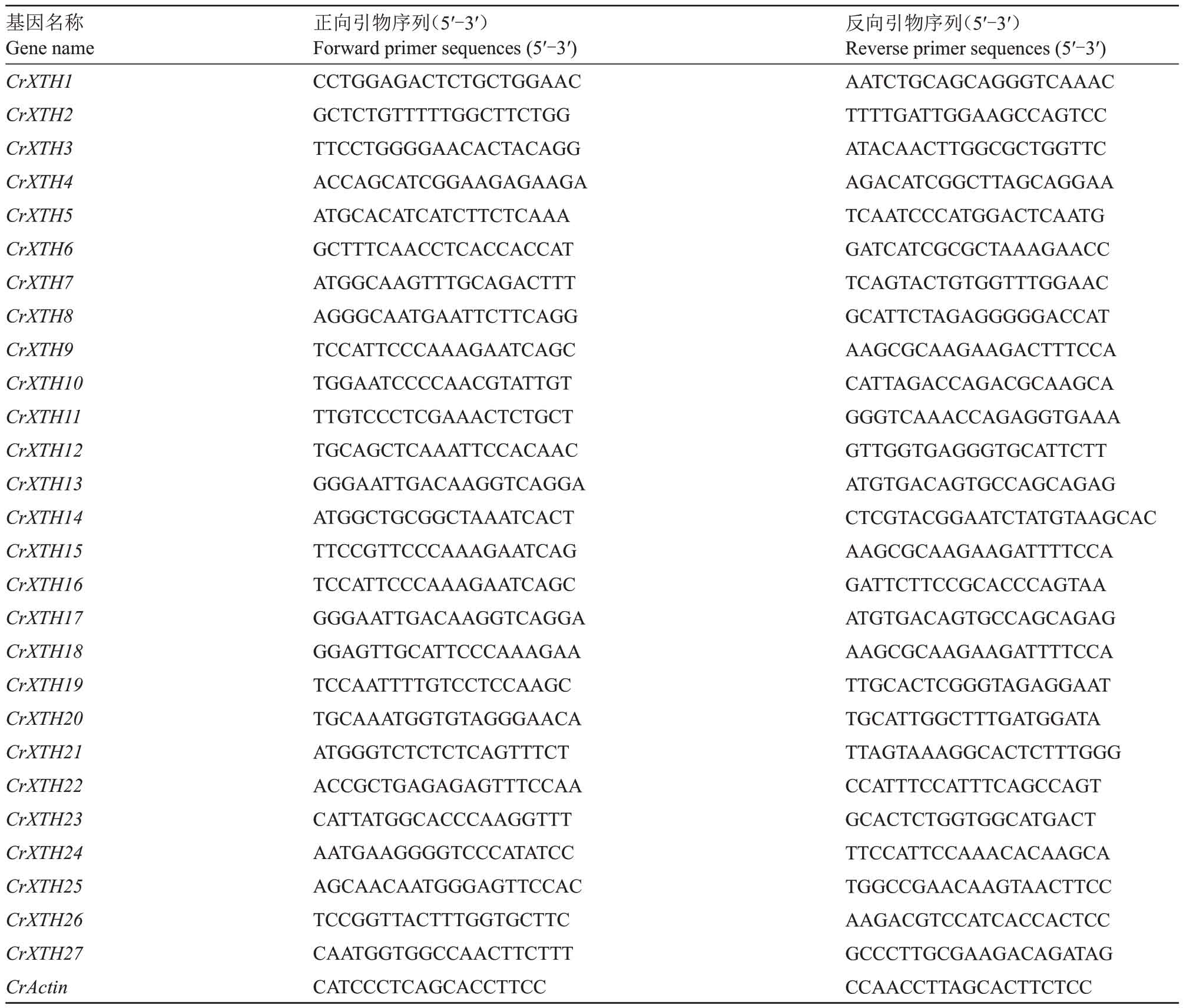
使用高多糖多酚植物总RNA 试剂盒(SIMGEN,杭州)进行总RNA 抽提,经Nanodrop 2000 分光光度计进行核酸定量分析,确认样本符合试验标准(A260/A280=1.8~2.1)。随后,采用第一链cDNA合成试剂盒(SIMGEN,杭州)进行反转录合成,所得cDNA 产物分装后于-80 ℃超低温冰箱长期冻存。CrXTHs 基因的qRT-PCR 引物通过Primer3Plus 网站(https://www.primer3plus.com)进行特异性设计(表1),引物合成由北京擎科生物科技有限公司(中国北京)完成。采用LightCycler®480 系统(Roche,Basel,Switzerland)进行定量分析。qRT-PCR反应体系(总体积10 μL):2×SYBR Green Premix Ex(SIMGEN,中国杭州)5 μL,10 μmol·L-1正/反向引物各0.5 μL,cDNA模板和ddH2O各2 μL。反应程序设置为95 ℃预变性2 min;随后进行40 个循环,每个循环为95 ℃变性20 s、60 ℃退火20 s、72 ℃延伸30 s。以柑橘Actin 作为内参基因进行表达量标准化。每个处理设置3次独立生物学重复,采用2-△△Ct方法计算相对表达量。
表1 qRT-PCR 引物序列
Table 1 Primer sequences for qRT-PCR
基因名称Gene name CrXTH1 CrXTH2 CrXTH3 CrXTH4 CrXTH5 CrXTH6 CrXTH7 CrXTH8 CrXTH9 CrXTH10 CrXTH11 CrXTH12 CrXTH13 CrXTH14 CrXTH15 CrXTH16 CrXTH17 CrXTH18 CrXTH19 CrXTH20 CrXTH21 CrXTH22 CrXTH23 CrXTH24 CrXTH25 CrXTH26 CrXTH27 CrActin正向引物序列(5′-3′)Forward primer sequences(5′-3′)CCTGGAGACTCTGCTGGAAC GCTCTGTTTTTGGCTTCTGG TTCCTGGGGAACACTACAGG ACCAGCATCGGAAGAGAAGA ATGCACATCATCTTCTCAAA GCTTTCAACCTCACCACCAT ATGGCAAGTTTGCAGACTTT AGGGCAATGAATTCTTCAGG TCCATTCCCAAAGAATCAGC TGGAATCCCCAACGTATTGT TTGTCCCTCGAAACTCTGCT TGCAGCTCAAATTCCACAAC GGGAATTGACAAGGTCAGGA ATGGCTGCGGCTAAATCACT TTCCGTTCCCAAAGAATCAG TCCATTCCCAAAGAATCAGC GGGAATTGACAAGGTCAGGA GGAGTTGCATTCCCAAAGAA TCCAATTTTGTCCTCCAAGC TGCAAATGGTGTAGGGAACA ATGGGTCTCTCTCAGTTTCT ACCGCTGAGAGAGTTTCCAA CATTATGGCACCCAAGGTTT AATGAAGGGGTCCCATATCC AGCAACAATGGGAGTTCCAC TCCGGTTACTTTGGTGCTTC CAATGGTGGCCAACTTCTTT CATCCCTCAGCACCTTCC反向引物序列(5′-3′)Reverse primer sequences(5′-3′)AATCTGCAGCAGGGTCAAAC TTTTGATTGGAAGCCAGTCC ATACAACTTGGCGCTGGTTC AGACATCGGCTTAGCAGGAA TCAATCCCATGGACTCAATG GATCATCGCGCTAAAGAACC TCAGTACTGTGGTTTGGAAC GCATTCTAGAGGGGGACCAT AAGCGCAAGAAGACTTTCCA CATTAGACCAGACGCAAGCA GGGTCAAACCAGAGGTGAAA GTTGGTGAGGGTGCATTCTT ATGTGACAGTGCCAGCAGAG CTCGTACGGAATCTATGTAAGCAC AAGCGCAAGAAGATTTTCCA GATTCTTCCGCACCCAGTAA ATGTGACAGTGCCAGCAGAG AAGCGCAAGAAGATTTTCCA TTGCACTCGGGTAGAGGAAT TGCATTGGCTTTGATGGATA TTAGTAAAGGCACTCTTTGGG CCATTTCCATTTCAGCCAGT GCACTCTGGTGGCATGACT TTCCATTCCAAACACAAGCA TGGCCGAACAAGTAACTTCC AAGACGTCCATCACCACTCC GCCCTTGCGAAGACAGATAG CCAACCTTAGCACTTCTCC
1.9 GUS染色
将DX2181G载体用Hind Ⅲ和BamH Ⅰ进行双酶切线性化处理。以长度为1500 bp 的CrXTH10、CrXTH11 和CrXTH12 启动子片段为模板,在引物5′端引入与线性化载体末端同源的15~20 bp序列(表2),进行PCR 扩增。随后,使用ClonExpress® ⅡOne Step Cloning Kit(诺唯赞,南京)将各片段与酶切载体进行同源重组,构建GUS 报告基因融合载体。将测序验证正确的重组质粒转化至农杆菌GV3101中,挑取阳性单克隆于-80 ℃保存。通过农杆菌介导的瞬时转化法侵染柑橘愈伤组织[25],用GUS 基因引物进行阳性愈伤组织鉴定。采用GUS染色试剂盒(Coolaber,北京)进行组织化学染色,具体方法参考说明书。利用Image J软件对GUS染色结果进行量化分析。
表2 GUS 染色试验引物序列
Table 2 Primer sequences for GUS staining
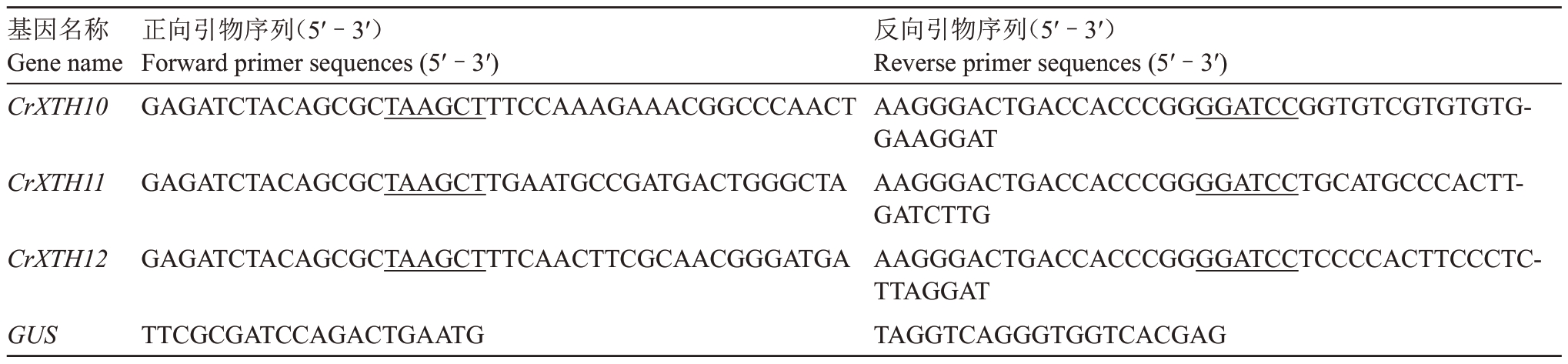
注:下划线表示酶切位点。
Note:Underlined sequences indicate restriction enzyme sites.
基因名称Gene name CrXTH10正向引物序列(5′-3′)Forward primer sequences(5′-3′)GAGATCTACAGCGCTAAGCTTTCCAAAGAAACGGCCCAACT反向引物序列(5′-3′)Reverse primer sequences(5′-3′)AAGGGACTGACCACCCGGGGATCCGGTGTCGTGTGTGCrXTH11 GAGATCTACAGCGCTAAGCTTGAATGCCGATGACTGGGCTA GAAGGAT AAGGGACTGACCACCCGGGGATCCTGCATGCCCACTTCrXTH12 GAGATCTACAGCGCTAAGCTTTCAACTTCGCAACGGGATGA GATCTTG AAGGGACTGACCACCCGGGGATCCTCCCCACTTCCCTCGUS TTAGGAT TAGGTCAGGGTGGTCACGAG TTCGCGATCCAGACTGAATG
1.10 数据分析方法
使用DPS9.01软件进行基因表达差异显著性分析,统计显著性水平设为P<0.05(*)。数据可视化使用GraphPad Prism 9.0软件完成。采用t检验方法进行统计分析。
2 结果与分析
2.1 CrXTHs基因家族成员鉴定及理化性质分析
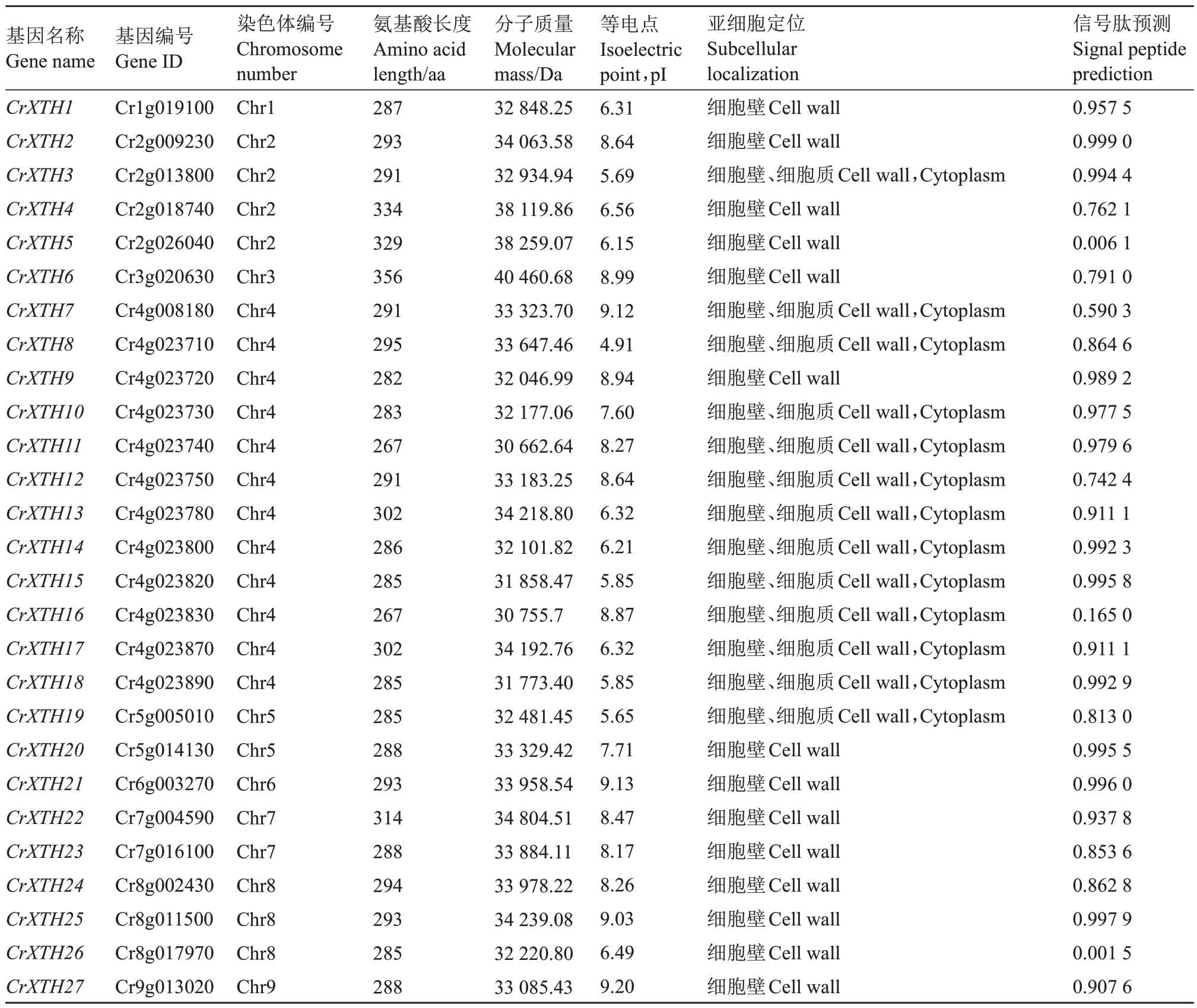
基于崇义野橘全基因组数据,本研究共鉴定出27个CrXTHs基因家族成员(表3)。崇义野橘CrXTHs蛋白质理化参数分析显示:氨基酸长度范围为267~356 aa,其中CrXTH11和CrXTH16最短,CrXTH6最长;预测分子质量范围为30.66~40.46 kDa;理论等电点范围为4.91~9.20,其中12 个成员呈酸性(pI<7.0),15个呈碱性。亚细胞定位预测结果显示,所有CrXTHs 均定位于细胞壁上,其中13 个成员同时定位在细胞质中。信号肽预测结果显示,CrXTH5、CrXTH16 和CrXTH26 的Sec/SPI 值均小于阈值0.5,提示它们可能无典型信号肽,其余CrXTHs 均含有高置信度的Sec信号肽。
表3 CrXTHs 基因相关信息
Table 3 Information related to CrXTHs
基因名称Gene name CrXTH1 CrXTH2 CrXTH3 CrXTH4 CrXTH5 CrXTH6 CrXTH7 CrXTH8 CrXTH9 CrXTH10 CrXTH11 CrXTH12 CrXTH13 CrXTH14 CrXTH15 CrXTH16 CrXTH17 CrXTH18 CrXTH19 CrXTH20 CrXTH21 CrXTH22 CrXTH23 CrXTH24 CrXTH25 CrXTH26 CrXTH27基因编号Gene ID Cr1g019100 Cr2g009230 Cr2g013800 Cr2g018740 Cr2g026040 Cr3g020630 Cr4g008180 Cr4g023710 Cr4g023720 Cr4g023730 Cr4g023740 Cr4g023750 Cr4g023780 Cr4g023800 Cr4g023820 Cr4g023830 Cr4g023870 Cr4g023890 Cr5g005010 Cr5g014130 Cr6g003270 Cr7g004590 Cr7g016100 Cr8g002430 Cr8g011500 Cr8g017970 Cr9g013020染色体编号Chromosome number Chr1 Chr2 Chr2 Chr2 Chr2 Chr3 Chr4 Chr4 Chr4 Chr4 Chr4 Chr4 Chr4 Chr4 Chr4 Chr4 Chr4 Chr4 Chr5 Chr5 Chr6 Chr7 Chr7 Chr8 Chr8 Chr8 Chr9氨基酸长度Amino acid length/aa 287 293 291 334 329 356 291 295 282 283 267 291 302 286 285 267 302 285 285 288 293 314 288 294 293 285 288分子质量Molecular mass/Da 32 848.25 34 063.58 32 934.94 38 119.86 38 259.07 40 460.68 33 323.70 33 647.46 32 046.99 32 177.06 30 662.64 33 183.25 34 218.80 32 101.82 31 858.47 30 755.7 34 192.76 31 773.40 32 481.45 33 329.42 33 958.54 34 804.51 33 884.11 33 978.22 34 239.08 32 220.80 33 085.43等电点Isoelectric point,pI 6.31 8.64 5.69 6.56 6.15 8.99 9.12 4.91 8.94 7.60 8.27 8.64 6.32 6.21 5.85 8.87 6.32 5.85 5.65 7.71 9.13 8.47 8.17 8.26 9.03 6.49 9.20亚细胞定位Subcellular localization细胞壁Cell wall细胞壁Cell wall细胞壁、细胞质Cell wall,Cytoplasm细胞壁Cell wall细胞壁Cell wall细胞壁Cell wall细胞壁、细胞质Cell wall,Cytoplasm细胞壁、细胞质Cell wall,Cytoplasm细胞壁Cell wall细胞壁、细胞质Cell wall,Cytoplasm细胞壁、细胞质Cell wall,Cytoplasm细胞壁、细胞质Cell wall,Cytoplasm细胞壁、细胞质Cell wall,Cytoplasm细胞壁、细胞质Cell wall,Cytoplasm细胞壁、细胞质Cell wall,Cytoplasm细胞壁、细胞质Cell wall,Cytoplasm细胞壁、细胞质Cell wall,Cytoplasm细胞壁、细胞质Cell wall,Cytoplasm细胞壁、细胞质Cell wall,Cytoplasm细胞壁Cell wall细胞壁Cell wall细胞壁Cell wall细胞壁Cell wall细胞壁Cell wall细胞壁Cell wall细胞壁Cell wall细胞壁Cell wall信号肽预测Signal peptide prediction 0.957 5 0.999 0 0.994 4 0.762 1 0.006 1 0.791 0 0.590 3 0.864 6 0.989 2 0.977 5 0.979 6 0.742 4 0.911 1 0.992 3 0.995 8 0.165 0 0.911 1 0.992 9 0.813 0 0.995 5 0.996 0 0.937 8 0.853 6 0.862 8 0.997 9 0.001 5 0.907 6
2.2 XTH在低温胁迫下浓度和活性测定
XTH 酶浓度(ρ,后同)(图1-A)在低温处理0、1和3 d 时分别为127.02、130.12、139.48 ng·L-1。与0 d相比,1 d 处理XTH 酶浓度上升,但无显著差异,而3 d 处理显著升高(P<0.05)。XTH 酶活性(图1-B)呈现相似变化趋势,其活性值分别为2 996.71、3 228.37、3 788.79 U·L-1,其中3 d 处理较0 d 显著增加(P<0.05),表明崇义野橘可能通过上调XTH 酶的生物合成及催化能力来响应持续低温胁迫。
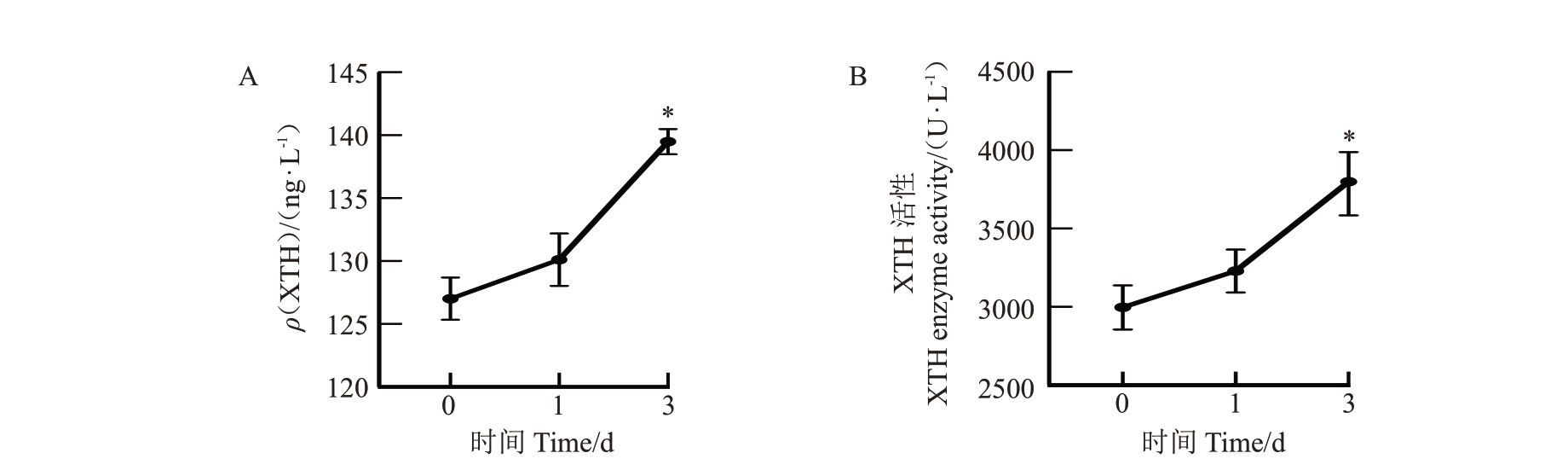
图1 低温胁迫下XTH 浓度和活性分析
Fig.1 Expression analysis of XTH concentration and activity under cold stress
*表示低温处理1 d 或3 d 与处理0 d 在P<0.05 水平上差异显著。下同。
* indicates a statistically significant difference at P<0.05 level under the 1 d or 3 d low-temperature treatment groups compared to the pretreatment control(0 d).The same below.
2.3 CrXTHs基因家族成员染色体定位及系统进化分析
根据CrXTHs 基因家族成员在染色体上的位置,依次命名为CrXTH1~CrXTH27。这些基因在9条染色体上呈不均匀分布,其中Chr4呈现高度聚集现象(12个成员,44.44%)(图2)。根据崇义野橘、拟南芥、水稻的系统发育关系,将该基因家族划分为Ⅰ/Ⅱ组、Ⅲ-A组、Ⅲ-B组和祖先组。崇义野橘XTHs成员中,Ⅰ/Ⅱ组占比最高(19 个,70.37%),其次为Ⅲ-B 组(4 个,14.81%),Ⅲ-A 组和祖先组各2 个(各占7.41%)(图3)。
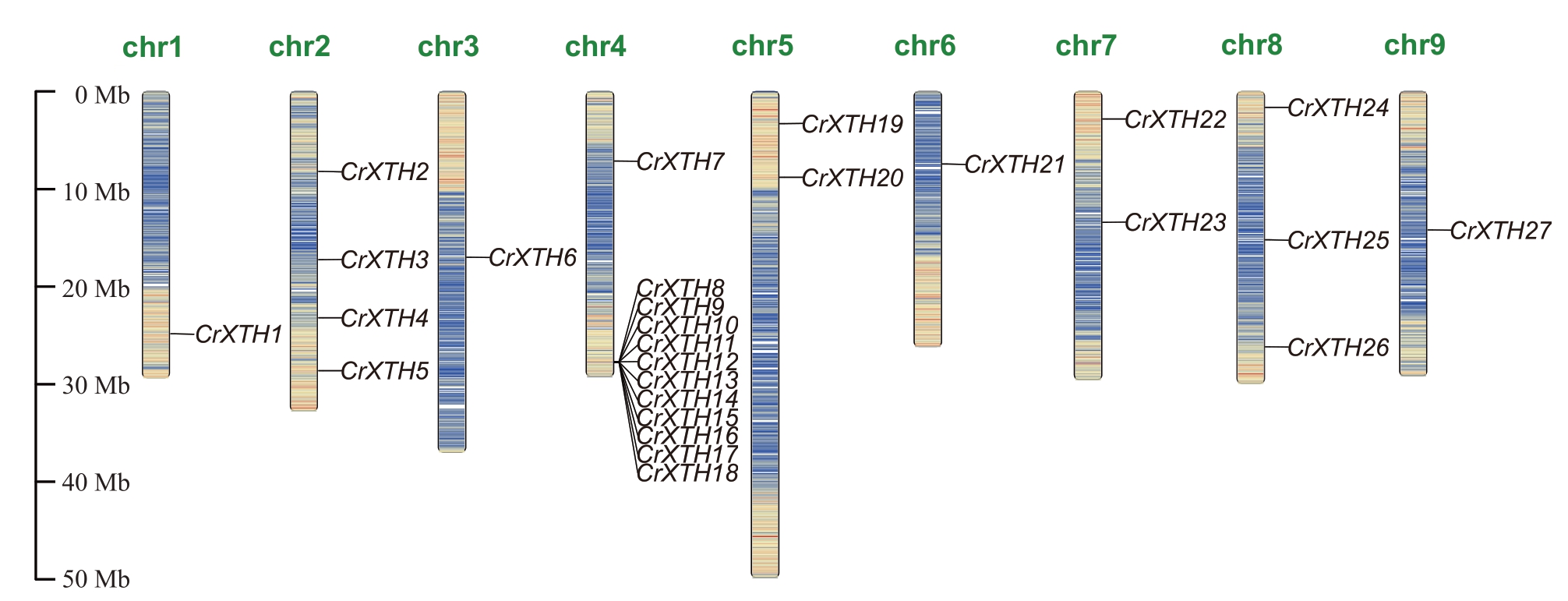
图2 CrXTHs 基因在染色体上的分布
Fig.2 Chromosomal distribution of CrXTHs genes
染色体颜色深浅代表基因密度。
The colors gradient on chromosomes indicates gene density.

图3 崇义野橘、拟南芥和水稻XTH 蛋白系统进化分析
Fig.3 Phylogenetic analysis of XTH proteins from Chongyi wild mandarin(C.reticulata),Arabidopsis thaliana,and rice(Oryza sativa)
2.4 CrXTHs基因结构、保守基序及共线性分析
MEME 软件鉴定的保守基序分析结果(图4-A)显示,所有CrXTH蛋白均包含与核心功能相关的Motif 3、Motif 4、Motif 5、Motif 7。其中,Motif 2、Motif 3、Motif 4、Motif 5、Motif7、Motif 9 和Motif 10在所有CrXTH蛋白中高度保守,Motif 6仅特异存在于Ⅰ/Ⅱ亚家族中,ⅢA 和ⅢB 亚家族则缺失Motif 1。所有CrXTH蛋白的C端均含有序列高度保守的Motif 10。基因结构分析结果(图4-B)显示:14 个CrXTHs基因家族成员同时拥有上游的非翻译区(5'-UTR)和下游的非翻译区(3'-UTR),8 个成员无UTR,2 个成员仅有5'-UTR。同一亚家族成员呈现高度保守的基因结构特征。所有CrXTHs蛋白均具有典型的Glyco_hydro_16(PF00722)催化结构域和XET_C(PF06955)保守结构域(图4-C)。
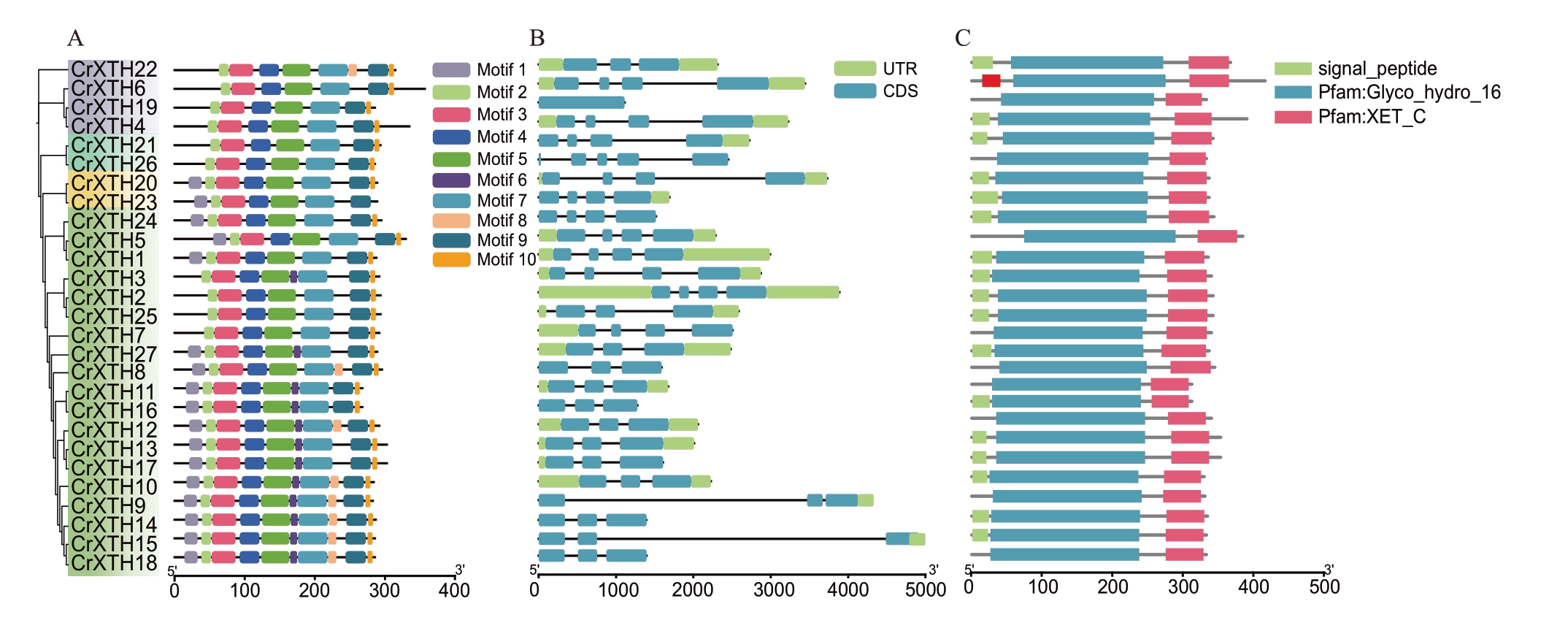
图4 CrXTHs 的保守基序(A)、基因结构(B)和蛋白结构域(C)
Fig.4 Conserved motifs(A),gene structure(B),and protein domains(C)of CrXTHs
为了进一步评估CrXTHs 基因家族的进化关系,构建了拟南芥、崇义野橘和水稻的共线性图(图5),共鉴定出19个CrXTHs存在显著共线性关系,其中15 个CrXTHs 基因与拟南芥25 个AtXTHs 基因存在共线性,4 个CrXTHs 基因与水稻4 个OsXTHs 基因存在共线性。根据3个物种的共线性基因对数可知,崇义野橘与拟南芥的进化关系较水稻更近。
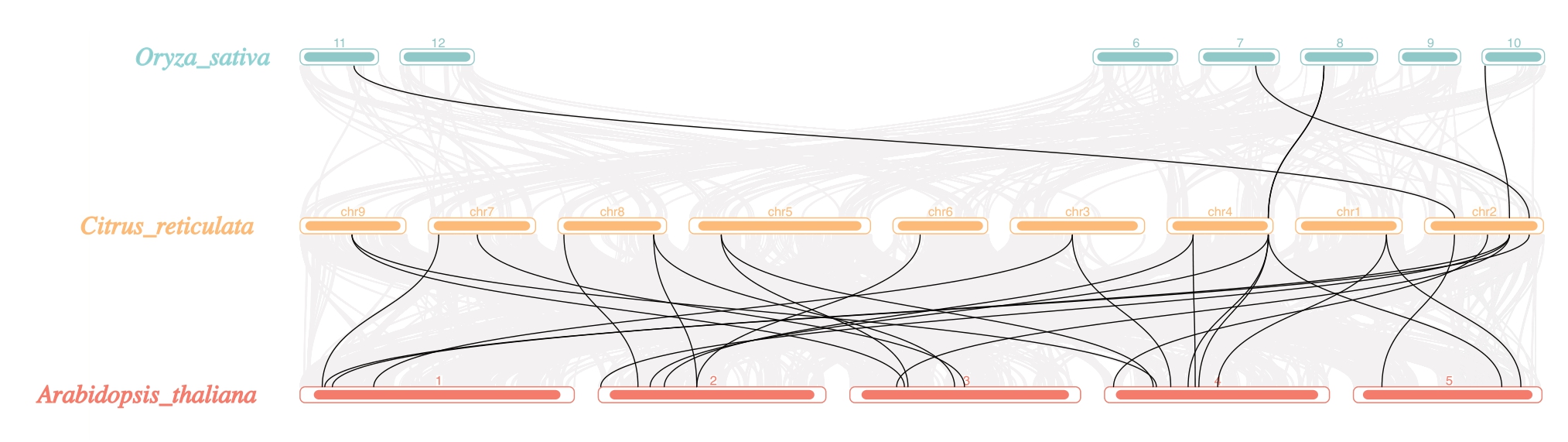
图5 崇义野橘与拟南芥、水稻XTH 基因家族的共线性分析
Fig.5 Collinearity analysis of XTH gene families from Chongyi wild mandarin,Arabidopsis and rice(Oryza sativa)
2.5 CrXTHs基因家族成员启动子顺式作用元件分析
顺式作用元件预测分析结果显示(图6),CrXTHs基因启动子区主要包括四大功能元件:光响应元件、激素响应元件、非生物胁迫响应元件和生长发育调控元件。其中,光响应元件数目最多,共367个,而且每个CrXTH启动子上含有多个该元件。激素响应元件包括:脱落酸(ABA,abscisic acid,77个)、茉莉酸甲酯(MeJA,jasmonic acid methyl ester,72个)、赤霉素(GA,gibberellin,30个)、生长素(auxin,9 个)、水杨酸(SA,salicylic acid,7 个)。其中,CrXTH20 启动子中存在10 个ABA 相关元件,而CrXTH7 启动子中存在8 个MeJA 相关元件。顺式作用元件分析表明,11 个CrXTHs 基因的启动子区共含有15 个低温响应元件,18 个CrXTHs 启动子携带26个干旱诱导相关元件。此外,还鉴定到多个厌氧胁迫响应元件。生长发育调控元件主要包含分生组织表达、代谢调控和种子特异性调控响应元件。以上结果表明,CrXTHs基因家族不仅参与多种非生物胁迫响应(特别是低温和干旱胁迫),还可能在光信号转导、激素响应及生长发育调控等生理过程中发挥重要功能。
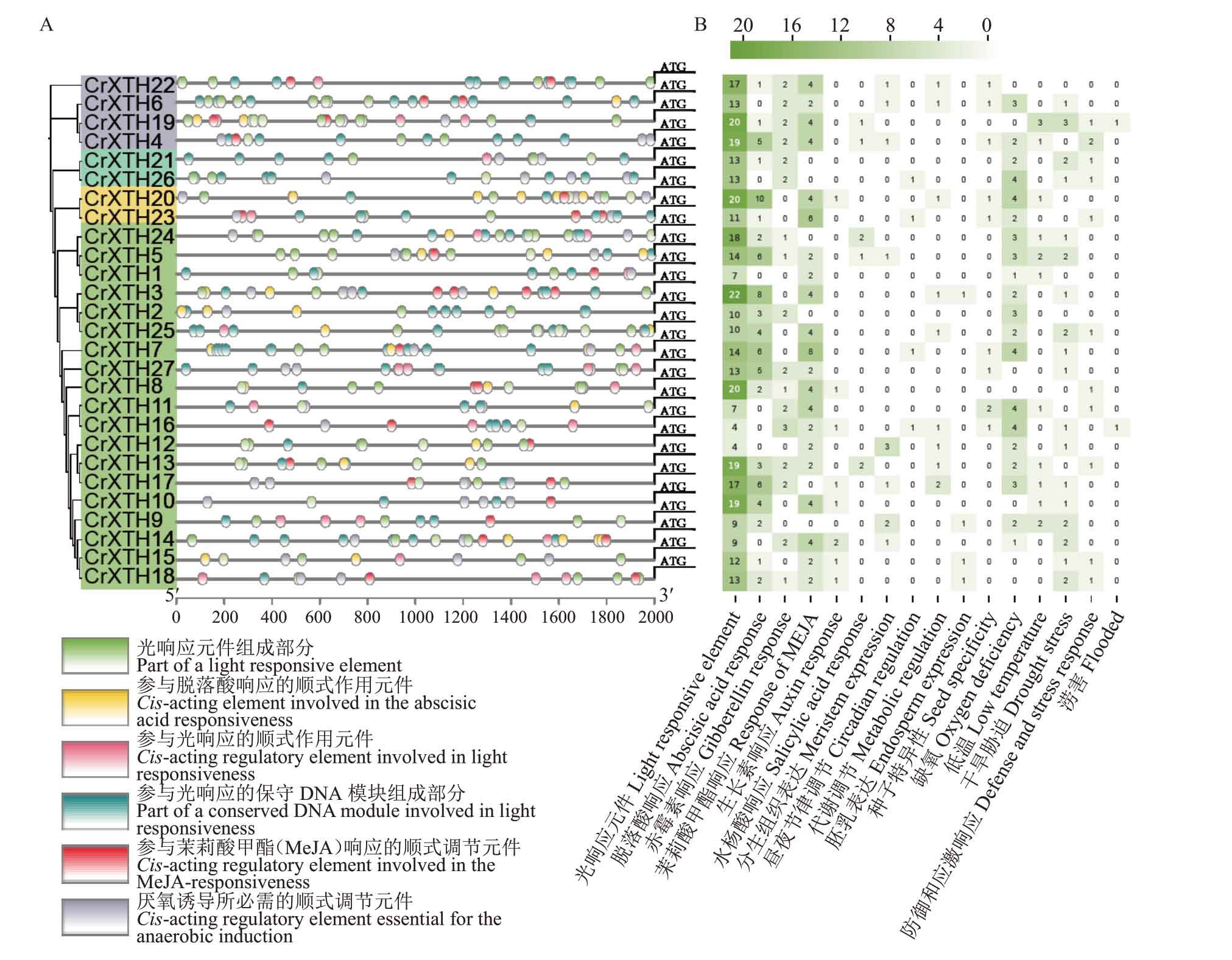
图6 CrXTHs 启动子顺式作用元件分布(A)和响应元件数量(B)
Fig.6 Distribution(A)and number(B)of cis-acting elements in the promoter regions of CrXTHs
2.6 CrXTHs的低温胁迫表达模式分析
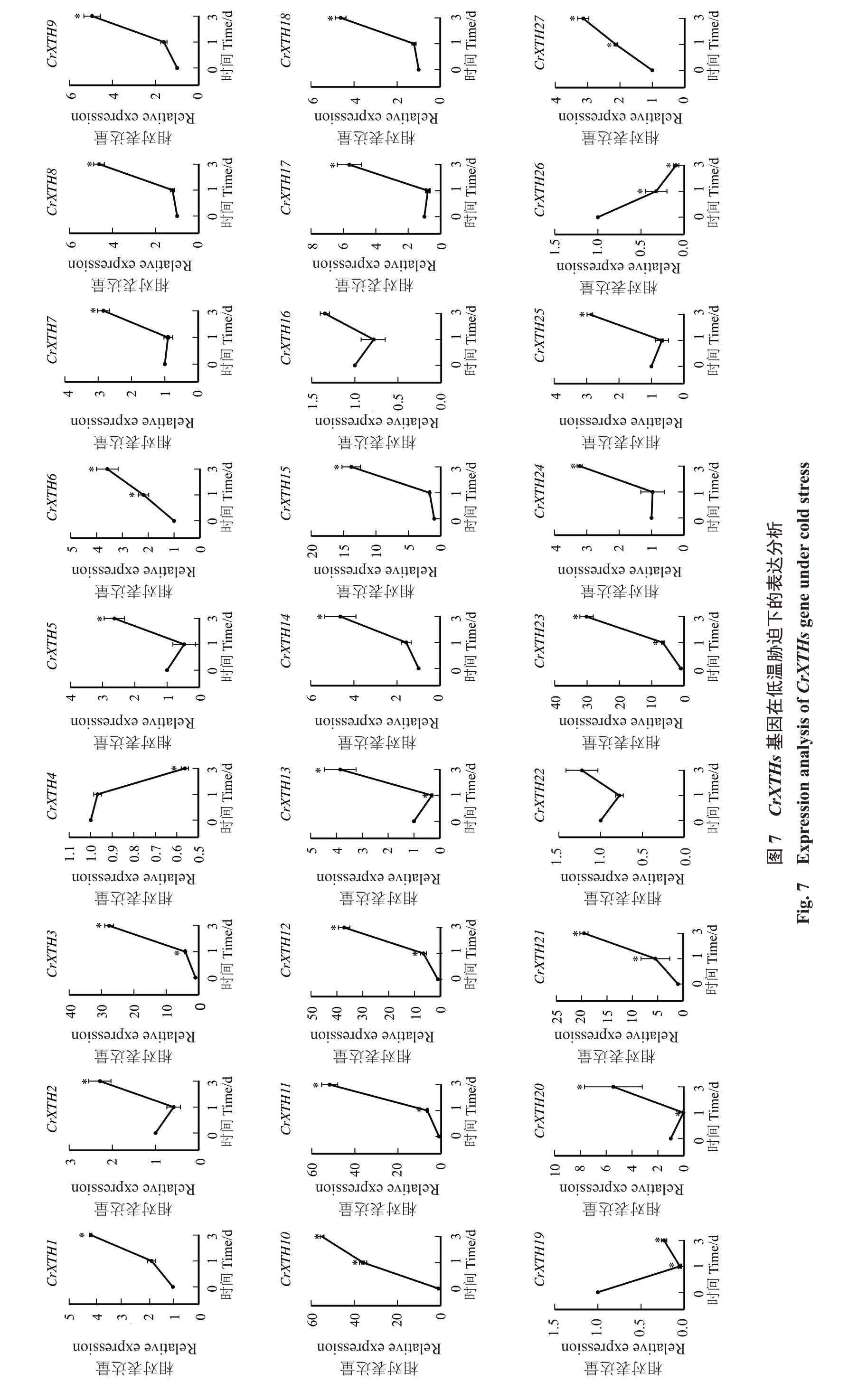
应用qRT-PCR 分析的结果显示,27 个CrXTHs基因中有25 个在低温胁迫下的表达发生显著改变(P<0.05)。其中,CrXTH10 受低温诱导表达最突出,低温处理3 d 较处理0 d 升高56.95 倍;而CrXTH4 的表达则受抑制最为显著(P<0.05),低温处理3 d 为处理0 d 的0.56。这些基因在低温下的表达模式大致可分为以下4 类:(1)持续诱导型:CrXTH1、CrXTH3、CrXTH6、CrXTH8、CrXTH9、CrXTH10、CrXTH11、CrXTH12、CrXTH14、CrXTH15、CrXTH18、CrXTH21、CrXTH23 和CrXTH27 共14 个基因,在低温胁迫1 d 和3 d 时表达量上调4~57倍;(2)后期上升型:CrXTH2、CrXTH5、CrXTH7、CrXTH13、CrXTH17、CrXTH19、CrXTH20、CrXTH24和CrXTH25共9个基因,在低温胁迫1 d时表达量均下降,其中CrXTH13、CrXTH19、CrXTH20 下降显著(P<0.05);低温胁迫3 d 时,9 个基因的表达量均显著上升(P<0.05);(3)抑制型:CrXTH4和CrXTH26,在低温胁迫下表达量较对照显著降低;(4)无响应型:CrXTH16 和CrXTH22,其表达量在1 d 和3 d 均无显著变化(图7)。
2.7 低温诱导CrXTHs 基因启动子活性增强的GUS验证分析
如图8 所示,在常温处理时,转化CrXTH10、CrXTH11和CrXTH12启动子::GUS的愈伤组织已出现明显蓝色,表明这3 个基因的启动子具有一定基础活性。经低温诱导后,GUS 染色程度显著加深。使用ImageJ对染色强度进行定量分析,发现低温处理后愈伤组织的GUS活性相对强度显著高于常温处理(P<0.05),表明CrXTH10、CrXTH11和CrXTH12启动子活性受低温显著诱导,与基因表达分析结果相一致。
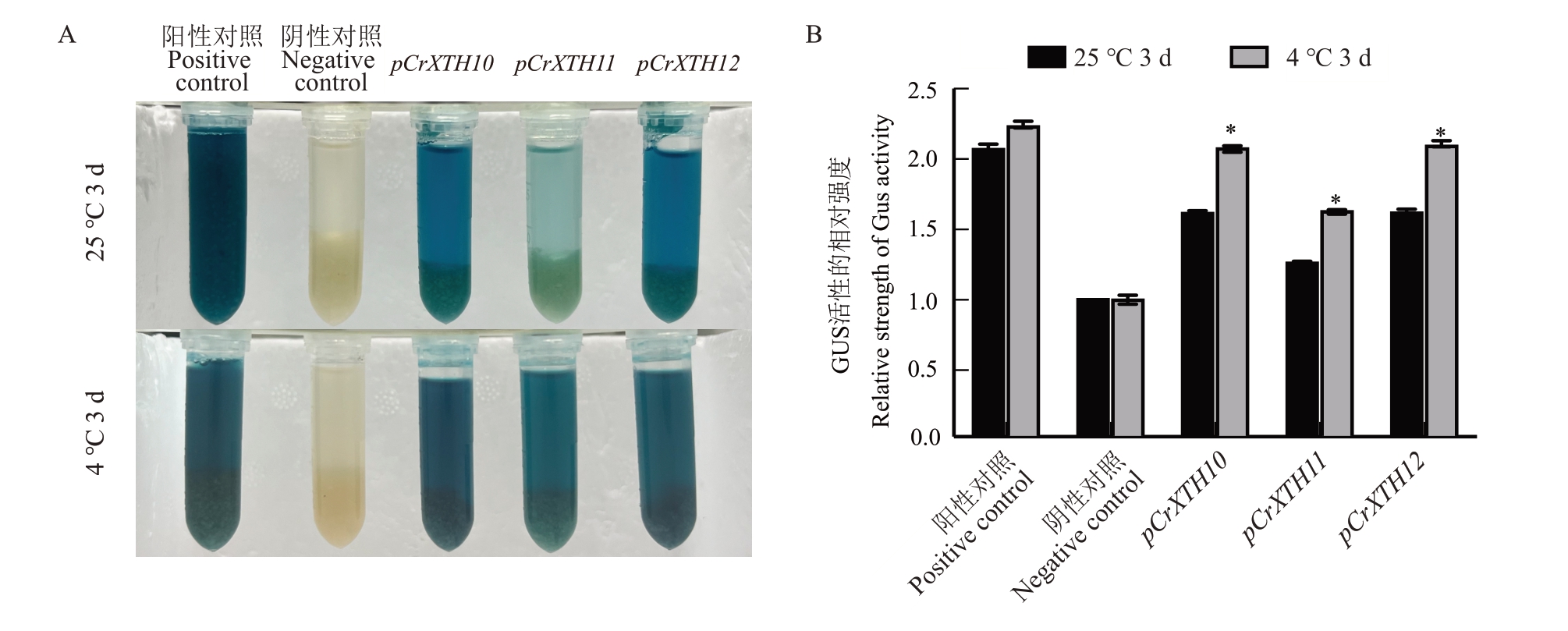
图8 CrXTH10、CrXTH11 和CrXTH12 启动子的GUS 染色定性(A)和定量(B)分析
Fig.8 Qualitative(A)and quantitative(B)analysis of CrXTH10,CrXTH11,and CrXTH12 promoters via GUS staining
阳性对照是能够稳定表达GUS 基因的组织或构建体,用于确认GUS 染色体系的正常运作;阴性对照是不表达GUS 基因的材料,用于检测背景染色或非特异性反应。*表示低温(4 ℃)处理与常温(25 ℃)处理在P<0.05 水平上差异显著。
The positive control is a tissue or construct that stably expresses the GUS gene, used to confirm the normal functioning of the GUS staining system.The negative control is a material that does not express the GUS gene,used to detect background staining or non-specific reactions.*indicates the significant difference(P<0.05)between cold treatment(4 ℃)and room temperature treatment(25 ℃).
3 讨 论
XTH 基因家族作为植物细胞壁修饰的关键酶类,在植物生长发育和环境适应过程中具有重要作用[26]。本研究首次对崇义野橘进行了全基因组XTH基因家族分析,共鉴定出27 个CrXTHs 基因成员。这些基因在崇义野橘基因组9条染色体上呈现不均匀分布,其中Chr4含13个成员,而Chr1/6/9都只有1个成员。枳(Poncirus trifoliata)NAC 基因家族在部分染色体上成簇分布,这种不均匀分布模式可能受到局部基因组复制或染色体特异性选择压力的影响[27],也可能与基因功能分化或适应性进化过程相关[28]。Chr4 上CrXTHs 的高度聚集暗示该染色体区域在进化过程中可能经历了特定的复制事件,这些基因在特定生理过程中具有协同调控作用。
亚细胞定位和信号肽预测结果表明,CrXTHs蛋白均定位于细胞壁,而且24 个CrXTHs 成员被预测含有典型信号肽,表明这些蛋白可能通过分泌途径定向转运于细胞壁发挥作用。这与该家族蛋白参与细胞壁重构的生物学功能相符[29]。此外,部分CrXTHs 被预测同时定位于细胞壁和细胞质,香蕉(Musa acuminata)中有26%的MaXTHs 也存在这种双定位特征[30],但仍需通过亚细胞定位试验进一步验证。
保守结构域和基因结构分析对阐明物种的起源、进化和遗传关系具有重要意义[31-32]。系统进化树分析将CrXTHs分为Ⅰ/Ⅱ、ⅢA和ⅢB和祖先组4个进化分支,这与双子叶植物拟南芥[10]和菠萝[33]XTH家族蛋白进化树分支相同,而单子叶植物水稻[7]和香蕉[30]没有祖先组,表明该家族在双子叶植物进化过程中具有高度保守性。所有CrXTHs 成员均具有Motif 2~5、Motif 7、Motif 9 和Motif 10,且同一亚族成员具有相似的基序组成[12],进一步验证了系统发育分析的可靠性。崇义野橘与拟南芥的共线性基因对数多于其与水稻的共线性基因对数,证明与双子叶植物的进化关系比单子叶植物更近,符合植物系统发育的分类关系。根据拟南芥和小麦XTHs 的系统进化和功能研究[34-35],崇义野橘Ⅰ/Ⅱ组(19 个CrXTHs 成员)和ⅢB 亚家族(CrXTH12、CrXTH13 和CrXTH19)可能主要具有XET活性,参与细胞壁的松弛和扩展;而ⅢA亚家族的CrXTH21 和CrXTH26,可能主要表现为XEH活性,负责细胞壁的重构与修复。上述发现为后续研究CrXTHs的功能分化提供了线索。
顺式作用元件分析结果揭示了CrXTHs 基因家族可能参与多种生物学过程的调控。在CrXTHs启动子区域中,光响应元件的数量最多,表明CrXTHs 的表达可能受到光照条件的广泛调控。在拟南芥中,光形态建成的关键转录因子HY5(Elongated Hypocotyl 5)及其同源蛋白HYH(HY5 Homologue)通过抑制XTHs 的表达以调控细胞壁重塑过程,进而影响植物的避阴反应及形态建成[36]。在遮光条件下,毛竹(Phyllostachys edulis)PheXTH3 可以介导细胞壁增厚[29]。柑橘作为喜光植物,其XTHs 可能通过调节细胞壁可塑性来影响光依赖的生长发育或者胁迫响应过程。此外,激素响应元件分布结果显示,CrXTHs 启动子区域ABA 和MeJA响应元件占比最高。作为植物响应逆境胁迫的两大关键激素[37],ABA和JA可以协同激活不同抗性通路,促进植保素的合成,以及关闭气孔以防止病原菌的入侵,从而增强植物防御能力[38]。因此,CrXTHs 启动子的顺式作用元件组成与其同源基因在其他植物中的功能高度吻合。
低温会限制植物的地理分布,并影响植物的生长、发育和产量[39]。一般0 ℃以上低温(0~15 ℃)会抑制植物发育,而0 ℃以下低温会造成冻害,导致细胞破裂和植株死亡[40]。细胞壁作为第一道物理屏障,适度低温驯化会促进细胞壁增厚和结构重塑,延缓或阻止冰晶侵入细胞内部,这可能是植物抵御低温胁迫的重要机制[41-43]。崇义野橘高度抗寒[22],本研究系统分析了CrXTHs在低温处理下的表达模式。在受低温显著诱导表达的25 个CrXTHs 中,仅2 个基因表达受到抑制,14个CrXTHs在胁迫处理1 d后即呈现持续上调表达模式。这一结果与双子叶植物番薯(Ipomoea batatas)相似,36 个IbXTHs 基因中仅有2 个基因表达受低温抑制[44]。研究表明,拟南芥在低温驯化过程中会显著上调XTH18 和XTH19 等细胞壁相关基因的表达水平及其编码蛋白丰度[2,45-46]。然而,在香蕉耐寒品种东莞大椒中共有53个MaXTHs,其中23个基因在低温胁迫下表达有显著变化,但是20个表达下调[30]。以上结果表明,XTHs在双子叶植物和单子叶植物中的低温表达模式可能存在明显差异。CrXTHs 基因家族对低温胁迫的快速响应特征表明可能参与崇义野橘早期低温应答机制。在柑橘抗寒育种中,上述基因可作为潜在的分子标记用于抗寒性状筛选,特别是在砧木改良方面具有重要应用价值。
4 结 论
在崇义野橘中鉴定出27 个CrXTHs 基因,这些基因在染色体上呈不均匀分布,其进化特征与双子叶植物保持高度保守性。CrXTHs 启动子区域含有大量的ABA/MeJA 等胁迫相关激素和低温响应元件。值得注意的是,25 个CrXTHs 的表达显著受低温诱导,表明该基因家族可能在柑橘低温应答中发挥重要作用。
[1] PAULY M,ALBERSHEIM P,DARVILL A,YORK W S. Molecular domains of the cellulose/xyloglucan network in the cell walls of higher plants[J]. The Plant Journal,1999,20(6):629-639.
[2] TAKAHASHI D,JOHNSON K L,HAO P F,TUONG T,ERBAN A,SAMPATHKUMAR A,BACIC A,LIVINGSTON III D P,KOPKA J,KUROHA T,YOKOYAMA R,NISHITANI K,ZUTHER E,HINCHA D K.Cell wall modification by the xyloglucan endotransglucosylase/hydrolase XTH19 influences freezing tolerance after cold and sub-zero acclimation[J]. Plant,Cell&Environment,2021,44(3):915-930.
[3] WU D,LIU A Q,QU X Y,LIANG J Y,SONG M. Genomewide identification,and phylogenetic and expression profiling analyses,of XTH gene families in Brassica rapa L. and Brassica oleracea L.[J].BMC Genomics,2020,21(1):782.
[4] ROSE J K C,BRAAM J,FRY S C,NISHITANI K. The XTH family of enzymes involved in xyloglucan endotransglucosylation and endohydrolysis:Current perspectives and a new unifying nomenclature[J]. Plant & Cell Physiology,2002,43(12):1421-1435.
[5] EKLÖF J M,BRUMER H.The XTH gene family:An update on enzyme structure,function,and phylogeny in xyloglucan remodeling[J].Plant Physiology,2010,153(2):456-466.
[6] BEHAR H,GRAHAM S W,BRUMER H. Comprehensive cross-genome survey and phylogeny of glycoside hydrolase family 16 members reveals the evolutionary origin of EG16 and XTH proteins in plant lineages[J]. The Plant Journal,2018,95(6):1114-1128.
[7] YOKOYAMA R,ROSE J K C,NISHITANI K.A surprising diversity and abundance of xyloglucan endotransglucosylase/hydrolases in rice. classification and expression analysis[J]. Plant Physiology,2004,134(3):1088-1099.
[8] FU M M,LIU C,WU F B. Genome-wide identification,characterization and expression analysis of xyloglucan endotransglucosylase/hydrolase genes family in barley (Hordeum vulgare)[J].Molecules,2019,24(10):1935.
[9] STRATILOVÁ B,ŠESTÁK S,STRATILOVÁ E,VADINOVÁ K,KOZMON S,HRMOVA M. Engineering of substrate specificity in a plant cell-wall modifying enzyme through alterations of carboxyl-terminal amino acid residues[J]. The Plant Journal,2023,116(5):1529-1544.
[10] YOKOYAMA R,NISHITANI K. A comprehensive expression analysis of all members of a gene family encoding cell-wall enzymes allowed us to predict cis-regulatory regions involved in cell-wall construction in specific organs of Arabidopsis[J]. Plant&Cell Physiology,2001,42(10):1025-1033.
[11] SARMIENTO- LÓPEZ L G,LÓPEZ- ESPINOZA M Y,JUÁREZ-VERDAYES M A,LÓPEZ-MEYER M. Genomewide characterization of the xyloglucan endotransglucosylase/hydrolase gene family in Solanum lycopersicum L. and gene expression analysis in response to arbuscular mycorrhizal symbiosis[J].PeerJ,2023,11:e15257.
[12] ESMAEILZADEH-MORIDANI M,ESFAHANI M,AALAMI A,MOUMENI A,KHALEDIAN M,CHALESHTORI M H.Expression profiling of yield related genes in rice cultivars under terminal drought stress[J]. Molecular Biology Reports,2023,50(11):8867-8875.
[13] HAN J J,LIU Y C,SHEN Y T,LI W H.A surprising diversity of xyloglucan endotransglucosylase/hydrolase in wheat:New in sight to the roles in drought tolerance[J]. International Journal of Molecular Sciences,2023,24(12):9886.
[14] 周琪,冯燕茹,李嵩,刘子辉,郑炜君,柴守诚.小麦TaXTH-7A基因的克隆及抗旱性鉴定[J]. 农业生物技术学报,2019,27(9):1521-1532.ZHOU Qi,FENG Yanru,LI Song,LIU Zihui,ZHENG Weijun,CHAI Shoucheng. Cloning and drought resistance identification of TaXTH-7A gene in wheat(Triticum aestivum)[J].Journal of Agricultural Biotechnology,2019,27(9):1521-1532.
[15] SONG L,VALLIYODAN B,PRINCE S,WAN J R,NGUYEN H T. Characterization of the XTH gene family:New insight to the roles in soybean flooding tolerance[J]. International Journal of Molecular Sciences,2018,19(9):2705.
[16] QIAO T,ZHANG L,YU Y Y,PANG Y N,TANG X J,WANG X,LI L J,LI B,SUN Q H. Identification and expression analysis of xyloglucan endotransglucosylase/hydrolase (XTH) family in grapevine(Vitis vinifera L.)[J].PeerJ,2022,10:e13546.
[17] TIIKA R J,WEI J,CUI G X,MA Y J,YANG H S,DUAN H R.Transcriptome-wide characterization and functional analysis of Xyloglucan endo-transglycosylase/hydrolase (XTH) gene family of Salicornia europaea L.under salinity and drought stress[J].BMC Plant Biology,2021,21(1):491.
[18] 贾西贝,李效雄,杜雨,胡晓桐,刘筠,马彦军.黑果枸杞XTH转录因子家族鉴定与生物信息学分析[J].草地学报,2023,31(10):2916-2924.JIA Xibei,LI Xiaoxiong,DU Yu,HU Xiaotong,LIU Yun,MA Yanjun. Identification and bioinformatics analysis of XTH transcription factor family in Lycium ruthenicum[J]. Acta Agrestia Sinica,2023,31(10):2916-2924.
[19] LE GALL H,PHILIPPE F,DOMON J M,GILLET F,PELLOUX J,RAYON C.Cell wall metabolism in response to abiotic stress[J].Plants,2015,4(1):112-166.
[20] ZHAO S W,CAO Q Q,LI L,ZHANG W Q,WU Y J,YANG Z C. Functional analysis of Cucumis melo CmXTH11 in regulating drought stress tolerance in Arabidopsis thaliana[J]. International Journal of Molecular Sciences,2024,25(20):11031.
[21] 杨义伶.柑橘砧木抗旱性评价及相关生理指标与基因表达差异分析[D].南昌:江西农业大学,2012.YANG Yiling. Evaluation of drought tolerance for citrus rootstocks and discrepancy analysis on related physiological indexes and gene expression[D].Nanchang:Jiangxi Agricultural University,2012.
[22] PENG T,YOU X S,GUO L,ZHONG B L,MI L F,CHEN J M,XIAO X. Transcriptome analysis of Chongyi wild mandarin,a wild species more cold-tolerant than Poncirus trifoliata,reveals key pathways in response to cold[J]. Environmental and Experimental Botany,2021,184:104371.
[23] ALTSCHUL S F,MADDEN T L,SCHÄFFER A A,ZHANG J,ZHANG Z,MILLER W,LIPMAN D J. Gapped BLAST and PSI-BLAST:A new generation of protein database search programs[J].Nucleic Acids Research,1997,25(17):3389-3402.
[24] LESCOT M,DÉHAIS P,THIJS G,MARCHAL K,MOREAU Y,VAN DE PEER Y,ROUZÉ P,ROMBAUTS S.PlantCARE,a database of plant cis-acting regulatory elements and a portal to tools for in silico analysis of promoter sequences[J].Nucleic Acids Research,2002,30(1):325-327.
[25] 李东栋,石玮,邓秀新,伊华林.不同根癌农杆菌菌株对柑橘愈伤组织遗传转化效率的影响[J].华中农业大学学报,2002,21(4):379-381.LI Dongdong,SHI Wei,DENG Xiuxin,YI Hualin. Influence of different strains on Agrobacterium-mediated callus transformation efficiency in citrus[J]. Journal of Huazhong Agricultural University,2002,21(4):379-381.
[26] KAUR P,VERMA K,SINGH A K,KUMAR R,SINGH S. Cocultivation of sweet basil (Ocimum basilicum L.) with food crops for efficient resource utilization and increasing the farm profits[J].Industrial Crops and Products,2024,214:118495.
[27] JIANG X Y,ASSIS R. Rapid functional divergence after smallscale gene duplication in grasses[J]. BMC Evolutionary Biology,2019,19(1):97.
[28] FANG T,WANG Y,CHEN H W,QU J,XIAO P,WANG Y L,JIANG X,LI C L,LIU J H.Genome-wide identification and expression profiles of NAC transcription factors in Poncirus trifoliata reveal their potential roles in cold tolerance[J]. BMC Plant Biology,2025,25(1):633.
[29] XIE Y L,XU J L,LI X Y,DOU Y P,GENG R M,CHENG Z C,WU C Y,GAO J.Shade-induced regulation of cell wall thickening in Moso bamboo:A molecular pathway involving XTH activity[J].Plant,Cell&Environment,2025,48(7):5472-5485.
[30] TAN Y H,ZHAN H L,CHEN H B,LI X Q,CHEN C J,LIU H,CHEN Y L,ZHAO Z Y,XIAO Y Y,LIU J,ZHAO Y F,SU Z X,XU C X. Genome-wide identification of XTH gene family in Musa acuminata and response analyses of MaXTHs and xyloglucan to low temperature[J].Physiologia Plantarum,2024,176(2):e14231.
[31] QU J,XIAO P,ZHAO Z Q,WANG Y L,ZENG Y K,ZENG X,LIU J H. Genome-wide identification,expression analysis of WRKY transcription factors in Citrus ichangensis and functional validation of CiWRKY31 in response to cold stress[J]. BMC Plant Biology,2024,24(1):617.
[32] 张珊珊,阮孙美,杨文忠.富民枳WRKY 基因家族的鉴定和干旱胁迫表达分析[J].果树学报,2025,42(3):508-525.ZHANG Shanshan,RUAN Sunmei,YANG Wenzhong. Identification of WRKY gene family and analysis of drought stress expression in Poncirus Polyandra[J]. Journal of Fruit Science,2025,42(3):508-525.
[33] LI Q Y,LI H Y,YIN C Y,WANG X T,JIANG Q,ZHANG R,GE F F,CHEN Y D,YANG L. Genome-wide identification and characterization of xyloglucan endotransglycosylase/hydrolase in Ananas comosus during development[J]. Genes,2019,10(7):537.
[34] LIU Y,LIU D C,ZHANG H Y,GAO H B,GUO X L,WANG D W,ZHANG X Q,ZHANG A M. The alpha- and beta-expansin and xyloglucan endotransglucosylase/hydrolase gene families of wheat:Molecular cloning,gene expression,and EST data mining[J].Genomics,2007,90(4):516-529.
[35] ISHIDA K,YOKOYAMA R. Reconsidering the function of the xyloglucan endotransglucosylase/hydrolase family[J]. Journal of Plant Research,2022,135(2):145-156.
[36] SHARMA A,PRIDGEON A J,LIU W,SEGERS F,SHARMA B,JENKINS G I,FRANKLIN K A.ELONGATED HYPOCOTYL5 (HY5) and HY5 HOMOLOGUE (HYH) maintain shade avoidance suppression in UV-B[J].The Plant Journal,2023,115(5):1394-1407.
[37] DAHRO B,LI C L,LIU J H. Overlapping responses to multiple abiotic stresses in citrus:From mechanism understanding to genetic improvement[J].Horticulture Advances,2023,1:4.
[38] SONG N,WU J S. NaWRKY70 is a key regulator of Nicotiana attenuata resistance to Alternaria alternata through regulation of phytohormones and phytoalexins biosynthesis[J]. The New Phytologist,2024,242(3):1289-1306.
[39] YU M Z,LUOBU Z X,ZHUOGA D Q,WEI X H,TANG Y W.Advances in plant response to low-temperature stress[J]. Plant Growth Regulation,2025,105(1):167-185.
[40] JI C Y,BIAN X F,LEE C J,KIM H S,KIM S E,PARK S C,XIE Y Z,GUO X D,KWAK S S. De novo transcriptome sequencing and gene expression profiling of sweet potato leaves during low temperature stress and recovery[J].Gene,2019,700:23-30.
[41] HOU N,HE J Q,BAO C N,ZHI F,SHEN X X,LIU Y,LI C S,FAN T L,YANG X Y,CHU B H,QIN G G,LIU Z Y,MEI C,TAN B,FENG J C,MA F W,MALNOY M,LI X W,GUAN Q M. MdDSK2a-like-MdMTA module functions in apple cold response via regulating ROS detoxification and cell wall deposition[J].Advanced Science,2025,12(26):2504405.
[42] CHOWHAN S,KIKUCHI T,OHASHI M,KUTSUNO T,HANDA H,KOTAKE T,TAKAHASHI D. Soluble sugars make a greater contribution than cell wall components to the variability of freezing tolerance in wheat cultivars[J].Plant Biotechnology,2024,41(4):401-415.
[43] WILLICK I R,TAKAHASHI D,FOWLER D B,UEMURA M,TANINO K K. Tissue-specific changes in apoplastic proteins and cell wall structure during cold acclimation of winter wheat crowns[J]. Journal of Experimental Botany,2018,69(5):1221-1234.
[44] ZHANG J Z,HE P W,XU X M,LÜ Z F,CUI P,GEORGE M S,LU G Q.Genome-wide identification and expression analysis of the xyloglucan endotransglucosylase/hydrolase gene family in sweet potato [Ipomoea batatas (L.) Lam.][J]. International Journal of Molecular Sciences,2023,24(1):775.
[45] LE M Q,PAGTER M,HINCHA D K. Global changes in gene expression,assayed by microarray hybridization and quantitative RT-PCR during acclimation of three Arabidopsis thaliana accessions to sub-zero temperatures after cold acclimation[J].Plant Molecular Biology,2015,87(1/2):1-15.
[46] TAKAHASHI D,GORKA M,ERBAN A,GRAF A,KOPKA J,ZUTHER E,HINCHA D K.Both cold and sub-zero acclimation induce cell wall modification and changes in the extracellular proteome in Arabidopsis thaliana[J]. Scientific Reports,2019,9(1):2289.