猕猴桃(Actinidiɑ)是20世纪人工驯化野生果树最成功的4种果树之一[1],果实风味独特,富含维生素、矿物质等营养物质,深受市场青睐并迅速发展。猕猴桃果实具有后熟特点,多数品种采收后在适当条件下能够贮藏4个月以上,极大地延长了销售时间,拓展了销售半径,适宜在山区发展[2],助力地方经济发展。而良种对于产业的稳健发展起着基础性的关键作用,直接关系到猕猴桃的产量、品质和市场竞争力。因此,选育果形正、风味佳、抗性强的优良品种,不仅有助于提升猕猴桃的种植效益,推动农民增收,还对促进猕猴桃产业的健康、可持续发展具有极其重要的意义。
1 选育过程
2007年9月,在湖北省十堰市武当山海拔约600 m处发现一株野生中华猕猴桃。果实倒卵圆形,果面被覆稀少短茸毛,果形端正整齐,平均单果质量70 g,果肉黄色,可溶性固形物含量(w,下同)达19.6%,具清香,酸甜可口。选取3个果形端正、可溶性固形物含量在19%以上的果实,洗种后沙藏;2008年3月播种,获得实生苗; 2009年2月选取60株实生苗栽植于十堰丹江口市六里坪镇孙家湾村(海拔195 m,土壤为黄棕壤土,pH值6.8);2013年,共有20株实生苗开花结果,其中试验小区第1行第4株单株,生长势较强,果形端正美观,可溶性固形物含量在19%以上,初选编号为武当07-1-4;2013年通过高接扩繁,进入区域试验;经过连续5 a(年)的试验,结果表明,该优系遗传性状稳定,暂定名为汉香。2019年申请新品种权保护,2024年12月获得新品种权证书(品种名称:汉香;品种权号:CNA20191001687)。
2 主要性状
2.1 植物学特征
汉香树势中庸,1年生枝阳面红褐色,粗约为1 cm,表皮粗糙,有黄色、大小中等的短梭形皮孔,芽座较小,1年生枝髓为片状髓。新梢顶端花青苷显色为中等,有短茸毛,密度中等。幼叶叶尖圆钝,叶基浅重叠。成叶近扇形,叶基心形,叶面绿色,茸毛极稀或无,波皱程度弱;叶背浅绿色,茸毛密度中等。叶长12.29 cm,叶宽15.49 cm,叶柄长9.69 cm,叶柄/叶长比为0.78,叶长/叶宽比为0.79。花多单生,花柄长2.1~2.7 cm,花萼红褐色,萼片5~7枚,花瓣基部重叠,花瓣白色,花冠直径2.8~3.5 cm,花丝淡绿色,花药黄色,花柱白色,水平生长,花柱27~35枚。
2.2 果实经济性状
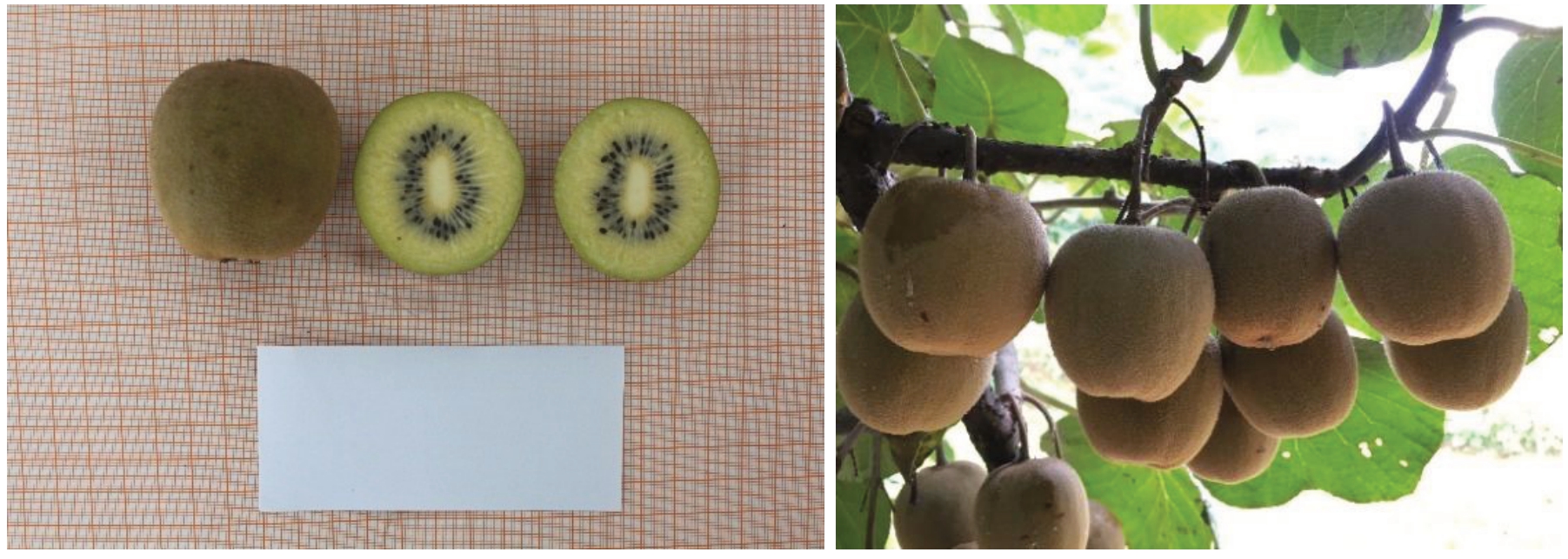
果实倒卵圆形,果面被覆短茸毛,极易脱落;果皮浅褐色或褐色,果柄较长,平均长度为4.99 cm;果实花萼环明显,果肩圆形,果喙浅凹。果实成熟后易脱落,果皮较难剥离,外层果肉浅黄色,内层果肉黄色,果心黄白色,肉质细腻、酸甜可口,具有浓郁果香味(图1)。平均单果质量73.8 g,最大单果质量85.6 g,纵径×横径×侧径为5.49 cm×5.12 cm×4.79 cm,纵径/横径比为1.07,果实赤道横切面为椭圆形,相对果心较小,为0.33 cm。可溶性固形物含量19.6%,可溶性糖含量12.04%,总酸含量1.25%,维生素C含量为750.4 mg·kg-1,干物质含量20.37%(表1)。
表1 汉香和金怡的果实特性比较
Table 1 Comparison of fruit characteristics of Hanxiang and Jinyi

品种Cultivar汉香Hanxiang金怡Jinyi平均单果质量Average single fruit mass/g 73.8 w(维生素C)Vitamin C content/(mg·kg-1)750.4 w(可溶性固形物)Soluble solids content/%19.6 w(总酸)Total acids content/%1.25 w(可溶性糖)Soluble sugar content/%12.04 w(干物质)Dry matter content/%20.37 70.3 1 298.0 20.3 1.30 14.15 21.59
2.3 生长结果习性和物候期
在鄂西北地区,汉香于3月上中旬开始萌芽,3月中下旬抽梢,4月上旬展叶现蕾,4月中旬开花,花期为4~6 d,9月中下旬果实成熟,果实发育期约150 d,12月中旬进入落叶期。汉香是一个萌芽率、成枝率均高的品种,萌芽率57.88%,成枝率92.98%。结果枝以中果枝和短果枝结果为主,结果枝的第1~6节均可开花结果,以1~4节为主。以单花结果(58.82%)为主,双花与三花占比分别为10.29%和30.88%。定植后第3年开花结果,后逐步进入盛果期,盛果期平均每666.7 m2产量为1365 kg。
2.4 适应性及抗逆性
在十堰市郧阳区高岭村、十堰市丹江口市岳家川村、十堰市张湾区长坪塘村等地开展连续多年的试验,结果表明,在秦巴山区及气候相似区,汉香猕猴桃适应性强,性状稳定,且表现出较强的溃疡病抗性。
3 栽培技术要点
3.1 建园方法
适宜在海拔800 m以下、土壤疏松肥沃、有机质含量丰富、排灌方便、pH值5.5~6.5的壤砂土地区种植。采用全园深翻、起垄的方式,一次性施足有机肥,株行距为3 m×(4~4.5)m。雄性品种推荐磨山雄2号,雌雄配置比例一般以8∶1~6∶1为宜。
3.2 水肥管理
一年施肥3次,分别于2月下旬至3月上旬施用萌芽肥、谢花后施用壮果肥、采收后结合土壤改良重施底肥。萌芽肥以氮肥为主,结合钾肥施用,一般成年树每株施用尿素0.25~0.5 kg、氯化钾0.2~0.4 kg,幼苗应减少用量;壮果肥以氮、磷、钾肥为主,配合人畜粪水施用,一般为尿素0.5 kg、氯化钾0.25 kg、磷肥0.5 kg;采果后重施基肥,在树盘周围挖深35 cm、宽30 cm的环形或半环形沟,将已腐熟的有机肥40~50 kg、饼肥2.5 kg、磷肥1~1.5 kg以及人畜粪水施入沟内。注重土壤墒情管理,高温时需及时灌水抗旱和树盘覆盖;雨季要注意及时排渍。
3.3 树体管理
树形以一干两蔓为宜。冬季修剪时,长枝保留10~12个芽,中枝保留8~10个芽,短枝保留5~8个芽。夏季注意及时除萌、抹芽和摘心。疏果一般在盛花后10~20 d进行。疏除小果、畸形果、病虫果和伤果,同时疏除侧果,保留中间果。短果枝保留1个果,中果枝保留2~3个果,长果枝保留3~4个果。
参考文献 References:
[1] 齐秀娟,郭丹丹,王然,钟云鹏,方金豹. 我国猕猴桃产业发展现状及对策建议[J] . 果树学报,2020,37(5):754-763.QI Xiujuan,GUO Dandan,WANG Ran,ZHONG Yunpeng,FANG Jinbao. Development status and suggestions on Chinese kiwifruit industry[J] . Journal of Fruit Science,2020,37(5):754-763.
[2] 齐秀娟,王然,张敏,林苗苗,李玉阔,孙雷明. 猕猴桃育种研究进展[J] . 果树学报,2024,41(11):2160-2172.QI Xiujuan,WANG Ran,ZHANG Min,LIN Miaomiao,LI Yukuo,SUN Leiming. Research progress in kiwifruit breeding[J] .Journal of Fruit Science,2024,41(11):2160-2172.
A new kiwifruit cultivar Hanxiang
XIAO Tao, HUANG Hailei, LIU Tao, CHENG Junhuan, XIAO Lili, WANG Hualing, ZHU Xianbo, HU Guangming, WU Wei*
(Shiyɑn Institute of Economic Crop Reseɑrch, Shiyɑn 442000, Hubei, Chinɑ)
Abstract:Hanxiang kiwifruit is a new Actinidiɑ chinensis cultivar selected from wild kiwifruit population. Excellent wild resources were found in Wudang Mountain, Shiyan City, Hubei Province, in 2007,seeds were sown in 2008, a single plant with strong growth potential and beautiful fruit shape was selected in 2013 (No. Wudang 07-1-4), and graft observation was made in 2013. After continuous observation over several years, it was found that this superior strain exhibited stable performance and a strong tree structure. New variety protection was applied for in 2019, and new variety right certificate was obtained in 2024 (variety name Hanxiang) with the variety right number CNA20191001687. The annual branch is reddish brown, the epidermis is rough, and there are short fusiform yellow pores. Leaf blade is subfan, with heart-shaped base, adaxially medium green color, no or very sparse fuzz, and weak corrugation, abaxially light green color, and medium density fuzz. The flowers are mostly solitary, with white petals, 5-7 sepals, 2.8-3.5 cm corolla in diameter, light green filaments, yellow anthers, white style, horizontal growth, and 2.1-2.7 cm stalk in length. The fruit is obovate, the maximum single fruit weight is 85.6 g, and the average single fruit weight is 73.8 g. Fruit surface is covered with yellowish brown short hairs and easy to fall off. The beak of the fruit is shallow concave, the shoulder is round, the calyx ring of the fruit is obvious, and the stalk is longer, averaging 4.99 cm. The peel is light brown or brown, the fruit is easy to fall off after maturity, and the peel is difficult to peel off. The core is yellowish-white and oval. The outer flesh is light yellow, and the inner flesh is yellow. Fruit soluble solid content is 19.6%,soluble sugar content is 12.04%, total acids content is 1.25%, and vitamin C content is 750.4 mg kg-1.When an orchard is built, the spacing between the plants should be 3 m × (4-4.5) m. It is recommended to use Moshan Xiong 2 or other male varieties whose flowering periods coincide with it, and the ratio of males to females is usually (6-8)∶1. Generally, fertilization is applied three times a year. The germination fertilizer is mainly nitrogen fertilizer, combined with potassium fertilizer application. The fruit swell fertilizer is mainly applied with nitrogen, phosphorus and potassium combined with human and animal manure water. After picking fruit, apply base fertilizer after digging a circular or semi-circular trench 35 cm deep and 30 cm wide around the tree disc, with the decomposed organic fertilizer. Pay attention to soil moisture management, timely irrigation in high temperature drought resistance and tree disc covering; Pay attention to timely drainage in rainy season. One trunk with two main vines remained is recommended. When pruning in winter, the amount of buds left should be appropriate, and in summer, attention should be paid to removing superfluous buds, sprouting and pinching. In the western part of Hubei Province, Hanxiang begins to sprout in early to mid-March, reaches its peak flowering in mid-April, with a flowering period of 4 to 6 days, and the fruits mature in late September. The northwest Hubei or similar climatic regions are suitable for cultivation.
Key words:Kiwifruit; New cultivar; Hanxiang
中图分类号:S663.4
文献标志码:A
文章编号:1009-9980(2026)03-0717-04
DOI:10.13925/j.cnki.gsxb.20250358
收稿日期:2025-06-27
接受日期:2025-07-15
基金项目:农业农村部果树育种技术重点实验室开放基金课题(NYB-202104-01);湖北省第四批现代农业产业技术体系专项资金(2024HBSTX4-08);湖北省支持种业高质量发展资金(HBZY2023A001-05);武当特色中药研究湖北省重点实验室(湖北医药学院)开放课题(WDCM2024012);十堰市农业科学院科技创新专项(SNK202502)
作者简介:肖涛,男,高级农艺师,本科,主要从事果树育种及栽培技术示范推广工作。E-mail:15897814573@163.com
*通信作者 Author for correspondence. Tel:0719-8680145,E-mail:wwsyhb@163.com