红肉软枣猕猴桃新品种紫妍的选育

张雨蕊1,张 浩1,贺浩浩2,刘占德1,刘艳飞1*

1西北农林科技大学园艺学院,陕西杨凌 712100; 2眉县果业技术推广服务中心,陕西眉县 722300)

摘 要:紫妍是从秦岭北麓野生猕猴桃资源中选育而成的红肉软枣猕猴桃新品种。四倍体雌性品种。果实圆柱形,果面光滑,平均单果质量29.09 g,果形指数约1.60;果实成熟后果皮、果肉、果心均为紫红色;果实酸甜适宜,即采即食,风味独特;可溶性固形物含量(w,后同)15.01%,总糖含量13.20%,总酸含量0.86%,维生素C含量2 040 mg·kg-1,总花青苷含量407.25 mg·kg-1。常温下可存放3~5 d,在(1.0±0.5)℃贮藏条件下可存放30~45 d。在陕西关中地区,紫妍于3月中旬萌芽,5月初开花,9月下旬果实成熟,果实生长发育期为145~150 d。树势强,枝条健壮,萌芽率66.98%,成枝率66.27%,以短果枝结果为主;具有较强的抗旱、耐热、耐寒能力,溃疡病等病害发生率极低。适宜在陕西秦岭北麓、陕南高海拔区及类似气候生态区域栽植,盛产期平均产量为12.75 t·hm-2

关键词:软枣猕猴桃;新品种;紫妍;红肉

软枣猕猴桃(Actinidiɑ ɑrgutɑ Planch.)原产于中国,具有显著的耐寒特性。当前国内选育的软枣猕猴桃主栽品种多来源于东北及华中地区[1-4]。陕西秦岭巴山地区的软枣猕猴桃野生资源极为丰富,但相比美味猕猴桃开发利用不足,有待进一步挖掘与评价利用,以期为丰富陕西地区猕猴桃品种结构、促进特色优势品种试验推广提供基础。

1 选育过程

2003年,西北农林科技大学猕猴桃团队在陕西秦岭北麓开展野生猕猴桃资源调查时,发现1株特征明显的野生软枣猕猴桃,红皮红肉,果个较大,果形端正。2004年,将该优株嫁接于西北农林科技大学眉县猕猴桃试验站资源圃。2006年,嫁接植株开始开花结果。经过连续8 a(年)的田间综合评价与鉴定,该优系果个大、果形端正,果皮、果肉、果心均为紫红色,口感较佳,抗逆性强且丰产。2015年春季在陕西省眉县、杨凌区、岐山县进行区域试验,2016年均开始结果。经过2016—2022年连续多年观察,该品种遗传性状稳定,特异性状表现明显。2024年9月通过陕西省农作物品种审定委员会审定(登记),定名为紫妍。

2 主要特征特性

2.1 倍性鉴定

以报道的二倍体红阳[5]作为对照,对紫妍进行倍性鉴定。检测结果表明,在同样的检测条件下,紫妍的峰值荧光(231.35)是二倍体红阳(110.95)的2.08倍,表明紫妍为四倍体植株(图1)。
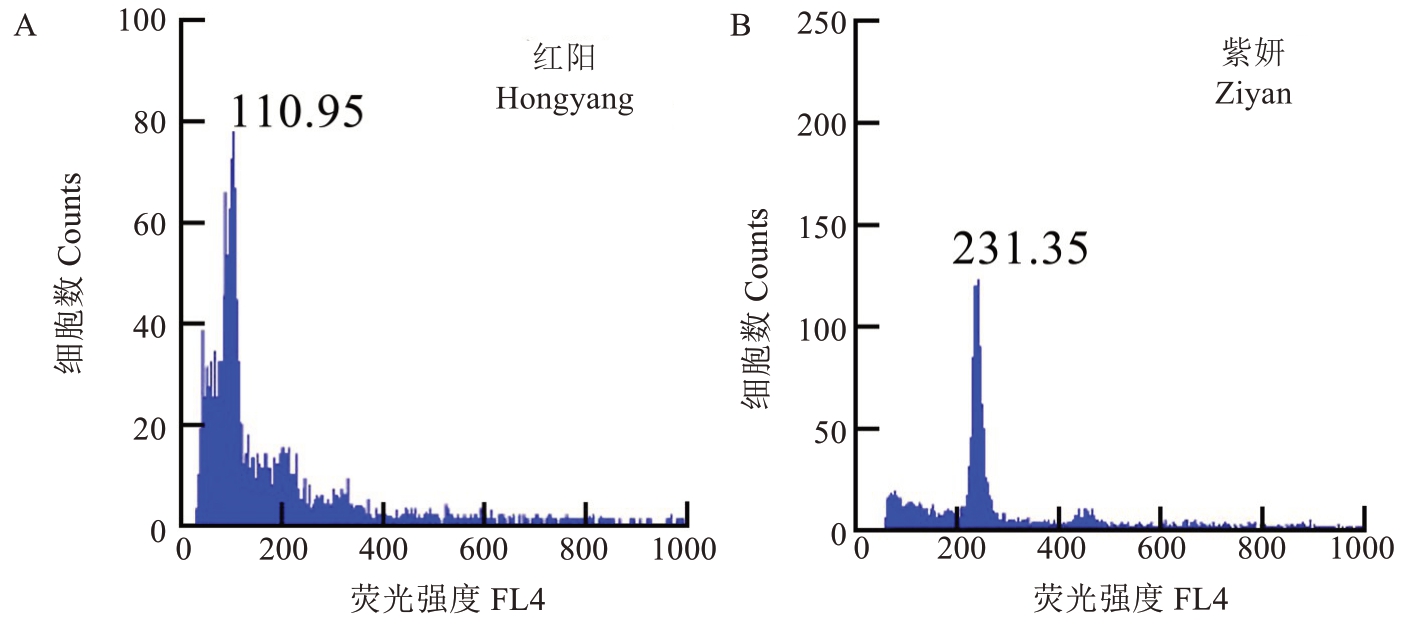
图1 倍性检测结果
Fig. 1 The result of ploidy tested

2.2 植物学特征

紫妍的1年生枝光滑,表面无毛;皮孔白色、短梭形、芽距较小,皮孔长度约1.72 mm、宽度0.95 mm;新梢红色。叶片披针形,深绿色、半革质;叶柄红色,长度6.20 cm;叶片平均长度约11.67 cm,宽度约6.06 cm。以单花为主,花柄长约23.45 mm,花冠平均直径28.72 mm;花瓣5~8枚,白绿色;花萼5片,红褐色;子房瓶状,花柱姿态水平,20~28枚;花丝白色,花药暗紫色(图2)。
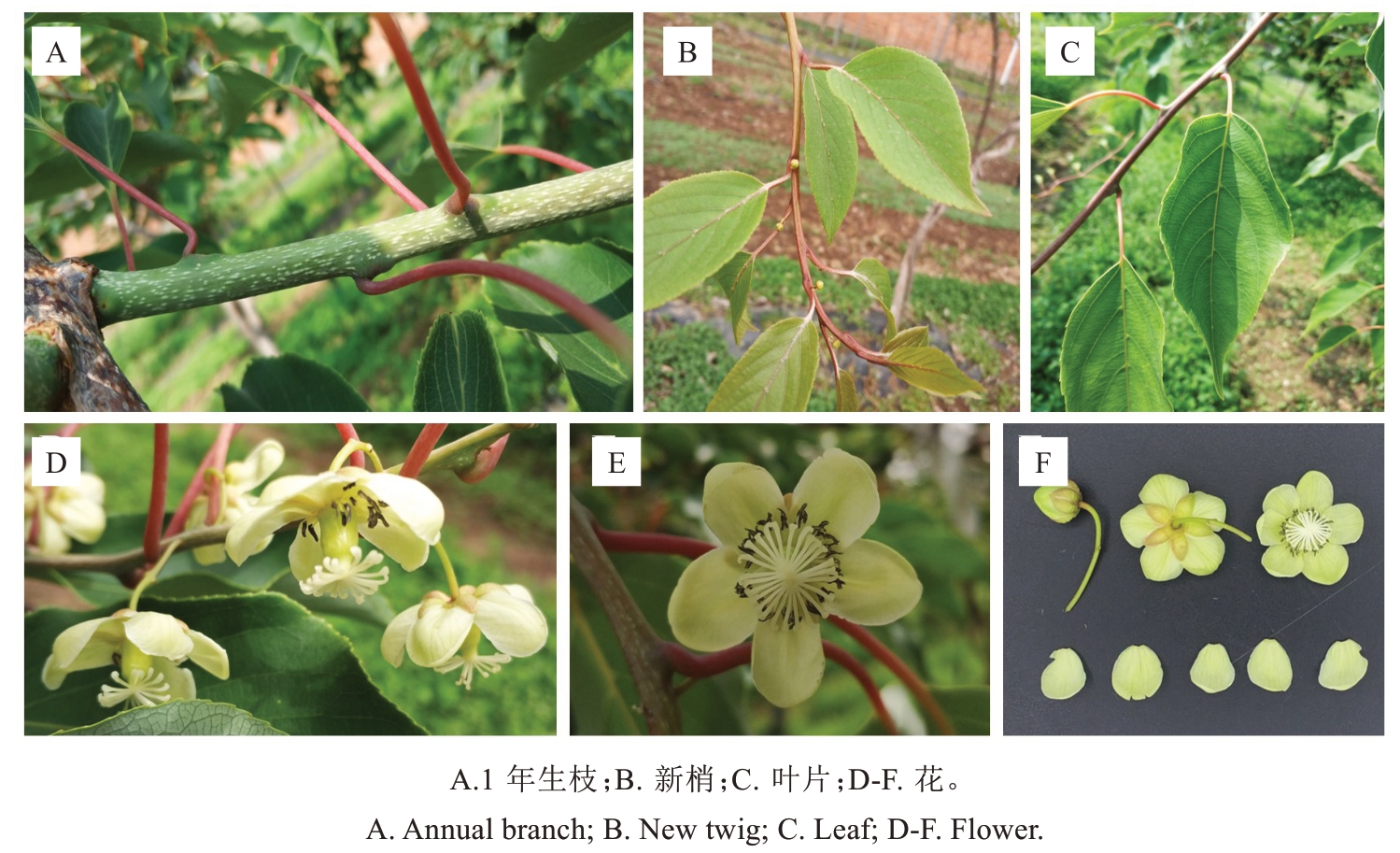
图2 紫妍植物学特征
Fig. 2 Botanical characteristics of Ziyan

2.3 果实经济性状

紫妍猕猴桃果实圆柱形,果面光滑,平均单果质量29.09 g,显著大于魁绿猕猴桃;紫妍果实纵径约50.69 mm,横径31.62 mm,果形指数约1.60;果实成熟时,果皮、果肉、果心均为紫红色,魁绿品种均为绿色;紫妍果实可溶性固形物含量(15.01%,w,后同)高于魁绿,而维生素C含量(2 040 mg·kg-1)低于魁绿;紫妍果实总花青苷含量高达407.25 mg·kg-1,而魁绿果实未检测出花青苷(表1,图3)。紫妍果实在常温下可存放3~5 d,在(1.0±0.5)℃贮藏条件下可存放30~45 d。

表1 紫妍和魁绿的主要果实经济性状比较
Table 1 Comparison of botanical characteristics of Ziyan and Kuilü

品种Cultivar紫妍Ziyan魁绿Kuilü果形Fruit shape index圆柱形Cylindrical椭圆形Oval平均单果质量Average single fruit mass/g 29.09 17.62果皮颜色Skin color紫红色Purple-red绿色Green果肉颜色Flesh color紫红色Purple-red绿色Green w(可溶性固形物)Soluble solids content/%15.01 14.11 w(维生素C)Vitamin C content/(mg·kg-1)2 040.00 3 960.00 w(花青苷)Anthocyain content/(mg·kg-1)407.25 0.00
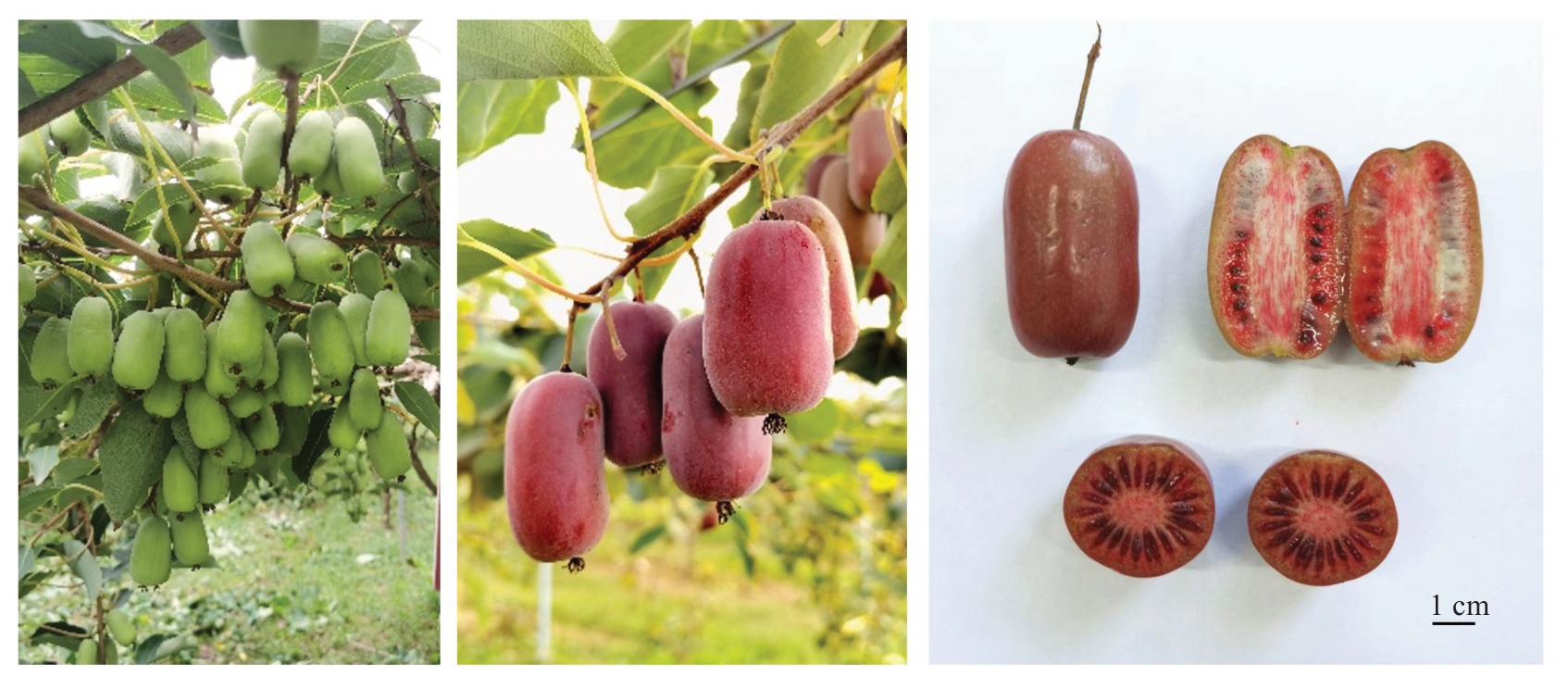
图3 紫妍果实性状
Fig. 3 Fruit characteristics of Ziyan

2.4 生长结果习性与物候期

该品种树势强,枝条健壮,萌芽率66.98%,成枝率66.27%,坐果率98.90%,以短果枝结果为主(78.13%)。在陕西关中地区,该品种于3月中旬萌芽,5月初开花,9月下旬果实成熟,果实生长发育期为145~150 d。盛产期平均产量为12.75 t·hm-2

3 栽培技术要点

3.1 优化选址,高标准建园

该品种适宜在陕西秦岭北麓、陕南高海拔区及类似气候生态区域栽植,可作为现代农业观光采摘特色猕猴桃品种。选择在具有良好排涝和灌溉条件的壤土质、土层1 m以上、土壤pH值6.5~7.5、有机质含量1%以上的地方建园。定植苗木选用组培苗或嫁接成品苗,株行距为3 m×4 m,授粉雄株为NDM07,雌雄比例(6~8)∶1。

3.2 整形修剪

采用水平大棚架和单主干双主蔓树形为宜。冬季修剪时,每平方米保留4~5个1年生中、长蔓,短蔓在不过密的情况下尽量保留;夏季修剪以摘心为主,每平方米除短蔓外,保留10~12个新梢。

3.3 花果管理

花期应及时进行人工辅助授粉或机械授粉,以确保充分授粉,提高坐果率。为保证果实质量,需疏花疏果。花蕾期应及时疏除病虫害、畸形、过密的花蕾;花后15~20 d疏果,疏除过密果、小果、畸形果、病虫果等不符合质量要求的果实。

3.4 肥水管理

根据植株生长需求加强肥水管理。基肥以充分腐熟的饼肥、农家肥等有机肥为主,并配合磷钾肥和生物菌肥。定植行宜进行树盘覆盖,结合行间生草,以改善果园环境条件。

3.5 病虫害防治

紫妍对溃疡病、花腐病等常见病害抗性强,常规防治以预防为主,并结合农业防治、物理防治和生物防治。冬季修剪后使用石硫合剂进行清园,生长季注意防治金龟子、斑衣蜡蝉等虫害,果实成熟前注意防治鸟害。

参考文献 References:

[1] 韩飞,黄宏文,刘小莉,李大卫,钟彩虹. 软枣猕猴桃新品种‘猕枣2号’的选育[J] . 中国果树,2018(1):91-93.HAN Fei,HUANG Hongwen,LIU Xiaoli,LI Dawei,ZHONG Caihong. Breeding of a new Actinidiɑ ɑrgutɑ Planch. Cultivar‘Mizao 2’[J] . China Fruits,2018(1):91-93.

[2] 黄文俊,冉欣雨,王周倩,钟彩虹. 不同贮藏温度对软枣猕猴桃‘猕枣1号’果实品质和贮藏性的影响[J] . 植物科学学报,2022,40(5):695-704.HUANG Wenjun,RAN Xinyu,WANG Zhouqian,ZHONG Caihong. Effects of different storage temperature on fruit quality and storability of Actinidiɑ ɑrgutɑ (Sieb. & Zucc.) Planch. ex Miq. ‘Mizao 1’[J] . Plant Science Journal,2022,40(5):695-704.

[3] 罗轩,陈庆红,张蕾,高磊,白福玺,汪志,叶丽霞,彭珏. 红肉软枣猕猴桃新品种‘金香红’[J] . 园艺学报,2023,50(增刊1):27-28.LUO Xuan,CHEN Qinghong,ZHANG Lei,GAO Lei,BAI Fuxi,WANG Zhi,YE Lixia,PENG Jue. A new cultivar of Actinidiɑ ɑrgutɑ with red-fleshed‘Jinxianghong’[J] . Acta Horticulturae Sinica,2023,50(Suppl. 1):27-28.

[4] 吴小南,王贺新,谷岩,徐国辉,娄鑫. 软枣猕猴桃新品种‘泉蜜’[J] . 园艺学报,2021,48(增刊2):2793-2794.WU Xiaonan,WANG Hexin,GU Yan,XU Guohui,LOU Xin. A new Actinidiɑ ɑrgutɑ cultivar ‘Quanmi’[J] . Acta Horticulturae Sinica,2021,48(Suppl. 2):2793-2794.

[5] HUANG S X,DING J,DENG D J,TANG W,SUN H H,LIU D Y,ZHANG L,NIU X L,ZHANG X,MENG M,YU J D,LIU J,HAN Y,SHI W,ZHANG D F,CAO S Q,WEI Z J,CUI Y L,XIA Y H,ZENG H P,BAO K,LIN L,MIN Y,ZHANG H,MIAO M,TANG X F,ZHU Y Y,SUI Y,LI G W,SUN H J,YUE J Y,SUN J Q,LIU F F,ZHOU L Q,LEI L,ZHENG X Q,LIU M,HUANG L,SONG J,XU C H,LI J W,YE K Y,ZHONG S L,LU B R,HE G H,XIAO F M,WANG H L,ZHENG H K,FEI Z J,LIU Y S. Draft genome of the kiwifruit Actinidiɑ chinensis[J] . Nature Communications,2013,4:2640.

A new red-fleshed Actinidia arguta cultivar Ziyan

ZHANG Yurui1, ZHANG Hao1, HE Haohao2, LIU Zhande1, LIU Yanfei1*

(1College of Horticulture, Northwest A & F University, Yɑngling 712100, Shɑɑnxi, Chinɑ; 2 Meixiɑn Agriculturɑl Technology Extension Service Center, Meixiɑn 722300, Shɑɑnxi, Chinɑ)

Abstract:Native to China and known for its remarkable cold tolerance, many Actinidiɑ ɑrgutɑ varieties are currently developed and have been predominantly cultivated in Northeast and Central China. While the Qinling-Bashan region of Shaanxi is exceptionally abundant in wild resources of Actinidiɑ ɑrgutɑ,its development and utilization remain inadequate and further improvement in exploration and evaluation are needed, compared to Actinidiɑ deliciosɑ. In 2003, the wild kiwifruit resource survey on the northern slopes of the Qinling Mountains in Shaanxi was conducted and a distinctive wild Actinidiɑ ɑrgutɑ specimen was discovered. Characterized by red skin, red flesh, and relatively large fruits, it was named as Ziyan. Through grafting and systematic observations on botanical traits, fruit characteristics,and genetic evaluations, Ziyan demonstrated stable and distinct features:large fruit size, red skin and flesh, unique flavor, high yield, and strong stress resistance. After six years of regional trial evaluations from 2016 to 2022, the breeding process was accomplished, and the variety was registered in 2024. Ziyan is tetraploid female variety featured with cylindrical fruit shape and smooth surface, averaging 29.09 g in weight and having a fruit shape index of approximately 1.60. The skin, flesh, and core of the fruit all turn purplish-red when fruits are ripe. With a unique flavor, the fruit offers a perfect balance of sweet and sour taste for directly fresh consumption after harvest, and contains a soluble solids content of 15.01%, total sugars of 13.20%, total acids of 0.86%, vitamin C of 2040 mg kg-1, and total anthocyanin content of 407.25 mg kg-1. The fruit has a shelf life of over 3-5 days under ambient conditions and 30-45 days when stored at 1.0 ± 0.5 ℃. In the Guanzhong area of Shaanxi Province, phenological development includes budbreak in mid-March, flowering in early May, and fruit maturation in late September,with a fruit growth period of 145-150 days. The variety demonstrates vigorous growth with robust branching, showing a sprouting rate of 66.98% and branching rate of 66.27%. Fruit bearing primarily occurs on spurs. The variety displays strong resistance to drought, heat, and cold, while maintaining an extremely low incidence rate of canker disease and other plant pathogens. It is suitable for cultivation in northern Qinling foothills, southern areas of Shaanxi with high-altitude, and similar ecological regions,achieving average yields of 12.75 t·hm-2 during peak production periods. In practical production, it can be used as a distinctive kiwifruit variety for modern agricultural sightseeing and picking. Orchard establishment should be in the sites of well-drained and irrigated loamy soil with soil layer >1 m, pH 6.5-7.5, and organic matter content >1%. Planting spacing should be 3 m × 4 m, using NDM07 as the pollinizer with female/male ratio of (6-8)∶1. Horizontal trellis system with “single main trunk and dual major vines” shape is recommended. Winter pruning focuses on minimal cutting, while summer pruning emphasizes shoot pinching. Flower/fruit management and fertilizer/water regulation should be strengthened, with fully decomposed cake fertilizer and farm manure as basal organic fertilizers, supplemented with phosphorus-potassium fertilizers and bio-bacterial fertilizers. The ground mulching should be applied in planting rows and inter-row cover cropping are proposed for improving orchard conditions.During growing season, scarab beetles and spotted lanternflies should be monitored, and bird prevention measures should be adopted before fruit maturation.

Key words:Actinidiɑ ɑrgutɑ; New cultivar; Ziyan; Red-flesh

中图分类号:S663.4

文献标志码:A

文章编号:1009-9980(2026)03-0713-04

DOI:10.13925/j.cnki.gsxb.20250336

收稿日期:2025-06-13

接受日期:2025-07-16

基金项目:国家现代农业产业技术体系建设专项资助(CARS-26);陕西省重点研发计划项目(2024NC-YBXM-022)

作者简介:张雨蕊,女,在读硕士研究生,研究方向为果树种质资源评价与创新利用。E-mail:2639590236@qq.com

*通信作者 Author for correspondence. E-mail:lyfkiwi@nwafu.edu.cn