脐橙在我国柑橘产业中占有重要地位,在全国主要柑橘产区均有种植。其中,纽荷尔是脐橙中种植面积最大的品种,年产量100万t以上[1]。脐橙以酸甜适中的口感和浓郁的橙香味深受消费者喜爱。但脐橙果实以近圆形为主,不同品种之间外观品质较为近似,消费者难以根据果实外观对品种或品牌进行区分和重点关注,一定程度上限制了不同脐橙品种和品牌之间的个性化特征和记忆点的体现。进入新时代,消费需求趋向个性化,商品需打造记忆点。现代农业的功能也从满足人们“吃”的需求向满足“吃、看、感受”的全面需求转变[2]。为满足人们不同的消费需求,多样化、个性化已经作为重要的经济性状成为水果新品种选育的目标[3-4]。因此,选育外观新颖、果形独特、综合性状优良的脐橙品种是增强柑橘产业多样化、个性化,满足时代发展需求的重要育种目标。长红脐橙由纽荷尔脐橙芽变选育而成,因其果实较普通脐橙大、外观长圆、果面橙红,受消费者青睐。金钟橙是长红脐橙的芽变新品种,果大高桩,外形独特,成熟时酷似金钟,外观较长红脐橙更独特,易吸引采摘者围观、品尝。金钟橙外观新颖,内在品质优良,风味浓郁,具有较高的鲜食、观赏和经济价值。
1 选育过程
2019年,科研人员在秭归县郭家坝镇柏杨坪村一孙姓果农的长红脐橙果园中发现一株果形变异单株。经过调查和寻访,该果农于1998年在秭归县两河口镇两面山村采集长红脐橙接穗,以红橘为基砧、锦橙为中间砧,进行高接换种,嫁接于秭归县郭家坝镇柏杨坪村果园。经过多年的栽培观察,发现有一株长红脐橙果实近似圆柱形,果实大且性状稳定。2006年,将变异枝条在同一果园内的5株以红橘为砧木的长红脐橙上进行了高接换种。在2008—2019年连续10余年的观察中,发现高接植株性状表型稳定,田间农艺性状整齐一致。该脐橙果形奇特,呈高桩圆柱形,果个较大,内在品质中上等,与长红脐橙相比,在果形、大小及风味上均存在较大差异。2020年,在果农孙大兵的协助下,研究人员对该芽变材料进行了科学、系统鉴定。运用分子标记技术对该芽变单株及其母本进行了遗传物质比较分析,结果表明,二者遗传物质发生了变异,确定其为真实芽变。对金钟橙的植物学特征和农艺性状进行观察分析,发现其果实形状变异稳定,且果实呈现均匀高桩圆柱形、新颖奇异、果实品质较好。经过多年多点试验,确定该芽变果形变异性状稳定、品质优良,丰产稳产性与母本相当,最终确定为优良脐橙新品种。2025年3月通过非主要农作物品种登记,定名为金钟橙(图1),登记编号为GPD柑橘(2025)420003。
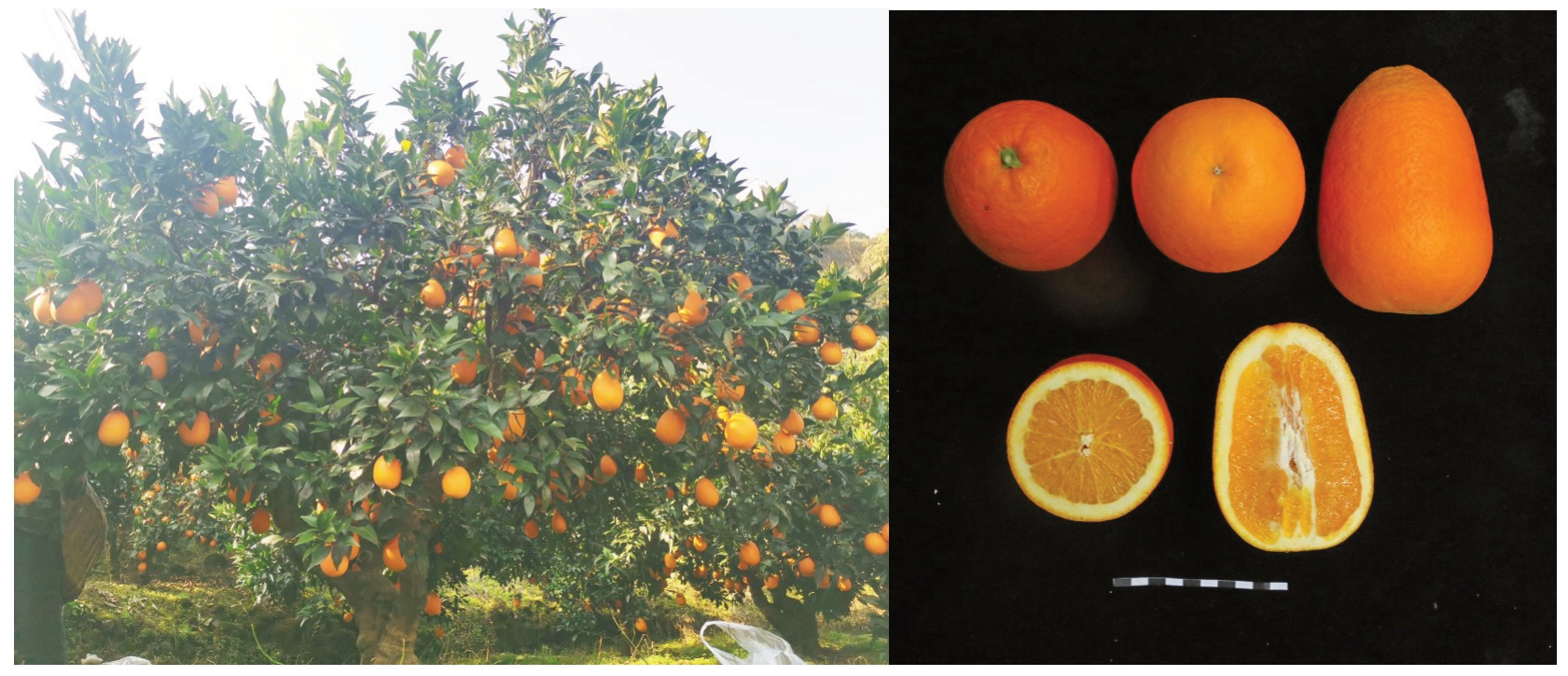
图1 金钟橙树体及其果实
Fig. 1 The tree body and fruits of Jinzhongcheng
2 主要性状
2.1 植物学特征
金钟橙树势较强,树冠自然开心形,树姿开张;叶片阔披针形,平均长度为85.0 mm,平均宽度为37.0 mm,叶片绿色,叶缘全缘,叶尖急尖,叶基狭楔形,有翼叶;1年开花1次,有花序,花瓣白色,多为5瓣花,舌形,无花粉,单性结实。
果实膨大期从第2次生理落果后持续至8月下旬,果面于9月中旬开始转色,至12月中旬完全成熟。
2.2 物候期
在湖北省秭归地区,金钟橙1年可抽生3~4次梢。3月中下旬抽生春梢,5月中下旬抽生夏梢,7月中下旬抽生秋梢。初花期在4月中下旬,盛花期在4月底;以顶花、有叶花坐果为主,第1次生理落果期在5月初,第2次生理落果期在5月中下旬。膨果期主要在第2次生理落果结束后持续至8月下旬,9月中旬果面开始转色,12月中旬果实成熟。
2.3 生长结果习性
金钟橙春梢、夏梢、秋梢均可成为结果母枝,枝梢萌芽率高。果实呈高桩圆柱形,平均横径79.53 mm,平均纵径112.62 mm,果形指数1.42,平均单果质量达396.88 g;果面橙红色、中等光滑,油胞密度中等;果皮较厚,厚度6.52 mm,难剥离;中心柱半充实,囊瓣整齐;果肉橙色中等,可食率中等,风味浓,香气浓,化渣;无种子;成熟果实可溶性固形物含量(w,后同)为15.03%,可滴定酸含量为1.29%,维生素C含量为58.49 mg·100 g-1,可食率为77.41%。金钟橙与母本长红脐橙相比,果实大而似钟形,果实单果质量显著增加,纵径明显变长,果形指数显著变大(表1~表2)。
表1 金钟橙及长红脐橙果实外在品质
Table 1 External fruit quality of Jinzhongcheng and Changhong navel orange

注:同列不同小写字母代表差异显著(P<0.05)。下同。
Note:Different small letters within the same column indicate significant differences (P<0.05). The same below.
品种Variety金钟橙Jinzhongcheng长红脐橙Changhong navel orange单果质量Single fruit mass/g 396.88±16.52 a 301.47±20.12 b果实纵径Fruit longitudinal diameter/mm 112.62±3.51 a 88.48±4.02 b果实横径Fruit transverse diameter/mm 79.53±0.52 a 79.26±0.51 a果形指数Fruit shape index 1.42±0.06 a 1.12±0.05 b果皮厚度Peel thickness/mm 6.52±0.93 a 6.09±0.59 a囊瓣数Number of segments 10.67±0.58 a 10.67±0.58 a种子数Number of seeds 0±0 a 0±0 a果皮颜色Fruit peel color橙红Tangerine red橙红Tangerine red果肉颜色Flesh color橙色Orange橙色Orange
表2 金钟橙及长红脐橙果实内在品质
Table 2 Internal fruit quality of Jinzhongcheng and Changhong navel orange

品种Variety金钟橙 Jinzhongcheng长红脐橙Changhong navel orange可食率Edible rate/%77.41±3.42 a 78.47±1.76 a出汁率Juice yield/%55.42±9.45 a 48.03±1.11 a w(可溶性固形物)Soluble solids content/%15.03±0.61 a 14.60±0.20 a w(可滴定酸)Titratable acid content/%1.29±0.25 a 1.52±0.06 a w(维生素C)Vitamin C content/(mg·100 g-1)58.49±5.44 a 59.96±3.84 a
2.4 丰产稳产性
金钟橙丰产稳产性较好。容器苗定植后一般3年试果,5年盛果,初果期产量为600 kg·666.7m-2,盛果期产量在2500 kg·666.7 m-2以上。2021—2022年连续两年对10年生金钟橙进行测产,按照55株·666.7 m-2计算,2年平均每666.7 m2产量分别为2 771.45 kg和2 923.25 kg(表3)。
表3 金钟橙与长红脐橙连续2年产量情况
Table 3 The yield of Jinzhong cheng and Changhong navel orange in two consecutive years

品种Variety金钟橙 Jinzhongcheng长红脐橙 Changhong navel orange 2021年 In 2021平均单株产量Average yield per plant/kg 50.39 50.00平均每666.7 m2产量(55株·666.7 m-2)Average yield per 666.7 m2(55 plants per 666.7 m2)/kg 2 771.45 2 750.00 2022年 In 2022平均单株产量Average yield per plant/kg 53.15 47.90平均每666.7 m2产量(55株·666.7 m-2)Average yield per 666.7 m2(55 plants per 666.7 m2/kg 2 923.25 2 634.50
3 分子标记鉴定
采用AFLP分子标记技术对长红脐橙及其芽变品种(金钟橙)进行遗传物质差异分析。采用CTAB小量法分别提取长红脐橙和金钟橙的叶片DNA,然后利用PCR技术扩增遗传物质。通过全自动毛细管电泳系统(QI Advanced,QIAGEN)进行差异条带分析。AFLP分子标记分析结果如图2所示,利用E-ACG/M-CTA引物(E-ACG:GACTGCGTACCAATTCACG;M-CTA:CATGAGTCCTGAGTAACTA)可在长红脐橙与金钟橙之间鉴定到1条稳定的差异条带,该条带长度约为282 bp,表明两者在DNA水平上存在明显差异。
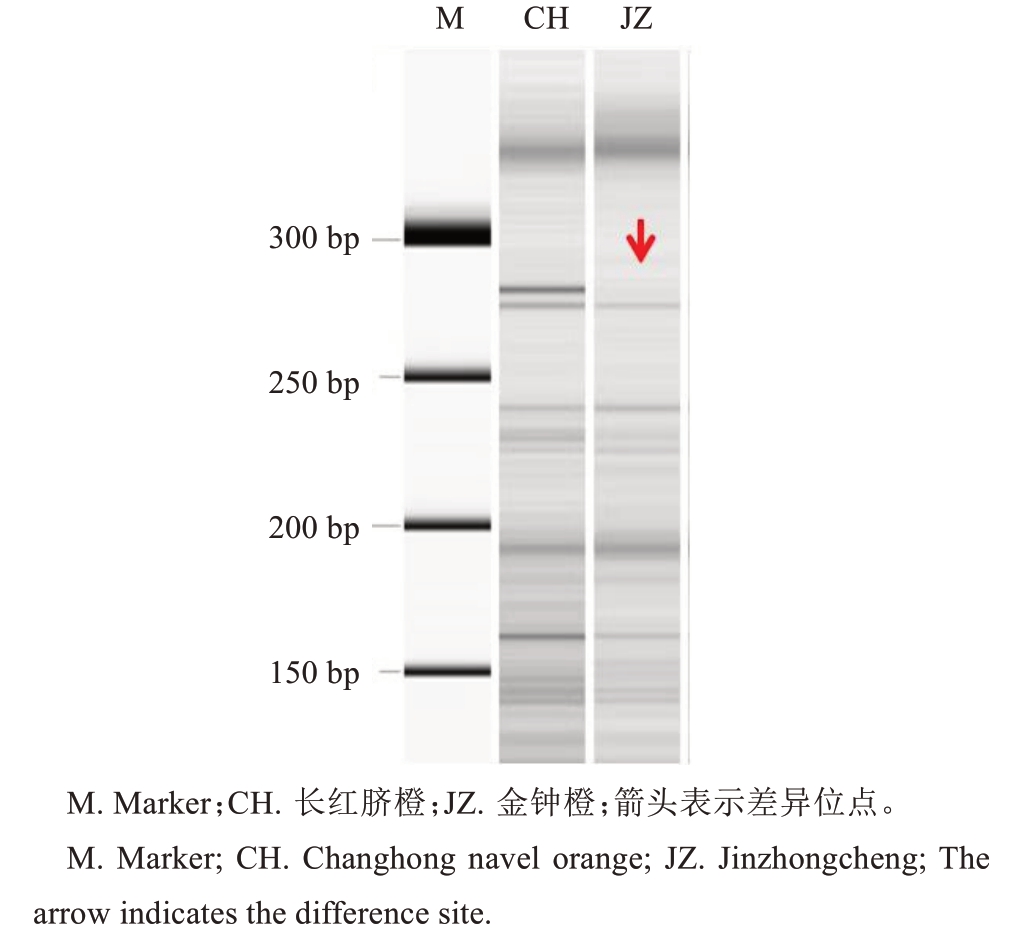
图2 金钟橙AFLP指纹图谱分析
Fig. 2 AFLP fingerprint analysis of Jinzhongcheng
4 栽培技术要点
4.1 适宜种植区域
金钟橙与长红脐橙适栽区域一致,适宜在pH=6.0~6.5的微酸性土壤、5500~6500 ℃有效年积温(≥10 ℃)、年平均气温≥18 ℃、冬季最低气温>-5 ℃的南方甜橙种植区种植。在土层深厚、有机质含量高、地下水位低于1 m的土壤条件下表现好。
4.2 建园定植
选择在适宜的气候条件种植。在湖北省宜昌市,金钟橙在春、秋季节种植较适宜。新建园宜选择缓坡地及丘陵山地,向阳面为佳,土层浅薄的园址应抽槽。高接园应注意选择基砧与中间砧:酸性土壤基砧以枳壳为好;碱性土壤基砧以红橘和资阳香橙较为适宜;中间砧以本砧、温州蜜柑及普通甜橙为佳。成年果园可全园生草或定期深翻施用有机肥,以改良土壤。
4.3 整形修剪与花果管理
树形采用自然开心形较为适宜。幼年期以轻剪扩冠为主,薄肥勤施,促使幼树多发新梢;疏除过密枝、徒长枝,培养均匀枝组,定干高度40 cm,以3主枝为主,均匀分布,摘除过多花果。成年树每年修剪2次,夏季以疏除直立枝、旺长枝为主,或结合放秋梢修剪;冬季以调整树体结构为主,剪除病虫枝、重叠枝、竞争枝,回缩衰弱枝,伤口较大时注意涂抹伤口愈合剂,避免病菌感染。加强疏果管理,摘除小果、病虫果、畸形果、日灼果,合理均匀挂果,克服大小年。
4.4 其他管理
金钟橙在建园定植、土肥水管理等方面与其他脐橙品种基本一致,无特殊要求。但其挂果后对镁元素需求较高,易出现缺镁现象,应注意及时补施。该品种耐溃疡病和衰退病,无特殊病虫害,生长期重点防治蚜虫、红蜘蛛和疮痂病。
5 综合评价
经过多年多点试验与分析发现,金钟橙较亲本长红脐橙在果形上表现出明显差异,其果形新颖美观,呈高桩圆柱形,形似金钟,果型大,风味浓郁,是具有发展前景的特色脐橙优良品种。
[1] 邓秀新. 柑橘产业发展趋势与桂林柑橘品种结构调整[J] . 南方园艺,2020,31(6):1-4.DENG Xiuxin. The development trend of citrus industry and the adjustment of citrus variety structure in Guilin[J] . Southern Horticulture,2020,31(6):1-4.
[2] 邓秀新. 现代农业与农业发展[J] . 华中农业大学学报(社会科学版),2014(1):1-4.DENG Xiuxin. Modern agriculture and agricultural development[J] . Journal of Huazhong Agricultural University (Social Sciences Edition),2014(1):1-4.
[3] 邓秀新,王力荣,李绍华,张绍铃,张志宏,丛佩华,易干军,陈学森,陈厚彬,钟彩虹. 果树育种40年回顾与展望[J] . 果树学报,2019,36(4):514-520.DENG Xiuxin,WANG Lirong,LI Shaohua,ZHANG Shaoling,ZHANG Zhihong,CONG Peihua,YI Ganjun,CHEN Xuesen,CHEN Houbin,ZHONG Caihong. Retrospection and prospect of fruit breeding for last four decades in China[J] . Journal of Fruit Science,2019,36(4):514-520.
[4] 郭文武,叶俊丽,邓秀新. 新中国果树科学研究70年:柑橘[J] .果树学报,2019,36(10):1264-1272.GUO Wenwu,YE Junli,DENG Xiuxin. Fruit scientific research in New China in the past 70 years:Citrus[J] . Journal of Fruit Science,2019,36(10):1264-1272.