枇杷是浙江省特色水果,栽培历史悠久,因风味佳美、质地细嫩、鲜甜适口而久负盛名[1]。浙江省统计年鉴数据显示,2023 年全省枇杷面积约1.40 万hm2,年产量10.93 万t,产值突破17 亿元[2]。枇杷已成为浙江省部分地区效益农业和休闲观光采摘的主要果树种类之一,在乡村振兴、共同富裕、农民增收中发挥了重要作用。
黄肉类枇杷品种种植面积约占浙江省种植总面积的40%,主栽品种有大红袍、洛阳青等[3-4]。这些品种的花期相对较晚,抗逆性较白肉品种好,主要缺点是果型小、肉质粗硬、化渣性差、糖分低、酸度高,难以满足消费者对高品质枇杷的需求[5]。因此,亟须培育大果型、品质优、抗逆性强、丰产性好的黄肉枇杷新品种。杂交育种是枇杷新品种选育的重要手段[6]。浙江省农业科学院园艺研究所通过种质资源筛选,基于表型性状互补原则,选用优质白肉品种宁海白为母本、福建大果晚花抗逆品种解放钟为父本构建杂交群体,开展枇杷杂交育种。历经13 a(年)培育成品质、果形、抗性均优于现有主栽黄肉品种大红袍的新品种漫山虹。漫山虹可为黄肉枇杷品种结构调整提供支撑,将促进浙江省乃至全国枇杷产业高质量发展。
1 选育经过
2011 年12 月,浙江省农业科学院园艺研究所枇杷育种团队从福建省果树研究所国家枇杷资源圃采集解放钟花粉,在浙江省农业科学院海宁杨渡创新基地与母本宁海白进行杂交,2012 年5 月下旬收获195 个杂交果实,获得541 粒种子,将其播种于营养钵获得450 株杂交实生苗,2013 年春季将实生苗定植于海宁杨渡创新基地,2016 年冬季开花,2017 年初结果。其中一株因花期迟、抗逆性强、果实外观圆整、坐果率高、品质优,2017 年被作为优株从杂交后代中选出,编号为A-207。2017—2019 年连续3 a 观察其叶、花、果等植物学性状以及单果质量、品质、抗逆性等农艺性状,其性状表现稳定,暂定名为浙红1号,2020 年申报国家植物新品种权,命名漫山虹(图1)。2018 年繁殖种苗,并在余杭区仁辰语家庭农场和兰溪市果香家庭农场等示范基地进行区域试验,区试点于2020 年起相继开花结果。根据2022—2024 年连续3 a 的区域试验观测数据,表明该品种树势强,花期晚,盛花期为12 月下旬至翌年1 月上旬;果肉细腻、糖度高、品质优;抗寒、抗裂果、抗栓皮;结果性与丰产性好,在特异性、一致性和稳定性方面与母树表现一致。2024 年获得国家新品种权(证书号:CNA20201005544),2024年12月通过浙江省林木良种审定委员会审定(编号:浙S-SV-EJ-005-2024)。
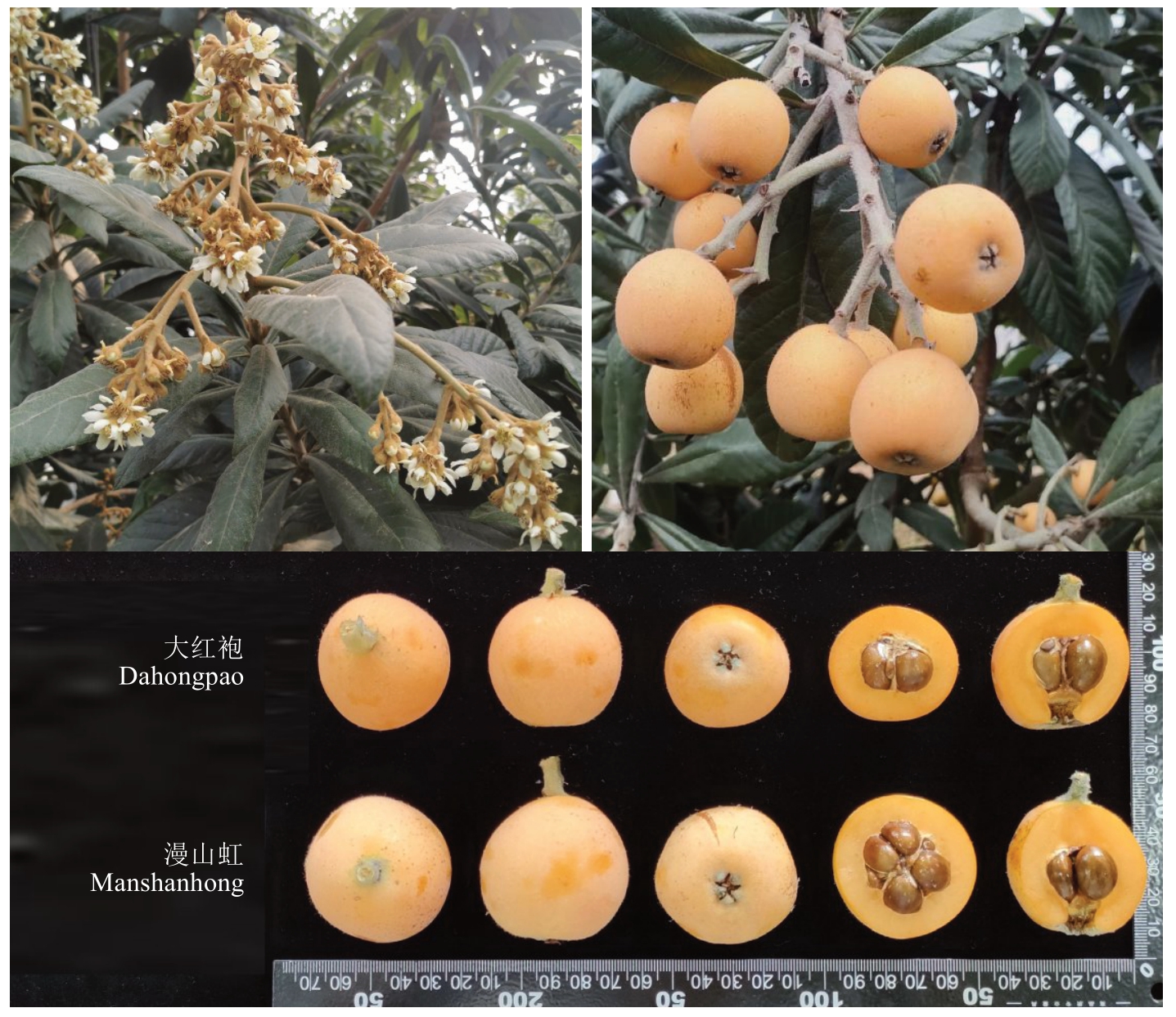
图1 枇杷新品种漫山虹花穗与果穗及果实对比
Fig. 1 The flowers and fruits of loquat cultivar Manshanhong and fruit comparison
2 主要性状
2.1 植物学特征
该品种树姿开张,树冠呈半圆球形,中心干明显,树势强。树干皮孔少,主干灰白色;1 年生老熟枝条棕褐色,茸毛量中等;中心枝平均长度57.0 cm,粗度1.4 cm;侧枝5个,平均长度44.5 cm,粗度1.3 cm,枝梢质地中等。1 年生春梢叶片深绿色,质地厚硬;老熟叶片椭圆形,浅绿色,质地厚硬,叶姿斜向上;叶长32.9 cm,叶宽12.1 cm,长宽比2.7,叶片厚度0.43 mm;叶尖渐尖,叶基楔形,叶缘平展,锯齿浅且密度中等,占叶缘长度的1/2;叶面稍皱,横切面呈凹形;叶背灰黄色、茸毛中等,叶脉16~18对,叶背中脉凸起明显,网脉明显,侧脉直出,叶脉茸毛较多;叶柄长度1.1 cm,粗度5.5 mm。花序圆锥形,疏散至中等密集,平均长度9.5 cm,宽度10.5 cm,花序支轴姿态平展,平均支轴8 个;平均每穗106 朵花,花直径26.6 mm,花瓣黄白色,平均花柱5 个,雄蕊22~24个。该品种于秋冬季开花,花期迟。始花期为12 月上旬,盛花期为12月下旬至翌年1月上旬,终花期为1 月下旬至2 月上旬。在浙江省农业科学院海宁杨渡基地,该品种成熟期为5月25日左右。
2.2 果实经济性状
果实整齐、近圆形,萼孔闭合。疏果后平均单果质量48.9 g。果皮橙黄色,韧性好,易剥皮;果肉橙黄色,硬度中等。平均可溶性固形物含量(w,后同)14.9%,最高达28.6%,可滴定酸含量0.31%,可食率75.8%;肉质细腻、糖度高、风味浓郁,遗传了优质白肉枇杷的品质风味。花穗抗寒性极强,在-9 ℃的强低温下坐果率较高,平均每穗坐果11.6个(不疏果),同时具备较强的抗裂果、抗日灼等能力(表1)。
表1 漫山虹和大红袍(疏果后)的果实经济性状比较
Table 1 Comparison of fruit economic traits between Manshanhong and Dahongpao (after fruit thinning)
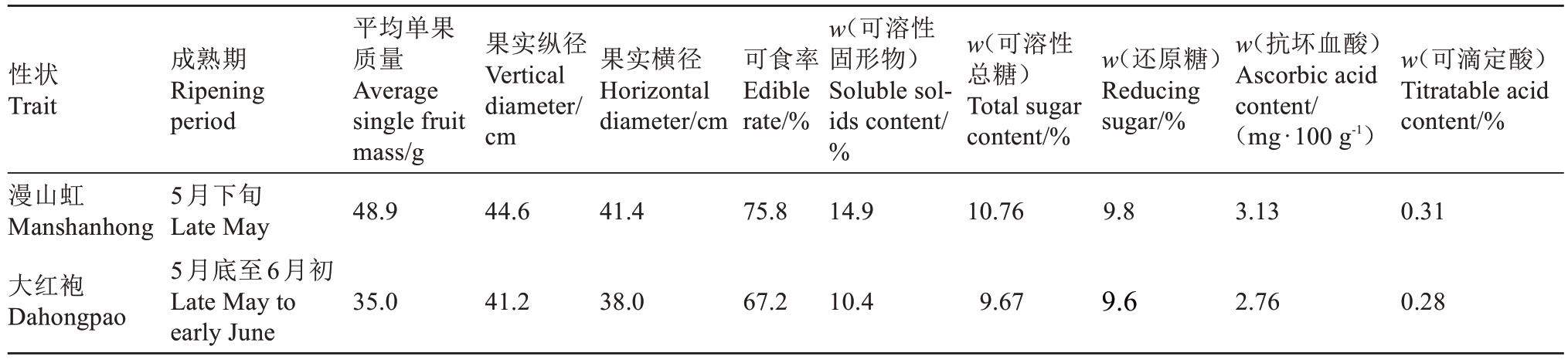
性状Trait成熟期Ripening period果实纵径Vertical diameter/cm果实横径Horizontal diameter/cm可食率Edible rate/%w(可溶性总糖)Total sugar content/%w(还原糖)Reducing sugar/%w(抗坏血酸)Ascorbic acid content/(mg·100 g-1)w(可滴定酸)Titratable acid content/%漫山虹Manshanhong大红袍Dahongpao 5月下旬Late May 5月底至6月初Late May to early June平均单果质量Average single fruit mass/g 48.9 44.6 41.4 75.8 w(可溶性固形物)Soluble solids content/%14.9 10.76 9.8 3.13 0.31 35.0 41.2 38.0 67.2 10.4 9.67 9.6 2.76 0.28
2.3 生长结果习性
漫山虹树势强,花穗坐果率高。该品种在浙江兰溪、余杭、海宁等地的成熟期为5 月中下旬,平均单果质量为48.9 g,平均每株结果穗为66 个,经疏果后每穗坐果6~8 个,平均株产12.33~29.73 kg,折合每666.7 m2 产量为505.53~1 218.93 kg。露地栽培6 年生树每666.7 m2 种植41 株,平均产量为979.9 kg·666.7 m-2。
2.4 物候期
2022—2024 年,在海宁许村镇杨渡村基地、杭州仁和街道辰语家庭农场、兰溪市果香家庭农场等3 处示范基地,通过露地种植,定树、定枝对漫山虹进行物候期观察,以大红袍作为对照,常规管理。结果表明,漫山虹在海宁和仁和示范基地的物候期与大红袍相近,春梢抽芽期为2月下旬至3月上旬。漫山虹现蕾期为10 月中下旬,露白期为11 月中下旬,始花期为11 月下旬至12 月上旬,盛花期为12 月中下旬至翌年1 月上旬,而对照品种大红袍盛花期在11 月下旬至12 月上旬,漫山虹花期较对照晚30~40 d。漫山虹果实于5 月下旬成熟,而大红袍在5 月底6 月初成熟。在兰溪市示范基地,漫山虹的春梢抽芽期为2月中下旬,现蕾期为10月上中旬,露白期在11 月中旬,始花期在11 月下旬,盛花期在12 月上中旬,而对照品种大红袍盛花期在11 月上中旬,花期较对照晚30~40 d。漫山虹果实成熟期约为5 月中旬,而大红袍为5月中下旬(表2)。
表2 漫山虹与大红袍的主要物候期比较
Table 2 Comparison of main phenological stages between Manshanhong and Dahongpao
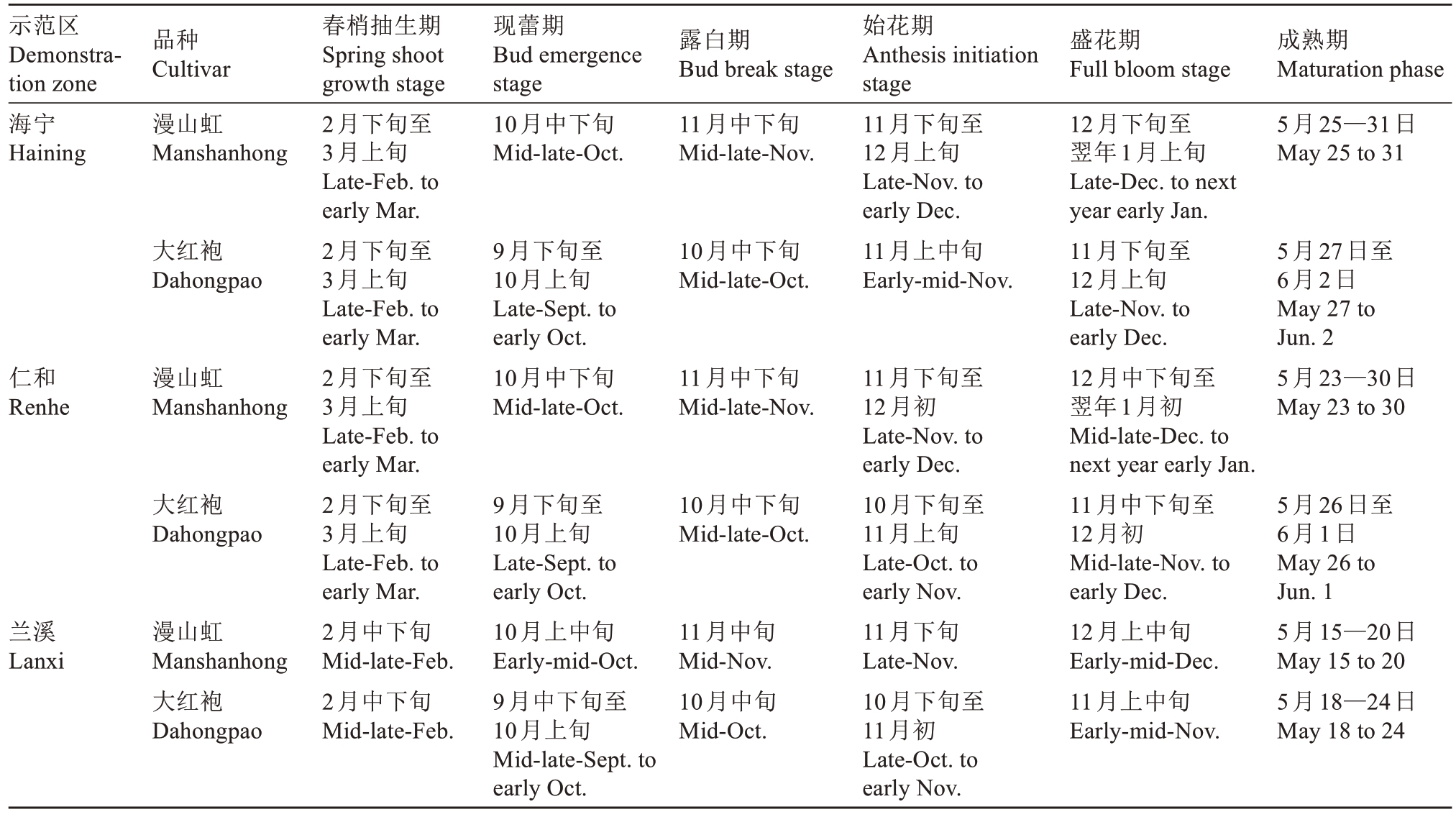
示范区Demonstration zone海宁Haining品种Cultivar漫山虹Manshanhong现蕾期Bud emergence stage 10月中下旬Mid-late-Oct.露白期Bud break stage 11月中下旬Mid-late-Nov.成熟期Maturation phase 5月25—31日May 25 to 31大红袍Dahongpao 10月中下旬Mid-late-Oct.始花期Anthesis initiation stage 11月下旬至12月上旬Late-Nov. to early Dec.11月上中旬Early-mid-Nov.仁和Renhe漫山虹Manshanhong 9月下旬至10月上旬Late-Sept. to early Oct.10月中下旬Mid-late-Oct.11月中下旬Mid-late-Nov.5月27日至6月2日May 27 to Jun. 2 5月23—30日May 23 to 30大红袍Dahongpao 10月中下旬Mid-late-Oct.兰溪Lanxi漫山虹Manshanhong大红袍Dahongpao春梢抽生期Spring shoot growth stage 2月下旬至3月上旬Late-Feb. to early Mar.2月下旬至3月上旬Late-Feb. to early Mar.2月下旬至3月上旬Late-Feb. to early Mar.2月下旬至3月上旬Late-Feb. to early Mar.2月中下旬Mid-late-Feb.2月中下旬Mid-late-Feb.9月下旬至10月上旬Late-Sept. to early Oct.10月上中旬Early-mid-Oct.9月中下旬至10月上旬Mid-late-Sept. to early Oct.11月中旬Mid-Nov.10月中旬Mid-Oct.11月下旬至12月初Late-Nov. to early Dec.10月下旬至11月上旬Late-Oct. to early Nov.11月下旬Late-Nov.10月下旬至11月初Late-Oct. to early Nov.盛花期Full bloom stage 12月下旬至翌年1月上旬Late-Dec. to next year early Jan.11月下旬至12月上旬Late-Nov. to early Dec.12月中下旬至翌年1月初Mid-late-Dec. to next year early Jan.11月中下旬至12月初Mid-late-Nov. to early Dec.12月上中旬Early-mid-Dec.11月上中旬Early-mid-Nov.5月26日至6月1日May 26 to Jun. 1 5月15—20日May 15 to 20 5月18—24日May 18 to 24
2.5 抗逆性与栽培适应性
2022—2024 年连续3 年对漫山虹进行区试试验,结果表明,漫山虹适应性强,具体表现为树势强健,花期晚,抗寒性强,3 个批次的花穗抗寒性明显优于对照品种大红袍。此外,漫山虹果实栓皮率显著低于大红袍,商品性更高。
3 栽培技术要点
3.1 建园
园地宜选择年平均气温≥15 ℃、极端最低温度≥-9 ℃、具有良好小气候环境的区域;山地建园以东南向或南向坡地为宜,坡度控制在15°~25°,避开风道、山脊突出及地势低洼区域。土壤以土质疏松、排水良好的壤砂土或透水性好的黄壤土为宜,在定植前施入有机肥进行深翻改土。
3.2 种植时间
种植以带土移栽为宜,可在2—3 月萌芽前春植或11—12月秋梢停长后种植。栽植前挖长宽各1 m、深80 cm 的定植穴,每穴施入50 kg 腐熟有机肥,并与土壤充分拌匀。
3.3 种植密度
株行距为4 m×4 m,每666.7 m2种植40~41株。
3.4 肥水管理
每年施肥4次,2月下旬施以高钾复合肥为主的春肥;4 月初施以硫酸钾为主的壮果肥;6 月上旬施采后肥;9 月下旬施有机肥作为基肥。应注意氮、磷、钾等大量元素和钙镁硼等中微量元素的配合施用。水分管理应根据叶花果生长需求均衡供水,切忌忽干、忽湿和积水。
3.5 疏花疏果
该品种花期晚,抗冻性强。冬季低温频发地区可不疏花;无冻害地区头批花可不疏,对第2、3批花进行适当疏花,以减少后续疏果次数。浙江产区于3月下旬至4月初进行疏果,根据枝条的粗细和树体的承载能力确定留果量。主枝或者粗壮结果枝每穗可保留4~6 个果;细弱枝或侧枝可适当保留2~4 个果;如果侧枝结果过多,需适当疏除部分果实。
3.6 病虫害防治
以农业防治与绿色防控为主,通过加强肥水管理和整形修剪,保持园地通风透光,培养健康强壮树体。冬季剪除减虫枝并进行清园。春季疏果后喷施1 次杀虫杀菌剂;采后喷施杀虫剂,防治黄毛虫、天牛与拟木蠹蛾等害虫;在花期(11 月至翌年2 月)每月喷施杀菌剂防治花腐病,确保正常坐果。
[1] 邱武陵 中国果树志·龙眼枇杷卷[M]. 北京:中国林业出版社,1996:90-95.QIU Wuling
 China Fruit Records-Longan and Loquat (in Chinese)[M]. Beijing:China Forestry Press,1996:90-95.
[2] 浙江省统计局,国家统计局浙江调查总队. 浙江统计年鉴2024[M]. 北京:中国统计出版社,2024:230.Zhejiang Provincial Bureau of Statistics,Survey Office in Zhejiang of National Bureau of Statistics. Zhejiang Statistical Yearbook 2024[M]. Beijing:China Statistics Press,2024:230.
[3] 庞法松,何娟,王朝丽. 塘栖枇杷种质资源的保护与创新[J].浙江农业科学,2015,56(5):731-733.PANG Fasong,HE Juan,WANG Zhaoli. Conservation and innovation of Tangqi loquat germplasm resources[J]. Journal of Zhejiang Agricultural Sciences,2015,56(5):731-733.
[4] LI X Y,XU H X,CHEN J W. Rapid identification of red-flesh loquat cultivars using EST-SSR markers based on manual cultivar identification diagram strategy[J]. Genetics and Molecular Research,2014,13(2):3384-3394.
[5] 江雪芳,李晓颖,鲍旭飞,方好金,汪末根. 千岛湖枇杷高质量发展的路径与对策研究[J]. 浙江农业科学,2025,66(2):536-540.JIANG Xuefang,LI Xiaoying,BAO Xufei,FANG Haojin,WANG Mogen. Research on the path and strategy of high quality development of loquat in Qiandao Lake[J]. Journal of Zhejiang Agricultural Sciences,2025,66(2):536-540.
[6] 朱启轩,李晓颖,武军凯,葛航,陈俊伟,徐红霞. 枇杷F1 代果实性状遗传倾向分析及综合品质评价[J]. 园艺学报,2024,51(6):1201-1215.ZHU Qixuan,LI Xiaoying,WU Junkai,GE Hang,CHEN Junwei,XU Hongxia. Genetic tendency analysis and comprehensive evaluation of the fruit traits in loquat F1 generation[J]. Acta Horticulturae Sinica,2024,51(6):1201-1215.