梨是中国仅次于柑橘和苹果的第三大水果[1],也是传统的出口创汇果品之一。2023 年,中国梨栽培面积和产量分别为93.5万hm2和1 995.5万t,分别占世界总量的70.4%和74.9%(https://www.fao.org/faostat/zh/#data/QCL),均居世界首位。甘肃境内气候干燥、光照充足、昼夜温差大,所产梨果风味浓、品质优,已成为中国重要的优质梨生产区域。梨品种资源丰富,栽培历史悠久[2],是甘肃省仅次于苹果的第二大水果,在地区经济和农村社会发展中发挥重要作用。然而,在梨树整个栽培周期中易受多种病虫的危害,对其产量和品质造成严重影响。
由梨球针壳菌(Phyllactinia pyri)引起的白粉病是梨树叶部主要病害之一。该病害主要危害梨树叶片。发病初期,叶片背面出现圆形或不规则形的白色粉状斑,病斑大小不一、数量不等,白粉层稀疏;随着病情的加重,病斑逐渐扩大至全叶,叶片背面布满了白色粉状物,白粉层逐渐变厚;发病后期,病斑上形成较多黄褐色闭囊壳,最后变为黑色;发病严重时,常导致梨树提早落叶[3-4]。该病害在中国辽宁、河北、甘肃、陕西、山东、山西、河南、江苏和台湾等梨主产区均有发生[5-6]。近年来,随着种植规模的逐渐扩大、种植年限的增加、种植模式及生态环境的改变,中国梨树白粉病的发生日趋加重,严重影响梨果产量和品质,制约了梨果产业的可持续发展。有效利用植物的抗病性是防治该病害的重要手段之一,也是当前国家在植保领域推行的绿色防控政策。近年来,国内在苹果白粉病的发生情况调查[7-8]、田间药剂筛选[9-10]、致病机制研究[11]、抗性研究[12-14]、抗病基因鉴定[15-16]及抗病基因克隆与功能分析[17-18]等方面已有大量报道,但对梨白粉病发生规律、致病机制的研究甚少,对品种抗性、抗病机制尚不清楚。本课题组已对梨树白粉病抗性与叶片结构的关系进行了分析[19],但关于不同品种叶片的叶绿素、营养物质含量及防御酶活性的相关研究尚未见报道。因此,笔者以8 个不同抗感白粉病的梨品种为试验材料,对梨树叶片叶绿素、营养物质含量及防御酶活性进行系统的比较研究,探讨梨树抗白粉病的生理机制,以期为抗病品种的培育和利用提供理论依据。
1 材料和方法
1.1 试验材料
试验材料均采自甘肃省兰州市榆中试验站梨资源圃。该资源圃建于2016 年,供试品种包括新红星、玉露香、圆黄、甘梨3 号、金二十世纪、龙园洋红梨、早酥、寒红,共8个品种。
1.2 梨树白粉病的田间抗性鉴定
在甘肃省兰州市榆中试验站梨资源圃进行试验,试验地管理较粗放,白粉病历年发生普遍。于2022—2024 年每年9 月中下旬,在梨树感病品种白粉病充分发病时,对圃内各品种的发病情况进行调查。每个品种选取3 株进行调查,每株树按东、西、南、北、中5 个方位选取2 个当年生新梢。每个新梢自上而下选取10~15 枚叶片,记录各级病叶数。病情分级采用曹素芳等[19]提出的6 级记载法。将梨叶片白粉病受害级别分为0,1,3,5,7,9 级,分别对应病斑面积占叶片总面积比例为0%,>0%~5%,>5%~25%,>25%~50%,>50%~75%,>75%~100%。抗病性分级标准参考刘会宁等[20]的方法,分为5 级。选用2 a相近病情指数(DI)的均值进行数据分析,评价不同梨树品种对白粉病的抗性程度,DI=0,免疫(I);0<DI≤5,高抗(HR);5<DI≤25,抗病(R);25<DI≤50,感病(S);50<DI≤100,高感(HS)。
1.3 梨树叶片叶绿素及营养物质含量测定
2024 年9 月15 日从梨园采集叶片,每个品种选取同一部位夏梢成熟叶片30 枚,将采集的叶片一部分放入冰盒保鲜,一部分放入液氮冷冻,带回实验室进行试验测定。叶绿素含量采用丙酮法[21]测定,可溶性糖含量采用蒽酮比色法[21]测定,可溶性蛋白含量采用考马斯亮蓝比色法[21]测定,丙二醛(MDA)含量使用北京索莱宝科技有限公司提供的试剂盒进行测定,脯氨酸含量采用茚三酮比色法[21]测定。每个生理生化指标重复测定3 次,取其平均值。
1.4 梨树防御酶活性测定
过氧化氢酶(CAT)活性、多酚氧化酶(PPO)活性、过氧化物酶(POD)活性、超氧化物歧化酶(SOD)活性、苯丙氨酸解氨酶(PAL)活性均使用北京索莱宝科技有限公司提供的试剂盒进行测定。每个生理生化指标重复测定3次,取其平均值。
1.5 数据统计分析
使用Excel软件进行数据处理,不同梨品种的抗性指数以及可溶性蛋白含量、可溶性糖含量、叶绿素含量均采用SPSS 22.0 统计分析软件进行差异显著性检验。利用相关性分析探究不同梨品种白粉病抗性与其可溶性蛋白含量、可溶性糖含量、叶绿素含量及防御酶活性的关系。
2 结果与分析
2.1 品种的抗性表现
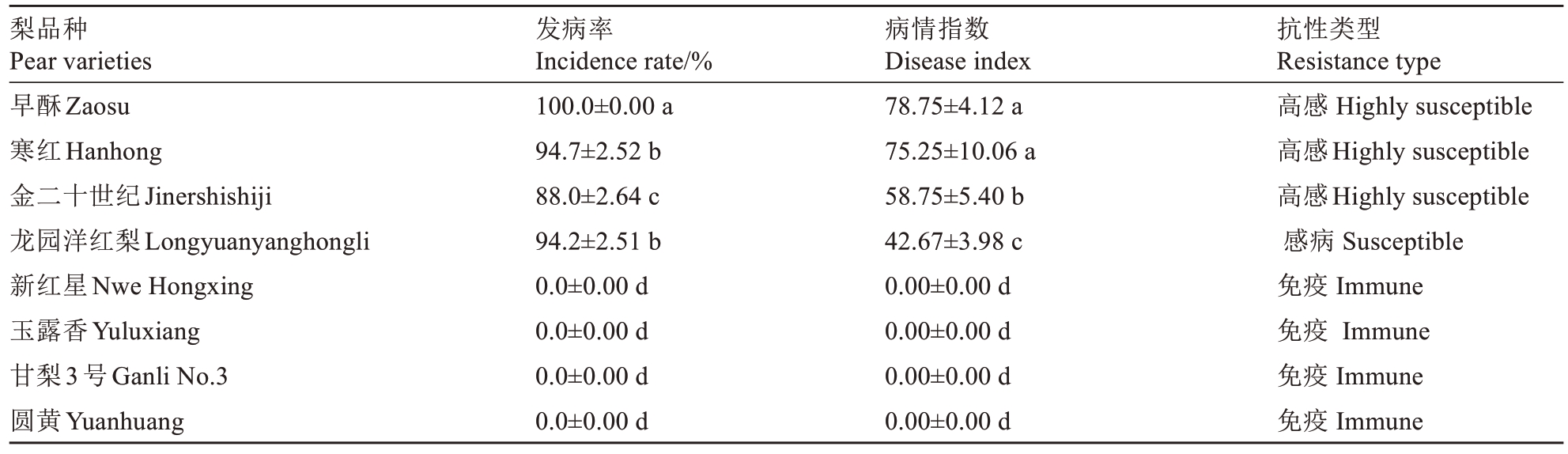
由表1可知,8个梨树品种对白粉病的抗性差异明显。抗性最差的品种是早酥,发病率为100.0%,病情指数为78.75;其次是寒红和金二十世纪,发病率分别为94.7%和88.0%,病情指数分别为75.25 和58.75;而新红星、玉露香、甘梨3 号及圆黄的发病率和病情指数均为0,抗性类型表现为免疫,对白粉病抗性最强。
表1 8 个供试品种的发病率和病情指数
Table 1 The incidence rate and disease index of the eight tested varieties
注:不同小写字母表示P<0.05 差异显著。下同。
Note:Different small letters indicate significant difference at P<0.05. The same below.
梨品种Pear varieties早酥Zaosu寒红Hanhong金二十世纪Jinershishiji龙园洋红梨Longyuanyanghongli新红星Nwe Hongxing玉露香Yuluxiang甘梨3号Ganli No.3圆黄Yuanhuang抗性类型Resistance type高感 Highly susceptible高感Highly susceptible高感Highly susceptible感病 Susceptible免疫 Immune免疫 Immune免疫 Immune免疫 Immune发病率Incidence rate/%100.0±0.00 a 94.7±2.52 b 88.0±2.64 c 94.2±2.51 b 0.0±0.00 d 0.0±0.00 d 0.0±0.00 d 0.0±0.00 d病情指数Disease index 78.75±4.12 a 75.25±10.06 a 58.75±5.40 b 42.67±3.98 c 0.00±0.00 d 0.00±0.00 d 0.00±0.00 d 0.00±0.00 d
2.2 不同梨品种叶绿素及营养物质含量的比较
由表2 可知,不同梨品种叶片叶绿素、可溶性糖及可溶性蛋白含量存在差异。其中,叶绿素含量(w,后同)最高的品种是新红星,为2.34 mg·g-1;其次是龙园洋红梨,为2.10 mg·g-1;最低的是圆黄,为1.66 mg·g-1。不同梨品种间可溶性糖与可溶性蛋白含量差异明显。可溶性糖和可溶性蛋白含量最高的品种分别是早酥(43.76 mg·g-1)和玉露香(6.42 mg·g-1);其次是寒红(43.63 mg·g-1)和新红星(5.96 mg·g-1);含量最低的均是金二十世纪,分别为33.75 mg·g-1和4.84 mg·g-1。不同梨品种间脯氨酸和丙二醛含量差别较大,含量最高的品种分别是龙园洋红梨(6.49 mg·100 g-1)和玉露香(288.97 nmol·g-1);含量最低的分别是早酥(3.59 mg·100 g-1)和新红星(133.63 nmol·g-1)。
表2 不同梨品种叶绿素及营养物质含量的比较
Table 2 Comparison of chlorophyll and nutrient contents in different pear varieties
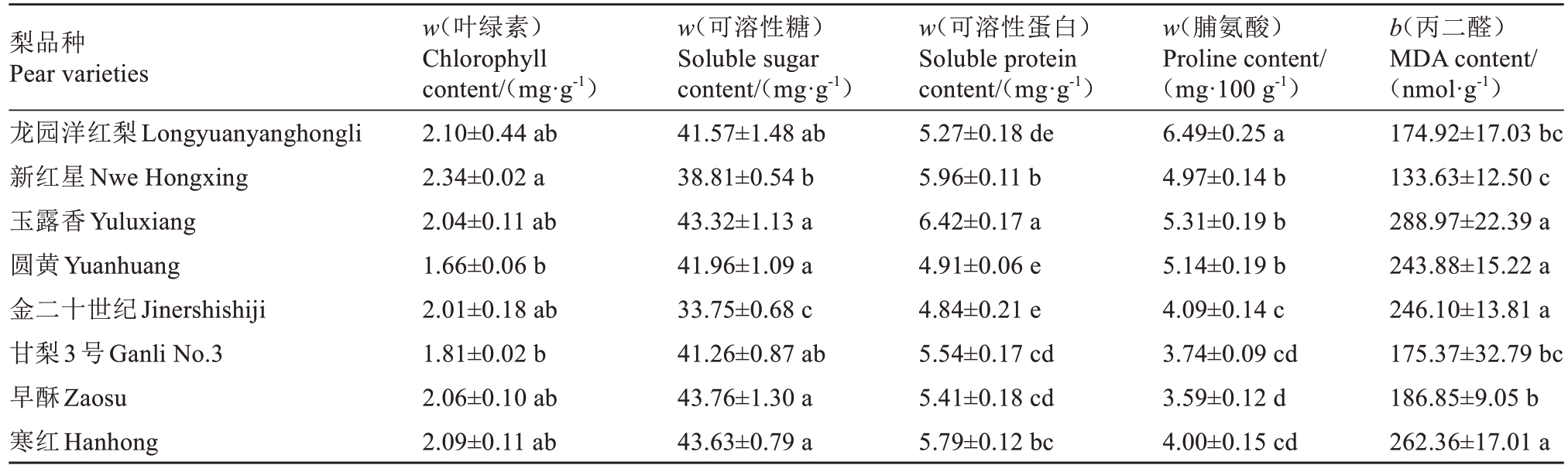
梨品种Pear varieties龙园洋红梨Longyuanyanghongli新红星Nwe Hongxing玉露香Yuluxiang圆黄Yuanhuang金二十世纪Jinershishiji甘梨3号Ganli No.3早酥Zaosu寒红Hanhong w(叶绿素)Chlorophyll content/(mg·g-1)2.10±0.44 ab 2.34±0.02 a 2.04±0.11 ab 1.66±0.06 b 2.01±0.18 ab 1.81±0.02 b 2.06±0.10 ab 2.09±0.11 ab w(可溶性糖)Soluble sugar content/(mg·g-1)41.57±1.48 ab 38.81±0.54 b 43.32±1.13 a 41.96±1.09 a 33.75±0.68 c 41.26±0.87 ab 43.76±1.30 a 43.63±0.79 a w(可溶性蛋白)Soluble protein content/(mg·g-1)5.27±0.18 de 5.96±0.11 b 6.42±0.17 a 4.91±0.06 e 4.84±0.21 e 5.54±0.17 cd 5.41±0.18 cd 5.79±0.12 bc w(脯氨酸)Proline content/(mg·100 g-1)6.49±0.25 a 4.97±0.14 b 5.31±0.19 b 5.14±0.19 b 4.09±0.14 c 3.74±0.09 cd 3.59±0.12 d 4.00±0.15 cd b(丙二醛)MDA content/(nmol·g-1)174.92±17.03 bc 133.63±12.50 c 288.97±22.39 a 243.88±15.22 a 246.10±13.81 a 175.37±32.79 bc 186.85±9.05 b 262.36±17.01 a
2.3 梨叶片叶绿素及营养物质含量与白粉病抗性的相关性分析
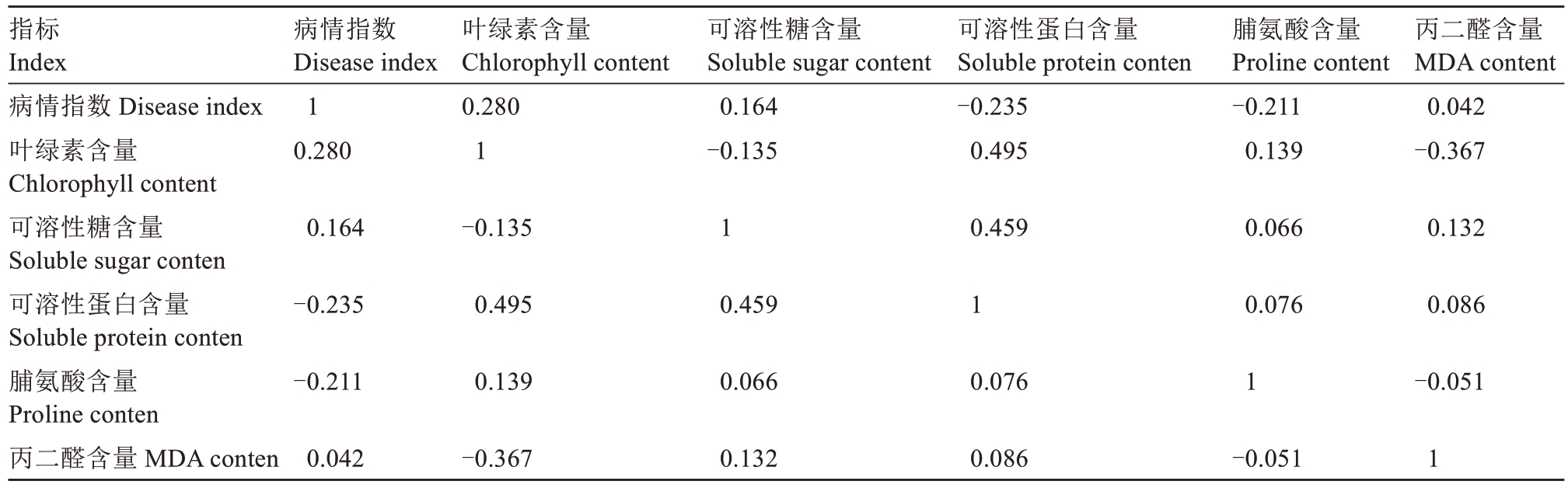
采用相关性分析探究了梨叶片叶绿素含量、营养物质含量与白粉病抗性间的关系(表3)。结果表明,梨叶片叶绿素、可溶性糖、可溶性蛋白、脯氨酸、丙二醛含量与梨树白粉病病情指数的相关系数分别为0.280、0.164、-0.235、-0.211、0.042,且均未达到显著水平(P>0.05),表明这些指标与梨树白粉病抗性无显著相关性。
表3 梨叶片叶绿素及营养物质含量与白粉病抗性的相关性(n=8)
Table 3 The correlation among the contents of chlorophyll and nutrients in pear leaves and disease index of powdery mildew (n=8)
注:*. 相关性在0.05 水平上显著(双尾)。
Note:*. Significant correlation at 0.05 level (double-tailed).
指标Index病情指数 Disease index叶绿素含量Chlorophyll content可溶性糖含量Soluble sugar conten可溶性蛋白含量Soluble protein conten脯氨酸含量Proline conten丙二醛含量 MDA conten病情指数Disease index 1 0.280叶绿素含量Chlorophyll content 0.280 1可溶性糖含量Soluble sugar content 0.164-0.135可溶性蛋白含量Soluble protein conten-0.235 0.495脯氨酸含量Proline content-0.211 0.139丙二醛含量MDA content 0.042-0.367 0.164-0.135 1 0.459 0.066 0.132-0.235 0.495 0.459 1 0.076 0.086-0.211 0.139 0.066 0.076 1-0.051 0.042-0.367 0.132 0.086-0.051 1
2.4 不同梨品种间防御酶活性分析
由表4 可知,抗感白粉病差异显著的梨品种,其叶片防御酶活性不同。其中,过氧化氢酶和过氧化物酶活性最高的品种均是早酥,分别为74.88 U·g-1和27 017.34 U·g-1;其次分别是圆黄(73.17 U·g-1)和玉露香(19 306.87 U·g-1);最低的分别是甘梨3 号(39.13 U·g-1)和金二十世纪(5 025.26 U·g-1)。超氧化物歧化酶活性最高的品种是新红星,为1 093.98 U·g-1;最低的是寒红,为561.08 U·g-1。多酚氧化酶和苯丙氨酸解氨酶活性最高的品种分别是寒红(195.77 U·g-1)和金二十世纪(204.69 U·g-1)。
表4 不同抗感梨品种间各种防御酶活性
Table 4 The activities of various defense enzymes activity among pear varieties with different susceptibility
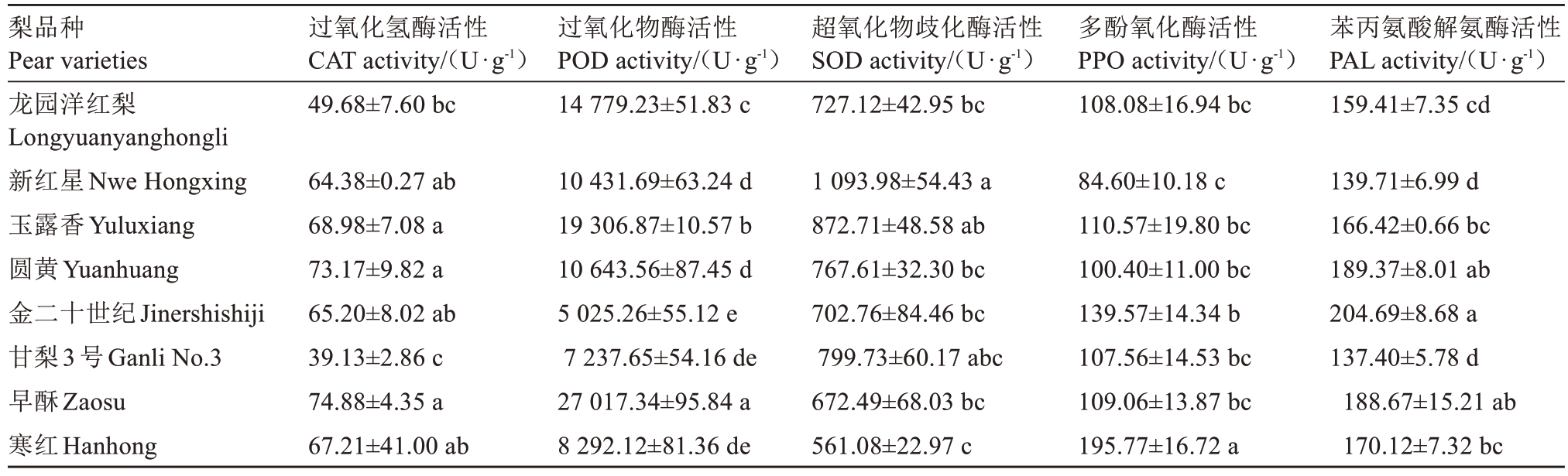
梨品种Pear varieties龙园洋红梨Longyuanyanghongli新红星Nwe Hongxing玉露香Yuluxiang圆黄Yuanhuang金二十世纪Jinershishiji甘梨3号Ganli No.3早酥Zaosu寒红Hanhong过氧化氢酶活性CAT activity/(U·g-1)49.68±7.60 bc过氧化物酶活性POD activity/(U·g-1)14 779.23±51.83 c超氧化物歧化酶活性SOD activity/(U·g-1)727.12±42.95 bc多酚氧化酶活性PPO activity/(U·g-1)108.08±16.94 bc苯丙氨酸解氨酶活性PAL activity/(U·g-1)159.41±7.35 cd 64.38±0.27 ab 68.98±7.08 a 73.17±9.82 a 65.20±8.02 ab 39.13±2.86 c 74.88±4.35 a 67.21±41.00 ab 10 431.69±63.24 d 19 306.87±10.57 b 10 643.56±87.45 d 5 025.26±55.12 e 7 237.65±54.16 de 27 017.34±95.84 a 8 292.12±81.36 de 1 093.98±54.43 a 872.71±48.58 ab 767.61±32.30 bc 702.76±84.46 bc 799.73±60.17 abc 672.49±68.03 bc 561.08±22.97 c 84.60±10.18 c 110.57±19.80 bc 100.40±11.00 bc 139.57±14.34 b 107.56±14.53 bc 109.06±13.87 bc 195.77±16.72 a 139.71±6.99 d 166.42±0.66 bc 189.37±8.01 ab 204.69±8.68 a 137.40±5.78 d 188.67±15.21 ab 170.12±7.32 bc
2.5 不同梨品种抗病相关酶活性与白粉病抗性的关系
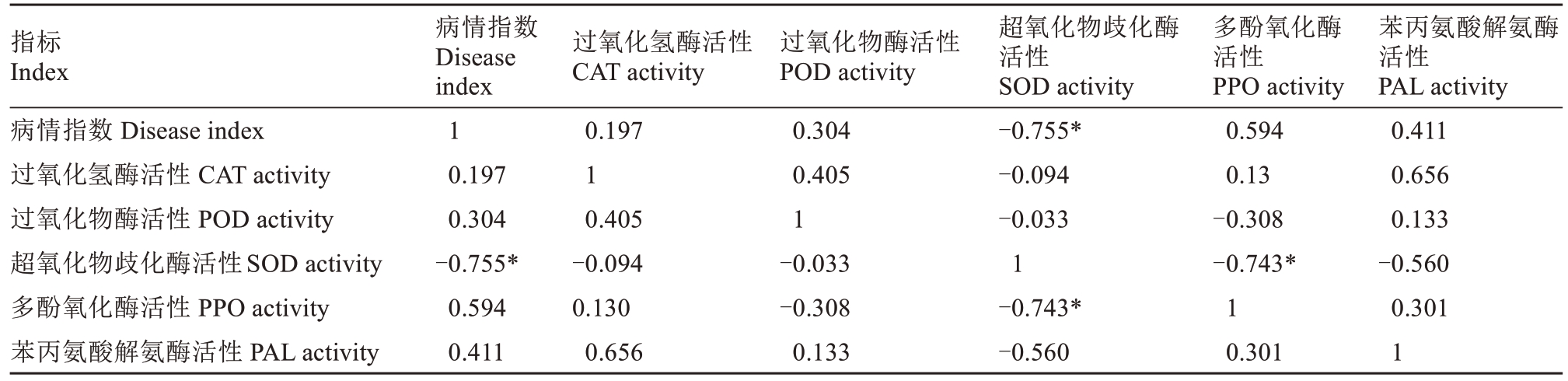
从表5 可知,CAT、POD、PPO 和PAL 活性与梨树白粉病病情指数的相关系数分别为0.197、0.304、0.594 和0.411,均未达到显著水平(P>0.05),表明CAT、POD、PPO 和PAL 活性与梨树白粉病抗性无显著相关性。SOD 活性与梨树白粉病病情指数呈显著负相关,相关系数为-0.755,即SOD 活性高的梨树品种对白粉病抗性强。
表5 梨叶片抗病相关酶活性与白粉病抗性的相关性(n=8)
Table 5 The correlation between the activities of disease-resistant-related enzymes in pear leaves and disease index of powdery mildew (n=8)
注:*. 相关性在0.05 水平上显著(双尾)。
Note:*. Significant correlation at P<0.05 (double-tailed).
指标Index过氧化氢酶活性CAT activity过氧化物酶活性POD activity病情指数 Disease index过氧化氢酶活性 CAT activity过氧化物酶活性 POD activity超氧化物歧化酶活性SOD activity多酚氧化酶活性 PPO activity苯丙氨酸解氨酶活性 PAL activity苯丙氨酸解氨酶活性PAL activity 0.411 0.656 0.133-0.560 0.301 1病情指数Disease index 1 0.197 0.304-0.755*0.594 0.411 0.197 1 0.405-0.094 0.130 0.656 0.304 0.405 1-0.033-0.308 0.133超氧化物歧化酶活性SOD activity-0.755*-0.094-0.033 1-0.743*-0.560多酚氧化酶活性PPO activity 0.594 0.13-0.308-0.743*1 0.301
3 讨 论
选育抗病优良品种是防治白粉病最经济、有效的途径。生产上主栽品种普遍对白粉病缺乏抗性,但不同品种间抗病性存在显著差异[6]。通过连续多年田间调查与分析,结果表明8 个梨树品种对白粉病的抗性存在显著差异。植物对某一病菌的抗性是一个非常复杂的过程,涉及植物生理生化代谢的多个方面。抗病性与总糖含量、蛋白质含量和叶绿素含量密切相关,这些指标的变化可作为准确鉴定寄主抗病性或感病性的依据[11]。关于叶绿素含量与植物病害关系的研究较多,但其相关性在不同作物和不同病害中存在差异。在欧亚种葡萄品种中,叶绿素含量与霜霉病病情指数呈显著正相关[22],即叶绿素含量越高,植物的抗病性越强。泡核桃抗褐斑病无性系叶片的叶绿素含量始终高于感病无性系[23]。胥爱玲等[24]研究表明黄瓜叶片叶绿素含量与其霜霉病、白粉病抗性呈正相关,而与枯萎病、疫霉病抗性无相关性。笔者发现不同梨品种的叶绿素含量与白粉病抗性无显著相关性,相关系数仅为0.280,该结果与部分研究一致。徐秉良等[25]研究表明不同抗病性苜蓿品种间叶绿素含量无显著差异;郑伟等[11]研究表明苹果白粉病的发生可降低叶片叶绿素含量,但不同品种间叶绿素含量与苹果白粉病抗性无显著相关性。
可溶性糖和可溶性蛋白在植物抗病性方面发挥着重要作用。石振亚等[26]认为叶片中可溶性糖含量越高,其抗病性越强。周博如等[27]认为大豆感病品种接种细菌性疫病菌后,可溶性总糖含量明显降低;而抗病品种可溶性总糖含量明显增加;在健康植株中,感病品种的可溶性总糖含量高于抗病品种。郑伟等[11]研究发现苹果不同品种蛋白质含量与苹果白粉病抗病性呈中等正相关。然而部分研究认为,可溶性糖和可溶性蛋白含量与抗病性无相关性。冯东昕等[28]研究表明菜豆在锈菌侵染后,蛋白质含量变化与品种抗病性无关[28];蔡昌玲[29]研究表明小麦接种白粉病菌后,可溶性糖含量在抗病和感病品种间无明显差异。王芳等[23]研究表明泡核桃接种褐斑病病原菌后,可溶性蛋白和可溶性糖含量在不同抗性品种间无明显差异。笔者发现梨树叶片可溶性糖和可溶性蛋白含量与白粉病抗性无相关性,与梨树白粉病病情指数的相关系数分别为0.164 和-0.235。脯氨酸作为渗透保护剂,通过维持细胞膨压与ROS稳态增强植株抗逆性。丙二醛含量与膜脂过氧化程度密切相关,也是植物抗病研究中的重要指标之一[30]。刁倩楠等[31]研究表明甜瓜在接种白粉病菌后,MDA 含量呈先升高后降低的趋势,抗病品种整体升高幅度大于感病品种。但另有研究表明小麦接种白粉病菌后,其叶片MDA 含量随着接种时间的延长而升高,且感病品种MDA 含量升高幅度远大于抗病品种[32]。本研究结果发现不同梨品种间脯氨酸和丙二醛含量差别较大,但其与梨树白粉病病情指数的相关系数分别为-0.211 和0.042,均未达到显著水平,表明梨树叶片脯氨酸和丙二醛含量与梨树白粉病抗性无显著相关性。这一研究结果与孔祥华等[33]的报道一致,研究表明苹果不同种质在接种炭疽叶枯病菌后,MDA 含量均在接种1 d 后达到峰值,随后缓慢下降,但其含量变化与种质的抗性水平无明显相关性。甜瓜对白粉病的抗性与其体内POD、CAT、APX、PAL、PPO 活性以及可溶性蛋白含量呈正相关,与MDA 含量呈负相关,而与SOD 活性无显著相关性[31]。
植物体内防御酶活性与其对病原物的抗病性密切相关[34-35]。前人研究结果表明,SOD、POD、CAT、PAL、PPO 等防御酶活性与植物抗病性呈正相关,抗病品种的防御酶活性及上升幅度高于或显著高于感病品种[36-37]。王贝贝等[38]、张兆辉等[39]的研究结果均表明病原菌侵染后,抗病种质的CAT 活性高于感病种质。陈泉等[40]的研究结果表明不同抗性柑橘品种在感染轮斑病菌后,PPO 活性均有不同程度的升高,高抗品种的PPO 活性及变化幅度明显高于高感品种。烟草接种白粉病菌后,PAL 活性显著高于对照组[41]。本研究结果中,CAT、POD、PPO 和PAL活性与梨树白粉病抗性无显著相关性。SOD活性与梨树白粉病病情指数呈显著负相关,相关系数为-0.755,即SOD活性高的梨树品种,白粉病抗性更强。这充分表明防御酶与植物抗病性密切相关,不仅有利于植物抗病能力的提高,还能够作为评价或鉴定植物抗病性的指标。由于植物中不同防御酶的功能不同,因此在植物抗病性中有可能发挥不同的作用。
梨产业已成为主产区农民增收致富的主导产业之一,但由于存在山地果园及传统老果园机械化程度低、生产力成本提高等问题,农户种植意愿低、梨的市场竞争力下降。筛选抗病性强的品种,解析其抗病机制,有助于减少梨产业种植过程中农药的施用量,降低生产成本,对打造优质绿色梨产业、提高梨产业的市场竞争力具有非常重要的意义。
4 结 论
明确了8 个梨品种白粉病的田间抗性类型,以及叶片营养物质含量和抗病相关酶类活性与白粉病抗性之间的关系。结果表明,叶片中超氧化物歧化酶活性可作为梨树白粉病抗性鉴定的主要生理指标。
[1] 张绍铃,谢智华. 我国梨产业发展现状、趋势、存在问题与对策建议[J]. 果树学报,2019,36(8):1067-1072.ZHANG Shaoling,XIE Zhihua. Current status,trends,main problems and the suggestions on development of pear industry in China[J]. Journal of Fruit Science,2019,36(8):1067-1072.
[2] 康天兰,李国梁,郑平生. 甘肃梨特色地方品种资源介绍及几点建议[J]. 落叶果树,2009,41(4):8-10.KANG Tianlan,LI Guoliang,ZHENG Pingsheng. Introduction to the characteristic local varies of pears in Gansu Province and several suggestions[J]. Deciduous Fruits,2009,41(4):8-10.
[3] 徐晓厚. 梨白粉病的发生规律及防治技术[J]. 果树实用技术与信息,2017(1):29-30.XU Xiaohou. Occurrence regularity and control technique of pear peodery[J]. Fruit Trees Practical Technology and Information,2017(1):29-30.
[4] 王虹,郭敏,顾暄,王坤宇. 梨树叶部病害的发生与防治[J]. 现代农村科技,2012(4):34.WANG Hong,GUO Min,GU Xuan,WANG Kunyu. The occurrence and control of diseases on pear leaves[J]. Modern Agriculture and technology,2012(4):34.
[5] 张艳杰,王斐,欧春青,方明,马力,赵亚楠,姜淑苓. 梨树白粉病研究进展[J]. 中国植保导刊,2019,39(7):23-27.ZHANG Yanjie,WANG Fei,OU Chunqing,FANG Ming,MA Li,ZHAO Yanan,JIANG Shuling. Research on pear powdery mildew[J]. China Plant Protection,2019,39(7):23-27.
[6] 曹素芳,曹继礼,丁辉,朱少聪,曹刚,陈龙,田靖,赵明新,王玮,李红旭. 甘肃省梨白粉病发生和防治现状调查[J]. 中国果树,2025(1):113-117.CAO Sufang,CAO Jili,DING Hui,ZHU Shaocong,CAO Gang,CHEN Long,TIAN Jing,ZHAO Mingxin,WANG Wei,LI Hongxu. Investigation on the occurrence and control status of pear powdery mildew in Gansu Province[J]. China Fruits,2025(1):113-117.
[7] 王颖卓. 苹果白粉病发生与防治方法[J]. 新农业,2017(19):27-29.WANG Yingzhuo. The occurrence and control methods of apple powdery mildew[J]. New Agriculture,2017(19):27-29.
[8] 侯珲,王丽,袁洪波,周增强,黄天祥,涂洪涛. 苹果白粉病发生情况调查及田间药剂筛选[J]. 中国农学通报,2023,39(4):119-124.HOU Hui,WANG Li,YUAN Hongbo,ZHOU Zengqiang,HUANG Tianxiang,TU Hongtao. Investigation of occurrence of apple powdery mildew and screening of pesticide in field[J].Chinese Agricultural Science Bulletin,2023,39(4):119-124.
[9] ZHENG W,WU Y W,WANG B,YANG F. Field efficacy of six kinds of fungicides for control and prevention of apple powdery mildew (Podosphaera leucotricha)[J]. Agricultural Science &Technology,2014,15(3):427-431.
[10] 普继雄,马桂梅,孙秀梅,马泽辉,张俊祥. 防治苹果白粉病的新型药剂室内毒力测定及田间药效试验[J]. 中国果树,2021(11):58-60.PU Jixiong,MA Guimei,SUN Xiumei,MA Zehui,ZHANG Junxiang. Laboratory toxicity test and field efficacy of new fungicides against powdery mildew on apple[J]. China Fruits,2021(11):58-60.
[11] 郑伟,吴亚维,王彬,宋莎,罗昌国. 白粉病对苹果叶片叶绿素及营养物质含量的影响[J]. 西南农业学报,2018,31(8):1628-1633.ZHENG Wei,WU Yawei,WANG Bin,SONG Sha,LUO Changguo. Effects of powdery mildew on leaf chlorophyll and nutrient content of apple[J]. Southwest China Journal of Agricultural Sciences,2018,31(8):1628-1633.
[12] 刘振中,王雷存,高华,赵政阳,樊红科. 苹果白粉病抗性研究[J]. 西北林学院学报,2012,27(4):177-180.LIU Zhenzhong,WANG Leicun,GAO Hua,ZHAO Zhengyang,FAN Hongke. Resistance of apple trees to powdery mildew[J].Journal of Northwest Forestry University,2012,27(4):177-180.
[13] 郑伟,吴亚维,王彬,宋莎,罗昌国. 苹果叶片结构与白粉病抗性的相关性初步研究[J]. 西南农业学报,2017,30(9):2108-2112.ZHENG Wei,WU Yawei,WANG Bin,SONG Sha,LUO Changguo. Preliminary study on correlation between leaf structure and powdery mildew resistance in apple[J]. Southwest China Journal of Agricultural Sciences,2017,30(9):2108-2112.
[14] 段淋渊,周军,王大玮,徐世宏,马玉梅,张惠祥. 苹果白粉病危害防治及抗性资源研究进展[J]. 西南林业大学学报,2015,35(5):104-109.DUAN Linyuan,ZHOU Jun,WANG Dawei,XU Shihong,MA Yumei,ZHANG Huixiang. Research progress on apple powdery mildew occurrence and resistance resources[J]. Journal of Southwest Forestry University,2015,35(5):104-109.
[15] 田小敏. 基于转录组水平的苹果抗白粉病基因筛选与感病叶片生理指标分析[D]. 杨凌:西北农林科技大学,2019.TIAN Xiaomin. Study on physiological indicators response to powdery mildew of apple and screening of the resistant gene based on transcriptome analysis[D]. Yangling:Northwest A & F University,2019.
[16] 张一平. 苹果抗白粉病MdERF100 互作蛋白MdbHLH92 的鉴定及功能分析[D]. 杨凌:西北农林科技大学,2022.ZHANG Yiping. Identification and functional analysis of the interaction protein MdbHLH92 of powdery mildew disease resistance gene MdERF100 in apple[D]. Yangling:Northwest A & F University,2022.
[17] 张莉. 苹果抗白粉病转录因子MdERF100 克隆与功能研究[D].杨凌:西北农林科技大学,2020.ZHANG Li. Cloning and function analysis of MdERF100 transcription factor in apple[D]. Yangling:Northwest A & F University,2020.
[18] 罗昌国,袁启凤,裴晓红,吴亚维,郑伟,章镇. 富士苹果Md-WRKY40b 基因克隆及其对白粉病的抗性分析[J]. 西北植物学报,2013,33(12):2382-2387.LUO Changguo,YUAN Qifeng,PEI Xiaohong,WU Yawei,ZHENG Wei,ZHANG Zhen. Cloning of MdWRKY40b gene in Fuji apple and its response to powdery mildew stress[J]. Acta Botanica Boreali-Occidentalia Sinica,2013,33(12):2382-2387.
[19] 曹素芳,王玮,赵明新,曹刚,李红旭. 梨树对白粉病抗性与叶片结构的关系[J]. 果树学报,2021,38(12):2148-2155.CAO Sufang,WANG Wei,ZHAO Mingxin,CAO Gang,LI Hongxu. Relationship between the leaf structure and its resistance to powdery mildew in pear[J]. Journal of Fruit Science,2021,38(12):2148-2155.
[20] 刘会宁,胡萍. 塑料大棚欧亚种葡萄对白粉病和灰霉病的抗性研究[J]. 湖北农学院学报,2004,24(4):261-263.LIU Huining,HU Ping. Study on the resistance of Vitis vinifera to Uncinula necator & Botrytis cinerea in plastic shed[J]. Journal of Hubei Agricultural College,2004,24(4):261-263.
[21] 王学奎. 植物生理生化实验原理和技术[M]. 2 版. 北京:高等教育出版社,2006.WANG Xuekui. Principles and techniques of plant physiological biochemical experiment[M]. 2nd ed. Beijing:Higher Education Press,2006.
[22] 刘会宁,朱建强,万幼新. 几个欧亚种葡萄品种对霜霉病的抗性鉴定[J]. 上海农业学报,2001,17(3):64-67.LIU Huining,ZHU Jianqiang,WAN Youxin. Evaluation of resistance to Plasmopara viticola for some Asian and European grape (Vitis vinifera) varieties[J]. Acta Agriculturae Shanghai,2001,17(3):64-67.
[23] 王芳,肖玉,糜加轩,时羽杰,万雪琴,杨汉波. 不同抗性泡核桃对褐斑病病原菌侵染的生理生化响应[J]. 西北植物学报,2022,42(12):2083-2092.WANG Fang,XIAO Yu,MI Jiaxuan,SHI Yujie,WAN Xueqin,YANG Hanbo. Physiological and biochemical responses of different resistant walnuts to brown spot infection by Ophiognomonia leptostyla[J]. Acta Botanica Boreali-Occidentalia Sinica,2022,42(12):2083-2092.
[24] 胥爱玲,张亚平,佘长夫. 黄瓜抗病性与叶绿素含量的关系及遗传性研究[J]. 新疆农业科学,1995,32(1):23-26.XU Ailing,ZHANG Yaping,SHE Changfu. Study on the relationship between disease resistance of cucumbers and chlorophyll content and heredity[J]. Xinjiang Agricultural Sciences,1995,32(1):23-26.
[25] 徐秉良,李敏权,郁继华,邢会琴. 苜蓿对白粉病的抗性与叶绿素含量的关系[J]. 草业科学,2005,22(4):72-74.XU Bingliang,LI Minquan,YU Jihua,XING Huiqin. The relation between the contents of chlorophyll in alfalfa varieties and the resistance to powder mildew of alfalfa[J]. Pratacultural Science,2005,22(4):72-74.
[26] 石振亚,樊慕贞,张留顺. 提高黄瓜植株含糖量预防黄瓜霜霉病[J]. 河北农学报,1981,6(4):60-64.SHI Zhenya,FAN Muzhen,ZHANG Liushun. Increase the sugar content of cucumber plants to prevent downy mildew in cucumbers[J]. Acta Agriculturae Boreali-Sinica,1981,6(4):60-64.
[27] 周博如,李永镐,刘太国,杨波,金淑梅,杨微. 不同抗性的大豆品种接种大豆细菌性疫病菌后可溶性蛋白、总糖含量变化的研究[J]. 大豆科学,2000,19(2):111-114.ZHOU Boru,LI Yonghao,LIU Taiguo,YANG Bo,JIN Shumei,YANG Wei. Studies on the changes of soluble protein and total sugar in the first leaves of soybean varieties inoculated with Pseudomonas syringes pv. glycinea[J]. Soybean Science,2000,19(2):111-114.
[28] 冯东昕,谢丙炎,杨宇红,冯兰香. 菜豆锈病菌侵染对寄主生理代谢的影响[J]. 石河子大学学报(自然科学版),2004,22(增刊1):113-117.FENG Dongxin,XIE Bingyan,YANG Yuhong,FENG Lanxiang. Effects of infection of Uromyces appendiculatus on phsiological metabolism of snap bean[J]. Journal of Shihezi University (Natural Science),2004,22(Suppl. 1):113-117.
[29] 蔡昌玲. 小麦抗白粉病生理生化的研究进展[J]. 贵州农业科学,1997,25(3):60-62.CAI Changling. Summary on physiological chemistry of wheat resistance to powdery mildew[J]. Guizhou Agricultural Sciences,1997,25(3):60-62.
[30] 刘爱媛,陈维信,李欣允. 菜心不同抗病品种感染炭疽病菌后丙二醛含量及几种酶活性的变化[J]. 植物保护学报,2005,32(4):433-434.LIU Aiyuan,CHEN Weixin,LI Xinyun. Changes in MDA content and activities of some enzymes in susceptible and resistant false pakchoi cultivars after inoculation with Colletotrichum higginsianum[J]. Journal of Plant Protection,2005,32(4):433-434.
[31] 刁倩楠,曹燕燕,蒋雪君,陈幼源,张永平. 白粉病菌对不同甜瓜品种幼苗生理生化指标的影响[J]. 分子植物育种,2021,19(7):2346-2353.DIAO Qiannan,CAO Yanyan,JIANG Xuejun,CHEN Youyuan,ZHANG Yongping. Effect of powdery mildew on physiological and biochemical indexes of different melon varieties[J]. Molecular Plant Breeding,2021,19(7):2346-2353.
[32] 韩庆典,胡晓君,黄坤艳,杨美娟,周晓燕,闫丽. 小麦白粉病菌对小麦幼苗MDA 含量及防御酶活性的影响[J]. 分子植物育种,2016,14(10):2803-2811.HAN Qingdian,HU Xiaojun,HUANG Kunyan,YANG Meijuan,ZHOU Xiaoyan,YAN Li. Effects in activities of defense enzymes and contents of MDA in wheat leaf infected by powdery mildew[J]. Molecular Plant Breeding,2016,14(10):2803-2811.
[33] 孔祥华,侯董亮,张伟,田义轲,刘源霞,王彩虹. 炭疽叶枯病菌诱导的不同苹果种质中防御酶活性及丙二醛含量比较[J].青岛农业大学学报(自然科学版),2017,34(1):5-8.KONG Xianghua,HOU Dongliang,ZHANG Wei,TIAN Yike,LIU Yuanxia,WANG Caihong. Comparison of defensive enzymes activities and malonaldehyde content induced by Glomerella cingulata among different apple resources[J]. Journal of Qingdao Agricultural University (Natural Science),2017,34(1):5-8.
[34] 张宁,毕研飞,郭静,徐兵划,钱春桃,陈劲枫. 不同抗性甜瓜接种蔓枯病菌后PAL、PPO 与POD 活性的变化[J]. 植物生理学报,2016,52(8):1169-1175.ZHANG Ning,BI Yanfei,GUO Jing,XU Binghua,QIAN Chuntao,CHEN Jinfeng. Changes of PAL,PPO and POD activites in melon with different resistances after inoculated with Didymella bryoniae[J]. Plant Physiology Journal,2016,52(8):1169-1175.
[35] 吴应海,李安定,张丽敏,彭熙,蔡国俊,张孙健. 不同百香果品种对茎基腐病的抗性鉴定及防御酶活性研究[J]. 农业与技术,2022,42(20):1-6.WU Yinghai,LI Anding,ZHANG Limin,PENG Xi,CAI Guojun,ZHANG Sunjian. Identification of resistance to stem base rot in different passion fruit varieties and study on the activity of defense enzymes[J]. Agriculture and Technology,2022,42(20):1-6.
[36] 丁玉梅,张杰,谢俊俊,姚春馨,刘庆,周晓罡,周丽英,杨正安,张兴国. 枯萎病菌胁迫下3 种黑籽南瓜HQRGA2 表达及抗氧化酶活性差异分析[J]. 植物生理学报,2019,55(3):349-358.DING Yumei,ZHANG Jie,XIE Junjun,YAO Chunxin,LIU Qing,ZHOU Xiaogang,ZHOU Liying,YANG Zheng’an,ZHANG Xingguo. Expression analysis of HQRGA2 and differences of anti-oxidant enzymes in three varieties of Cucurbita ficifolia under stress of Fusarium oxysporum f. sp. cucumerinum[J]. Plant Physiology Journal,2019,55(3):349-358.
[37] 刘鑫铭,郭汝凤,刘奕,林勇明,吴承祯,李键. 内生真菌侵染对化感物质胁迫下木麻黄幼苗根系活性氧代谢及保护酶系统的影响[J]. 植物生理学报,2020,56(9):1985-2006.LIU Xinming,GUO Rufeng,LIU Yi,LIN Yongming,WU Chengzhen,LI Jian. Effects of endophyte infection on reactive oxygen metabolism and protective enzyme system of Casuarina equisetifolia seedlings under allelopathic stress[J]. Plant Physiology Journal,2020,56(9):1985-2006.
[38] 王贝贝,田嘉. 不同梨种质叶片结构及防御酶活性与火疫病抗性的关联分析[J]. 中国果树,2024(10):113-123.WANG Beibei,TIAN Jia. Association analysis of leaf structure and defense enzyme activity with fire blight resistance in different pear germplasms[J]. China Fruits,2024(10):113-123.
[39] 张兆辉,卢盼玲,陈春宏,杨晓峰. 西葫芦抗白粉病的生理生化机制[J]. 分子植物育种,2021,19(9):3074-3080.ZHANG Zhaohui,LU Panling,CHEN Chunhong,YANG Xiaofeng. Resistance of squash against powdery mildew and its physiological and biochemical mechanism[J]. Molecular Plant Breeding,2021,19(9):3074-3080.
[40] 陈泉,徐嵩琳,何锦辉,刘忠贤. 不同抗性柑橘品种感染柑橘轮斑病菌后防御酶活性的变化[J]. 中国果树,2025(2):92-98.CHEN Quan,XU Songlin,HE Jinhui,LIU Zhongxian. Changes of defense enzyme activity in different resistant citrus varieties infected by Pseudofabraea citricarpar[J]. China Fruits,2025(2):92-98.
[41] 李小霞,肖仲久. 烟草白粉菌对烟草重要防御酶活性的影响[J].江苏农业科学,2015,43(1):148-149.LI Xiaoxia,XIAO Zhongjiu. The influence of tobacco powdery mildew fungus on the activities of important defense enzymes in tobacco[J]. Jiangsu Agricultural Sciences,2015,43(1):148-149.