软枣猕猴桃(Actinidia arguta Planch.)隶属于猕猴桃科猕猴桃属,是一种大型落叶木质藤本植物,主要分布于中国东北、西北以及长江流域等地区,种质资源丰富,具有重要的研究和开发价值。软枣猕猴桃果实风味独特,汁水丰富,且维生素C 含量较高[1]。研究发现,软枣猕猴桃果实具有抗氧化、抗炎以及润肠通便等多种保健功效,不仅可用于鲜食,还可用作加工软枣猕猴桃果汁、果酒、果酱等产品的优质原料[2]。作为多年生藤本类果树,软枣猕猴桃新梢生长旺盛,其花果均具观赏价值,可作为园林绿化树种,展现出良好的应用前景。目前,我国已公开报道了包括佳绿[3]、馨绿[4]、魁绿[5]等20余个软枣猕猴桃品种[6-8]。从品种构成来看,目前选育的软枣猕猴桃品种以中晚熟和晚熟品种为主,早熟品种占比较低[2],导致果品上市期集中,销售及贮藏压力增大,不利于产业的良性健康发展。吉农软枣1 号具有成熟期早、抗逆性强、品质优良、丰产稳产等特点,对弥补软枣猕猴桃早熟品种不足具有重要作用。
1 选育过程
2011 年,吉林农业大学北方特色浆果资源评价与利用团队在吉林省白山市长白县宝泉山镇老局所村(41°31.0′ N,127°27.9′ E,Elev.755 m)进行资源调查时发现1 株优良野生单株,具有果大、早熟、可溶性固形物含量高等特点,定名为长白1101。2012 年6 月进行绿枝嫁接繁殖,2013 年定植于白山市长白朝鲜族自治县软枣猕猴桃种植基地,2015 年开始结果。2016 年在吉林省集安市、抚松县和长白县等地进行区域适应性试验。综合性状评价结果显示,该株系具有优质、抗寒、早熟、丰产稳产的特点(图1)。SSR 分子鉴定表明,株系1101 的遗传背景与多个软枣猕猴桃主栽品种存在显著差异(图2)。2022 年通过吉林省林木良种审定委员会审定,定名为吉农软枣1号,良种编号:吉S-SC-AA-014-2022。
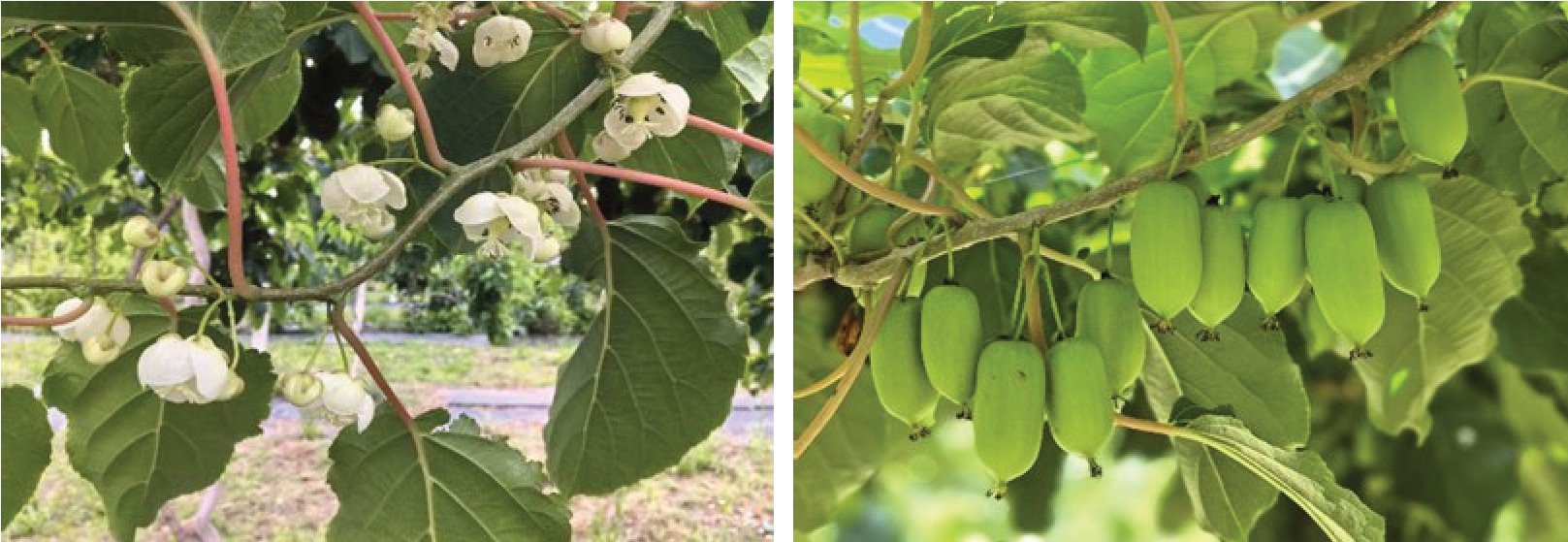
图1 软枣猕猴桃新品种吉农软枣1 号的花与果实
Fig. 1 Flowers and fruits of new cultivar Jinongruanzao No. 1
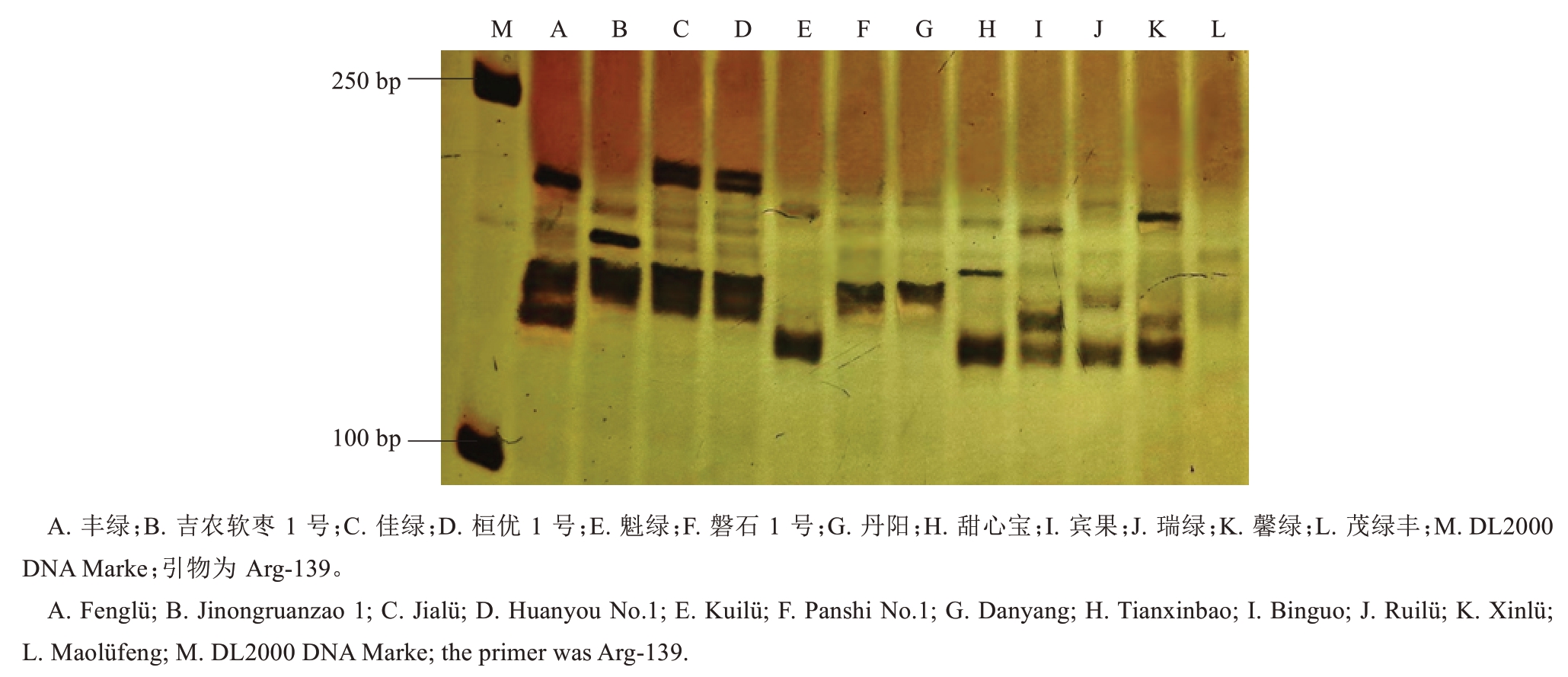
图2 12 个软枣猕猴桃品种SSR 分子鉴定图谱
Fig. 2 SSR molecular identification map of 12 different varieties of Actinidia arguta
2 主要性状
2.1 生物学特性
吉农软枣1 号为多年生右旋落叶木质藤本,一年生枝条灰褐色,新梢节间绿带红色,新梢被毛稀,褐色;成龄叶卵圆形,叶尖为尾尖,叶缘具粗单锯齿或二出复锯齿,叶基圆形或心形,叶面绿色,叶背灰绿色,叶长11.5 cm,叶宽8.7 cm,叶柄浅红色,叶柄长4.8 cm;雌花,二歧聚伞花序,每花序着生1~3 朵花,花瓣卵圆形,花瓣5~6 枚,花冠直径2.2 cm,花萼红褐色,花柱斜生,花药浅黑色,子房卵圆形。萌芽率77.3%,成枝力66.7%,定植后第3年开花结果。
2.2 果实经济性状
果实长圆柱形,果实横径25.1 mm,纵径43.7 mm,果皮绿色,果肉绿色,果心绿白色,果心横截面圆形。平均单果质量17.4 g,果实可溶性固形物含量20.2%,最大单果质量22.63 g,可溶性糖含量8.46%,可滴定酸含量1.46 %,维生素C 含量1.43 mg·g-1,果实货架期5~10 d,冷藏期约45 d,果实品质明显优于对照品种丰绿(表1)。
表1 吉农软枣1 号与对照品种丰绿主要性状比较
Table 1 Comparison of main traits between Jinongruanzao No. 1 and control varieties
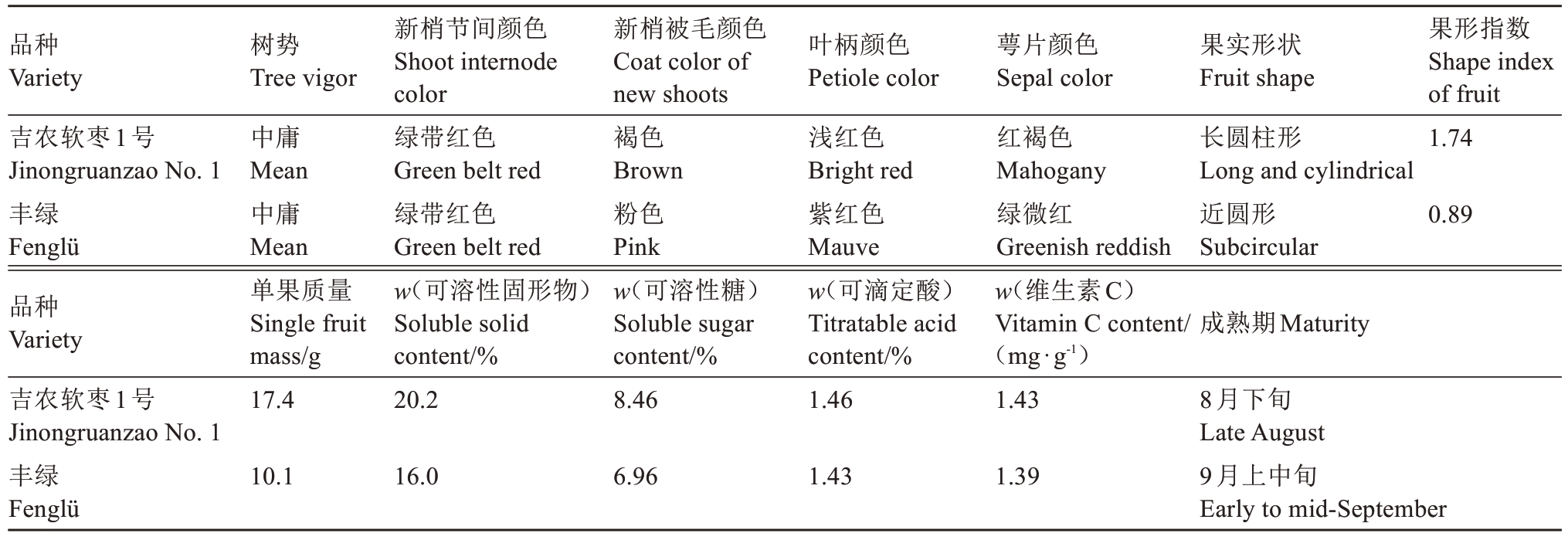
品种Variety吉农软枣1号Jinongruanzao No. 1丰绿Fenglü品种Variety吉农软枣1号Jinongruanzao No. 1丰绿Fenglü树势Tree vigor中庸Mean中庸Mean单果质量Single fruit mass/g 17.4新梢节间颜色Shoot internode color绿带红色Green belt red绿带红色Green belt red w(可溶性固形物)Soluble solid content/%20.2新梢被毛颜色Coat color of new shoots褐色Brown粉色Pink w(可溶性糖)Soluble sugar content/%8.46叶柄颜色Petiole color浅红色Bright red紫红色Mauve w(可滴定酸)Titratable acid content/%1.46萼片颜色Sepal color红褐色Mahogany绿微红Greenish reddish果实形状Fruit shape长圆柱形Long and cylindrical近圆形Subcircular果形指数Shape index of fruit 1.74 0.89 w(维生素C)Vitamin C content/(mg·g-1)1.43成熟期Maturity 10.1 16.0 6.96 1.43 1.39 8月下旬Late August 9月上中旬Early to mid-September
2.3 物候期
在长春地区,吉农软枣1 号于4 月下旬萌芽,6月上旬开花,8 月下旬果实成熟,果实发育期80~85 d。不同区域物候期见表2。
表2 吉农软枣1 号不同试验区栽培物候期观察
Table 2 Observation on cultivation phenophase of Jinongruanzao No. 1 in different experimental areas
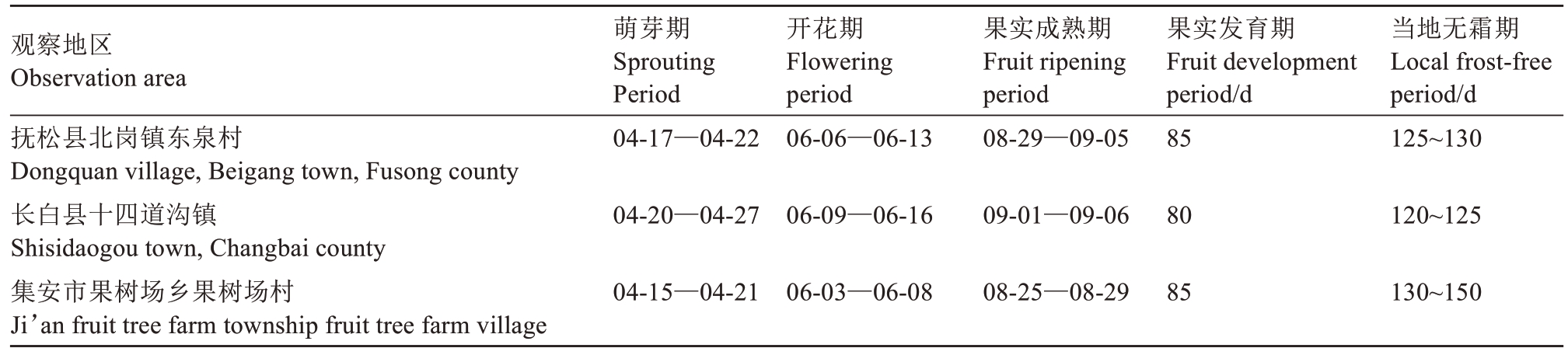
观察地区Observation area抚松县北岗镇东泉村Dongquan village, Beigang town, Fusong county长白县十四道沟镇Shisidaogou town, Changbai county集安市果树场乡果树场村Ji’an fruit tree farm township fruit tree farm village萌芽期Sprouting Period 04-17—04-22开花期Flowering period 06-06—06-13果实成熟期Fruit ripening period 08-29—09-05果实发育期Fruit development period/d 85当地无霜期Local frost-free period/d 125~130 04-20—04-27 06-09—06-16 09-01—09-06 80 120~125 04-15—04-21 06-03—06-08 08-25—08-29 85 130~150
2.4 产量性状
2019—2021 年连续3 年在抚松县北岗镇东泉村、长白县十四道沟镇和集安市果树场乡果树场村三处进行区域试验,对照品种为目前已经推广的软枣猕猴桃品种丰绿。结果显示,2019 年,4 年生果园平均产量为12 266.6 kg·hm-2,较对照增产7.9%;2020 年,5 年生果园平均产量为17 867.2 kg·hm-2,较对照增产9.1%;2021 年,6 年生果园平均产量18 340.8 kg·hm-2,较对照增产8.1%,增产效果明显(表3)。
表3 吉农软枣1 号不同区产量调查
Table 3 Investigation on yield of Jinnongruanzao No. 1 in different regions
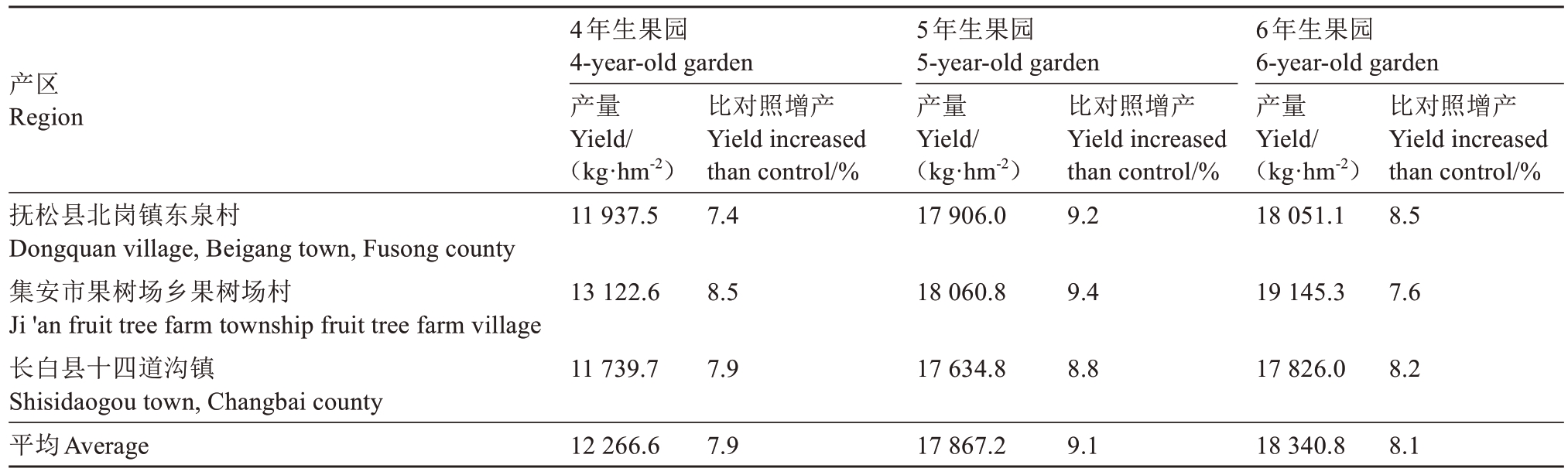
产区Region抚松县北岗镇东泉村Dongquan village, Beigang town, Fusong county集安市果树场乡果树场村Ji 'an fruit tree farm township fruit tree farm village长白县十四道沟镇Shisidaogou town, Changbai county平均Average 4年生果园4-year-old garden产量Yield/(kg·hm-2)11 937.5比对照增产Yield increased than control/%7.4 5年生果园5-year-old garden产量Yield/(kg·hm-2)17 906.0比对照增产Yield increased than control/%9.2 6年生果园6-year-old garden产量Yield/(kg·hm-2)18 051.1比对照增产Yield increased than control/%8.5 13 122.6 8.5 18 060.8 9.4 19 145.3 7.6 11 739.7 7.9 17 634.8 8.8 17 826.0 8.2 12 266.6 7.9 17 867.2 9.1 18 340.8 8.1
2.5 抗逆性及栽培适应性
连续多年观测发现,吉农软枣1 号在长白县、抚松县和集安市试验园均能露地越冬,且生长和结果表现正常,无冻害发生,较抗茎基腐病。适宜在年无霜期125 d以上,活动积温2700 ℃以上、冬季极端最低气温-38 ℃的地区栽培。
3 栽培技术要点
3.1 苗木繁殖
吉农软枣1 号可采用扦插、压条、嫁接及组织培养等方式进行育苗。在嫁接繁殖时,砧木为软枣猕猴桃实生苗。
3.2 定植
在吉林地区,吉农软枣1号适宜定植时期为4月中下旬。栽植株行距为2.0 m×3.5 m;挖掘80.0 cm见方的栽植穴,施入底肥,栽植深度不宜过深;授粉树选用绿王,雌雄比例为8∶1。
3.3 整形修剪
架式以棚架或“T”形架为宜,架高200 cm;单干双蔓或独龙干整形,每个主蔓上着生结果母枝或结果枝组,主干高度约170 cm,随着主蔓的生长,每隔40~50 cm 选留1 个结果母枝,在结果母枝上每隔30 cm选留1个结果枝。
3.4 土肥水管理
3.4.1 土壤管理 以中性至微酸性土壤为宜,可采用清耕法或覆盖法。
3.4.2 施肥管理 每年施肥2~3 次。第1 次在萌芽期追施速效氮肥,第2 次在果实加速生长前约10 d(即6 月下旬至7 月上旬)追施钾肥和磷肥,第3 次于采果后施入腐熟农家肥或有机肥。
3.4.3 水分管理 在生长季,应根据土壤含水量状况进行3~4次灌水。土壤化冻后至萌芽前灌1次水,开花前灌1 次水,开花后至浆果成熟前灌水1~2 次,封冻前灌水1次。根据降雨情况和土壤墒情确定灌水次数和灌溉量。在排水方面,7—8 月降雨集中期,在园内挖排水沟,及时排出积水。
3.5 病虫害防治
吉农软枣1 号的抗性较强,病虫害发生较少,偶见茎基腐病、离子瘿螨等危害,应以农业防治为基础,以生物防治为核心,科学使用化学防治等综合防治技术,有效控制病虫危害。
3.5.1 茎基腐病 茎基腐病是导致软枣猕猴桃茎基部腐烂、茎皮脱落,最终整株枯死的一种严重病害。防治方法如下:(1)避开土壤黏重、地势低洼的地块,选择排灌便利的坡地或平地建园;下雨后及时排水,避免田间积水;秋季落叶后至上冻前,树干涂白或根颈部位埋土防寒。(2)使用高效广谱杀菌剂,在受害植株茎基部浇灌,使药液沿茎干进入根部及周围土壤,或使用锋利刀片在病部每隔1.0 cm左右纵割,并将上述药剂涂抹于病部。施药后及时观察防治效果,可于7~10 d根据防治效果酌情施药。
3.5.2 离子瘿螨 每年发生多代,7—8 月的高温干旱有利于软枣猕猴桃离子瘿螨的发生和繁衍,是防治的关键时期。防治上应采用综合防治的技术措施,加强园地清理,于春季萌芽前全园喷施一次3~5°Bé 石硫合剂;在6 月中旬至8 月上旬,根据田间发生情况喷施杀螨剂进行防治。
4 综合评价
吉农软枣1 号树势中庸,具有抗寒、耐涝等特性;果实品质优良,维生素C 及可溶性固形物含量高,糖酸比调和,成熟期早;较丰产稳产。适宜在年无霜期125 d以上、年活动积温2700 ℃以上、冬季极端最低气温-38 ℃的地区及相似产区引种试栽。
[1] 艾军. 软枣猕猴桃栽培与加工技术[M]. 北京:中国农业出版社,2014.AI Jun. Cultivation and processing technology of Actinidia arguta[M]. Beijing:China Agriculture Press,2014.
[2] 黄国辉. 软枣猕猴桃产业发展现状与问题[J]. 北方果树,2020(1):41-43.HUANG Guohui. Development status and problems of Actinidia arguta industry[J]. Northern Fruits,2020(1):41-43.
[3] 秦红艳,杨义明,艾军,范书田,王振兴,许培磊,刘迎雪,赵滢,张庆田,张宝香,李晓艳,李晓红,赵淑兰. 软枣猕猴桃新品种:‘佳绿’的选育[J]. 果树学报,2015,32(4):733-735.QIN Hongyan,YANG Yiming,AI Jun,FAN Shutian,WANG Zhenxing,XU Peilei,LIU Yingxue,ZHAO Ying,ZHANG Qingtian,ZHANG Baoxiang,LI Xiaoyan,LI Xiaohong,ZHAO Shulan. A new cultivar of Actinidia arguta Planch. ‘Jialü’[J]. Journal of Fruit Science,2015,32(4):733-735.
[4] 秦红艳,范书田,艾军,杨义明,王振兴,刘迎雪,赵滢,许培磊,张宝香,李昌禹,张庆田. 软枣猕猴桃新品种‘馨绿’[J]. 园艺学报,2017,44(10):2029-2030.QIN Hongyan,FAN Shutian,AI Jun,YANG Yiming,WANG Zhenxing,LIU Yingxue,ZHAO Ying,XU Peilei,ZHANG Baoxiang,LI Changyu,ZHANG Qingtian. A new cultivar of Actinidia arguta ‘Xinlü’[J]. Acta Horticulturae Sinica,2017,44(10):2029-2030.
[5] 赵淑兰,袁福贵,马月申,赵井才,杨金茹. 软枣猕猴桃新品种魁绿[J]. 园艺学报,1994,21(2):207-208.ZHAO Shulan,YUAN Fugui,MA Yueshen,ZHAO Jingcai,YANG Jinru. Kuilü-A new cultivar of Actinidia arguta Planch.[J].Acta Horticulturae Sinica,1994,21(2):207-208.
[6] 赵凤军,王东来,潘奥,周文杰,张艳红,姚平,鞠方成,孙书伟,罗璇,黄国辉. 软枣猕猴桃新品种绿佳人的选育[J]. 果树学报,2022,39(6):1125-1128.ZHAO Fengjun,WANG Donglai,PAN Ao,ZHOU Wenjie,ZHANG Yanhong,YAO Ping,JU Fangcheng,SUN Shuwei,LUO Xuan,HUANG Guohui. Breeding of a new Actinidia arguta Planch. cultivar Lüjiaren[J]. Journal of Fruit Science,2022,39(6):1125-1128.
[7] 赵凤军,张明瀚,张艳红,王丹丹. 软枣猕猴桃新品种丹阳的选育[J]. 果树学报,2022,39(1):148-151.ZHAO Fengjun,ZHANG Minghan,ZHANG Yanhong,WANG Dandan. Breeding report of a new Actinidia arguta Planch. cultivar Danyang[J]. Journal of Fruit Science,2022,39(1):148-151.
[8] 艾军. 中国软枣猕猴桃种质资源[M]. 北京:中国农业出版社,2023.AI Jun. Germplasm resources of Actinidia arguta in China[M].Beijing:China Agriculture Press,2023.