早熟玫瑰香味葡萄新品种彤玫瑰的选育

杜 佳1,陈 鹏1,童洪升2,程建徽3*

1金华市婺城区第一良种场,浙江金华 321025; 2金华市优喜水果专业合作社,浙江金华 321025;3浙江省农业科学院园艺研究所,杭州 310021)

摘 要:彤玫瑰是从阳光玫瑰与黑巴拉多的杂交后代中选育出的早熟、玫瑰香型、红色葡萄新品种。果穗圆柱形,平均单穗质量426.1 g。果粒红色,椭圆形,平均单粒质量9.7 g;皮薄,果肉脆;具有玫瑰香味,可溶性固形物含量(w,后同)16.6%,可滴定酸含量(ρ)2.21 g·L-1,维生素C含量55.4 mg·kg-1,在自然条件下含种子1~2粒。在浙江金华地区,果实于6月底7月初成熟,抗病性较强,易成花,适宜在浙江及南方相似生态区进行设施栽培。

关键词:葡萄;新品种;彤玫瑰;早熟

葡萄是浙江省栽培面积最大的落叶果树,各地区均有种植,是高效益经济作物,在促进乡村振兴和农民增收致富中发挥了重要作用[1-2]。浙江省地处我国东南沿海,年气温适中,高温高湿弱光,葡萄生长期以阴雨天气为主,葡萄病害发生种类多,防控灰霉病、白粉病、白腐病的压力大[3]。葡萄集中上市期为7 月下旬至8 月底,当地高效益的早熟品种少,尤其是兼具红色与香型的早熟品种。因此,需要选育适宜本地湿热生态条件的早熟优质葡萄新品种来优化品种结构。新品种是促进葡萄产业发展的关键,优质品种是实现高质量发展的根本[4-5]。因此,笔者以适宜中国南方湿热生态条件的葡萄设施栽培为前提,以国内市场为主导,通过选配优质亲本开展杂交育种,以早熟、红色、抗病、优质葡萄新种质为目标,经过多年选育,成功获得具有自主知识产权的早熟玫瑰香型红色葡萄新品种——彤玫瑰(图1)。

图1 葡萄新品种彤玫瑰
Fig. 1 A new grape cultivar Tongmeigui

1 选育过程

2016 年,金华市优喜水果专业合作社在婺城区第一良种场以阳光玫瑰为母本,黑巴拉多为父本进行杂交育种,成熟后收集果穗共获得263 粒种子,并低温贮藏。2017 年春播获得167 株杂交苗,2018 年3 月定植。2020 年,杂交苗进入结果期,经2020—2021年连续两年观察,筛选出编号XN-16-40的红色型葡萄优系,具备早熟、肉质脆、玫瑰香、口味甜、适宜无核化栽培等优良特性。2022—2024 年,开展生物学性状、果实性状、适应性观察与栽培技术研究。特异性、一致性和稳定性测试结果表明,其植株间枝、蔓、叶的性状表现稳定一致,具有成熟期早、外观美、品质优等特点,综合性状优良。2024 年4 月获得农业农村部植物新品种权,品种权号CNA20211005580,定名为彤玫瑰。

2 主要性状

2.1 植物学特征

彤玫瑰属于欧美杂种,二倍体。梢尖半开张、密生茸毛、花青素显色弱。幼叶上表面呈浅红褐色,下表面主脉间密生匍匐茸毛、主脉上密生直立茸毛。成龄叶为五角形、三裂,裂刻浅、开张,叶面泡状凸起中等,叶柄洼轻度开张,锯齿中长、两侧直;叶正面主脉上花青素着色深,叶背面匍匐茸毛中密,主脉上密生直立茸毛。新梢节间背侧绿带红条纹;卷须中长。两性花,第一花序着生于第3~4节。

2.2 果实经济性状

彤玫瑰果穗圆柱形,平均单穗质量426.1 g,果穗紧密;果粒成熟度一致,果梗与果粒分离难,果粒椭圆形,平均单粒质量9.7 g,果皮红色、果粉少,果皮薄易剥离,可带皮食用;果肉较脆,具有玫瑰香味,可溶性固形物含量16.6%,可滴定酸含量(ρ)2.21 g·L-1,维生素C 含量55.4 mg·kg-1(表1),在自然条件下每果粒含种子1~2粒,适宜无核化栽培。

表1 彤玫瑰和父母本果实性状比较
Table 1 Typical characteristics of Tongmeigui and its parents
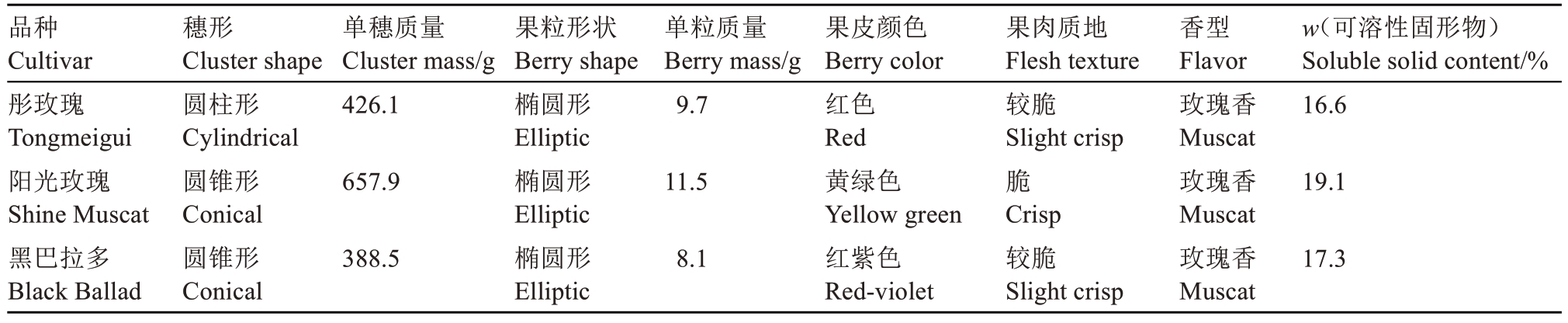
品种Cultivar彤玫瑰Tongmeigui阳光玫瑰Shine Muscat黑巴拉多Black Ballad穗形Cluster shape圆柱形Cylindrical圆锥形Conical圆锥形Conical单穗质量Cluster mass/g 426.1单粒质量Berry mass/g 9.7 w(可溶性固形物)Soluble solid content/%16.6 657.9 11.5 19.1 388.5果粒形状Berry shape椭圆形Elliptic椭圆形Elliptic椭圆形Elliptic 8.1果皮颜色Berry color红色Red黄绿色Yellow green红紫色Red-violet果肉质地Flesh texture较脆Slight crisp脆Crisp较脆Slight crisp香型Flavor玫瑰香Muscat玫瑰香Muscat玫瑰香Muscat 17.3

2.3 生长结果习性

萌芽率(81.5%)与结果枝率(85.7%)较高,花芽易分化,每果枝平均着生花序数1.2个,产量稳定。

2.4 物候期

在浙江金华地区,彤玫瑰的萌芽期为3 月中旬,开花期为4 月下旬,成熟期为6 月底7 月初,从开花到浆果成熟约70 d,属于早熟品种。

2.5 适应性与抗逆性

彤玫瑰叶片绿、质地厚,树体成型快,适应性强,田间抗灰霉病、霜霉病能力较强,在常规防治下基本无明显病害发生。但该品种挂树期短,采收期遭遇夏季高温易产生软果,需严格控制产量。

3 栽培技术要点

3.1 整形

该品种宜采用大棚设施进行促成栽培,一、T 或H 形大树冠整形;株行距为2 m×3 m 或4 m×6 m,每666.7 m2栽植30~110 株;冬季修剪以短梢修剪为主;花前2~3 d摘心,在花序上方保留6枚叶片,副梢留1枚叶片绝后或不留副梢。

3.2 花果管理

进入盛果期后,每666.7 m2 产量控制在1250~1500 kg。弱枝不留果穗,中庸枝保留1果穗,个别粗壮枝保留2 果穗。于葡萄见花期开始整理花序,无核化栽培时保留穗尖5~6 cm;盛花期使用赤霉素进行无核保果处理,处理后12~15 d,进行膨大处理,适当疏果;果实采收前2 周拆袋见光,并于地面铺设反光膜促进上色。

3.3 肥水管理

基肥以羊粪发酵有机肥为主;萌芽前灌透水,花期不灌水;坐果后施用高氮水溶肥与中量元素钙镁肥,肥水同灌;着色后,分2 次施用高钾水溶肥;采收后施用复合肥以恢复树势;叶面喷施酵素酶解氨基酸、黄腐酸3~4次。

3.4 病虫害防治

葡萄冬季修剪后进入休眠期,需施用3~5 °Bé石硫合剂进行全面清园消毒;芽绒绣期再次喷施1 次3~5 °Bé石硫合剂。在早春新梢生长期(2 叶1 心)应预防绿盲蝽,花前与花后是防治灰霉病、穗轴褐枯病的关键时期,坐果后应预防白粉病、炭疽病、白腐病和叶蝉,揭膜后应预防葡萄霜霉病的发生。

4 综合评价

彤玫瑰长势旺,投产快,花芽易形成,果实成熟早,果皮薄、质地脆、品质优、外观美、风味浓,适宜在浙江及南方相似生态区进行设施促早栽培,有助于优化当前以中晚熟品种巨峰、阳光玫瑰为主的浙江葡萄产业结构,弥补红色系、早熟、香型自育葡萄品种的不足,具有较好的推广应用前景。

参考文献 References:

[1] 郑婷,程建徽,魏灵珠,向江,吴江. 特早熟无核葡萄新品种天工翠香蜜的选育[J]. 果树学报,2023,40(8):1771-1773.ZHENG Ting,CHENG Jianhui,WEI Lingzhu,XIANG Jiang,WU Jiang. A new early ripening seedless grape cultivar Tiangong Cuixiangmi[J]. Journal of Fruit Science,2023,40(8):1771-1773.

[2] 李清良,吴昊,胡丽鹏,沈宣才,毛肇蓬,赵战马,程建徽. 不同水溶肥喷施对葡萄果实着色和品质的影响[J]. 浙江农业科学,2023,64(9):2188-2190.LI Qingliang,WU Hao,HU Lipeng,SHEN Xuancai,MAO Zhaopeng,ZHAO Zhanma,CHENG Jianhui. Effects of spraying different water-soluble fertilizers on fruit coloring and quality of grape[J]. Journal of Zhejiang Agricultural Sciences,2023,64(9):2188-2190.

[3] 童洪升,程建徽,吴江,李依岚. ‘金之星’葡萄特性及其大树冠栽培技术[J]. 中外葡萄与葡萄酒,2021(4):76-79.TONG Hongsheng,CHENG Jianhui,WU Jiang,LI Yilan. Characteristics of ‘Jinzhixing’ grape and large canopy cultivation techniques[J]. Sino-Overseas Grapevine & Wine,2021(4):76-79.

[4] 姜建福,樊秀彩,张颖,孙海生,李民,刘崇怀. 中国葡萄品种选育的成就与可持续发展建议[J]. 中外葡萄与葡萄酒,2018(1):60-67.JIANG Jianfu,FAN Xiucai,ZHANG Ying,SUN Haisheng,LI Min,LIU Chonghuai. Achievements and sustainable development suggestions of grape breeding in China[J]. Sino-Overseas Grapevine & Wine,2018(1):60-67.

[5] 段长青,刘崇怀,刘凤之,王忠跃,刘延琳,徐丽明. 新中国果树科学研究70 年:葡萄[J]. 果树学报,2019,36(10):1292-1301.DUAN Changqing,LIU Chonghuai,LIU Fengzhi,WANG Zhongyue,LIU Yanlin,XU Liming. Fruit scientific research in New China in the past 70 years:Grape[J]. Journal of Fruit Science,2019,36(10):1292-1301.

A new early-ripening rose aroma table grape cultivar Tongmeigui

DU Jia1, CHEN Peng1, TONG Hongsheng2, CHENG Jianhui3*

(1The First Seed Farm in Wucheng District, Jinhua 321025, Zhejiang, China; 2Jinhua Youxi Fruit Professional Cooperative, Jinhua 321025, Zhejiang, China; 3Institute of Horticulture, Zhejiang Academy of Agricultural Sciences, Hangzhou 310021, Zhejiang, China)

Abstract:Tongmeigui is a new early ripening grape variety derived from the cross between Shine Muscat and Black Ballad by the First Seed Farm in Wucheng District. In 2016, we collected grape berries and obtained 263 seeds. After low-temperature storage, we obtained 167 hybrid seedlings in the spring of 2017. In 2018, they were planted, and entered the fruiting period in 2020. After two years of observation from 2020 to 2021, a red-type grape superior line numbered XN-16-40 was selected. It had excellent characteristics such as early maturity, crisp meat, rose aroma, sweet taste, and suitability for seedless cultivation. From 2022 to 2024, single vine propagation was carried out and trait records and key cultivation techniques were studied. It was found that the traits of each vine were consistent, with early maturity, beautiful appearance, excellent quality, stable performance and excellent comprehensive traits.In 2024, it was authorized with the new plant variety right (CNA20211005580) by the Ministry of Agriculture and Rural Affairs, and was named as Tongmeigui. The tender tip is semi-open with weak anthocyanins and dense villi. The color of the dorsal side of the internode is green with red stripes. The tendrils are of medium length. The upper surface of the young leaves is light reddish brown, with dense creeping hairs between the main veins on the back and erect hairs on the main veins. The mature leaves are 3-lobed and pentagonal, and the leaf surface is bubbly convex. The main vein on the front of the leaf has deep anthocyanin accumulation, the back creeping villi are medium dense, and the main vein is dense with erect villi. The upper lateral sinus is shallow and open. The petiole sinus is mildly open. The teeth are of medium length and straight on both sides. It has bisexual flowers, and the first inflorescence usually emerges on the 3rd-4th node. The cluster is cylindrical, with an average weight of 426.1 g and tight density. The berry is oval, and the berry stem is difficult to separate from the grain. The berry is neat and the maturity is consistent. The average berry weight is 9.7 g and the berry is red in color. The skin is thin and can be eaten. It is easy to peel, with less berry powder. The flesh is crispy and has muscat aroma. The soluble solids content is 16.6%, the acid content is 2.21 g·L-1 and the vitamin C content is 55.4 mg·kg-1. It is suitable for seedless treatment. Tongmeigui is an early ripening variety. Under the cultivation conditions in Jinhua area, Tongmeigui shows budbreak in mid-March, flowering in late April and berry ripening in late June and early July. The average budbreak rate is 81.5%, and the bearing cane rate is 85.7%. The average number of grape ears per bearing cane is 1.2. The variety has strong adaptability and strong resistance to gray mold and downy mildew in the field. However, the vine-hanging time of this variety is not long, and it is easy to produce soft berry when encountering high temperature in summer, so it is necessary to control production. The average yield is recommended for 1250-1500 kg per 666.7 m2. It is recommended to use a planting spacing of 2 m×3 m or 4 m×6 m. This variety grows vigorously and can produce quickly. It is suitable for early cultivation in hot and humid climate facilities in Zhejiang Province, and has a good application prospect.

Key words:Grape; New cultivar; Tongmeigui; Early ripening

中图分类号:S663.1

文献标志码:A

文章编号:1009-9980(2026)01-0219-04

DOI:10.13925/j.cnki.gsxb.20250344

收稿日期:2025-06-10

接受日期:2025-07-17

基金项目:浙江省“十四五”果品新品种选育专项(2021C02066-6);浙江省现代种业发展项目(2025R05A60D03)

作者简介:杜佳,男,农艺师,本科,主要从事良种繁育与栽培研究。E-mail:149174916@qq.com

*通信作者 Author for correspondence. E-mail:jianhuicheng@126.com