梨是重要的经济果树之一,果实富含有机酸和矿物质等多种营养成分,具有很高的营养价值和药用价值。除鲜食外,还可制作成果汁、罐头、梨膏等加工食品[1-3]。中国是梨属植物的重要产地,栽培历史悠久、分布范围广泛,拥有丰富的梨种质资源,在世界梨生产中占据主导地位,其栽培面积、产量均居世界第一[4]。然而,随着我国农村劳动力短缺和劳动力成本逐年攀升,管理省时省工的宽行密植栽培模式发展迅速。树型紧凑、矮化,适合密植和省力化栽培管理的新品种成为新的育种方向之一。自2006 年起,以优质、风味浓郁、果面红晕、树型矮小紧凑为重点育种目标。笔者以黄冠与中矮1号为亲本进行杂交,成功获得了杂交后代,经过多年对杂交后代的评价和筛选,选育出杂交优系08-22-67-5。该优系果实品质优良,风味独特带有玫瑰香味,树型紧凑,丰产性强,经多年田间调查未发现黑星病和黑斑病。经过多年多点区域试验,对其植物学特征、生物学性状及果实品质进行观察评价,结果表明该品种性状稳定一致。2025年1月通过河北省林木品种审定委员会审定,正式定名为冀玫(冀S-SV-PB-035-2024)(图1)。
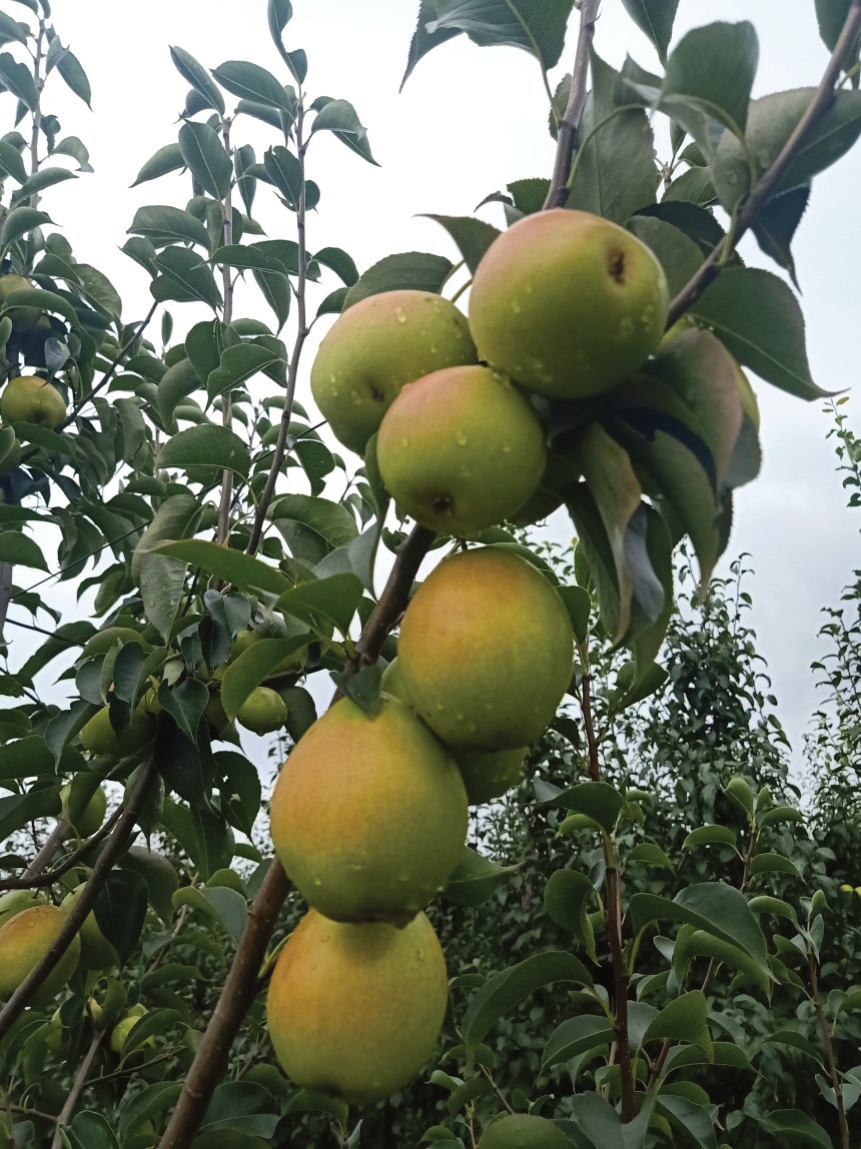
图1 梨新品种冀玫
Fig. 1 A new pear cultivar Jimei
1 选育过程
冀玫是以黄冠为母本中矮一号为父本杂交选育而成的新品种,原代号08-22-67-5。2006 年进行杂交,2007年播种并获得456株杂交苗,2008年将杂交苗以“簇状”栽培模式(每个定植穴5株)定植于河北省农林科学院石家庄果树研究所实生选种圃。待该批实生苗陆续开始结果后,依据育种目标,对每株实生苗的单果质量、形状、色泽、肉质、风味、果心大小、石细胞含量和可溶性固形物含量等指标进行鉴定。经过多年观察,发现08-22-67-5 实生苗表现出果面光洁美观、阳面着红晕、风味浓郁、树型紧凑、节间短等特性,因此将其纳入初选优系。2016 年,在河北省农林科学院石家庄果树研究所、河北省邢台市威县、邯郸市魏县建立了3 个区试园,其株行距分别为3 m×5 m、2 m×4 m 和1 m×4 m,黄冠作为对照品种,本项目所有试验与调查均在3 个区试园进行。经过连续多年对果实综合经济性状、始果年龄、丰产性、连续结果能力、抗病性等特性进行鉴定评价,结果表明,该品系遗传性状表现稳定,鉴定其为优质、中晚熟、树型紧凑的红皮梨新品种。
2 主要性状
2.1 植物学特征
冀玫树姿半开张,树形圆锥形;主干及多年生枝灰褐色,树皮光滑,1 年生枝灰褐色,皮孔小且密,节间长3.12 cm;叶芽斜生,幼叶淡绿色,成熟叶片深绿色,叶片椭圆形,长10.0 cm、宽5.30 cm,叶片抱合生长,叶基楔形,叶尖急尖,叶缘锐锯齿,有刺芒;花蕾浅粉红色,花瓣椭圆形、分离,每朵花为5~7 枚花瓣,花冠白色,花药紫红色,每个花序为5~8朵花。
2.2 果实经济性状
冀玫果实长圆形,果面呈绿黄色,成熟时果实向阳面着红晕25%~45%,果皮薄,蜡质丰富,果点不明显,果肉白色,肉质细、松脆,汁液多,风味酸甜适口、略具玫瑰香味,果心小。平均单果质量259.9 g,平均果实纵径8.29 cm、横径7.95 cm,果形指数1.04。石细胞及残渣少,可溶性固形物含量13.10%,可溶性糖含量9.26%,可滴定酸含量0.11%,维生素含量为4.42 mg·100 g-1,果肉硬度为6.32 kg·cm-2(表1)。常温下可贮藏10 d 以上,低温条件下其贮藏期可延长至12 月,果面不失水、不皱缩,仍保持原有外观品质、口感及风味。
表1 冀玫与对照品种果实主要性状比较
Table 1 Comparison of main characters between Jimei and the control cultivar
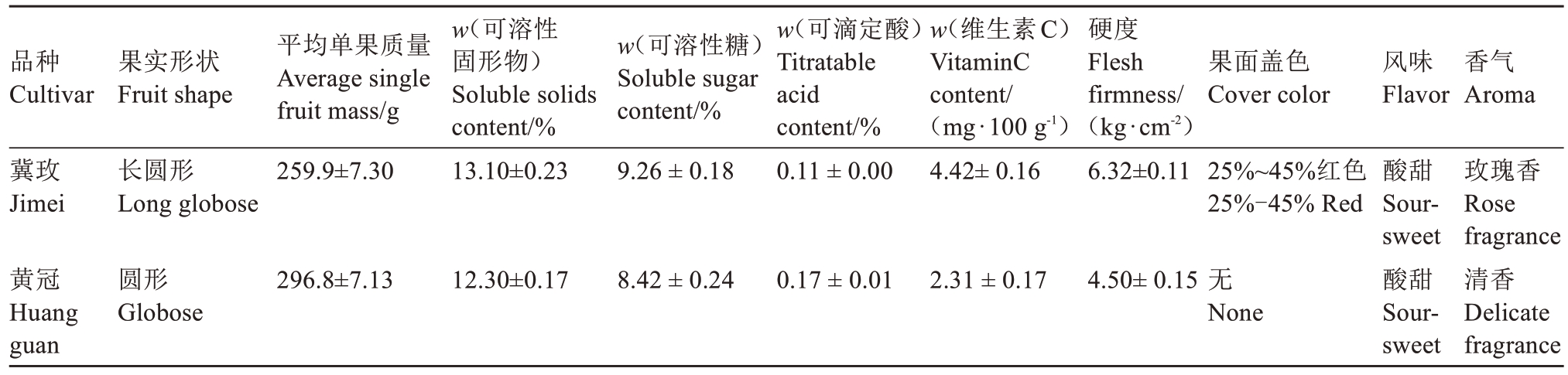
品种Cultivar果实形状Fruit shape果面盖色Cover color风味Flavor香气Aroma冀玫Jimei长圆形Long globose平均单果质量Average single fruit mass/g 259.9±7.30 w(可溶性固形物)Soluble solids content/%13.10±0.23 w(可溶性糖)Soluble sugar content/%9.26 ± 0.18 w(可滴定酸)Titratable acid content/%0.11 ± 0.00 w(维生素C)VitaminC content/(mg·100 g-1)4.42± 0.16硬度Flesh firmness/(kg·cm-2)6.32±0.11 25%~45%红色25%-45% Red黄冠Huang guan圆形Globose 296.8±7.13 12.30±0.17 8.42 ± 0.24 0.17 ± 0.01 2.31 ± 0.17 4.50± 0.15无None酸甜Soursweet酸甜Soursweet玫瑰香Rose fragrance清香Delicate fragrance
2.3 主要物候期
在石家庄地区,冀玫通常于3 月中旬芽萌动,4月初进入初花期,4月上旬盛花,4月上中旬落花,花期为7~9 d(其物候期比黄冠早1~2 d)。冀玫果实成熟期为9 月初,较黄冠果实成熟期(8 月中旬)晚15~20 d。新梢4 月中旬开始生长,6 月中下旬停止生长,落叶期为11月初。
2.4 生长结果习性
冀玫树势中庸,树姿半开张。萌芽率(52.70 %)与成枝力(剪口下可抽生15 cm 以上枝条3.07 个)中等。始果年龄早,正常管理条件下,冀玫定植2~3年即可结果,无大小年现象,具良好的丰产稳产性能。4 年生树产量可达562.7 kg·666.7 m-2,7 年生树产量可达2648 kg·666.7 m-2,密植栽培下早期产量更高。以长果枝结果为主,果台副梢连续结果能力较弱。自然授粉条件下平均每花序坐果4.33 个,具良好的丰产性能(表2)。
表2 冀玫与对照品种生长结果习性比较
Table 2 Comparison of growth and fruiting habits between Jimei and the control cultivar

品种Cultivar冀玫Jimei黄冠Huangguan萌芽率Germination rate/%52.70±4.71 71.43 ±3.30成枝力Branching ability 3.07±0.21 3.23±0.31果枝比例Branch rate/%长果枝Long branch 66.04±4.94 16.80±1.13中果枝Middle branch 11.52±2.21 10.80±0.87短果枝Short branch 17.46±2.37 68.90±4.26腋花芽Axillary flower bud 4.98±1.17 3.50±0.53自然坐果率Natural fruit setting rate/%54.13±4.91 43.75±3.94
3 栽培技术要点
冀玫树体紧凑,树姿半开张。枝条生长量小,树冠小,适宜宽行密植的省力化栽培模式,株行距以(0.75~2.5)m×(3~4)m 为宜。授粉品种可选择雪花梨、黄冠、库尔勒香梨、冀锦等。梨树栽植后,主要通过刻芽、拉枝、抹除萌蘖等技术开张树姿,并培养20个左右的单轴延伸结果枝组。通过2~3年的幼树整形,逐步转入正式结果期。在结果初期,还需注意培养树形,继续完成整形任务。而整个结果期修剪的重点是调节生长与结果的平衡,以保持树体健壮生长。
通过疏花疏果调节负载量以确保果实品质。疏果在花后40 d 左右进行,疏除畸形果、病虫果,每个花序留单果,尽量选留低序位果实(2~3 序位),幼果空间距离以25 cm 左右为宜。套袋应以单层白蜡袋为宜,为促进果实着色,可于采收前10~15 d摘袋,摘袋应避开中午阳光强烈的时间,以免果实发生日灼。
施肥以秋施基肥为主,肥料种类以堆肥、圈肥、鸡粪、羊粪、牛粪等为主,施用量以不低于“斤果斤肥”为标准。亦可施用作物秸秆等,但需同时施入少许N肥,以利于秸秆腐熟。盛果期树的施肥:花后株施1.0 kg 速效N 肥,7 月上旬追施1 次P、K 复合肥。水分管理遵循前期保证、后期控制的原则。
冀玫的生长量和叶片均较小,故采收后应重视叶片的保护工作,防止因病虫害导致树体早期落叶及秋季“返花”现象的发生。采收后需喷布一次杀菌剂,如遇秋雨连绵年份,则需间隔10~15 d 连续用药2~3 次。重点防治梨小食心虫、梨木虱、黄粉虫等病虫害,重视综合防治,在做好农业防治的基础上,选用矿物源、植物源、微生物农药及高效低毒的化学药剂,如石硫合剂、波尔多液、大生、吡虫啉、阿维菌素、螺虫乙酯等。
[1] 王文辉,佟伟,贾晓辉. 我国冻梨生产历史、产业现状与问题分析[J]. 保鲜与加工,2015,15(6):1-6.WANG Wenhui,TONG Wei,JIA Xiaohui. Investigation and analyses of the frozen pear production history,present situation and the industrial problems[J]. Storage and Process,2015,15(6):1-6.
[2] 李明初,陈志周,刘文慧,季佳琪,李冬霞,谭雅宁,王颉,牟建楼. 新梨7 号-南果梨混合梨汁的配比优化[J]. 食品研究与开发,2024,45(8):30-37.LI Mingchu,CHEN Zhizhou,LIU Wenhui,JI Jiaqi,LI Dongxia,TAN Yaning,WANG Jie,MU Jianlou. Optimization of blend ratio of Xinli 7-Nanguo pear mixed pear juice[J]. Food Research and Development,2024,45(8):30-37.
[3] 董雪君,陈义伦. 加工过程对莱阳梨清膏总酚及抗氧化能力的影响[J]. 食品科技,2019,44(1):115-119.DONG Xuejun,CHEN Yilun. Effect of working process on total polyphenol and antioxidant capacity of Laiyang pear clear syrup[J]. Food Science and Technology,2019,44(1):115-119.
[4] 张绍铃,谢智华. 我国梨产业发展现状、趋势、存在问题与对策建议[J]. 果树学报,2019,36(8):1067-1072.ZHANG Shaoling,XIE Zhihua. Current status,trends,main problems and the suggestions on development of pear industry in China[J]. Journal of Fruit Science,2019,36(8):1067-1072.