油梨(Persea americana Mill.),又名牛油果、鳄梨、樟梨等,为樟科(Lauraceae)鳄梨属(Persea)多年生常绿果树,原产于中南美洲的热带、亚热带地区[1]。油梨果肉质地细腻,富含以不饱和脂肪酸为主的油脂、黄酮和酚类等营养元素,具有预防动脉硬化、脑中风和糖尿病等保健功能[2-4]。因其营养和经济价值高,近年来油梨产业在国际市场上发展迅速。根据联合国粮食及农业组织公布的数据,2022年油梨的全球种植面积和产量分别达到88.4 万hm2和897.8 万t。近年来,油梨产业在中国云南、广东、广西和四川等省份迅速发展,种植面积和产量已达到1.4 万hm2和13.6 万t[5]。由于中国油梨产业起步较晚,优良商业品种的缺乏制约了中国油梨产业的健康发展[6]。
当前,中国除了引进一些Hass、Fuerte 和Reed等国外优异资源外,也自主育成了桂垦大2号、桂垦大3 号和桂研10 号等品种[7]。前人研究发现,不同油梨品种果实的脂肪酸组成、干物质含量、可溶性固形物含量以及生物活性物质含量等品质指标存在明显差异[8-11]。然而,对于中国自主选育品种与引进品种在果实品质方面的比较研究较少,制约了优异种质资源的筛选及开发利用。果实综合品质由多个品质指标组成,仅凭单项指标进行评价过于片面,且采用单一评价方法难以反映真实情况[12]。当前,主成分分析、聚类分析、隶属函数分析等方法广泛应用于不同品种果实性状的综合评价[13-16],但在油梨果实品质综合评价上应用较少,如何准确评价油梨果实品质是亟待解决的产业问题。因此,采集11 个国外引进品种和16 个国内自主选育品种,对油梨果肉的干物质含量、可溶性固形物含量、生物活性物质含量以及脂肪酸组成等品质指标进行检测,利用多种综合评价方法全面分析不同品种的果实品质,以期为油梨优良品种的筛选与利用提供理论依据。
1 材料和方法
1.1 材料
27 个油梨品种均来源于广西南亚热带农业科学研究所油梨资源圃,其果实表型如图1 所示。选取5 年以上树龄的成年树,每个品种选取3 株树,在每株树树冠中部的东西南北方向各取1 个成熟的健康果实,共12 个果实。为确保所有品种的果实营养品质具有可比性,以种子与果肉间的缝隙、果实大小与往年相近以及往年采收时间作为基础的参考指标,确定不同油梨品种采收的时间。部分新鲜果肉用于测定干物质含量和可溶性固形物含量,另取中果皮的鲜果肉研磨后放到液氮中速冻,-80 ℃冰箱保存,用于其他品质指标的测定。
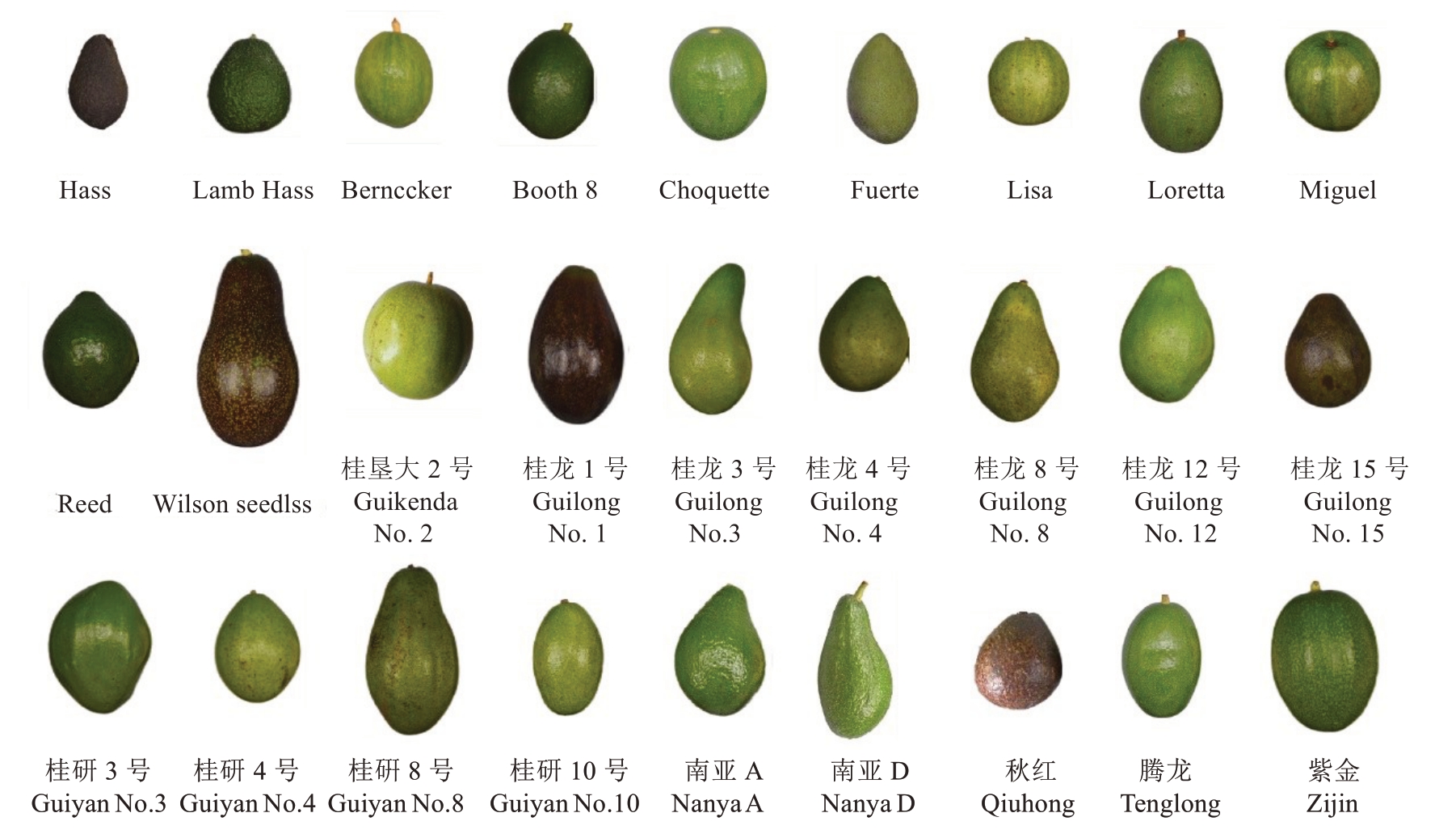
图1 27 个油梨品种的果实表型
Fig. 1 Fruit phenotypes of 27 avocado varieties
37 种混合脂肪酸甲酯标准品:上海安谱实验科技有限公司;十一碳酸甘油三酯:北京坛墨质检科技有限公司。
1.2 方法
1.2.1 干物质含量测定 称取研磨的新鲜果肉10 g,置于鼓风干燥箱中80 ℃烘干至恒质量,按照公式(1)计算:

1.2.2 可溶性固形物含量测定 称取研磨的新鲜果肉10 g,取汁液,用PAL-1便携式数显折射仪测定。
1.2.3 总酚和总黄酮含量测定 油梨果肉总酚和总黄酮含量测定参照葛宇等[17]的方法。
1.2.4 抗氧化活性测定 DPPH 和ABTS 自由基清除率使用试剂盒(Comin,苏州,中国)测定。
1.2.5 脂肪酸组分及含量测定 脂肪酸组分及含量测定参照国标GB5009.168—2016《食品安全国家标准 食品中脂肪酸的测定》[18]。标准品包括37种混合脂肪酸甲酯标准品,内标为十一碳酸甘油三酯。脂肪酸组分含量按照公式(2)计算:
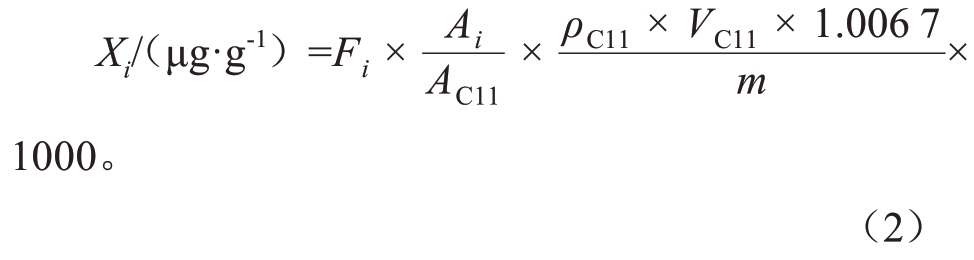
式中Xi为试样中脂肪酸甲酯i含量;Fi为脂肪酸甲酯i 的响应因子;Ai为试样中脂肪酸甲酯i 的峰面积;AC11为试样中加入的内标物十一碳酸甲酯峰面积;ρC11为十一碳酸甘油三酯浓度(mg·mL-1);VC11为试样中加入十一碳酸甘油三酯体积(mL);1.006 7为十一碳酸甘油三酯转化成十一碳酸甲酯的转换系数;m为试样的质量(g)。
总脂肪酸、饱和脂肪酸、单不饱和脂肪酸、多不饱和脂肪酸和不饱和脂肪酸分别表示为TFA、SFA、MUFA、PUFA 和UFA。PUFA/SFA(P/S)值为多不饱和脂肪酸含量与饱和脂肪酸含量比值,而MUFA/SFA(M/S)值为单不饱和脂肪酸含量与饱和脂肪酸含量比值。
1.3 数据分析
试验结果以平均值±标准差表示,使用Excel 2020 软件进行数据处理,使用SPSS 23.0 软件进行方差分析、多重比较(Duncan)、主成分分析及聚类分析。隶属函数分析评价是通过对各指标进行隶属函数值计算,以各指标隶属函数值的平均值作为评价标准,隶属函数平均值越大,油梨果实的综合品质越好。各指标隶属函数值按照公式(3)计算:

式中,Xj为测定的指标值,Xmax和Xmix分别为该指标所测定的最大值和最小值。
2 结果与分析
2.1 不同油梨品种的果实品质比较分析
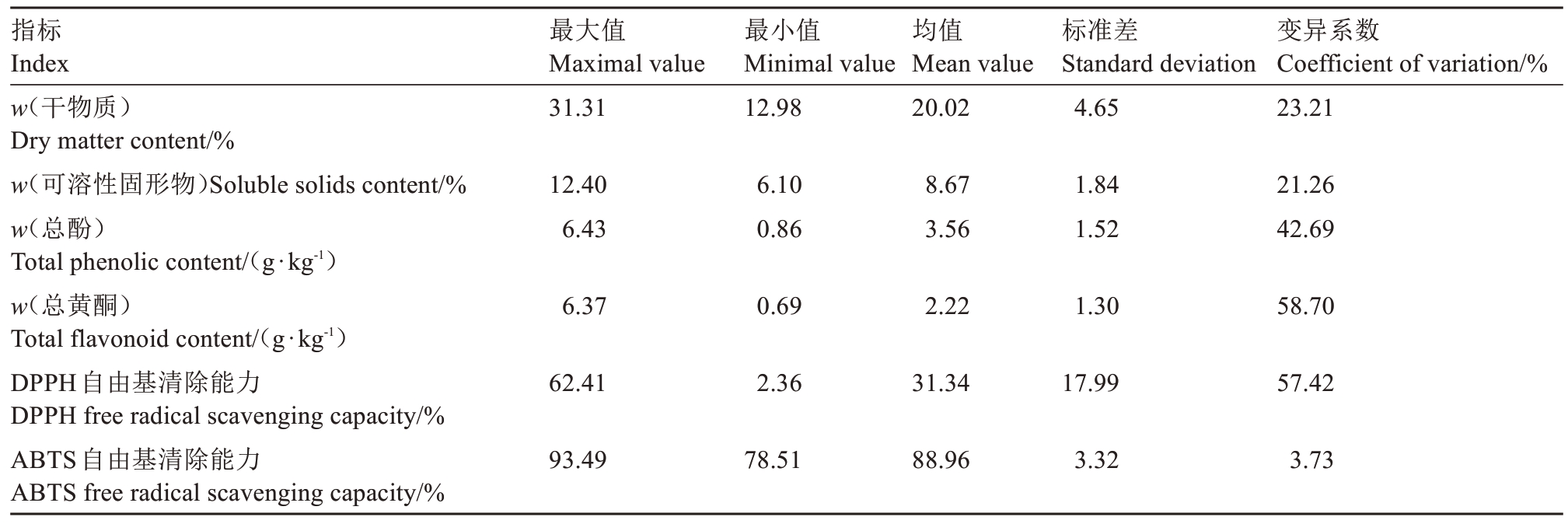
2.1.1 干物质含量和可溶性固形物含量比较分析由表1 可知,果实干物质含量和可溶性固形物含量在27个油梨品种间存在一定的变异,变异系数分别为23.21%和21.26%,均超过了20%,属高度变异。方差分析和多重比较结果表明,果实干物质含量和可溶性固形物含量在不同油梨品种间存在显著差异(图2)。不同油梨品种间干物质含量变化范围为12.98%~31.31%,均值为20.02%,其中13 个品种的干物质含量超过平均值,含量最高的品种为Hass。可溶性固形物含量变化范围为6.10%~12.40%,均值为8.67%,其中12 个品种的可溶性固形物含量超过平均值,桂龙4 号和南亚D 的可溶性固形物含量显著高于其他品种。
表1 不同油梨品种果肉干物质含量、可溶性固形物含量、生物活性物质含量以及抗氧化能力的差异分布情况
Table 1 Differential distribution of dry matter content, soluble solids content, bioactive substances content, and antioxidant ability in pulp of different avocado varieties
指标Index w(干物质)Dry matter content/%w(可溶性固形物)Soluble solids content/%w(总酚)Total phenolic content/(g·kg-1)w(总黄酮)Total flavonoid content/(g·kg-1)DPPH自由基清除能力DPPH free radical scavenging capacity/%ABTS自由基清除能力ABTS free radical scavenging capacity/%最大值Maximal value 31.31最小值Minimal value 12.98均值Mean value 20.02标准差Standard deviation 4.65变异系数Coefficient of variation/%23.21 12.40 6.43 6.10 0.86 8.67 3.56 1.84 1.52 21.26 42.69 6.37 0.69 2.22 1.30 58.70 62.41 2.36 31.34 17.99 57.42 93.49 78.51 88.96 3.32 3.73
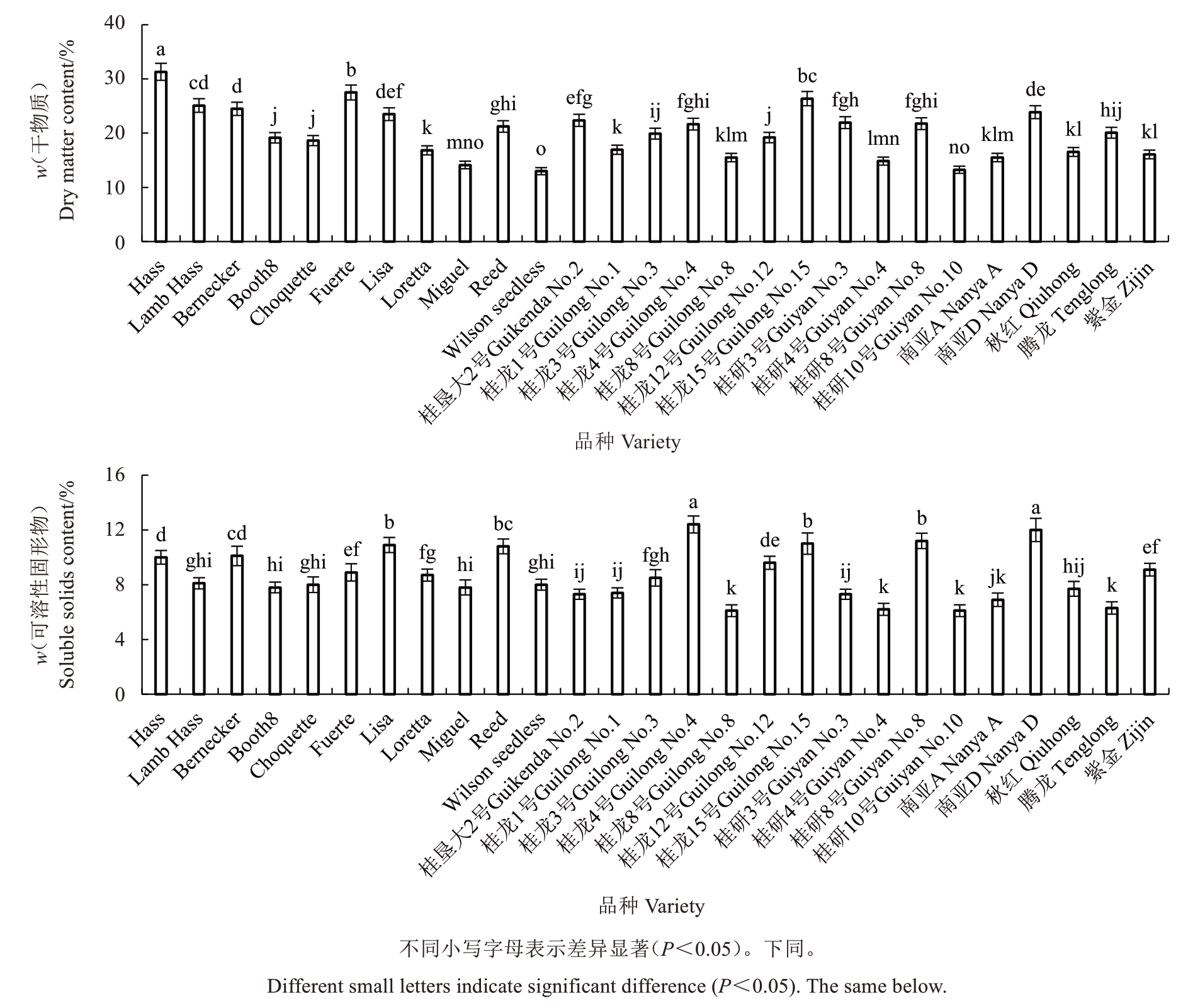
图2 不同油梨品种果肉干物质含量和可溶性固形物含量比较
Fig. 2 Comparison of content of dry matter and soluble solids in pulp of different avocado varieties
2.1.2 生物活性物质含量和抗氧化能力比较分析对27 个油梨品种的生物活性物质含量和抗氧化能力的测定结果(表1)分析表明,总酚含量、总黄酮含量和DPPH 自由基清除能力的变异系数分别为42.69%、58.70%和57.42%,均超过了20%,属高度变异;而ABTS 自由基清除能力的变异系数仅为3.73%,属低度变异。由图3 和图4 可知,不同油梨品种果实的生物活性物质含量和抗氧化能力存在显著差异。不同油梨品种的总酚含量和总黄酮含量变化范围分别为0.86~6.43 g·kg-1和0.69~6.37 g·kg-1,而DPPH 自由基清除能力和ABTS 自由基清除能力分别介于2.36%~62.41%和78.51%~93.49%之间。总酚含量和总黄酮含量高的品种分别为Lisa 和桂龙3号,而DPPH 自由基清除能力和ABTS 自由基清除能力分别在腾龙和桂研3号中表现最好。
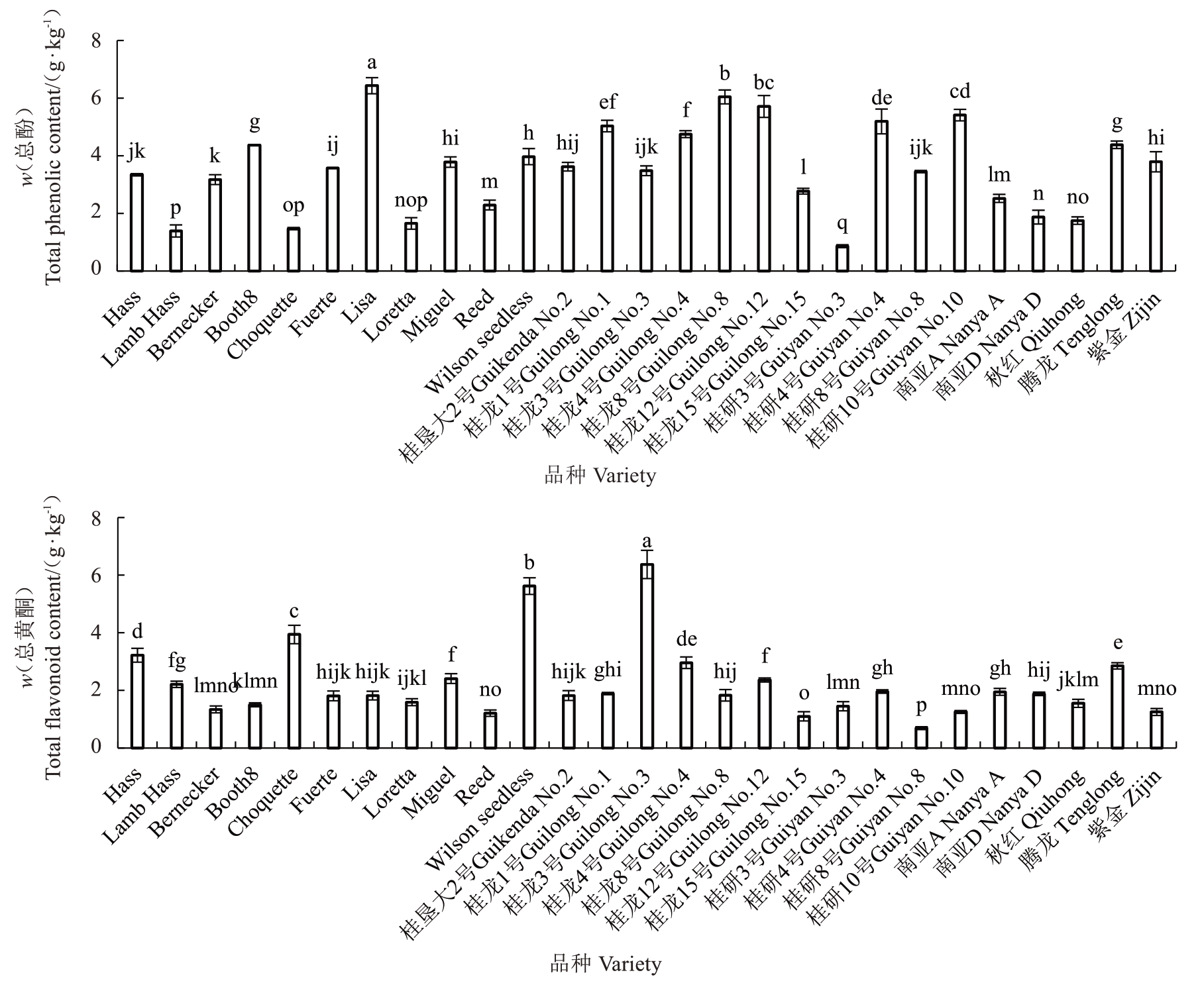
图3 不同油梨品种果肉总酚含量和黄酮含量比较
Fig. 3 Comparison of contents of total phenol and total flavonoid in pulp of different avocado varieties
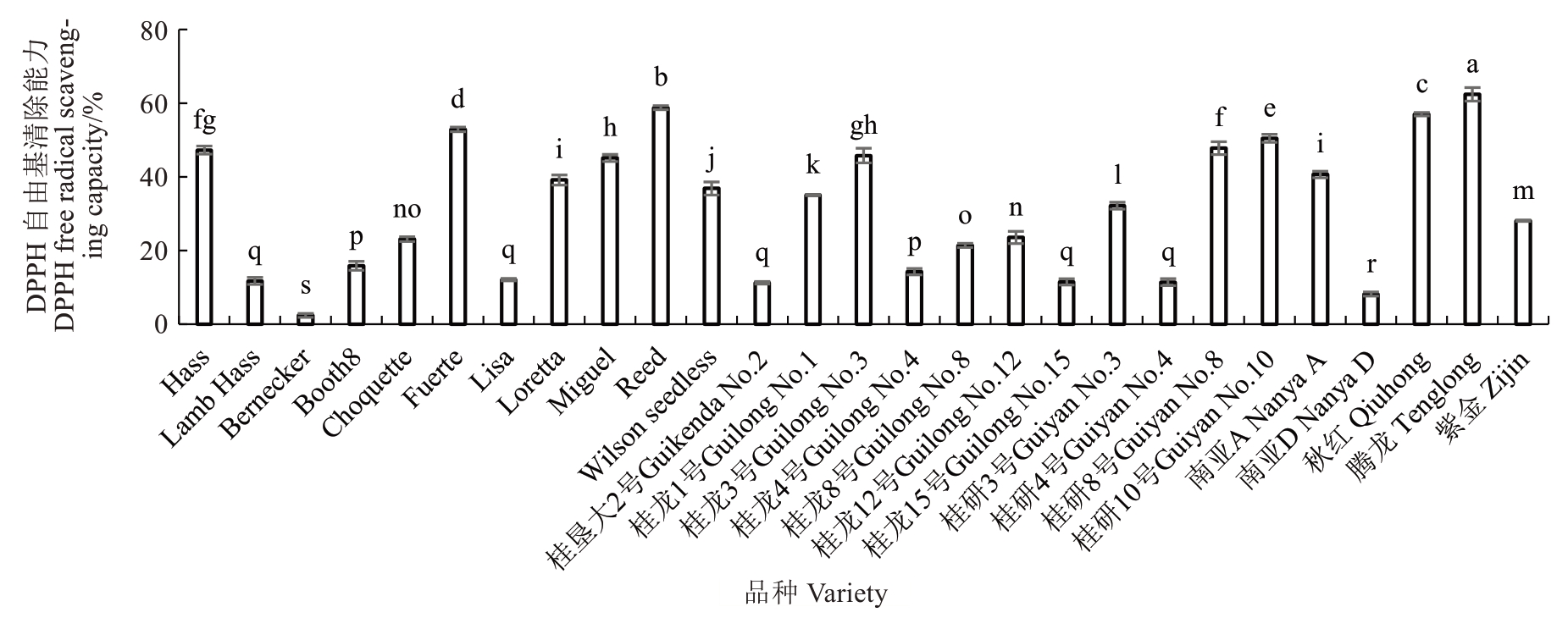
图4 不同油梨品种果肉DPPH 和ABTS 自由基清除能力比较
Fig. 4 Comparison of free radical scavenging capacities DPPH and ABTS in pulp of different avocado varieties
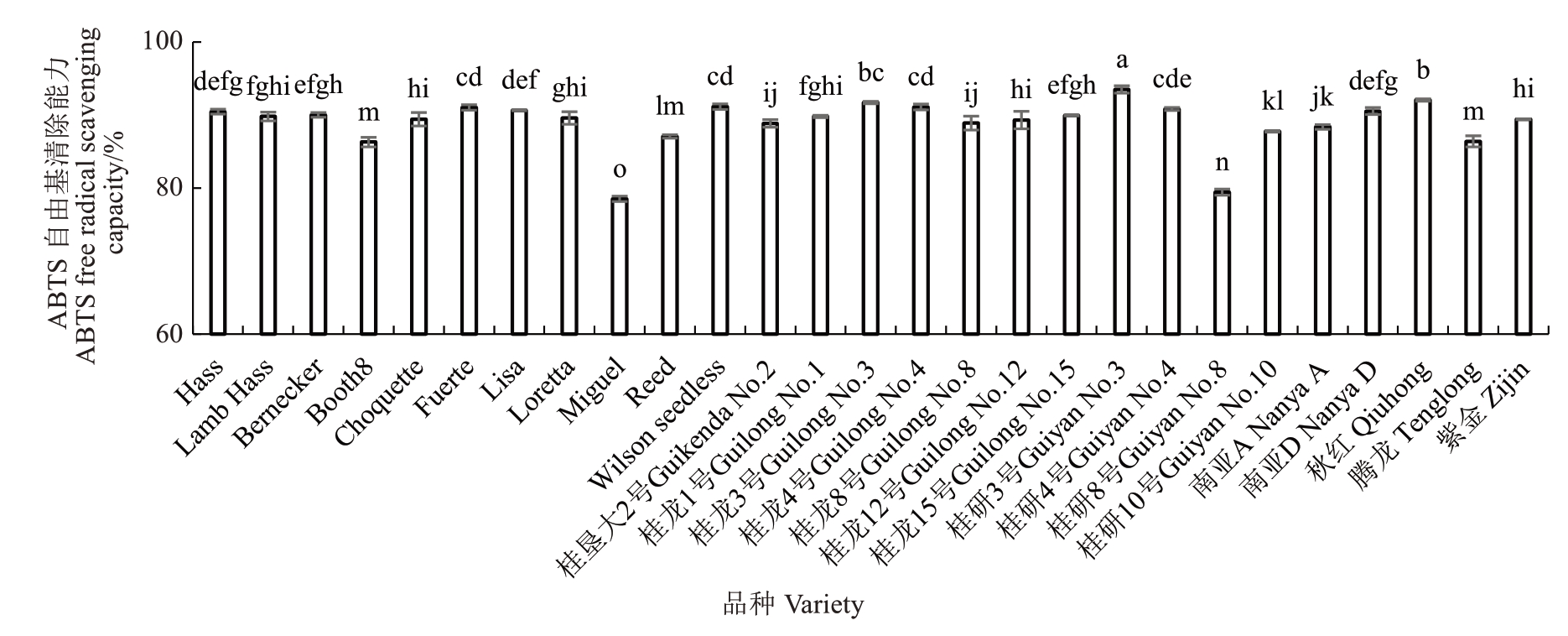
图4 (续) Fig. 4 (Continued)
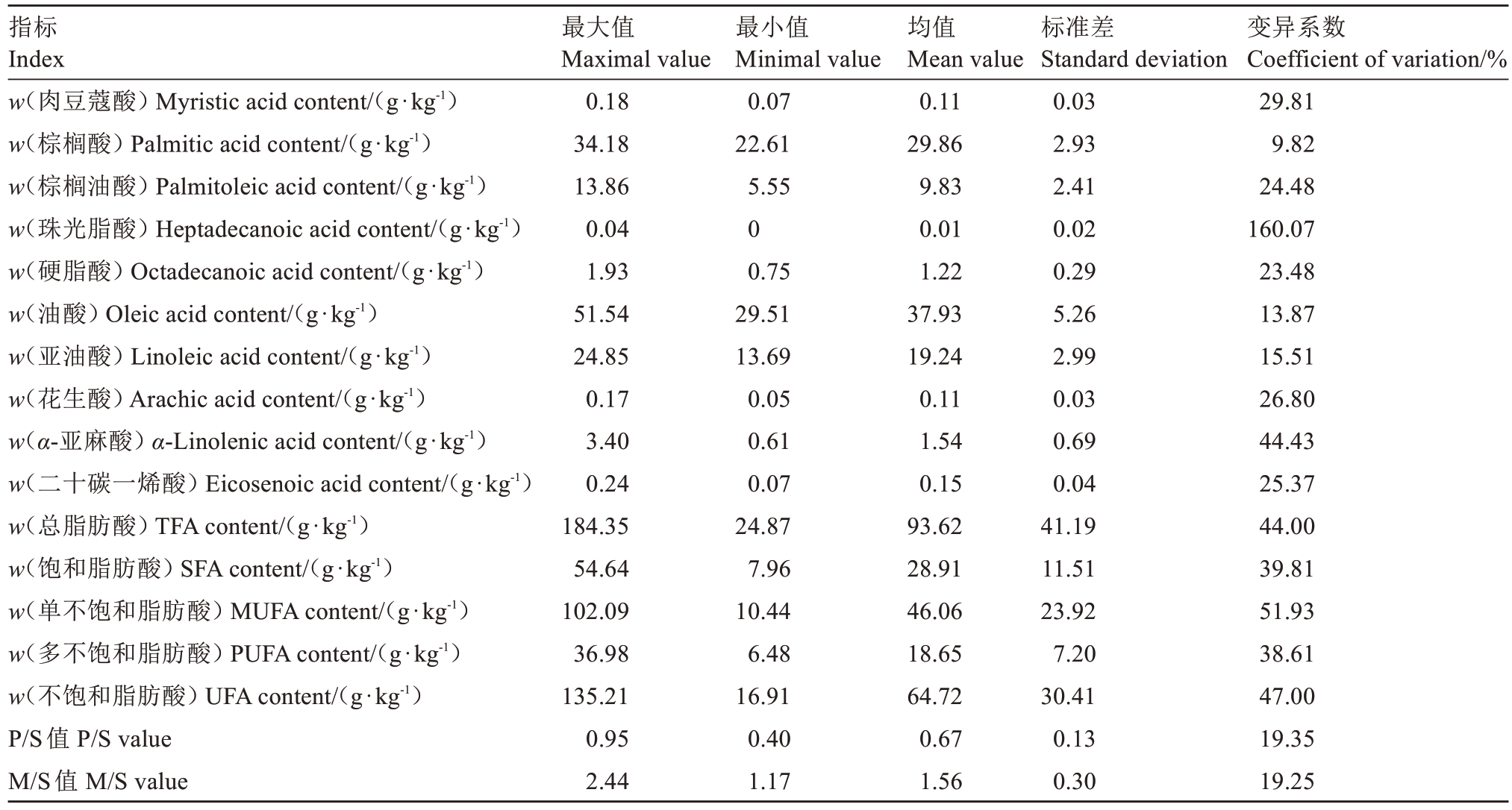
2.1.3 脂肪酸组成及含量比较分析 由图5 可知,油梨的脂肪酸由肉豆蔻酸、棕榈酸、棕榈油酸、珠光脂酸、硬脂酸、油酸、亚油酸、花生酸、α-亚麻酸和二十碳一烯酸组成。其中珠光脂酸仅在8 个品种(Booth8、Choquette、Fuerte、Lisa、桂垦大2 号、桂龙3号、桂龙4 号和桂龙8 号)中检测出。由表2 可以看出,油梨果实的脂肪酸各组分平均含量由高到低的顺序为油酸(37.93 g·kg-1)>棕榈酸(29.86 g·kg-1)>亚油酸(19.24 g·kg-1)>棕榈油酸(9.83 g·kg-1)>α-亚麻酸(1.54 g·kg-1)>硬脂酸(1.22 g·kg-1)>二十碳一烯酸(0.15 g·kg-1)>花生酸(0.11 g·kg-1)=肉豆蔻酸(0.11 g·kg-1)>珠光脂酸(0.01 g·kg-1)。脂肪酸各组分的变异系数范围为9.82%~160.07%,其中,珠光脂酸的变异系数最高,其次是α-亚麻酸。
表2 不同油梨品种果肉脂肪酸组成的差异分布情况
Table 2 Differential distribution of fatty acid composition in pulp of different avocado varieties
指标Index w(肉豆蔻酸) Myristic acid content/(g·kg-1)w(棕榈酸) Palmitic acid content/(g·kg-1)w(棕榈油酸) Palmitoleic acid content/(g·kg-1)w(珠光脂酸) Heptadecanoic acid content/(g·kg-1)w(硬脂酸) Octadecanoic acid content/(g·kg-1)w(油酸) Oleic acid content/(g·kg-1)w(亚油酸) Linoleic acid content/(g·kg-1)w(花生酸) Arachic acid content/(g·kg-1)w(α-亚麻酸) α-Linolenic acid content/(g·kg-1)w(二十碳一烯酸) Eicosenoic acid content/(g·kg-1)w(总脂肪酸) TFA content/(g·kg-1)w(饱和脂肪酸) SFA content/(g·kg-1)w(单不饱和脂肪酸) MUFA content/(g·kg-1)w(多不饱和脂肪酸) PUFA content/(g·kg-1)w(不饱和脂肪酸) UFA content/(g·kg-1)P/S值 P/S value M/S值 M/S value最大值Maximal value 0.18 34.18 13.86 0.04 1.93 51.54 24.85 0.17 3.40 0.24 184.35 54.64 102.09 36.98 135.21 0.95 2.44最小值Minimal value 0.07 22.61 5.55 0 0.75 29.51 13.69 0.05 0.61 0.07 24.87 7.96 10.44 6.48 16.91 0.40 1.17均值Mean value 0.11 29.86 9.83 0.01 1.22 37.93 19.24 0.11 1.54 0.15 93.62 28.91 46.06 18.65 64.72 0.67 1.56标准差Standard deviation 0.03 2.93 2.41 0.02 0.29 5.26 2.99 0.03 0.69 0.04 41.19 11.51 23.92 7.20 30.41 0.13 0.30变异系数Coefficient of variation/%29.81 9.82 24.48 160.07 23.48 13.87 15.51 26.80 44.43 25.37 44.00 39.81 51.93 38.61 47.00 19.35 19.25
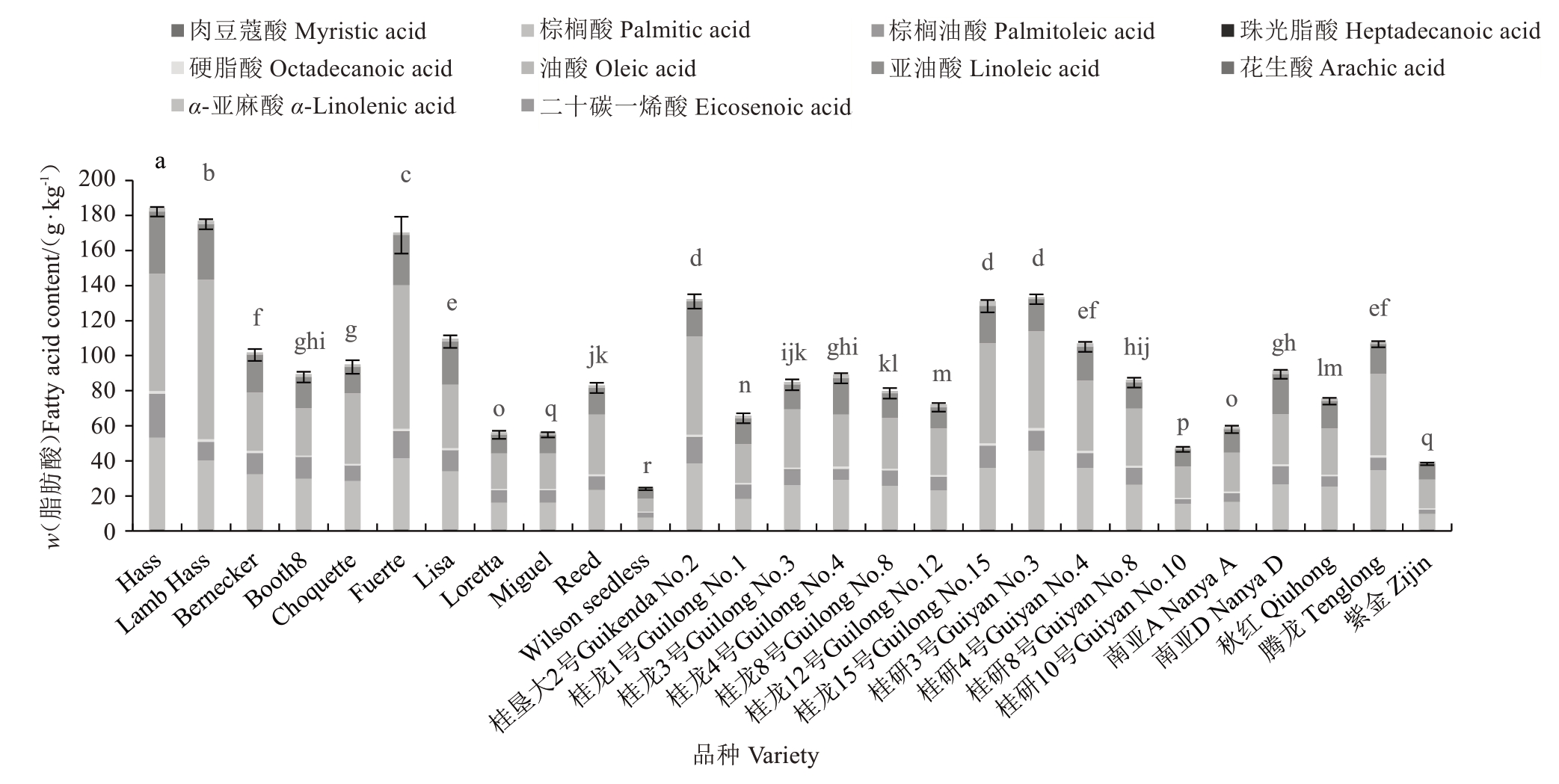
图5 不同油梨品种果肉脂肪酸组分比较
Fig. 5 Comparison of fatty acid composition in pulp of different avocado varieties
油梨果实的SFA包括肉豆蔻酸、棕榈酸、珠光脂酸、硬脂酸和花生酸,UFA包括MUFA(棕榈油酸、油酸和二十碳一烯酸)和PUFA(亚油酸和α-亚麻酸)。由表2可知,TFA、SFA、MUFA、PUFA和UFA的含量在27个油梨品种间均存在一定程度的变异,变异系数范围为38.61%~51.93%。方差分析和多重比较结果表明,TFA、SFA、MUFA、PUFA 和UFA 的含量在不同品种间均存在显著差异,其中Hass的TFA、SFA和PUFA 含量最高,而MUFA 和UFA 含量以Lamb Hass最高。
进一步分析SFA、MUFA、PUFA 和UFA 在脂肪酸中的占比,发现油梨果实脂肪酸以UFA 为主,其中MUFA 占比更高(表3)。SFA、MUFA、PUFA 和UFA 的占比在不同品种间存在显著差异,其中MUFA 和UFA 占比最高的品种为Lamb Hass,SFA 占比最高的品种为桂研3号,而PUFA占比最高的品种则为南亚D。M/S、P/S 值代表油梨可食部分的营养价值以及不饱和程度。不同油梨品种的MUFA/SFA(M/S)和PUFA/SFA(P/S)值存在显著差异。其中,M/S和P/S值分别在Lamb Hass和紫金品种中最高。
表3 不同油梨品种果肉脂肪酸组成的差异分布情况
Table 3 Comparison of fatty acid composition in pulp of different avocado varieties

?
2.2 综合评价
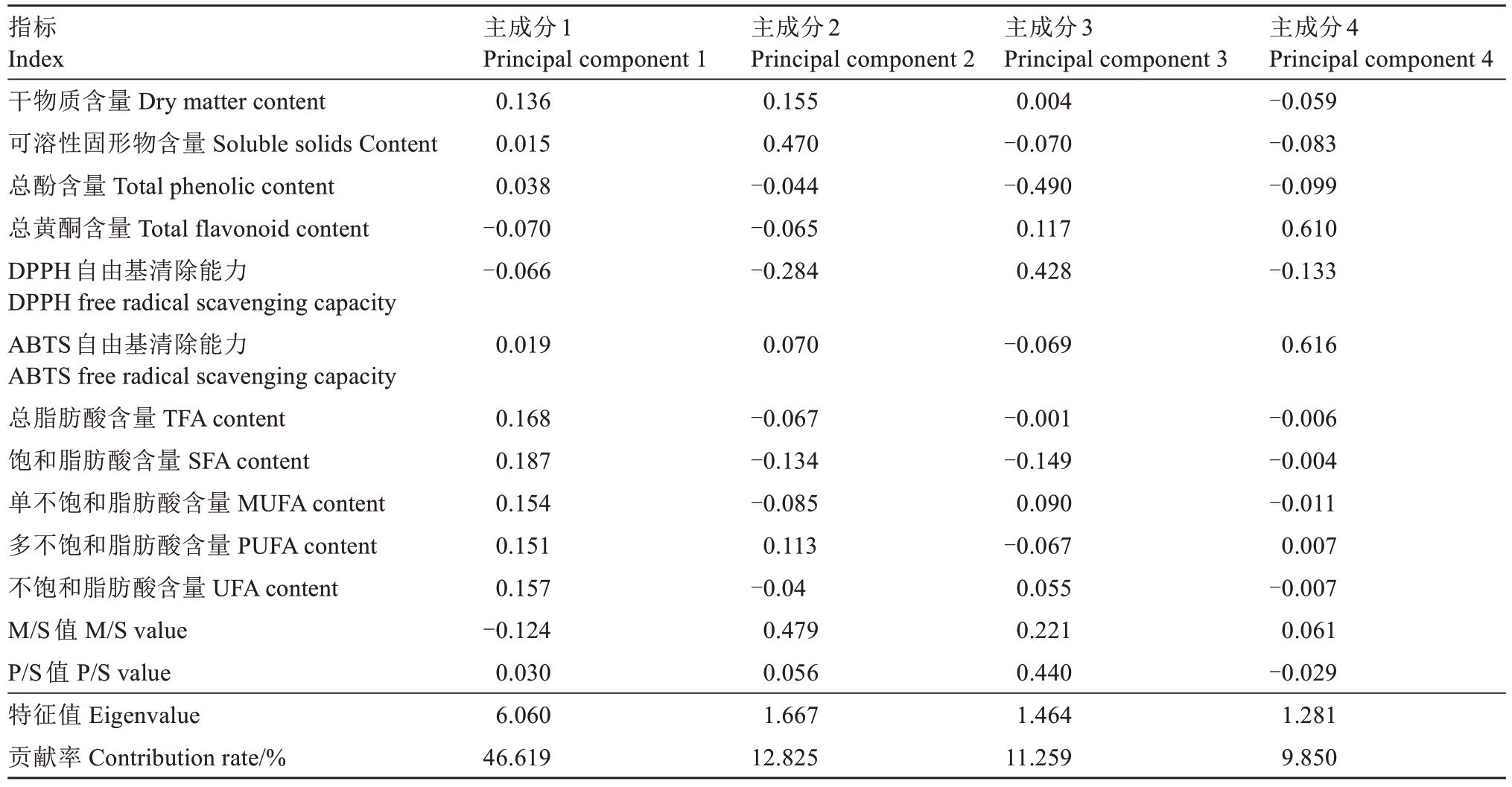
2.2.1 主成分分析 对13 个油梨品种果实营养指标进行主成分分析,根据特征值>1 和方差累计贡献率>75%的原则提取4 个主成分,其贡献率分别为46.619%、12.825%、11.259%和9.850%,累计贡献率达80.553%(表4)。其中,第1 主成分上载荷量较大的因子是总脂肪酸、饱和脂肪酸、单不饱和脂肪酸、多不饱和脂肪酸和不饱和脂肪酸含量;第2主成分上载荷量较大的因子是可溶性固形物含量、M/S值;第3 主成分上载荷量较大的因子是DPPH 自由基清除能力和P/S值,第4主成分上载荷量较大的因子是总黄酮含量和ABTS自由基清除能力。
表4 PCA 载荷矩阵
Table 4 PCA loadings matrix
指标Index干物质含量 Dry matter content可溶性固形物含量 Soluble solids Content总酚含量 Total phenolic content总黄酮含量 Total flavonoid content DPPH自由基清除能力DPPH free radical scavenging capacity ABTS自由基清除能力ABTS free radical scavenging capacity总脂肪酸含量 TFA content饱和脂肪酸含量 SFA content单不饱和脂肪酸含量 MUFA content多不饱和脂肪酸含量 PUFA content不饱和脂肪酸含量 UFA content M/S值 M/S value P/S值 P/S value特征值 Eigenvalue贡献率 Contribution rate/%主成分1 Principal component 1 0.136 0.015 0.038-0.070-0.066主成分2 Principal component 2 0.155 0.470-0.044-0.065-0.284主成分3 Principal component 3 0.004-0.070-0.490 0.117 0.428主成分4 Principal component 4-0.059-0.083-0.099 0.610-0.133 0.019 0.070-0.069 0.616 0.168 0.187 0.154 0.151 0.157-0.124 0.030 6.060 46.619-0.067-0.134-0.085 0.113-0.04 0.479 0.056 1.667 12.825-0.001-0.149 0.090-0.067 0.055 0.221 0.440 1.464 11.259-0.006-0.004-0.011 0.007-0.007 0.061-0.029 1.281 9.850
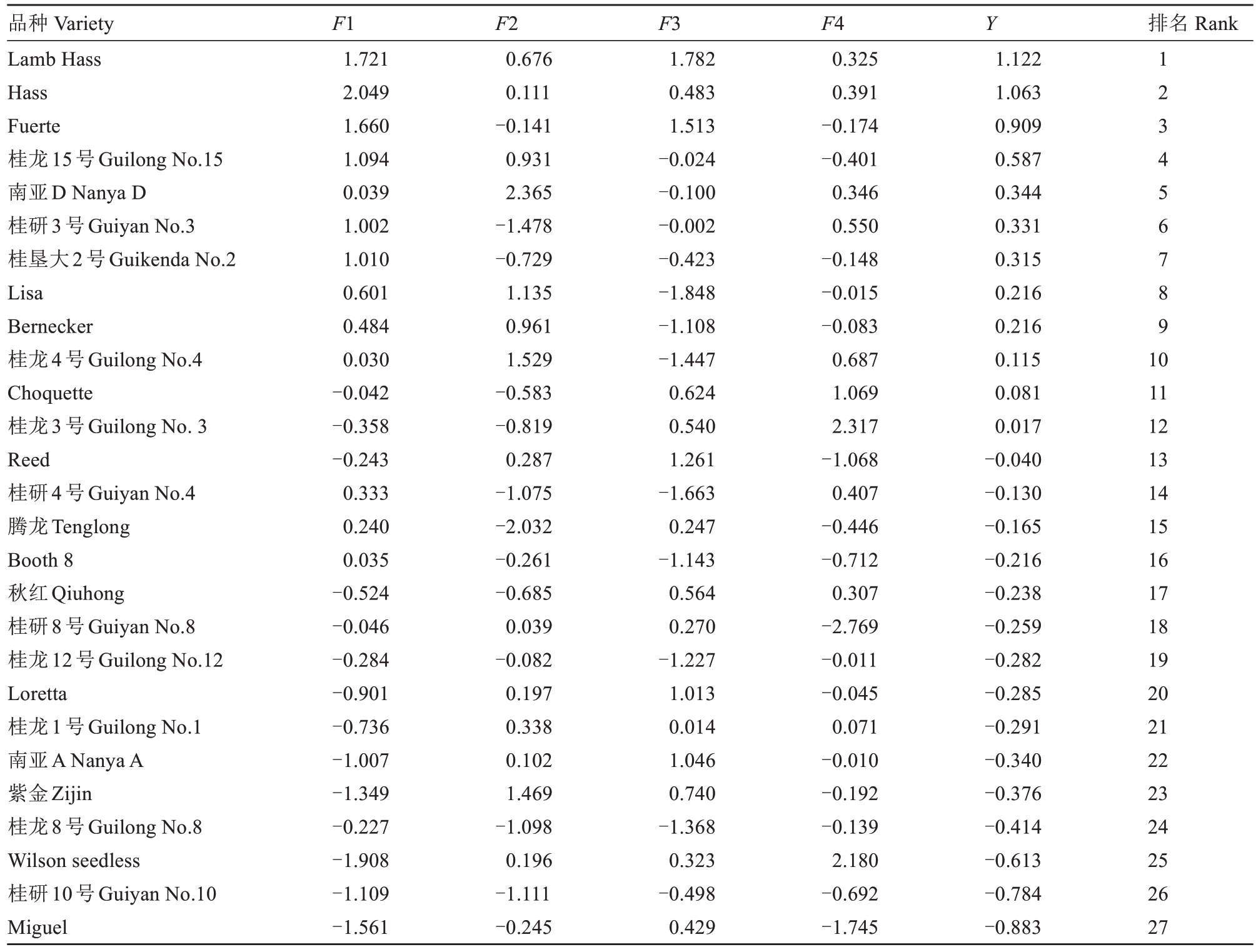
根据4 个主成分的载荷矩阵计算出每个主成分的得分,再以每个主成分的贡献率为权重对主成分得分进行加和,求得主成分综合得分Y(表5)。综合得分反映各品种品质的优劣,对Y值进行降序排列,排名前3的品种依次为Lamb Hass、Hass和Fuerte。
表5 不同油梨品种果实主成分得分及综合得分
Table 5 Principal component and comprehensive score of different avocado varieties
品种 Variety Lamb Hass Hass Fuerte桂龙15号Guilong No.15南亚D Nanya D桂研3号Guiyan No.3桂垦大2号Guikenda No.2 Lisa Bernecker桂龙4号Guilong No.4 Choquette桂龙3号Guilong No. 3 Reed桂研4号Guiyan No.4腾龙Tenglong Booth 8秋红Qiuhong桂研8号Guiyan No.8桂龙12号Guilong No.12 Loretta桂龙1号Guilong No.1南亚A Nanya A紫金Zijin桂龙8号Guilong No.8 Wilson seedless桂研10号Guiyan No.10 Miguel F1 1.721 2.049 1.660 1.094 0.039 1.002 1.010 0.601 0.484 0.030-0.042-0.358-0.243 0.333 0.240 0.035-0.524-0.046-0.284-0.901-0.736-1.007-1.349-0.227-1.908-1.109-1.561 F2 0.676 0.111-0.141 0.931 2.365-1.478-0.729 1.135 0.961 1.529-0.583-0.819 0.287-1.075-2.032-0.261-0.685 0.039-0.082 0.197 0.338 0.102 1.469-1.098 0.196-1.111-0.245 F3 1.782 0.483 1.513-0.024-0.100-0.002-0.423-1.848-1.108-1.447 0.624 0.540 1.261-1.663 0.247-1.143 0.564 0.270-1.227 1.013 0.014 1.046 0.740-1.368 0.323-0.498 0.429 F4 0.325 0.391-0.174-0.401 0.346 0.550-0.148-0.015-0.083 0.687 1.069 2.317-1.068 0.407-0.446-0.712 0.307-2.769-0.011-0.045 0.071-0.010-0.192-0.139 2.180-0.692-1.745 Y 排名 Rank 1.122 1.063 0.909 0.587 0.344 0.331 0.315 0.216 0.216 0.115 0.081 0.017-0.040-0.130-0.165-0.216-0.238-0.259-0.282-0.285-0.291-0.340-0.376-0.414-0.613-0.784-0.883 1 2 3 4 5 6 7 8 9 10 11 12 13 14 15 16 17 18 19 20 21 22 23 24 25 26 27
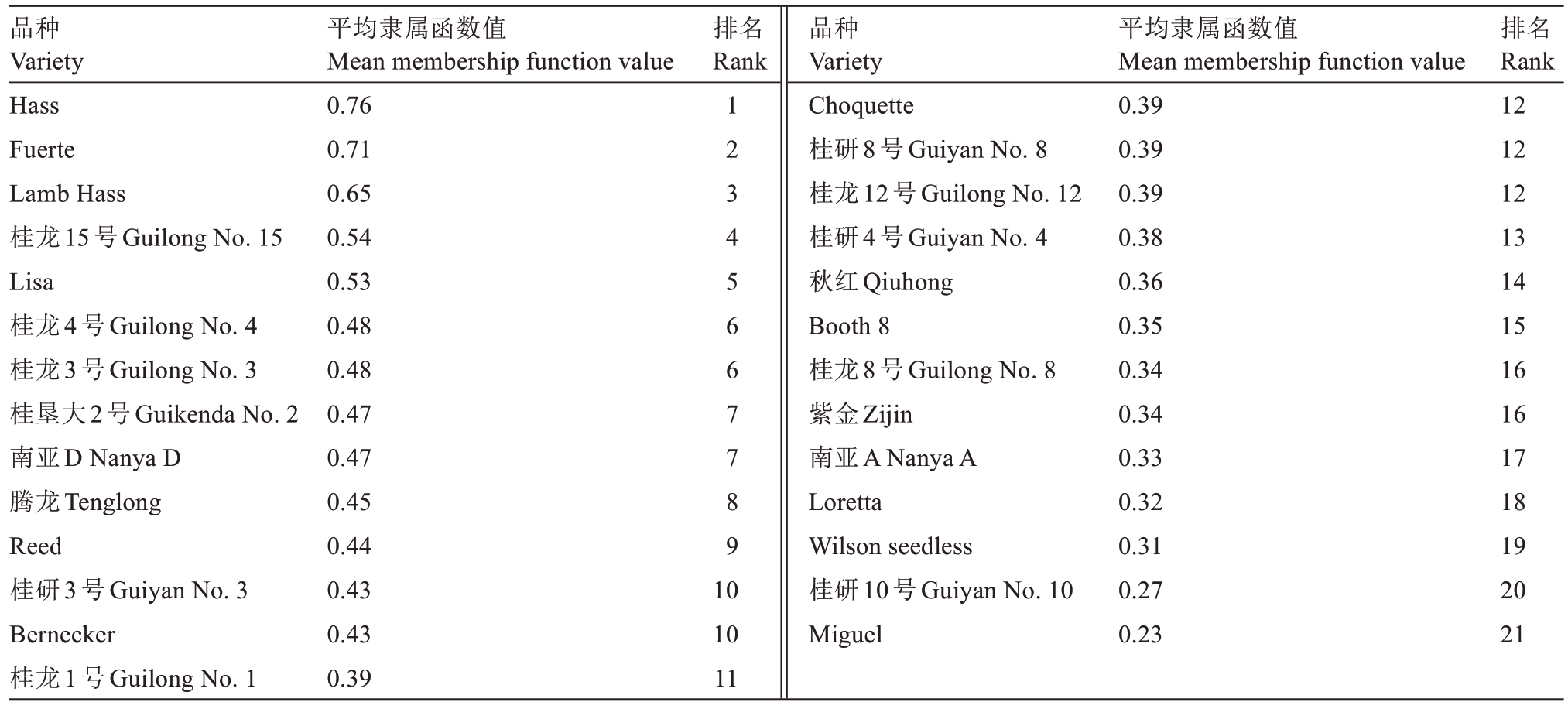
2.2.2 隶属函数分析 基于13 项油梨果实的品质指标,采用隶属函数分析法对27个油梨品种的果实品质进行综合评价,结果见表6。27 个油梨品种的平均隶属函数值范围为0.23~0.76。其中,平均隶属函数值≥0.60的仅有3个品种,分别为Hass、Fuerte和Lamb Hass;0.40≤平均隶属函数值<0.60 的油梨品种共有10个,而14个油梨品种的平均隶属函数值小于0.40。
表6 不同油梨品种果实的平均隶属函值
Table 6 Average membership function value of different avocado varieties
品种Variety Hass Fuerte Lamb Hass桂龙15号Guilong No. 15 Lisa桂龙4号Guilong No. 4桂龙3号Guilong No. 3桂垦大2号Guikenda No. 2南亚D Nanya D腾龙Tenglong Reed桂研3号Guiyan No. 3 Bernecker桂龙1号Guilong No. 1平均隶属函数值Mean membership function value 0.76 0.71 0.65 0.54 0.53 0.48 0.48 0.47 0.47 0.45 0.44 0.43 0.43 0.39排名Rank 1 2 3 4 5 6 6 7 7 8 9 10 10 11品种Variety Choquette桂研8号Guiyan No. 8桂龙12号Guilong No. 12桂研4号Guiyan No. 4秋红Qiuhong Booth 8桂龙8号Guilong No. 8紫金Zijin南亚A Nanya A Loretta Wilson seedless桂研10号Guiyan No. 10 Miguel平均隶属函数值Mean membership function value 0.39 0.39 0.39 0.38 0.36 0.35 0.34 0.34 0.33 0.32 0.31 0.27 0.23排名Rank 12 12 12 13 14 15 16 16 17 18 19 20 21
2.2.3 聚类分析 基于27 个油梨品种的13 项果实品质指标进行聚类分析,聚类方法采用Ward 法,聚类区间为平方欧氏距离,结果见图6。在欧式距离3.0 处可以将27 个油梨品种分为5 个类群。类群1聚集了Hass、Fuerte 和Lamb Hass;类群2 聚集了桂垦大2 号、桂龙15 号和桂研3 号;类群3 聚集了9 个品种,包括Lisa、桂研4号、Bernecker、桂龙8号、桂龙12号、Booth 8、桂龙4号、南亚D 和Choquette;类群4聚集了桂龙3 号、桂研8 号、Reed、秋红和腾龙;类群5 聚集了Loretta、南亚A、桂龙1 号、Miguel、桂研10号、Wilson seedless 和紫金。其中,类群1 的脂肪酸含量和干物质含量最高,其余品质指标也较优,果实综合品质表现优良。
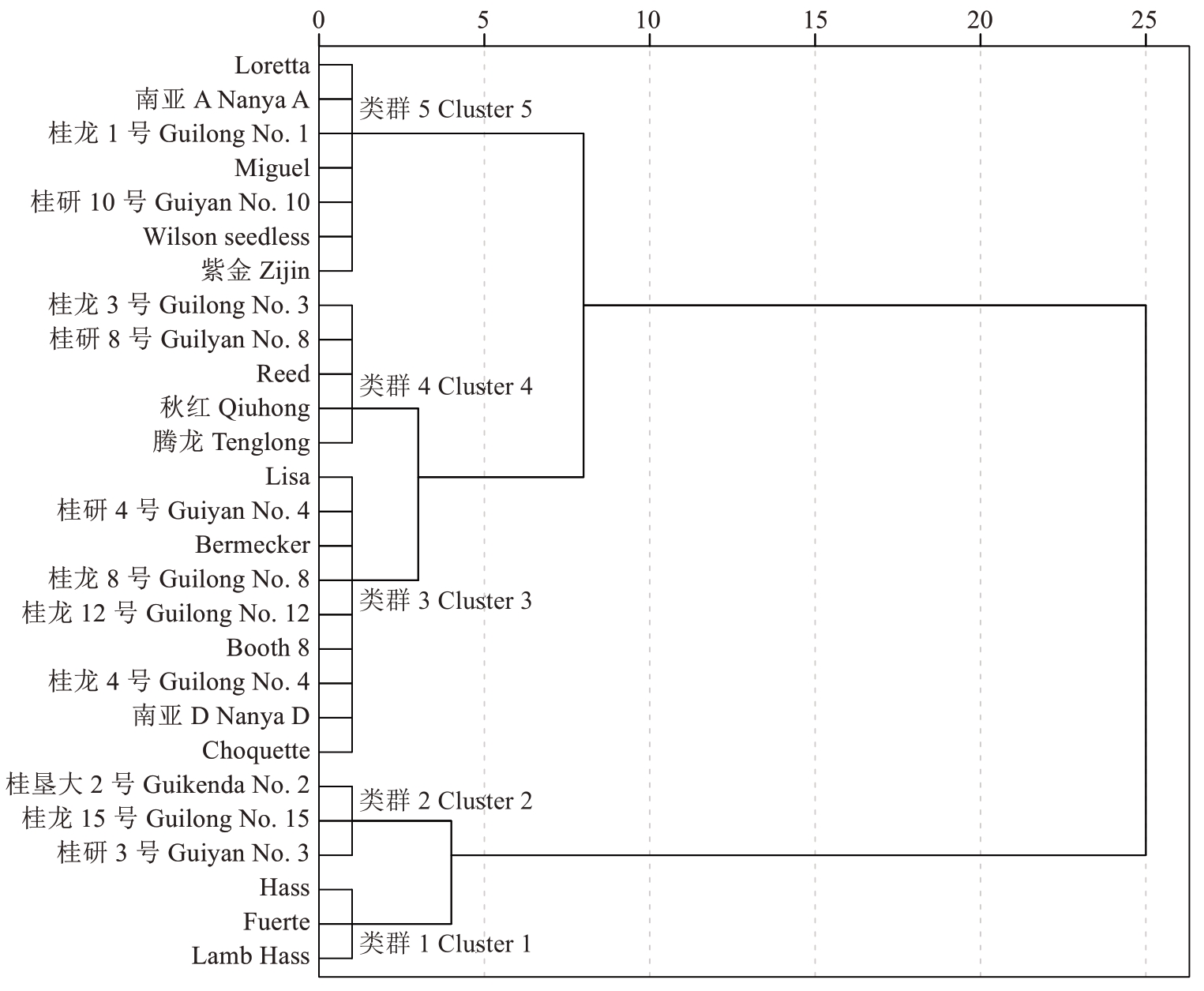
图6 27 个油梨品种的系统聚类分析
Fig. 6 Hierarchical cluster analysis of 27 avocado varieties
3 讨 论
果实品质评价是筛选优异种质资源的主要依据之一,而优异的种质资源是种质创新的重要基础[19]。果实综合品质是多个品质性状共同作用的结果,遗传因素是造成不同种质资源果实品质差异的关键因素[20]。本研究结果表明,23 个品质指标在不同油梨品种间存在显著差异(P<0.05),且变异系数在3.73%~160.07%,说明油梨果实品质指标间均存在丰富的变异。
由于不同种质资源的果实品质差异大,如何科学评价果实品质对筛选优异种质资源至关重要[21]。对于果实品质综合评价而言,由于每个品质指标无明显主次之分,仅依赖单一或少数几个指标进行评价不太合理,且不同评价方法各有优缺点。因此,将多种评价方法相结合,进行全面评价更为科学、可靠[22-23]。贺鹏等[24]运用因子分析和聚类分析对澳洲坚果的41 个果实品质指标进行综合评价。李文静等[25]利用主成分分析、感官评价和聚类分析相结合的方法,构建了海棠果实品质综合评价体系,全面评价了14 种海棠果实品质。笔者利用主成分分析法将13 个油梨果实品质指标进行简化,提取了4 个主成分,累计贡献率达80.553%。基于因子分析法对不同品种的果实品质进行综合评价,筛选了Lamb Hass、Hass 和Fuerte 为品质优良的品种。同时,采用隶属函数法综合评价27 个油梨品种的果实品质,其结果与主成分分析的结果基本一致,Hass、Fuerte 和Lamb Hass 为最优的3 个品种。另外,基于13 个油梨果实品质指标,聚类分析将27个油梨品种在欧式距离为3.0 时划分为5 个类群,Hass、Fuerte 和Lamb Hass 为类群1。结合主成分综合得分以及隶属函数得分可知,类群1 的果实品质最优。上述结果与陈海红等[7]和张雪芹等[26]的研究结果一致,在中国生产的油梨品种中,以Hass品质最优。然而,Hass在中国的生理落果现象比较严重,严重影响了产量。因此,建议种植户在油梨生产中选择Fuerte 和Lamb Hass。
综上所述,Hass、Fuerte 和Lamb Hass 为果实品质表现最优的品种,可作为优良种质创新选育的材料。然而,此次对油梨品种的评价仅限于果实品质,实际生产还需考虑丰产性、抗逆性和耐贮性等农艺性状以及不同生态适应性等因素,以便于推广应用。
4 结 论
27 个油梨品种的果实品质指标之间存在显著差异,利用主成分分析、模糊数学隶属函数以及聚类分析相结合的方法对其进行综合评价,筛选出Hass、Fuerte 和Lamb Hass 为果实品质最优的品种。饱和脂肪酸含量、M/S 值、DPPH 自由基清除能力和总黄酮含量为油梨果实品质评价的核心指标。本研究结果可为油梨新品种选育及深入开发利用提供理论依据。
[1] GALLART M,PAUNGFOO-LONHIENNE C,TRUEMAN S J.Effects of a growth-promoting Paraburkholderia species on nitrogen acquisition by avocado seedlings[J]. Scientia Horticulturae,2022,295:110767.
[2] JESUS D,OLIVEIRA J R,OLIVEIRA F E,HIGA K C,JUNQUEIRA J C,JORGE A O C,BACK-BRITO G N,OLIVEIRA L D. Persea americana glycolic extract:In vitro study of antimicrobial activity against Candida albicans biofilm and cytotoxicity evaluation[J]. The Scientific World Journal,2015,2015:531972.
[3] BHUYAN D J,ALSHERBINY M A,PERERA S,LOW M,BASU A,DEVI O A,BAROOAH M S,LI C G,PAPOUTSIS K.The odyssey of bioactive compounds in avocado (Persea americana) and their health benefits[J]. Antioxidants,2019,8(10):426.
[4] ABD ELKADER A M,LABIB S,TAHA T F,ALTHOBAITI F,ALDHAHRANI A,SALEM H M,SAAD A,IBRAHIM F M.Phytogenic compounds from avocado (Persea americana L.) extracts;antioxidant activity,amylase inhibitory activity,therapeutic potential of type 2 diabetes[J]. Saudi Journal of Biological Sciences,2022,29(3):1428-1433.
[5] FAOSTAT (Food and Agriculture Organization of the United Nations). Crops and livestock products[EB/OL]. (2023-12-27)[2024-04-30]. http://www.fao.org/faostat/zh/#data/QCL.
[6] 朱利飞,刘丽琴,郑雪文,胡小文,杨转英. 3 个美国油梨品种在广东湛江引种表现评价[J]. 中国南方果树,2024,53(1):83-90.ZHU Lifei,LIU Liqin,ZHENG Xuewen,HU Xiaowen,YANG Zhuanying. Evaluation of performance of 3 American avocado cultivars introduced in Zhanjiang of Guangdong[J]. South China Fruits,2024,53(1):83-90.
[7] 陈海红,陈川,王晓平,唐鑫,黄余周,彭东海. 12 个油梨品种在广西的生长结果表现[J]. 中国南方果树,2022,51(4):84-89.CHEN Haihong,CHEN Chuan,WANG Xiaoping,TANG Xin,HUANG Yuzhou,PENG Donghai. Growth and fruiting performance of 12 avocado varieties in Guangxi[J]. South China Fruits,2022,51(4):84-89.
[8] 罗立娜,韩树全,王代谷,李茂富,马蔚红,张正学,刘小翠. 油梨果实品质的差异分析与评价[J]. 中国农业科技导报,2021,23(3):105-113.LUO Lina,HAN Shuquan,WANG Daigu,LI Maofu,MA Weihong,ZHANG Zhengxue,LIU Xiaocui. Analysis and evaluation of the differences in fruit quality of avocado[J]. Journal of Agricultural Science and Technology,2021,23(3):105-113.
[9] 潘贞珍,郑树芳,贺鹏,王文林,许鹏,宋海云,汤秀华,杜鸿平.不同油梨种质资源果实脂肪酸分析及评价[J]. 食品研究与开发,2023,44(17):133-144.PAN Zhenzhen,ZHENG Shufang,HE Peng,WANG Wenlin,XU Peng,SONG Haiyun,TANG Xiuhua,DU Hongping. Analysis and evaluation of fatty acids in different avocado germplasm resources[J]. Food Research and Development,2023,44(17):133-144.
[10] GONÇALVES D,GOUVEIA C S S,FERREIRA M J,GANANÇA J F T,PINTO D C G,DE CARVALHO M A A P. Comparative analysis of antioxidant and fatty acid composition in avocado (Persea americana Mill.) fruits:Exploring regional and commercial varieties[J]. Food Chemistry,2024,442:138403.
[11] YANG H B,WANG F Q,LI Y Q,GUO Y K,TANG X H,GU S L,CHEN H H,PANG C H,LI Y X,ZHANG J L,MA W H,WANG J S. Metabolomics analyses provide insights into the nutritional quality profiling in 95 avocado germplasms grown in China[J]. Food Chemistry:X,2024,24:101971.
[12] 程文强,徐阳,吴开云,赵献民,龚榜初. 3 种综合评价方法在柿果品质评价中的应用[J]. 南京林业大学学报(自然科学版),2023,47(4):61-72.CHENG Wenqiang,XU Yang,WU Kaiyun,ZHAO Xianmin,GONG Bangchu. Comparison of three comprehensive evaluation methods to evaluate the quality of persimmon fruit[J]. Journal of Nanjing Forestry University (Natural Sciences Edition),2023,47(4):61-72.
[13] 李勋兰,洪林,杨蕾,王武,韩国辉,农江飞,谭平. 11 个柑橘品种果实营养成分分析与品质综合评价[J]. 食品科学,2020,41(8):228-233.LI Xunlan,HONG Lin,YANG Lei,WANG Wu,HAN Guohui,NONG Jiangfei,TAN Ping. Analysis of nutritional components and comprehensive quality evaluation of citrus fruit from eleven varieties[J]. Food Science,2020,41(8):228-233.
[14] HASHEMI S M,KHADIVI A. Morphological variability of Prunus lycioides Spach germplasm using multivariate analysis[J].Scientia Horticulturae,2020,261:108973.
[15] POONIA A,PHOGAT D S,VERSHA,NAGAR S,SHARMA P,KUMAR V. Biochemical assessment of oat genotypes revealed variability in grain quality with nutrition and crop improvement implications[J]. Food Chemistry,2022,377:131982.
[16] 王因花,孔雨光,燕丽萍,吴德军,任飞,李庆华. 山东省22 份元宝枫种质资源含油率及脂肪酸组分分析[J]. 中南林业科技大学学报,2023,43(2):180-187.WANG Yinhua,KONG Yuguang,YAN Liping,WU Dejun,REN Fei,LI Qinghua. Seed oil content and fatty acid composition analysis of 22 germplasm of Acer truncatum Bunge in Shandong province[J]. Journal of Central South University of Forestry & Technology,2023,43(2):180-187.
[17] 葛宇,司雄元,曹剑秋,胡福初,吴康,徐慧敏,檀华蓉,臧小平,马蔚红. 油梨果肉营养及生物活性成分分析[J]. 中国南方果树,2017,46(5):50-53.GE Yu,SI Xiongyuan,CAO Jianqiu,HU Fuchu,WU Kang,XU Huimin,TAN Huarong,ZANG Xiaoping,MA Weihong. Analysis of nutritional and bioactive components in avocado pulp[J].South China Fruits,2017,46(5):50-53.
[18] 国家卫生和计划生育委员会,国家食品药品监督管理总局.食品安全国家标准 食品中脂肪酸的测定:GB 5009.168—2016[S]. 北京:中国标准出版社,2017.National Health and Family Planning Commission of the People’s Republic of China,China Food and Drug Administration.National food safety standards determination of fatty acids in food:GB 5009.168—2016[S]. Beijing:Standards Press of China,2017.
[19] 张琦,蒲婷婷,王艺儒,胡银凤,李华威,韩卫娟,索玉静,傅建敏. 不同柿种质果实品质多样性评价[J]. 中国农业大学学报,2025,30(2):61-71.ZHANG Qi,PU Tingting,WANG Yiru,HU Yinfeng,LI Huawei,HAN Weijuan,SUO Yujing,FU Jianmin. Quality diversity evaluation of different persimmon fruits[J]. Journal of China Agricultural University,2025,30(2):61-71.
[20] 蔡宗明,刘仁,聂林芽,贺小林,朱琪,郭志强,张旭,钟文斌.不同种源苦槠果实品质差异及综合评价[J]. 中南林业科技大学学报,2024,44(12):39-50.CAI Zongming,LIU Ren,NIE Linya,HE Xiaolin,ZHU Qi,GUO Zhiqiang,ZHANG Xu,ZHONG Wenbin. Study on fruit quality difference and comprehensive evaluation of different provenances of Castanopsis sclerophylla[J]. Journal of Central South University of Forestry & Technology,2024,44(12):39-50.
[21] 何艳丽,秦红艳,温锦丽,范书田,杨义明,张宝香,曹炜玉,路文鹏,李昌禹. 35 份软枣猕猴桃资源果实品质分析与综合评价[J]. 果树学报,2023,40(8):1523-1533.HE Yanli,QIN Hongyan,WEN Jinli,FAN Shutian,YANG Yiming,ZHANG Baoxiang,CAO Weiyu,LU Wenpeng,LI Changyu.Quality analysis and comprehensive evaluation of 35 Actinidia argute accessions[J]. Journal of Fruit Science,2023,40(8):1523-1533.
[22] 陈烨锜,庞柳,陈小央,郑婷,向江,魏灵珠,吴江,徐凯,程建徽. 基于不同方法综合评价浙北平原地区101 份鲜食葡萄果实品质[J]. 果树学报,2024,41(12):2377-2388.CHEN Yeqi,PANG Liu,CHEN Xiaoyang,ZHENG Ting,XIANG Jiang,WEI Lingzhu,WU Jiang,XU Kai,CHENG Jianhui. Comprehensive evaluation of berry qualities of 101 table grape cultivars cultivated in northern Zhejiang plain based on different methods[J]. Journal of Fruit Science,2024,41(12):2377-2388.
[23] 张慧艺,汪丽霞,吴伊静,毕旭灿,王刚,赵四清,徐昌杰,陈昆松. 18 份胡柚种质果实品质分析与综合评价[J]. 果树学报,2024,41(6):1033-1043.ZHANG Huiyi,WANG Lixia,WU Yijing,BI Xucan,WANG Gang,ZHAO Siqing,XU Changjie,CHEN Kunsong. Fruit quality analysis and comprehensive evaluation of 18 Huyou (Citrus changshanensis) accessions[J]. Journal of Fruit Science,2024,41(6):1033-1043.
[24] 贺鹏,张涛,宋海云,谭秋锦,郑树芳,覃振师,黄锡云,汤秀华,王文林. 广西澳洲坚果果实品质分析与综合评价[J]. 食品科学,2021,42(24):242-251.HE Peng,ZHANG Tao,SONG Haiyun,TAN Qiujin,ZHENG Shufang,QIN Zhenshi,HUANG Xiyun,TANG Xiuhua,WANG Wenlin. Quality analysis and comprehensive evaluation of the fruit of Macadamia integrifolia grown in Guangxi province[J].Food Science,2021,42(24):242-251.
[25] 李文静,刘一心,陈明堃,卓越,吴杨,李厚华. 14 种海棠果实品质分析及综合评价[J]. 食品科学,2024,45(16):121-130.LI Wenjing,LIU Yixin,CHEN Mingkun,ZHUO Yue,WU Yang,LI Houhua. Quality analysis and comprehensive evaluation of 14 varieties of crabapples[J]. Food Science,2024,45(16):121-130.
[26] 张雪芹,欧阳海波,谢志南,林丽霞,赖瑞云,钟赞华,林建忠.不同品种油梨果实品质、光合特性比较及其相关分析[J]. 南方农业学报,2023,54(2):405-413.ZHANG Xueqin,OUYANG Haibo,XIE Zhinan,LIN Lixia,LAI Ruiyun,ZHONG Zanhua,LIN Jianzhong. Comparison and correlation analysis of fruit quality and photosynthetic characteristics of different varieties of avocado[J]. Journal of Southern Agriculture,2023,54(2):405-413.