甘肃省陇东地区是中国重要的苹果主产区,凭借其独特的地理环境和气候条件,所产苹果甜度高、着色好、果香浓郁[1]。但陇东地处黄土高原,干旱少雨,水资源匮乏,农业以雨养为主。长期连年种植导致土壤有机质含量降低,养分失衡,严重制约了苹果产业的可持续发展[2]。由于当地果园多采用清耕制,导致土壤有机质含量(w,后同)仅0.6%~1.2%,低于果树生长的适宜水平(1.5%)[3]。此外,该地区水土流失严重,导致土体结构疏松,保水蓄肥能力下降。长期不合理的节水保墒措施,导致土壤团聚体的稳定性下降、孔隙度降低、黏粒含量增加,不利于土壤中有机碳的固存[4-5]。目前,该产区常年采取覆膜的方式进行节水保墒,进一步加剧了土壤退化,严重影响苹果产业的可持续发展。针对陇东地区苹果种植面临的问题,研究者多采用果园管理措施进行改良,其中间作(intercropping)因能有效改善果园土壤质量而受到广泛关注。在旱地果园与油菜间作能够有效提升土壤孔隙度,提高土壤的通气性与保水能力[6]。
间作作为陇东旱塬苹果园重要的种植模式,即通过在同一土地上协调种植苹果与其他作物,能够显著改善土壤理化性质并促进碳氮循环[7]。相比传统单作模式,间作能够利用不同植物的生态位互补效应,在养分利用、空间分布及水分竞争等方面形成协同关系,从而优化资源利用效率并促进植物生长。果园间作白三叶草能够使土壤有机质含量显著提高16%~61%,其作用机制表现为:细菌群落多样性增加促进了有机质组分的转化,而真菌通过选择性降解木质素形成难降解的腐殖质[8]。这一过程与豆科作物的生态功能密切相关,其通过生物固氮作用提高了土壤氮素含量,同时根系分泌物和残体归还显著增加了土壤有机碳储量,形成了良性的碳氮循环体系[9]。不同作物根系的穿插作用能够改善土壤孔隙结构和水分利用效率。间作模式通过增强植物-土壤-微生物的互作,形成了高效的碳氮循环体系,对维持旱塬区苹果园的土壤肥力和生态可持续性具有重要作用。例如,茶树-大豆间作通过调控硝化菌和反硝化菌的群落组成减少N2O 排放,并通过凋落物输入增加土壤有机碳含量,提高团聚体稳定性[10]。此外,间作能有效提高光、热、水、肥等资源的利用率。如高秆与矮秆作物间作可形成立体冠层结构,提高光能利用率;深根作物与浅根作物间作可以充分利用不同土层的养分和水分[11]。间作还能够改善田间的生态环境,抑制病虫害的发生,减少对化学农药的依赖,促进农业生态系统的平衡,为绿色农业和可持续发展提供重要途径[12]。当前陇东旱塬区果园间作系统研究存在明显不足,主要表现为适生作物筛选体系尚未建立,土壤养分循环与理化性质改良的互作机制研究较少,间作模式的生态改良效应未能充分发挥。
本研究以陇东旱塬苹果园为研究对象,以清耕为对照,分析葱、油菜间作和自然生草3种处理对果园土壤理化性质、机械组成、酶活性及碳氮组分的调控效应,系统阐明不同间作模式下土壤理化性质与土壤碳氮组分的互作机制,以期为旱作果园的土壤培肥与可持续管理提供理论依据和技术支撑。
1 材料和方法
1.1 试验区概况
本试验地位于国家苹果农业产业技术体系平凉综合试验站(35°18.657′ N,107°37.974′ E),平均海拔1282 m,年均气温9.9 ℃,年日照时长2315 h,无霜期174 d,年均降水量553.4 mm,蒸发量1438 mm。土壤类型为黄绵土,土壤养分含量为:硝态氮26.44 mg·kg-1,铵态氮18.33 mg·kg-1,速效磷36.24 mg·kg-1,速效钾218.3 mg·kg-1,饱和含水率21.9%。
1.2 试验设计和采样方法
试验于2022 年3 月至2024 年10 月进行,为期3年,每年9 月重新播种以保持种植模式的一致性。选用8 年生礼泉短富苹果树为研究对象,砧木为M26/八棱海棠,株行距为2 m×4 m。试验共设置4个处理:(1)清耕(对照,CK):人工除草,保持地面无植被;(2)葱间作(A):距主干0.5 m 处撒播,播种量45 kg·hm-2,生长期除草,成熟后整株移除;(3)油菜间作(B):距主干0.5 m处撒播,播种量37.5 kg·hm-2,花期刈割并粉碎还田,留茬5 cm;(4)自然生草(C):保留杂草并每月刈割,留茬10 cm,主要草种类型包括蒲公英21.5%、灰条18.1%、夏至草15.1%、油菜13.7%、二月兰12.6%、萹蓄10.3%和离子芥8.7%。每个处理设置3 个重复小区,每小区包含3 行×5 株(120 m2)。播种前统一深翻20 cm,施入过磷酸钙300 kg·hm-2和氯化钾75 kg·hm-2作为基肥。2024年10 月采样,每个小区采用五点取样法,分别在果树滴水线(距主干0.75 m)和间作带中心位置采集0~20 cm 和20~40 cm 土层样品。其中,环刀法采集原状土用于土壤物理性质测定;混合土样过2 mm筛后分为两份,一份用于土壤机械组成测定(自然风干),另一份用于碳氮组分及酶活性测定(4 ℃保存)。
1.3 土壤理化性质测定
土壤物理性质测定:将环刀采集的土壤转入已称质量铝盒(M0)内,再次称质量(M1),将铝盒转入烘箱内105 ℃烘干至恒质量,称取质量(M2),土壤各物理性质计算如下:
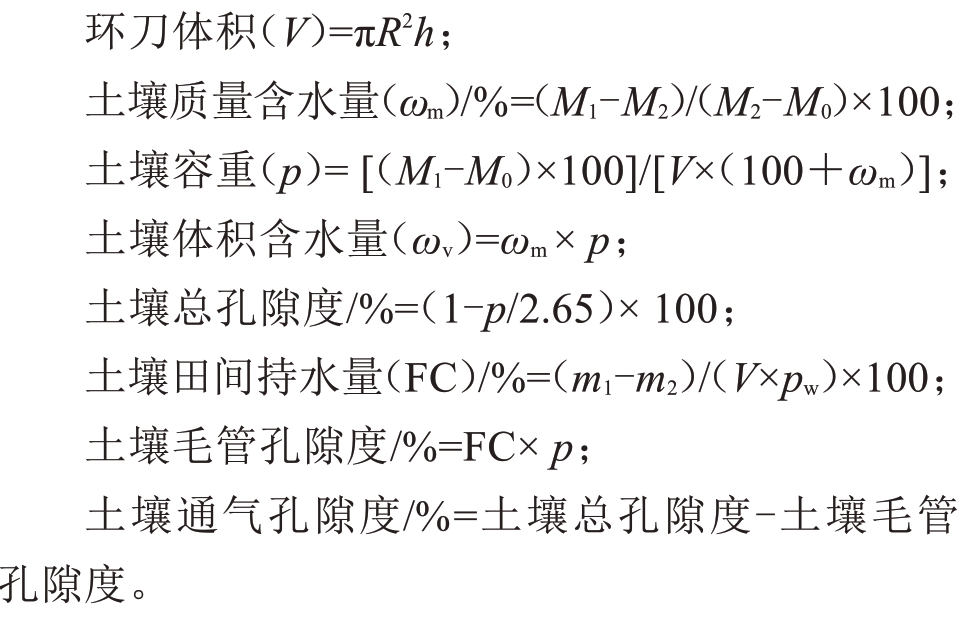
式中,m1为土样饱和后排水至重力水消失的质量;m2为土样烘干后的质量;pw为水的密度值(1 g·cm-3)。
土壤机械组成测定:采用激光粒度分析仪(Mastersizer 2000,Malvern Panalytical,Worcestershire,UK)测定,每个样品重复测定3次,取平均值。
土壤碳氮组分含量测定:总有机碳和有机质含量采用重铬酸钾外加热法测定;颗粒有机氮和全氮含量采用凯氏定氮法测定;全碳含量采用高温燃烧法测定;微生物生物量碳、氮含量采用氯仿熏蒸法测定;可溶性有机氮含量采用硫酸钾氧化法测定;可溶性有机碳含量采用总有机碳分析仪(TOC-L)测定;易氧化有机碳含量采用333 mmol·L-1高锰酸钾氧化法测定;颗粒有机碳含量采用六偏磷酸钠分散法测定;重组有机碳和轻组有机碳含量采用密度分离法测定[13]。
土壤酶活性测定:脲酶活性测定采用靛酚蓝比色法;β-1,4-葡萄糖苷酶、β-1,4-N-乙酰基氨基葡萄糖苷酶、亮氨酸氨基肽酶、纤维二糖水解酶和β-1,4-木糖苷酶活性测定采用微孔板荧光法[14]。
1.4 数据处理
使用Microsoft Excel 2019 进行数据处理,使用SPSS 23.0软件进行单因素方差分析(ANOVA,LSD,P<0.05),使用Origin 2021 软件绘制相关数据图。
2 结果与分析
2.1 不同间作模式对土壤物理性质的影响
如图1 所示,不同间作模式均提高了表层土壤(0~20 cm)的含水量。其中,B 处理的土壤体积含水量和质量含水量较CK 分别提高了31.56%和18.76%。与CK 相比,A 和B 处理的土壤容重降低7.97%~8.70%,总孔隙度提高8.66%~9.74%;C 处理的土壤容重增加2.17%,毛管孔隙度显著提高48.47%;A处理的土壤通气孔隙度增加6.31%。
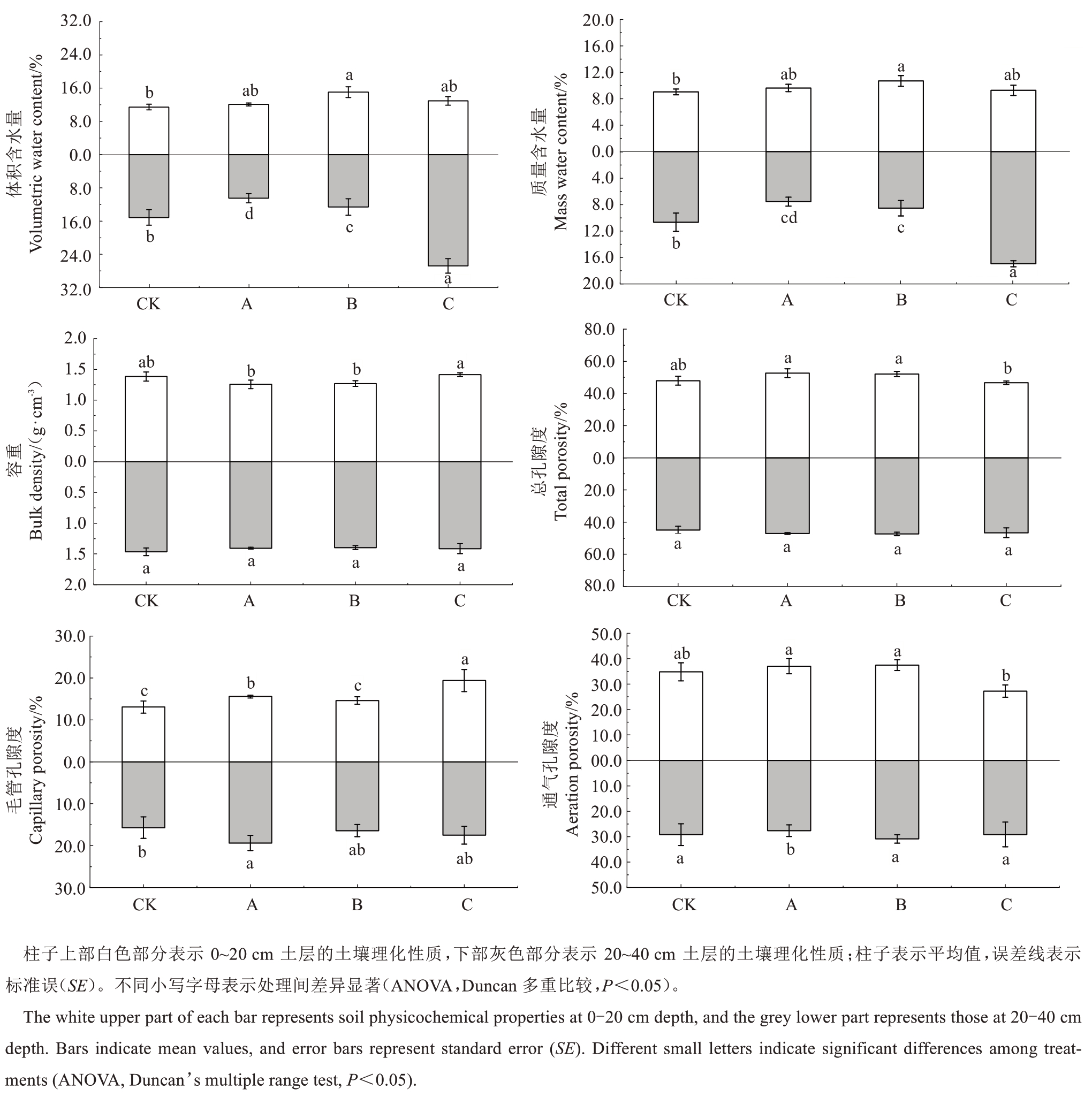
图1 不同间作模式对土壤理化性质的影响
Fig. 1 Effects of different intercropping modes on soil physicochemical properties
在亚表层土壤(20~40 cm)中,C 处理的土壤体积含水量和质量含水量较CK 分别提高了77.15%和58.65%。各处理间的土壤容重和总孔隙度均无显著差异。不同间作模式土壤毛管孔隙度均高于CK,较CK 分别增加了23.31%、4.59%和11.40%。A 处理的土壤通气孔隙度较CK降低了5.27%(图1)。
2.2 不同间作模式对土壤质地的影响
根据国际制土壤质地分类标准划分土壤颗粒组成,在表层土壤中黏粒(<0.002 mm)占比10.53%~11.01%,粉粒(0.002~0.050 mm)占比68.17%~71.65%,砂粒(0.05~2.00 mm)占比16.45%~20.38%。不同间作处理的土壤粗砂(0.5~1.0 mm)占比存在差异,其中CK 和A 处理的土壤粗砂占比较高,分别为0.92%和0.76%;而在B 和C 处理中占比较低,分别为0.38%和0.27%(图2)。
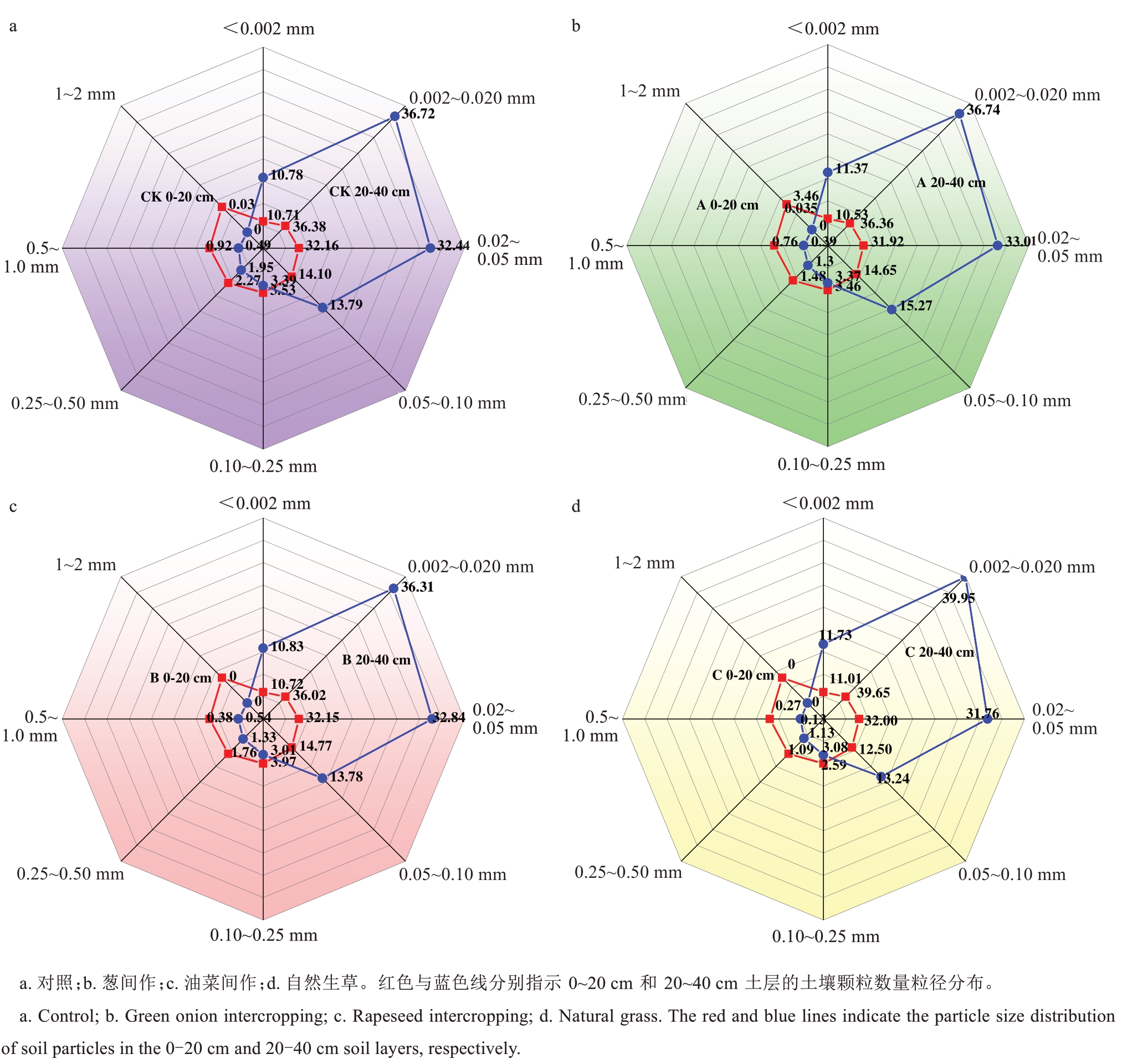
图2 不同间作模式对土壤机械组成的影响
Fig. 2 Effects of different intercropping patterns on soil mechanical composition
不同间作处理亚表层土壤中黏粒(<0.002 mm)占比10.83%~11.73%,粉粒(0.002~0.050 mm)占比69.15%~71.71%,砂粒(0.05~2.00 mm)占比17.58%~20.33%。不同间作处理的土壤中砂粒(0.05~0.10 mm、0.10~0.25 mm、0.25~0.50 mm)和粗砂(0.5~1.0 mm)占比存在一定的差异。其中,C处理土壤中>0.05 mm的土壤颗粒占比均低于其他处理,B 处理土壤中砂(0.25~0.50 mm)和粗砂(0.5~1.0 mm)含量最高,分别为1.33%和0.54%(图2)。
2.3 不同间作模式对土壤碳氮组分的影响
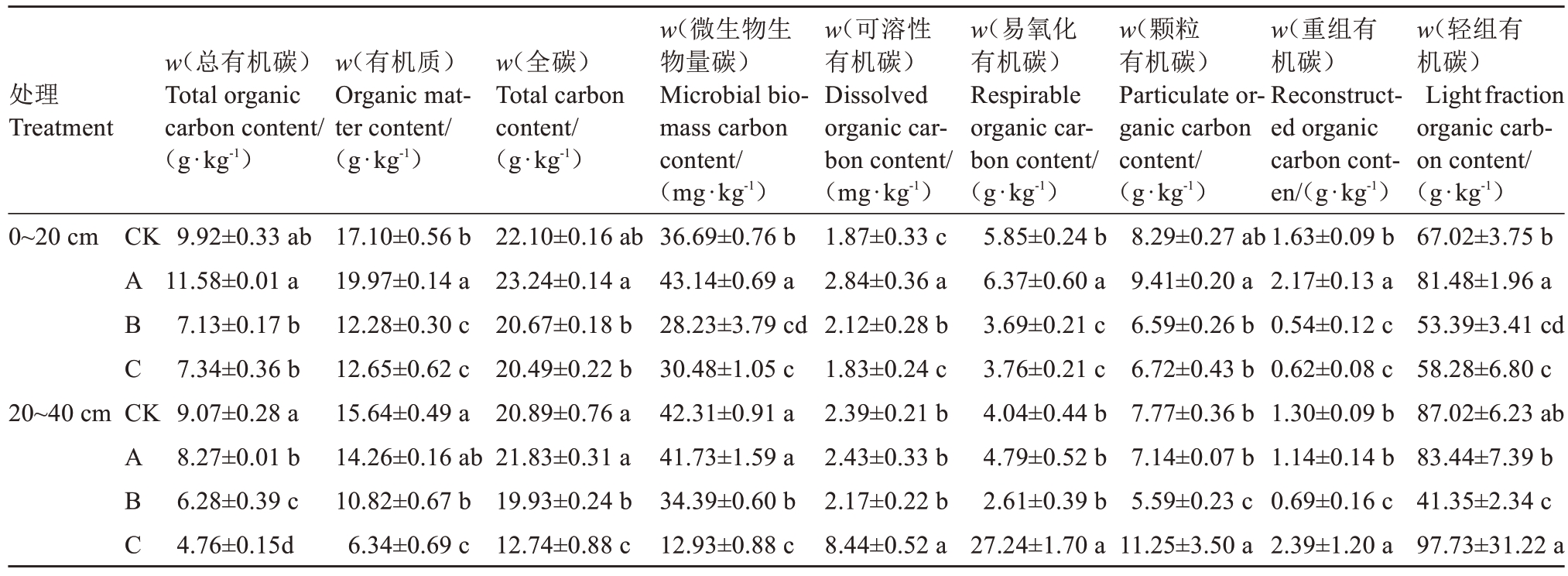
在表层土壤中,A 处理能增加土壤中碳氮养分含量,其中有机质和微生物生物量碳含量较CK 分别增加了16.78%和17.58%;全氮和微生物生物量氮含量较CK 分别增加了25.27%和47.37%。而B 和C处理土壤中,总有机碳、有机质、全碳、微生物生物量碳、全氮、微生物生物量氮和可溶性有机氮含量均低于CK。A 处理显著提高了土壤中部分活性碳组分含量,其中可溶性有机碳含量增幅最大(51.87%),其次是重组有机碳(33.13%)。其他处理土壤各碳氮指标均低于CK(表1~表2)。
表1 不同间作模式对土壤碳组分的影响
Table 1 Effects of different intercropping patterns on soil carbon components
注:同列不同小写字母表示差异显著(P<0.05)。下同。
Note:Different small letters in the same column indicate significant difference at P<0.05. The same below.
处理Treatment w(总有机碳)Total organic carbon content/(g·kg-1)w(有机质)Organic matter content/(g·kg-1)w(全碳)Total carbon content/(g·kg-1)0~20 cm CK 20~40 cm w(轻组有机碳)Light fraction organic carbon content/(g·kg-1)67.02±3.75 b 81.48±1.96 a 53.39±3.41 cd 58.28±6.80 c 87.02±6.23 ab 83.44±7.39 b 41.35±2.34 c 97.73±31.22 a A B C C K A B C 9.92±0.33 ab 11.58±0.01 a 7.13±0.17 b 7.34±0.36 b 9.07±0.28 a 8.27±0.01 b 6.28±0.39 c 4.76±0.15d 17.10±0.56 b 19.97±0.14 a 12.28±0.30 c 12.65±0.62 c 15.64±0.49 a 14.26±0.16 ab 10.82±0.67 b 6.34±0.69 c 22.10±0.16 ab 23.24±0.14 a 20.67±0.18 b 20.49±0.22 b 20.89±0.76 a 21.83±0.31 a 19.93±0.24 b 12.74±0.88 c w(微生物生物量碳)Microbial biomass carbon content/(mg·kg-1)36.69±0.76 b 43.14±0.69 a 28.23±3.79 cd 30.48±1.05 c 42.31±0.91 a 41.73±1.59 a 34.39±0.60 b 12.93±0.88 c w(可溶性有机碳)Dissolved organic carbon content/(mg·kg-1)1.87±0.33 c 2.84±0.36 a 2.12±0.28 b 1.83±0.24 c 2.39±0.21 b 2.43±0.33 b 2.17±0.22 b 8.44±0.52 a w(易氧化有机碳)Respirable organic carbon content/(g·kg-1)5.85±0.24 b 6.37±0.60 a 3.69±0.21 c 3.76±0.21 c 4.04±0.44 b 4.79±0.52 b 2.61±0.39 b 27.24±1.70 a w(颗粒有机碳)Particulate organic carbon content/(g·kg-1)8.29±0.27 ab 9.41±0.20 a 6.59±0.26 b 6.72±0.43 b 7.77±0.36 b 7.14±0.07 b 5.59±0.23 c 11.25±3.50 a w(重组有机碳)Reconstructed organic carbon conten/(g·kg-1)1.63±0.09 b 2.17±0.13 a 0.54±0.12 c 0.62±0.08 c 1.30±0.09 b 1.14±0.14 b 0.69±0.16 c 2.39±1.20 a
表2 不同间作模式对土壤氮组分的影响
Table 2 Effects of different intercropping modes on soil nitrogen components
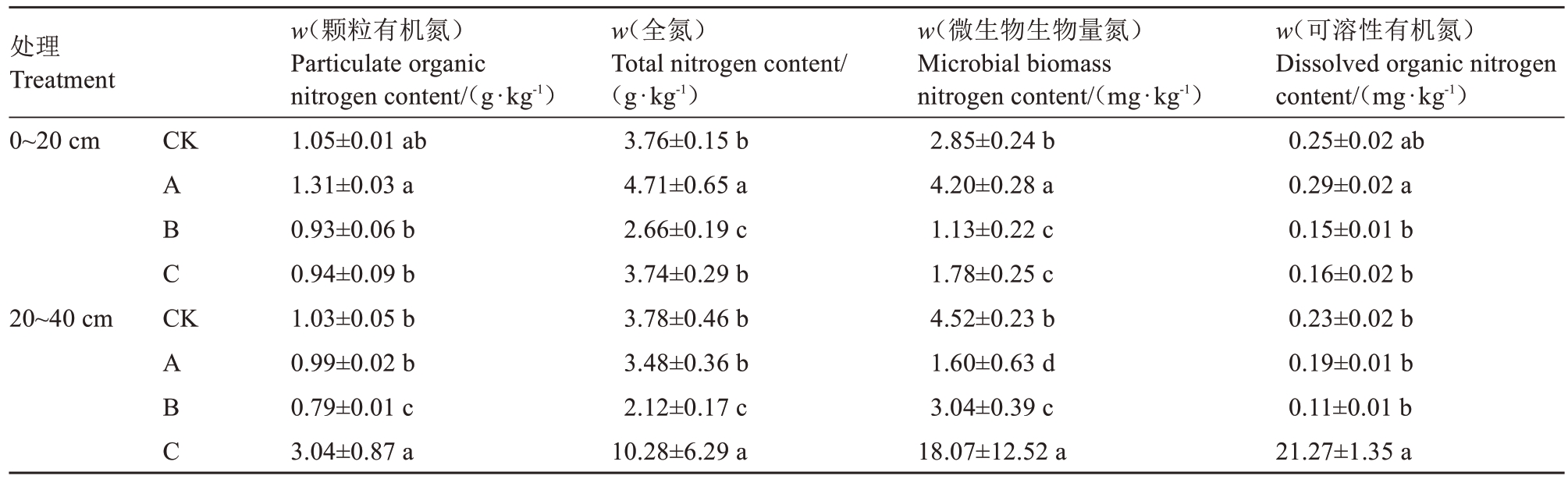
处理Treatment 0~20 cm CK 20~40 cm A B C C K A B C w(颗粒有机氮)Particulate organic nitrogen content/(g·kg-1)1.05±0.01 ab 1.31±0.03 a 0.93±0.06 b 0.94±0.09 b 1.03±0.05 b 0.99±0.02 b 0.79±0.01 c 3.04±0.87 a w(全氮)Total nitrogen content/(g·kg-1)3.76±0.15 b 4.71±0.65 a 2.66±0.19 c 3.74±0.29 b 3.78±0.46 b 3.48±0.36 b w(微生物生物量氮)Microbial biomass nitrogen content/(mg·kg-1)2.85±0.24 b 4.20±0.28 a 1.13±0.22 c 1.78±0.25 c 4.52±0.23 b 1.60±0.63 d w(可溶性有机氮)Dissolved organic nitrogen content/(mg·kg-1)0.25±0.02 ab 0.29±0.02 a 0.15±0.01 b 0.16±0.02 b 0.23±0.02 b 0.19±0.01 b 2.12±0.17 c 10.28±6.29 a 3.04±0.39 c 18.07±12.52 a 0.11±0.01 b 21.27±1.35 a
在亚表层土壤中,CK 土壤中总有机碳和有机质含量高于其他处理。A处理土壤中全碳含量高于其他处理,较CK 增加了4.50%。C 处理土壤中易氧化有机碳、颗粒有机碳、颗粒有机氮、重组有机碳和轻组有机碳含量分别较CK增加了574.25%、44.79%、195.15%、83.85%和12.31%,而CK 和A 处理土壤中全碳和微生物生物量碳含量显著高于其他处理。C处理土壤中颗粒有机氮、全氮、微生物生物量氮和可溶性有机氮含量均显著高于其他处理(表1~表2)。
2.4 不同间作模式对土壤酶活性的影响
不同间作处理对土壤酶活性的影响如图3 所示。在表层土壤中,不同处理的土壤中脲酶活性无显著差异(P>0.05)。C 处理土壤中β-1,4-葡萄糖苷酶和纤维二糖水解酶活性高于其他处理(P<0.05),较CK 分别增加了68.89%和105.49%。A 处理土壤中β-1,4-N-乙酰基氨基葡萄糖苷酶活性较CK 升高了13.53%。B处理土壤中β-1,4-木糖苷酶活性较CK升高了55.60%。
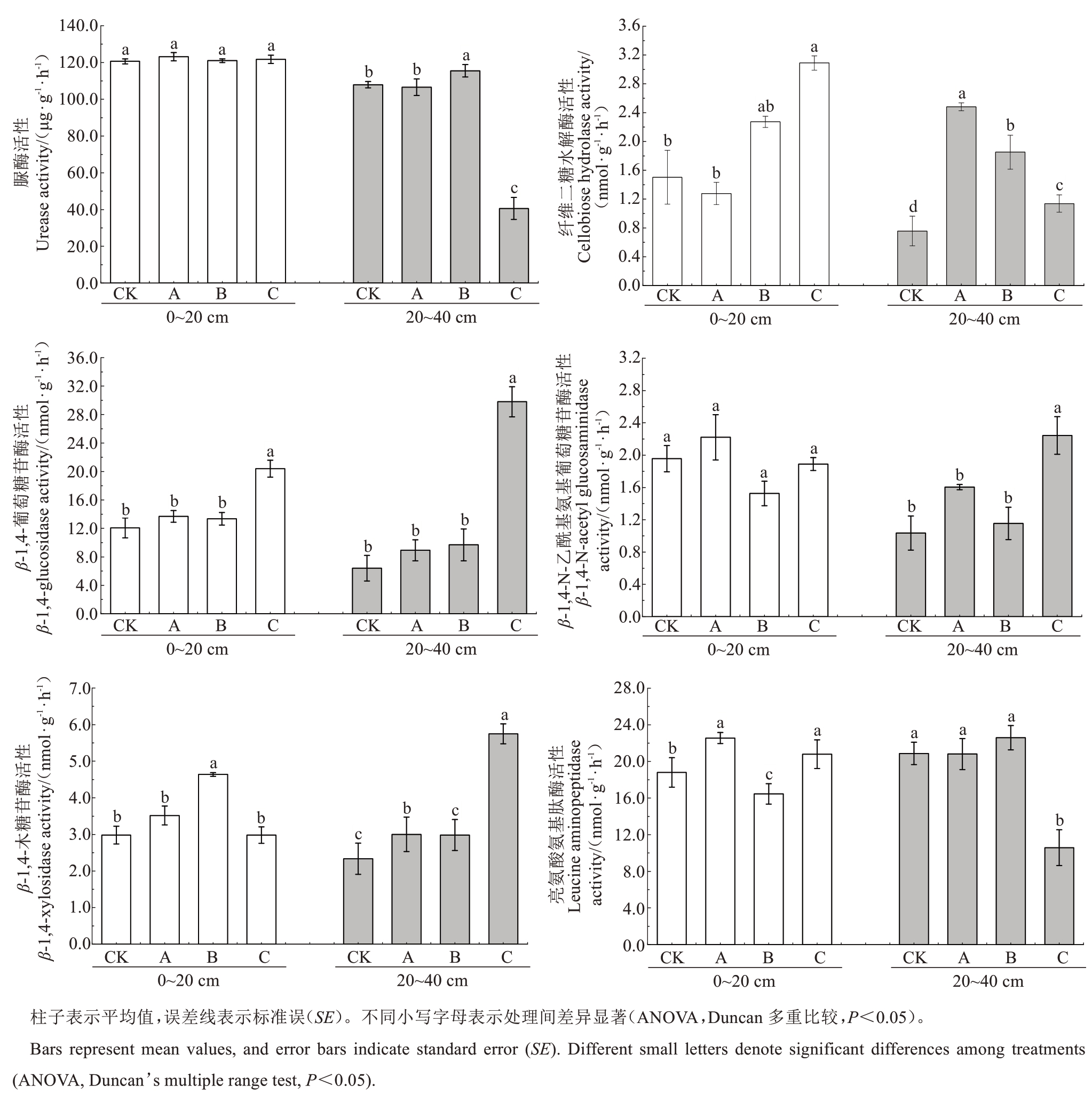
图3 不同间作模式对土壤酶活性的影响
Fig. 3 Effects of different intercropping patterns on soil enzyme activities
B 处理显著提高了亚表层土壤中脲酶活性,较CK增加了7.02%。C处理土壤中β-1,4-葡萄糖苷酶、β-1,4-N-乙酰基氨基葡萄糖苷酶和β-1,4-木糖苷酶活性较CK 分别增加了365.78%、115.38%和145.30%。A 处理土壤中纤维二糖水解酶活性较CK 增加了230.67%(图3)。
2.5 土壤理化性质与碳氮组分的相关性分析
土壤理化性质与碳氮组分的相关性分析(P<0.01,P<0.05)结果表明(图4),不同土层中土壤理化性质与碳氮组分存在显著相关性。在表层土壤中,物理性质对土壤碳氮组分具有显著影响,其中土壤容重和孔隙度与颗粒有机碳含量呈显著负相关(r=-0.98)和正相关(r=0.98)。土壤黏粒含量与全碳含量呈显著负相关(r=-0.97)。酶活性方面,脲酶活性与微生物生物量氮含量呈显著正相关(r=0.97),β-1,4-N-乙酰基氨基葡萄糖苷酶活性与易氧化有机碳含量呈完全正相关(r=1.00),β-1,4-木糖苷酶活性则与微生物生物量碳含量呈显著负相关(r=-0.98)。

图4 不同间作模式土壤理化性质与土壤碳氮组分的相关性分析
Fig. 4 Correlation analysis of soil physicochemical properties and soil carbon and nitrogen components in different intercropping modes
亚表层土壤中各理化因子与碳氮组分的相关性呈现规律性特征。土壤水分指标(体积含水量和质量含水量)与微生物生物量氮、易氧化有机碳、颗粒有机碳、颗粒有机氮及全氮含量均呈显著正相关(r=0.95~0.98)。土壤机械组成的影响具有粒径特异性,其中0.002~0.020 mm 粉粒与大多数碳氮组分呈正相关(r=0.96~1.00),而0.05~1.00 mm 砂粒则普遍呈负相关(r=-0.95~-0.96)。酶活性指标对土壤碳氮组分表现出复杂的调控模式,其中脲酶活性与部分碳组分呈正相关(r=0.98),而与氮组分呈负相关(r=-0.96~-0.99);β-1,4-葡萄糖苷酶活性与氮组分呈高度正相关(r=0.97~1.00),但与部分碳组分呈负相关(r=-0.96~-0.99);β-1,4-木糖苷酶活性与全碳含量呈完全负相关(r=-1.00),而与氮组分普遍呈正相关(r=0.96~0.99)。
3 讨 论
3.1 不同间作模式对土壤物理性质的影响
间作模式可有效改善土壤物理性质,优化土壤结构,提高孔隙度、通气性和水分渗透能力[15]。本研究结果表明不同间作模式对土壤水分保蓄、容重及孔隙结构影响显著。在表层土壤中,C 处理显著提高了表层土壤含水量,其改善效果主要取决于植物根系的结构和分布特征。油菜属于直根系,主根粗且入土深,有利于改善土壤的透气性和提高水分下渗能力[16]。因此,B 处理显著提高了土壤质量含水量和体积含水量,较CK 分别提高了18.76%和31.56%。葱的须根发达,分布浅且广,其密集的根系网络可显著增加表层土壤孔隙度[17]。因此,A 处理能有效提高土壤总孔隙度(较CK 提高9.74%)和通气孔隙度(较CK 提高6.31%),改善土壤的透气性。C 处理则因多层次、多方向的根系结构,部分草种根系深入亚表层土壤的特性,表现出更持久的土壤改良效果[18]。因此,C 处理的土壤毛管孔隙度最高,较CK 增加了48.47%,表明其在增强毛细水保持能力方面具有显著优势。研究表明毛细水持水能力的增强可缓解冬春连旱的不利影响,维持土壤微生物活性,进而促进苹果根系活力恢复和树液流动[19]。在亚表层土壤中(苹果主要根系分布区),C处理因多种草种根系密集深扎,显著提升了土壤持水能力,促进了水分下渗与贮存,优化了根系活力,并显著改善了根际微生态环境。此外,各处理间土壤容重和总孔隙度均未表现出显著差异,表明间作模式对深层土壤(亚表层)结构影响较弱。但各间作模式的毛管孔隙度均高于CK,说明间作有助于增强土壤水分的毛管传输能力。其中,A 与B 处理通过增加土壤孔隙度改善土壤透气性,从而促进土壤有机碳循环;而C处理因独特的根系结构,更有利于提升土壤持水性和毛细输水能力,进而促进亚表层土壤氮素的转化[20]。
土壤物理性质的改善与其机械组成密切相关。土壤孔隙度和持水能力等宏观物理特性本质上是土壤颗粒组成、粒径分布与级配特征的微观表现[21]。反之,土壤颗粒组成决定了其结构稳定性、通气性和保水性等基础性能[22]。研究表明,间作植物根系在生长过程中通过机械扰动与生物化学作用,改变土壤颗粒分布,促进团聚体的形成与分解,从而优化土壤结构[23-24]。本研究结果表明间作模式对不同粒径土壤颗粒的分布具有显著的影响。在表层土壤中,各处理土壤颗粒组成主要为粉粒,其中0.5~1.0 mm的粗砂颗粒在不同间作处理间存在差异。A 和B 处理通过根系生物量积累与土壤颗粒细化作用,显著提升了粗砂比例及土壤通气性[25];而C 处理通过多样化的根系网络及根系分泌物作用,细化了土壤颗粒,优化了粒径分布,从而增强土壤结构的稳定性。在亚表层土壤中,土壤颗粒分布范围较广,且不同间作模式对各粒径土壤颗粒的影响显著。土壤颗粒组成具有显著差异,C 处理土壤中粗砂含量最低,B 处理土壤中大颗粒占比较高,这主要与油菜的根系形态有关[26]。因此,在果园土壤管理中,应结合改良目标和土壤类型优化土壤物理性质与机械组成。
3.2 不同间作模式对土壤碳氮循环的影响
研究表明,间作处理通过增加外源有机质的输入、优化土壤碳氮比、提高氮素含量、促进微生物活动以减少碳氮流失[27-28]。本研究结果进一步证实,不同间作模式对土壤有机碳、氮素养分及其活性组分的分布具有显著影响,且这种影响随土层深度变化呈现差异化特征。在表层土壤中,A 处理显著提高了有机质、微生物生物量碳、可溶性有机碳、全氮和微生物生物量氮等的含量,对碳氮养分积累和活性碳组分增强具有双重促进作用。研究表明葱的根系分泌物能够提高微生物群落多样性与代谢活性,进而促进有机质分解和团聚体形成,与本研究结果一致[29]。在亚表层土壤中,有机质积累主要受自然沉积过程(植物、动物及微生物残体)的影响[30],但C 处理显著提高了深层土壤的全氮、微生物生物量氮和部分活性有机碳组分含量,表明该模式在深层土壤中仍能提高有机碳稳定性和碳氮储存能力。针对苹果根系层碳氮匮乏的果园,可采用此方法以改善营养供给。在果园管理中,若需增加表层碳氮养分,宜采用A 处理;若需提升深层土壤-苹果根系集中分布区域的碳储存能力与生态稳定性,C处理更具优势。
土壤酶活性驱动土壤碳氮组分的积累和转化过程,可作为碳氮循环潜力的重要生物学指标[31]。本研究发现,不同间作模式对土壤酶活性的影响具有显著差异性。在表层土壤中,不同处理土壤中脲酶活性无显著差异,表明间作对氮素转化的直接驱动有限。C 处理显著提高了β-1,4-葡萄糖苷酶、亮氨酸氨基肽酶和纤维二糖水解酶等碳水化合物和蛋白质降解相关的酶活性,分别较CK 增加了68.89%、10.64%和105.49%。研究表明油菜间作能够提高土壤碳氮循环相关酶活性,加速土壤有机质分解和矿化,提高微生物活性和碳源可利用性,这与本研究结果一致[32]。A 处理显著提高了β-1,4-N-乙酰基氨基葡萄糖苷酶活性,该酶与几丁质、含氮有机物的分解密切相关[33],表明葱间作提高了土壤有机氮源的矿化速率,间接促进了土壤氮素的积累。B 处理土壤中β-1,4-木糖苷酶活性较高,该酶是半纤维素降解的核心酶,能促进木质纤维素类有机物的分解,释放可溶性碳源,驱动土壤碳循环[34],表明油菜间作可提升作物残体和凋落物的分解效率,增加碳源输入的活性比例。在亚表层土壤中,酶活性差异反映了不同处理对碳氮转化潜力的调控。其中,B 处理显著提高了亚表层土壤中脲酶活性,促进氮素矿化和提高其有效性,但对表层土壤无显著影响,其在亚表层的促进作用及其机制有待进一步研究。而C处理显著提升了β-1,4-葡萄糖苷酶、β-1,4-N-乙酰基氨基葡萄糖苷酶和β-1,4-木糖苷酶活性,表明其能增强深层土壤碳源降解和氮源释放的能力,促进稳定有机质的矿化和养分再循环。间作处理通过调控酶活性,推动碳氮组分的分解与积累,形成了“酶-碳氮-微生物”的正向反馈机制。因此,果园管理中应根据目标土层与作物特性优化间作配置,实现苹果根系集中分布区域的土壤养分供给与生态功能的协同提升。
3.3 不同间作模式土壤理化性质与土壤碳氮组分的相关性分析
研究表明土壤物理性质直接影响碳氮的分布和动态变化。良好的土壤结构有利于水分和空气的流通,促进微生物活动,从而加速有机质的分解和碳氮的释放[35]。本研究通过相关性分析探讨了不同土壤理化性质与碳氮组分的互作关系。土壤物理性质、含水量及关键酶活性均对碳氮组分的分布和转化具有显著影响,且在不同土层中表现出显著差异性。在表层土壤中,土壤容重与孔隙度对土壤颗粒有机碳含量的影响最为显著,二者分别呈高度负相关和正相关。这表明较低的土壤容重和较高的孔隙度有利于提高土壤有机质含量和碳组分稳定性。土壤质量含水量与可溶性有机氮含量呈显著正相关,表明水分供应能够促进氮素的溶解和转化,促进氮素循环过程[36]。土壤酶活性是碳氮循环的关键驱动力,脲酶、脱氢酶和磷酸酶等酶活性直接影响有机质的分解和养分的释放[37]。本研究中土壤脲酶活性对微生物生物量氮的积累具有显著促进作用,通过促进氮素的水解,提高可供微生物利用的无机氮水平。β-1,4-N-乙酰基氨基葡萄糖苷酶对易氧化有机碳具有极显著影响,表明该酶在土壤碳分解和活性有机碳组分转化中发挥关键作用。β-1,4-木糖苷酶与微生物生物量碳呈显著负相关,表明在木质素降解过程中,微生物群落对碳源的利用存在竞争关系。此外,土壤机械组成决定了土壤的保水保肥能力,黏粒含量高的土壤通常具有较高的有机碳和氮素保留能力[38]。本研究表明<0.002 mm 土壤颗粒与全碳含量呈显著负相关,土壤细颗粒组分可通过物理-化学保护机制显著抑制有机碳的矿化过程,其高比表面积和强吸附特性降低了有机碳的生物可利用性[39]。
在亚表层土壤中,体积含水量与多个碳氮组分含量呈显著正相关,包括微生物生物量氮、易氧化有机碳、颗粒有机碳、颗粒有机氮、重组有机碳、轻组有机碳和全氮。这表明较高的水分含量可提高微生物代谢活性,促进有机质分解,提高碳氮组分的周转能力和有效性[40]。0.002~0.020 mm 土壤颗粒与微生物生物量氮、可溶性有机氮、重组有机碳、轻组有机碳、易氧化有机碳、颗粒有机碳、颗粒有机氮和全氮含量均呈极显著正相关,而与全碳含量呈显著负相关。该粒径范围的土壤颗粒对活性有机碳的存储和转化发挥了重要作用。反之,0.05~1.00 mm 土壤颗粒与上述碳氮组分大多呈显著负相关,可能与较粗颗粒降低土壤有机质的稳定性和微生物利用效率有关[41]。本研究中C 处理显著减少了土壤中粗砂比例,有利于碳氮组分的转化。此外,β-1,4-木糖苷酶活性与可溶性有机氮、易氧化有机碳、颗粒有机碳、颗粒有机氮和全氮含量呈显著正相关,而与可溶性有机碳和全碳含量呈显著负相关,这有利于苹果根际土壤中短期碳组分的活化与利用[42]。土壤碳氮组分的空间分异与转化受物理结构-水分-酶活性三元协同驱动,其中表层碳氮积累受土壤容重、孔隙度与关键酶主导,深层碳氮活化依赖于粉粒与水分调控[43-44]。因此,针对陇东旱塬苹果园生态脆弱型土壤,可根据具体目标实行间作。如对于表层土壤紧实化状况,可采用油菜或葱间作处理;为改善土壤水分和碳氮循环,宜采用自然生草模式。
4 结 论
间作处理可通过调控土壤结构与生物功能,构建“结构-水分-酶-碳氮”联动机制,提升旱地果园土壤质量与生态功能:(1)油菜与葱间作可改善表层土壤板结和结构不良状况,提高通气性与透水性。(2)自然生草有助于保持表层和亚表层土壤水分,更适用于干旱地区果园的土壤改良。(3)在碳氮转化方面,葱间作能提高有机质含量并促进活性碳组分的生成;自然生草则可增强碳循环相关酶活性,加速有机质分解和碳循环,这两种种植方式均能改善土壤肥力。
[1] 孙文泰,杨阳,马明,董铁,尹晓宁,牛军强. 覆膜对陇东旱地苹果根际土壤化感物质积累与真菌群落特征的影响[J]. 果树学报,2024,41(7):1342-1358.SUN Wentai,YANG Yang,MA Ming,DONG Tie,YIN Xiaoning,NIU Junqiang. Effects of film mulching on allelopathic material accumulation and fungal community characteristics in rhizosphere soil of apple in Longdong dryland[J]. Journal of Fruit Science,2024,41(7):1342-1358.
[2] 孙文泰,马明,牛军强,尹晓宁,董铁,刘兴禄. 陇东雨养苹果覆膜对土壤团聚体结构稳定性与细根分布的影响[J]. 生态学报,2022,42(4):1582-1593.SUN Wentai,MA Ming,NIU Junqiang,YIN Xiaoning,DONG Tie,LIU Xinglu. Effects of film mulching on soil aggregate structure stability and fine root distribution of rain-fed apple in eastern Gansu[J]. Acta Ecologica Sinica,2022,42(4):1582-1593.
[3] 李惟婕. 黄土旱塬区苹果园生草覆盖对深层土壤水碳氮分布的影响[D]. 兰州:兰州大学,2022.LI Weijie. Effects of cover crop on water,carbon and nitrogen distribution in deep soil of apple orchard in Loess Plateau[D].Lanzhou:Lanzhou University,2022.
[4] 张梦月,张钊玮,杨毅轩,张莉敏,栗如祥,韩晓阳,林文. 黄土塬区不同土地利用方式对土壤理化性质的影响[J]. 水土保持学报,2024,38(5):192-202.ZHANG Mengyue,ZHANG Zhaowei,YANG Yixuan,ZHANG Limin,LI Ruxiang,HAN Xiaoyang,LIN Wen. Effects of different land use patterns on soil physicochemical properties in the Loess Plateau area[J]. Journal of Soil and Water Conservation,2024,38(5):192-202.
[5] 孙文泰,马明. 黄土高原长期覆膜苹果园土壤物理退化与细根生长响应[J]. 植物生态学报,2021,45(9):972-986.SUN Wentai,MA Ming. Response of soil physical degradation and fine root growth on long-term film mulching in apple orchards on Loess Plateau[J]. Chinese Journal of Plant Ecology,2021,45(9):972-986.
[6] LI T F,WANG Y Y,KAMRAN M,CHEN X Y,TAN H,LONG M X. Effects of grass inter-planting on soil nutrients,enzyme activity,and bacterial community diversity in an apple orchard[J].Frontiers in Plant Science,2022,13:901143.
[7] 何娜娜,贾如浩,叶苗泰,赵西宁,高晓东. 黄土高原旱地苹果园油菜间作对土壤大孔隙结构的影响[J]. 水土保持学报,2021,35(1):259-264.HE Nana,JIA Ruhao,YE Miaotai,ZHAO Xining,GAO Xiaodong.Effect of rape intercropping on soil macropore structure in dryland apple orchard of the Loess Plateau[J]. Journal of Soil and Water Conservation,2021,35(1):259-264.
[8] ZHANG R Q,LIU Z L,WANG Y J,JIANG Z F,LI M,LI H K,ZHAO X N,DUAN Z L,SONG X L. Effects of intercropping on composition and molecular diversity of soil dissolved organic matter in apple orchards:Different roles of bacteria and fungi[J].Agriculture,Ecosystems & Environment,2025,382:109509.
[9] 任家兵,张梦瑶,肖靖秀,郑毅,汤利. 小麦||蚕豆间作提高间作产量的优势及其氮肥响应[J]. 中国生态农业学报(中英文),2020,28(12):1890-1900.REN Jiabing,ZHANG Mengyao,XIAO Jingxiu,ZHENG Yi,TANG Li. Wheat and faba bean intercropping to improve yield and response to nitrogen[J]. Chinese Journal of Eco-Agriculture,2020,28(12):1890-1900.
[10] ZHONG Y J,LIANG L N,XU R N,XU H Y,SUN L L,LIAO H. Intercropping tea plantations with soybean and rapeseed enhances nitrogen fixation through shifts in soil microbial communities[J]. Frontiers of Agricultural Science and Engineering,2022,9(3):344-355.
[11] LI X F,WANG Z G,BAO X G,SUN J H,YANG S C,WANG P,WANG C B,WU J P,LIU X R,TIAN X L,WANG Y,LI J P,WANG Y,XIA H Y,MEI P P,WANG X F,ZHAO J H,YU R P,ZHANG W P,CHE Z X,GUI L G,CALLAWAY R M,TILMAN D,LI L. Long-term increased grain yield and soil fertility from intercropping[J]. Nature Sustainability,2021,4(11):943-950.
[12] DUCHENE O,VIAN J F,CELETTE F. Intercropping with legume for agroecological cropping systems:Complementarity and facilitation processes and the importance of soil microorganisms. A review[J]. Agriculture,Ecosystems & Environment,2017,240:148-161.
[13] LIU B Y,DAI Y S,CHENG X,HE X,BEI Q C,WANG Y F,ZHOU Y L,ZHU B,ZHANG K P,TIAN X Q,DUAN M C,XIE X Y,WANG L C. Straw mulch improves soil carbon and nitrogen cycle by mediating microbial community structure and function in the maize field[J]. Frontiers in Microbiology,2023,14:1217966.
[14] WANG Z G,JIN X,BAO X G,LI X F,ZHAO J H,SUN J H,CHRISTIE P,LI L. Intercropping enhances productivity and maintains the most soil fertility properties relative to sole cropping[J]. PLoS One,2014,9(12):e113984.
[15] SINGH A K,SINGH J B,SINGH R,KANTWA S R,JHA P K,AHAMAD S,SINGH A,GHOSH A,PRASAD M,SINGH S,SINGH S,VARA PRASAD P V. Understanding soil carbon and phosphorus dynamics under grass- legume intercropping in a semi-arid region[J]. Agronomy,2023,13(7):1692.
[16] LIU T T,WANG X Y,SHEN L,WEI W W,ZHANG S,WANG M F,ZHU Y,TUERTIA T,ZHANG W. Apricot can improve root system characteristics and yield by intercropping with alfalfa in semi-arid areas[J]. Plant and Soil,2025,506(1):91-108.
[17] HUSS C P,HOLMES K D,BLUBAUGH C K. Benefits and risks of intercropping for crop resilience and pest management[J].Journal of Economic Entomology,2022,115(5):1350-1362.
[18] ZHANG Y W,WANG K B,WANG J,LIU C H,SHANGGUAN Z P. Changes in soil water holding capacity and water availability following vegetation restoration on the Chinese Loess Plateau[J]. Scientific Reports,2021,11(1):9692.
[19] 梅孔灿,程蕾,张秋芳,林开淼,周嘉聪,曾泉鑫,吴玥,徐建国,周锦容,陈岳民. 不同植物来源可溶性有机质对亚热带森林土壤酶活性的影响[J]. 植物生态学报,2020,44(12):1273-1284.MEI Kongcan,CHENG Lei,ZHANG Qiufang,LIN Kaimiao,ZHOU Jiacong,ZENG Quanxin,WU Yue,XU Jianguo,ZHOU Jinrong,CHEN Yuemin. Effects of dissolved organic matter from different plant sources on soil enzyme activities in subtropical forests[J]. Chinese Journal of Plant Ecology,2020,44(12):1273-1284.
[20] ZHU L Z,HE J,TIAN Y,LI X Y,LI Y H,WANG F,QIN K,WANG J. Intercropping Wolfberry with Gramineae plants improves productivity and soil quality[J]. Scientia Horticulturae,2022,292:110632.
[21] WANG Z H,LIU R,FU L,TAO S T,BAO J P. Effects of orchard grass on soil fertility and nutritional status of fruit trees in Korla fragrant pear orchard[J]. Horticulturae,2023,9(8):903.
[22] 杨建利,贾如浩,王春丽,张智,王小军,王周礼,赵西宁,冯浩.黄土高原苹果园间作油菜对土壤水分与苹果品质的影响[J].植物营养与肥料学报,2021,27(8):1397-1406.YANG Jianli,JIA Ruhao,WANG Chunli,ZHANG Zhi,WANG Xiaojun,WANG Zhouli,ZHAO Xining,FENG Hao. Effects of intercropping rape on soil moisture and quality of apple fruit in an apple orchard in the Loess Plateau[J]. Journal of Plant Nutrition and Fertilizers,2021,27(8):1397-1406.
[23] 沈心涛,涂保华,刘朝阳,赵远,丁骥贤,梁玉婷. 酸性逆境土壤中根际微生物调控植物根系构型的作用机制[J]. 环境科学,2025,46(1):570-578.SHEN Xintao,TU Baohua,LIU Chaoyang,ZHAO Yuan,DING Jixian,LIANG Yuting. Mechanisms of rhizosphere microorganisms in regulating plant root system architecture in acidic soils[J].Environmental Science,2025,46(1):570-578.
[24] DUAN Z P,GAN Y W,WANG B J,HAO X D,XU W L,ZHANG W,LI L H. Interspecific interaction alters root morphology in young walnut/wheat agroforestry systems in northwest China[J]. Agroforestry Systems,2019,93(2):419-434.
[25] LUCAS M,SCHLÜTER S,VOGEL H J,VETTERLEIN D.Roots compact the surrounding soil depending on the structures they encounter[J]. Scientific Reports,2019,9:16236.
[26] ZHAO X P,HAO C K,ZHANG R Q,JIAO N Y,TIAN J,LAMBERS H,LIANG C,CONG W F,ZHANG F S. Intercropping increases soil macroaggregate carbon through root traits induced microbial necromass accumulation[J]. Soil Biology and Biochemistry,2023,185:109146.
[27] AGARWAL P,VIBHANDIK R,AGRAHARI R,DAVEREY A,RANI R. Role of root exudates on the soil microbial diversity and biogeochemistry of heavy metals[J]. Applied Biochemistry and Biotechnology,2024,196(5):2673-2693.
[28] ZHANG L C,LI J,ZHANG M Q. Effect of rice-rice-rape rotation on physicochemical property and bacterial community of rhizosphere soil[J]. Oil Crop Science,2020,5(3):149-155.
[29] ZHANG Z G,WANG J,XIONG S W,HUANG W B,LI X F,XIN M H,HAN Y C,WANG G P,FENG L,LEI Y P,YANG B F,LI Y B,WANG Z B. Orychophragmus violaceus/cotton relay intercropping with reduced N application maintains or improves crop productivity and soil carbon and nitrogen fractions[J].Field Crops Research,2023,291:108807.
[30] LEI X,SHEN Y T,ZHAO J N,HUANG J J,WANG H,YU Y,XIAO C W. Root exudates mediate the processes of soil organic carbon input and efflux[J]. Plants,2023,12(3):630.
[31] FAN X Y,GE A H,QI S S,GUAN Y F,WANG R,YU N,WANG E T. Root exudates and microbial metabolites:Signals and nutrients in plant-microbe interactions[J]. Science China Life Sciences,2025,68(8):2290-2302.
[32] YANG Y,GUNINA A,CHENG H,LIU L X,WANG B R,DOU Y X,WANG Y Q,LIANG C,AN S S,CHANG S X. Unlocking mechanisms for soil organic matter accumulation:Carbon use efficiency and microbial necromass as the keys[J]. Global Change Biology,2025,31(1):e70033.
[33] DANG P F,LU C,HUANG T T,ZHANG M M,YANG N,HAN X Q,XU C H,WANG S G,WAN C X,QIN X L,SIDDIQUE K H M. Enhancing intercropping sustainability:Manipulating soybean rhizosphere microbiome through cropping patterns[J]. Science of the Total Environment,2024,931:172714.
[34] 黄佳佳,何莉莉,刘玉学,吕豪豪,汪玉瑛,陈照明,陈金媛,杨生茂. 生物炭配施硝化/脲酶抑制剂对亚热带水稻土活性氮气体排放的影响[J]. 应用生态学报,2022,33(4):1027-1036.HUANG Jiajia,HE Lili,LIU Yuxue,LÜ Haohao,WANG Yuying,CHEN Zhaoming,CHEN Jinyuan,YANG Shengmao. Effects of biochar combined with nitrification/urease inhibitors on soil active nitrogen emissions from subtropical paddy soils[J].Chinese Journal of Applied Ecology,2022,33(4):1027-1036.
[35] ABAY P,GONG L,LUO Y,ZHU H Q,DING Z L. Soil extracellular enzyme stoichiometry reveals the nutrient limitations in soil microbial metabolism under different carbon input manipulations[J]. Science of the Total Environment,2024,913:169793.
[36] LI Y,ZHANG J L,QIU Q Y,ZHOU Y,YOU W B. Changes in soil properties and enzyme stoichiometry in three different forest types changed to tea plantations[J]. Forests,2023,14(10):2043.
[37] GUO H L,ZHAO Y,CHANG J S,LEE D J. Enzymes and enzymatic mechanisms in enzymatic degradation of lignocellulosic biomass:A mini-review[J]. Bioresource Technology,2023,367:128252.
[38] GAUDEL G,XING L,RASEDUZZAMAN M,POUDEL M,DONG W X,HU C S. Soil microbes,carbon,nitrogen,and the carbon to nitrogen ratio indicate priming effects across terrestrial ecosystems[J]. Journal of Soils and Sediments,2024,24(1):307-322.
[39] HAN H H,GAO R,CUI Y L,GU S X. Transport and transformation of water and nitrogen under different irrigation modes and urea application regimes in paddy fields[J]. Agricultural Water Management,2021,255:107024.
[40] XU C Y,DU C,JIAN J S,HOU L,WANG Z K,WANG Q,GENG Z C. The interplay of labile organic carbon,enzyme activities and microbial communities of two forest soils across seasons[J]. Scientific Reports,2021,11:5002.
[41] CUI J W,ZHU R L,WANG X Y,XU X P,AI C,HE P,LIANG G Q,ZHOU W,ZHU P. Effect of high soil C/N ratio and nitrogen limitation caused by the long-term combined organic-inorganic fertilization on the soil microbial community structure and its dominated SOC decomposition[J]. Journal of Environmental Management,2022,303:114155.
[42] WU M Y,PANG D B,CHEN L,LI X B,LIU L Z,LIU B,LI J Y,WANG J F,MA L L. Chemical composition of soil organic carbon and aggregate stability along an elevation gradient in Helan Mountains,northwest China[J]. Ecological Indicators,2021,131:108228.
[43] HUANG R L,CROWTHER T W,SUI Y Y,SUN B,LIANG Y T. High stability and metabolic capacity of bacterial community promote the rapid reduction of easily decomposing carbon in soil[J]. Communications Biology,2021,4:1376.
[44] XU B,LI Y F,LIU Y. Spatial distribution of soil carbon and nitrogen content in the Danjiangkou Reservoir area and their responses to land-use types[J]. Sustainability,2024,16(1):444.