有机酸不仅作为三羧酸循环(TCA)的重要中间产物,参与呼吸作用和光合作用等代谢过程,还参与植物抗氧化防御过程,帮助植物抵御环境胁迫和病原体侵袭。有机酸通过调节细胞内pH值和离子平衡,维持细胞的正常功能和稳定性[1]。有机酸在果树生长和果实发育过程中起着至关重要的作用。酸味是水果风味品质的重要指标之一,而有机酸含量是决定酸味品质的重要因素。有机酸不仅赋予果实独特的风味,还影响果实的色泽和质地,同时也是氨基酸、色素、芳香物质等营养成分合成的基础物质[2]。有机酸对人体健康也有益处,具有促消化、增强免疫力和抗氧化等功效。
有机酸积累是一个复杂的过程,涉及多种代谢途径和细胞器如细胞质、线粒体、液泡、过氧化物酶体等,并受多种因素控制[3]。近年来,关于果实中有机酸的种类、积累、运输和代谢及调控机制的研究取得一定的结果。有机酸成分显著影响果实风味,苹果酸和柠檬酸为最主要的有机酸[4]。苹果酸和柠檬酸积累受遗传和环境等多因素控制。不同栽培措施,如矿物施肥、激素处理、干旱、水涝和光照等均对苹果酸和柠檬酸积累产生影响[4]。本文对最新的研究成果进行总结,为深入开展相关研究提供参考。
1 水果果实中有机酸的种类及在发育过程中的变化规律
1.1 果实中有机酸的种类
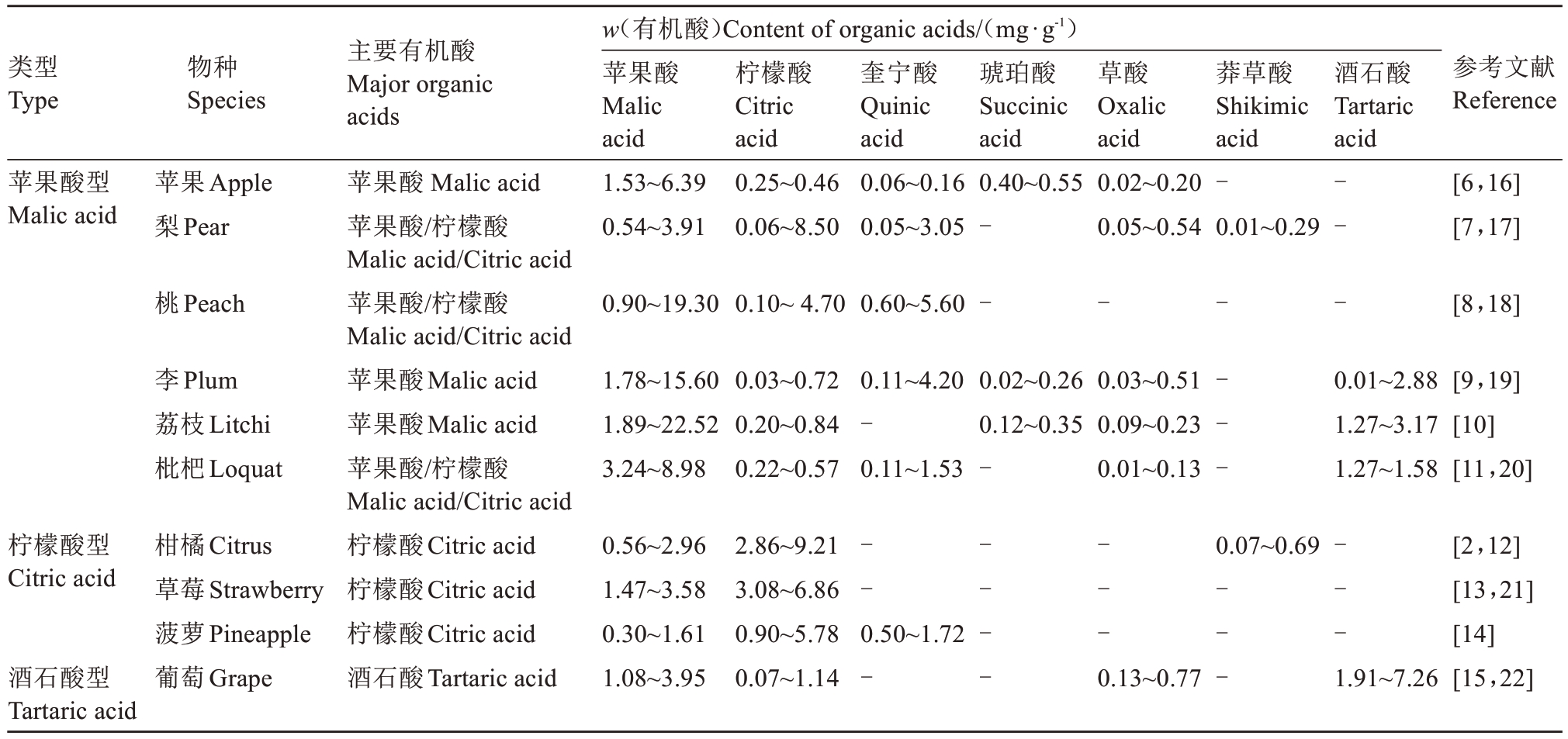
果实有机酸组分主要包括苹果酸、柠檬酸、酒石酸、琥珀酸、草酸、奎宁酸和抗坏血酸等,通常以一或两种有机酸为主,其他有机酸的含量维持在少量或微量水平[5]。根据成熟果实中积累的主要有机酸种类,可划分为苹果酸型、柠檬酸型和酒石酸型等三大类型[5](表1)。
表1 不同水果果实中主要有机酸种类及含量
Table 1 The content and types of major organic acid in different fruits
注:-表示参考文献中没有明确相关数据。
Note:- Indicates that there is no clear relevant data in the references.
类型Type物种Species主要有机酸Major organic acids酒石酸Tartaric acid参考文献Reference苹果酸型Malic acid苹果Apple梨Pear w(有机酸)Content of organic acids/(mg·g-1)苹果酸Malic acid 1.53~6.39 0.54~3.91柠檬酸Citric acid 0.25~0.46 0.06~8.50奎宁酸Quinic acid 0.06~0.16 0.05~3.05琥珀酸Succinic acid 0.40~0.55草酸Oxalic acid 0.02~0.20 0.05~0.54莽草酸Shikimic acid-0.01~0.29[6,16] [7,17] 桃Peach 0.90~19.300.10~ 4.700.60~5.60------[8,18] 李Plum荔枝Litchi枇杷Loquat 1.78~15.60 1.89~22.52 3.24~8.98 0.03~0.72 0.20~0.84 0.22~0.57 0.11~4.20-0.11~1.53 0.02~0.26 0.12~0.35 0.03~0.51 0.09~0.23 0.01~0.13----0.01~2.88 1.27~3.17 1.27~1.58[9,19] [10] [11,20] 柠檬酸型Citric acid-----0.07~0.69---酒石酸型Tartaric acid柑橘Citrus草莓Strawberry菠萝Pineapple葡萄Grape苹果酸 Malic acid苹果酸/柠檬酸Malic acid/Citric acid苹果酸/柠檬酸Malic acid/Citric acid苹果酸Malic acid苹果酸Malic acid苹果酸/柠檬酸Malic acid/Citric acid柠檬酸Citric acid柠檬酸Citric acid柠檬酸Citric acid酒石酸Tartaric acid 0.56~2.96 1.47~3.58 0.30~1.61 1.08~3.95 2.86~9.21 3.08~6.86 0.90~5.78 0.07~1.14 0.50~1.72------0.13~0.77---1.91~7.26[2,12] [13,21] [14] [15,22]
苹果酸型果实种类较多,如苹果、枇杷、梨、桃、李、荔枝等。苹果中苹果酸占总有机酸的90%,其次为柠檬酸,但含量较低[6]。梨中以苹果酸和柠檬酸为主,约占总酸含量的70%[7]。桃果实中以苹果酸和柠檬酸为主,少数桃果实以奎宁酸和柠檬酸为主[8]。李果实中苹果酸占总有机酸的88%[9]。荔枝和枇杷果实中主要有机酸也为苹果酸[10-11]。
柠檬酸型果实是指在生长发育过程中主要形成积累柠檬酸的果实,包括柑橘、草莓、菠萝等。柑橘类水果中主要有机酸是柠檬酸,约占总有机酸的75.4%~96.9%,而低酸或无酸的柑橘类果实则以苹果酸为主[12]。草莓果实中有机酸以柠檬酸为主[13]。成熟菠萝果实有机酸以柠檬酸含量最高,约占有机酸的60.0%,其次是奎宁酸和苹果酸[14]。
酒石酸型果实是指在生长发育过程中主要积累酒石酸的果实,此种类型的果实种类较少,以葡萄为代表,酒石酸是其主要有机酸,其次为苹果酸[15]。
1.2 果实生长发育过程中有机酸含量的变化规律
不同有机酸在果实生长发育过程中变化较大。随着果实生长发育,大多数有机酸的含量逐渐增高,当果实生长发育停止转入成熟时,有机酸含量开始下降。大多数苹果果实中,苹果酸和柠檬酸含量呈现逐渐增加的趋势,少数品种呈先增加后下降的趋势[16]。桃果实中,大多数水蜜桃品种果实中总有机酸和苹果酸含量呈下降的趋势[17]。梨果实的有机酸通常在发育早期积累,整体呈先上升后下降的趋势[18]。大五星与果真好1号枇杷果实中,可滴定酸、总有机酸和苹果酸含量随果实发育变化的趋势相似,均在盛花后135 d达到峰值,随后逐渐下降[19]。大部分柑橘品种在发育前期快速积累有机酸,后期缓慢降解,以马家柚为例,柠檬酸含量变化趋势与总有机酸基本相同,在果实膨大期不断上升而在果实成熟期开始下降,所以柠檬酸含量决定了总有机酸的变化趋势[20]。草莓果实柠檬酸含量的变化动态有先升后降,而苹果酸含量的变化动态除了先升后降外,还有持续上升及维持稳定水平的模式[21]。草莓果实发育过程中,柠檬酸积累从绿果阶段持续下降,而在转色至成熟阶段显著上升[22]。在荔枝中,低酸品种怀枝在果实成熟过程中苹果酸和柠檬酸含量急剧降低,而高酸品种Boye_No.8(B8)在果实成熟过程中柠檬酸含量增加,苹果酸含量表现出一定程度的降低[23]。阳光玫瑰、巨峰、欧亚种意大利和摩尔多瓦葡萄随着果实发育,酒石酸含量基本呈平缓下降的趋势,总酸含量总体逐渐下降,且在转色末期前降幅较大,转色末期至成熟期降幅较小[24]。综合前人研究发现,苹果酸和柠檬酸在不同水果发育过程中具有较大差异。
2 果实中有机酸的代谢
2.1 果实中有机酸的合成与降解
果实中有机酸多是通过羧化反应合成的(图1)。柠檬酸合酶(citrate synthase,CS)、顺乌头酸酶(aconitase,ACO)、异柠檬酸脱氢酶(isocitrate dehydrogenase,IDH)、磷酸烯醇式丙酮酸羧化酶(phosphoenolpyruvate carboxylase,PEPC)、苹果酸脱氢酶(NAD-MDH)和NADP-苹果酸酶(NADP-ME)是影响果实柠檬酸和苹果酸合成的重要酶。苹果酸脱氢酶催化可逆反应,主要定位于细胞质(Cyt-MDH,最重要同工酶)、线粒体和叶绿体中[25]。根据辅酶特性,ME有NAD-ME和NADP-ME两种形式,NADME主要位于线粒体中,而NADP-ME主要位于细胞质和质体中。前人研究表明,果实苹果酸主要在细胞质中由草酰乙酸(OAA)经NAD-MDH作用合成[3]。苹果酸最终被转运到液泡中,这一过程对维持细胞质pH平衡和调节果实酸味至关重要[26]。通过同位素示踪和嫁接试验确定了柠檬酸合成的主要部位为线粒体,柠檬酸主要经三羧酸循环合成,并储存在液泡中[27]。柠檬酸的合成途径:首先磷酸烯醇式丙酮酸(PEP)在PEPC催化下,与CO2结合生成了草酰乙酸;随后在线粒体CS催化作用下,草酰乙酸和乙酸辅酶A生成柠檬酸。酒石酸生物合成始于L-抗坏血酸(维生素C)[28]。
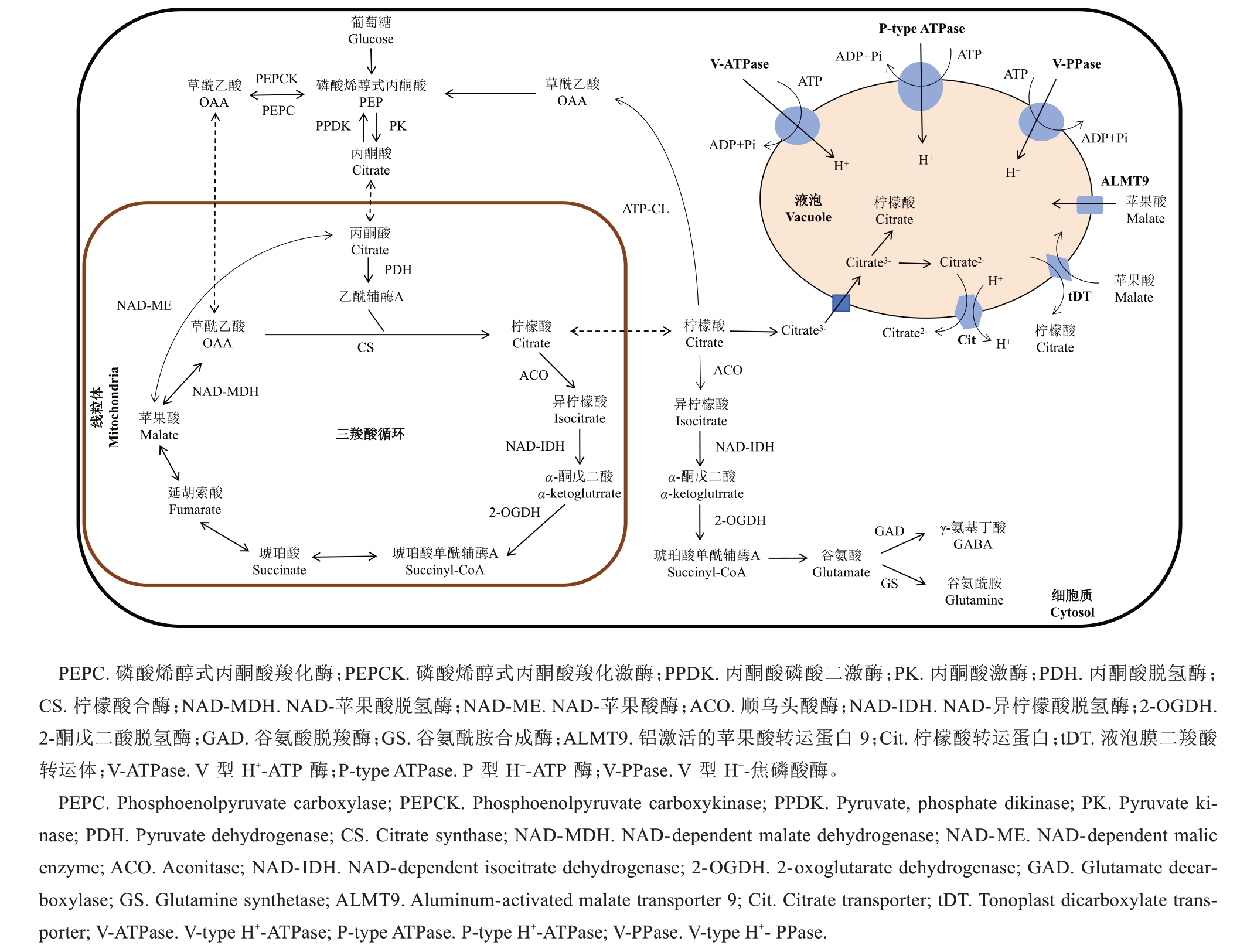
图1 苹果酸和柠檬酸在果实中代谢和转运(修改自文献[3] )
Fig. 1 Metabolism of malic acid and citric acid in fruit (modified from the reference [3] )
CS、PEPC、MDH、ME等相关酶协同调控柠檬酸的积累和降解[29]。大量报道表明,γ-氨基丁酸(GABA)代谢支路对有机酸降解起到了非常重要的作用[30]。该途径第一步是通过顺乌头酸酶(aconitase,Aco)将柠檬酸转化为异柠檬酸,而后经NADPIDH生成谷氨酸,谷氨酸在谷氨酸脱羧酶(glutamate decarboxylase,GAD)或谷氨酰胺合成酶(glutamine synthetase,GS)作用下经谷氨酰胺或GABA途径进行降解[20]。在柑橘中,CitAco3与柠檬酸含量呈负相关,CitAco3可能导致柠檬酸盐降解[31]。除了GABA支路外,乙酰辅酶A通路也可促进柠檬酸盐降解,其中ATP-柠檬酸裂解酶(ACL)被认为是关键调节因子,它能够将柠檬酸裂解成草酰乙酸和乙酰辅酶A[32]。前人研究表明,在低酸性柑橘中ACL基因的转录水平和酶活性显著高于在正常酸性柑橘,这表明前者的柠檬酸被大量降解[33]。在砀山酥梨中,随着果实发育,柠檬酸含量呈总体下降趋势,苹果酸含量总体呈上升趋势,CS、NAD-IDH、NADMDH和NADP-ME活性总体呈上升趋势,Aco和PEPC活性总体呈下降趋势[34]。在番荔枝果实成熟过程中,可能是NAD-MDH活性增加导致苹果酸在最后阶段增加,CS活性增强导致柠檬酸含量增加[35]。
2.2 果实中有机酸的转运
液泡作为植物最重要的有机酸贮存库,其对有机酸的转运至关重要。有机酸从细胞质转运至液泡中,依赖于多种转运蛋白和质子泵的协同作用(图1)。柠檬酸和苹果酸分别在线粒体和细胞质中合成后,需要通过特定转运蛋白,被转运至液泡中储存。有机酸转运蛋白(organic acid transporters,OATs)负责将有机酸从细胞质转运到液泡内。有机酸跨膜转运过程主要由包括液泡膜二羧酸转运体(tonoplast dicarboxylate transporter,TDT)[36]、铝激活苹果酸转运蛋白(aluminum-activated malate transporter,ALMT)[37],以及液泡柠檬酸转运体Cit1[38]协助完成。质子泵(proton pumps)主要包括V型(V-H+-ATPase和V-H+-PPase)和P型(P-H+-ATPase)和F型,在液泡膜上工作,建立质子梯度,泵出质子H+,在液泡内形成酸性环境。在质子梯度的驱动下,有机酸转运蛋白将有机酸从细胞质转运到液泡内。这一过程不仅有助于调节细胞内pH值,还能维持细胞渗透压平衡。
2.2.1 液泡膜二羧酸转运体 TDT是一种重要的苹果酸转运体,在苹果酸积累和降解过程中发挥转运功能。在拟南芥中,AtTDT对pH稳态调节起着关键作用[39],AtTDT突变体仅表现出微弱的苹果酸转运活性,叶片中总苹果酸含量显著降低[36]。番茄中过表达SlTDT可显著提高果实中苹果酸的含量,降低柠檬酸的含量,而抑制SlTDT表达则降低苹果酸的含量,增加柠檬酸的含量[40]。马瑟兰葡萄果实转色后,苹果酸含量下降,可能与VvtDT表达水平降低有关,并且在马瑟兰愈伤组织中过表达VvTDT能够促进苹果酸积累[41]。在李果实中发现,TDT-like基因对皇冠李、黑琥珀李、西瓜李中苹果酸的积累起到正向调控作用[42]。
2.2.2 铝激活苹果酸转运蛋白 ALMT家族成员发挥多种功能,包括对土壤中铝的耐受性、果实酸度调节、离子稳态和气孔孔径调节[43-44]。ALMT是植物特有的阴离子通道蛋白,以苹果酸阴离子形式将苹果酸转运到液泡中[45]。在拟南芥中,编码苹果酸外排转运基因AtALMT1负责在胁迫条件下将苹果酸从根尖流出[46],AtALMT9和AtALMT6也能在叶肉和保卫细胞中编码液泡苹果酸通道[47-48]。葡萄中AtALMT9同源基因VvALMT9能够调节葡萄中苹果酸和酒石酸的积累[49]。Royal Gala苹果中ALMT9/Ma1可变性剪切可产生Ma1α和Ma1β两种亚型蛋白,Ma1α具有转运苹果酸的功能,而Ma1β不具有直接转运苹果酸的功能,但Ma1β可与Ma1α相互作用形成异二聚体,在液泡苹果酸转运过程中起到协同作用[44]。
2.2.3 液泡柠檬酸转运体 在柑橘中研究发现,柠檬酸转运蛋白1基因CsCit1编码一种新型液泡柠檬酸盐/H+同向转运蛋白,利于维持液泡柠檬酸稳态[38]。通过高酸类果实高橙和低酸类果实温州蜜柑热处理后的转录组测序,筛选出二羧酸载体基因CitDIC和阳离子/H+交换基因CitCHX,这两个基因可能与柑橘类水果中柠檬酸降解有关[50]。
2.2.4 其他转运体 液泡膜糖转运蛋白TST负责细胞质葡萄糖向液泡跨膜运输,部分成员还具备蔗糖转运功能[51]。有研究发现,在桃果实中,PpTST1负调控有机酸积累[52]。
2.2.5 质子泵 植物中存在三种质子泵,即V型[VH+-ATPase(VHA)和V-H+-PPase(VHP)] 、P型[P-H+-ATPase(PHA)] 和F型,目前研究发现只有V型和P型质子泵与酸有关[53-54]。植物P型H+-ATP酶由单个多肽组成,由多基因家族编码。P型H+-ATP酶首次在牵牛花中被发现可能与液泡酸化有关,PhPH5和PhPH1促进花瓣中液泡酸化[54-55]。柑橘CitPH1和CitPH5与柠檬酸含量密切相关[56]。P型质子泵基因CsPH8是一种PhPH5同源基因,参与柑橘类水果液泡酸化,在低酸品种中表达量低,而在高酸品种中表达量高[57]。桃溪蜜柚果实中CmVHA-c4和CmVHP2能够共同正向调控柠檬酸的积累[58]。
3 果实中有机酸积累相关基因定位研究
随着组学技术的发展,多组学分析已成功应用于果实风味物质积累的调控研究。果实酸度是多基因调控的数量性状,遗传机制相对复杂[59]。苹果中控制果实酸度的主要QTL被定位到第16连锁群[60]。Ma位于16号染色体上主要QTL,其编码铝活化苹果酸转运蛋白(ALMT)候选Ma1基因负责苹果酸积累,是苹果果实酸度形成的主要原因[61]。除Ma基因外,在第2、8、10、13、15和17连锁群上检测到了其他6个苹果果实酸度QTL[62],其中MdMYB44是苹果果实酸度主要qtl08.1区域的候选基因[59]。利用蜜脆×秦冠杂交后代通过QTL定位筛选到第13连锁群(LG)上细胞质苹果酸脱氢酶基因MdMa7(MDH1),其过表达显著增加苹果果实中苹果酸含量,而瞬时沉默降低苹果酸的含量,即MdMa7可正调控苹果酸含量[63]。对Jonathan×Golden Delicious和Zisai Pearl×Red Fuji群体利用MapQTL和BSAseq技术对苹果果实苹果酸含量进行QTL定位,发现了4个主要定位在8号染色体和16号染色体与苹果酸相关的主效QTLs[59]。为了构建葡萄中糖和酸遗传连锁图谱,对其可溶性糖和有机酸进行了QTL定位,发现10个与糖含量相关QTL位点,3个与酸含量相关QTL位点[64]。通过对贮藏期间桃果实可溶性固形物含量(SSC)和果实可滴定酸含量(TAC)动态QTL分析,分别获得18个和32个动态QTLs[65]。在枣中,通过转录组和代谢组分析鉴定出调节柠檬酸和苹果酸代谢关键基因乌头酸酶1(ZjACO1)和乌头酸酶3(ZjACO3)[66]。利用多组学研究发现柑橘质子泵基因CitPH5(CsPpPH8)、ATP柠檬酸裂解酶(ACL)等基因在柠檬酸积累中具有重要作用[57-58]。
4 果实中有机酸含量的分子调控机制研究
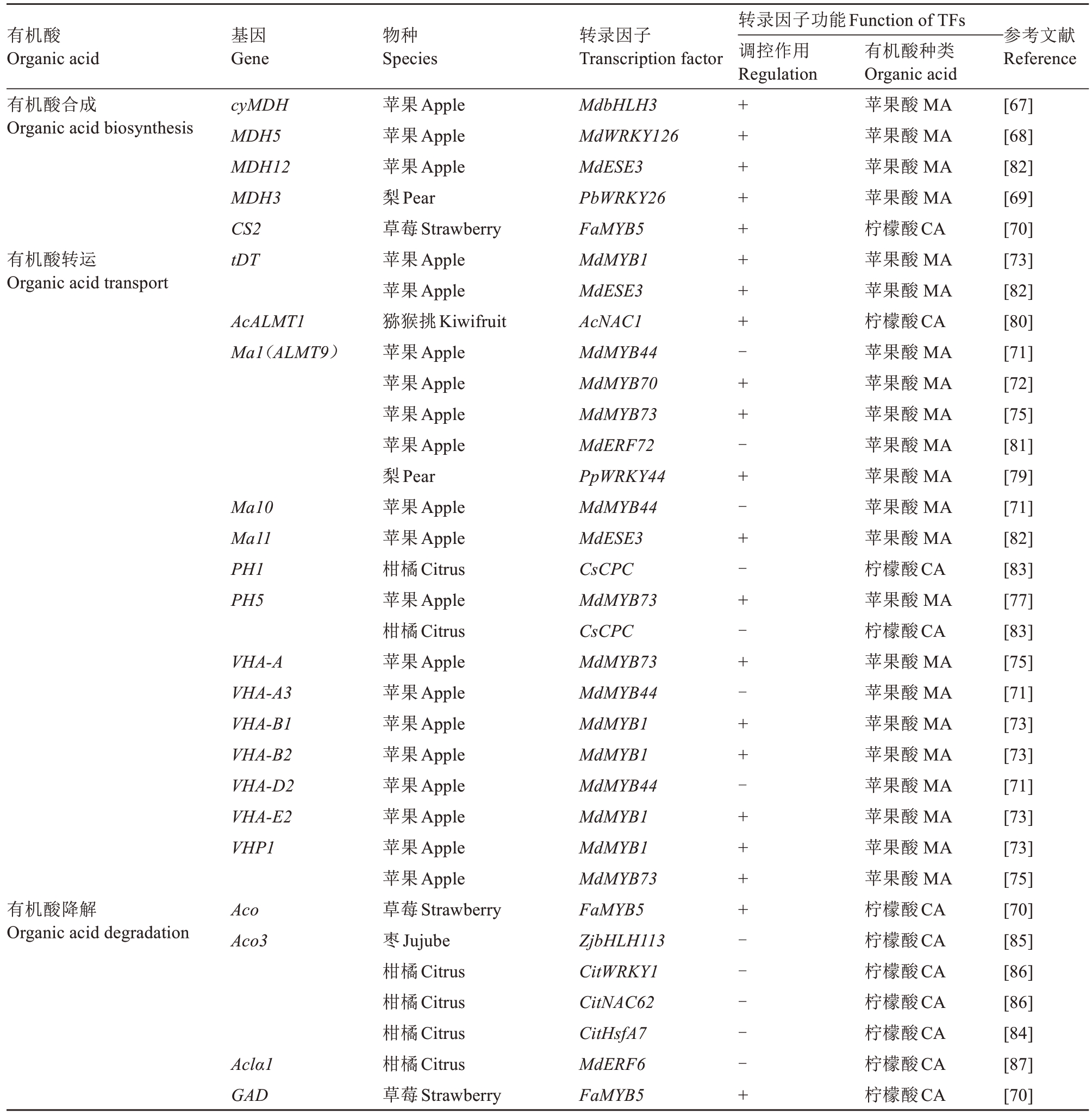
转录因子在果实品质形成中发挥着重要的调控作用,如MYB、bHLH、WRKY等家族与果实有机酸积累密切相关(表2)。苹果中MdbHLH3直接与编码苹果胞质NAD依赖性苹果酸脱氢酶MdcyMDH启动子结合,激活其转录表达,从而促进苹果果实中苹果酸积累[67]。MdWRKY126与MdMDH5启动子直接结合并促进其表达,从而提高苹果果实的苹果酸含量[68]。梨转录因子PbWRKY26通过结合苹果酸脱氢酶基因PbMDH3启动子来促进其表达,进一步提高MDH酶活性,从而促进OAA向苹果酸转化,促进苹果酸积累[69]。草莓转录因子FaMYB5正调控FaCS2表达,促进柠檬酸积累[70](图2)。
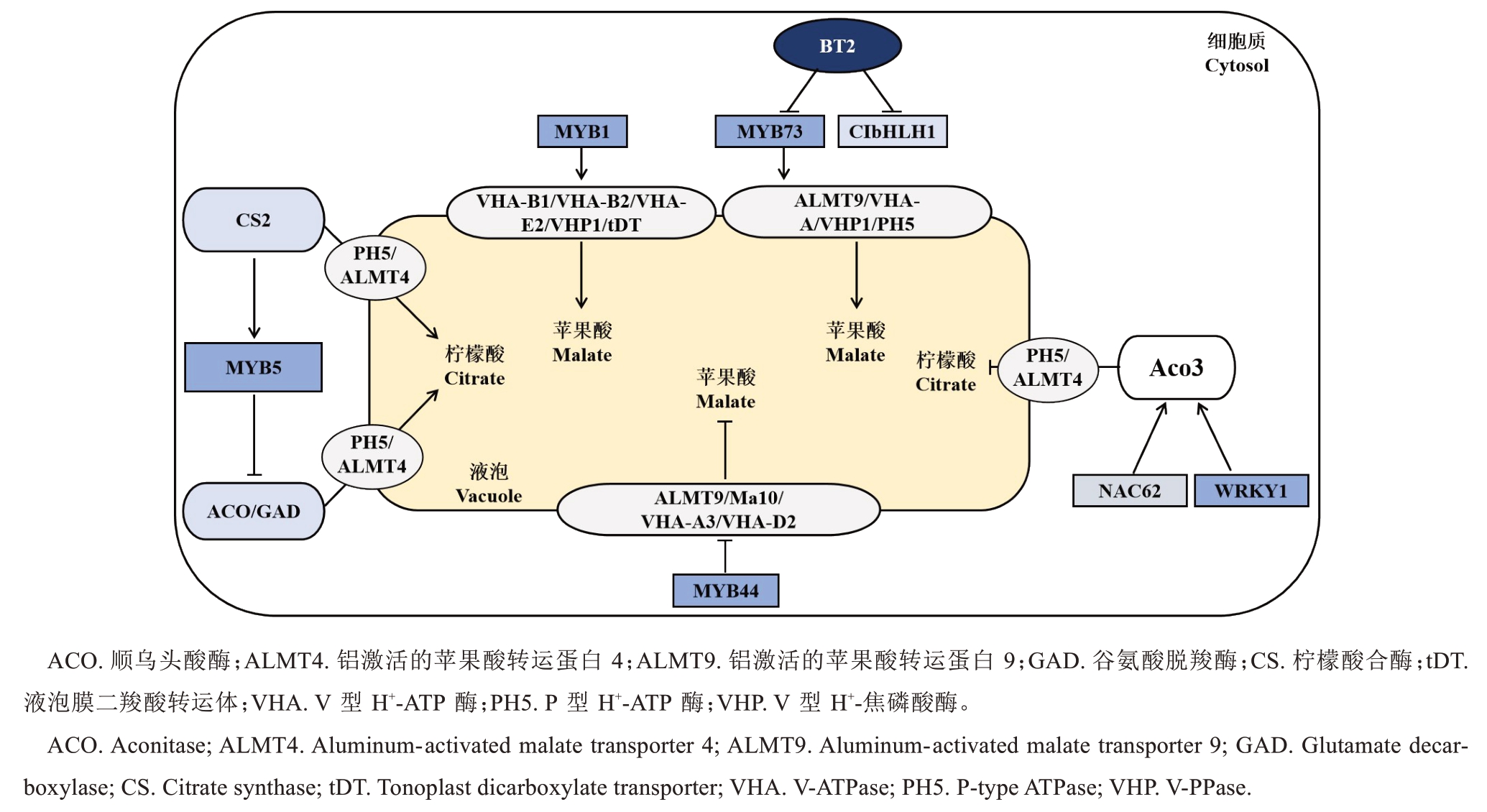
图2 果实细胞中苹果酸和柠檬酸的合成、转运和降解调控分子机制
Fig. 2 Molecular mechanism of synthesis, transport and degradation regulation of malic acid and citric acid in fruit cells
表2 果实有机酸代谢关键基因及上游调控因子
Table 2 Key genes and regulatory factors involved in fruit organic acid metabolism
注:+表示正调控,-表示负调控;MA. 苹果酸;CA. 柠檬酸。
Note:+/- Indicates positive or negative regulation relationship. MA. Malic acid; CA. Citric acid.
有机酸Organic acid基因Gene物种Species转录因子Transcription factor转录因子功能Function of TFs调控作用Regulation参考文献Reference有机酸合成Organic acid biosynthesis有机酸转运Organic acid transport[67] [68] [82] [69] [70] [73] [82] [80] [71] [72] [75] [81] [79] [71] [82] [83] [77] [83] [75] [71] [73] [73] [71] [73] [73] [75] [70] [85] [86] [86] [84] [87] [70] cyMDH MDH5 MDH12 MDH3 CS2 tDT AcALMT1 Ma1(ALMT9)Ma10 Ma11 PH1 PH5 VHA-A VHA-A3 VHA-B1 VHA-B2 VHA-D2 VHA-E2 VHP1有机酸降解Organic acid degradation Aco Aco3 Aclα1 GAD苹果Apple苹果Apple苹果Apple梨Pear草莓Strawberry苹果Apple苹果Apple猕猴挑Kiwifruit苹果Apple苹果Apple苹果Apple苹果Apple梨Pear苹果Apple苹果Apple柑橘Citrus苹果Apple柑橘Citrus苹果Apple苹果Apple苹果Apple苹果Apple苹果Apple苹果Apple苹果Apple苹果Apple草莓Strawberry枣Jujube柑橘Citrus柑橘Citrus柑橘Citrus柑橘Citrus草莓Strawberry MdbHLH3 MdWRKY126 MdESE3 PbWRKY26 FaMYB5 MdMYB1 MdESE3 AcNAC1 MdMYB44 MdMYB70 MdMYB73 MdERF72 PpWRKY44 MdMYB44 MdESE3 CsCPC MdMYB73 CsCPC MdMYB73 MdMYB44 MdMYB1 MdMYB1 MdMYB44 MdMYB1 MdMYB1 MdMYB73 FaMYB5 ZjbHLH113 CitWRKY1 CitNAC62 CitHsfA7 MdERF6 FaMYB5++++++++-++-+-+-+-+-++-++++-----+有机酸种类Organic acid苹果酸 MA苹果酸 MA苹果酸 MA苹果酸 MA柠檬酸CA苹果酸 MA苹果酸 MA柠檬酸CA苹果酸 MA苹果酸 MA苹果酸 MA苹果酸 MA苹果酸 MA苹果酸 MA苹果酸 MA柠檬酸CA苹果酸 MA柠檬酸CA苹果酸 MA苹果酸 MA苹果酸 MA苹果酸 MA苹果酸 MA苹果酸 MA苹果酸 MA苹果酸 MA柠檬酸CA柠檬酸CA柠檬酸CA柠檬酸CA柠檬酸CA柠檬酸CA柠檬酸CA
转录因子在有机酸转运中的研究更为广泛(图2)。苹果MdMYB44通过抑制苹果酸积累相关基因Ma1(ALMT9)、Ma10(P-type ATPase10)、MdVHA-A3(V-type ATPase A3)和MdVHA-D2(V-type ATPase-D2)的启动子活性来负调节果实苹果酸含量[71]。在干旱胁迫下,MdMYB70可激活MdALMT9表达,促进苹果酸的积累,而MdMYB44可抑制MdMYB70的转录活性,进而降低苹果酸含量[72]。MdbHLH49正调控MdMYB44进而减少苹果酸积累[71]。Md-MYB1通过激活编码液泡质子泵亚基MdVHA-B1、MdVHA-B2、MdVHA-E2和MdVHP1来增强VHA的活性,激活苹果酸转运蛋白MdtDT表达,促进苹果酸转运到液泡[73]。椪柑CrMYB73表达与柠檬酸含量呈正相关,瞬时过表达能引起柠檬酸高积累[74]。MdMYB73激活MdALMT9、MdVHA-A和MdVHP1表达,同时MdCIbHLH1与MdMYB73相互作用并增强其对下游靶基因的活性[75]。BTB-BACK-TAZ硝酸盐反应蛋白MdBT2调节苹果酸积累和液泡pH值,且介导MdCIbHLH1和MdMYB73泛素化负调控苹果酸积累和液泡酸化[76]。P-ATPase基因MdPH5参与苹果中苹果酸的转运和液泡酸化,MdMYB73可激活MdPH5表达以促进苹果酸积累[77]。Md-MYB123可与MdMa1和MdMa11启动子结合,正调控苹果酸积累[78]。梨PpWRKY44可激活PpALMT9表达,盐度响应蛋白PpABF3通过激活PpWRKY44表达促进苹果酸积累[79]。猕猴桃AcNAC1可以激活AcALMT1表达,促进柠檬酸积累[80]。最近研究表明,苹果乙烯信号因子ERF72可负调控MdALMT9表达,负调节苹果贮藏过程中苹果酸含量[81]。MdESE3则可激活MdMa11(P3A-type ATPase)、Mdt‐DT和MdMDH12转录,促进苹果酸积累[82]。MYB转录因子CsCPC通过抑制液泡膜质子泵相关基因CsPH1和CsPH5的表达负调控柠檬酸的积累[83]。
转录因子与有机酸降解相关基因有着密切联系。草莓转录因子FaMYB5负调控FaGAD和FaACO,抑制柠檬酸降解[70](图2)。此外发现,柑橘热休克转录因子CitHsfA7能够直接与CitAco3启动子结合并激活其转录,促进柠檬酸降解[84]。枣转录因子ZjbHLH113直接与ZjACO3启动子结合,转录激活它的表达,增强柠檬酸降解[85]。柑橘中,转录因子CitNAC62和CitWRKY1直接结合CitAco3启动子激活其表达,进而促进柠檬酸降解,且CitNAC62和CitWRKY1蛋白存在相互作用[86]。柑橘CitERF6通过上调CitAclα1(ATP-柠檬酸裂解酶亚基α)的表达促进柠檬酸降解[87]。
5 影响果实中有机酸积累的其他因素
5.1 激素在果实有机酸积累中具有较大作用
果实品质的形成受多种激素调控。水杨酸(SA)是重要的内源性激素,外源性SA处理可以保持采后果实品质并延缓果实腐烂和病害发生[88-89]。SA处理促进了柑橘类水果中有机酸的积累[90]。蓝莓中发现SA增强果实中PEPC、NAD-MDH和CS活性,并抑制苹果酸和柠檬酸降解蛋白NADP-ME、ACL和ACO等的活性[91],促进苹果酸和柠檬酸合成。对靖安椪柑果实进行外源GABA处理,发现果实柠檬酸、总有机酸和可滴定酸含量维持在较高水平,可有效保持采后品质[92]。乙烯信号传递分子机制错综复杂,它与生长素、ABA、糖代谢等信号通路有交叉作用,但是其在有机酸代谢中的作用尚未明确。有研究发现10 mmol·L-1外源GABA处理Cripps Pink苹果会抑制果实乙烯生物合成,进而有效抑制果实在贮藏过程中的苹果酸消耗,保持果实品质[93]。
5.2 其他环境因素对有机酸的影响
干旱胁迫下温州蜜柑果实中CS基因表达上调及IDH基因表达下调可能是柠檬酸积累的主要原因之一[94]。水涝胁迫能够促进赤霞珠葡萄有机酸合成相关基因IDH、PEPC和CS的表达,增加果实酒石酸、苹果酸、柠檬酸的含量[95]。
膨大剂(氯吡脲)处理枇杷果实可抑制有机酸合成酶PEPC、CS、NAD-MDH的活性,同时诱导NADP-ME、NADP-IDH有机酸降解酶活性上升,减少果实有机酸的含量[96]。对高酸枇杷品种解放中进行吲熟酯处理,可减弱PEPC和NAD-MDH的活性,增强NADP-ME的活性,从而降低枇杷果肉中苹果酸的含量[97]。施用磷肥可减少柑橘类水果柠檬酸的积累[98]。
温度和光照在一定程度上影响果实的内在品质。高温处理葡萄后增高了果实的pH值,降低了可滴定酸和有机酸的含量[99],而低温会延迟葡萄发育,并导致成熟果实中的苹果酸含量较高[100]。在光照充足的条件下,沃柑果实中的柠檬酸、苹果酸及总酸的含量显著高于遮阴果实[101]。40%遮阴可显著降低猕猴桃有机酸的含量[102]。
设施栽培技术可以提高鸡尾葡萄柚可溶性糖含量和柠檬酸含量,CsPEPC2的表达对柠檬酸的积累调控有重要作用[103]。不套袋栽培的苹果果实可滴定酸含量明显低于套袋果,导致不套袋果口感更好[104]。
基因编辑技术在有机酸研究中得到了应用。猕猴桃AcNAC1能够转录激活具有柠檬酸转运功能AcALMT1基因表达,在猕猴桃中定向CRISPR-Cas9诱发AcNAC1突变导致柠檬酸盐水平显著下降,而苹果酸盐和奎尼酸盐水平基本不受影响[80]。另外,有机酸相关基因表达的转录后水平调控研究有了一定的进展。梨钙依赖性蛋白激酶PbCPK28可以与液泡糖转运蛋白PbTST4以及液泡质子泵PbVHAA1相互作用并磷酸化,从而为PbTST4提供质子动力,促进过量的糖被转运到液泡中从而增加梨果实发育过程中糖积累[105]。
6 展 望
果实酸度作为显著影响果实品质和营养价值的性状,深度理解和剖析其遗传规律和分子基础是十分必要的。本文对果树中果实有机酸相关的研究进展进行综述,揭示控制果实酸度变化的关键途径和基因,以期为改良果实品质、提高果实的经济价值、培育不同酸甜度的新品种、促进产业发展提供参考。
果实中大部分代谢产物和营养物质被转运和储存在成熟果实细胞的液泡中。柠檬酸和苹果酸是果实中的主要有机酸,两者的积累是代谢过程和液泡储存之间相互作用的结果,主要的调控机制十分复杂(图2)。环境因子通过调节有机酸代谢通路上关键基因来改变果实酸度,影响果实品质[3]。定位在液泡膜上的转运蛋白和质子泵有助于代谢产物的积累,并影响果实的风味品质和产量。然而,液泡膜蛋白成员及其功能仅在少量园艺作物中得到验证,对其分子调控机制的研究有待进一步加强。为更好地理解果实中糖、酸积累和转运的分子机制,需要对果实液泡和膜转运蛋白等进行充分探索,并为果实酸度和风味形成提供新的见解。此外,基因组学、转录组、蛋白质组学和代谢组学等方法联合分析[106-107],将为有机酸积累关键基因挖掘提供新的思路。基因编辑技术的产生,为有机酸积累关键基因功能研究和定向改良提供了新的工具。
[1] DOIREAU R,JAŚLAN J,CUBERO-FONT P,DEMESCAUSSE E,BERTAUX K,CASSAN C,PÉTRIACQ P,DE ANGELI A. AtALMT5 mediates vacuolar fumarate import and regulates the malate/fumarate balance in Arabidopsis[J] . The New Phytologist,2024,244(3):811-824.
[2] HUSSAIN S B,SHI C Y,GUO L X,KAMRAN H M,SADKA A,LIU Y Z. Recent advances in the regulation of citric acid metabolism in citrus fruit[J] . Critical Reviews in Plant Sciences,2017,36(4):241-256.
[3] ETIENNE A,GÉNARD M,LOBIT P,MBEGUIÉ-AMBÉGUIÉ D,BUGAUD C. What controls fleshy fruit acidity A review of malate and citrate accumulation in fruit cells[J] .Journal of Experimental Botany,2013,64(6):1451-1469.
[4] MIAO S X,WEI X Y,ZHU L C,MA B Q,LI M J. The art of tartness:The genetics of organic acid content in fresh fruits[J] .Horticulture Research,2024,11(10):uhae225.
[5] SHIOMI S,KUBO Y,WAMOCHO L S,KOAZE H,NAKAMURA R,INABA A. Postharvest ripening and ethylene biosynthesis in purple passion fruit[J] . Postharvest Biology and Technology,1996,8(3):199-207.
[6] 冯建文,栾北辰,韩秀梅,杨华,李顺雨,牛歆雨,吴亚维. 不同苹果种质资源果实糖酸品质特征研究[J] . 中国南方果树,2024,53(5):169-177.FENG Jianwen,LUAN Beichen,HAN Xiumei,YANG Hua,LI Shunyu,NIU Xinyu,WU Yawei. Study on fruit sugar and organic acid characteristics in different apple germplasm resources[J] .South China Fruits,2024,53(5):169-177.
[7] WU J Y,FAN J B,LI Q H,JIA L T,XU L L,WU X,WANG Z W,LI H X,QI K J,QIAO X,ZHANG S L,YIN H. Variation of organic acids in mature fruits of 193 pear (Pyrus spp.) cultivars[J] . Journal of Food Composition and Analysis,2022,109:104483.
[8] 徐子媛,严娟,蔡志翔,孙朦,宿子文,沈志军,马瑞娟,俞明亮.桃果实糖酸和酚类物质与口感风味的相关性[J] . 江苏农业学报,2022,38(1):190-199.XU Ziyuan,YAN Juan,CAI Zhixiang,SUN Meng,SU Ziwen,SHEN Zhijun,MA Ruijuan,YU Mingliang. Correlation between soluble sugar,organic acid and phenolic substances with tasted flavor in peach fruit[J] . Jiangsu Journal of Agricultural Sciences,2022,38(1):190-199.
[9] XIAO Q,YE S Y,WANG H,XING S S,ZHU W L,ZHANG H N,ZHU J W,PU C B,ZHAO D Q,ZHOU Q,WANG J,LIN L J,LIANG D,LV X L. Soluble sugar,organic acid and phenolic composition and flavor evaluation of plum fruits[J] . Food Chemistry:X,2024,24:101790.
[10] 董晨,郑雪文,马智玲,王弋,全振炫,李伟才,胡桂兵. 九份特早熟和早熟荔枝种质资源有机酸组分及含量特征分析[J] . 南方农业,2023,17(9):23-27.DONG Chen,ZHENG Xuewen,MA Zhiling,WANG Yi,QUAN Zhenxuan,LI Weicai,HU Guibing. Analysis of organic acid composition and content characteristics of nine ultra-early maturity and early maturity litchi germplasm resources[J] .South China Agriculture,2023,17(9):23-27.
[11] 李怡诺,王洋,赵小娜,郑伟,鲁周民. 7个产区大五星枇杷果实品质差异研究[J] . 西北农林科技大学学报(自然科学版),2023,51(12):29-38.LI Yinuo,WANG Yang,ZHAO Xiaona,ZHENG Wei,LU Zhoumin. Differences in fruit quality of Dawuxing loquat from seven production regions[J] . Journal of Northwest A & F University(Natural Science Edition),2023,51(12):29-38.
[12] 林媚,姚周麟,王天玉,徐阳,徐建国,张伟清. 8个杂交柑橘品种的糖酸组分含量及特征研究[J] . 果树学报,2021,38(2):202-211.LIN Mei,YAO Zhoulin,WANG Tianyu,XU Yang,XU Jianguo,ZHANG Weiqing. A study on the components and characteristics of sugars and acids in 8 hybrid citrus cultivars[J] . Journal of Fruit Science,2021,38(2):202-211.
[13] MILOSAVLJEVIĆ D,MAKSIMOVIĆ V,MILIVOJEVIĆ J,DJEKIĆ I,WOLF B,ZUBER J,VOGT C,DRAGIŠIĆ MAKSIMOVIĆ J. Sugars and organic acids in 25 strawberry cultivars:Qualitative and quantitative evaluation[J] . Plants,2023,12(12):2238.
[14] 陆新华,孙德权,吴青松,刘胜辉,陈菁,孙光明. 菠萝种质资源有机酸含量的比较研究[J] . 热带作物学报,2013,34(5):915-920.LU Xinhua,SUN Dequan,WU Qingsong,LIU Shenghui,CHEN Jing,SUN Guangming. Components and contents of organic acids in pineapple germplasm[J] . Chinese Journal of Tropical Crops,2013,34(5):915-920.
[15] 郭权,郭印山,郭修武. 葡萄果实发育过程中糖酸含量的动态变化[J] . 新疆农业科学,2022,59(7):1680-1689.GUO Quan,GUO Yinshan,GUO Xiuwu. Dynamic changes of sugar and acid content in grape fruits during development[J] .Xinjiang Agricultural Sciences,2022,59(7):1680-1689.
[16] 高萌. ‘蜜脆’ב秦冠’杂交后代果实苹果酸含量QTL定位及遗传调控机制解析[D] . 杨凌:西北农林科技大学,2024.GAO Meng. QTL mapping on fruit malic acid of the hybrids from‘Honeycrisp’ בQinguan’ and genetic regulatory analysis[D] .Yangling:Northwest A & F University,2024.
[17] 殷晨,田路明,曹玉芬,董星光,张莹,霍宏亮,齐丹,徐家玉,刘超. 梨果实糖酸研究进展[J] . 果树学报,2023,40(12):2610-2623.YIN Chen,TIAN Luming,CAO Yufen,DONG Xingguang,ZHANG Ying,HUO Hongliang,QI Dan,XU Jiayu,LIU Chao.Research progress in sugar and acid in pear fruit[J] . Journal of Fruit Science,2023,40(12):2610-2623.
[18] 李依尘. 11个水蜜桃品种果实糖酸和芳香品质分析评价[D] .杭州:浙江大学,2023.LI Yichen. Analysis and evaluation of fruit sugar,acid and aroma quality of 11 peach varieties[D] . Hangzhou:Zhejiang University,2023.
[19] 巫伟峰. 李果实苹果酸转运体的克隆表达及其有机酸的关联性分析[D] . 福州:福建农林大学,2017.WU Weifeng. Cloning and expression analysis of malate transporter in plum fruit and analysis of the correlation of organic acids[D] . Fuzhou:Fujian Agriculture and Forestry University,2017.
[20] 周甲云,张坤,王羊,宋潘晖,张慧芬,罗弦,郝宇轩,邓群仙.‘果真好1号’与其亲本‘大五星’枇杷果实苹果酸代谢差异比较[J] . 四川农业大学学报,2024,42(3):546-553.ZHOU Jiayun,ZHANG Kun,WANG Yang,SONG Panhui,ZHANG Huifen,LUO Xian,HAO Yuxuan,DENG Qunxian.Comparison of malic acid metabolism between ‘Guozhenhao 1’and its parent ‘Dawuxing’ loquat fruits[J] . Journal of Sichuan Agricultural University,2024,42(3):546-553.
[21] VALLARINO J G,DE ABREU E,LIMA F,SORIA C,TONG H,POTT D M,WILLMITZER L,FERNIE A R,NIKOLOSKI Z,OSORIO S. Genetic diversity of strawberry germplasm using metabolomic biomarkers[J] . Scientific Reports,2018,8:14386.
[22] 任言,刘婉君,李美璇,乔月莲,王莉,师校欣,杜国强. 鲜食葡萄果实发育过程中有机酸积累差异研究[J] . 中外葡萄与葡萄酒,2024(3):67-74.REN Yan,LIU Wanjun,LI Meixuan,QIAO Yuelian,WANG Li,SHI Xiaoxin,DU Guoqiang. Study on differences of organic acid accumulation during fruit development of table grape[J] . Sino-Overseas Grapevine & Wine,2024(3):67-74.
[23] MA B Q,YUAN Y Y,GAO M,LI C Y,OGUTU C,LI M J,MA F W. Determination of predominant organic acid components in Malus species:Correlation with apple domestication[J] . Metabolites,2018,8(4):74.
[24] 易明亮,张王妮,杨莉,匡柳青,刘德春,刘勇,胡威. ‘马家柚’果实发育期有机酸含量变化及柠檬酸代谢相关基因的表达分析[J] . 江西农业大学学报,2022,44(4):841-851.YI Mingliang,ZHANG Wangni,YANG Li,KUANG Liuqing,LIU Dechun,LIU Yong,HU Wei. Analysis of organic acid content and expression of citric acid metabolism related genes during fruit development of ‘Majia’ pomelo[J] . Acta Agriculturae Universitatis Jiangxiensis,2022,44(4):841-851.
[25] 董书琦,刘海婷,段可,邹小花,杨静,周艳孔,倪迪安,高清华.不同草莓资源果实有机酸的积累动态及其多样性分析[J] . 上海农业学报,2023,39(1):26-31.DONG Shuqi,LIU Haiting,DUAN Ke,ZOU Xiaohua,YANG Jing,ZHOU Yankong,NI Di’an,GAO Qinghua. Study on dynamic patterns and diversity of organic acids accumulation in strawberry fruits of different germplasms[J] . Acta Agriculturae Shanghai,2023,39(1):26-31.
[26] JIANG Y H,QI Y W,CHEN X L,YAN Q,CHEN J Z,LIU H L,SHI F C,WEN Y J,CAI C H,OU L X. Combined metabolome and transcriptome analyses unveil the molecular mechanisms of fruit acidity variation in litchi (Litchi chinensis Sonn.)[J] . International Journal of Molecular Sciences,2023,24(3):1871.
[27] YAO Y X,LI M,ZHAI H,YOU C X,HAO Y J. Isolation and characterization of an apple cytosolic malate dehydrogenase gene reveal its function in malate synthesis[J] . Journal of Plant Physiology,2011,168(5):474-480.
[28] MARTÍNEZ-ESTESO M J,SELLÉS-MARCHART S,LIJAVETZKY D,PEDREÑO M A,BRU-MARTÍNEZ R. A DIGEbased quantitative proteomic analysis of grape berry flesh development and ripening reveals key events in sugar and organic acid metabolism[J] . Journal of Experimental Botany,2011,62(8):2521-2569.
[29] SADKA A,DAHAN E,COHEN L,MARSH K B. Aconitase activity and expression during the development of lemon fruit[J] .Physiologia Plantarum,2000,108(3):255-262.
[30] SAITO K,KASAI Z. Tartaric acid synthesis from l-ascorbic acid-1-14C in grape berries[J] . Phytochemistry,1969,8(11):2177-2182.
[31] 赵永,朱红菊,杨东东,龚成胜,刘文革. 果实柠檬酸代谢研究进展[J] . 园艺学报,2022,49(12):2579-2596.ZHAO Yong,ZHU Hongju,YANG Dongdong,GONG Chengsheng,LIU Wenge. Research progress of citric acid metabolism in the fruit[J] . Acta Horticulturae Sinica,2022,49(12):2579-2596.
[32] TEROL J,SOLER G,TALON M,CERCOS M. The aconitate hydratase family from Citrus[J] . BMC Plant Biology,2010,10(1):222.
[33] CHEN M,JIANG Q,YIN X R,LIN Q,CHEN J Y,ALLAN A C,XU C J,CHEN K S. Effect of hot air treatment on organic acid- and sugar-metabolism in Ponkan (Citrus reticulata) fruit[J] .Scientia Horticulturae,2012,147:118-125.
[34] KATZ E,FON M,LEE Y J,PHINNEY B S,SADKA A,BLUMWALD E. The citrus fruit proteome:Insights into citrus fruit metabolism[J] . Planta,2007,226(4):989-1005.
[35] GUO L X,SHI C Y,LIU X,NING D Y,JING L F,YANG H,LIU Y Z. Citrate accumulation-related gene expression and/or enzyme activity analysis combined with metabolomics provide a novel insight for an orange mutant[J] . Scientific Reports,2016,6:29343.
[36] SHA S F,LI J C,WU J,ZHANG S L. Changes in the organic acid content and related metabolic enzyme activities in developing‘Xinping’ pear fruit[J] . African Journal of Agricultural Research,2011,6(15):3560-3567.
[37] GONZÁLEZ-AGÜERO M,PARDO L T,ZAMUDIO M S,CONTRERAS C,UNDURRAGA P,DEFILIPPI B G. The unusual acid-accumulating behavior during ripening of cherimoya(Annona cherimola Mill.) is linked to changes in transcription and enzyme activity related to citric and malic acid metabolism[J] .Molecules,2016,21(5):398.
[38] EMMERLICH V,LINKA N,REINHOLD T,HURTH M A,TRAUB M,MARTINOIA E,NEUHAUS H E. The plant homolog to the human sodium/dicarboxylic cotransporter is the vacuolar malate carrier[J] . Proceedings of the National Academy of Sciences of the United States of America,2003,100(19):11122-11126.
[39] YE J,WANG X,HU T X,ZHANG F X,WANG B,LI C X,YANG T X,LI H X,LU Y E,GIOVANNONI J J,ZHANG Y Y,YE Z B. An InDel in the promoter of Al-ACTIVATED MALATE TRANSPORTER9 selected during tomato domestication determines fruit malate contents and aluminum tolerance[J] . The Plant Cell,2017,29(9):2249-2268.
[40] SHIMADA T,NAKANO R,SHULAEV V,SADKA A,BLUMWALD E. Vacuolar citrate/H+ symporter of citrus juice cells[J] .Planta,2006,224(2):472-480.
[41] HURTH M A,SUH S J,KRETZSCHMAR T,GEIS T,BREGANTE M,GAMBALE F,MARTINOIA E,NEUHAUS H E. Impaired pH homeostasis in Arabidopsis lacking the vacuolar dicarboxylate transporter and analysis of carboxylic acid transport across the tonoplast[J] . Plant Physiology,2005,137(3):901-910.
[42] LIU R L,LI B Q,QIN G Z,ZHANG Z Q,TIAN S P. Identification and functional characterization of a tonoplast dicarboxylate transporter in tomato (Solanum lycopersicum)[J] . Frontiers in Plant Science,2017,8:186.
[43] 詹振楠. 水分亏缺对酿酒葡萄果实苹果酸代谢的调控机理研究[D] . 银川:宁夏大学,2024.ZHAN Zhennan. Regulation mechanisms of water deficit on malate metabolism in grape (Vitis vinifera L.) berries[D] . Yinchuan:Ningxia University,2024.
[44] WANG Z R,LIU L,SU H,GUO L Q,ZHANG J L,LI Y F,XU J Y,ZHANG X C,GUO Y D,ZHANG N. Jasmonate and aluminum crosstalk in tomato:Identification and expression analysis of WRKYs and ALMTs during JA/Al-regulated root growth[J] .Plant Physiology and Biochemistry,2020,154:409-418.
[45] LI C L,KRISHNAN S,ZHANG M X,HU D G,MENG D,RIEDELSBERGER J,DOUGHERTY L,XU K N,PIÑEROS M A,CHENG L L. Alternative splicing underpins the ALMT9 transporter function for vacuolar malic acid accumulation in apple[J] .Advanced Science,2024,11(22):2310159.
[46] SHARMA T,DREYER I,KOCHIAN L,PIÑEROS M A. The ALMT family of organic acid transporters in plants and their involvement in detoxification and nutrient security[J] . Frontiers in Plant Science,2016,7:1488.
[47] KOBAYASHI Y,HOEKENGA O A,ITOH H,NAKASHIMA M,SAITO S,SHAFF J E,MARON L G,PINEROS M A,KOCHIAN L V,KOYAMA H. Characterization of AtALMT1 expression in aluminum-inducible malate release and its role for rhizotoxic stress tolerance in Arabidopsis[J] . Plant Physiology,2007,145(3):843-852.
[48] KOVERMANN P,MEYER S,HÖRTENSTEINER S,PICCO C,SCHOLZ-STARKE J,RAVERA S,LEE Y,MARTINOIA E.The Arabidopsis vacuolar malate channel is a member of the ALMT family[J] . The Plant Journal,2007,52(6):1169-1180.
[49] MEYER S,SCHOLZ-STARKE J,DE ANGELI A,KOVERMANN P,BURLA B,GAMBALE F,MARTINOIA E. Malate transport by the vacuolar AtALMT6 channel in guard cells is subject to multiple regulation[J] . The Plant Journal,2011,67(2):247-257.
[50] DE ANGELI A,BAETZ U,FRANCISCO R,ZHANG J B,CHAVES M M,REGALADO A. The vacuolar channel VvALMT9 mediates malate and tartrate accumulation in berries of Vitis vinifera[J] . Planta,2013,238(2):283-291.
[51] LIN Q,LI S J,DONG W C,FENG C,YIN X R,XU C J,SUN C D,CHEN K S. Involvement of CitCHX and CitDIC in developmental-related and postharvest-hot-air driven citrate degradation in citrus fruits[J] . PLoS One,2015,10(3):e0119410.
[52] JUNG B,LUDEWIG F,SCHULZ A,MEIßNER G,WÖSTEFELD N,FLÜGGE U I,POMMERRENIG B,WIRSCHING P,SAUER N,KOCH W,SOMMER F,MÜHLHAUS T,SCHRODA M,CUIN T A,GRAUS D,MARTEN I,HEDRICH R,NEUHAUS H E. Identification of the transporter responsible for sucrose accumulation in sugar beet taproots[J] . Nature Plants,2015,1:14001.
[53] WANG Q,CAO K,CHENG L L,LI Y,GUO J,YANG X W,WANG J,KHAN I A,ZHU G R,FANG W C,CHEN C W,WANG X W,WU J L,XU Q,WANG L R. Multi-omics approaches identify a key gene,PpTST1,for organic acid accumulation in peach[J] . Horticulture Research,2022,9:uhac026.
[54] MARTINOIA E,MAESHIMA M,NEUHAUS H E. Vacuolar transporters and their essential role in plant metabolism[J] . Journal of Experimental Botany,2007,58(1):83-102.
[55] VERWEIJ W,SPELT C,DI SANSEBASTIANO G P,VERMEER J,REALE L,FERRANTI F,KOES R,QUATTROCCHIO F. An H+ P-ATPase on the tonoplast determines vacuolar pH and flower colour[J] . Nature Cell Biology,2008,10(12):1456-1462.
[56] FARACO M,SPELT C,BLIEK M,VERWEIJ W,HOSHINO A,ESPEN L,PRINSI B,JAARSMA R,TARHAN E,DE BOER A H,DI SANSEBASTIANO G P,KOES R,QUATTROCCHIO F M. Hyperacidification of vacuoles by the combined action of two different P-ATPases in the tonoplast determines flower color[J] . Cell Reports,2014,6(1):32-43.
[57] HUANG Y,HE J X,XU Y T,ZHENG W K,WANG S H,CHEN P,ZENG B,YANG S Z,JIANG X L,LIU Z S,WANG L,WANG X,LIU S J,LU Z H,LIU Z A,YU H W,YUE J Q,GAO J Y,ZHOU X Y,LONG C R,ZENG X L,GUO Y J,ZHANG W F,XIE Z Z,LI C L,MA Z C,JIAO W B,ZHANG F,LARKIN R M,KRUEGER R R,SMITH M W,MING R,DENG X X,XU Q. Pangenome analysis provides insight into the evolution of the orange subfamily and a key gene for citric acid accumulation in citrus fruits[J] . Nature Genetics,2023,55(11):1964-1975.
[58] SHI C Y,HUSSAIN S B,YANG H,BAI Y X,KHAN M A,LIU Y Z. CsPH8,a P-type proton pump gene,plays a key role in the diversity of citric acid accumulation in citrus fruits[J] . Plant Science,2019,289:110288.
[59] 赵凌吉,廖香娇,刘德春,胡威,匡柳青,宋杰,易明亮,刘勇,杨莉. 桃溪蜜柚果实贮藏期有机酸含量变化及相关基因表达分析[J] . 浙江农业学报,2024,36(11):2510-2520.ZHAO Lingji,LIAO Xiangjiao,LIU Dechun,HU Wei,KUANG Liuqing,SONG Jie,YI Mingliang,LIU Yong,YANG Li. Changes of organic acid content in Taoxi pomelo fruits during the storage period and citric acid related gene expression analysis[J] .Acta Agriculturae Zhejiangensis,2024,36(11):2510-2520.
[60] JIA D J,SHEN F,WANG Y,WU T,XU X F,ZHANG X Z,HAN Z H. Apple fruit acidity is genetically diversified by natural variations in three hierarchical epistatic genes:MdSAUR37,MdPP2CH and MdALMTII[J] . The Plant Journal,2018,95(3):427-443.
[61] KHAN S A,BEEKWILDER J,SCHAART J G,MUMM R,SORIANO J M,JACOBSEN E,SCHOUTEN H J. Differences in acidity of apples are probably mainly caused by a malic acid transporter gene on LG16[J] . Tree Genetics & Genomes,2013,9(2):475-487.
[62] BAI Y,DOUGHERTY L,LI M J,FAZIO G,CHENG L L,XU K N. A natural mutation-led truncation in one of the two aluminum-activated malate transporter-like genes at the Ma locus is associated with low fruit acidity in apple[J] . Molecular Genetics and Genomics,2012,287(8):663-678.
[63] ZHANG Q,MA B Q,LI H,CHANG Y S,HAN Y Y,LI J,WEI G C,ZHAO S,KHAN M A,ZHOU Y,GU C,ZHANG X Z,HAN Z H,KORBAN S S,LI S H,HAN Y P. Identification,characterization,and utilization of genome-wide simple sequence repeats to identify a QTL for acidity in apple[J] . BMC Genomics,2012,13:537.
[64] CHEN J,WANG N,FANG L C,LIANG Z C,LI S H,WU B H.Construction of a high-density genetic map and QTLs mapping for sugars and acids in grape berries[J] . BMC Plant Biology,2015,15:28.
[65] SHI P,XU Z,ZHANG S Y,WANG X J,MA X F,ZHENG J C,XING L B,ZHANG D,MA J J,HAN M Y,ZHAO C P. Construction of a high-density SNP-based genetic map and identification of fruit-related QTLs and candidate genes in peach[Prunus persica (L.) Batsch[J] . BMC Plant Biology,2020,20(1):438.
[66] TONG P P,LU D Y,LIAO G L,WU C Y,WANG J B. Identification and functional analysis of key genes regulating organic acid metabolism in jujube fruit[J] . Agronomy,2024,14(11):2515.
[67] YU J Q,GU K D,SUN C H,ZHANG Q Y,WANG J H,MA F F,YOU C X,HU D G,HAO Y J. The apple bHLH transcription factor MdbHLH3 functions in determining the fruit carbohydrates and malate[J] . Plant Biotechnology Journal,2021,19(2):285-299.
[68] ZHANG L H,MA B Q,WANG C Z,CHEN X Y,RUAN Y L,YUAN Y Y,MA F W,LI M J. MdWRKY126 modulates malate accumulation in apple fruit by regulating cytosolic malate dehydrogenase (MdMDH5)[J] . Plant Physiology,2022,188(4):2059-2072.
[69] 杨美亦. PbWRKY26参与梨果实苹果酸积累的分子机制解析[D] . 杨凌:西北农林科技大学,2024.YANG Meiyi. Molecular mechanism analysis of PbWRKY26 involved in malic acid accumulation in pear fruit[D] . Yangling:Northwest A & F University,2024.
[70] LIU Y X,ZHU L,YANG M J,XIE X B,SUN P P,FANG C B,ZHAO J. R2R3-MYB transcription factor FaMYB5 is involved in citric acid metabolism in strawberry fruits[J] . Journal of Plant Physiology,2022,277:153789.
[71] JIA D J,WU P,SHEN F,LI W,ZHENG X D,WANG Y Z,YUAN Y B,ZHANG X Z,HAN Z H. Genetic variation in the promoter of an R2R3-MYB transcription factor determines fruit malate content in apple (Malus domestica Borkh.)[J] . Plant Physiology,2021,186(1):549-568.
[72] 王萍. 苹果MdMYB70转录因子应答干旱胁迫调控苹果酸积累的机理研究[D] . 兰州:甘肃农业大学,2023.WANG Ping. Molecular mechanisim by which apple Md-MYB70 transcription factor mediates malate accumulation in response to drought stress[D] . Lanzhou:Gansu Agricultural University,2023.
[73] HU D G,SUN C H,MA Q J,YOU C X,CHENG L L,HAO Y J. MdMYB1 regulates anthocyanin and malate accumulation by directly facilitating their transport into vacuoles in apples[J] .Plant Physiology,2016,170(3):1315-1330.
[74] LI S J,LIU X J,XIE X L,SUN C D,GRIERSON D,YIN X R,CHEN K S. CrMYB73,a PH-like gene,contributes to citric acid accumulation in citrus fruit[J] . Scientia Horticulturae,2015,197:212-217.
[75] HU D G,LI Y Y,ZHANG Q Y,LI M,SUN C H,YU J Q,HAO Y J. The R2R3-MYB transcription factor MdMYB73 is involved in malate accumulation and vacuolar acidification in apple[J] . The Plant Journal,2017,91(3):443-454.
[76] ZHANG Q Y,GU K D,WANG J H,YU J Q,WANG X F,ZHANG S,YOU C X,HU D G,HAO Y J. BTB-BACK-TAZ domain protein MdBT2-mediated MdMYB73 ubiquitination negatively regulates malate accumulation and vacuolar acidification in apple[J] . Horticulture Research,2020,7:151.
[77] HUANG X Y,XIANG Y,ZHAO Y W,WANG C K,WANG J H,WANG W Y,LIU X L,SUN Q,HU D G. Regulation of a vacuolar proton-pumping P-ATPase MdPH5 by MdMYB73 and its role in malate accumulation and vacuolar acidification[J] .aBIOTECH,2023,4(4):303-314.
[78] ZHENG L T,LIAO L,DUAN C B,MA W F,PENG Y J,YUAN Y Y,HAN Y P,MA F W,LI M J,MA B Q. Allelic variation of MdMYB123 controls malic acid content by regulating Md‐Ma1 and MdMa11 expression in apple[J] . Plant Physiology,2023,192(3):1877-1891.
[79] ALABD A,CHENG H Y,AHMAD M,WU X Y,PENG L,WANG L,YANG S L,BAI S L,NI J B,TENG Y W. ABRE-BINDING FACTOR3-WRKY DNA-BINDING PROTEIN44 module promotes salinity-induced malate accumulation in pear[J] . Plant Physiology,2023,192(3):1982-1996.
[80] FU B L,WANG W Q,LI X,QI T H,SHEN Q F,LI K F,LIU X F,LI S J,ALLAN A C,YIN X R. A dramatic decline in fruit citrate induced by mutagenesis of a NAC transcription factor,Ac‐NAC1[J] . Plant Biotechnology Journal,2023,21(8):1695-1706.
[81] WANG J H,GU K D,ZHANG Q Y,YU J Q,WANG C K,YOU C X,CHENG L L,HU D G. Ethylene inhibits malate accumulation in apple by transcriptional repression of aluminum-activat‐ed malate transporter 9 via the WRKY31-ERF72 network[J] .New Phytologist,2023,239(3):1014-1034.
[82] ZHENG L T,MA W F,LIU P P,SONG S J,WANG L,YANG W,REN H,WEI X Y,ZHU L C,PENG J Q,MA F W,LI M J,MA B Q. Transcriptional factor MdESE3 controls fruit acidity by activating genes regulating malic acid content in apple[J] .Plant Physiology,2024,196(1):261-272.
[83] WANG T T,SONG X,ZHANG M,FAN Y J,REN J,DUAN Y Y,GUAN S P,LUO X,YANG W H,CAO H X,WU X M,GUO W W,XIE K D. CsCPC,an R3-MYB transcription factor,acts as a negative regulator of citric acid accumulation in Citrus[J] . The Plant Journal,2025,121(1):e17189.
[84] LI S J,LIU S C,LIN X H,GRIERSON D,YIN X R,CHEN K S. Citrus heat shock transcription factor CitHsfA7-mediated citric acid degradation in response to heat stress[J] . Plant,Cell &Environment,2022,45(1):95-104.
[85] LIU H X,ZHAO X N,BI J X,DONG X C,ZHANG C M. A natural mutation in the promoter of the aconitase gene ZjACO3 influences fruit citric acid content in jujube[J] . Horticulture Research,2024,11(3):uhae003.
[86] LI S J,YIN X R,WANG W L,LIU X F,ZHANG B,CHEN K S. Citrus CitNAC62 cooperates with CitWRKY1 to participate in citric acid degradation via up-regulation of CitAco3[J] . Journal of Experimental Botany,2017,68(13):3419-3426.
[87] LI S J,WANG W L,MA Y C,LIU S C,GRIERSON D,YIN X R,CHEN K S. Citrus CitERF6 contributes to citric acid degradation via upregulation of CitAclα1,encoding ATP-citrate lyase subunit α[J] . Journal of Agricultural and Food Chemistry,2020,68(37):10081-10087.
[88] YANG C,DUAN W Y,XIE K L,REN C H,ZHU C Q,CHEN K S,ZHANG B. Effect of salicylic acid treatment on sensory quality,flavor-related chemicals and gene expression in peach fruit after cold storage[J] . Postharvest Biology and Technology,2020,161:111089.
[89] RACHAPPANAVAR V,PADIYAL A,SHARMA J K,GUPTA S K. Plant hormone-mediated stress regulation responses in fruit crops:A review[J] . Scientia Horticulturae,2022,304:111302.
[90] WANG S P,ZHOU Y H,LUO W,DENG L L,YAO S X,ZENG K F. Primary metabolites analysis of induced citrus fruit disease resistance upon treatment with oligochitosan,salicylic acid and Pichia membranaefaciens[J] . Biological Control,2020,148:104289.
[91] JIANG B,FANG X J,FU D Q,WU W J,HAN Y C,CHEN H J,LIU R L,GAO H Y. Exogenous salicylic acid regulates organic acids metabolism in postharvest blueberry fruit[J] . Frontiers in Plant Science,2022,13:1024909.
[92] 陈秀,罗震宇,张亚男,杨雪珍,余志汇,向妙莲,陈金印,陈明. 外源GABA处理对采后靖安椪柑果实品质和保鲜效果的影响[J] . 果树学报,2022,39(4):652-661.CHEN Xiu,LUO Zhenyu,ZHANG Yanan,YANG Xuezhen,YU Zhihui,XIANG Miaolian,CHEN Jinyin,CHEN Ming. Effects of exogenous γ-aminobutyric acid treatment on fruit quality and preservation of postharvest Jing’an ponkan[J] . Journal of Fruit Science,2022,39(4):652-661.
[93] HAN S K,NAN Y Y,QU W,HE Y H,BAN Q Y,LV Y R,RAO J P. Exogenous γ-aminobutyric acid treatment that contributes to regulation of malate metabolism and ethylene synthesis in apple fruit during storage[J] . Journal of Agricultural and Food Chemistry,2018,66(51):13473-13482.
[94] 肖玉明. 干旱胁迫对温州蜜柑果实品质及柠檬酸代谢相关基因表达的影响[D] . 长沙:湖南农业大学,2014.XIAO Yuming. Effects of drought stress on the fruit quality and relative gene expression in citrate-metabolism of Satsuma mandarin[D] . Changsha:Hunan Agricultural University,2014.
[95] 甘军,李光宗,单守明,刘成敏,兰鑫. 水分胁迫对赤霞珠葡萄果实品质及相关基因表达的影响[J] . 中国南方果树,2024,53(5):153-159.GAN Jun,LI Guangzong,SHAN Shouming,LIU Chengmin,LAN Xin. Effect of water stress on fruit quality and expressions of related genes in grapes[J] . South China Fruits,2024,53(5):153-159.
[96] 吴敏兰,林锦锦,吴锦程,陈进树,王美容. 膨大剂对早熟枇杷品种‘早钟6号’有机酸代谢与积累的影响[J] . 福建热作科技,2022,47(3):5-10.WU Minlan,LIN Jinjin,WU Jincheng,CHEN Jinshu,WANG Meirong. Effects of fruit-expander on organic acid metabolism during the fruits development of Eriobotrya japonica Lindl. cv.‘Zaozhong No. 6’[J] . Fujian Science & Technology of Tropical Crops,2022,47(3):5-10.
[97] YANG J,ZHANG J,NIU X Q,ZHENG X L,CHEN X,ZHENG G H,WU J C. Comparative transcriptome analysis reveals key genes potentially related to organic acid and sugar accumulation in loquat[J] . PLoS One,2021,16(4):e0238873.
[98] WU S W,LI M,ZHANG C M,TAN Q L,YANG X Z,SUN X C,PAN Z Y,DENG X X,HU C X. Effects of phosphorus on fruit soluble sugar and citric acid accumulations in citrus[J] .Plant Physiology and Biochemistry,2021,160:73-81.
[99] HEWITT S,HERNÁNDEZ-MONTES E,DHINGRA A,KELLER M. Impact of heat stress,water stress,and their combined effects on the metabolism and transcriptome of grape berries[J] . Scientific Reports,2023,13:9907.
[100] RIENTH M,TORREGROSA L,SARAH G,ARDISSON M,BRILLOUET J M,ROMIEU C. Temperature desynchronizes sugar and organic acid metabolism in ripening grapevine fruits and remodels their transcriptome[J] . BMC Plant Biology,2016,16(1):164.
[101] 贾聚金,陈香玲,孙权,包心茹,张红艳,徐娟,柴利军,邓秀新,叶俊丽. 沃柑树冠不同结果部位光照条件对果实品质的影响[J] . 华中农业大学学报,2021,40(6):112-118.JIA Jujin,CHEN Xiangling,SUN Quan,BAO Xinru,ZHANG Hongyan,XU Juan,CHAI Lijun,DENG Xiuxin,YE Junli. Effects of light conditions on fruit quality in different fruiting positions of Orah mandarin canopy[J] . Journal of Huazhong Agricultural University,2021,40(6):112-118.
[102] 韦兰英,莫凌,袁维圆,曾丹娟,焦继飞,尤业明. 不同遮阴强度对猕猴桃“桂海4号” 光合特性及果实品质的影响[J] . 广西科学,2009,16(3):326-330.WEI Lanying,MO Ling,YUAN Weiyuan,ZENG Danjuan,JIAO Jifei,YOU Yeming. Responses of photosynthetic characterization of kiwifruit (Actinidia chinensis Planch. cv. Guihaia 4)submitted to shading[J] . Guangxi Sciences,2009,16(3):326-330.
[103] 贺晨菲. 不同栽培措施对‘鸡尾’葡萄柚果实品质的影响[D] .武汉:华中农业大学,2023.HE Chenfei. Effects of different cultivation measures on fruit quality of ‘Cocktail’ grapefruit[D] . Wuhan:Huazhong Agricultural University,2023.
[104] 王贵平,翟浩,陈汝,薛晓敏. 不套袋栽培对红色苹果品种果实品质的影响[J] . 落叶果树,2022,54(1):11-14.WANG Guiping,ZHAI Hao,CHEN Ru,XUE Xiaomin. Effects of non-bagging cultivation on fruit quality of red apple varieties[J] . Deciduous Fruits,2022,54(1):11-14.
[105] LI J M,ZHU R X,ZHANG M Y,CAO B B,LI X L,SONG B B,LIU Z C,WU J. Natural variations in the PbCPK28 promoter regulate sugar content through interaction with PbTST4 and Pb-VHA-A1 in pear[J] . The Plant Journal,2023,114(1):124-141.
[106] LIAN X D,ZHANG H P,JIANG C,GAO F,YAN L,ZHENG X B,CHENG J,WANG W,WANG X B,YE X,LI J D,ZHANG L L,LI Z Q,TAN B,FENG J C. De novo chromosomelevel genome of a semi-dwarf cultivar of Prunus persica identifies the aquaporin PpTIP2 as responsible for temperature-sensitive semi-dwarf trait and PpB3-1 for flower type and size[J] .Plant Biotechnology Journal,2022,20(5):886-902.
[107] ZHANG H P,LIAN X D,GAO F,SONG C H,FENG B B,ZHENG X B,WANG X B,HOU N,CHENG J,WANG W,ZHANG L L,LI J D,YE X,FENG J C,TAN B. A gap-free genome of pillar peach (Prunus persica L.) provides new insights into branch angle and double flower traits[J] . Plant Biotechnology Journal,2025,23(1):81-83.