荔枝作为热带和亚热带地区的重要经济果树,优异的果实品质和较高的经济价值使其成为全球果树种植的重要品种之一[1]。随着全球气候变化、生产模式的多样化以及市场需求的变化,荔枝产业面临着资源保护与技术创新的双重挑战[2]。种质资源是荔枝产业可持续发展的根基,而资源的科学利用和共享则是推动产业持续发展的关键。
国家荔枝香蕉种质资源圃(广州),以下简称“荔枝圃”,作为我国热带作物种质资源保护体系的重要枢纽,在推动荔枝产业高质量发展中扮演着“种质基因库”与“创新策源地”的双重角色。依托5 hm2圃地面积与一流种质资源平台,荔枝圃已构建起涵盖700 份以上国内外荔枝种质资源的活体保存体系,并建立了包含表型-基因型数据库的智慧管理平台。通过资源共享、技术赋能、产业协同三位一体的模式,平台年均开展种质分享及技术培训100 次以上,覆盖我国华南及西南地区荔枝主产区,形成了“保存-研究-应用”的全链条资源共享生态。
本文回顾了荔枝圃自建设以来在种质资源共享方面的具体实践与成效,探讨资源共享在荔枝产业发展中的实际作用,并对未来如何更有效地利用这一平台进行资源的优化配置与技术创新进行深入思考。
1 荔枝圃的建设历史
1.1 圃地建设
荔枝圃坐落于广东省广州市,海拔19—20 m,处于荔枝生产的最适宜生态区的中心地带[3],始建于20 世纪60 年代,1989 年授牌“国家果树种质——广州荔枝圃”(图1),是最早建成的国家级果树种质圃之一。2017 年在国家种子工程项目资助下完成大规模改扩建,新增分子实验室及先进检测设备,显著提升资源鉴定评价水平。2022 年正式更名为“国家荔枝香蕉种质资源圃(广州)”,标志着其在全国荔枝种质资源保护网络中的核心地位。历经60 余年建设,荔枝圃已发展成为国家级种质资源保护与科研平台,进行荔枝种质收集、保存、鉴定、共享和科普推广等多项工作,为我国荔枝资源保存与科学利用提供保障。
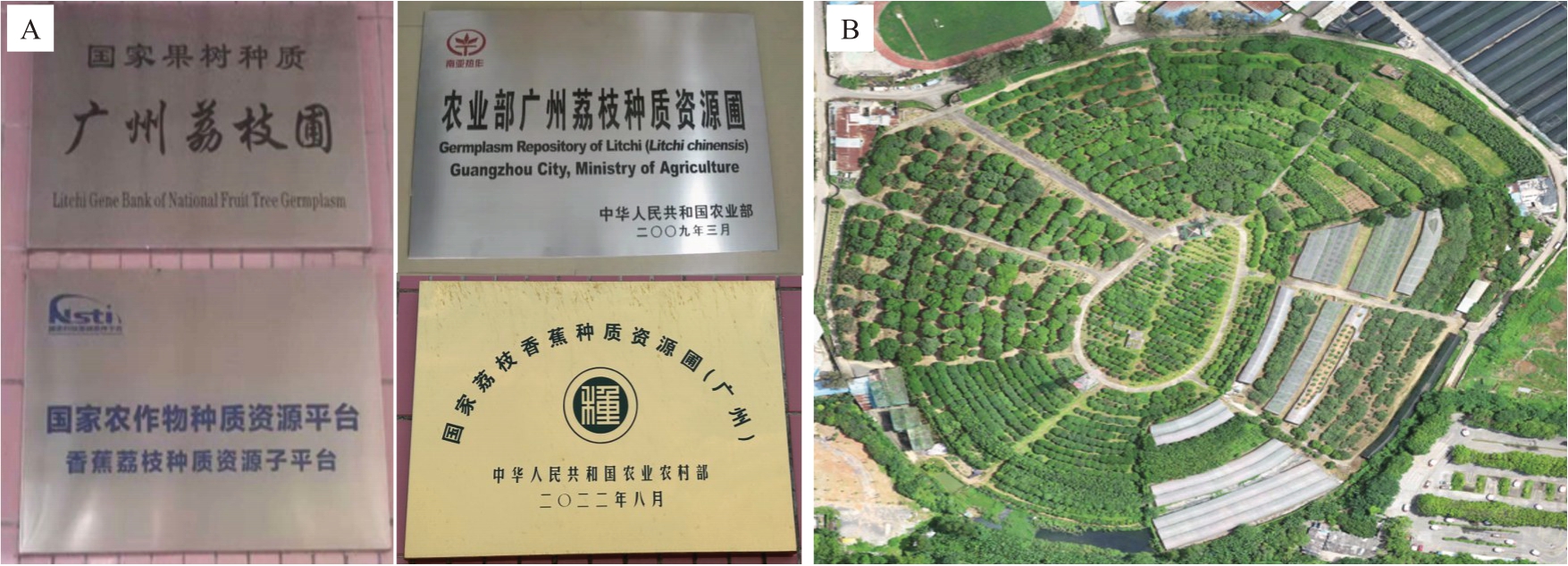
图1 荔枝圃的规划建设历史
Fig.1 Development and construction of the NLBGR
A.历年来荔枝圃所获称号。1989 年农牧渔业部授牌“国家果树种质——广州荔枝圃”;2009 年农业部授牌成为“农业部广州荔枝种质资源圃”。2018 年成为国家园艺种质资源库共建单位,“国家农作物种质资源平台——国家香蕉荔枝种质资源子平台”;2022 年农业农村部授牌更名为“国家荔枝香蕉资源圃(广州)”;B.2017 年荔枝圃全局俯瞰图。
A.Titles and Recognitions of the Litchi Germplasm Repository Over the Years.In 1989, the Ministry of Agriculture, Animal Husbandry, and Fisheries designated the repository as the “Litchi Gene Bank of National Fruit Tree Germplasm”.In 2009, the Ministry of Agriculture officially recognized it as the “Germplasm Repository of Litchi (Litchi chinensis) Guangzhou City, Ministry of Agriculture”.In 2018, it became a co-establishment unit of the National Horticultural Germplasm Resource Bank and was incorporated into the “National Crop Germplasm Resource Platform: National Banana and Litchi Germplasm Sub-platform” In 2022, the Ministry of Agriculture and Rural Affairs renamed it the “National Litchi and Banana Germplasm Repository (Guangzhou)”; B.Aerial view of the Litchi Germplasm Repository in 2017.
1.2 资源收集、保存和编目
团队在长期的走访调查中发现,我国荔枝资源分布呈现明显地域差异:海南野生资源种群分布广泛,广东、广西兼具栽培与野生资源多样性,福建资源多样性较低,云南、四川及台湾荔枝资源稀缺,各省份荔枝原生资源总量800~1000份。自建圃以来,荔枝圃资源收集工作呈现显著阶段性特征(表1):1978 年前(建圃前期),保存广州本地优质品种30份;1979—1989 年国家圃建设时期,从海南、广东、广西等主产区新增收集资源59 份,总保存量达89份;1990—1999 年,因工作经费短缺,新增资源仅有29 份。2000—2008 年,利用专项资金对已有资源进行更新复壮,完成整理清查任务。2016 年起,荔枝圃在国家和省级多项资金的支持下,全面推进荔枝种质资源收集、保护、鉴定及分发共享等各项工作,至2020 年前累计编目保存荔枝种质340 份,完成182份衰退资源复壮及58份嫁接改良,累计更新720份次。2021—2024 年第三次全国普查期间,经筛选后接收154 份资源入圃试种保存,同步开展年度20份野生及特异资源收集,至2024 年总保存量突破700 份(433 份完成编目),建成全球规模最大、多样性最丰富的荔枝种质资源库,其中超过90%的种质为野生或半野生状态,大量资源在原生境处于濒危状态。
表1 荔枝圃不同阶段编目资源产地及数量统计
Table 1 Cataloging of Resource Origins and Annual Conservation Status of NLBGR
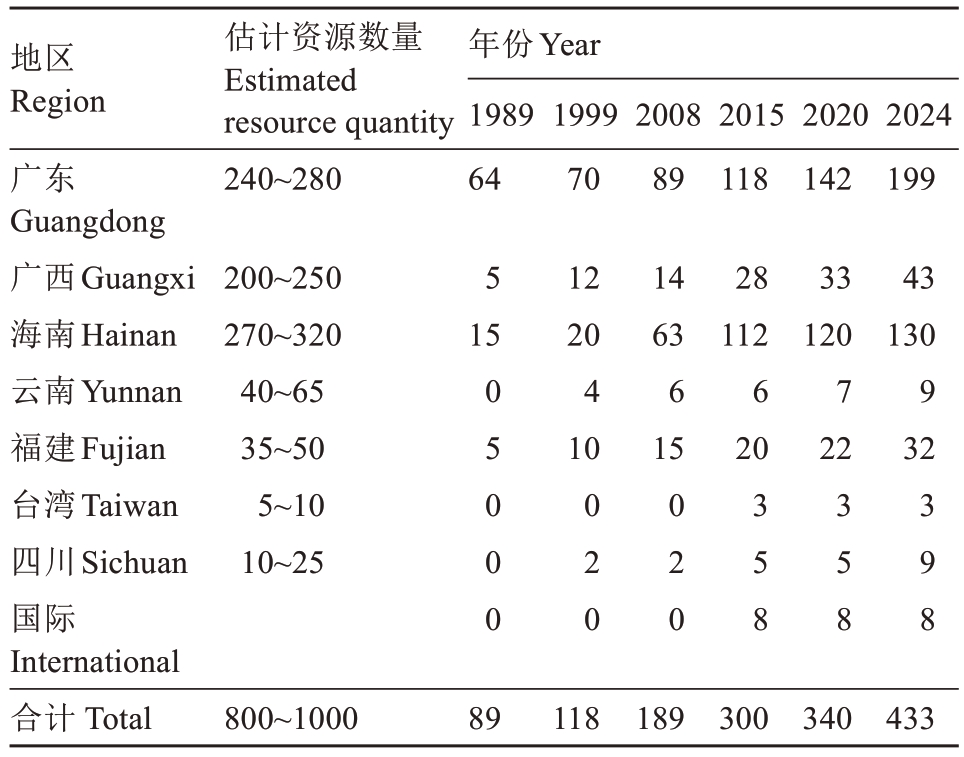
地区Region广东Guangdong广西Guangxi海南Hainan云南Yunnan福建Fujian台湾Taiwan四川Sichuan国际International合计 Total估计资源数量Estimated resource quantity 240~280年份Year 1989 64 1999 70 2008 89 2015 118 2020 142 2024 199 200~250 270~320 40~65 35~50 5~10 10~25 5 15 0 5 0 0 0 12 20 4 10 14 63 6 15 28 112 6 20 33 120 7 22 43 130 9 32 0 2 0 0 2 0 3 5 8 3 5 8 3 9 8 800~1000 89 118 189 300 340 433
1.3 资源信息化建设
荔枝圃自“七五”计划起逐步开展荔枝种质表型鉴定,2007 年建成荔枝种质资源信息子网并录入79份数据,同步向“热带作物种质资源信息网”提交209 份资源信息。2018 年成为国家园艺种质资源库共建单位,国家园艺种质广州荔枝香蕉分库,通过中国作物种质信息网公开97 份荔枝种质12 项关键数据;在国家园艺种质信息网及中国科技资源共享网开放68 份优稀荔枝资源信息,方便广大民众查询。2023年荔枝圃内自主构建荔枝数字档案系统(https://litchi.gdfruit.cn:8312/apply),实现表型-基因型数据库信息化管理,提供全国用户免费“一站式”资源获取服务。
2 资源宣传与共享,引领产业发展
荔枝圃自建成伊始,便始终坚守种质资源保护、研究与共享的使命,不仅向科研机构、企业和地方政府提供种质资源,还提供优异种质信息及栽培技术等,借助多元化的共享模式,为荔枝产业的创新与可持续发展注入强劲动力。
2.1 加强科普和技术宣传,推动资源保护和利用
2000 年前后是我国荔枝产业发展的第一个黄金时期,课题组前往各荔枝主产区进行资源调查和收集工作,宣传优质资源及其栽培技术。1997—2004 年累计开展技术培训超160 期,年均培训果农1万~2万人次,总受训人数突破10万。通过《广东科技报》连载技术文章,与广东、海南电视台合作制作《荔枝1 分钟》《摇钱树》电视节目等构建起“培训+媒体+资料”三维技术传播网络,推荐优新品种(种质)及其栽培管理技术,8 年间累计受众超5 亿人次。
除了与地方政府、企业和协会等联合举办技术培训班外,荔枝圃还日常接待广东、广西等荔枝主产区科研工作者及相关从业人员前来参观交流,提供优稀荔枝种质给相关单位,开展科研、引种示范或建设小规模的科普观光园,充分发挥科普平台交流作用。自2020 年起固定在9 月22 日举办科普开放日活动,通过现场讲解、荔枝圃参观、品种品鉴等形式,向公众展示圃内保存的丰富资源,重点推介红绣球、凤山红灯笼等荔枝新品种及荔枝干、荔枝蜜等加工产品。2010—2024 年期间,荔枝圃累计开展科普服务1620 人次、专业培训3530 人次,接待参观访问及学术交流活动2520人次(图2)。服务对象覆盖荔枝种植户群体及普通公众,形成了多层次的社会服务网络,推动形成“科研机构+种植户+消费者”的协同保护和利用机制。
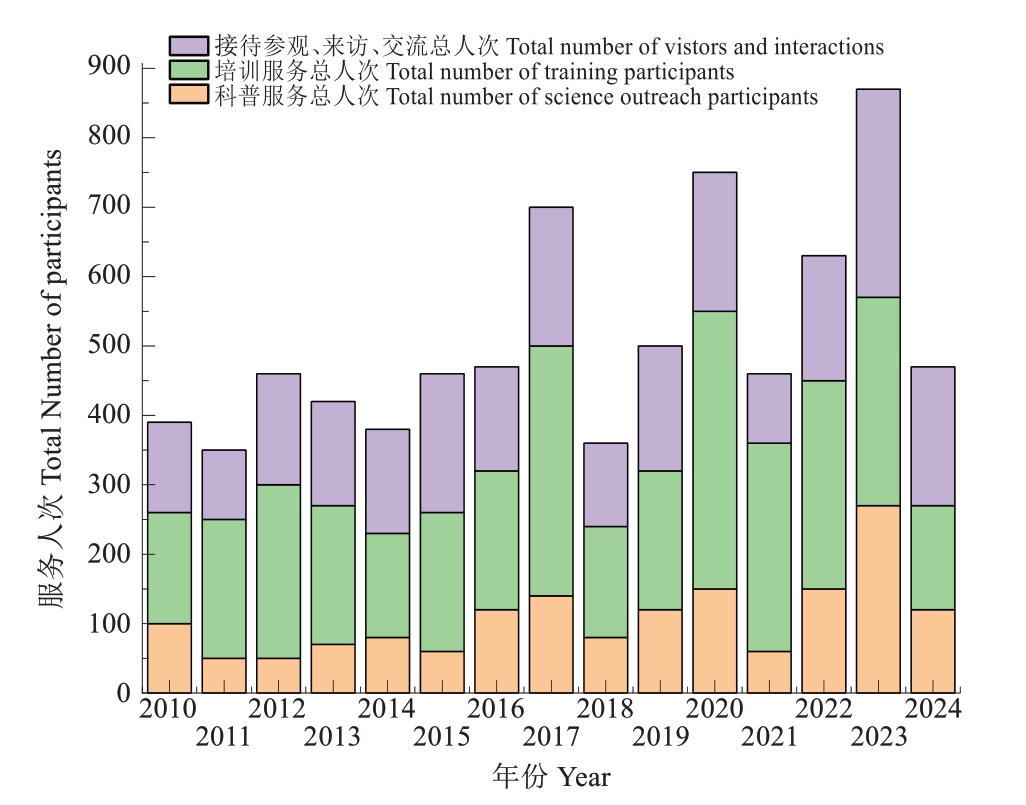
图2 国家荔枝圃2010—2024 年各交流科普活动服务人次统计
Fig.2 Statistics of the number of participants in various outreach and popular science activities by NLBGR from 2010 to 2024
2.2 科研合作,为产业发展储备人才
荔枝圃积极践行种质资源共享理念,过去20 年间,长期向广东省农业科学院果树研究所、华南农业大学、华南植物园、中山大学等诸多高校及科研机构提供优异荔枝种质资源,为相关领域研究提供了不可或缺的物质基础。经统计,荔枝圃累计向广东、广西、四川、海南、福建和海南等逾19 家科研单位提供了近3000 份珍贵的荔枝种质资源,涵盖凤山红灯笼、仙进奉、尚书怀等多个优质栽培品种,禾虾串、无核荔、厚叶等单性结实的特异种质,野生荔枝9 号、12 号等珍贵的野生资源。其中,总分享资源份数超100 份的单位有8 家,主要用于科学研究和人才培养,少量用于引种示范和杂交育种(表2)。
表2 荔枝圃向部分科研单位共享的种质资源信息汇总
Table 2 Summary of germplasm resources information shared by NLBGR
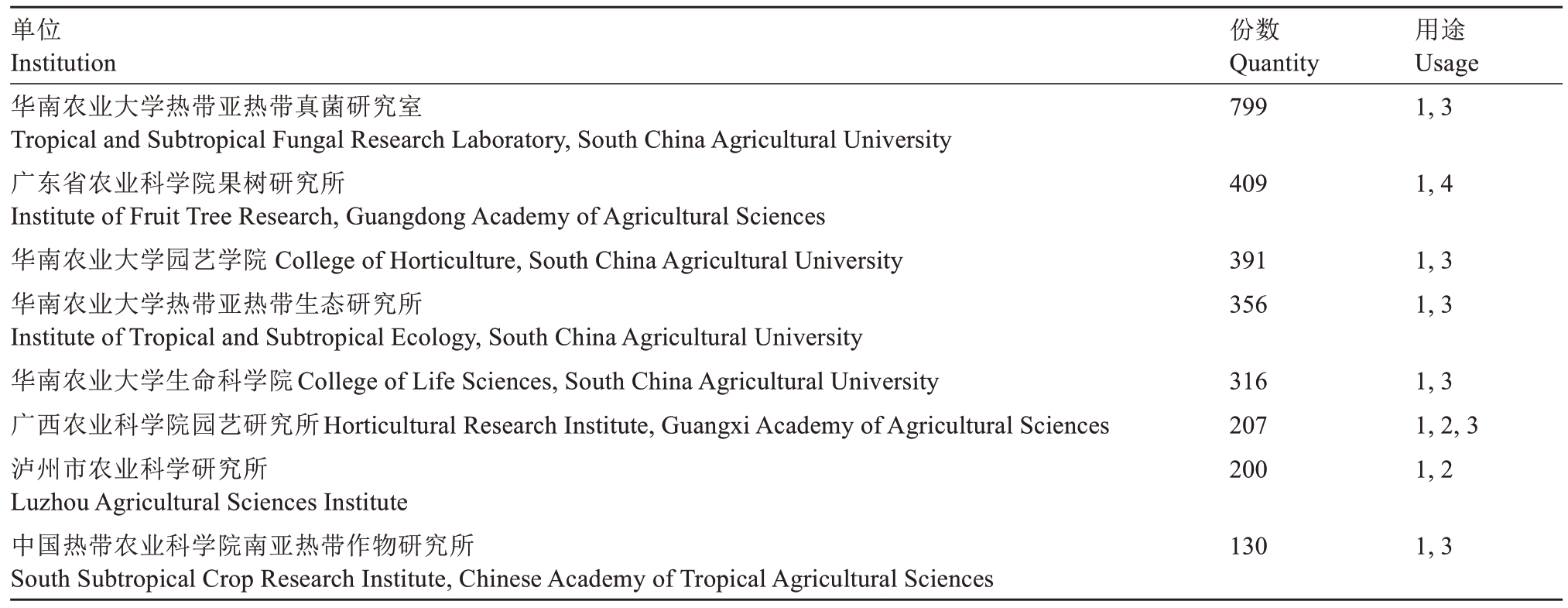
注:数据统计范围为2004—2024 年;用途编号:1.科学研究,2.引种示范,3.人才培养,4.杂交育种。
Note: The data coverage spans from 2004 to 2024, with a minimum sample size of 4; Usage Code: 1.Scientific Research, 2.Introduction and Demonstration, 3.Talent Cultivation, 4.Hybrid Breeding.
单位Institution华南农业大学热带亚热带真菌研究室Tropical and Subtropical Fungal Research Laboratory, South China Agricultural University广东省农业科学院果树研究所Institute of Fruit Tree Research, Guangdong Academy of Agricultural Sciences华南农业大学园艺学院 College of Horticulture, South China Agricultural University华南农业大学热带亚热带生态研究所Institute of Tropical and Subtropical Ecology, South China Agricultural University华南农业大学生命科学院College of Life Sciences, South China Agricultural University广西农业科学院园艺研究所Horticultural Research Institute, Guangxi Academy of Agricultural Sciences泸州市农业科学研究所Luzhou Agricultural Sciences Institute中国热带农业科学院南亚热带作物研究所South Subtropical Crop Research Institute, Chinese Academy of Tropical Agricultural Sciences份数Quantity 799用途Usage 1, 3 409 1, 4 391 356 1, 3 1, 3 316 207 200 1, 3 1, 2, 3 1, 2 130 1, 3
这些种质资源广泛应用于品种选育、遗传多样性分析、抗逆性研究以及分子标记开发等多领域研究,如在2004—2008 年间,广东省农业科学院果树研究所与华南农业大学开展联合研究生培养工作,荔枝圃提供了陈紫、尚书怀等120份种质资源,深入开展荔枝ISSR分子标记研究,为狄凤香硕士论文的撰写奠定了坚实的试验基础[4-5],亦有其他研究生开展AFLP 分子标记、离体培养及杂交育种等研究[6-11]。同时,荔枝圃还向广东省农业科学院生物研究所、华南农业大学食品学院等单位提供八宝香、布袋、将军荔等优质果实,用于果品营养成分分析[12],为孙远明教授指导的吴雅静等硕士研究生的培养提供了宝贵实践机会。荔枝圃不仅为大量硕士、博士学位论文的完成提供了关键的数据支撑,还支撑各类项目73 项,包含重大专项14 项、自然科学基金项目9项、重点研发计划4项和省部级科研项目15项,有力推动了众多科研项目的顺利开展。
2.3 凝练科研成果,为产业发展筑牢基石
凭借各类项目的资金支持和丰富的种质资源,团队先后撰写了《广东荔枝志》《广东荔枝图谱》《荔枝》和《中国果树种质资源多样性-荔枝》等15 本专著,对我国各地名优荔枝和种质资源进行图文描述[12]。为消除不同单位、不同研究人员对资源的描述、评价的人为误差,实现数据的统一性和可比性,团队在1990 制定荔枝种质资源首个描述规范——果树种质资源描述符(荔枝),性状描述以育种的需要为主,兼顾生产需要;2008 年以资源共享和利用为主要目标,制定了荔枝种质资源描述的第一部规范和行业标准——《荔枝种质资源描述规范和数据标准》;2013 年结合荔枝鉴定的实际工作需要,制定了行业标准《农作物种质资源鉴定技术规范-荔枝》;至2024 年底,已建立技术规程17 个,有效规范了荔枝种质描述,促进大众对我国荔枝种质资源多样性的了解。
依托不断改善的试验条件,荔枝圃已支撑发表期刊论文109 篇,包含中文核心期刊论文66 篇,SCI论文16 篇。诸多论文中影响力最大的为2022 年广东省农业科学院果树研究所与华南农业大学夏瑞团队合力解密妃子笑荔枝基因组,借助荔枝圃提供的73 份种质首次揭示荔枝的两起独立驯化事件:极早熟品种主要与云南野生种群存在紧密关联,晚熟品种则与海南野生种群息息相关[13]。这一突破性成果发表于国际知名学术期刊Nature Genetics,极大地提升了我国荔枝研究在国际上的影响力,不仅填补了荔枝起源和驯化历史研究领域的关键空白,更为后续的分子育种和品种改良提供了极具价值的遗传资源,成功使我国在荔枝基因组学研究方面跻身国际前列。
3 优新品种培育与推广,直接推动产业发展
3.1 优异种质筛选与培育
20 世纪80—90 年代,随着我国经济的起步,对荔枝需求非常旺盛,荔枝供不应求,优质荔枝糯米糍价格一度在200 元·kg-1以上,巨大的经济效益带动了荔枝种植的高速发展。广东、广西、福建和海南等省份掀起了大种荔枝的高潮,此时全国各地栽种的荔枝品种有怀枝(禾荔、淮枝)、黑叶(乌叶)、大造(大红袍)、三月红、白蜡、妃子笑、糯米糍和桂味等。
三月红在5 月上旬成熟,属于早熟品种,在我国多数荔枝产区是上市最早的品种,风味酸甜,品质中下,果实成熟时遇多雨天气,极易感病和裂果[14-15]。妃子笑在5月下旬至6月上旬成熟,是中早熟优质荔枝,果大核小,肉厚质脆,味道清甜爽口,品质中上[16];但栽培期间易翻花,挂果率低,产量不稳定。黑叶在6 月中旬成熟,属于中熟品种;怀枝在6 月下旬成熟,属于晚熟品种,两个品种果实品质中等,因适应性强、丰产稳产、易管理,是全国栽培面积最广泛的品种。糯米糍和桂味在6 月中下旬成熟,属于中晚熟优质品种,品质均为上乘,糯米糍软滑细嫩、风味浓甜;桂味爽脆细嫩,清甜多汁[17];但二者成花要求高,坐果率低,糯米糍成熟后期极易裂果,大小年结果极为严重,对栽培和管理技术有较高的要求。
进入21 世纪,随着科技发展,居民生活水平不断提高,单一的荔枝品种已经不能满足人民群众日益增长的美好需求。针对荔枝熟期集中、优质品种少的困境,团队在2008 年开展荔枝杂交育种技术摸索,至今已筛选和育成红绣球、仙进奉、凤山红灯笼、赛糯、离娘香、清风、红嵄荔等诸多荔枝新品种(图3,表3)。
表3 部分名优荔枝品种特性描述
Table 3 Description of the characteristics of some superior litchi varieties
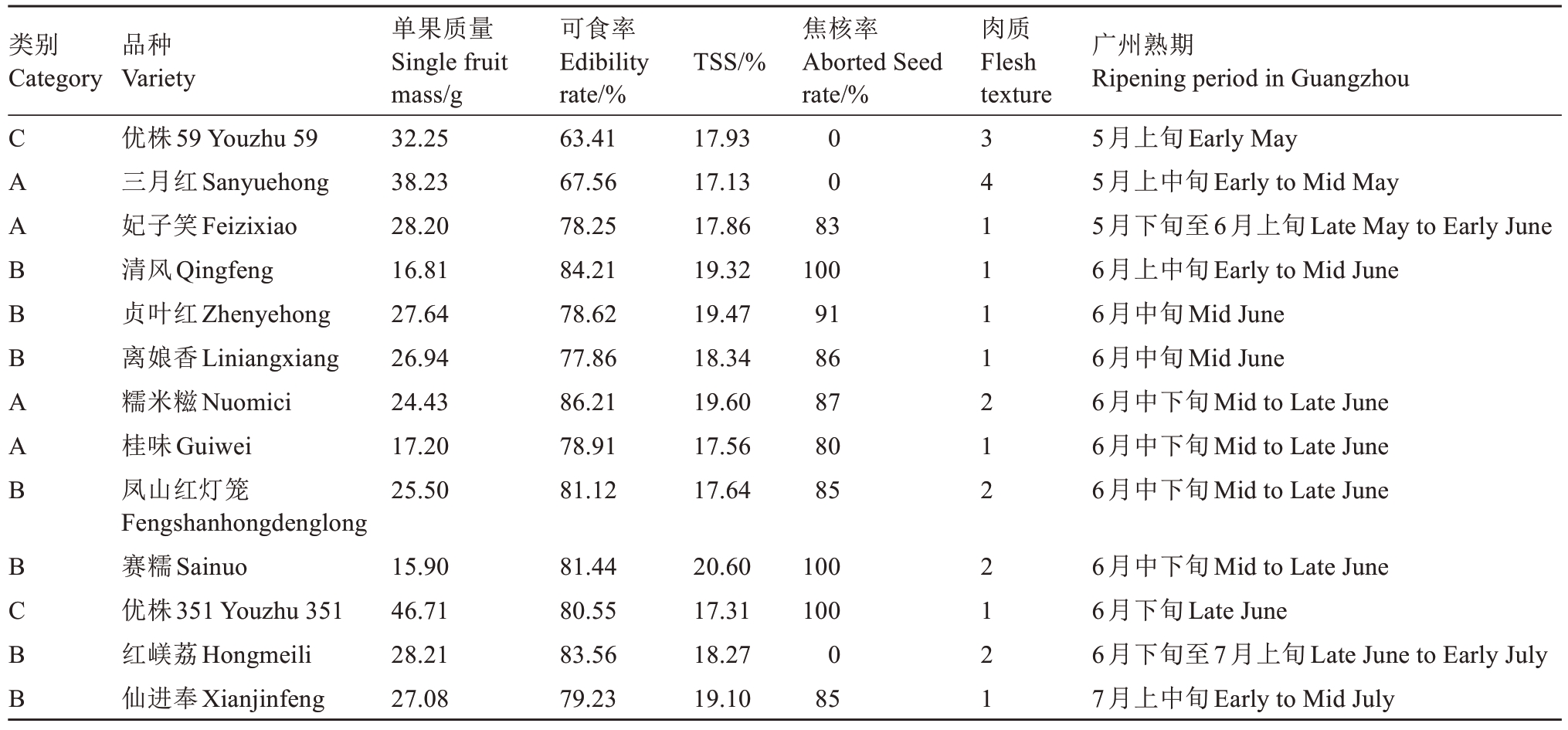
注:类别栏中A 为老品种,B 为新品种,C 为待申报品种;肉质栏中1 为爽脆,2 为细嫩,3 为细韧,4 为粗韧。
Note: In the “Category” column, A refers to traditional varieties, B to new varieties, and C to varieties pending registration; In the “Flesh texture”column, 1 indicates crisp, 2 indicates tender, 3 indicates fine and fibrous, and 4 indicates coarse and fibrous.
类别Category TSS/%焦核率Aborted Seed rate/%肉质Flesh texture C A A B B B A A B B C B B品种Variety优株59 Youzhu 59三月红Sanyuehong妃子笑Feizixiao清风Qingfeng贞叶红Zhenyehong离娘香Liniangxiang糯米糍Nuomici桂味Guiwei凤山红灯笼Fengshanhongdenglong赛糯Sainuo优株351 Youzhu 351红嵄荔Hongmeili仙进奉Xianjinfeng单果质量Single fruit mass/g 32.25 38.23 28.20 16.81 27.64 26.94 24.43 17.20 25.50可食率Edibility rate/%63.41 67.56 78.25 84.21 78.62 77.86 86.21 78.91 81.12 17.93 17.13 17.86 19.32 19.47 18.34 19.60 17.56 17.64 0 0 83 100 91 86 87 80 85广州熟期Ripening period in Guangzhou 5月上旬Early May 5月上中旬Early to Mid May 5月下旬至6月上旬Late May to Early June 6月上中旬Early to Mid June 6月中旬Mid June 6月中旬Mid June 6月中下旬Mid to Late June 6月中下旬Mid to Late June 6月中下旬Mid to Late June 6月中下旬Mid to Late June 6月下旬Late June 6月下旬至7月上旬Late June to Early July 7月上中旬Early to Mid July 15.90 46.71 28.21 27.08 81.44 80.55 83.56 79.23 20.60 17.31 18.27 19.10 100 100 0 85 3 4 1 1 1 1 2 1 2 2 1 2 1
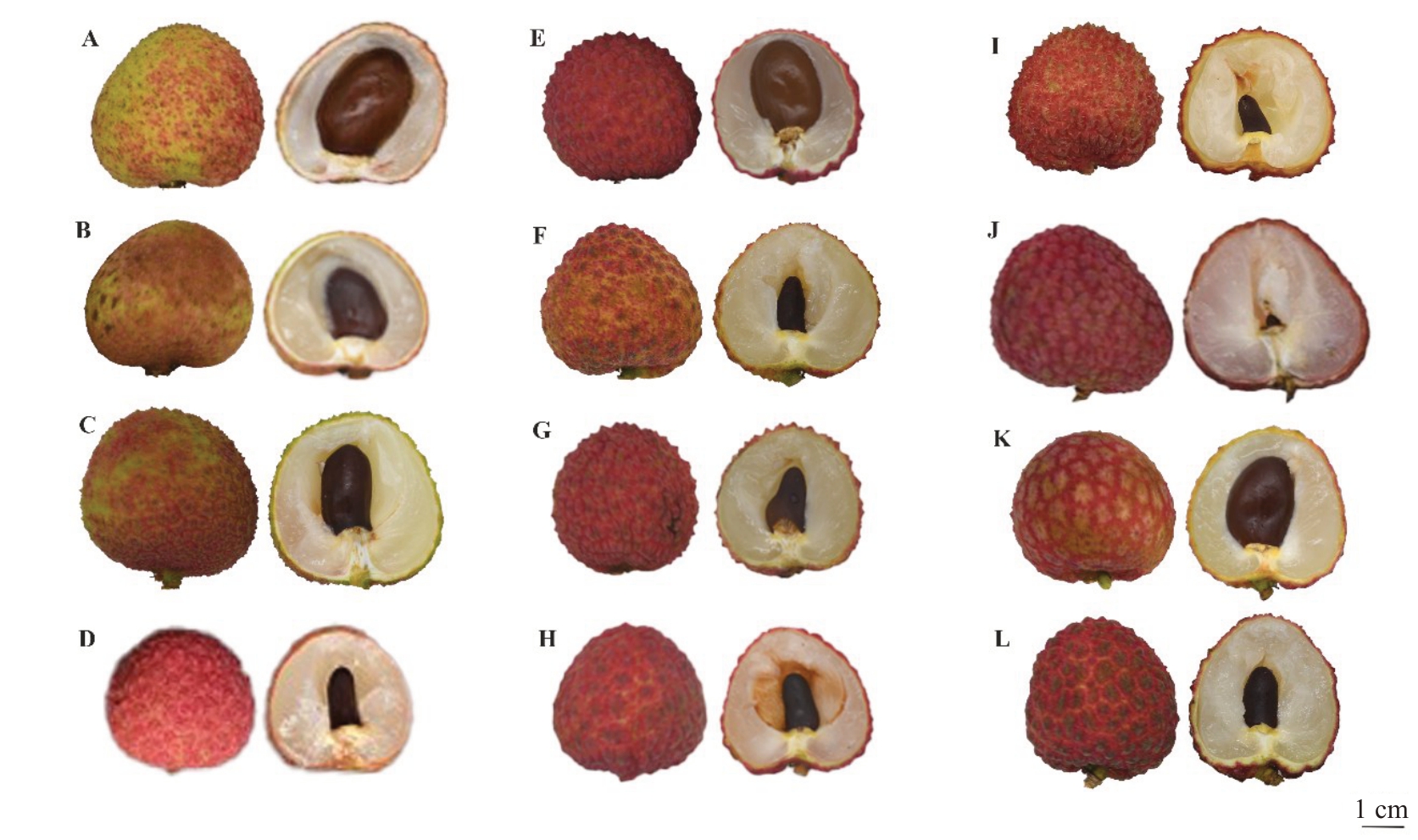
图3 部分名优荔枝品种果实图像
Fig.3 The fruit images of some superior litchi varieties
A.优株59;B.三月红;C.妃子笑;D.清风;E.离娘香;F.糯米糍;G.桂味;H.凤山红灯笼;I.赛糯;J.优株351;K.红嵄荔;L.仙进奉。
A.Youzhu 59; B.Sanyuehong; C.Feizixiao; D.Qingfeng; E.Liniangxiang; F.Nuomici; G.Guiwei; H.Fengshanhongdenglong; I.Sainuo; J.Youzhu 351; K.Hongmeili; L.Xianjinfeng.
仙进奉是发现于广东增城新塘镇的实生变异单株,果实歪心形,果较大,果肉厚,蜡黄色,味清甜,散发独特蜜香。挂树时间长,风味品质不发生改变,果皮厚而韧,且具备一定的自带保鲜时长[18],极适合远程贮运销售,是开拓海外市场的优质候选品种。球状结果性状明显,裂果率3.5%~3.8%,容易丰产稳产;3~5年生嫁接树平均株产分别为25、45和75 kg,平均666.7 m2产量为600 kg。在广州7月上旬成熟,是晚熟品种,在东莞地区成熟期较糯米糍晚7~10 d。广东省的珠江三角洲、粤西内陆地区和粤东地区等荔枝中迟熟产区均可种植,在荔枝主产区北缘区高接换种或栽培,其晚熟特性更为突出。如在晚熟荔枝产区广西桂平,仙进奉成熟期比怀枝晚7 d,比桂味迟14 d。
凤山红灯笼是发现于广东汕尾鲤鱼尾的实生变异单株。果实正心形,肉质细嫩,不流汁,味清甜,可与糯米糍媲美;裂果率在5%以下,显著低于糯米糍30%~50%的裂果率;丰产性、稳产性与怀枝接近,而远优于糯米糍。在相同树龄、相同种植密度的情况下,凤山红灯笼的666.7 m2 产量比糯米糍高出40%。在广州6 月中下旬成熟,是中晚熟品种,适宜在广东中东部、广西桂东南、福建南部、四川合江等中晚熟荔枝适宜区推广种植[19]。
红嵄荔是发现于广东汕尾鲤鱼尾的实生变异单株,性状与怀枝接近,果肉软绵细腻多汁,入口即化,无渣,口感清爽,品质远超怀枝。果实商业成熟后留树7 d仍可保持极高的商品价值,是新的晚熟、优质、耐储运品种,适合远销。在汕尾地区,红嵄荔成熟期比桂味迟10 d左右,比凤山红灯笼迟5 d左右。
清风是发现于广东德庆的实生变异单株,性状与桂味相似,果肉蜡白色、味清甜,爽脆,汁液少,口感优于桂味荔枝,且所有果实均为焦核,可食率高于桂味,丰产性高,在德庆地区6 月上中旬成熟,比同地区的桂味熟期晚3~5 d,属中晚熟品种。
离娘香、赛糯、贞叶红和优株59、优株351 都是荔枝圃自主选育的优异品种和株系。优株59 为早熟品种,熟期与三月红相当,肉质细韧,风味清甜,果肉品质优于三月红;不易裂果,抗霜疫霉病能力强于三月红,适宜在海南、粤西等荔枝早熟产区推广。其余4 个品种均为晚熟荔枝新品种,最具特色的为离娘香,果实具有浓郁玫瑰花香味,果实耐贮性强,常温贮藏9 d 不发生果皮褐变,保鲜期比桂味长3 d 以上[20]。
3.2 优异新品种推广
目前,我国荔枝育种专家已经选育出凤山红灯笼、仙进奉、冰荔、观音绿、北园绿、井岗红糯、桂早荔、新球蜜荔等优质荔枝新品种40 多个,各品种均在荔枝圃保种备份。截至2024 年,荔枝圃已向广东、广西、四川、云南等省份的22个企业和个人共享各类优质荔枝接穗超过2500份次。
3.2.1 仙进奉的示范推广 在众多新品种中,仙进奉荔枝的推广效果最为显著,该品种于2011 年通过广东省农作物品种审定委员会的审定,自2013 至今,9 次被评为广东省农业主导品种;不仅荣获国家地理标志保护产品、广东省名牌产品称号,更是2023—2024 年唯一入选“农业农村部农业主导品种”的荔枝品种。
仙进奉原产于增城,因其良好的品质及广泛的适应性,最先在广东省内的茂名、广州和潮州等6个市区迅速推广,2014 年建成标准化示范基地10 个(核心示范面积3 586.66 hm2),推广总面积4 733.33 hm2。推广面积最大的为茂名地区,在茂南和电白区共示范推广1 513.33 hm2;其次是广州和潮州,超过666.67 hm2;江门、东莞和珠海等地推广面积均在333.33 hm2 以下。2016 年各产区仙进奉产量为186.4 万kg,为2014 年的1.95 倍;其中广州地区的产量最高,是茂名地区的1.97倍,这可能是因为广州是仙进奉荔枝的原产地,栽培技术成熟,推广时间较早,调查期间已有大量树体进入丰产期,江门和珠海等地的果园则因推广较晚,嫁接苗刚进入挂果期。种植户的收入由3571万元提升至6 290.5万元,经济效益最高的为广州,这与优质优价的市场规律及当地政府和企业对该新品种的大力宣传密切相关。良好的经济效益推动仙进奉在广东、广西、福建、四川、重庆、云南等中晚熟荔枝产区广泛种植,据不完全统计,2023 年仙进奉全国种植面积已达16 666.67 hm2[21]。不同产区错峰成熟,让仙进奉鲜果的销售周期从40 d 延长到150 d,用“品牌共赢”凝聚产能,探索我国荔枝产业发展新模式。
3.2.2 凤山红灯笼的示范推广 凤山红灯笼荔枝在2010 年通过新品种审定,但因栽培技术等因素限制,品种推广力度不足。经过多年探索,蔡长河联合当地专家制定了2 项地方标准《凤山红灯笼荔枝栽培技术规程》和《汕尾市荔枝高接换种技术规程》,标准化凤山红灯笼高接换种和相关栽培技术,使其品种特性得以充分发挥。2017 年,广西玉林中国国际荔枝产业大会举行“全国优质荔枝擂台赛”,凤山红灯笼凭借端正的果形、鲜红的果色和优异的品质荣获金奖。
汕尾常年荔枝产量在10 万t 以上,种植面积居广东省前六,但品种老旧、知名度低、效益差[22]。以本土选育的荔枝凤山红灯笼为契机,广东省及汕尾市政府大力推进品种结构调整。2021 年,蔡长河率领团队与汕尾市革命老区3 家企业展开合作,引进仙进奉、冰荔、美人系列等荔枝优异新品种16 个,累计高接换种4100多株,建成3个优质荔枝采穗圃,总面积30.67 hm2,每年可以提供15 个优质荔枝接穗1 万kg 以上[23]。以此为中心,向周边陆河县、惠来县、惠东县、广州增城区、云浮县、茂名市及广西、四川、福建等地辐射。截至2024 年,团队在广东、广西、四川和福建等地共建立优质荔枝示范基地15个,举办现场观摩会和技术培训班60 场以上,结合田间指导、会议交流和发放技术资料等多种方式,在全国范围内推广“凤山红灯笼”荔枝及其高产优质栽培技术。在政府、科研单位和企业等多方合作下,凤山红灯笼知名度日益提高,推广面积和品牌效益也逐步增加。按实际结果面积来算(表4),2021—2023年,广东省内累计推广凤山红灯笼面积达9 133.3 hm2,创造社会经济效益逾50.19 亿元,新增利润总额48.54亿元,节支总额1.37亿元。凤山红灯笼从寂寂无名的“土特产”逆袭成为汕尾农业产业化的“金招牌”,增强了汕尾荔枝的市场竞争力。
表4 2021—2023 年凤山红灯笼推广情况统计
Table 4 Statistics on the promotion of Fengshanhongdenglong from 2021 to 2023

内容Item省内推广规模Scale of promotion within Guangdong新增销售额Incremental sales新增利润Incremental profit节约成本Cost savings单位Unit公顷hm2万元104 Y年份Year总计202120222023Total 2 133.333 000.004 000.009 133.33 uan117 200.00165 150.00219 550.00501 900.00 uan113 360.00159 750.00212 350.00485 460.00 uan3 200.004 500.006 000.0013 700.00万元104 Y万元104 Y
3.2.3 其他 因丰产、易管理,黑叶、怀枝是全国各荔枝产区的主要栽培品种,但其果实品质中等,果品售价低。2015 年起,团队在广西北流和钦州多个产地建立良种采穗圃,引进凤山红灯笼、仙进奉、观音绿等优良荔枝品种;2017 年春季开始大面积高接换种,建成仙进奉、岭丰糯、观音绿、凤山红灯笼等荔枝良种示范园3.33 hm2,2018 年示范园顺利挂果。该年全国荔枝大丰收,黑叶、怀枝售价只有1元·kg-1,桂味、糯米糍等传统优良品种也只有6~10 元·kg-1,广西地区仙进奉、红蜜荔、凤山红灯笼的市场售价30~60元·kg-1,经产值比原来增加10万元以上。农业农村部官方网站在2018 年以“名贵荔枝仙进奉将成为广西未来主推优良新品种”为题对此进行宣传报道。可见,仙进奉在广西荔枝品种结构调整、提质增效方面产生巨大的社会效益。
四川省是我国荔枝第五大产区[24],乐山市水口镇在大渡河与青衣江交界处形成一个特殊的小气候,是我国荔枝种植的“北极”,当地种植的晚熟荔枝可以在8、9 月份上市,比其他产区迟1 个月以上。2017—2020 年应当地农业部门及四川嘉美佳有限公司的邀请,团队前往当地推广凤山红灯笼、仙进奉、红绣球等优良荔枝新品种,推广面积已有60余hm2。2021 年后多数果园陆续挂果,果实销售价格较高,经济效益较好。
4 展 望
4.1 规划荔枝圃资源,助力产业新发展
在我国荔枝产业发展中,荔枝圃资源的长远规划和可持续利用至关重要。资源收集与保护是产业发展的基础,国家荔枝圃应加强国际合作,继续拓宽荔枝遗传背景,提升品种多样性和抗逆性,培育适应市场需求的新品种[25]。当前,荔枝种质资源收集数量增长与圃地资源有限的矛盾日益突出,推动基于基因型的核心种质研究,如应用全基因组重测序技术[26-27]和靶向序列捕获技术[28]提高种质间遗传相似度的鉴别能力;同时随着树体生长,园内荫蔽情况严重,病虫害防治和资源维护工作迫在眉睫,急需科学高效的管理策略,优化人力资源配置、探索机械化管理模式等[29-31]。同时,完善资源共享制度,推动科研成果产业化,将助力荔枝产业转型升级[32]。荔枝圃资源的可持续利用涉及多个领域,需通过科研合作和制度创新,构建高效开放的资源利用体系,为荔枝产业的健康发展继续提供物理支撑。
4.2 推进荔种培育,构建保护新体系
荔枝品种质量直接影响产业的未来,科学高效地管理新品种的审定、保护和利用工作迫在眉睫[33]。当前,荔枝新品种审定流程复杂、耗时长,频发繁殖偷苗现象,严重损害育种者权益并阻碍产业发展。以新西兰佳沛集团为例,其猕猴桃品种在中国市场遭遇侵权。虽然维权成功,但遭遇了诸多困难,反映出品种保护的严峻性[34]。为此,需构建完善的品种权保护体系,加强国际合作,提升公众参与度,并引入防伪技术等手段,全方位推进荔枝新品种保护工作,确保种质资源的合理利用,为产业健康发展筑牢根基[35]。
4.3 多元宣传护荔种,全民参与促发展
在国家荔枝产业高质量发展过程中,荔枝圃作为珍贵种质资源的储存地,其运行与安全需要社会各方的参与[36]。为增强公众对荔枝种质资源的保护意识,需通过多样化宣传策略,具体包括:利用电台广播深入乡村地区,普及保护知识;借助微信平台发布动态和成功案例,增强互动;通过抖音制作科普短视频,吸引年轻群体关注[37-38]。宣传内容聚焦资源对产业、生物多样性及粮食安全的重要性,展示保护成果,广泛激励果农和企业参与,包括但不限于制定奖励机制,对积极参与保护的果农个人和集体给予物质奖励和荣誉证书。通过系列举措,构建政府引导、果农参与、社会关注的保护格局,发挥国家荔枝圃的纽带作用,推动荔枝产业繁荣与生物多样性保护。
荔枝圃作为荔枝产业的核心科研平台,在种质资源的收集、保存、鉴定与共享方面取得了显著成就,为荔枝产业的可持续发展提供了坚实的物质基础和数据支撑;也通过种质创新与技术研发,推动荔枝产业品种结构优化和效益提升;还从多维度为人才培养和科研创新贡献宝贵的试验材料,切实将种质资源的价值发挥到极致。未来,荔枝圃将继续强化资源保存鉴定工作,完善资源共享机制,加强种质资源的精准鉴定与高效利用,进一步促进荔枝产业的高质量发展。同时,通过多元化的科普宣传,进一步提升社会对种质资源保护的意识,为荔枝产业的长远发展和生物多样性保护贡献更大的力量。
[1] 吴炬怡.荔枝种植产业的现状与经济可持续发展[J].当代农机,2025(1):83-84.WU Juyi.The current situation and economic sustainable development of litchi planting industry[J].Contemporary Farm Machinery,2025(1):83-84.
[2] 吴洁芳,唐小浪,陈洁珍,黄秉智,潘建平,刘岩.热带南亚热带果树种质资源研究现状与发展思考[J].中国热带农业,2011(4):27-29.WU Jiefang,TANG Xiaolang,CHEN Jiezhen,HUANG Bingzhi,PAN Jianping,LIU Yan.Research status and development thoughts on tropical and south asian tropical fruit tree germplasm resources[J].China Tropical Agriculture,2011(4):27-29.
[3] 罗森波.广州市荔枝气候区的划分与荔枝生产合理布局[J].热带地理,1988,8(4):291-299.LUO Senbo.The climatic divisions of litchi production and its rational layout in Guangzhou[J].Tropical Geography,1988,8(4):291-299.
[4] 欧良喜,向旭,狄凤香,白丽军,陈洁珍,孙清明.SSR 分子标记在荔枝上的研究进展[J].生物技术通报,2009,25(增刊1):83-87.OU Liangxi,XIANG Xu,DI Fengxiang,BAI Lijun,CHEN Jiezhen,SUN Qingming.Advances of studies on SSR markers in litchi[J].Biotechnology Bulletin,2009,25(Suppl.1):83-87.
[5] 刘伟,蒋侬辉,袁沛元,邱燕萍,凡超,杨晓燕,向旭.SSR 和SNP 标记在荔枝遗传育种中的应用[J].生物技术进展,2017,7(1):7-12.LIU Wei,JIANG Nonghui,YUAN Peiyuan,QIU Yanping,FAN Chao,YANG Xiaoyan,XIANG Xu.Application of SSR and SNP molecular marker in litchi breeding[J].Current Biotechnology,2017,7(1):7-12.
[6] 向旭.荔枝EST-SSR 与SNP 分子标记辅助育种技术平台的创建与育种应用[Z].广州:广东省农业科学院果树研究所,2018.XIANG Xu.The creation and application of Litchi EST-SSR and SNP molecular marker-assisted breeding technology platform for breeding[Z].Guangzhou:Research Institute of Pomology Guangdong Academy of Agricultural Sciences,2018.
[7] 吴元立,易干军,周碧容,曾继吾,黄永红.荔枝与龙眼种质资源研究进展[J].植物遗传资源学报,2007,8(4):498-502.WU Yuanli,YI Ganjun,ZHOU Birong,ZENG Jiwu,HUANG Yonghong.Advances on the research of litchi and Longan germplasm resources[J].Journal of Plant Genetic Resources,2007,8(4):498-502.
[8] 孙清明,欧良喜,陈洁珍,向旭,蔡长河.荔枝离体培养育种研究进展[C].广州:广东省园艺学会第九次会员大会暨学术研讨会论文集,2010:55-59.SUN Qingming,OU Liangxi,CHEN Jiezhen,XIANG Xu,CAI Changhe.Advances in Lychee in vitro culture and breeding research[C].Guangzhou:Proceedings of the 9th General Assembly and Academic Seminar of Guangdong Horticultural Society,2010:55-59.
[9] 孙清明,欧良喜,陈洁珍,向旭,蔡长河.荔枝育种研究进展:常规育种[C].广州:广东省园艺学会第九次会员大会暨学术研讨会论文集,2010:60-67.SUN Qingming,OU Liangxi,CHEN Jiezhen,XIANG Xu,CAI Changhe.Advances in Litchi Breeding Research:Conventional Breeding[C].Guangzhou: Proceedings of the 9th General Assembly and Academic Seminar of Guangdong Horticultural Society,2010:60-67.
[10] 昝逢刚,吴转娣,曾淇,张惠云,李明芳,郑学勤.荔枝种质遗传多样性的SRAP 分析[J].分子植物育种,2009,7(3):562-568.ZAN Fenggang,WU Zhuandi,ZENG Qi,ZHANG Huiyun,LI Mingfang,ZHENG Xueqin.Genetic diversity analysis of Litchi germplasm by SRAP markers[J].Molecular Plant Breeding,2009,7(3):562-568.
[11] 向旭,欧良喜,陈厚彬,孙清明,陈洁珍,蔡长河,白丽军,赵俊生.中国96 个荔枝种质资源的EST-SSR 遗传多样性分析[J].基因组学与应用生物学,2010,29(6):1082-1092.XIANG Xu,OU Liangxi,CHEN Houbin,SUN Qingming,CHEN Jiezhen,CAI Changhe,BAI Lijun,ZHAO Junsheng.EST-SSR analysis of genetic diversity in 96 litchi (Litchi chinensis Sonn.) germplasm resources in China[J].Genomics and Applied Biology,2010,29(6):1082-1092.
[12] 崔永宁,陈洁珍,史发超,姜永华,严倩,欧良喜,刘海伦,蔡长河.基于TPA 法的荔枝资源果肉质地品质分析[J].果树学报,2022,39(12):2241-2252.CUI Yongning,CHEN Jiezhen,SHI Fachao,JIANG Yonghua,YAN Qian,OU Liangxi,LIU Hailun,CAI Changhe.Analysis of texture quality of the fruits in litchi based on the texture profile analysis (TPA)[J].Journal of Fruit Science,2022,39(12):2241-2252.
[13] HU G B,FENG J T,XIANG X,WANG J B,SALOJÄRVI J,LIU C M,WU Z X,ZHANG J S,LIANG X M,JIANG Z D,LIU W,OU L X,LI J W,FAN G Y,MAI Y X,CHEN C J,ZHANG X T,ZHENG J K,ZHANG Y Q,PENG H X,YAO L X,WAI C M,LUO X P,FU J X,TANG H B,LAN T Y,LAI B,SUN J H,WEI Y Z,LI H L,CHEN J Z,HUANG X M,YAN Q,LIU X,MCHALE L K,ROLLING W,GUYOT R,SANKOFF D,ZHENG C F,ALBERT V A,MING R,CHEN H B,XIA R,LI J G.Two divergent haplotypes from a highly heterozygous lychee genome suggest independent domestication events for early and late-maturing cultivars[J].Nature Genetics,2022,54(1):73-83.
[14] 梁晶晶.早熟荔枝“三月红” 受市场冲击逐年减产[J].农村百事通,2007(11):23.LIANG Jingjing.Early maturing lychee “Sanyuehong” has been affected by the market and has seen a year-by-year reduction in production[J].Nongcun Baishitong,2007(11):23.
[15] 苏渊卫,陈铭豪,李腾龙.特早熟三月红荔枝特性及其丰产栽培[J].中国农技推广,2005,21(2):32-33.SU Yuanwei,CHEN Minghao,LI Tenglong.Early maturing Sanyuehong lychee characteristics and high-yield cultivation[J].China Agro-technology Extension,2005,21(2):32-33.
[16] 李东.妃子笑荔枝种植中优质高效栽培技术的运用分析[J].河北农机,2023(21):70-72.LI Dong.Analysis of the application of high-quality and efficient cultivation techniques in the planting of Litchi (Feizixiao)[J].Hebei Agricultural Machinery,2023(21):70-72.
[17] 方壮东,范琴,彭远璇.广东十大主推荔枝品种特性分析[J].中国果业信息,2024,41(9):96-101.FANG Zhuangdong,FAN Qin,PENG Yuanxuan.Analysis of the characteristics of the Top Ten Main Promoted Litchi Varieties in Guangdong[J].China Fruit News,2024,41(9):96-101.
[18] 邱燕萍,李志强,袁沛元,欧良喜,向旭,陈洁珍,孙清明,蔡长河.荔枝新品种仙进奉的性状观察[J].广东农业科学,2010,37(8):65-66.QIU Yanping,LI Zhiqiang,YUAN Peiyuan,OU Liangxi,XIANG Xu,CHEN Jiezhen,SUN Qingming,CAI Changhe.Observation of the traits of the new lychee variety Xianjinfeng[J].Guangdong Agricultural Sciences,2010,37(8):65-66.
[19] 欧良喜,陈洁珍,蔡长河,崔保国,向旭,孙清明,叶林焕,陈泉,邱燕萍,李志强.优质荔枝新品种凤山红灯笼的选育[J].果树学报,2012,29(2):314-315.OU Liangxi,CHEN Jiezhen,CAI Changhe,CUI Baoguo,XIANG Xu,SUN Qingming,YE Linhuan,CHEN Quan,QIU Yanping,LI Zhiqiang.New high quality litchi cultivar, Fengshan Hongdenglong[J].Journal of Fruit Science,2012,29(2):314-315.
[20] 严倩,陈洁珍,吴洁芳,蔡长河,姜永华,欧良喜.荔枝新品种‘离娘香’的选育[J].中国果树,2021(12):78-80.YAN Qian,CHEN Jiezhen,WU Jiefang,CAI Changhe,JIANG Yonghua,OU Liangxi.Breeding of a new litchi cultivar ‘Liniangxiang’[J].China Fruits,2021(12):78-80.
[21] 佚名.世界荔枝看广东,优质荔枝在增城[J].农产品市场,2024(3):8-9.Anon.World lychee looks at Guangdong,high-quality lychee in Zengcheng[J].Agricultural Products Market,2024(3):8-9.
[22] 叶建东,方壮东,林少钦.汕尾市荔枝产业发展现状与对策分析[J].热带农业科学,2021,41(9):126-132.YE Jiandong,FANG Zhuangdong,LIN Shaoqin.The present development status of and the development countermeasures for litchi industry in Shanwei City[J].Chinese Journal of Tropical Agriculture,2021,41(9):126-132.
[23] 广东省农业农村厅.广东荔枝产业高质量发展三年行动计划(2021—2023 年)[EB/OL].(2021-01-01)[2025-04-29].https://dara.gd.gov.cn/zwgk/tzgg/content/post_3164871.html.PROVINCE Agriculturalandruraldepartment.Guangdong Litchi Industry High-Quality Development Three-Year Action Plan(2021—2023)[EB/OL].(2021-01-01)[2025-04-29].https://dara.gd.gov.cn/zwgk/tzgg/content/post_3164871.html.
[24] 陈厚彬,苏钻贤,杨胜男.2022 年全国荔枝生产形势分析[J].中国热带农业,2022(3):5-14.CHEN Houbin,SU Zuanxian,YANG Shengnan.Analysis on the litchi production situation in 2022[J].China Tropical Agriculture,2022(3):5-14.
[25] 向旭,欧良喜,陈洁珍,孙清明,蔡长河,赵俊生,方静,杨晓燕.广东省荔枝育种中长期战略与策略的探讨[J].广东农业科学,2011,38(19):39-44.XIANG Xu,OU Liangxi,CHEN Jiezhen,SUN Qingming,CAI Changhe,ZHAO Junsheng,FANG Jing,YANG Xiaoyan.Exploration on the strategy and resources of litchi breeding in medium-long term for Guangdong province[J].Guangdong Agricultural Sciences,2011,38(19):39-44.
[26] KUMAR A,KUMAR S,SINGH K B M,PRASAD M,THAKUR J K.Designing a mini-core collection effectively representing 3004 diverse rice accessions[J].Plant Communications,2020,1(5):100049.
[27] LEE H Y,JANG S,YU C R,KANG B C,CHIN J H,SONG K.Population structure and genetic diversity of Cucurbita moschata based on genome-wide high-quality SNPs[J].Plants,2020,10(1):56.
[28] LI C C,YE X X,JIN Z X,HUO K S,MA J X,TIE W W,DING Z H,ZHOU Y F,HU W.GenoBaits Cassava35K:High-resolution multi-SNP arrays for genetic analysis and molecular breeding using targeted sequencing and liquid chip technology[J].Horticulture Research,2025,12(2):uhae305.
[29] 崔华玲,曾坤宏,王旭,王富华,马蕾,季天荣,殷秋妙,钱波,杨慧.广东省荔枝全产业链标准体系现状及建议[J].农产品质量与安全,2023(6):21-28.CUI Hualing,ZENG Kunhong,WANG Xu,WANG Fuhua,MA Lei,JI Tianrong,YIN Qiumiao,QIAN Bo,YANG Hui.Current status and recommendations of the litchi industry chain standard system in guangdong province[J].Quality and Safety of Agro-Products,2023(6):21-28.
[30] 卢新雄,王力荣,辛霞,尹广鹍,张金梅,陈晓玲,何娟娟,刘运霞.种质圃作物种质资源安全保存策略与实践[J].植物遗传资源学报,2023,24(1):32-43.LU Xinxiong,WANG Lirong,XIN Xia,YIN Guangkun,ZHANG Jinmei,CHEN Xiaoling,HE Juanjuan,LIU Yunxia.Strategy and practice of the safe conservation of crop germplasm resources in national field genebanks of China[J].Journal of Plant Genetic Resources,2023,24(1):32-43.
[31] 谢汝羡.阳江新洲镇以智取胜 科技“助荔” 焕生机[J].源流,2023(7):25.XIE Ruxian.Yangjiang Xinzhou Town wins with wisdom,technology “assists litchis” and revitalizes life[J].Origins,2023(7):25.
[32] 郑旭芸.我国荔枝示范园生产投入及经济效益分析[J].安徽农业科学,2017,45(30):212-214.ZHENG Xuyun.Input and economic benefits of litchi demonstration garden in China[J].Journal of Anhui Agricultural Sciences,2017,45(30):212-214.
[33] 胡桂兵,郑少泉,向旭,王家保,彭宏祥,赵杰堂,黄旭明,朱建华,李鸿莉,刘成明,石胜友,陈洁珍,邓朝军,姜帆,徐奇志,陈厚彬.荔枝龙眼种业“十四五” 发展思路[J].中国热带农业,2020(3):4-6.HU Guibing,ZHENG Shaoquan,XIANG Xu,WANG Jiabao,PENG Hongxiang,ZHAO Jietang,HUANG Xuming,ZHU Jianhua,LI Hongli,LIU Chengming,SHI Shengyou,CHEN Jiezhen,DENG Chaojun,JIANG Fan,XU Qizhi,CHEN Houbin.Litchi and longan industry development plan for the 14th fiveyear plan[J].China Tropical Agriculture,2020(3):4-6.
[34] 何蕾.植物品种权跨境侵权问题研究:以“佳沛”案为例[D].重庆:西南政法大学,2021.HE Lei.Research on the cross-border infringement of plant variety rights[D].Chongqing:Southwest University of Political Science and Law,2021.
[35] 杨欣,颜伟,朱银,狄佳春,孟珊,徐婷婷,朱小品,王宁.江苏省农业种质资源开放共享问题及对策研究[J].农业科技管理,2024,43(5):11-14.YANG Xin,YAN Wei,ZHU Yin,DI Jiachun,MENG Shan,XU Tingting,ZHU Xiaopin,WANG Ning.Research on issues and countermeasures of open sharing of agricultural germplasm resources in Jiangsu Province[J].Management of Agricultural Science and Technology,2024,43(5):11-14.
[36] 李奕霏,熊应军.乡村振兴视域下广东省荔枝产业新媒体技术应用探究[J].山西农经,2022(3):117-119.LI Yifei,XIONG Yingjun.Exploration of the application of new media technologies in the litchi industry of Guangdong province from the perspective of rural revitalization[J].Shanxi Agricultural Economy,2022(3):117-119.
[37] 石云.数字经济驱动荔枝产业高质量发展的机制与路径[J].农家参谋,2024(23):32-34.SHI Yun.The mechanism and path for the digital economy to drive the high-quality development of the lychee industry[J].The Farmers Consultant,2024(23):32-34.
[38] 陈永遥.新媒体背景下广东荔枝营销策略创新[J].食品研究与开发,2021,42(14):227-228.CHEN Yongyao.Innovative marketing strategies for guangdong litchis under the new media background[J].Food Research and Development,2021,42(14):227-228.