枇杷[Eriobotrya japonica (Thunb.) Lindl.]为原产于中国的亚热带常绿果树。果实风味浓郁、营养丰富,具有润肺、止咳、健脾等功效,是一种药食同源的保健水果[1]。枇杷秋萌冬花,春果夏熟,花和幼果的生长期恰逢一年中最寒冷的季节,花果的低温冻害是威胁枇杷产量和品质的重要因素。此外,传统白肉枇杷易裂果腐烂、耐贮性较差。因此,培育抗逆性强的品种是枇杷育种的重要目标之一。
实生选种、芽变育种、杂交育种是枇杷传统高效的育种方法。近年来,相关教学、科研单位采用这些方式培育出一系列白肉枇杷新品种。如白雪早[2]、三月白[3]、香妃[4]、早佳8 号[5]、冬玉[6]、迎雪[7]、永路[8]等。新品种的育成与推广,为进一步优化枇杷品种结构奠定了基础。永溪是浙江省柑橘研究所通过实生选种选育出来的枇杷新品种。该品种适应性强,农艺性状优良稳定,具有晚熟、抗裂果、耐低温等特点(图1)。
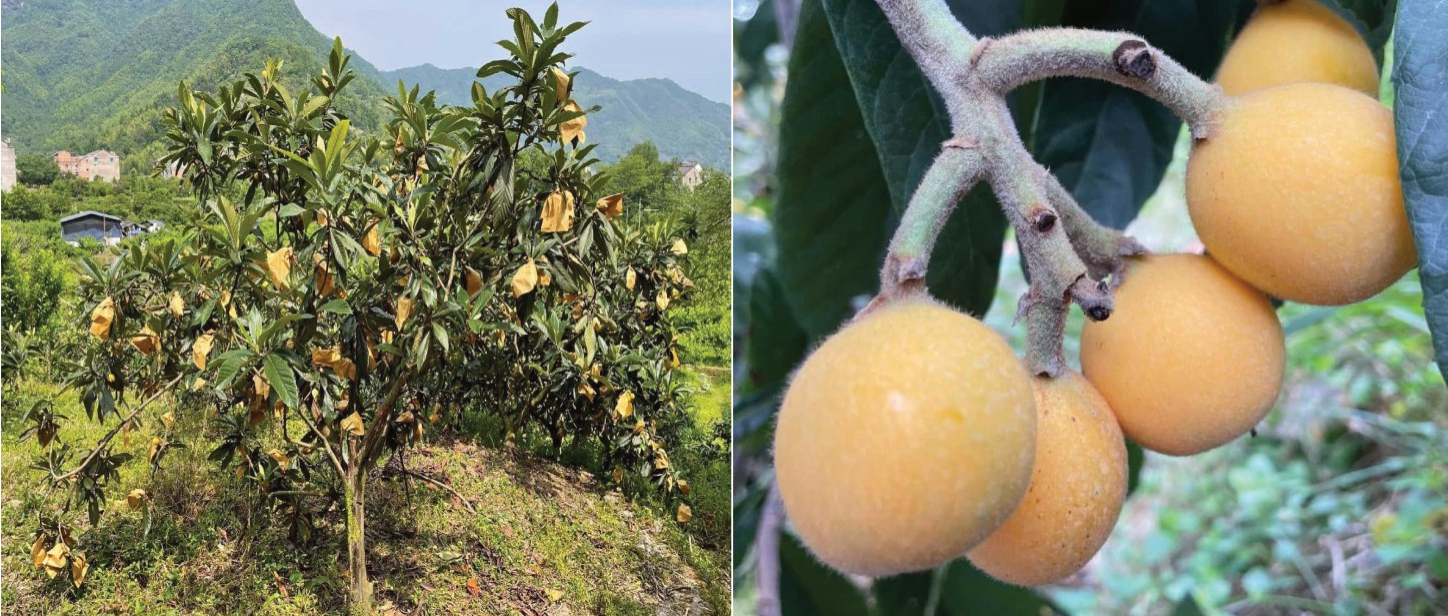
图1 枇杷新品种永溪
Fig.1 A new loquat variety Yongxi
1 选育过程
课题组2005 年在浙江省台州市黄岩区溪上村进行种质资源调查时,发现溪上白沙枇杷(由软条白沙品种分化出的地方品系)实生后代中有一单株的果实、叶片性状异于母本的优良单株,随即进行挂牌标记(标记名XSB)。经过多年连续观察,发现其生物学性状稳定且抗寒性显著强于亲本和当地主栽品种软条白沙。2012 年,将其枝条高接至浙江省柑橘研究所枇杷种质资源圃。第2 年开始挂果,后在台州各地陆续种植100 多株进行多点区试和品种比较试验。在种质鉴定中为防止同物异名、异物同名以及饰变等现象的出现,采用重测序的方法对其进行遗传关系检测,发现新种质与溪上白沙亲缘关系最近(图2)。该种质于2024年9月获得植物新品种权(品种权号:CNA20211001290),定名为永溪。
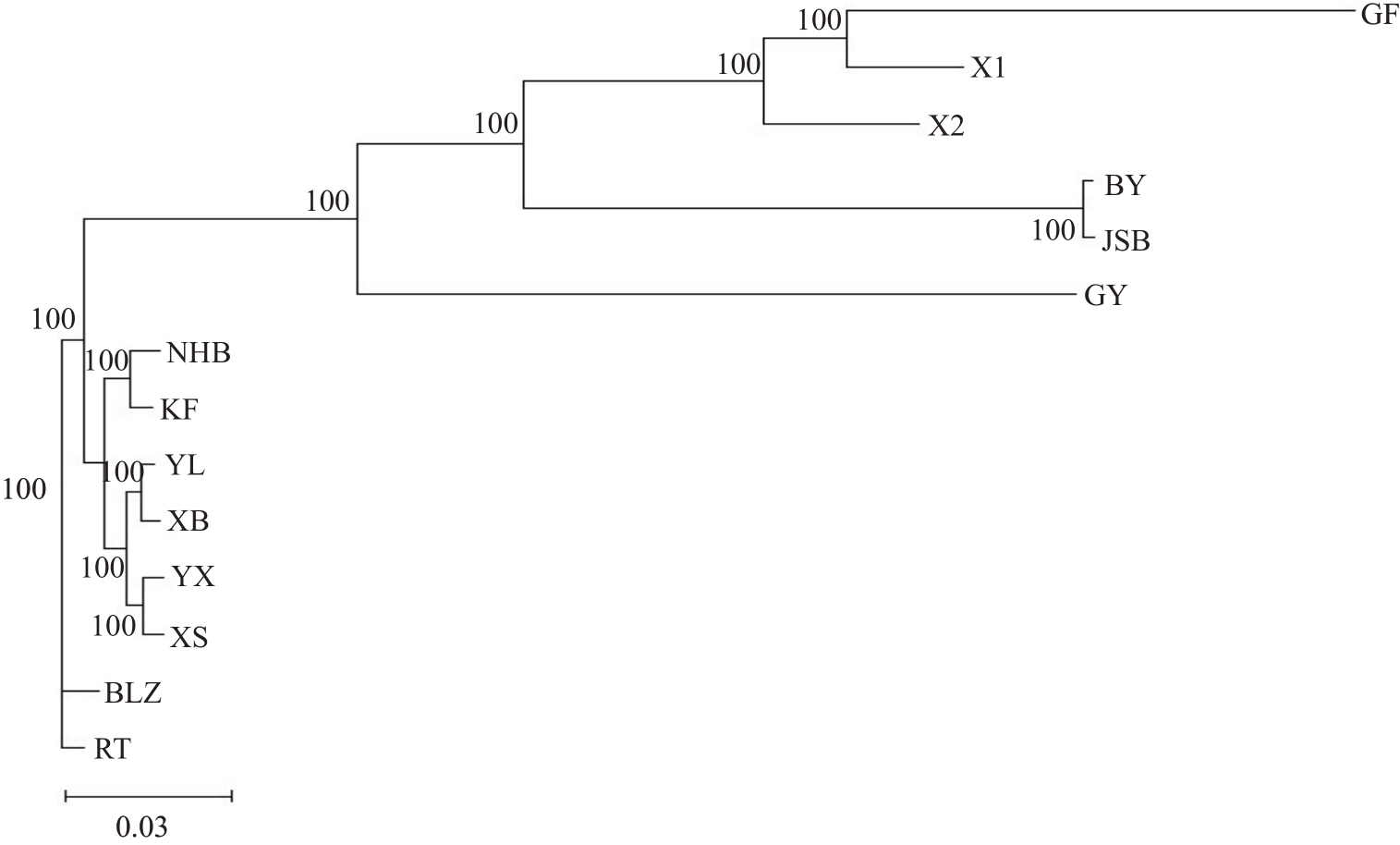
图2 永溪与其他枇杷品种的亲缘关系聚类分析
Fig.2 Genetic relationship between Yongxi and other loquat varieties
GF.贵妃;BY.白玉;JSB.江苏地方品种;GY.冠玉;NHB.宁海白;KF.槐樊枇杷;XB.湘北白沙;YX.永溪;XS.溪上白沙;BLZ.白荔枝;RT.软条白沙;YL.永路;X1,X2.杂交材料。
GF.Guifei;BY.Baiyu;JSB.Jiangsu local varieties;GY.Guanyu;NHB.Ninghaibai;KF.Kuifan loquat;XB.Xiangbeibaisha;YX.Yongxi;XS.Xishangbaisha;BLZ.Bailizhi;RT.Ruantiaobaisha;YL.Yonglu;X1,X2.Hybrid material.
2 主要性状
2.1 植物学特征
永溪枇杷树姿半直立,树冠圆头形,生长势较强。叶片着生姿态斜向上,叶片披针形,叶面深绿色,叶背茸毛多。叶尖渐尖,叶缘锯齿浅,基部狭楔形。花序圆锥状,平均长度11.4 cm,宽9.2 cm,平均每穗花朵数85 朵,雄蕊数多。果实中等大小,果肉黄白色,汁液多,风味酸甜可口。
2.2 物候期
在浙中和东南部地区,永溪一般每年抽梢3次,即春梢、夏梢、秋梢,个别年份有晚秋梢抽生。春梢抽生时间为3月上中旬,梢长8~12 cm。夏梢通常在5月初抽生,是主要的结果母枝。秋梢发生在8月中下旬至10月中旬。花期多在10月至翌年2月上旬,盛花期通常从11月上旬至翌年1月上旬。果实成熟期为5月下旬,比亲本溪上白沙晚7 d左右。
2.3 果实主要经济性状
永溪平均单果质量38.1 g,果实卵圆形,果面橙黄色,锈斑少;果肉黄白色,肉质细腻,化渣性强;可溶性固形物含量(w,后同)14.1%,可滴定酸含量0.37%,维生素C 含量13.5 mg·g-1;可食率72.1%;每果含种子数2~4 粒,种子倒卵圆形,种子大小中等,种皮黄褐色,斑点少,种皮不开裂(表1)。
表1 永溪与软条白沙果实主要品质性状比较
Table 1 Comparison of main economic traits between Yongxi and Ruantiaobaisha

?
2.4 抗逆性
2020—2022 年连续3 a(年)对永溪裂果率和种胚受冻率进行调查(表2)。结果表明,与对照品种软条白沙相比,永溪裂果率和种胚受冻率显著降低。2021 年1 月浙江省遭遇了强寒潮天气,种植地最低温度达到了-6 ℃。经过调查,永溪的种胚受冻率为29.2%,而软条白沙的种胚受冻率达到91.3%。其他年份永溪种胚受冻率均在5%以下,而软条白沙均在20%以上。永溪裂果率保持在10%以下,而软条白沙裂果率高于20%。
表2 永溪与软条白沙抗逆性比较
Table 2 Comparison of stress resistance between Yongxi and Ruantiaobaisha
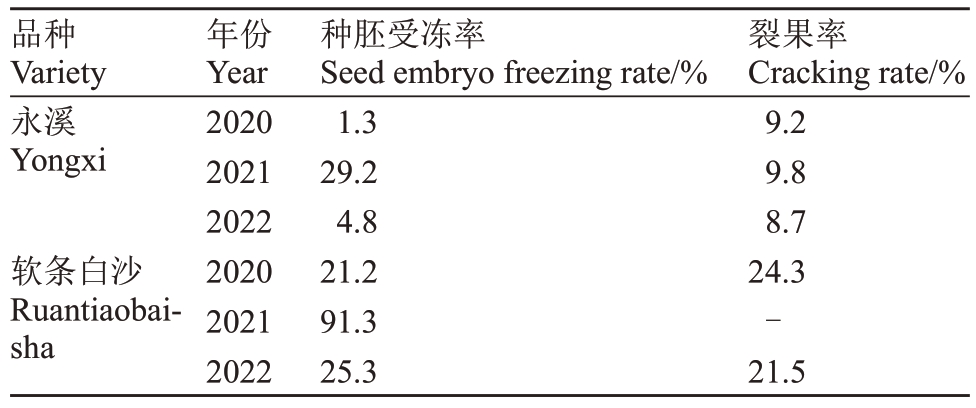
注:“-”表示2021 年软条白沙受冻率高,果实存活少,无裂果率数值。
Note:The “-”indicates no data available for the fruit cracking rate because of the high freezing rate in 2021.
?
3 栽培技术要点
3.1 繁殖方法
永溪可通过嫁接育苗的方法保持母株的优良性状,砧木宜选用共砧(普通枇杷),嫁接后生长结果良好。嫁接前15 d对砧木苗床进行除草、松土并施适量腐熟有机肥。小砧木多用切接或腹接,大砧木多用劈接或切接。在江苏省、浙江省一带,嫁接时期在2月下旬至3月中旬。
3.2 园地选择
平地建园宜选择地势高、排水良好、土层深而疏松的沙质土壤,山地建园应选择土层深厚、土质疏松、坡度35°以下的坡地。种植密度应在1110株·hm-2左右,株行距3.0 m×3.5 m。管理上与其他白肉枇杷的常规栽培技术基本相同。但以规模化、集约化栽培效果最佳。要适当改良酸性土壤,增施石灰为代表的钙素,同时配施钾元素,以改变土壤团粒结构,从而提高可溶性固形物含量。
3.3 整形修剪
在整形修剪中,应重视矮化栽培技术的推广,树高控制在3 m 以内。利用树体自然特性,培养主干分层形树形。第一层主枝离地面50~60 cm,在4~5个轮生枝中选留位置适当、均匀分布的3 个作为主枝,其余疏去,共留3~4层主枝群。每年注意疏剪多余枝条,避免内部郁闭。
3.4 病虫害防治
主要病虫害有癌肿病、叶斑病、黄毛虫、大蓑蛾、天牛等。提倡以农业防治为主,优先采用生物防治的方法。重视冬季清园工作,消除越冬病虫害源头。疏果后注意喷施市售耐药性弱、农残率低的杀虫杀菌剂。喷药后5 d内完成套袋,可有效防止果实裂果、腐烂,提高果实品质。
[1] 陈方永,吴锦程,王引,王平,倪海枝,颜帮国,程玉芳.枇杷种质资源创新利用研究进展[J].中国南方果树,2023,52(5):199-203.CHEN Fangyong,WU Jincheng,WANG Yin,WANG Ping,NI Haizhi,YAN Bangguo,CHENG Yufang. Research progress on innovative utilization of loquat germplasm resources [J]. South China Fruits,2023,52(5):199-203.
[2] 郑少泉,蒋际谋,邓朝军,姜帆,陈秀萍,胡文舜,许家辉,许奇志,苏文炳.特早熟优质大果白肉枇杷新品种‘白雪早’[J].园艺学报,2020,47(增刊2):2958-2959.ZHENG Shaoquan,JIANG Jimou,DENG Chaojun,JIANG Fan,CHEN Xiuping,HU Wenshun,XU Jiahui,XU Qizhi,SU Wenbing.A new extremely early ripening loquat cultivar‘Baixuezao’with high quality and large size[J].Acta Horticulturae Sinica,2020,47(Suppl.2):2958-2959.
[3] 郑少泉,蒋际谋,姜帆,邓朝军,陈秀萍,胡文舜,许家辉,许奇志,苏文炳.特早熟优质大果白肉枇杷新品种‘三月白’[J].园艺学报,2020,47(增刊2):2956-2957.ZHENG Shaoquan,JIANG Jimou,JIANG Fan,DENG Chaojun,CHEN Xiuping,HU Wenshun,XU Jiahui,XU Qizhi,SU Wenbing. A new extremely early ripening loquat cultivar‘Sanyuebai’with high quality,large size and white flesh[J].Acta Horticulturae Sinica,2020,47(Suppl.2):2956-2957.
[4] 郑少泉,蒋际谋,邓朝军,姜帆,陈秀萍,胡文舜,许家辉,许奇志,苏文炳.特晚熟优质大果白肉枇杷新品种‘香妃’[J].园艺学报,2020,47(增刊2):2954-2955.ZHENG Shaoquan,JIANG Jimou,DENG Chaojun,JIANG Fan,CHEN Xiuping,HU Wenshun,XU Jiahui,XU Qizhi,SU Wenbing.A new extremely late ripening loquat cultivar‘Xiangfei’with high quality and large size[J].Acta Horticulturae Sinica,2020,47(Suppl.2):2954-2955.
[5] 张展伟,阮贤聪,林顺权,陈健,冯瑞祥,杨向晖,徐社金.早熟白肉枇杷新品种‘早佳8 号’[J].园艺学报,2022,49(增刊1):45-46.ZHANG Zhanwei,RUAN Xiancong,LIN Shunquan,CHEN Jian,FENG Ruixiang,YANG Xianghui,XU Shejin. A new early maturing white-flesh loquat cultivar‘Zaojia 8’[J]. Acta Horticulturae Sinica,2022,49(Suppl.1):45-46.
[6] 王化坤,钱剑林,杨忠星,储春荣,李浩宇,周建锋,郄红丽,周晓明.抗寒优质白肉枇杷新品种‘冬玉’的选育[J].果树学报,2016,33(11):1464-1467.WANG Huakun,QIAN Jianlin,YANG Zhongxing,CHU Chunrong,LI Haoyu,ZHOU Jianfeng,QIE Hongli,ZHOU Xiaoming. Breeding of a new cold-resistant and high quality white pulp loquat cultivar‘Dongyu’[J]. Journal of Fruit Science,2016,33(11):1464-1467.
[7] 徐红霞,李晓颖,葛航,陈俊伟.晚熟白肉枇杷新品种迎雪的选育[J].果树学报,2023,40(10):2291-2295.XU Hongxia,LI Xiaoying,GE Hang,CHEN Junwei. Breeding report of a new loquat variety Yingxue[J]. Journal of Fruit Science,2023,40(10):2291-2295.
[8] 陈方永,王引,倪海枝,颜帮国.少籽型白沙枇杷芽变资源永路的选育[J].植物遗传资源学报,2018,19(5):1016-1018.CHEN Fangyong,WANG Yin,NI Haizhi,YAN Bangguo.Breeding of fewer seed white loquat‘Yonglu’[J]. Journal of Plant Genetic Resources,2018,19(5):1016-1018.