自21世纪初,中国开始大规模地实施蓝莓的产业化栽培,至今已积累了25 a(年)的栽培经验。在此期间,随着蓝莓基质栽培技术以及水肥一体化技术的显著进步和突破,中国的蓝莓产业在近年来展现出了迅猛的发展势头。根据最新的统计数据,截至2024年,中国的蓝莓栽培面积已经扩展到了9.59万hm2,总产量更是达到了78 万t,中国在蓝莓的栽培面积和产量方面跃居全球之首[1]。尽管如此,目前中国主要栽培的蓝莓品种大多依赖于国外的鲜食品种,随着蓝莓市场的不断扩大和消费者需求的日益多样化,一些蓝莓品种的品质已经无法完全满足市场的需求。因此,迫切需要对现有的品种进行更新换代[2]。与此同时,以鲜果为主导的蓝莓深加工产业也正在蓬勃发展,但目前市场上适合深加工的蓝莓品种相对缺乏,这已经成为蓝莓深加工产业进一步发展的瓶颈[3]。除此之外,2024 年发生的蓝莓品种侵权事件,引起了社会广泛关注和维权行动,这也凸显了中国在蓝莓品种知识产权保护方面的不足。鉴于上述情况,中国迫切需要培育具有自主知识产权的优质蓝莓新品种,以满足市场的需求,推动产业的持续健康发展。
1 选育过程
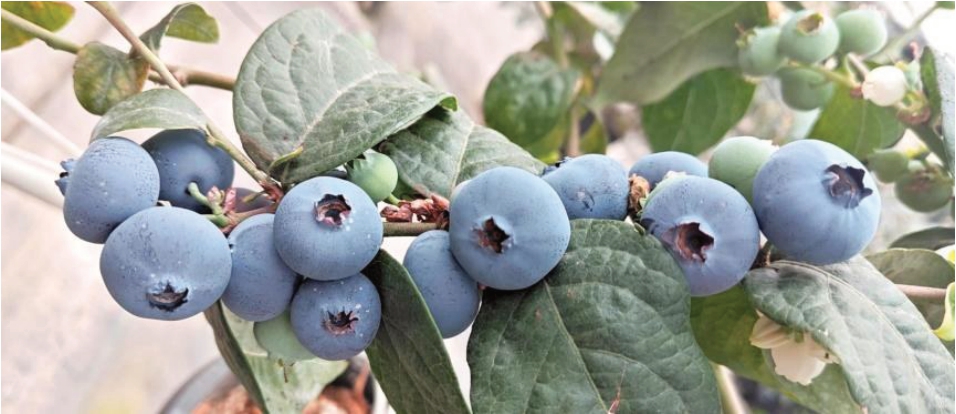
安徽紫约种业有限公司,于2016年12月采购秘鲁的进口鲜果,其编号为L4。鲜果取种后,置于适宜的低温环境中进行贮藏,旨在打破种子的休眠状态。随后,将其播种在人工气候室内,并成功获得了实生幼苗。2017 年9 月,公司从这些幼苗中挑选出了一批健壮的个体,并将它们定植在设施基质盆中,进行抚育工作。2018 年5 月,公司以大果、品质优良、耐运输作为主要的育种目标,对幼苗的果实性状、植株生长特性、开花结果习性等进行了全面的调查和研究。通过这一系列的评估,最终初选出编号为ZY04 的优良单株。为了进一步验证其潜力,公司对ZY04 进行了组培育苗,并在云南省石林彝族自治县(北纬24°45′,东经103°15′,海拔1800 m)开展了小区试验。经过2020—2022年连续3个产季的系统评估,全面考察了ZY04在高原季风气候(年均温15.7 ℃,年降水量1100 mm)下的适应性表现。经过评价分析得出:ZY04 具有群体表现一致性高、果实大、质地硬脆、口感酸甜、丰产稳产等特点。基于这些显著优点,公司在2022年正式向相关部门申请了品种保护。2024 年获得了国家林业和草原局颁发的植物新品种权证书(品种权号:20240294)。公司正式将ZY04命名为紫约6号(图1)。
2 主要性状
2.1 植物学特征
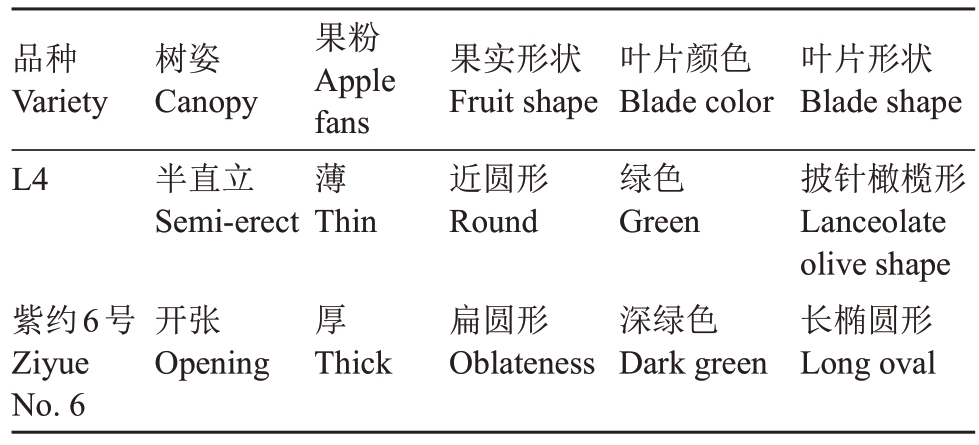
紫约6 号属于南高丛蓝莓品种,是一种多年生常绿小灌木。该品种表现出较强的生长势,树姿呈开张型。3 年生植株高度可达1.38 m,平均冠幅为1.2 m。其枝条具有中等的萌发力和成枝能力。随着生长周期的延长,1年生枝条展现出不同颜色:上部挂叶枝条呈绿色,叶片成熟且即将落叶的枝条呈现红色,而下部落叶枝条则为红褐色,并伴有纵裂现象。这些枝条直立而不弯曲,平均节间长度为2.67 cm。叶片为单叶互生,不对称,叶柄极短。叶片呈长椭圆形,正面为深绿色,叶脉间叶肉凹凸不平,边缘具有锯齿,叶尖为钝尖形。叶片正面光滑,背面无茸毛,叶片的着生姿势略向上倾斜(叶基角≤90°),叶形指数为2.36。花序为总状花序,花序较短,平均长度为2.97 cm,每个花序包含4~8 朵花。花冠呈倒钟状,柱头位置低于花冠(表1)。
表1 紫约6 号与对照品种主要特征比较
Table 1 Comparison of main characteristics between Ziyue No.6 and control varieties
?
2.2 果实经济性状
紫约6 号品种的果穗表现出疏松的结构,其果实大,平均单果质量达到3.97 g,最大单果质量可达7.90 g。该品种的果实形状为扁圆形,其果形指数为0.65,表面覆盖有中等厚度的果粉,去除果粉后呈现中等蓝色。果肉颜色为淡绿色。果蒂痕较小、干且深。该品种的果实可溶性固形物含量(w,后同)为13.30%,维生素C 含量为0.24 mg·g-1。成熟果实的质地硬而脆,口感酸甜多汁,平均硬度为17 kg·cm-2,风味极佳。
2.3 物候期
紫约6 号在云南石林地区进行设施栽培,自10月份起开始花芽分化,11月上旬进入初花期,次年2月中旬达到终花期;果实自1 月上旬开始成熟,2 月中旬达到批量成熟状态,3 月下旬可完成全部采收工作,属于中晚熟品种。
2.4 生长结果习性
紫约6 号树体营养生长旺盛,在云南省石林彝族自治县,该品种一年内可进行3~4次摘心操作,当年生枝条的花芽数量为5~8个,平均每花穗包含4朵花,且具有较高的坐果率。该品种对低温需求较低,适宜在中国西南部地区以及北方地区日光温室设施中进行基质栽培。
3 栽培技术要点
3.1 苗木选择
选择苗木时,应优先考虑1~2年生的品种纯正、生长状况良好、株高约20 cm、基部直径大于0.4 cm的个体苗木。苗木应具备发达的须根,根毛密集且呈乳白色,主根长度至少15 cm。此外,苗木应具有3~4 个分布均匀的分枝,叶片颜色浓绿,芽眼饱满,且无病虫害。
3.2 定植管理
选择栽培基质时,宜采用椰糠、珍珠岩、草炭等混合均匀的蓝莓专用基质。定植的适宜时期应选择在日均温度稳定≥8 ℃的气候阶段,全国范围内春季和秋季均为最佳定植时期。株行距建议为(0.5~1.0)m×(2.5~3.0)m,每666.7 m2可定植350~400株。定植前需将基质盆中的基质充分浇透,然后将钵苗破根栽入,栽植深度以原钵基质痕与种植盆基质表面平齐为宜,定植后应立即浇透定根水。
3.3 花果期管理
为确保授粉效率并降低畸形果率,建议在初花期引入蜜蜂进行辅助授粉。蜜蜂种类的选择应基于生产基地的规模及气候特征,常见的授粉蜂种包括西方蜜蜂、熊蜂、中华蜜蜂和意大利蜜蜂等。蜂群的适宜密度为每666.7 m2配置1箱。在盛花期,通过喷洒硼砂和磷酸二氢钾溶液,可以有效提升果实的坐果率。进入幼果期后,根据坐果状况及生产目标,应对过密的果穗进行疏果处理,以确保果实品质。
3.4 水肥管理
以设施基质栽培技术为例,实施水肥一体化管理策略。紫约6 号品种在营养生长阶段(从腋芽萌发—花芽分化期间),依据气象条件及枝条生长状况,每天进行2~4 次滴灌,维持电导率(EC 值)在0.9~1.1 mS·cm-1范围内,每次滴灌时间控制在10~30 min;进入生殖生长阶段(从花芽分化—果实采收期间),适时提升磷钾肥施用量,并适量添加钙肥,以促进花芽分化并提升果实品质;在幼树期及采后修剪阶段,适当减少施肥频次或仅以清水进行灌溉;在夏季高温时段,可适当增加灌溉频次,采用多次少量的滴灌方式或增加雾化降温灌溉措施。
3.5 整形修剪
定植约15 d后,植株已缓苗。此时,应选择分布相对均匀的3~5个基生枝,将其短截至25 cm长度,同时疏除细弱的基生枝。在生长期间,修剪以摘心为主,云南省石林地区约45 d进行一次摘心,摘心位置宜选择半木质化部位,被摘心新梢应保留6~8枚功能叶,并及时去除病弱枝条,以促进枝条和冠幅的扩展。采果期结束后,应剪除结果枝组、细弱枝和内膛枝,适当保留4~6个骨干枝进行回缩更新,回缩至基部30 cm处,并注意保留呼吸枝,以促进不定芽的萌发。
3.6 病虫害防治
该品种主要的病虫害包括灰霉病、白粉病、蚜虫、蓟马等。其植保策略以“预防为主,综合防治”为核心理念。在防控措施上,主要依赖于农业防治和生物防治手段,化学防治作为辅助手段。
在常规管理中,可采取一系列农业防治策略以实现预防目的。具体措施包括:在园区周边种植特定植物如蓖麻以抑制其他杂草的生长;确保行间具有良好的通风和透光条件,同时将设施内的相对湿度维持在65%以下,以降低病虫害的发生概率;在清理园区时,采用石硫合剂进行全园喷洒。
在病虫害发生的早期阶段,可采取生物防治策略。例如,释放加州新小绥螨以控制红蜘蛛种群;悬挂蓝板以诱捕蓟马成虫;在花期前喷洒枯草芽孢杆菌以预防灰霉病的发生。
在植物病害的化学防治中,最佳的防治时期为病害发生的初期阶段。此时,应选用高效且低毒性的药剂进行处理。例如,在白粉病的防治中,推荐使用43%氟菌-肟菌酯悬浮剂3000 倍液喷洒;对于灰霉病,建议采用50%咯菌腈可湿性粉剂4000倍液防治;而在蚜虫的控制上,22%氟啶虫胺腈悬浮剂4500倍液是有效的选择。在化学防治时,必须严格遵守施药安全间隔期的规定,确保在采收前至少20 d 停止施用农药,以保障食品安全。
参考文献References:
[1] 李亚东,刘成,魏鑫,刘佳欣,郝佳,陈丽,孙海悦. 2024 年中国蓝莓产业发展报告[J]. 吉林农业大学学报,2025,47(1):1-14.LI Yadong,LIU Cheng,WEI Xin,LIU Jiaxin,HAO Jia,CHEN Li,SUN Haiyue. Development report of 2024 China blueberry industry[J].Journal of Jilin Agricultural University,2025,47(1):1-14.
[2] 孙海悦,雷蕾,董梅,田友文,陈丽,和加卫,李亚东.蓝莓新品种‘都瑞’[J].园艺学报,2023,50(增刊2):25-26.SUN Haiyue,LEI Lei,DONG Mei,TIAN Youwen,CHEN Li,HE Jiawei,LI Yadong. A New Blueberry Cultivar‘Durui’[J].Acta Horticulturae Sinica,2023,50(Suppl.2):25-26.
[3] 吴林,胡晶,唐雪东,刘海广,王颖,李金英,李亚男.我国蓝莓产业的现状与思考[J].中国果树,2025(2):1-5.WU Lin,HU Jing,TANG Xuedong,LIU Haiguang,WANG Ying,LI Jinying,LI Yanan.Current situation and thinking of the blueberry industry in China[J].China Fruits,2025(2):1-5.
Breeding report of a new blueberry variety Ziyue No.6
HUANG Jinxia1,JIANG Xin1,ZHU Mingliang1,3,YAN Liming1,LI Yadong2*
(1Ziyue Agricultural Technology Group Co., Ltd., Wuwei 238300, Anhui, China;2College of Horticulture, Jilin Agricultural University,Changchun 130118,Jilin,China;3College of Life Sciences,Anhui Normal University,Wuhu 241000,Anhui,China)
Abstract: Blueberries are native to North America and belong to the Vaccinium genus of the Ericaceae family.During the late 19th to the early 20th centuries,American agricultural scientists began systematically selecting and cultivating varieties, gradually developing the main varieties of modern commercial blueberries,including highbush and lowbush blueberries.In the 1980s,Jilin Agricultural University pioneered the introduction of highbush blueberry varieties from the United States, marking the beginning of scientific introduction and trial cultivation research of blueberries in China.Between 2000 and 2010,blueberry cultivation techniques were systematically accumulated, laying the foundation for the commercialization of blueberries. Since 2010, China's indigenous blueberry industry has experienced rapid development,characterized by a continuous expansion of cultivation areas,a significant increase in production, and the gradual establishment of independently cultivated varieties. Ziyue No. 6 is a mediumlate maturing variety of table blueberry with an excellent appearance.It was developed by Anhui Ziyue Seed Industry Co., Ltd. using the offspring of blueberry L4 imported from Peru. The breeding process commenced with sowing in an artificial climate chamber in December 2016. In 2017, the plants were transplanted into a substrate-based cultivation system.By 2018,with a focus on large fruit size,superior quality, and transportability, a comprehensive evaluation was conducted on plant morphology, flowering and growth habits,as well as fruit characteristics.Following this series of assessments,the superior individual plant designated as ZY04 was preliminarily selected.From 2020 to 2022,regional trials were carried out to evaluate the adaptability of ZY04 under the plateau monsoon climate conditions (characterized by an average annual temperature of 15.7 ℃and annual precipitation of 1100 mm). After the thorough evaluation and analysis,it was determined that ZY04 exhibited consistent performance across groups,large fruit size,firm and crisp texture,balanced sweet and sour flavor,and high and stable yield.In 2022, the company officially submitted an application for variety protection to the relevant authorities.Subsequently,in 2024,ZY04 was granted a plant new variety right certificate by the National Forestry and Grassland Administration and officially named Ziyue No. 6. This variety reaches a height of approximately 2 meters, features an open crown, and exhibits vigorous growth. Young branches are green and smooth, glabrous, gradually turning reddish-brown and becoming rough. Leaves are oblong,acuminate, 5-8 cm long, 4 cm wide, with serrated edges. Flowers are milky white, and 1-2 cm long.Fruits are predominantly oblate in shape,with a medium-blue peel.The flesh is light green,crisp,juicy,hard-textured,and aromatic.The average fruit weight is 3.79 g,the maximum fruit weight is 7.90 g,and the fruit shape index is 0.65.The fruit stalk scars are small and can be either dry or wet.The soluble solids content is 13.30%,the hardness is 17 kg·cm-2,and the Vitamin C content is 0.24 mg·g-1.The variety has a long storage life,and the fruit retains a rich aroma even after prolonged storage.The fruit development period is 45 d and it matures at the mid-February in the Shilin area of Yunnan.This variety exhibits a certain level of resistance to downy mildew,powdery mildew,aphids,and thrips.However,it is essential to implement timely control measures during the early stages of gray mold, powdery mildew,aphid infestations,and thrips attacks.Ziyue No.6 is well-suited for substrate cultivation in greenhouses located in the southwestern and northern regions of our country. Seedlings should be carefully selected based on their vigor,disease resistance,uniformity in purity,and age of 1 to 2 years.It is recommended that the row spacing and plant spacing be set at(2.5-3.0)×(0.5-1.0).Adequate irrigation should be performed both before and after planting.Daily water and fertilizer management should be adjusted appropriately according to bush growth and weather conditions, with careful control over the frequency and amount of watering and fertilization. During the vegetative growth phase, pruning primarily involves pinching to promote bushier growth, while after fruit harvest, pruning focuses on rejuvenation through cutting back to control bush size and maintain its vigor.
Key words:Blueberry;New variety;Ziyue No.6;Southern Highbush