玉露香梨是以库尔勒香梨为母本、雪花梨为父本的杂交梨品种,具有品质优、产量高、耐贮藏的特点[1]。近年来,该品种逐步成为现代梨果产业布局和品种更新的主导品种[2]。合适的栽培模式是实现果树优质栽培管理的关键,能让果树达到早果、丰产、省工的目的。不同树形对果树的生长发育和果实品质形成具有影响。鲁韧强等[3]在桃树的研究中发现,采用倾斜主干偏展形栽培的瑞蟠5 号比Y 字形栽培的有效光照体积比率高,且果实产量和品质也比Y字形栽培的高。高登涛等[4]研究发现,大冠园栽培下的苹果产量和品质均优于中冠园和小冠园。Zhao等[5]对5种树形栽培的早酥梨进行研究发现,单臂和双臂棚架栽培模式具有良好的通风和透光性,可以促进果树的生长和品质的提升。
氨基酸是蛋白质的基本组成单位,是影响果实品质的关键因子之一,其种类和含量是衡量果实营养价值的重要指标[6-7]。陈成等[8]对比了4 个红心猕猴桃品种的物候期、果实品质、糖组分及氨基酸含量,发现红阳果实中赖氨酸、苯丙氨酸和缬氨酸等9种游离氨基酸含量及氨基酸总含量最高。陈海江等[9]研究了不同负载量对套袋鸭梨果实中游离氨基酸的影响,发现果实中有13 种游离氨基酸,其中天门冬氨酸、苏氨酸、丝氨酸比例最高,并发现在一定负载量范围内,游离氨基酸总含量随着负载量的增加而下降。陈华伟等[10]发现不同棚膜颜色会影响赤霞珠葡萄果实的氨基酸含量,采用蓝色棚膜显著提高了葡萄中大部分氨基酸的含量,如谷氨酸、丝氨酸和天冬氨酸等。前人的研究发现,氨基酸含量随着果树的品种和栽培技术的改变而改变。笔者以不同树形的玉露香梨果实为试材,探究不同树形对玉露香梨果实氨基酸含量和内外在品质的影响,初步了解影响玉露香梨果实风味的主要氨基酸种类,为玉露香梨适宜的栽培模式提供参考依据。
1 材料和方法
1.1 试验材料
试验于2023年9月在山西农业大学果树研究所梨试验园进行。供试品种为生长健壮、长势一致的玉露香梨,砧木为杜梨,树龄均为15 年生。选取梨园中5 种树形进行研究,分别包括:疏散分层形,株行距为3 m×4 m;高干开心形,株行距为3 m×4 m;细长纺锤形,株行距为1.5 m×4 m;自由纺锤形,株行距为3 m×4 m;双臂顺行式棚架,株行距为4 m×4 m,均为南北行向,田间栽培管理条件一致。在果实成熟期,从每种栽培模式中随机选择5株树,在每株树的东、西、南、北方向随机选取20 个无病虫害的梨果,立即送至实验室。
1.2 仪器与试剂
甲酸铵、甲酸、甲醇、乙腈、16种氨基酸标样(德国Merck 公司,纯度≥99%),其他化学试剂为国产分析纯。
1.3 测定方法
1.3.1 果实氨基酸含量的测定 梨果实样品取样方法参照刘振艳等[11]的研究。利用Agilent 1290 Infinity超高效液相色谱仪(安捷伦公司)对样品进行氨基酸分离。仪器参数设置如下:自动进样器温度为4 ℃,柱温控制在40 ℃,流速保持为250 μL·min-1,进样量为1 μL。流动相:A液是25 mmol·L-1的甲酸铵与0.08%甲酸的水溶液,B 液是含有0.1%甲酸的乙腈溶液。液相梯度设置如下:0~12 min,B 液从90%降至到70%;>12~18 min,B 液从70%降至到50%;>18~25 min,B 液从50%降至到40%,>25~30 min,B 液从40%升至到90%;>30~37 min,B 液维持在90%。
采用AB SCIEX 5500 QTRAP 液相色谱质谱联用仪(岛津公司)在正离子模式下进行质谱分析工作。其中,ESI源相关参数设定如下:离子源温度为500 ℃,离子源气体1 和气体2(Gas 1 和Gas 2)数值均设定为40,帘气(CUR)设定为30,离子喷射电压浮动值(ISVF)设定为5500 V。此外,运用多反应监测(MRM)模式对待测的氨基酸离子对进行定量检测。每个样品重复测定3次,取其平均值。
1.3.2 果实外观品质的测定 果实单果质量采用YP10002B 电子天平(力辰科技)测定;果实纵径和横径采用数显游标卡尺(上海美耐特公司)测量;果形指数计算公式为纵径/横径;色差指数L*(亮度)、a*(红绿值)和b*(黄蓝值)采用CR-400色彩色差仪(柯尼卡美能达公司)测定。每个样品重复测定5次,取其平均值。
1.3.3 果实内在品质的测定 可溶性固形物含量采用PAL-1 数显糖度计(日本Atago 公司)测定;硬度采用GS-15 型FTA 水果质地分析仪(美国GUSS 公司)测定;糖、酸含量测定参照杨盛等[12]的方法。每个样品重复测定5次,取其平均值。
1.4 数据分析
试验数据采用SPSS 25.0软件进行统计分析,利用ChiPlot 在线平台(https://www.chiplot.online/)制图。
2 结果与分析
2.1 不同树形对玉露香梨果实氨基酸含量的影响
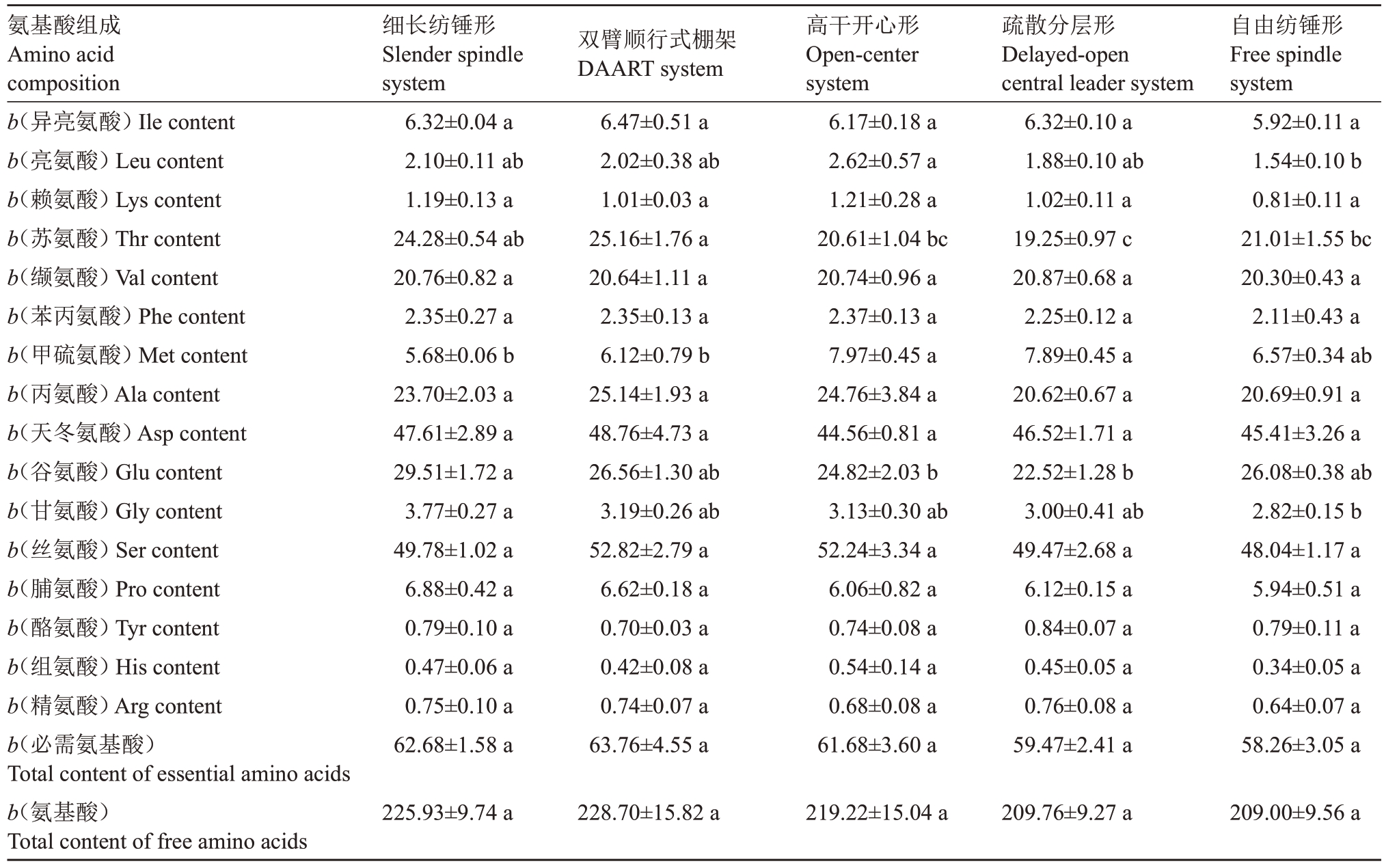
2.1.1 对果实游离氨基酸含量的影响 从表1可知,在5 种树形栽培条件下,玉露香梨果实均检测到16种氨基酸组分。天冬氨酸(44.56~48.76 mmol·g-1)、丝氨酸(48.04~52.82 mmol·g-1)含量较高;其次是苏氨酸(19.25~25.16 mmol·g- 1)、缬氨酸(20.30~20.87 mmol·g-1)、丙氨酸(20.62~25.14 mmol·g-1)和谷氨酸(22.52~29.51 mmol·g-1);组氨酸(0.34~0.54 mmol·g-1)、精氨酸(0.64~0.76 mmol·g-1)和酪氨酸(0.70~0.84 mmol·g-1)含量较少。从必需氨基酸和氨基酸总含量来看,双臂顺行式棚架栽培的玉露香梨果实中总含量均最高,自由纺锤形的最低。除亮氨酸、苏氨酸、甲硫氨酸、谷氨酸和甘氨酸外,其余氨基酸在不同树形间均无显著差异。
表1 不同树形对果实氨基酸含量的影响
Table 1 Effect of different training systems on amino acids contents of Yuluxiang pear (mmol·g-1)
注:不同小写字母表示在P<0.05 水平差异显著。下同。
Note:Different small letters indicate significant differences at the P<0.05 level.The same below.
?
2.1.2 对果实必需氨基酸含量的影响 研究结果显示(表1),5 种树形的玉露香梨果实中均能检测出7种人体必需氨基酸,包括异亮氨酸、亮氨酸、赖氨酸、苏氨酸、缬氨酸、苯丙氨酸和甲硫氨酸。从必需氨基酸总含量来看,自由纺锤形栽培的玉露香梨果实中必需氨基酸总含量最低,为58.26 mmol·g-1;双臂顺行式棚架栽培的果实中必需氨基酸总含量最高,为63.76 mmol·g-1。高干开心形栽培的玉露香梨果实中亮氨酸含量最高,为2.62 mmol·g-1,与自由纺锤形栽培存在显著差异;双臂顺行式棚架栽培的果实中苏氨酸含量最高,为25.16 mmol·g-1,与高干开心形、疏散分层形和自由纺锤形栽培存在显著差异;高干开心形和疏散分层形的甲硫氨酸含量与细长纺锤形、双臂顺行式棚架栽培存在显著差异。5 种树形的异亮氨酸、赖氨酸、缬氨酸和苯丙氨酸含量无显著差异。
2.2 不同树形的果实氨基酸含量主成分分析
由表2 可知,通过对玉露香梨果实的16 种氨基酸含量进行主成分分析,一共提取了3个主成分,它们的特征值均大于1,累计方差贡献率达98.847%。第一主成分方差贡献率为64.150%,特征值为16.816;在第一主成分中除甲硫氨酸和酪氨酸外,其余氨基酸载荷量均为正值,其中苏氨酸和谷氨酸载荷量较高,分别为2.480 和2.106。第二主成分方差贡献率为25.432%,特征值为6.667;丝氨酸和丙氨酸载荷量较大,分别为1.714 和1.284。第三主成分方差贡献率为9.265%,特征值为2.429;天冬氨酸载荷量最大,为1.167。
表2 玉露香梨果实16 种氨基酸的主成分分析
Table 2 Principal component analysis of 16 amino acids in Yuluxiang pear

?
2.3 不同树形对玉露香梨果实品质的影响
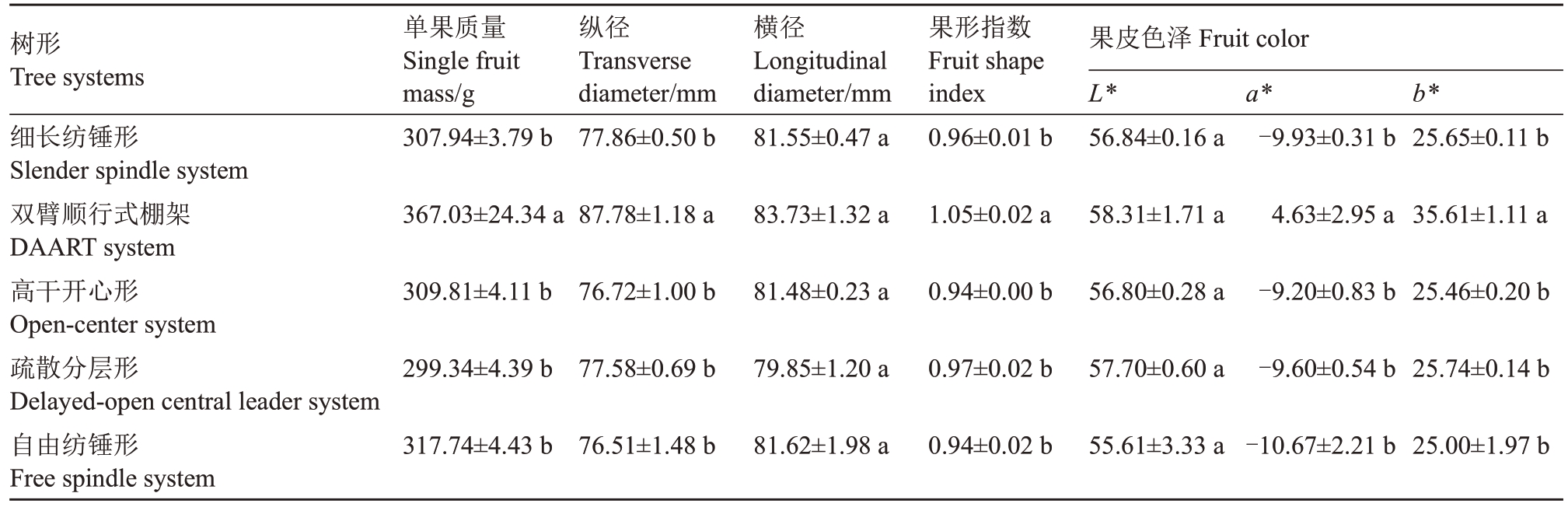
2.3.1 对果实外观品质的影响 不同树形对玉露香梨果实外观品质的影响如表3 和图1 所示。双臂顺行式棚架栽培果实的单果质量、果实纵径、果形指数、果皮色泽a*和b*均为最大,分别为367.03 g、87.78 mm、1.05、4.63 和35.61,显著高于其他4 种树形;细长纺锤形、高干开心形、疏散分层性和自由纺锤形4 种树形间单果质量、果实纵径、果形指数、果皮色泽a*和b*无显著差异。5种树形间果实横径和果皮色泽L*均无显著差异。双臂顺行式棚架栽培果实的果皮色泽L*、a*和b*最大,说明其果实有光泽、红晕较多、果实底色呈黄色。
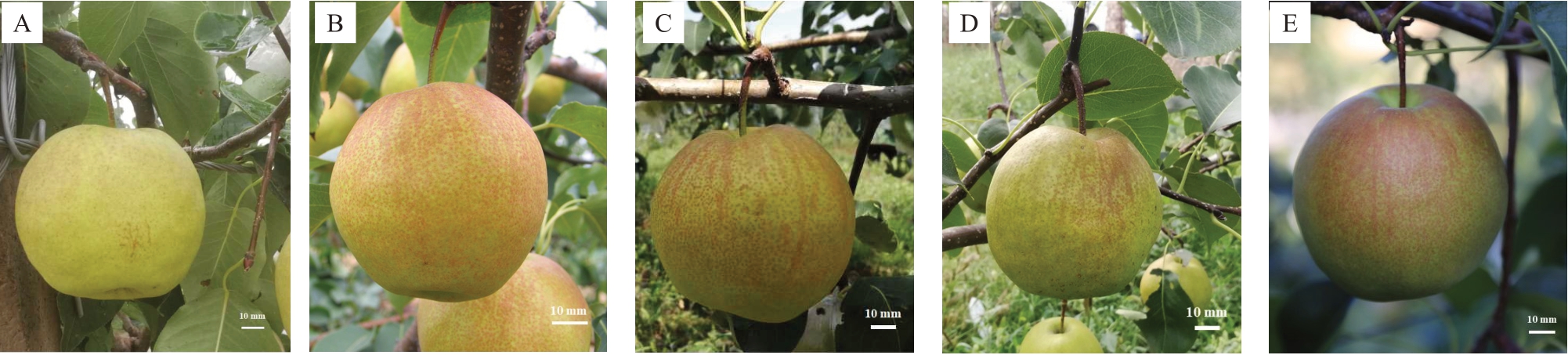
图1 不同树形的玉露香梨果实
Fig.1 Fruits of Yuluxiang pear in different training systems
A.细长纺锤形栽培果实;B.双臂顺行式棚架栽培果实;C.高干开心形栽培果实;D.疏散分层形栽培果实;E.自由纺锤形栽培果实。
A.Fruits cultivated in slender spindle system;B.Fruits cultivated in DAART system;C.Fruits cultivated in open-center system;D.Fruits cultivated in delayed-open central leader system;E.Fruits cultivated in free spindle system.
表3 不同树形对果实外观品质的影响
Table 3 Effects of different training systems on the external quality of fruits
?
2.3.2 对果实内在品质的影响 果实的可溶性固形物含量、硬度、糖酸含量是衡量果实内在品质优劣的重要指标。由表4可知,5种树形间玉露香梨果实内在品质除葡萄糖含量外,其余指标均存在显著差异。双臂顺行式棚架栽培果实的可溶性固形物含量最高,为13.57%,与细长纺锤形、疏散分层形和自由纺锤形存在显著差异;其总糖和果糖含量最高,分别为131.55%和69.69 mg·g-1,与疏散分层形和自由纺锤形存在显著差异;其总酸和苹果酸含量最低,分别为2.62%和1.78 mg·g-1,与高干开心形存在显著差异。高干开心形栽培果实的可溶性固形物含量与细长纺锤形、疏散分层形和自由纺锤形存在显著差异,其总糖含量与自由纺锤形存在显著差异。细长纺锤形栽培果实的可溶性固形物含量与疏散分层形存在显著差异。疏散分层形栽培果实的可溶性固形物含量最低而硬度最高,与其他4种树形存在差异。总体来说,玉露香梨果实内在品质排列顺序为双臂顺行式棚架>高干开心形>细长纺锤形>自由纺锤形>疏散分层形。
表4 不同树形对果实内在品质的影响
Table 4 Effects of different training systems on the internal quality of fruits

?
2.4 玉露香梨果实品质与必需氨基酸含量间的相关性分析
2.4.1 果实外观品质与必需氨基酸含量间的相关性分析 果实外观品质和必需氨基酸含量的相关性分析结果显示(图2),异亮氨酸含量与果实纵径、果皮色泽a*和b*呈显著负相关;亮氨酸、赖氨酸含量与果皮色泽L*呈显著负相关;缬氨酸含量与果皮色泽a*、b*呈显著负相关;苏氨酸含量与果皮色泽a*呈显著负相关;苯丙氨酸含量与果实纵径、果形指数、果皮色泽a*和b*呈极显著负相关;甲硫氨酸含量与果实外观品质指标均无显著相关性;所有必需氨基酸(异亮氨酸、亮氨酸、赖氨酸、苏氨酸、缬氨酸、苯丙氨酸和甲硫氨酸)含量与单果质量均无显著相关性。
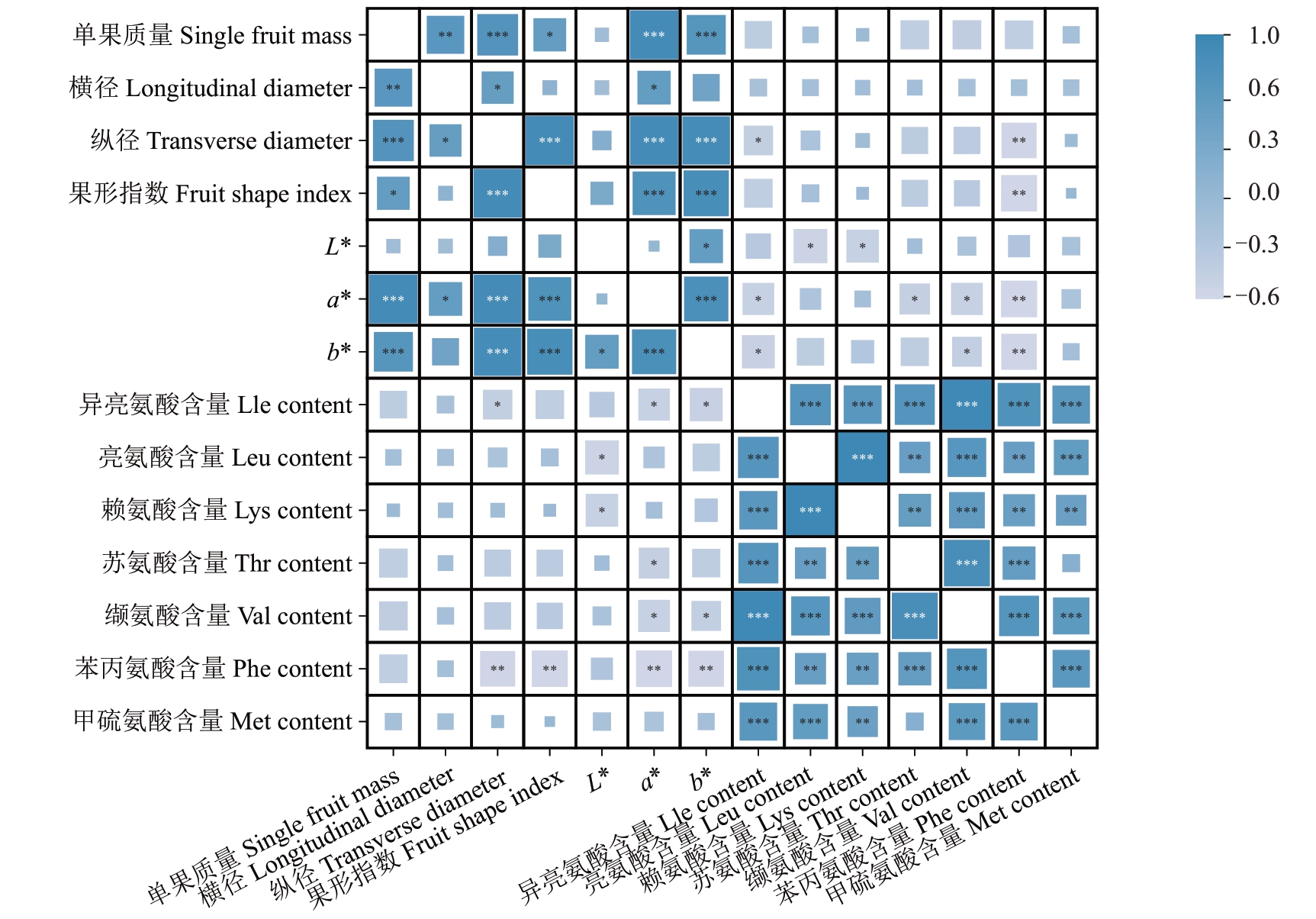
图2 果实外观品质指标与必需氨基酸含量间的相关性分析
Fig.2 Correlation analysis between external quality of fruits and essential amino acid content
*在0.05 级别(双尾)相关性显著;**在0.01 级别(双尾)相关性显著;***在0.001 级别(双尾)相关性显著。下同。
*indicates significant correlation at the 0.05 level(two-tailed);**indicates significant correlation at the 0.01 level(two-tailed);***indicates significant correlation at the 0.001 level(two-tailed).The same below.
2.4.2 果实内在品质与必需氨基酸含量间的相关性分析 果实内在品质和必需氨基酸含量的相关性分析结果显示(图3),亮氨酸含量与可溶性固形物含量、硬度和总酸含量呈显著正相关,与总糖含量呈显著负相关;赖氨酸含量与可溶性固形物含量、硬度和总酸含量呈显著正相关,与总糖含量呈显著负相关;甲硫氨酸含量与总糖含量呈显著负相关。异亮氨酸、苏氨酸、缬氨酸、苯丙氨酸含量与硬度、总酸含量、总糖含量和可溶性固形物含量等均无显著相关性。
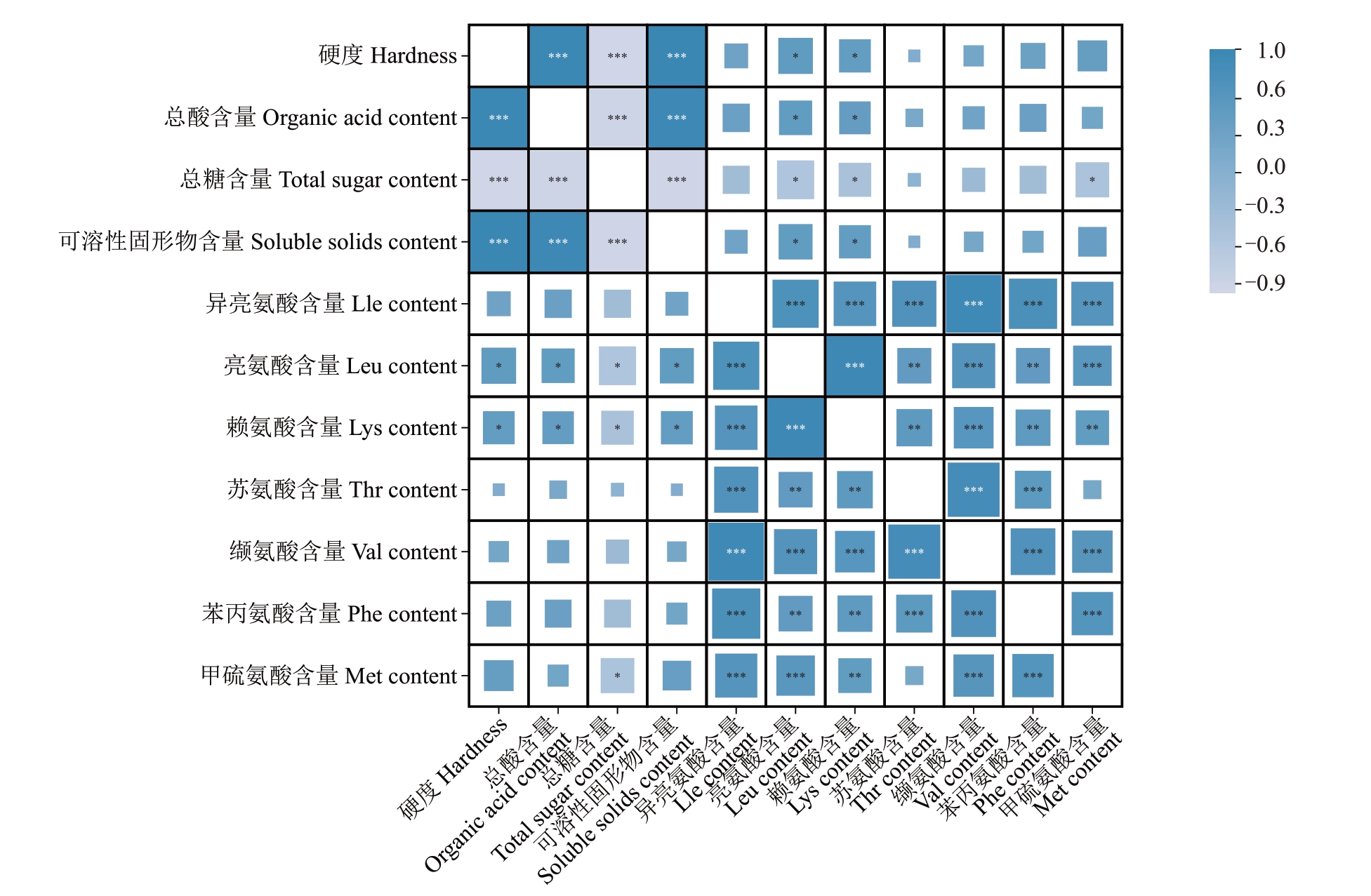
图3 果实内在品质指标与必需氨基酸含量间的相关性分析
Fig.3 Correlation analysis between internal quality of fruits and essential amino acid content
3 讨 论
中国梨树的大面积生产栽培主要采用疏散分层形、开心形和纺锤形等树形。不同树形通过改变树冠内的光照条件,从而影响果树光合产物的含量和果实的品质[13-15]。在本试验结果中,5 种树形间玉露香梨果实品质除果实横径、果皮色泽L*和葡萄糖含量外均存在差异。双臂顺行式棚架栽培果实的单果质量、果实纵径、果形指数、果皮色泽a*和b*、可溶性固形物含量和总糖含量显著高于其他4 种树形。总体来说,双臂顺行式棚架栽培的玉露香梨果实品质表现最好,高干开心形次之,细长纺锤形和自由纺锤形较差,疏散分层形最差。这可能是由于双臂顺行式棚架栽培的玉露香梨光能捕获能力和光合生产能力较其他4 种树形强,从叶片运输到果实中的光合产物也较其他树形多。因此,果皮色泽好、可溶性固形物和总糖含量高。而疏散分层形主干明显、主枝多、层次多,容易引起树冠郁闭,树冠内光合有效辐射和叶片净光合速率均较低。因此,栽培的果实品质较其他4 种树形差。高干开心形大枝少、小枝多,单轴延伸,光照良好,树冠叶片净光合速率高。因此,栽培的果实品质较细长纺锤形、自由纺锤形和疏散分层形好。这与莱阳茌梨[16]、库尔勒香梨[17]、鲜黄梨[18]和丰水梨[19]的研究结果一致,棚架或开心形栽培的梨果实品质优于疏散分层形。
游离氨基酸不仅在植物生长发育中发挥重要作用,而且参与果实中风味物质的形成[20-21]。侯娜等[22]依据氨基酸的呈味特征,将17 种氨基酸大致分为4类:甜味氨基酸(Thr、Ser、Pro、His)、苦味氨基酸(Ile、Leu、Val、Met、Arg)、鲜味氨基酸(Lys、Ala、Asp、Glu、Gly)、芳香族氨基酸(Phe、Cys、Tyr)。多项研究[23-27]证实,在苹果、香蕉和草莓等果实中支链酯类的生物合成均依赖特定氨基酸作为重要前体物质。果实中氨基酸的积累既受到内部代谢活动的调节,也与外部栽培条件密切相关[28]。在本研究结果中,不同树形对玉露香梨的氨基酸种类无影响,均检测到16 种游离氨基酸。其中,含量最高的是丝氨酸,其次是天冬氨酸,最低的是组氨酸。与其他已报道的梨品种相比,游离氨基酸种类存在一定差异。何子顺等[29]研究发现,在库尔勒香梨果实中检测到15 种游离氨基酸,与本研究的玉露香梨相比,缺少丝氨酸和苏氨酸,但多检测出半胱氨酸。苏俊等[7]和史星雲等[30]分别在3个砂梨品种和黄冠梨果实中检测到17种氨基酸,除了本研究中玉露香梨果实检测到的游离氨基酸外,还检测到半胱氨酸。因此,不同梨果实的氨基酸种类因品种而异。双臂顺行式棚架栽培的玉露香梨果实中,丝氨酸和苏氨酸(甜味氨基酸)含量、天冬氨酸和丙氨酸(鲜味氨基酸)含量在5 种树形中最高,且果实中必需氨基酸和氨基酸总含量也是最高。因此,高含量的甜味氨基酸和鲜味氨基酸可能是双臂顺行式棚架栽培的玉露香梨果实口感和风味优于其他4 种树形的原因,这与王振东等[6]和何子顺等[29]在库尔勒香梨上的研究结果一致。综上所述,不同树形栽培的玉露香梨果实中氨基酸含量影响了其果实的内外在品质。
相关性分析发现,苯丙氨酸含量与果皮色泽a*和b*呈显著负相关,可能是在苯丙烷类代谢途径中,高Phe 含量通过抑制苯丙氨酸解氨酶(PAL)活性,减少了花青素和类黄酮合成,导致果皮色泽a*和b*降低,这与张驰等[31]关于PAL 是香梨花青苷合成的关键酶的结果一致。亮氨酸、赖氨酸含量分别与总酸含量呈显著正相关,与总糖含量呈显著负相关,可能是Leu 通过支链氨基酸(BCAA)途径产生中间产物乙酰辅酶A和琥珀酰辅酶A,Lys降解转化为α-酮戊二酸和乙酰辅酶A,这些中间产物进入TCA 循环,促进苹果酸和柠檬酸积累,从而提高了总酸含量、降低了总糖含量。甲硫氨酸含量与总糖含量呈显著负相关,可能是因为Met 作为乙烯前体物质S-腺苷甲硫氨酸(SAM)的合成原料,乙烯可加速糖分的消耗,这与郭素霞等[32]研究发现香蕉果实经高浓度乙烯处理后总糖含量先上升后下降的结果一致。因此,部分氨基酸含量的变化通过调控代谢过程间接影响果实的内外在品质。
通过PCA从16种氨基酸中提取到3个主成分,累计贡献率达98.847%。第一主成分中苏氨酸(2.480)和谷氨酸(2.106)载荷量较高。刘伟等[33]研究发现苏氨酸是主要的甜味氨基酸,具清香甜味;谷氨酸是鲜味最强的氨基酸,具有较高的营养价值。在果实发育过程中,氮元素的储存和再分配促进了谷氨酸的积累,而高含量的谷氨酸有助于提升果实的风味品质。因此,苏氨酸和谷氨酸在第一主成分中较高的载荷量可能是影响玉露香梨果实味甜、清香的原因。
4 结 论
笔者通过测定不同树形玉露香梨果实的游离氨基酸含量、果实外观及内在品质指标,并结合差异性和相关性分析,发现双臂顺行式棚架栽培的玉露香梨果实氨基酸总含量和果实内外在品质更好,更有利于玉露香梨品质的提升,为今后玉露香梨的引种推广、开发利用及果实品质评价提供参考。
[1] 张绍铃,谢智华.我国梨产业发展现状、趋势、存在问题与对策建议[J].果树学报,2019,36(8):1067-1072.ZHANG Shaoling,XIE Zhihua. Current status,trends,main problems and the suggestions on development of pear industry in China[J].Journal of Fruit Science,2019,36(8):1067-1072.
[2] 郭黄萍,郝国伟,张晓伟,杨盛,王璐.玉露香梨优质丰产栽培及贮藏保鲜技术[J].河北果树,2011(5):17-18.GUO Huangping,HAO Guowei,ZHANG Xiaowei,YANG Sheng,WANG Lu. High quality and high-yield cultivation and storage preservation techniques for Yuluxiang pear[J]. Hebei Fruits,2011(5):17-18.
[3] 鲁韧强,王小伟,郭宝林,刘军,魏钦平.桃树倾斜主干偏展形的光照分布与果实产量品质的关系[J]. 果树学报,2003,20(6):509-511.LU Renqiang,WANG Xiaowei,GUO Baolin,LIU Jun,WEI Qinping. Effects of light distribution on yield and fruit quality of Ruipan 5 flat peach variety trained in slanting central leader system[J].Journal of Fruit Science,2003,20(6):509-511.
[4] 高登涛,韩明玉,李丙智,张林森,白茹.渭北3 种不同类型苹果园冠层特征及光照特性[J].果树学报,2007,24(3):259-262.GAO Dengtao,HAN Mingyu,LI Bingzhi,ZHANG Linsen,BAI Ru. Canopy characteristics and light distribution in three types of apple orchards in Weibei area,Shaanxi province[J]. Journal of Fruit Science,2007,24(3):259-262.
[5] ZHAO M X,SUN W T,LI H X,WANG W,CAO G,WANG F L.The effects of the tree structure of Zaosu pear on the transport and distribution of photosynthetic assimilates and fruit quality under desert-area conditions[J].Agronomy,2022,12(10):2440.
[6] 王振东,兖攀,陈奇凌,郑强卿,王文军.氨基酸叶面肥对库尔勒香梨游离氨基酸含量及果实品质的影响[J].北方园艺,2022(15):40-45.WANG Zhendong,YAN Pan,CHEN Qiling,ZHENG Qiangqing,WANG Wenjun. Effects of amino acid foliar fertilizer on free amino acid content and fruit quality of Korla Fragrant pear[J].Northern Horticulture,2022(15):40-45.
[7] 苏俊,黄兴龙,陈霞,何英云,李自生,舒群.3 个红色砂梨新品种的果实氨基酸组分与含量分析[J].果树学报,2018,35(增刊1):114-117.SU Jun,HUANG Xinglong,CHEN Xia,HE Yingyun,LI Zisheng,SHU Qun.Analysis of amino acid composition and content in three new varieties of red sand pear[J]. Journal of Fruit Science,2018,35(Suppl.1):114-117.
[8] 陈成,王依,许媛,宋思言,孙晓童,杨勇,万春雁,阎永齐.4 个红心猕猴桃品种果实品质及氨基酸代谢研究[J].安徽农业科学,2024,52(6):44-46.CHEN Cheng,WANG Yi,XU Yuan,SONG Siyan,SUN Xiaotong,YANG Yong,WAN Chunyan,YAN Yongqi.Study on fruit quality and amino acid metabolism of four red cartridge kiwifruit cultivars[J]. Journal of Anhui Agricultural Sciences,2024,52(6):44-46.
[9] 陈海江,徐继忠,王颉,邵建柱.负载量对鸭梨果实内挥发性物质和氨基酸含量的影响[J]. 河北农业大学学报,2004,27(6):38-40.CHEN Haijiang,XU Jizhong,WANG Jie,SHAO Jianzhu. Effects of different yields on the volatile constituents and dissociation amino acid in the fruit of Yali pear[J].Journal of Agricultural University of Hebei,2004,27(6):38-40.
[10] 陈华伟,乐小凤,张振文.不同棚膜颜色对赤霞珠葡萄果实氨基酸含量的影响[J].中国酿造,2021,40(3):143-148.CHEN Huawei,LE Xiaofeng,ZHANG Zhenwen. Effects of different colors of rain-shelter plastic films on the amino acid content of Cabernet Sauvignon grape fruit[J].China Brewing,2021,40(3):143-148.
[11] 刘振艳,关宏,朱金峰,马淑丽,杨文钦,陈晓婷.不同品种鲜食梨的氨基酸组成特征及其营养评价[J].食品安全质量检测学报,2022,13(11):3541-3548.LIU Zhenyan,GUAN Hong,ZHU Jinfeng,MA Shuli,YANG Wenqin,CHEN Xiaoting. Amino acid composition characteristics and nutritional evaluation of different table Pyrus spp.varieties[J]. Journal of Food Safety & Quality,2022,13(11):3541-3548.
[12] 杨盛,白牡丹,郝国伟,张晓伟,杜海燕,高鹏,郭黄萍.‘玉露香’梨果实发育过程中糖、酸积累特性研究[J]. 果树学报,2019,36(8):1013-1019.YANG Sheng,BAI Mudan,HAO Guowei,ZHANG Xiaowei,DU Haiyan,GAO Peng,GUO Huangping. Study on sugar and organic acid accumulation during fruit development in‘Yuluxiang’pear[J].Journal of Fruit Science,2019,36(8):1013-1019.
[13] 张晓伟,郝国伟,杨盛,白牡丹,王燕平.不同栽培模式下玉露香梨和黄冠梨光合特性影响的比较[J].果树资源学报,2021,2(1):18-21.ZHANG Xiaowei,HAO Guowei,YANG Sheng,BAI Mudan,WANG Yanping. Effects of different cultivation mode on photosynthetic characteristics of Yuluxiang pear and Huangguan pear[J].Journal of Fruit Resources,2021,2(1):18-21.
[14] 赵瑾,汪志辉,刘燕,邱利娜,范娜娜,熊碧玲,蒋黎黎,江光富.4 种树形鲜黄梨园冠层特征及果实产量的比较研究[J].中国南方果树,2010,39(3):70-72.ZHAO Jin,WANG Zhihui,LIU Yan,QIU Lina,FAN Nana,XIONG Biling,JIANG Lili,JIANG Guangfu. Comparison between canopy structure and yield of four tree shapes of Xianhuang pear[J].South China Fruits,2010,39(3):70-72.
[15] 彭麟,周超华,倪隽蓓,白松龄,滕元文.两种树形对梨果实品质影响的初步研究[J].中国南方果树,2022,51(2):154-159.PENG Lin,ZHOU Chaohua,NI Juanpei,BAI Songling,TENG Yuanwen. Preliminary study on the influence of two tree shapes on pear fruit quality[J].South China Fruits,2022,51(2):154-159.
[16] 牟红梅,于强,李庆余,王义菊,姜福东,李元军.‘莱阳茌梨’高光效树形光合特性与果实品质的研究[J]. 北方园艺,2018(12):58-62.MU Hongmei,YU Qiang,LI Qingyu,WANG Yiju,JIANG Fudong,LI Yuanjun. Research on photosynthetic characteristics and fruit quality of high light use efficiency tree shape on‘Laiyang Pear’[J].Northern Horticulture,2018(12):58-62.
[17] 江振斌,廖康,赵世荣,达梦香,徐桂香,章世奎,徐乐.库尔勒香梨3 种树形冠层结构和产量品质的比较[J].新疆农业科学,2016,53(10):1816-1822.JIANG Zhenbin,LIAO Kang,ZHAO Shirong,DA Mengxiang,XU Guixiang,ZHANG Shikui,XU Le. Comparison between canopy structure,yield and fruit quality of three tree shapes of Korla Fragrant pear[J]. Xinjiang Agricultural Sciences,2016,53(10):1816-1822.
[18] 熊碧玲.3 种树形对鲜黄梨果实发育过程中糖组分及山梨醇转化酶活性的影响[D].雅安:四川农业大学,2012.XIONG Biling.Effects of three tree shape on the sugar accumulation process and activities of sorbitol-invertase during the development of Pyrus pyrifolia Sunhwang[D].Yaan:Sichuan Agricultural University,2012.
[19] 伍涛,张绍铃,吴俊,肖家欣,吴华清,刘吉祥,张华,吴桂法.‘丰水’梨棚架与疏散分层冠层结构特点及产量品质的比较[J].园艺学报,2008,35(10):1411-1418.WU Tao,ZHANG Shaoling,WU Jun,XIAO Jiaxin,WU Huaqing,LIU Jixiang,ZHANG Hua,WU Guifa. Comparative studies on canopy structure characteristics,yield and fruit quality in horizontal trellis system and delayed-open central leader system of‘Hosui’pear tree[J].Acta Horticulturae Sinica,2008,35(10):1411-1418.
[20] 朱奕凡,王妍,汪国云,周超超,焦云,甘可欣,孙德利,朱长青,贾惠娟,高中山.不同杨梅品种果实游离氨基酸组成分析[J].浙江大学学报(农业与生命科学版),2021,47(6):736-742.ZHU Yifan,WANG Yan,WANG Guoyun,ZHOU Chaochao,JIAO Yun,GAN Kexin,SUN Deli,ZHU Changqing,JIA Huijuan,GAO Zhongshan.Analysis of free amino acid composition in fruits of different bayberry(Morella rubra) varieties[J]. Journal of Zhejiang University (Agriculture and Life Sciences),2021,47(6):736-742.
[21] 杨东东,袁明,路绪强,龚成胜,赵永,袁飞,刘文革.3 个不同类型西瓜品种果实发育过程中游离氨基酸的积累分析[J].果树学报,2023,40(8):1651-1665.YANG Dongdong,YUAN Ming,LU Xuqiang,GONG Chengsheng,ZHAO Yong,YUAN Fei,LIU Wenge.Analysis of free amino acids accumulation during fruit development in three different types of watermelons[J]. Journal of Fruit Science,2023,40(8):1651-1665.
[22] 侯娜,赵莉莉,魏安智,杨途熙.不同种质花椒氨基酸组成及营养价值评价[J].食品科学,2017,38(18):113-118.HOU Na,ZHAO Lili,WEI Anzhi,YANG Tuxi. Amino acid composition and nutritional quality evaluation of different germplasms of Chinese prickly ash (Zanthoxylum bungeanum Maxim)[J].Food Science,2017,38(18):113-118.
[23] 刘林,张江周,王斌,韦义波,覃贤桂,李宝深.香蕉果指喷施叶面肥对其外观品质和产量的影响[J].南方农业学报,2017,48(12):2204-2209.LIU Lin,ZHANG Jiangzhou,WANG Bin,WEI Yibo,QIN Xiangui,LI Baoshen. Effects of spraying foliar fertilizers on appearance quality and yield of banana fingers[J]. Journal of Southern Agriculture,2017,48(12):2204-2209.
[24] LV J H,PANG Q Q,CHEN X Q,LI T,FANG J G,LIN S Y,JIA H F.Transcriptome analysis of strawberry fruit in response to exogenous arginine[J].Planta,2020,252(5):82.
[25] 乜兰春,孙建设,邸葆.苹果果实香气产生过程中氨基酸和脂肪酸含量及一些相关酶活性的变化[J].植物生理与分子生物学学报,2005,31(6):663-667.NIE Lanchun,SUN Jianshe,DI Bao.Changes in amino acid and fatty acid contents as well as acitivity of some related enzymes in apple fruit during aroma production[J].Journal of Plant Physiology and Molecular Biology,2005,31(6):663-667.
[26] 王欢欢,马越,白冰,王宇滨,赵晓燕,张超.番茄果实呈香组分及其代谢途径研究进展[J].中国瓜菜,2018,31(12):1-4.WANG Huanhuan,MA Yue,BAI Bing,WANG Yubin,ZHAO Xiaoyan,ZHANG Chao. Progress of aroma volatiles of tomato fruit and their metabolic pathway[J]. China Cucurbits and Vegetables,2018,31(12):1-4.
[27] 王宝驹,齐红岩,刘圆,王佳辉.薄皮甜瓜果实不同部位中的挥发性酯类物质与氨基酸的关系[J].植物生理学通讯,2008,44(2):215-220.WANG Baoju,QI Hongyan,LIU Yuan,WANG Jiahui.The relationship between volatile esters and free amino acids in different parts of ripe melon(Cucumis melo L.)[J].Plant Physiology Communications,2008,44(2):215-220.
[28] 樊进补,张苏玲,马敏,刘志强,任雅倩,吴昌琦,王利斌,张绍铃.套袋对‘鸭梨’果实中游离氨基酸和水解氨基酸含量的影响[J].果树学报,2020,37(2):204-214.FAN Jinbu,ZHANG Suling,MA Min,LIU Zhiqiang,REN Yaqian,WU Changqi,WANG Libin,ZHANG Shaoling. Effects of bagging on free amino acid and hydrolyzed amino acid contents in fruit of Pyrus bretschneideri‘Yali’[J]. Journal of Fruit Science,2020,37(2):204-214.
[29] 何子顺,李芳芳,张绍铃,白茹,张虎平.套袋对‘库尔勒香梨’果实中游离脂肪酸和游离氨基酸含量的影响[J].果树学报,2016,33(7):804-813.HE Zishun,LI Fangfang,ZHANG Shaoling,BAI Ru,ZHANG Huping. Changes in free fatty acid and free amino acid contents in fruit of Pyrus sinkiangensis‘Kuerle Xiangli’by bagging[J].Journal of Fruit Science,2016,33(7):804-813.
[30] 史星雲,徐珊珊,殷益明,李强,何彩,赵连鑫.黄冠梨果实中氨基酸及矿质元素分析与评价[J]. 林业科技通讯,2022(2):15-20.SHI Xingyun,XU Shanshan,YIN Yiming,LI Qiang,HE Cai,ZHAO Lianxin.Analysis and evaluation of amino acids and mineral elements in‘Huangguanli’fruit[J].Forest Science and Technology,2022(2):15-20.
[31] 张驰,穆凯代斯罕·伊萨克,吴俊杰,上杰,张琦.基于不同去袋期分析红皮梨花青苷合成酶及相关因子[J].江苏农业科学,2023,51(9):147-154.ZHANG Chi,Mukaidaisi · Yisake,WU Junjie,SHANG Jie,ZHANG Qi.Analysis of anthocyanin synthase and related factors in red-skinned pears based on different bag removal periods[J].Jiangsu Agricultural Sciences,2023,51(9):147-154.
[32] 郭素霞,孙佩光,程志号,孙长君,郭刚,谭再欢,吴琼.不同乙烯处理对4 种香蕉果实采后品质变化的影响[J].分子植物育种,2022,20(18):6160-6166.GUO Suxia,SUN Peiguang,CHENG Zhihao,SUN Changjun,GUO Gang,TAN Zaihuan,WU Qiong. Effect of different ethylene concentration on the quality changes of 4 banana varieties[J].Molecular Plant Breeding,2022,20(18):6160-6166.
[33] 刘伟,张群,李志坚,卞建明,黄绿红,朱向荣,单杨.不同品种黄花菜游离氨基酸组成的主成分分析及聚类分析[J].食品科学,2019,40(10):243-250.LIU Wei,ZHANG Qun,LI Zhijian,BIAN Jianming,HUANG Lühong,ZHU Xiangrong,SHAN Yang. Principal component analysis and cluster analysis for evaluating free amino acids of different cultivars of daylily buds[J]. Food Science,2019,40(10):243-250.